Litigation Privilege: Why Restraining Order Fraud Is Pandered to and Why the Falsely Accused Are Denied Recourse to the Law for Vindication, Relief, and Recovery of Damages

“Fraud is deliberately deceiving someone else [including a judge] with the intent of causing damage.”

Cornell Legal Information Institute

“Generally, lying during trial (or any other part of litigation) is expected to come out at the time of trial. This means an action against someone for lying during a prior proceeding would fail because even lies are protected by the litigation privilege. You have to catch them at the time; you cannot attack them collaterally (in a different proceeding).”

Attorney Catherine Elizabeth Bennett

Here are examples of restraining order fraud and repeated abuse of process (others are here and here, and comments and posts on this site are replete with them).

Here is the obstacle to obtaining relief from fraud committed by restraining order petitioners that the falsely accused face no matter how high up the judicial chain they muster the fortitude to climb:

  1. So-called protective orders were designed to allow battered women to apply directly to a judge for relief from household violence and intimidation. Their origin harks back to the late ’70s/early ’80s. When these orders were conceived 30 or 40 years ago, domestic violence was hush-hush, and (actual) victims faced alienation from their families for airing dirty laundry in public and rocking the boat. They faced, as well, the possibility of their claims’ being discounted by police or even ridiculed (compounding their misery and humiliation). So the middlemen (i.e., cops and prosecutors) were cut out of the process. Thus could allegations be made and ruled upon in the absence of any investigation. It seemed a reasonable stopgap at the time. Over the decades since, despite radical changes in how claims of domestic violence are received by the public and law enforcement (due in no small part to the investment of billions of federal tax dollars), the standards for substantiating an assertion of victimhood remain lenient, while what qualifies as grounds for a court injunction has steadily broadened. People now get orders against their friends, lovers, neighbors, moms, dads, kids, etc., and violence need not even be alleged; some claim of apprehension usually suffices. The process has morphed from a life-preserver for battered women with no other way out of a hellish situation to a sop to satisfy any complainant who fills out an application. Court policy pretends that anybody who walks into a courthouse with a beef (real or not) deserves a private audience with a judge to shield him or her from the terrors of public scorn or disapproval from the cops. Anyone with an ax to grind, that is, is treated like a battered woman circa 1979. So institutionalized has the process become, and so profitable to so many (both financially and politically), that no one questions whether this is ethical. So the restraining order process has become a game, a game played according to anachronistic rules. Maximum latitude is given to anyone (no fee or i.d. required) to litigate any claims s/he wants in a backroom conference with a judge, and rulings are issued ex parte, which means the person who’s accused is prejudged sight unseen. The due process rights of the accused are scotched. Grants under the Violence Against Women Act will explicitly forbid the use of lie detectors. The dictate is purely rhetorical; it’s meant to stress that what a complainant alleges shouldn’t be doubted. This expectation extends to any petitioner. Hence judicial scrutiny is minimal, and judges may actually bristle when the falsely accused allege that petitioners are lying. This is called fair and just.
  2. The idea behind “litigation privilege,” which basically ensures that whatever a litigant or his or her attorney alleges is protected from liability (from charges of defamation, for example), is the same: Accusers need to feel secure to air “the facts” without fear of prosecution.

The protections sketched above were not put in place to defend the right of any fraudster to falsely allege anything off the top of his or her head against a target of malice in a court of law. Perjury, after all, is a statutory crime. Lying isn’t condoned by the law, but it is swallowed by cops and defended by judges.

They’ve had their priorities impressed upon them in no uncertain terms.

So emphatic is the priority to give accusers the benefit of the doubt that people who’ve been wrongly accused have little or no credibility with judges and absolutely no recourse to sue for damages caused by false allegations (to reputation, employment, enjoyment of life, and health). The court doesn’t recognize there are any damages to being falsely accused of stalking, for instance, or violent threat, sexual harassment, assault, or even rape. False accusations that are dismissed as baseless are harmful enough (the stresses they cause are beyond quantification). When false allegations stick, the guilt of the accused is presumed, and subsequent legal actions they may venture to undertake (lawsuits and appeals) may be summarily tossed for lacking merit. In contrast, the merit of rulings that are typically the products of procedures lasting mere minutes isn’t questioned. Some judges will even hold that accusations litigated in court can’t constitute perjury because of the “litigation privilege” (i.e., because they were uttered in court instead of on, say, Facebook or the radio, they can’t be lies).

Accusers (all of them identified with battered women of 1979) must be free to claim whatever they want without fear of risk or blame—that’s the overriding precept. Translated, this means the court’s position is that people must be allowed to lie and snooker the court as they choose…and anyone who’s lied about be damned.

Copyright © 2015 RestrainingOrderAbuse.com

*From “‘Out of Left Field’: The Litigation Privilege Defense to Adverse Party Suits” by attorney Keith A. Call (emphases added):

Despite some authority characterizing the litigation privilege as “absolute,” it is certainly not without limits. There are some claims for which the litigation privilege is usually not a defense. Such claims may include malicious prosecution, fraud, criminal perjury, suborning perjury, and professional discipline. See, e.g., Hagberg v. Cal. Fed. Bank FSB, 81 P.3d 244, 259 (Cal. 2004) (the litigation privilege “operates to bar civil liability for any tort claim based upon a privileged communication, with the exception of malicious prosecution”); Bushell v. Caterpillar, Inc., 683 N.E.2d 1286, 1289 (Ill. Ct. App. 1997) (litigation privilege does not provide immunity from criminal perjury); Hawkins v. Harris, 661 A.2d 284, 288 (N.J. 1995) (litigation privilege is not bar to professional discipline or criminal perjury); Dello Russo v. Nagel, 817 A.2d 426, 433 (N.J. Super. Ct. App. Div. 2003) (litigation privilege does not insulate against malicious prosecution or professional discipline); N.Y. Cooling Towers, Inc. v. Goidel, 805 N.Y.S.2d 779, 783 (N.Y. Sup. Ct. 2005) (refusing to dismiss claims against adverse party’s attorney based on fraud and collusion); Clark v. Druckman, 624 S.E.2d 864, 870-72 (W. Va. Ct. App. 2005) (litigation privilege does not immunize attorney from claims of fraud or malicious conduct).
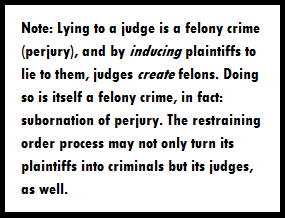
Repeat after Me: RESTRAINING ORDER and FRAUD May Mean the Same Thing

Judge: “Are you afraid of her?”

Man: “No, I….”

Judge: “Are you afraid of her?”

Man: “No, it’s not that. It’s—”

Judge: “I can’t award a restraining order unless you tell me you’re afraid of her. I’m going to ask you one more time: Are you afraid of her?”

Man: “Okay, yes, I’m very afraid of her.”

The above isn’t satire but an exchange between a plaintiff and a judge whose equivalent may be heard any weekday, particularly in Midwestern states like Illinois and Ohio. While this sort of ritual litany might have its place in church, it has no place in a courtroom.

The restraining order process has become a perfunctory routine verging on a skit, a scripted pas de deux between a judge and a complainant. Exposure of the iniquity of this procedural farce hardly requires commentary.

Upon the basis of a manifestly crooked “adjudication of facts” like this one, a defendant will be confronted at his or her home by an officer of the state and presented with a minatory order of the court alleging anything from harassment to stalking to threatening conduct or battery and warning him or her that s/he’ll be subject to arrest and incarceration for violation of that order.

This alone is excruciatingly humiliating and nerve-wracking, and brings a defendant’s life to an abrupt halt. These allegations become all s/he can think about—and this state of emotional anarchy may be one that a defendant is forced to live in for years (while everything around him or her deteriorates). Restraining orders expire but never wither and fall off the books unless vacated. All this horror may be based on allegations that are false and/or coerced.

It’s no wonder that some defendants refer to the restraining order process as “domestic terrorism.”

Once a plaintiff, by contrast, sees how eager the state is to play along, s/he may transform from a child of spite into a monster of menace, and a few impulsive lies may rapidly blossom into a protracted and layered assault.

Alleging a defendant violated an order of the court may be as farcical an exchange as the one sketched above, only this time it will be between the plaintiff and a cop: “Did she?” “Um.” “Did she?” “Er.” “DID SHE?” “YES!” A plaintiff may alternatively bait a defendant into actually violating a restraining order’s proscriptions by conveying the message that s/he had the order canceled, cold-calling him or her, or approaching him or her and provoking a scene.

A few posts ago, I stressed that the restraining order racket wasn’t the product of a conspiracy, and I keep finding myself having to qualify that. Police officers and officers of the court follow an established protocol, possibly knowing goddam well that its basis is a sham. They don’t perceive this as a collusive act, but an outsider’s perceiving it that way is certainly reasonable.

What restraining orders and their policies do is authorize these public servants to act. Though the grounds for action may be arbitrary, those grounds can be represented as sound and just. Policy is clear-cut and easily executed with no risk of repercussions to its agents.

That execution may spell the devastation of a life (or several), but it fills the day and ensures that there’ll be plenty more to do tomorrow.

Copyright © 2013 RestrainingOrderAbuse.com

“Are You Serious?”: One Commenter’s Experience of Restraining Order Corruption

A commenter on this blog’s Q&A page recently submitted an update on his own ordeal that illumines the contradictions, corruption, and chaos that mar the restraining order process. His story, which I’ve edited for clarity, is worthy of the attention of legislators and should be of interest to anyone who has a stake in these matters or is curious to know how the restraining order process has been debauched since its advent decades ago.

As I mentioned before, I made an attempt to file an order of protection against the scorned sociopathic woman who put one on me. I was told I could not, yet nobody was able to tell me what statute prohibits this or what the law says except, “You cannot put an order of protection on anyone who has one on you.” I did, however, file a motion to dismiss/vacate.

One day last week I was going to visit my mother for lunch—her house is one of the few places I will go. She lives downtown. While on the way to visit her, I decided to make another attempt to file this order of protection. The court building is very close to where my mother lives. I went to the main courthouse and was ultimately told by a clerk (as well as lawyer who had overheard me) that to file a restraining order, I had to go to another building specifically for this. This new courthouse is about three years old. I took a taxi to the new building, made it into the area to file, gave my info, signed in, and waited. Ninety percent of the people there were women, most of whom looked like trouble. There were no secretaries. Questions and answers were audible to everyone. There were some very legitimate people, though I could see a lot of these people were simply looking for trouble. Not one was turned away.

They should get a revolving door put in soon.

There were about 20 forms to fill out. I was handed examples of how to fill them out with arrows, underlines, and check marks to indicate where everything went. I had already filled mine out in advance, using an online PDF. I handed the paperwork in, and it was gone over with me before the helper entered it into the computer. A short while later, a woman called my name. She asked me if had a case with this woman. I said yes. She said she sees I’m in the computer for filing a motion to vacate. She asked, “Vacate what?” I said, “Restraining order.” She told me, “You cannot put an order of protection on a person who has one on you.” I said, “I have not been out of my house in a year. I am the one who needs this. This woman is a scorned sociopath, and she is looking to get me in trouble.” She said a judge usually won’t hear a case like this. I said, “The constitution says we have equal protection under the law.” She said, “Let me see what I can do.” A short while later another woman called me and said the judge will see you at 2. I sat around and phoned my mother to say lunch was off. Two o’clock rolled around. I headed to the courtroom and saw the youngest female judge I have ever encountered (my fourth female judge). I thought to myself, she looks like a nice woman; I think she will be unbiased.

I honestly think people become possessed by demons when they put that black robe on. Most of them, anyway.

While I waited to be called, I did witness a couple of cases that were legit. I also saw some are-you-serious? cases. One woman just wanted her ex-boyfriend to stop calling and bugging her. I thought, no way is she getting one. The judge asked her, “Are you afraid he will hurt you?” She answered, “No.” The judge said, “I cannot issue one if you have no fear of him.” She said, “I don’t think he will hurt me…I don’t want him to bug me,” and fumbled for what else to say. The judge again leaned in, stuck her head forward and said, “I am going to ask you one more time: Do you fear him?” She said, “Yes.” Bingo! You just won a restraining order. Congrats!

Now I was called.

The judge had thought my order was up in a couple weeks, though that was the motion to dismiss. She said, “I cannot give an order of protection to anyone who has one on them from the other party.” I said, “What about the U.S. Constitution and the Illinois Constitution that state citizens have equal protection under the law?” She was cocky and said, “Oh, really. Where exactly does it say that?” I went into my carrier, which has a stack of paperwork for this case, and I pulled out the full constitution and said, “Article1, Section 2: ‘nor be denied the equal protection of the laws.’” I heard gasps at the back of the courtroom. She said, “Well, it is law I cannot give you one.” (By the way, this was the fastest talker I had ever encountered in my life—Adderall added, I’m guessing.) I grabbed my pen and said, “I have looked all over for such laws and cannot find any. Can you give me that statute?” She grabbed a book and said it was in the Illinois restraining order law book (I missed the page number), statute 750:60/215. I tried to find this book or that statute and had no luck. I must have written it down wrong, or she made it up, because she found it as fast as I could put pen to paper.

The good news is she made the restraining order “pending,” and it will be heard the same day as the motion. Her final words were, “You’ve made all the proper steps so far.” Like a game, eh? If that book does exists (I’m sure it does), I’d love to buy a copy!

The statute the judge quoted to him does exist (750 ILCS 60/215):

Mutual orders of protection; correlative separate orders. Mutual orders of protection are prohibited. Correlative separate orders of protection undermine the purposes of this Act and are prohibited unless both parties have properly filed written pleadings, proved past abuse by the other party, given prior written notice to the other party unless excused under Section 217, satisfied all prerequisites for the type of order and each remedy granted, and otherwise complied with this Act. In these cases, the court shall hear relevant evidence, make findings, and issue separate orders in accordance with Sections 214 and 221. The fact that correlative separate orders are issued shall not be a sufficient basis to deny any remedy to petitioner or to prove that the parties are equally at fault or equally endangered.

This statute is over 25 years old and derives from the Illinois Domestic Violence Act of 1986. The commenter above was not a batterer, nor, it’s very likely, were most of the men (and possibly women) who were slated to be issued restraining orders as a consequence of allegations made against them on the afternoon the commenter visited the courthouse (allegations, it’s worthy to note, that may have been coerced by the presiding judge: judicial subornation of perjury). The language of the statute (“protection,” “abuse,” “endangered”) along with the title of the act that instituted it into law plainly suggest that a much narrower application of it was intended by lawmakers than obtains in the administration of restraining orders today.

I find this commenter’s account very credible, as I hope any legislators who may read it will. “Are you serious?” is right.

Copyright © 2013 RestrainingOrderAbuse.com