
Tag stress
What Do People Accused in Civil Court Have to Complain About?: Civil Prosecutions and PTSD

“Contemplating, undergoing, or having undergone a lawsuit is disruptive. The experience saps energy and distracts the litigant from the normal daily preoccupations that we call ‘life.’ Litigants, who commonly feel alone, isolated, and helpless, are challenged to confront and manage the emotional burden of the legal process. The distress of litigation can be expressed in multiple symptoms: sleeplessness, anger, frustration, humiliation, headaches, difficulty concentrating, loss of self-confidence, indecision, anxiety, despondency: the picture has much in common with the symptoms of posttraumatic stress disorder (PTSD).”
—Dr. Larry H. Strasburger (1999)
Prior posts on this blog have considered Legal Abuse Syndrome (LAS), a concept proposed by marriage and family therapist Karin Huffer that has been discounted by the courts as a “novel theory.” This post spotlights a journal monograph published almost 20 years ago by psychiatrist Larry H. Strasburger that unequivocally states Dr. Huffer isn’t wrong and the courts are.
Dr. Strasburger’s comments in “The Litigant-Patient: Mental Health Consequences of Civil Litigation” are based on his having treated the legally abused (who may include anyone who’s been exposed to litigation).
The therapist of a litigant will encounter not only the trauma that produced the lawsuit, but the distress and disruption of litigation as well, including the delays, rehashing and reliving the original trauma, and challenges to honesty and integrity. The patient may come after years of feeling frustrated and thwarted by a system that moves at a snail’s pace, preventing the litigant from putting the issue of the litigation behind him [or her] and “moving on” with life. Gutheil et al. have recently coined the term “critogenic harm” to describe these emotional harms resulting from the legal process itself.
The term “critogenic harm,” by its etymology, refers to the psychic damages that arise from judgment, i.e., the pain and humiliation of being verbally attacked and publicly disparaged.
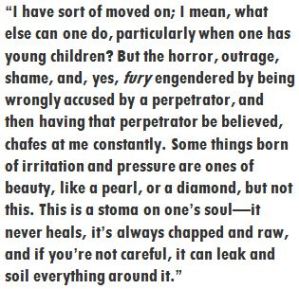 This, the reader will note, is a blaring clinical denunciation of those self-appointed, armchair authorities who would deny the damages of false prosecution. Nearly two decades after the publication of the journal article this post examines, such deniers are everywhere, including in the mainstream press.
The deniers, according to the experts, are talking out of their blowholes. Mere accusation, ignoring the effects of protracted legal battles, drives some to suicide and multitudes more into agoraphobic withdrawal.
The adversarial system is also a threat to the maintenance of personal boundaries. Formal complaints, interrogatories, depositions, public testimony, and cross-examination are intrusive procedures that aggravate feelings previously caused by trauma. Such procedures amplify feelings that the world is an unsafe place, redoubling the litigant’s need to regain a sense of control—often in any way he or she can, including exhibiting characteristic symptoms or defenses. It is not unusual to find entries such as the following in the medical records of litigants: “Janet is hearing voices to cut herself again after talking to her lawyer today.” Similarly, a male plaintiff in a sexual harassment suit threatened violence when he was informed that he was to be deposed, and he required hospitalization.
Exposure to civil process can very literally drive people nuts, and inspire in them urges to commit violence, whether to themselves or others.
Consider Dr. Strasburger’s remarks in the context of restraining order abuse and appreciate that the strains they describe can be compounded by loss of residence (some defendants are left homeless), loss of family, loss of income, loss of employment/career, loss of property, etc. Those so deprived may accordingly become estranged from friends and relations, if not socially ostracized. (They must also live with the consciousness that they’re vulnerable to warrantless arrest at any time.)
Litigants are often further distressed as various members of their support systems “burn out.” Their need for human connection and their need to talk about their experience often exceed the tolerance of family members and friends. Embarrassment and humiliation shrink their social world.
That’s besides the discord and isolation caused by a damning accusation, which may be accepted as fact even by kith and kin. Loyalties may become divided, and the accused may be spurned based on allegations that aren’t true. The sources of outrage to the mind and emotions multiply like cancer cells.
It should come as no surprise then that many who complain of procedural abuse report they’re in therapy. If the costs weren’t prohibitive to most, they might all be. Desolating, as Dr. Strasburger points out, is that even if this were the case, the promise of “healing” isn’t necessarily good. The therapist’s role may be little more than cheerleader.
Psychotherapy for a patient involved in ongoing litigation can take on the aspects of managing a continuing crisis. The therapist, facing this need for crisis management, may be providing support more than insight.
Litigation (or its aftermath) may become consuming; normal, healthy activities are suspended. (One woman this author has corresponded with laments she hasn’t known intimate contact in years; a recent female commenter, alienated from her child, refers to herself as a living homicide.) People may become stuck in a tape loop perpetuated by interminable indeterminacy, insurmountable loss, and a galling sense of injustice.
The legal battle enables people to put their lives on “hold,” thereby avoiding other aspects of their lives (e.g., “How can I be intimate with you when I’m involved in this lawsuit?”). The patient may be so attuned to psycholegal issues and hypotheses that she focuses thereupon in resistance to dealing with significant personal conflict. As a result, she is continually “pleading her case” in the therapy hour.
This cognitive rut exemplifies Legal Abuse Syndrome, and the state may be unending.

Copyright © 2015 RestrainingOrderAbuse.com
*The journal article cited in this post may be introduced to the court by litigants in need of an authoritative voice to validate complaints of pain and suffering induced by fraudulent or vexatious prosecution.

Courthouse Violations and PTSD: What Is “Legal Abuse Syndrome”?
This is the first post on this blog to introduce Legal Abuse Syndrome (LAS), a condition proposed by marriage and family therapist Karin P. Huffer, whose books on the subject of posttraumatic stress stemming from court-mediated violations are Overcoming the Devastation of Legal Abuse Syndrome (1995) and Legal Abuse Syndrome: 8 Steps for Avoiding the Traumatic Stress Caused by the Justice System (2013), and Legal Abuse Syndrome: A Preventable Public Health Problem (2018).
“Anyone who has ever worked in a legal aid office or law library has met people whose lives have come unhinged after a bad contact with the legal system. The details vary—they may have lost a business or inheritance or the custody of a child—but the common theme of feeling violated by the legal system does not. Even 20 years after losing a lawsuit, some people who suffer from Legal Abuse Syndrome still carry a suitcase of old legal papers around, desperately hoping someone will help them find justice.”
—Ralph Warner, quoted in the San Francisco Chronicle (1997)
I’ve encountered the ghostly men and women described by Mr. Warner in the epigraph. They haunt law libraries the way some exiles haunt coffeehouses or used to haunt bookstores. They carry sheaves of papers, foxed file folders, and weathered satchels, just as Mr. Warner describes. They’re known to one another and exchange muted greetings and tinny words of encouragement.
 They desultorily pore over computerized case law and weighty reference tomes—whether pursuing a lead or just out of habit, it’s impossible to tell—and they propound among themselves novel approaches to revisiting one or another of the dusty judgments that have plainly come to consume their lives.
The eager young law students who mill and toil never cast a glance in the direction of these damned souls, who palpably emanate doom.
Maybe I’m a fatalist, or maybe I was smart enough to recognize a fix when I saw one. A few self-navigated trips through the legal ringer were enough to cement in me a sense of futility. Otherwise, I suppose I might have found myself among this skeleton crew.
After my most recent pelting in that burlesque show advertised as process of law (2013), I resolved to stick with what I know: writing. I have no illusions that this makes me any more a master of my fate than if I clung to a corner and allayed my outrage by rocking back and forth and muttering imprecations, but the activity provides a sense of purpose, however lackluster, and bestows a semblance of order to my inner world (my outer world is a hopeless shambles from which the writing blessedly distracts).
I surface now and again to discover people I knew have aged, have entered puberty or college, have married or divorced, or have died.
Elucidating the trauma that forces a person to exchange living for some deranged form of solace like prating in a blog in defiance of a juggernaut is all this initial post on Legal Abuse Syndrome aspires to. For this, I defer to Dr. Huffer (though anyone who has tracked posts and comments here will find significant correspondences between their positions and hers):
LEGAL ABUSE SYNDROME (LAS) is a form of posttraumatic stress disorder (PTSD). It is a psychic injury, not a mental illness. It is a personal injury that develops in individuals assaulted by ethical violations, legal abuses, betrayals, and fraud. Abuse of power and authority and a profound lack of accountability in our courts have become rampant, compounding an already stressful experience.
This stress can and does lead to physical illness. AMA statistics show that around 85% of all physical illness is directly attributable to stress. Legal Abuse Syndrome is a public health menace in this country. It leads to massive medical intervention costs, burdens insurance companies, and adds to Medicare and Social Security costs. Most painfully, it crushes the brilliance and creativity of its sufferers. Legal Abuse Syndrome is detrimental to all of society, and nobody is immune.
Whatever the court setting, whether it is regarding divorce, child custody, parental support, probate matters, personal injury, property disputes, legal or medical malpractice, criminal charges, or other deeply personal issues, the frauds put forth in our courts add greatly to the trauma. When litigants are unable to get fair resolution to their issues, when the court dysfunction further adds to the litigant’s burden, when no amount of actual case law compels an equitable outcome, litigants suffer often disabling levels of stress. When further attempts to achieve redress fail, litigants display the hallmark signs of Legal Abuse Syndrome (LAS).
I’ll conclude with a refrain that has become trite with repetition: The thesis Dr. Huffer’s statements delineate was put forward decades ago, like so many arguments from journalists, jurists, and other social critics against a heedless and unyielding status quo that has prevailed for far too long.
Copyright © 2015 RestrainingOrderAbuse.com
*The concept of Legal Abuse Syndrome was brought to the attention of this writer by investigative journalist Michael Volpe, coauthor of Bullied to Death: The Chris Mackney Story.
 TALKING BACK to restraining orders