“The consequences that arise once a protective order is entered against a person (the respondent) are substantial. Though technically considered civil proceedings, protective orders have a close relationship to criminal law. The consequences of having a protective order entered often include restrictions on constitutional rights in addition to financial obligations. Violations of protective orders bring about serious criminal charges.”
“I have been fighting for 10 years to clear my son’s name from a false restraining order that [was] dismissed and vacated by the court. But to clear themselves, [officers of] the judicial system turn their heads to the wrongdoing and cause this young man to be [defamed], not able to continue his education, etc. His [access to] life has, it seems like, forever been barred.”
The remark above by a criminal lawyer on the “consequences of protective orders” echoes those of many other attorneys (which may observe that restraining order records limit job opportunities and can interfere with the lease of a home, getting government housing, or obtaining credit). I could find you a quotation along the same lines from a law firm in any state of the Union. The woman whose remark follows the lawyer’s, Lena Bennett, identifies herself as a “concerned mother who needs to be heard,” and this post is dedicated to her and her son.
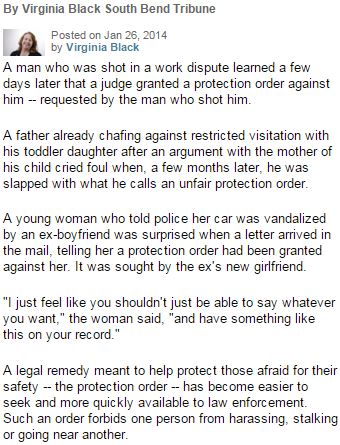 A former trial attorney, Larry Smith, who knows the law in this arena better than he wishes he did, responded to Lena: “I doubt that you can get an expired order expunged in most states because the restraining order, although it has may components of the criminal law, is said to be civil.”
As usual, Larry gets right to the heart of the matter. The fact is there are laws on the books that allow a person who’s been convicted in a criminal court of, say, harassment, stalking, terroristic threats, or assault to later have the charges expunged.
But if a person is baselessly accused of any or all of these acts on a civil restraining order, there’s no legislation in place (except in Tennessee) to enable him or her to have the accusations removed from his or her public record even if a judge determined them to be baseless and dismissed the order.
Note: People who have actually committed crimes can relieve themselves of the onus of a court record (that may hobble their employment opportunities), while people who’ve merely been accused on an ex parte order of the court (30 minutes in and out) are incriminated for life without ever having been tried for a crime, and that, again, is even if a judge formally decreed them innocent and tossed the accusations.
The paper trail, which may include multiple false reports to police officers and registration in police and publicly accessible state databases, is indefinitely preserved.
(Let’s say you’re an employer screening a male job applicant, and you see a restraining order record on which a woman has indicated that he stalked or sexually assaulted her. Let’s even say the court dismissed the case as lacking any foundation. Will you or won’t you be influenced by that record?)
Excuses for preserving restraining order records, which emerge from anti-domestic-violence dogmatists, are anachronistic. Typical of the law, statutes are about 20 years behind social trends.
Consider:
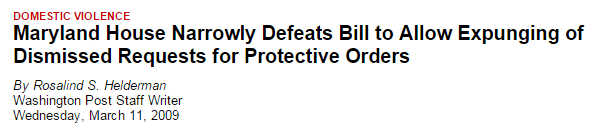
The bill whose defeat is reported in the headline above would have allowed citizens of Maryland who had been accused of domestic violence on a dismissed restraining order petition to have the allegations completely expunged (erased). It was shot down.
Supporters of the measure argued that abuse accusations carry such a stigma that allowing records to remain public in cases that have been deemed unfounded unfairly hurts innocent people as they seek employment or housing.
Opponents contended that requests for protective orders are often dismissed because battered victims, usually women, are too scared or intimidated to pursue the matter. They said records are not expunged in other kinds of civil cases, even when allegations are unproved.
Never mind that these opponents are well aware that restraining order cases are not like “other kinds of civil cases.” Their implications are plainly criminal and highly prejudicial. They’re recorded in police databases.
 A year later, another bill is proposed to the same legislature. This one wouldn’t expunge anything, but it would “hide” restraining order records from public view.
“Shielding” is possible in Maryland today and only requires a clerk to sign off on it. It removes the record of a dismissed order from Maryland’s Judiciary Case Search. The record still exists, however, and can be easily accessed by anyone who swings by the courthouse.
In the whole of the nation, as revealed by a Google search performed yesterday, these are the only states in which there are reportedly means to have a restraining order expunged:
Of these, only Tennessee has an actual statute (law) enabling a person who’s been accused on a restraining order petition that was later dismissed to move the court to expunge the record.
And in only a handful of states (again, according to a casual Google search) has legislation been proposed that would offer the same opportunity to their citizens:
That’s it.
Copyright © 2016 RestrainingOrderAbuse.com

 TALKING BACK to restraining orders