
“Americans need to wake up to the sobering fact they are living in an ongoing Constitutional crisis in the U.S.A. Their Constitutional rights are being deep-sixed by the courts in bulk. And once they’re gone, they’re gone forever, [with] ‘precedent’ and ‘stare decisis’ standing in their place.”
—Former attorney Larry Smith, author of BuncyBlawg.com
Imagine if there were a process of law that allowed citizens’ constitutional rights to be circumvented. Imagine if someone—anyone, possibly a complete stranger—were authorized to take an accusation (any accusation) straight to a judge and receive a ruling on that accusation within hours or minutes. Imagine further if judicial tendencies in the formulation of a ruling in this process had been socially conditioned and monetarily influenced. Then imagine that the accused could be incriminated, absent any investigation, entered into multiple police registries, and deprived of property and livelihood…without ever being heard from at all.
 Now imagine that such a process existed in the United States of America and a plurality of other countries, and was conducted millions of times a year, right out in the open and not only under the noses of journalists and other social critics but largely with their earnest approval.
You’ve seen the rhetorical ploy the introduction uses and won’t be surprised to be told such a process doesn’t need to be imagined; it exists and has for a long time.
The writer could enumerate the various civil rights violations licensed by the restraining order process (and has, as have many others), but is it really necessary? Read the first paragraph again.
Viewed in stark simplicity, minus propaganda and graphics and “social science” figures, the process is horrifying. Criticism of it is framed as a political debate, which is merely a distraction. Is a process like that limned in the first paragraph constitutionally, socially, or ethically conscionable? Plainly, it isn’t.
The argument against it is really that basic. Yet the process has not only persisted unchecked but magnified in its scope and severity since its advent nearly 40 years ago.
The epigraph, a quotation from a former trial lawyer with a personal investment in exposing the injustice of this process, highlights what the decades of social tolerance of it imply.
 Rights may be called “inalienable” all day long, but if a judge can find a precedent—some snatch of text from a previously published ruling—s/he can lawfully deny those rights. That’s on top of the violations already allowed by statutory law.
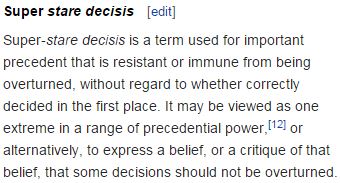
The law accretes according to “stare decisis.” The phrase is Latin and means “to stand by decided matters.” A judgment that denied one person his or her constitutional rights (any time, even in the distant past) can be used to deny everyone else theirs.
This is how “inalienable rights” can be judicially obliterated. Citizens have those rights only until they actually depend on them for self-defense. Then they’re not there. The citation of a prior judgment or judgments in a related case or cases nullifies them.
In other words, those rights aren’t real; they’re just pretty words.
Copyright © 2015 RestrainingOrderAbuse.com
 A principle of law that everyone ensnarled in any sort of legal shenanigan should be aware of is stare decisis. This Latin phrase means “to abide by, or adhere to, decided things” (Black’s Law Dictionary). Law proceeds and “evolves” in accordance with stare decisis.
 TALKING BACK to restraining orders