#MeToo Restraining Orders Petitioned by Politicians This Month

Some recent posts on this blog concerned a frivolous restraining order granted to Warrenton, Virginia Vice Mayor Sunny Reynolds. Curious, I took a look to see whether this was a one-off among politicians.

It wasn’t.

This post looks at other restraining orders petitioned at the people’s expense by representatives of the people (all women)—reported in one month (March 2018). The majority seem to concern disruptions of public speeches. Of note, especially considering the plaintiffs are representatives of government, is that at least one of the orders is patently unconstitutional.

From the various news stories digested below, my favorite quotation was this: “It’s hard to keep track of who is driving this clown car.


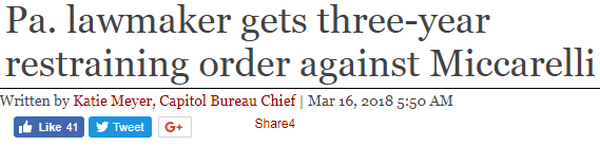
Republican Congresswoman Tarah Toohil was granted a three-year restraining order against fellow Republican state representative Nick Miccarelli, both of Pennsylvania, after alleging he abused and threatened to kill her during a relationship six years prior. Miccarelli, who was stripped of a badge that allows lawmakers to swipe into the Capitol complex and must enter with the general public through a metal detector, is being criminally investigated based on Toohil’s claims and those of another woman who prefers to remain anonymous.
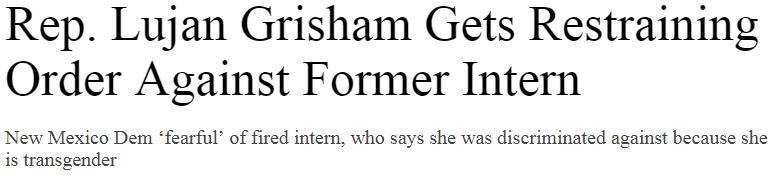

Democratic Congresswoman Michelle Lujan Grisham, a candidate for governor of New Mexico, was granted a temporary restraining order (TRO) against a former intern, Riley Del Rey, a transgender woman who alleges her termination was discrimination-based. Del Rey interrupted a Mar. 11 political speech, for which she was jailed, and was alleged to have “barged into a room” and “disrupted” a different event the month previous. A criminal investigation is pending in this case, which already required that Del Rey keep her distance from Lujan Grisham. The TRO was consequently tossed.


Cape Coral, Florida Mayor Marni Sawicki was granted a restraining order against her ex-husband, Ken Retzer. The only reported allegation was that he was “previously accused of attacking the one-term mayor last year during a conference in Miami.”
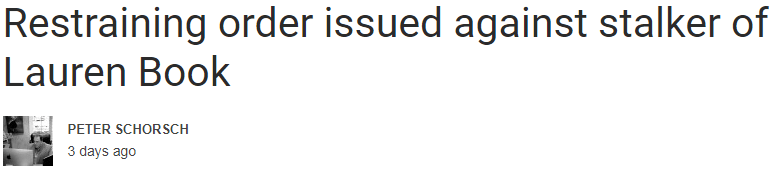

Florida Democratic Sen. Lauren Book was granted a permanent restraining order against Derek Logue for political speech (i.e., an unlawful prior restraint). Logue reportedly heckled Book at public events and published criticisms of her on Twitter and YouTube that included obscene words. (“Logue posted a video on Twitter entitled ‘You are a C**t,’” reports writer Peter Schorsch on the website Florida Politics, “that included lyrics saying he would ‘f**k up [Book’s] face.’” Schorsch also reports “[t]hat video was deemed a credible threat to Book’s safety by the FBI and other law enforcement agencies.” The quoted lyrics are plainly those of Australian singer-songwriter Kat McSnatch, whose performance of the song is viewable here, and if Logue only linked to McSnatch’s video, the finding of “credible threat” by law enforcement, the court, and, most deplorably, Schorsch, is absurd.)


Copyright © 2018 RestrainingOrderAbuse.com

*In an instance of the people’s getting theirs back, the ex-husband of a woman said to have had an affair with Missouri Governor Eric Greitens, who was reportedly indicted in February on the charge of felony invasion of privacy for taking a nude photo of the woman without her permission in 2015, is seeking a restraining order against Greitens, a retired Navy SEAL, on the grounds he feels intimidated by him.

BABY ON BOARD: Restraining Order by Virginia Vice Mayor Sunny Reynolds Kneecaps Town Council Election Rival Who “Pointed His Finger at Her”; Letter to the Editor Criticizes Conduct

The administration of restraining orders is a frequent target of censure by First Amendment scholar and UCLA law professor Eugene Volokh in his blog, The Volokh Conspiracy. That’s because restraining orders may be exploited, besides as gag orders generally, as SLAPPs to suppress political speech, which the First Amendment is there to protect above all other kinds.

This post shares a letter to the editor of the Fauquier Times that was recently submitted by Virginian Nathan Larson and that concerns an injunction sought by Warrenton Vice Mayor Linda “Sunny” Reynolds, whose nickname and whose evident hypersensitivity are strikingly incongruous. “Misty” Reynolds would seem to suit her better—or maybe “Runny.”
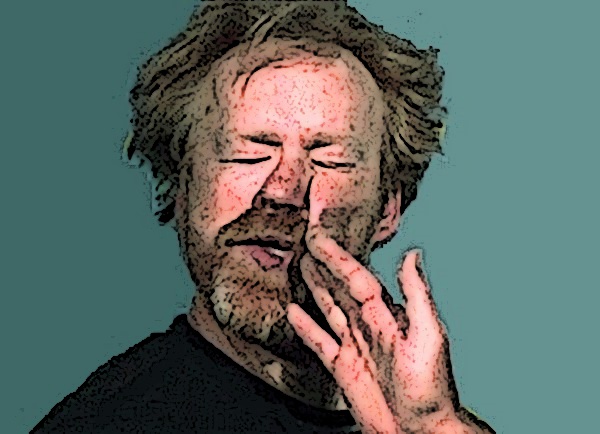
According to the Fauquier Times, Ms. Reynolds petitioned and was granted an obviously spiteful restraining order against Warrenton real estate investor Keith Macdonald based on the allegation that he “appeared to be ‘very angry’” and “pointed his finger at her” during a public exchange about a proposed municipal development project (a library) that occurred in a restaurant where both were dining with others. Ms. Reynolds testified that Mr. Macdonald “invaded her personal space, preventing her from leaving the table.”

Not clarified in the story is whether she ever asked to be excused or made a move to rise.

One of Ms. Reynolds two female witnesses in court worked for the newspaper that reported the story. The other, Ms. Reynold’s dinner companion, Crystal McKinsey, “testified that she could tell Reynolds ‘felt very threatened by the situation and was very fearful.’” What was characterized as a harrowing confrontation transpired in a populated eatery, and there was no report that voices had even been raised.

Mr. MacDonald represented himself in court; Ms. Reynolds had an attorney.

The judge, J. Gregory Ashwell, “decided in favor of Reynolds’ petition, saying he believed Reynolds’ testimony and that of her dinner companion met the legal requirement to issue a protective order.” He offered the explanation that it was “clearly an ‘awkward interaction.’”

Mr. MacDonald, who says he intends to appeal, opposes Ms. Reynolds in an upcoming town council election.

The Fauquier Times reports “[i]t’s not clear if the final order, which will be issued by the court, will…bar Macdonald from town council meetings or town hall.”

Ms. Reynolds’ reelection campaign is titled, “Sunny, for a Voice.” Her bio identifies her as the mother of two daughters but contains no reference to a father.


LETTER TO THE EDITOR

By Nathan Larson

The recent article, “Judge grants Warrenton vice mayor protective order against council opponent,” shows why we need to reform Virginia’s laws concerning restraining orders.

Warrenton Vice Mayor Sunny Reynolds was able to obtain a restraining order under a statute, Code of Virginia § 19.2-152.9, that required only that she prove she had been “subjected to an act of violence, force, or threat by a preponderance of the evidence.”

This is a much lower standard than the “beyond a reasonable doubt” standard which is used in criminal court. That higher standard exists because of the principle that a person’s liberty should not be taken away without strong evidence that he broke a law. Yet without having been convicted of any crime, Reynolds’ challenger in the May election, Keith Macdonald, has been deprived of his First Amendment right to petition his government (specifically, his vice mayor) for a redress of grievances. He also has been deprived of his Second Amendment right to possess a gun.

The article says, “Reynolds also said she felt taken advantage of as the only woman member of the Warrenton Town Council.” But it will have a chilling effect on free speech if men feel they could easily be deprived of their liberty just for confronting a female elected official about her public policies and threatening to run for office against her. The voters lose out too, because now any prospect of these two candidates’ appearing together in a forum to debate issues of public interest is gone.


Mr. Larson retracted his statement about Mr. McDonald’s being denied the right to own a firearm. In Virginia, he explains, a citizen may be slapped with a restraining order for an unwanted gesture, like pointing a finger, but to be denied gun ownership, Mr. McDonald would have to have been in an “intimate” relationship with Ms. Reynolds.

Copyright © 2018 RestrainingOrderAbuse.com

*Probably unsurprising to a reader here, Ms. Reynolds, the plaintiff in the case, called applying for a protective order, which requires filling out some forms and appearing in court for a brief hearing, “very difficult, both timewise and emotionally.” In contrast, proponents of the process argue that being publicly accused (and having one’s name indefinitely registered in local and federal police databases) is no big deal at all.

Restraining Orders as Strategic Lawsuits Against Public Participation (SLAPPs)

Not a day goes by when a search engine query doesn’t lead someone to this blog because s/he wants to know whether speech on Facebook can be prohibited by the court.

Lawfully…maybe. If someone sends communications TO someone else after the someone else has repeatedly requested that s/he be left alone, this can be labeled “harassment,” and a judge can “properly” issue an injunction forbidding further contact.

If, however, a person merely makes remarks ABOUT another person (even a so-called “private figure”) or otherwise expresses his or her view on something, that’s his or her constitutional right (see the First Amendment). Americans are guaranteed the freedom to criticize one another, as well as their government, and judges have no business poking their noses in…which doesn’t mean they won’t if invited. A person merely making remarks ABOUT someone can still be sued. Anyone can be, whether on meritorious grounds or frivolous or vexatious ones.

Enter the “SLAPP,” or, Strategic Lawsuit Against Public Participation.

Lawsuits whose motive is to silence critical speech by intimidation are SLAPPs. They typically allege that an opinion is “defamatory.” There can be no defamation in opinion, but that doesn’t matter.

SLAPPs work because being sued is stressful and expensive. Only about half of states have anti-SLAPP laws on their books and their content varies significantly, as well as do targets’ means to hire attorneys and prosecute a defense. (For just this reason, a federal “Speak Free Act” has been proposed.)

Making matters worse, how SLAPPs are used, particularly when they take the form of restraining order petitions, is by alleging a constellation of offenses that may be utterly false but can nevertheless be very persuasive.

The writer of this post is the defendant in three such litigations right now. The complainants don’t like what I’ve reported or opined about them. They haven’t, though, alleged that I’ve been unkind in my characterizations; they’ve claimed they’re afraid for their lives, that they’ve been harassed, that they’ve been defamed, that they’ve been stalked, that they’ve been sexually aggressed against…that kind of thing. The more frenzied of the two women who are prosecuting me—a woman who emailed me four years ago calling herself an “avid reader” of the blog and calling the other woman who’s prosecuting me a “sociopath”—today says she’s packing a gun. (I’ve seen this person once in 10 years: I consented to join her for coffee, and afterwards she hugged me.)

You see how it works: You make your allegations lurid to distract from your real motive, which is to shut somebody up who’s making you look bad (because you are bad).

Commenters on this blog have reported having restraining orders petitioned against them because the plaintiff owed them money or because they had knowledge of the plaintiff’s commission of a criminal act, like drug abuse, tax evasion, or violence, including rape.

In instances like this, restraining orders are SLAPPs. They’re meant to make sure the defendant is gagged and subdued.

As SLAPPs is just another way restraining orders are abused.

Copyright © 2016 RestrainingOrderAbuse.com