What Defamation Is and Isn’t: On Writing about Abuses of Process


“Defamation is the general term for a legal claim involving injury to one’s reputation caused by a false statement of fact and includes both libel (defamation in written or fixed form) and slander (spoken defamation). The crux of a defamation claim is falsity. Truthful statements that harm another’s reputation will not create liability for defamation (although they may open you up to other forms of liability if the information you publish is of a personal or highly private nature).”

Digital Media Law Project

No honest lawyer would deny that a whole lot of lying goes on in court—though there are more than a few jaded veterans of legal process who would deny there’s such a thing as an honest lawyer.

Either way: a whole lot of lying.

A purpose of the First Amendment is to protect the citizen’s right to register disapproval of anyone or anything, for example, rampant lying in court. If a plaintiff lies in court and prevails because of it, a defendant may have no means to reverse the court’s opinion after the fact. The plaintiff will, for legal purposes, have gotten away with it.

That doesn’t, of course, mean s/he didn’t lie.

It also doesn’t mean the defendant is prohibited from bringing the truth to light in the court of public opinion. What transpires in a courtroom is public property, and the right of a witness to talk about that (and his or her life) is sacrosanct. There’s an obvious public interest, besides, in knowing lying occurs in court, which makes speech about lying in court political, and political speech is what the First Amendment is preeminently there to safeguard.

Journalism is the true court of last resort, and bloggers enjoy the same privileges as the institutional press. A trial judge may not recognize that, but the law does.

A purpose of a plaintiff’s lying to the court to procure an injunction (a “restraining order”) is always to shut the defendant up (possibly to conceal unethical or unlawful acts s/he has committed). The same plaintiff who thought it was perfectly fine to lie up and down about the defendant under oath will be livid if s/he’s then exposed for it in a public medium that could be read by friends, family, and coworkers. Bottling the truth to maintain appearances was the point of misleading the court in the first place.

The plaintiff’s immediate turn-to recourse will be to claim the defendant violated the injunction by writing about him or her. This is invalidated by the First Amendment, but a trial judge may not know that (talking or writing to someone may be properly prohibited by the court; not so talking or writing about someone, which is protected speech). Additional to alleging harassment, a plaintiff will likely claim s/he has been “defamed.

Defamation is a word that’s applied casually to any negative speech about a person. As the epigraph shows, the significance of the word in the law is very narrow, however: to qualify as defamatory, speech must be false. Speech that’s merely critical, offensive, upsetting, or coercive (i.e., meant to urge someone to change his or her ways) is protected by the First Amendment.

To ground this discussion, let’s say a man cheats on his wife, and let’s say the unknowing mistress finds out and threatens to tell her—and his friends, his boss, etc.—unless he apologizes and comes clean. The man gets a restraining order to silence the woman, maybe alleging harassment or stalking…or threats against his pet bunny. (He can make up anything he wants—and if there are a few angry emails or texts, easy-peasy.)

This disarms the woman (who is the actual wronged party), robs her of credibility—“She’s just some crazy person who’s obsessed with me; I had to get a restraining order”—and besides humiliates and terrifies her: She is instantly the creep.

Now what if instead of contacting the man’s wife (boss, friends, etc.), the deceived woman subsequently writes about the ordeal in a blog? Contrary to what most may think, including lawyers and judges, this is protected one-to-many speech—like orating on a campus quad or in the town square, or wearing a sandwich board and marching up and down the sidewalk. Willing listeners can attend; everyone else can turn away.

Negative speech about a person usually will qualify, by the dictionary definition of the word, as defamatory. Certainly if I call someone a “scumbag,” it’s not likely to enhance his or her image and popularity. Is calling someone a name actionable? No.

So speech can defame and still be defensible. Liability for defamation requires that unwanted speech be false.

If I think someone’s a scumbag, that’s not false speech; it’s my opinion. So it isn’t defamatory according to the law…even if a judge might believe otherwise.

Let’s help him or her out: Is pronouncing that someone is a criminal defamatory? Certainly. But judges do it all the time. Defaming people is their business. Generally speaking, judges’ defamatory speech is the most harmful kind.

The distinction is, if someone is sentenced for the commission of a criminal act, s/he is ipso facto a “convicted criminal” (and maybe even a “felon”). Saying so is defamatory, but it isn’t “defamation” by the standard recognized by the law. It isn’t false.

Similarly, if someone committed a crime (like perjury) and wasn’t caught, that doesn’t mean s/he didn’t lie under oath. (Parenthetically, there is no one who has never told a lie so just calling someone a liar can never be defamatory by the legal standard.)

In a courtroom, a person’s allowed to make any defamatory allegation against someone else, whether true or not. Judges (and everybody else) get hung up on the question of what you can say outside of one. It’s as if they imagine what happens in court isn’t public or “doesn’t count.”

An irony lost on judges is that lies uttered with impunity in court procedures can carry grave and permanent consequences. A judge will just stonily sit there and listen. (The author, for example, was accused in 2013 of “propositioning” a woman he’s been in and out of court with for almost 12 years. It never happened, but the judge didn’t bat an eyelash.) “Objectionable” opinions and truths spoken outside of court may well arouse a judge’s ire, though. This is a prejudice, and it’s more than a little backwards.

Critical speech cannot help but defame. That doesn’t mean it’s unjust, and it doesn’t mean it’s punishable.

We don’t say the truth hurts for nothing.

Copyright © 2017 RestrainingOrderAbuse.com

*An Arizona Superior Court judge in 2013 ruled speech of mine to be “defamatory on its face.” Defamation is a jury question (as any superior court judge should know…and I wasn’t even afforded a bench trial). The law doesn’t recognize the instant conclusion “defamatory on its face” (i.e., at first glance). Many of the conclusions drawn by the judge who declared my speech “defamatory on its face” were flagrantly unlawful. His administration of the 2013 case, Bredfeldt v. Greene, violated both the state constitution and the Constitution. Judges can do that, you ask? They can and they do—all the time.
Courtroom Fraud and Smear Campaigns: The Full Machiavelli

Cheryl Lyn Walker PhD, Dr. Cheryl Lyn Walker, Dr. Cheryl L. Walker PhD, M.D. Anderson Cancer Center, Michael Honeycutt PhD, Michael Honeycutt TCEQ

“False Accusations, Distortion Campaigns, and Smear Campaigns can all be used with or without a grain of truth, and have the potential to cause enormous emotional hurt to the victim or even impact [his or her] professional or personal reputation and character.”

—“False Accusations and Distortion Campaigns

There are several fine explications on the Internet about the smear campaigns of false accusers. Some sketch method and motive generally; some catalog specific damages that ensue when lies are fed to the police and courts.

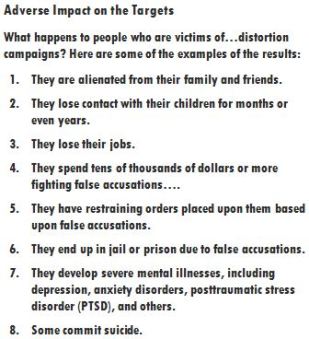
This survey of “adverse impacts” is credited to lies told by people with borderline personality disorder. Conducting “distortion campaigns” isn’t exclusive to BPDs, however, and the “adverse impacts” are the same, irrespective of campaigners’ particular cognitive kinks.

The valuable role of the police and courts in the prosecution of campaigns to slander, libel, and otherwise bully and defame can’t be overstated. They’re instrumental to a well-orchestrated character assassination.

Lies can be told to anyone, of course, and lies told to anyone can have toxic effects. The right lie told in a workplace, for example, can cost someone a job and impair or imperil a career.

Lies told to police and judges—especially judges—they’re the real wrecking balls, though. False allegations of threat or abuse are handily put over in restraining order or domestic violence procedures, and they endure indefinitely (and embolden accusers to tell further lies, which are that much more persuasive).

Among the motives of false accusation are blame-shifting (cover-up), attention, profit, and revenge (all corroborated by the FBI). Lying, however, may become its own motive, particularly when the target of lies resists. The appetite for malice, once rewarded, may persist long after an initial (possibly impulsive) goal is realized. Smear campaigns that employ legal abuse may go on for years, or indefinitely (usually depending on the stamina of the falsely accused to fight back).

Legitimation of lies by the court both encourages lying and reinforces lies told to others. Consider the implications of this pronouncement: “I had to take out a restraining order on her.” Who’s going to question whether the grounds were real or the testimony was true? Moreover, who’s going to question anything said about the accused once that claim has been made? It’s open season.

In the accuser’s circle, at least—which may be broad and influential—no one may even entertain a doubt, and the falsely accused can’t know who’s been told what and often can’t safely inquire.

Judgments enable smear and distortion campaigners to slander, libel, and otherwise bully with impunity, because their targets have been discredited and left defenseless (judges may even punish them for lawfully exercising their First Amendment rights and effectively gag them). The courts, besides, may rule that specific lies are “true,” target_of_blamethereby making the slanders and libels impervious to legal relief. Statements that are “true” aren’t defamatory. The man or woman, for instance, who’s wrongly found guilty of domestic violence (and entered into a police database) may be called a domestic abuser completely on the up and up (to friends, family, or neighbors, for example, or to staff at a child’s school).

Lies become facts that may be shared with anybody and publicly (court rulings are public records). Smear campaigners don’t limit themselves to court-validated lies, either, but it seldom comes back to bite them once a solid foundation has been laid.

Some so-called high-conflict people, the sorts described in the epigraph, conduct their smear or distortion campaigns brazenly and confrontationally. Some poison insidiously, spreading rumors behind closed doors, in conversation and private correspondence. As Dr. Tara Palmatier has remarked, social media also present them with attractive and potent platforms (and many respondents to this blog report being tarred on Facebook or even mobbed, i.e., bullied by multiple parties, including strangers).

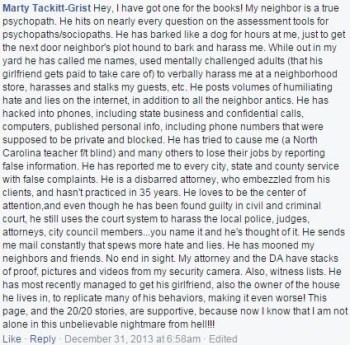
Even when false accusers’ claims are outlandish and over the top, like these posted on Facebook by North Carolinian Marty Tackitt-Grist, they’re rarely viewed with suspicion—and almost never if a court ruling (or rulings) in the accusers’ favor can be asserted. The man accused in this comment to ABC’s 20/20 is a retiree with three toy poodles and a passion for aviation who couldn’t “hack” firewood without pain, because his spine is deformed. He is a retired lawyer, but he wasn’t “disbarred” and hasn’t “embezzled” (or, for that matter, “mooned” anyone). He has, however, been jailed consequent to insistent and serial falsehoods from his patently disturbed neighbor…who’s a schoolteacher.

For Crazy, social media websites are an endless source of attention, self-promotion, self-aggrandizement, and a sophisticated weapon. Many narcissists, histrionics, borderlines, and other self-obsessed, abusive personality types use Facebook, Twitter, and the like to run smear campaigns, to make false allegations, to perpetrate parental alienation, and to stalk and harass their targets while simultaneously portraying themselves as the much maligned victim, superwoman, and/or mother of the year.

(A respondent to this blog who’s been relentlessly harried by lies for two years, who’s consequently homeless and penniless, and who’s taken flight to another state, recently reported that a woman who’d offered her aid suddenly and inexplicably defriended her on Facebook and shut her out without a word. Her “friend” had evidently been gotten to.)

(An advocate for legal reform who was falsely accused in court last year by her husband and succeeded in having the allegations against her dismissed reports that he afterwards circulated it around town that she tried to kill him.)

I was falsely accused in 2006 by a woman who had nightly hung around outside of my house for a season. She was married and concealed the fact. Then she lied to conceal the concealment and the behavior that motivated the concealment. She has sustained her fictions (and honed them) for nearly 10 years. People like this build tissues of lies, aptly and commonly called webs.

Their infrastructures are visible, but many strands may not be…and the spinners never stop spinning.

The personality types associated with chronic lying are often represented as serpentine, arachnoid, or vampiric. This ironically feeds into some false accusers’ delusions of potency. Instead of shaming them, it turns them on.

I know from corresponding with many others who’ve endured the same traumas I have that they’ve been induced to do the same thing I did: write to others to defend the truth and hope to gain an advocate to help them unsnarl a skein of falsehoods that propelled them face-first into a slough of despond. (Why people write, if clarification is needed, is because there is no other way to articulate what are often layered and “bizarre” frauds.)

I know with heart-wrenching certainty, also, that these others’ honest and plaintive missives have probably been received with exactly the same suspicion, contempt, and apprehension that mine were. It’s a hideous irony that attempts to dispel false accusations are typically perceived as confirmations of them, including by the court. To complain of being called a stalker, for example, is interpreted as an act of stalking. There’s a kind of awful beauty to the synergy of procedural abuse and lies. (Judges pat bullies on the head and send them home with smiles on their faces.)

Smear campaigns wrap up false accusations authorized by the court with a ribbon and a bow.

Copyright © 2015 RestrainingOrderAbuse.com

*The name Machiavelli, referenced in the title of this post, is associated with the use of any means necessary to obtain political dominion (i.e., power and control). Psychologists have adapted the name to characterize one aspect of a syzygy of virulent character traits called “The Dark Triad.”

Restraining Orders as “Revenge Porn”

In the second season of HBO’s The Newsroom, a lead character is exposed on a website called Revenge Porn by a man with whom she’d had a brief fling.

After sitting huddled in a corner and pronouncing, “I want to die,” she rallies and confronts her former lover while he’s conducting a business meeting. Without much prelude, she kicks him in the testicles and bloodies his nose.

It makes for engaging TV.

If only an ex-intimate’s exploitation of the legal equivalent of Revenge Porn could be so briskly requited and resolved.

What I’m referring to, of course, is treacherously defamatory representations to the court on a civil restraining order, representations intended to publicly humiliate and satisfy a scorned lover’s urge to wound. The restraining order is an invitation for the system to poke its nose into the crevices, one it’s glad to accept.

The TV show character wasn’t able to sue the man who betrayed her, because she posed for the pictures. She even bought the camera for him.

Had the man surreptitiously shot the photos and aired them without her consent, she could have taken him to the cleaners. The courts do more than frown upon that kind of thing, especially when the photos are nudies.

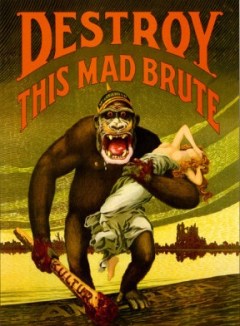
Non-photographic representations that use the justice system as their porn site, though, are embraced as compelling causes of action.

Stalking, indecent exposure, assault, child molestation, bestiality, rape—no pubic allegation, however scandalous, is off the table, and there are no consequences for falsely portraying someone as a lewd and lascivious beast. It’s not defamation; it’s testimony. This distinction sublimates obscene slanders and libels into protected speech, and denies defendants any recourse for realizing compensation for the damage they inflict, psychological, physical, financial, and material.

The court hosts the site, and judges, the site’s administrators, are only answerable to the law, which licenses the site.

This revenge porn is legal—and has the feminist stamp of approval.

Copyright © 2014 RestrainingOrderAbuse.com

“Predator” v. “Porn Star”: Restraining Order Fraud, False Allegations, and Suing for Defamation

destroyPeople falsely alleged to be abusers on restraining order petitions, particularly men, are treated like brutes, sex offenders, and scum by officers of the court and its staff, besides by authorities and any number of others. Some report their own relatives remain suspicious—often based merely on finger-pointing that’s validated by some judge in a few-minute procedure (and that’s when relatives aren’t the ones making the false allegations).

The social alienation and emotional distress felt by the falsely accused may be both extreme and persistent.

The urge to credit accusations of abuse has been sharpened to a reflex in recent decades by feminist propaganda and its ill begot progeny, the Violence Against Women Act. No one thinks twice about it.

Using four-letter words in court is strictly policed. Even judges can’t do it without risking censure. Falsely implicating someone, however, as a stalker, for example, or a child molester—that isn’t policed at all. Commerce in lies, whether by accusers, their representatives, or even judges themselves is unregulated. No one is answerable for sh* s/he makes up.

Accordingly, false allegations and fraud are rewarding and therefore commonplace.

It should be noted that false allegations and fraud can be distinctly different. For example, David Letterman famously had a restraining order petitioned against him by a woman who was seemingly convinced he was communicating to her through her TV, and her interpretations of his “coded messages” probably were genuinely oppressive to her. David Letterman lived in another state, had never met her, and assuredly had no idea who she was. Her allegations of misconduct weren’t true, but they weren’t intended to mislead (and the fact that they did mislead a judge into signing off on her petition only underscores the complete absence of judicial responsibility in this legal arena).

Fraud, in contrast, is manipulative and deceptive by design. It occurs when an accuser intentionally lies (or spins the facts) to give a false impression and steer a judge toward a wrong conclusion that serves the interests of the fraudster.

Regardless, though, of whether false allegations are made knowingly or unknowingly, they’re rarely discerned as false by the court, are seldom acknowledged as false even if recognized as such, and are always destructive when treated as real, urgent, and true, which they commonly are.

The falsely accused (often private citizens who’ve never had a prior brush with the law) are publicly humiliated and shamed, which by itself is predictably traumatizing. They are besides invariably (and indefinitely) entered into police databases, both local and national, and may be entered into one or more domestic violence registries, too (also indefinitely). These facts pop up on background checks, and defendants in some states may even appear in registries accessible by anyone (including friends, neighbors, family members, boy- and girlfriends, employers, colleagues, students, patients, and/or clients).

This costs the falsely accused leases, loans, and jobs (being turned down for which, of course, aggravates the gnawing indignity and outrage they already feel). Those falsely accused of domestic violence may further be prohibited from attending school functions or working with or around children (permanently). Defendants of false restraining orders may besides be barred from their homes, children, assets, and possessions. Some (including salaried, professional men and women) are left ostracized and destitute. Retirees report having to live out of their cars.

This, remember, is the result of someone’s lodging a superficial complaint against them in a procedure that only requires that the accuser fill out some paperwork and briefly talk to a judge. A successful fraud may be based on nothing more substantive, in fact, than five “magic” words: “I’m afraid for my life” (which can be directed against anyone: a friend, a neighbor, an intimate, a spouse, a relative, a coworker—even a TV celebrity their speaker has never met).

This incantation takes a little over a second to utter (and its speaker, who can be a criminal or a mental case, need not even live in the same state as the accused).

Accordingly, people’s names and lives are trashed—and no surprise if they become unhinged. (Those five “magic” words, what’s more, may be uttered by the actual abusers in relationships to conceal their own misconduct and redirect blame. That includes, for example, stalkers. Those “magic” words may also be used to cover up any nature of other misbehavior, including criminal. They instantly discredit anything the accused might say about their speakers.)

The prescribed course of action to redress slanders and libels is a defamation suit, but allegations of defamation brought by those falsely accused on restraining orders or in related prosecutions are typically discounted by the court. Perjury (lying to the court) can’t be prosecuted by a private litigant (only by the district attorney’s office, which never does), and those who allege defamation are typically told the court has already ruled on the factualness of the restraining order petitioner’s testimony and that it can’t be reviewed (the facts may not even be reviewed by appellate judges, who may only consider whether the conduct of the previous judge demonstrated “clear abuse of discretion”). The plaintiff’s testimony, they’re told, is a res judicata—an already “decided thing.” (Never mind that docket time dedicated to the formation of that “decision” may literally have been a couple of minutes.)

So…slanders and libels made by abuse of court process aren’t actionable, slanders and libels that completely sunder the lives of the wrongly accused, who can’t even get them expunged from their records to simply reset their fractured lives to zero.

Such slanders and libels may include false allegations of stalking, physical or sexual aggression, assault, child abuse, or even rape. In the eyes of the court, someone’s being falsely implicated as a monster, publicly and for life, is no biggie.

In contrast, it was reported last month that the court awarded a Kansas woman $1,000,000 in a defamation suit brought against a radio station that falsely called her a “porn star.”

When violated people speak of legal inequities, this exemplifies what they’re talking about: Falsely and publicly implicating someone as a sex offender is fine and no grounds for complaint in the eyes of the justice system, but for the act of falsely and publicly calling someone a mere sex performer, someone may be fined a million bucks.

Copyright © 2014 RestrainingOrderAbuse.com

Larry’s Story, Part 2: Suing a False Accuser and the Judge She Rode in On

Buncombe County, North Carolina, where Larry Smith has for three years been harried by relentless false allegations from a disturbed neighbor, is the source of the word bunkum.

Bunkum (or bunk) is more familiarly called BS, which is what Larry’s been daily forced to tolerate for three years. He’s 70, and the time he’s had stolen from him was precious.

Larry filed a lawsuit in federal district court this week (pro se) against the State of North Carolina, his neighbor-cum-accuser, the judge who encouraged her reign of terror, and a number of other public officials to be named later in an amendment to his complaint.

Larry, a grandfather living on Social Security who practiced law in his salad days, is an object lesson about why it’s ill-advised to poke a sleeping bear.

Despite suffering from agonizing scoliosis (a degenerative spinal disorder), Larry’s been summoned to court over 30 times since 2011, locked in a cell, and had a gun pointed at him consequent to crank allegations from a vengeful neighbor who’s publicly accused him of being a disbarred attorney, an embezzler, and a psychopath (including on Facebook).

She says he’s “barked like a dog” at her, recruited “mentally challenged adults” to harass her while shopping, and mooned her friends. She says he’s cyberstalked her, too, besides hacking into her phone and computer.

Larry, who’s in pain even when he’s sitting down, has been reported to the police a dozen times or more while out walking his toy poodles or just puttering around his house. His accuser has also twice filed restraining orders against him since he took exception to her cat’s killing the local songbirds that have always been a source of joy to him to watch. The first time she petitioned a restraining order, she reported that he violated it later the same day.

Larry hadn’t even seen the woman.

Larry’s accuser’s is an extreme version of the mischief that’s widely reported by targets of restraining orders. Notable (and telling) is that even the outrageous degree of flagrant procedural abuse Larry’s been subjected to is winked at by authorities and judges.

There’s liable to be more blinking than winking this time around: Mr. Smith is going to Washington—and circumventing the local old boy’s network.

Larry’s lawsuit alleges deception; fraud; judicial dereliction; frivolous and malicious prosecution; fundamental constitutional rights violations; false imprisonment; unjust stigmatization; judicial politicking; collusion, conspiracy, and tyrannical oppression by representatives of regional government; and felonious forgery of a criminal complaint.

It also requests a jury.

One man’s debunking procedures this country and many others have invested faith and a fortune in is probably a forlorn hope, but the endeavor is nothing shy of heroic (and may at least restore to a sorely hectored man his peace of mind).

Copyright © 2014 RestrainingOrderAbuse.com