
“Socially aversive personality traits such as Psychopathy, Machiavellianism, and Narcissism have been studied intensively in clinical and social psychology. […] Although each of these three constructs may have some unique features not shared by the other two, they do appear to share some common elements such as exploitation, manipulativeness, and a grandiose sense of self-importance. Accordingly, Paulhus and Williams (2002) have called these three constructs the ‘Dark Triad’ of personality….”
—Kibeom Lee and Michael C. Ashton
“Members of the Dark Triad tend to be especially untrustworthy in the mating context.”
—Daniel N. Jones and Delroy L. Paulhus
Restraining orders are commonly used to sever relationships. The assumption is that the applicant of a restraining order has been the victim of mistreatment. Many who’ve been implicated as abusers, however, report mistreatment by manipulative personalities who then exploited court process to dominate them, garner attention, and/or deflect blame for their own conduct—typically by lying through their teeth.
 It turns out there’s a sexy phrase for the collective personality traits exhibited by manipulators of this sort: the “Dark Triad.”
Several of the posts on this blog have discussed personality-disordered and high-conflict people (who may be personality-disordered), and such people are a central focus of the work of attorney, mediator, and therapist Bill Eddy and psychologist Tara Palmatier, whom I’ve frequently quoted and who’ve written volubly about abuses of legal process by predatory personalities. Narcissism and psychopathy, two of the constituents of the Dark Triad, also qualify as “Cluster B” personality disorders.
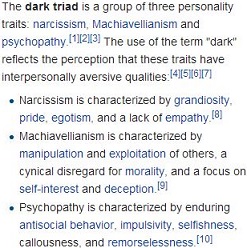 As should be evident to anyone who’s read up on these matters, there’s a high degree of overlap among attempts to define, differentiate, and distinguish the mentally kinked.
The context in which the phrase Dark Triad is applied is interpersonal relationships that are familiarly called “romantic.” This should be of interest to victims of court process, because their abusers are more often than not current or former spouses, boy- or girlfriends, or intimates.
The concept of the Dark Triad should also be of interest to them because clinical labels may only roughly match their abusers’ conduct, conduct like deception, inexplicable betrayals, irreconcilable (mixed) messages, etc. (behaviors that “don’t make sense”). People who fall within this (subclinical) delta of personality quirks represent their interest and intentions to be sincere, and reveal them, often abruptly, to have been shallow or even sinister.
From “How the Dark Triad Traits Predict Relationship Choices” (Jonason, Luevano, & Adams):
 The Dark Triad traits should be associated with preferring casual relationships of one kind or another. Narcissism in particular should be associated with desiring a variety of relationships. Narcissism is the most social of the three, having an approach orientation towards friends (Foster & Trimm, 2008) and an externally validated ‘ego’ (Buffardi & Campbell, 2008). By preferring a range of relationships, narcissists are better suited to reinforce their sense of self. Therefore, although collectively the Dark Triad traits will be correlated with preferring different casual sex relationships, after controlling for the shared variability among the three traits, we expect that narcissism will correlate with preferences for one-night stands and friend[s]-with-benefits.
In contrast, psychopathy may be characterized by an opportunistic, exploitive mating strategy (Figueredo et al., 2006; Jonason et al., 2009b; Mealey, 1995). Booty-call relationships by their very name denote a degree of exploitation. That is, individuals use others—their booty-call partner[s]—for sex by a late night phone call with the expressed or implied purpose of sex (Jonason et al., 2009). Therefore, we expect that after controlling for the shared variability among the three traits, psychopathy will be correlated with preferences for booty-call relationships. Such a relationship may be consistent with their exploitive mating strategy. Last, although prior work has linked Machiavellianism with a short-term mating style (McHoskey, 2001), more sophisticated analyses controlling for the shared correlation with psychopathy has revealed that Machiavellianism might not be central to predicting short-term mating (Jonason et al., 2011). Therefore, we expect Machiavellianism to not be correlated with preferences for any relationships.
What we’re talking about, basically, are people who exploit others for sexual attention and/or satisfaction (that is, players). The common denominator is a disinclination toward or disinterest in what’s called a “meaningful” or “serious” relationship. The motive is noncommittal, urge-driven self-pleasure (assisted masturbation, as it were). Psychologists sometimes remark in writing about narcissists in other contexts that they entertain “romantic fantasies” but conclude that these fantasies are exclusively about personal feelings and not interpersonal anything.
 What we’re talking about in the context of abuse of restraining orders are people who exploit others and then exploit legal process as a convenient means to discard them when they’re through (while whitewashing their own behaviors, procuring additional narcissistic supply in the forms of attention and special treatment, and possibly exacting a measure of revenge if they feel they’ve been criticized or contemned).
Since it’s only natural that people with normally constructed minds will struggle to comprehend the motives of those with Dark Triad traits, they conveniently set themselves up for allegations of harassment or stalking, which are easily established with nothing more than some emails or text messages (that may, for example, be pleas for an explanation—or demands for one). People abused by manipulators who then abuse legal process to compound their injuries typically report that they were “confused,” “angry,” and/or “wanted to understand.”
This is the Jonason & Webster “Dirty Dozen” scale for assessing Dark Triad candidacy:
 I tend to manipulate others to get my way.
- I tend to lack remorse.
- I tend to want others to admire me.
- I tend to be unconcerned with the morality of my actions.
- I have used deceit or lied to get my way.
- I tend to be callous or insensitive.
- I have used flattery to get my way.
- I tend to seek prestige or status.
- I tend to be cynical.
- I tend to exploit others toward my own end.
- I tend to expect special favors from others.
- I want others to pay attention to me.
Victims of restraining order abuse by manipulative lovers or “romantic” stalkers will note a number of correspondences with their accusers’ personalities, as well as discern motives for their lying to the police and courts, which elicits special treatment and attention from authority figures…and subsequently every other sucker with whom they share their “ordeal.”
Copyright © 2014 RestrainingOrderAbuse.com
*Some specialist monographs on this subject are here.
 Restraining orders are unparalleled tools for discrediting, intimidating, and silencing those they’ve been petitioned against. It’s presumed that those people (their defendants) are menaces of one sort or another. Why else would they be accused?
 Memorable stories of restraining orders’ being used to conceal (or indulge) indiscretions or infidelities that have been shared with me since I began this blog over two years ago include a woman’s being accused of domestic violence by a former boyfriend she briefly renewed a (Platonic) friendship with who had a viciously jealous wife who put him up to it; a man’s being charged with domestic violence after catching his wife texting her lover and wrestling with her for possession of the phone for an hour (he was forced to abandon his house so his rival could move in); and a young , female attorney’s being seduced by an older, married colleague who never told her he was married and subsequently petitioned an emergency restraining order against her, both to shut her up and to minimize her opportunity to prepare a defense. I’ve even been apprised of people’s (women’s) having restraining orders petitioned against them by spouses (women) who resented being informed of their mates’ sleeping around.
 TALKING BACK to restraining orders