“I want my life back. Restraining orders have stolen everything from me, and I’d give anything to have it back.”
—From “End Restraining Order Abuses”
Here’s what no one on the outside of the restraining order process can possibly grasp: that it can strip from someone, possibly based on nothing but maliciously false allegations, everything that s/he held dear.
That everything may have been what we conventionally regard as the worthiest values in life: home, family, and children. Or that everything may have been a career, an ambition, or sanity, peace of mind, and well-being. It may have been faith in government…or God. Or it may have been good repute.
All of these values are sacred ones and ones protected by our Constitution, and all of these values are vulnerable to casual violation by a state process engineered, intentionally or not, to abet casual violations. Restraining orders not only enable but legitimate attacks that wouldn’t otherwise be possible, let alone legal.
The source of the gnawing outrage so evident in complaints about restraining order abuse isn’t simply false allegations but the eagerness with which they’re accepted as fact by the court and effectively sublimated into fact by application of a judicial signature.
 Consider: If someone falsely circulates that you’re a sexual harasser, stalker, and/or violent threat—possibly endangering your employment, to say nothing of savaging you psychologically—you can report that person to the police, seek a restraining order against that person for harassment, and/or sue that person for defamation and intentional infliction of emotional distress. If, however, that person first obtains a restraining order against you based on the same false allegations—which is simply a matter of filling out a form and lying to a judge for five or 10 minutes—s/he can then circulate those allegations, which have been officially recognized as legitimate on an order of the court, with impunity. Your credibility, both among colleagues, perhaps, as well as with authorities and the courts, is instantly shot. You may, besides, be subject to police interference based on further false allegations, or even jailed (arrest for violation of a restraining order doesn’t require that the arresting officer actually witness or have incontrovertible proof of anything). And if you are arrested, your credibility is so hopelessly compromised that a false accuser can successfully continue a campaign of harassment indefinitely. Not only that, s/he can expect to do so with the solicitous support and approval of all those who recognize him or her as a “victim” (which may be practically everyone).
Can a completely innocent person be completely destroyed like this in gratification of a sick impulse by someone with a yen for vengeance or an attention-seeking personality disorder? Totally. The allegations, files, and records (public records) gradually accrete to mock, humiliate, and destabilize that person indefinitely, denying him or her a sense of security and any reasonable expectation of receiving just treatment from his or her own government.
It works this way: police officers and judges have only brief exposure(s) to the matter and, having no investment in it, couldn’t care less either way; people who are on the fence are liable to maintain their perch, being disinclined to get involved; those who know better will express their sympathies, which are kind but powerless to work any sort of remedial or regenerative effect; and those who don’t know any better will swallow a liar’s frauds, because their reactions have been socially conditioned and they have, besides, no reason to doubt the merits of a court’s (or multiple courts’) findings.
It’s a piece of cake.
Liars typically don’t expect to have their frauds challenged, but if they are, those frauds are more likely than not to continue to succeed (the courts are averse to backpedaling, and there’s no oversight). Lies don’t even have to be consistent or particularly cunning, just sensational and dramatically delivered (bigger, more lurid lies are actually easier sells than small ones). The rewards of attention, social sympathy and encouragement, recognition by authority figures, and the sense of power that comes from prevailing over an opponent are furthermore heady and addictive, and easily eclipse any twinge of conscience or fear that a liar may feel.
Victims of abuse are left eating their hearts out while those who’ve abused them can expect to be surrounded by consoling arms. In work settings, those abusers may even end up with promotions.
Copyright © 2013 RestrainingOrderAbuse.com
 Restraining orders are unparalleled tools for discrediting, intimidating, and silencing those they’ve been petitioned against. It’s presumed that those people (their defendants) are menaces of one sort or another. Why else would they be accused?
 Memorable stories of restraining orders’ being used to conceal (or indulge) indiscretions or infidelities that have been shared with me since I began this blog over two years ago include a woman’s being accused of domestic violence by a former boyfriend she briefly renewed a (Platonic) friendship with who had a viciously jealous wife who put him up to it; a man’s being charged with domestic violence after catching his wife texting her lover and wrestling with her for possession of the phone for an hour (he was forced to abandon his house so his rival could move in); and a young , female attorney’s being seduced by an older, married colleague who never told her he was married and subsequently petitioned an emergency restraining order against her, both to shut her up and to minimize her opportunity to prepare a defense. I’ve even been apprised of people’s (women’s) having restraining orders petitioned against them by spouses (women) who resented being informed of their mates’ sleeping around.
 What this blog and

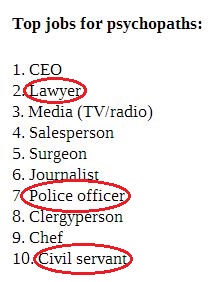 The reason I’m revisiting Dr. Dutton’s book in this post is that several of the jobs it identifies as most likely to draw psychopaths are ones in the legal profession and government.
 That’s why I’m particularly impressed when I encounter writers whose literary protests are not only controlled but very lucid and balanced. One such writer maintains a blog titled
  Casual charlatanism, though, is hardly an accomplishment for people without consciences to answer to. And rubes and tools are ten cents a dozen.
 A principle of law that everyone ensnarled in any sort of legal shenanigan should be aware of is stare decisis. This Latin phrase means “to abide by, or adhere to, decided things” (Black’s Law Dictionary). Law proceeds and “evolves” in accordance with stare decisis.
 This means defendants can be denied access to the family pet(s), besides.
 I had an exceptional encounter with an exceptional woman this week who was raped as a child (by a child) and later violently raped as a young adult, and whose assailants were never held accountable for their actions. It’s her firm conviction—and one supported by her own experiences and those of women she’s counseled—that allegations of rape and violence in criminal court can too easily be dismissed when, for example, a woman has voluntarily entered a man’s living quarters and an expectation of consent to intercourse has been aroused.
 Lapses by the courts have piqued the outrage of victims of both genders against the opposite gender, because most victims of rape are female, and most victims of false allegations are male.
 As many people who’ve responded to this blog have been, this woman was used and abused then publicly condemned and humiliated to compound the torment. She’s shelled out thousands in legal fees, lost a job, is in therapy to try to maintain her sanity, and is due back in court next week. And she has three kids who depend on her.
 The
The  Not many years ago, philosopher Harry Frankfurt published a treatise that I was amused to discover called
  The logical extension of there being no consequences for lying is there being no consequences for lying back. Bigger and better.
 The sad and disgusting fact is that success in the courts, particularly in the drive-thru arena of restraining order prosecution, is largely about impressions. Ask yourself who’s likelier to make the more impressive showing: the liar who’s free to let his or her imagination run wickedly rampant or the honest person who’s constrained by ethics to be faithful to the facts?
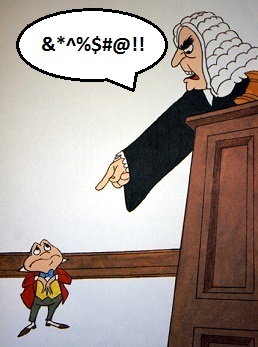 Judicial misbehavior is often complained of by defendants who’ve been abused by the restraining order process. Cited instances include gross dereliction, judge-attorney cronyism, gender bias, open contempt, and warrantless verbal cruelty. Avenues for seeking the censure of a judge who has engaged in negligent or vicious misconduct vary from state to state. In my own state of Arizona, complaints may be filed with the Commission on Judicial Conduct. Similar boards, panels, and tribunals exist in most other states.
 Restraining orders occupy an exceptional status among complaints made to our courts, because their defendants (recipients) are denied
 Following Tylenol’s being tampered with in 1981, everything from diced onions to multivitamins requires a safety seal. Naive trust was violated, and legislators responded.
 Dr. Charles Corry, president of the

 So how is it so many men are railroaded through a process that may be initiated on no evidence at all, may strip them of their most valued investments and every bit of social and financial equity they’ve built in their lives—kids, home, money, property, business, and reputation—and may ensure that they’re never able to recover what they’ve been deprived of?
 It shouldn’t be any mystery why with millions of restraining orders being issued each year in the Internet age complaints of abuses aren’t louder and more numerous: stigma.
 TALKING BACK to restraining orders