

“Predator” v. “Porn Star”: Restraining Order Fraud, False Allegations, and Suing for Defamation

destroyPeople falsely alleged to be abusers on restraining order petitions, particularly men, are treated like brutes, sex offenders, and scum by officers of the court and its staff, besides by authorities and any number of others. Some report their own relatives remain suspicious—often based merely on finger-pointing that’s validated by some judge in a few-minute procedure (and that’s when relatives aren’t the ones making the false allegations).

The social alienation and emotional distress felt by the falsely accused may be both extreme and persistent.

The urge to credit accusations of abuse has been sharpened to a reflex in recent decades by feminist propaganda and its ill begot progeny, the Violence Against Women Act. No one thinks twice about it.

Using four-letter words in court is strictly policed. Even judges can’t do it without risking censure. Falsely implicating someone, however, as a stalker, for example, or a child molester—that isn’t policed at all. Commerce in lies, whether by accusers, their representatives, or even judges themselves is unregulated. No one is answerable for sh* s/he makes up.

Accordingly, false allegations and fraud are rewarding and therefore commonplace.

It should be noted that false allegations and fraud can be distinctly different. For example, David Letterman famously had a restraining order petitioned against him by a woman who was seemingly convinced he was communicating to her through her TV, and her interpretations of his “coded messages” probably were genuinely oppressive to her. David Letterman lived in another state, had never met her, and assuredly had no idea who she was. Her allegations of misconduct weren’t true, but they weren’t intended to mislead (and the fact that they did mislead a judge into signing off on her petition only underscores the complete absence of judicial responsibility in this legal arena).

Fraud, in contrast, is manipulative and deceptive by design. It occurs when an accuser intentionally lies (or spins the facts) to give a false impression and steer a judge toward a wrong conclusion that serves the interests of the fraudster.

Regardless, though, of whether false allegations are made knowingly or unknowingly, they’re rarely discerned as false by the court, are seldom acknowledged as false even if recognized as such, and are always destructive when treated as real, urgent, and true, which they commonly are.

The falsely accused (often private citizens who’ve never had a prior brush with the law) are publicly humiliated and shamed, which by itself is predictably traumatizing. They are besides invariably (and indefinitely) entered into police databases, both local and national, and may be entered into one or more domestic violence registries, too (also indefinitely). These facts pop up on background checks, and defendants in some states may even appear in registries accessible by anyone (including friends, neighbors, family members, boy- and girlfriends, employers, colleagues, students, patients, and/or clients).

This costs the falsely accused leases, loans, and jobs (being turned down for which, of course, aggravates the gnawing indignity and outrage they already feel). Those falsely accused of domestic violence may further be prohibited from attending school functions or working with or around children (permanently). Defendants of false restraining orders may besides be barred from their homes, children, assets, and possessions. Some (including salaried, professional men and women) are left ostracized and destitute. Retirees report having to live out of their cars.

This, remember, is the result of someone’s lodging a superficial complaint against them in a procedure that only requires that the accuser fill out some paperwork and briefly talk to a judge. A successful fraud may be based on nothing more substantive, in fact, than five “magic” words: “I’m afraid for my life” (which can be directed against anyone: a friend, a neighbor, an intimate, a spouse, a relative, a coworker—even a TV celebrity their speaker has never met).

This incantation takes a little over a second to utter (and its speaker, who can be a criminal or a mental case, need not even live in the same state as the accused).

Accordingly, people’s names and lives are trashed—and no surprise if they become unhinged. (Those five “magic” words, what’s more, may be uttered by the actual abusers in relationships to conceal their own misconduct and redirect blame. That includes, for example, stalkers. Those “magic” words may also be used to cover up any nature of other misbehavior, including criminal. They instantly discredit anything the accused might say about their speakers.)

The prescribed course of action to redress slanders and libels is a defamation suit, but allegations of defamation brought by those falsely accused on restraining orders or in related prosecutions are typically discounted by the court. Perjury (lying to the court) can’t be prosecuted by a private litigant (only by the district attorney’s office, which never does), and those who allege defamation are typically told the court has already ruled on the factualness of the restraining order petitioner’s testimony and that it can’t be reviewed (the facts may not even be reviewed by appellate judges, who may only consider whether the conduct of the previous judge demonstrated “clear abuse of discretion”). The plaintiff’s testimony, they’re told, is a res judicata—an already “decided thing.” (Never mind that docket time dedicated to the formation of that “decision” may literally have been a couple of minutes.)

So…slanders and libels made by abuse of court process aren’t actionable, slanders and libels that completely sunder the lives of the wrongly accused, who can’t even get them expunged from their records to simply reset their fractured lives to zero.

Such slanders and libels may include false allegations of stalking, physical or sexual aggression, assault, child abuse, or even rape. In the eyes of the court, someone’s being falsely implicated as a monster, publicly and for life, is no biggie.

In contrast, it was reported last month that the court awarded a Kansas woman $1,000,000 in a defamation suit brought against a radio station that falsely called her a “porn star.”

When violated people speak of legal inequities, this exemplifies what they’re talking about: Falsely and publicly implicating someone as a sex offender is fine and no grounds for complaint in the eyes of the justice system, but for the act of falsely and publicly calling someone a mere sex performer, someone may be fined a million bucks.

Copyright © 2014 RestrainingOrderAbuse.com

Restraining Order Registries: Using Indiana’s Policies to Expose Government’s Abuse of Its Citizens

One of the thrusts of the Violence Against Women Act (VAWA) has been to establish public restraining order registries like those that identify sex offenders.

To underscore the inappropriateness of equating restraining order recipients with sex offenders, appreciate that the latter (sex offenders) have been tried and convicted in criminal court, and the former (restraining order defendants) have typically been labeled “offenders” according to civil criteria.

You’ve heard the phrases “innocent until proven guilty” and “proof beyond a reasonable doubt”? These don’t apply.

The usual “standard” applied to restraining order adjudications is “preponderance of the evidence,” according to which if a judge feels, on the force of a plaintiff’s testimony, that there’s a 51% probability that s/he’s mostly telling the truth, a restraining order should be awarded.

Often no ascertainable evidence is required at all to substantiate allegations ranging from pestering to physical or sexual assault. A mere claim of abuse or apprehension may be sufficient.

Restraining orders are largely approved according to judicial discretion. Judges are authorized to reckon the truth based on brief interviews with accusers (the accused are just names on forms). Judicial predisposition, furthermore, has been conditioned by federal cash inducements under VAWA to favor those pointing fingers. (These inducements are in the form of grants issued to courts in return for having their judges and staff “educated” about how to regard restraining order plaintiffs’ accusations.)

Note: restraining order proceedings are concluded in minutes, and there are no juries (or even anyone looking over judges’ shoulders). The game is played by house rules.

Despite the dubiousness of restraining order rulings vis-à-vis criminal rulings, however, it’s deemed just not only to enter the names of restraining order recipients in state and national police databases (indefinitely) but to enter them in conveniently accessible public registries (also indefinitely) the way sex offenders’ names are.

This isn’t a universal policy, but unquestionably were certain political interests to be given their way (and they increasingly have been in recent decades), it would be universal policy.

Recent reading I’ve done almost prompted me to take back past statements on this blog that public registries make finding out who’s received a restraining order “enticing” or “alluring.” Several state registries I’ve learned of limit registry access to specific government agencies, staff and officers of the court, and the like.

Some, however, don’t. Their registries are public in the most literal sense.

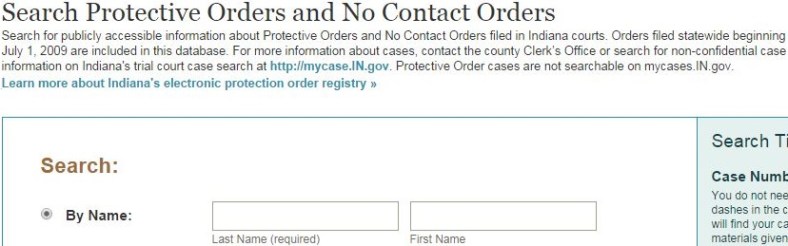
Here, for example, is what Indiana’s registry website looks like:

Every Indianan who’s been issued a “protective order” or “no contact order” since July 1, 2009 is recorded in this registry, including the ones whose cases were dismissed, that is, even those found “innocent” of the allegations against them are “outed” as having been accused of stalking, perhaps, or domestic violence or sexual assault. Browsers’ imaginations are free to take wing.

This search engine is simple to use. A restraining order recipient’s employer, landlord, student, client, patient, neighbor, girl- or boyfriend, etc. can perform a search in seconds—and as the headnote helpfully explains, “more information about cases” can be obtained by contacting the county clerk’s office.

Consider for a moment what the justification for a database like this could be. It doesn’t do anything to “protect” the plaintiffs of restraining orders. Therefore the justification must be to “protect” the public. Implicit then in the existence of such a database is that restraining order defendants are “dangerous.” Recall the basis upon which the determination of “dangerousness” was formed in the first place: a five-minute interview. Appreciate, too, that a restraining order recipient registered in a database like this may have been condemned for text messaging someone who resented the contact. And, as should go without saying, s/he may have been condemned on completely false allegations.

A process that’s highly prejudiced and answerable to no oversight is also highly punitive. Restraining order defendants are implicated according to kangaroo procedures whose rulings their noses are then rubbed in everlastingly.

Defendants often have mere days to respond to restraining orders, which can make procuring an attorney’s aid impossible even if defendants grasp the need for representation and can afford to shell out a few thousand at the drop of a hat. Appeals hearings, moreover, may be 30 minutes or less in duration (and only half that time is afforded to defendants’ testimony).

The process is a lock, but rulings are represented as the products of diligence and deliberation—and the public takes those rulings seriously, rulings that Indiana legitimates and publishes in a conveniently accessible database.

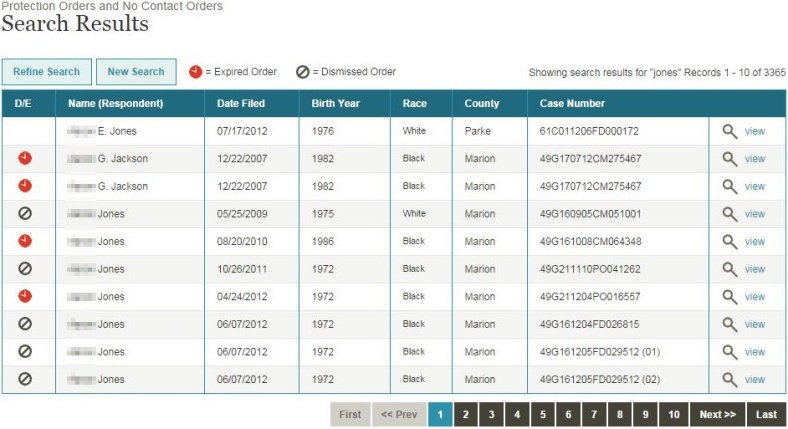
Here’s what returns look like if you simply enter the last name Jones into Indiana’s registry search engine:

Only half of the orders on the first page this search pulled up were actually finalized. The other half were tossed—after previously having been approved. The judicial error rate reflected in this random sampling is 50%. This statistic’s economic ($) implications are disgraceful by themselves. If you further allow that some of the restraining orders that were upheld were cases of false allegations’ succeeding, then judicial error is the norm.

A few months ago, a friend joked to me that her daughter (a smart cookie) had researched her teachers’ criminal records to use as leverage in the event of a grade crisis.

Arizona, blessedly, doesn’t yet have a nifty resource like Indiana’s for teenaged blackmailers to mine.

Copyright © 2014 RestrainingOrderAbuse.com

“Fag,” “Stalker,” “Sicko,” “Brute,” “Creep”: On Labeling and the Psychic Effects of Public Revilement in and out of Court

One of my favorite puzzles when I was a boy directed the solver to figure out what was different between almost identical pictures. I think it appeared in Highlights for Children. I have a collection of Highlights someplace, because I meant to write for kids and used to study and practice children’s writing daily, but I haven’t looked at them in years.

I’m reminded of this, because, as you might have discerned, one among the epithets in this post’s title is distinct from the others: fag.

When I was growing up, I knew a very simple boy who was singled out at an early age—nine or thereabouts—and routinely ridiculed by the “cool” boys at school. Some girls occasionally joined in, too, albeit half-heartedly, to curry favor with boys they wanted to like them. “Fag!” or “Faggot!” was a favored insult among schoolboys. No other had anything close to its heft as a term of contempt to pierce a man-child to the bone.

The boy I’m recalling happened to be Polish, and Polack was a competing term of derision that might have conveniently been used to hurt him. It didn’t rouse nearly as much pack frenzy, though. His name started with F, besides, so its pairing with fag was poetic kismet. “Fag!” followed this boy from grade to grade like a toxic echo. It was how he was greeted, and he would sometimes mince, affect limp wrists, and swipe at the other boys, because it amused them and won him attention and the closest thing to membership he could hope for.

The boy wasn’t gay; he was just easy meat to sate the bloodlust of cruel kids.

The last time I saw him was when I was a young adult. He was panhandling outside of a drugstore for diaper money. He’d apparently gotten a girl pregnant right out of high school to prove his virility. The abuses to which he’d been relentlessly subjected determined the arc of his life.

I relate this story in the context of restraining order abuse to highlight the grave effects of public humiliation and revilement. Labeling of this sort isn’t just tormenting and alienating but destructive. It corrupts the mind, silently and sinuously. It confounds ambitions, erodes trust, and hobbles lives.

Victims of false allegations made on restraining orders may be labeled “stalker,” “batterer,” “sicko,” “sexual harasser,” “child-abuser,” “whore,” or even “rapist”—publicly and permanently—by accusers whose sole motive is to brutalize. And agents of these victims’ own government(s) arbitrarily authorize this bullying and may baselessly and basely participate in it, compounding the injury exponentially.

I’ve been contacted by people who’ve either been explicitly or implicitly branded with one or several of these labels. Falsely and maliciously. I’ve been branded with more than one myself, and these epithets have been repeatedly used with and among people I don’t even know. For many years. Even at one of my former places of work. And there’s f* all I can do about it, legally.

Labels like these, even when perceived as false by judges, aren’t scrupulously scrubbed away. Resisting them, furthermore, simply invites the application of more of the same. Judges’ turning a blind eye to them, what’s more than that, authorizes their continuously being used with impunity, as the boys in the story I shared used the word fag. Victims of false allegations report being in therapy, being on meds for psychological disturbances like depression and insomnia, leaving or losing jobs—sometimes serially—and entertaining homicidal thoughts and even acting on suicidal ones.

No standard of proof is applied to labels scribbled or check-marked on restraining orders, which to malicious accusers are the documentary equivalents of toilet stalls begging for graffiti.

That the courts may only enable bullying, taunting, and humiliation is no defense, nor is “policy.” Adding muscle to malice is hardly blameless. Anyone occupying a position of public trust who abets this kind of brutality, actively or passively, knowingly or carelessly, should be removed, whether a judge, a police officer, or other government official, agent, or employee.

This hateful misconduct is bad enough when it originates on the playground.

Copyright © 2014 RestrainingOrderAbuse.com

Restraining Order Administration and Money, Money, Money, Money, Money

“The restraining order law is perhaps the second most unconstitutional abomination in our legal system, after our so-called child protection (DSS) laws. The restraining order process is designed to allow an order to be issued very easily, and to be appealed, stopped, or vacated only with the utmost difficulty….

“The motives for this law are legion. First, it makes the Commonwealth a bunch of money by allowing it to leverage massive Federal grants. It makes feminist victim groups a lot of money by providing millions in state and federal grants to stop ‘domestic violence.’ It makes lawyers and court personnel a lot money as they administer the Godzilla-sized system they have built to deal with these orders. It makes police a lot of money, as they are able to leverage huge grants for arrests of violators. It makes mental health professionals a lot of money dealing with the mandatory therapy always required in these situations. It makes thousands of social workers a lot of money providing social services for all the families that the law destroys. It makes dozens of men’s batterers programs a lot of money providing anger management treatment ordered by courts in these proceedings.”

Attorney Gregory Hession

The aggregation of money is not only the dirty little secret behind the perpetuation of constitutionally insupportable restraining order laws that are a firmly rooted institution in this country and in many others across the globe; money is also what ensures that very few mainstream public figures ever voice dissenting views on the legitimacy and justice of restraining orders.

Lawyers and judges I’ve talked to readily own their disenchantment with restraining order policy and don’t hesitate to acknowledge its malodor. It’s very rare, though, to find a quotation in print from an officer of the court that says as much. Job security is as important to them as it is to the next guy, and restraining orders are a political hot potato, because the feminist lobby is a powerful one and one that’s not distinguished for its temperateness or receptiveness to compromise or criticism.

I’m not employed as an investigative journalist. I’m a would-be kids’ humorist who earns his crust as a manual laborer and sometime editor of student essays and flier copy. My available research tools are a beater laptop and Google.

What a casual search engine query returned to me in terms of numbers and government rhetoric that substantiate the arguments made in this post’s epigraph is this (emphases in the excerpts below are added):

Grants to Encourage Arrest Policies and Enforcement of Protection Orders Program

Number: 16.590
Agency: Department of Justice
Office: Violence Against Women Office

Program Information

Authorization:

Violence Against Women and Department of Justice Reauthorization Act of 2005, Title I, Section 102, Public Law 109-162; Violence Against Women Act of 2000, Public Law 106-386; Violent Crime Control and Law Enforcement Act of 1994, 42 U.S.C. 3796hh, as amended.

Objectives:

To encourage States, Indian tribal governments, State and local courts (including juvenile courts), tribal courts, and units of local government to treat domestic violence, dating violence, sexual assault, and stalking as serious violations of criminal law.

Types of Assistance:

PROJECT GRANTS

Uses and Use Restrictions:

Grants may be used for the following statutory program purposes: (1) To implement proarrest programs and policies in police departments, including policies for protection order violations. (2) To develop policies, educational programs, protection order registries, and training in police departments to improve tracking of cases involving domestic violence, dating violence, sexual assault, and stalking. Policies, educational programs, protection order registries, and training described in this paragraph shall incorporate confidentiality, and privacy protections for victims of domestic violence, dating violence, sexual assault, and stalking. (3) To centralize and coordinate police enforcement, prosecution, or judicial responsibility for domestic violence, dating violence, sexual assault, and stalking cases in teams or units of police officers, prosecutors, parole and probation officers, or judges. (4) To coordinate computer tracking systems to ensure communication between police, prosecutors, parole and probation officers, and both criminal and family courts. (5) To strengthen legal advocacy service programs for victims of domestic violence, dating violence, sexual assault, and stalking, including strengthening assistance to such victims in immigration matters. (6) To educate judges in criminal and civil courts (including juvenile courts) about domestic violence, dating violence, sexual assault, and stalking and to improve judicial handling of such cases. (7) To provide technical assistance and computer and other equipment to police departments, prosecutors, courts, and tribal jurisdictions to facilitate the widespread enforcement of protection orders, including interstate enforcement, enforcement between States and tribal jurisdictions, and enforcement between tribal jurisdictions. (8) To develop or strengthen policies and training for police, prosecutors, and the judiciary in recognizing, investigating, and prosecuting instances of domestic violence and sexual assault against older individuals (as defined in section 3002 of this title) and individuals with disabilities (as defined in section 12102(2) of this title). (9) To develop State, tribal, territorial, or local policies, procedures, and protocols for preventing dual arrests and prosecutions in cases of domestic violence, dating violence, sexual assault, and stalking, and to develop effective methods for identifying the pattern and history of abuse that indicates which party is the actual perpetrator of abuse. (10) To plan, develop and establish comprehensive victim service and support centers, such as family justice centers, designed to bring together victim advocates from non-profit, non-governmental victim services organizations, law enforcement officers, prosecutors, probation officers, governmental victim assistants, forensic medical professionals, civil legal attorneys, chaplains, legal advocates, representatives from community-based organizations and other relevant public or private agencies or organizations into one centralized location, in order to improve safety, access to services, and confidentiality for victims and families. Although funds may be used to support the colocation of project partners under this paragraph, funds may not support construction or major renovation expenses or activities that fall outside of the scope of the other statutory purpose areas. (11) To develop and implement policies and training for police, prosecutors, probation and parole officers, and the judiciary in recognizing, investigating, and prosecuting instances of sexual assault, with an emphasis on recognizing the threat to the community for repeat crime perpetration by such individuals. (12) To develop, enhance, and maintain protection order registries. (13) To develop human immunodeficiency virus (HIV) testing programs for sexual assault perpetrators and notification and counseling protocols.

Applicant Eligibility:

Grants are available to States, Indian tribal governments, units of local government, and State, tribal, territorial, and local courts.

Beneficiary Eligibility:

Beneficiaries include criminal and tribal justice practitioners, domestic violence, dating violence, sexual assault and stalking victim advocates, and other service providers who respond to victims of domestic violence, dating violence, sexual assault, and stalking.

Credentials/Documentation:

According to 42 U.S.C. § 3796hh(c), to be eligible to receive funding through this Program, applicants must:
(1) certify that their laws or official policies
(A) encourage or mandate arrests of domestic violence offenders based on probable cause that an offense has been committed; and
(B) encourage or mandate arrest of domestic violence offenders who violate the terms of a valid and outstanding protection order;
(2) demonstrate that their laws, policies, or practices and their training programs
discourage dual arrests of offender and victim;
(3) certify that their laws, policies, or practices prohibit issuance of mutual restraining orders of protection except in cases where both spouses file a claim and the court makes detailed findings of fact indicating that both spouses acted primarily as aggressors and that neither spouse acted primarily in self-defense; and
(4) certify that their laws, policies, and practices do not require, in connection with the prosecution of any misdemeanor or felony domestic violence offense, or in connection with the filing, issuance, registration, or service of a protection order, or a petition for a protection order, to protect a victim of sexual assault, domestic violence, or stalking, that the victim bear the costs associated with the filing of criminal charges against the offender, or the costs associated with the filing, issuance, registration, or service of a warrant, protection order, petition for a protection order, or witness subpoena, whether issued inside or outside the State, Tribal or local jurisdiction; and
(5) certify that their laws, policies, or practices ensure that
(A) no law enforcement officer, prosecuting officer or other government official shall ask or require an adult, youth, or child victim of a sex offense as defined under Federal, Tribal, State, Territorial, or local law to submit to a polygraph examination or other truth telling device as a condition for proceeding with the investigation of such an offense; and
(B) the refusal of a victim to submit to an examination described in subparagraph (A) shall not prevent the investigation of the offense.

Range and Average of Financial Assistance:

Range: $176,735–$1,167,713
Average: $571,816.

That’s a pretty fair lump of dough, and what it’s for—among other things as you’ll notice if you read between the lines—is to “educate” our police officers and judges about what their priorities should be.

Note that eligibility requirements for receiving grants through this program include (1) the prohibition of counter-injunctions, that is, restraining orders counter-filed by people who have had restraining orders issued against them; (2) the issuance of restraining orders at no cost to their applicants; and (3) the acceptance of plaintiffs’ allegations on faith. Note, also, that one of the objectives of this program is to promote the establishment of registries that make the names of restraining order recipients conveniently available to the general public.

The legitimacy of these grants (“grants” having a more benevolent resonance to it than “inducements”) goes largely uncontested, because who’s going to say they’re “for” crimes against women and children?

The rhetorical design of all things related to the administration of restraining orders and the laws that authorize them is ingenious and, on its surface, unimpeachable.

By everyone, that is, except the victims of a process that is as manifestly and multifariously crooked as a papier-mâché flagpole.

Paying authorities and the judiciary to assume a preferential disposition toward restraining order applicants completely undermines the principles of impartiality and fair and equal treatment that our system of laws was established upon.

It isn’t cash this process needs. It’s change.

Copyright © 2013 RestrainingOrderAbuse.com