False Accusations and Murder: More Headlines about the Effects of Finger-Pointing and Legal Abuse

“[W]hy would someone lie about being sexually assaulted? What could be gained from that? Nothing, really.”

Tracie Egan Morrissey, Jezebel (Feb. 28, 2014)

The quotation above derives from a piece titled, “Rape, Lies and the Internet: The Story of Conor Oberst and His Accuser.” It’s spotlighted because it echoes the sentiment expressed by the writer of the prior post’s epigraph, who’s also a feminist and who betrays the same blindness.

What’s disturbing to the author of the blog you’re reading is that feminists who ask questions like Ms. Morrissey’s make a strong case for rape denial, because it might just as unreasonably be asked, “Why would someone sexually assault anyone? What could be gained from that?”

What could be “gained” from raping someone is the same thing that could be “gained” from lying about being raped—or lying about any number of other offenses: the exultation of control (i.e., power, dominance).

Other reasons for lying suggested by Ms. Morrisey’s own reportage are attention-seeking, self-aggrandizement, and mythomania. There have also been a number of publicized cases about false rape accusations’ being used for concealment of sexual infidelity. Two hyperlinks in this post lead to stories exemplifying this motive. Of course (and significantly), none of these motives applies exclusively to false rape claims. Besides avarice and malice, they’re common motives among false accusers (of all types). People hurt people…to hurt people. Appetites, least of all vicious ones, don’t answer to sense.

The previous post emphasized the emotional trauma of accusation, particularly false accusation, by highlighting a number of suicides reported in the news.

Suicide is a recognized consequence of bullying; name-calling and public humiliation are recognized as among the forms that bullying takes; and falsely branding someone a stalker, rapist, child abuser, or killer, for example, certainly qualifies as publicly humiliating name-calling.

Whether someone is disparaged on the playground, on Facebook, in a courtroom, or in the headlines makes absolutely no difference; the effect is the same, and it may be unbearable.

This stuff shouldn’t need to be pointed out to grown-ups. But since the fatal consequences of false accusation don’t support any dominant political agendas—and may undermine them—they’re ignored. That people are harried and hectored by lies, sometimes to death, is an inconvenient truth.

At least it is here. Many of the news clippings featured in the last post notably originate from the U.K., as do two of the clippings below. Journalism is far more balanced there, and it’s less taboo to call a jade a jade. A Jezebel reporter might denounce this as “misogynistic,”  but truth isn’t misogynistic; it’s just the truth, and it doesn’t play favorites (nor should its purveyors).

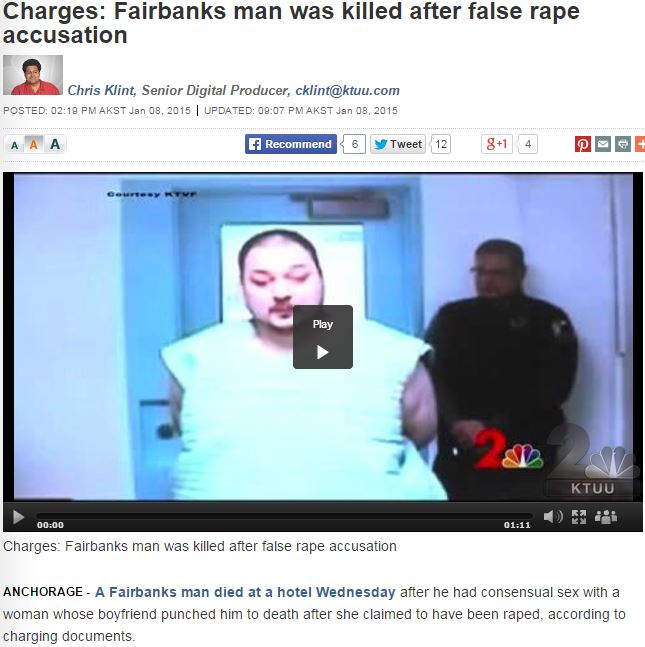
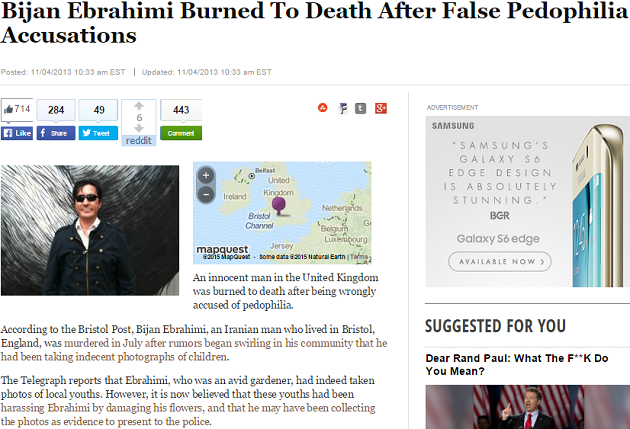
This post looks at the other lethal upshot of false accusation: murder. The stories that follow are about people who existed and now do not.

The point of introducing these stories isn’t to assert incidents like these are common; the point is to reveal the emotions that are inspired by false accusations, whether by women, by men, or by mobs. It’s also to reveal their consequences…writ large and lurid. These same emotions are aroused in cops and judges no less than they are in anyone else. False accusers know what reactions they can expect, and they know how to manipulate their audience—and bending others to do their will is thrilling.

Nothing makes the emotions provoked by accusation more manifest than when accusation inspires others to beat someone to death—or set him ablaze.

This is nevertheless typically lost on reporters and their viewers and readers. The details that are stressed and eagerly sought are who got it, and how. Why, which is always the more speculative aspect, is in its broader implications the most important one, however.

Gore is sexy. It’s what gets airplay and column space. It’s an attention-grabber and a ratings booster. Nothing draws the eye like the color red.

What sensation eclipses, though, is that for every false accusation that ends in red, thousands or hundreds of thousands end in gray, an interminable state of disquiet, disease, and dolor.

Copyright © 2015 RestrainingOrderAbuse.com

*Jezebel, if I’m remembering my Bible stories right, was a mass murderer who was condemned for promoting a false dogma. (Among her victims was a man she had judicially executed.)
Feminism and False Accusation Culture

“The idea that—as pandering anti-feminist goon Christina Hoff Sommers asserted over the weekend—university campuses have a ‘false accusation culture’ is as ludicrous as the idea that Sommers herself is a feminist. Not only do we not have a ‘false accusation culture’ anywhere on earth, we don’t have an accusation culture at all. Most victims never say a word. The price is too high. And, if their joy at the outing, harassment and supposed ‘discrediting’ of Jackie is any indication, Sommers and her cohort would like to keep it that way.”

Lindy West, The Guardian (Dec. 9, 2014)

Alongside the headline of Lindy West’s op-ed, “Rolling Stone threw a rape victim to the misogynist horde,” is a tag that reads, “Comment is free.” It’s a fitting commentary on Ms. West’s commentary, which is cheaper than just cheap.

Not only is false accusation culture real; it extends beyond the quad.

Ms. West’s piece centers on the “Jackie story,” a Rolling Stone “exposé” that ran a couple of months ago about a purported gang rape at the University of Virginia whose details have since proved unreliable.

According to Ms. West, “The result was swift, frightening and predictable [italics added]. Jackie became an anti-feminist rallying point—incontrovertible ‘proof’ that women maliciously (or recreationally, even) lie about rape to ruin men’s lives, and that ‘rape culture’ is nothing but hysterical feminist propaganda.”

Ms. West’s diagnosis is itself hysterical feminist propaganda that’s swift and predictable…and shopworn. Writers like her incite rhetorical food fights. They tweak and pique, and this excites a flood of comments, some of them earnest, some of them dismissive or disgusted, and all of them leading to nothing.

This is a constructive formula: thesis + antithesis = synthesis. There is no synthesis, though. Provocateurs like Ms. West never relent and are only egged on by criticism, even if it’s coolly reasoned. They’re looking for conflict, not a conversation. Their arguments are purposefully outrageous to ignite attention, a motive that not coincidentally underlies many false accusations, especially ones made by women.

The quotation from Ms. West at the top of this post is stressed because it exemplifies the flatfooted feminist m.o.: nonsensical but snarky.

Ignoring the slight to Dr. Sommers, whose discernment Windy Lindy’s doesn’t hold a candle to, here’s a quickie analysis of Ms. West’s assertion that there’s no “‘false accusation culture’ anywhere on earth” (an assertion that only merits a quickie analysis):

  1. Ms. West says there’s no “false accusation culture.”
  2. The proof, she says, is there’s no “accusation culture.”
  3. The evidence of this is that “most victims never say a word” (i.e., most victims never make accusations).

The only victims of a false accusation culture are the falsely accused; false accusers aren’t victims. A false accusation culture doesn’t require that actual victims of abuse ever report anything. Therefore whether actual victims “never say a word” is completely irrelevant to the existence of a false accusation culture. Feminists are encouraged to read this paragraph again and to look up words they may misunderstand, such as false.

There is a false accusation culture, and feminists like Ms. West are the reason why. They’ve made it attractive and rewarding (even ennobling) for people to style themselves “victims.” They’re also, consequently, the authors of what they label “rape denial.”

The culture of false accusation they’ve inspired is why there are so-called rape deniers. Sure, there may actually be people who deny “rape!” is ever rape, but it’s a fair deduction that most resistance to feminist social indictment that’s called “rape denial” is really a manifestation of resentment toward what feminist rhetoric has wrought. Men who’ve wrongly been treated like brutes and sex offenders over the decades since the enactment of the Violence Against Women Act (VAWA), which ensures all men are regarded by the system prejudicially, are pained animals. (Appreciate that while prosecuting rape may be rare and difficult in criminal court, implicating someone as a violent offender in civil court, including falsely, is cake.) What do pained animals do? They snarl and claw at what hurt them (and whatever they associate with it).

Feminists provoke animosity—which rightly or wrongly may be directed toward all women—and then they denounce that animosity as misogyny…which provokes more animosity…which is denounced as misogyny (and on and on). “Rape deniers” may simply be people who’ve been conditioned to distrust accusations of violence from women and to hate feminists.

Unconscious of this, along comes someone like Megan Carpentier, who writes in the same commentary section of The Guardian as Ms. West, “I’m a victim of sexual assault and the law failed. How many of us must speak out for you to believe?” She describes a harrowing experience, to which response is mostly sympathetic, and responses that are guarded don’t challenge the accuracy of her account; they reasonably point out that “these constant calls for automatic belief of accusers signal a desire to move away from the presumption of innocence.” This challenge is what’s commonly represented as “rape denial,” and it’s the challenge of minds jaded by a culture that tolerates and rewards—and thus encourages—false accusations.

Ms. Carpentier says that “of every 100 sexual assaults in the United States, only 40 are reported to the police, only 10 result in arrests, only eight get prosecuted and only four result in a felony conviction,” not appreciating that this can only touch as it should the person (particularly the man) who has never been falsely implicated or known someone who was. Snipes like this one, besides, don’t win over any fence-sitters: “Too many women who are sexually assaulted are not considered sexual assault victims in the eyes of the law—and in the words of more than a few bloviating bystanders.”

The irony of her statement is that feminists are the original “bloviating bystanders,” and it’s their call for selective accountability instead of universal accountability that has aroused skepticism toward allegations of violence against women, including sexual violence.

Feminists blame reactions they themselves have provoked by fostering a climate of false accusation.

Copyright © 2015 RestrainingOrderAbuse.com

Scapegoating: All Violence against Women, Including Rape, IS Punished—It’s Just Not the Guilty Who Necessarily Bear the Blame

Many of the posts published here in 2014 concern how we talk about violence against women.

Criticism of anti-violence rhetoric and policies is sternly denounced or dismissed, including by mainstream, populist writers. Toeing the line of political correctness, they call such criticism “denialist.” To criticize anti-rape zealotry, for instance, is said to mean a critic is a “rape denier.”

This is what the late William F. Buckley called rebuttal by epithet.

Name-calling isn’t an argument. But it’s easier than thinking—and when it identifies you with the in-crowd, it’s congenial, besides. Using epithets like “rape denier” is PC; it makes you one of the team.

The fact is the people who are said to “deny” rape are often the people who bear the blame for all of the rapists and domestic tyrants who never receive the punishment they’re due, and never will.

I had a brief but enlightening conversation years ago with a detective in my local county attorney’s office. I called to report perjury (lying to the court) by a restraining order petitioner. He sympathized but said his office was too preoccupied with prosecuting more pressing felonies, like murder, to investigate allegations of perjury.

His evasion wasn’t the enlightening part.

The enlightening part was this: He opined that the reason why judges so eagerly gibbet restraining order defendants is that they’re straw targets. They’re available scapegoats.

Realize that judges have been told for decades that physical and sexual violence against women is “epidemic,” and the alert status has never been downgraded from red. Judges, furthermore, are hardly insensitive to the expectation placed upon the justice system to arrest violence against women—or to statistics that say a majority of rapes are never reported, let alone punished.

Judges can’t act independently of allegations; they can only exercise wrath upon those who are implicated as abusers…and they do. Physical and sexual violence that’s said to go unpunished is punished—by proxy.

Proving rape in a criminal proceeding is exceedingly hard. There are seldom witnesses, and evidence can be highly uncertain, besides being ephemeral. Because rape is a serious crime punishable by a lengthy prison sentence, the evidentiary bar is high, so rulings can predictably disappoint. Rapists, even when they are reported, may escape justice.

Those accused in civil court, though, are fish in a barrel. Judges are authorized to decide restraining order cases according to personal whim. There’s no “proof beyond a reasonable doubt” criterion to satisfy, and they know they have the green light to rule however they want.

How they’re predisposed to rule shouldn’t be a mystery.

Restraining order defendants aren’t exclusively male, but most of them are of the demonized sex. Courts, what’s more, proceed by precedent, and judges act habitually. So female restraining order defendants face judicial vigilantism by association. Restraining order recipients are trussed targets, and they bear the brunt of society’s lust for vengeance, because they can be made to.

Criticism here and elsewhere of how we talk about rape and domestic violence doesn’t deny that they occur. It urges, rather, that the influence of rhetoric be recognized and that its fervor be tempered. Violent rhetoric, no less than physical violence, destroys lives.

The person who believes otherwise is the one in denial.

Copyright © 2014 RestrainingOrderAbuse.com