
“[Tina] Renton still has nightmares about her time in the witness box. ‘During the day I can cope with it. In my sleep…. You can’t control your subconscious.’ She dreams of ‘running and never being able to find anyone able to help you’ and of ‘standing in court, people laughing at you, but you don’t know why.’”
—Amelia Gentleman, the Guardian (April 13, 2013)
Above are the words of a woman who was the prosecuting witness in the rape trial of her stepfather.
Below are the words of a man who was repeatedly accused by a prosecuting witness (his estranged wife and the mother of his children):
I couldn’t flee and I could not fight. I was never going to be allowed to heal or recover. I wish I were better at articulating the psychological and emotional trauma I experienced.
I could fill a book with all the lies and mysterious rulings of the Court. Never have I experienced this kind of pain. I asked for help, but good men did nothing and evil prevailed.
Correspondences between the man’s and woman’s statements are obvious, as are contrasts between the man’s and woman’s treatment under the law.
The woman prevailed in criminal court. She also authored a book. The man was hectored in family court until he killed himself, and his wife obtained a court order granting her the intellectual property rights to his final words, which she attempted to expunge from every nook and cranny of the Internet.
Tina Renton, quoted in the epigraph, accused her stepfather of “raping and assaulting her multiple times during her childhood,” and a jury found him guilty. The trauma Ms. Renton describes, however, isn’t the residue of being physically violated by a parental figure years before; it’s the aftereffect of being psychologically violated in court.
She defended herself and was taunted and denounced as a liar.
“It is hard being accused of being a liar,” she says. “I would never have put myself through the trauma of a court case if it wasn’t true.”
Her stepfather was sentenced to 14 years. Still Ms. Renton reports having nightmares about her experiences in court, and certainly no feminist is going to contradict her claim of trauma.
Why, then, are feminists the most adamant critics of those who allege they’ve been falsely vilified or persecuted in civil and family court (where there is no standard of proof)? Is it reasonable to argue that being falsely called a “liar” is more traumatic than being falsely called a “stalker,” “wife batterer,” “child abuser,” or worse? If feminists understand the trauma described by Tina Renton and sympathize with it, why are they the most unyielding obstacle to reform of restraining order and domestic violence laws that make false accusation easy and rewarding? Ms. Renton, a woman, very plausibly says she was caused lasting injury by being falsely accused of lying. Yet some feminists assert that a man’s being falsely accused of rape is insignificant. How is this not only hypocritical but heinous?

When it’s asserted that rape victims face “being raped all over again” in court, what’s meant is that they face being lied about, misrepresented, defamed, badgered, and shamed. They face, in sum, being falsely accused.
This is compared to being raped.
It must be appreciated that those falsely accused in civil or family court (women among them) are traumatized by exactly the same treatment (including by their judges), and many of them may also have been abused by their accusers, including violently. Moreover, the abuse they receive in and from the court may be aggravated (exorbitantly) by having their children taken from them, being cast out of their homes, and/or being forced to pay their false accusers’ living expenses.
Feminists seem to have no difficulty imagining the psychic scars caused to rape victims by being denounced and disparaged in criminal court.
For feminists to identify with complainants of false accusation in civil and family court, then, they need only imagine what it would feel like for those rape victims to be forced to surrender all they value to their abusers and pay them for the privilege of being lied about and publicly humiliated.
Copyright © 2015 RestrainingOrderAbuse.com
*The quoted Guardian story includes a case of a woman who prevailed in court but nevertheless committed suicide. “Her son, Oliver, told a newspaper how profoundly the cross-examination had affected her.”
 Her statement owns that “false reports [of rape] do really exist.” It also owns that they’re “incredibly damaging.” But it completely discounts the damage to the people falsely accused by those reports.






 Presuming to deny others’ pain, furthermore, because you believe you can quantify it or “imagine” what it “should” be like—that’s stepping way over the line.
 I do know what it is to be falsely accused, and the sources of pain are the same, only the suspicion and reproach aren’t an “expectation.” When you’re the target of damning fingers, suspicion and reproach inevitably ensue; they’re a given.


 Many of the posts published here in 2014 concern how we talk about violence against women.
 I had a brief but enlightening conversation years ago with a detective in my local county attorney’s office. I called to report
  Those accused in civil court, though, are fish in a barrel. Judges are authorized to decide restraining order cases according to personal whim. There’s no “proof beyond a reasonable doubt” criterion to satisfy, and they know they have the green light to rule however they want.
 What people should find disturbing about these stories is how feminine false accusers think about lying, including lying about physical and sexual violence (or their threat). They think it’s no big deal—or they don’t think about it at all.
 Feminine and feminist psychology are due more scrutiny than they receive. I can’t count the number of times I’ve read even sympathetic reporters of false allegations say they recognize that the more urgent problem is (sexual) violence against women—a sentiment that, intentionally or not, motivates false allegations. False accusers aren’t just aided and abetted by this pronouncement of priority; they’re encouraged by it.
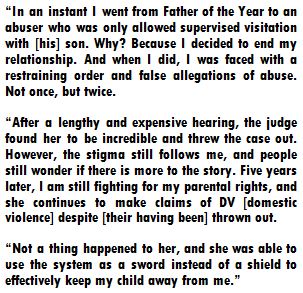
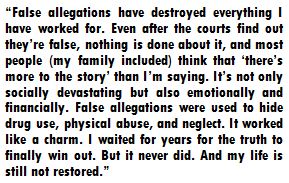
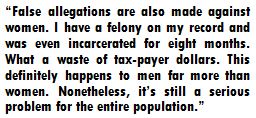
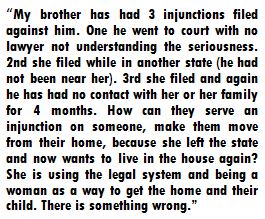
 Rape and domestic violence happen. There’s no question about it. There’s likewise no question that their effects may be damaging beyond either qualification or quantification.
 A significant number, if not the majority, of respondents to this blog who report being the victims of false allegations on restraining orders—particularly the ones who detail their stories at length—are women. This doesn’t mean that women, who represent less than 20% of restraining order defendants, are more commonly the victims of false allegations. It’s indicative, rather, of women’s disposition to socially connect and express their pain, indignity, and outrage. (Women, furthermore, aren’t perceived as dangerous and deviant, so they feel less insecure about publicly declaiming their innocence; they have the greater expectation of being believed and receiving sympathy.)

 Ignore that and consider what judge, in the “bad old days” before restraining orders existed, would have allowed a woman to be publicly labeled a rapist, merely by implication.
 In fact, what it and any number of others’ ordeals show is that when you offer people an easy means to excite drama and conflict, they’ll exploit it.


 I hear weekly if not daily from victims of second-wave feminist rhetoric and the influence it’s exercised over the past 30 years on social perceptions that translate to public policy. Today most Americans assume that the instrument born of 60s and 70s consciousness-raising efforts by equity feminists, the civil restraining order, is rarely abused. This falsehood is promulgated through the unconsciousness-raising efforts of radical feminist usurpers who’ve left proto-feminists like philosopher Christina Hoff Sommers asking,
  The Wikipedia entry I’ve cited explains rape culture includes behaviors like “victim-blaming” and “trivializing rape.” Considering that a significant proportion of restraining order abuses may be instances of victim-blaming, that is, of abusers’ (including violent abusers’) inducing the state to harass, humiliate, and drop the hammer on their victims; and considering that this abuse (characterized by some as “rape”) is arguably trivialized by its being categorically ignored or denied, a case arises for the reverse application of the phrase rape culture.
 Restraining orders are unparalleled tools for discrediting, intimidating, and silencing those they’ve been petitioned against. It’s presumed that those people (their defendants) are menaces of one sort or another. Why else would they be accused?
 Memorable stories of restraining orders’ being used to conceal (or indulge) indiscretions or infidelities that have been shared with me since I began this blog over two years ago include a woman’s being accused of domestic violence by a former boyfriend she briefly renewed a (Platonic) friendship with who had a viciously jealous wife who put him up to it; a man’s being charged with domestic violence after catching his wife texting her lover and wrestling with her for possession of the phone for an hour (he was forced to abandon his house so his rival could move in); and a young , female attorney’s being seduced by an older, married colleague who never told her he was married and subsequently petitioned an emergency restraining order against her, both to shut her up and to minimize her opportunity to prepare a defense. I’ve even been apprised of people’s (women’s) having restraining orders petitioned against them by spouses (women) who resented being informed of their mates’ sleeping around.
 I had an exceptional encounter with an exceptional woman this week who was raped as a child (by a child) and later violently raped as a young adult, and whose assailants were never held accountable for their actions. It’s her firm conviction—and one supported by her own experiences and those of women she’s counseled—that allegations of rape and violence in criminal court can too easily be dismissed when, for example, a woman has voluntarily entered a man’s living quarters and an expectation of consent to intercourse has been aroused.
 Lapses by the courts have piqued the outrage of victims of both genders against the opposite gender, because most victims of rape are female, and most victims of false allegations are male.
 As many people who’ve responded to this blog have been, this woman was used and abused then publicly condemned and humiliated to compound the torment. She’s shelled out thousands in legal fees, lost a job, is in therapy to try to maintain her sanity, and is due back in court next week. And she has three kids who depend on her.
 TALKING BACK to restraining orders