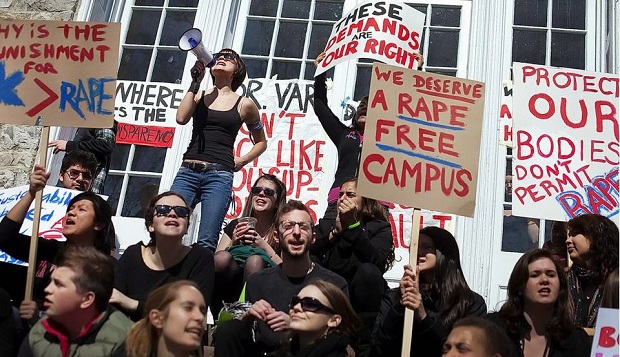
Rape is a crime that has become a totem for many. Its invocation impoverishes all other violations of significance and accordingly authorizes violations that would not otherwise be tolerated, like lying about abuse to authorities and the courts. That rape occurs and that it’s an ineffably vicious act aren’t questions but facts. They are urgent facts, but their denial of other urgent facts is wrong. Those who zealously defend the criminal primacy of violence against women, to the exclusion of all other considerations, eagerly discover callousness in any who question the consequences of unchecked violence rhetoric, and the selfsame “advocates of sensitivity” dictate how victims of false accusation are “allowed” to feel.

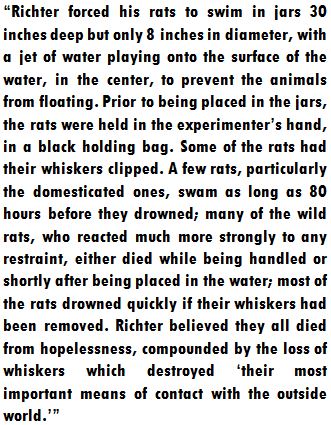
These fish, caught in nets intended to trap shrimp, are called “bycatch.” For every shrimp that’s caught, there are as many as 20 casualties. The unintended victims are not released; they’re left to suffocate and rot (in the interest of economy).
There’s a reflex that’s triggered in a lot of people’s minds when you juxtapose the word rape with the phrase false accusation. The reason is basic.
Violence rhetoric has spawned laws that are like fishing nets: They snare anything that blunders into them, whether it’s what they were meant to catch or not. The intended and unintended targets of those laws are clubbed and gutted with the same zealous vigor and dispassion, and this conditions people who are railroaded through the system and stripped of everything on false, skewed, or exaggerated grounds to hate.
These people are predominately men, and they know they have decades of rampant violence rhetoric to thank for their loss of home, family, livelihood, and dignity. What’s more, civil complaints of legal abuses garner no attention except ridicule—and that, typically, from feminist quarters, which are also the source of the violence rhetoric that has engendered restraining order, domestic violence, family court, and child protection laws and policies that are billowy, careless, hyper-reactive, and easily exploited by the unscrupulous (and to dire effect).
This spurs aggressive counter-rhetoric, which is conveniently labeled “misogyny” and “rape denial,” particularly by the liberally biased, who accordingly react hysterically if rape and false accusation are compared. If you’re among those who decry “misogyny” and “rape denial,” look up the word etiology.
I’m not a misogynist, a rape-denier, or a liberal; I’m an analyst with no doctrinal loyalties. Rape and false accusation are not dissimilar, and I’ll tell you why.
- Most victims of false accusation, like most rape victims, are known to their attackers, often intimately; so the act of false accusation, like the act of rape, is a particularly treacherous and personal assault.
- Victims of false accusation, like victims of rape, are objectified; they’re denied their personhood and typecast according to a set of representations.
- The false accuser, like the rapist, is guided by the will to dominate and subjugate; his or her motive is control (as is the court’s).
- The falsely accused, like the rape victim, is denied his or her personal agency: S/he’s held down and forced to tolerate what’s inflicted upon him or her under threat of receiving worse.
- The falsely accused, like the rape victim, consequently suffers distrust, insecurity, and the mental trauma (PTSD) that comes of having it confirmed that s/he has no control over his or her circumstances.
- Like rapists, false accusers violate people because they can.
- Finally, like rape victims, the falsely accused enjoy no expectation of justice.
How false accusation and rape differ is that the false accuser uses a proxy terrorist (the awesome power of the state), his or her crime is public (with all the humiliation that implies), its toll may be extravagant (the victim may be left with nothing), and besides enjoying no expectation of justice, the falsely accused enjoys no expectation of recognition or sympathy, either (and may be harried relentlessly and then expunged).
Copyright © 2015 RestrainingOrderAbuse.com
*Yes, false accusation is bloodless (discounting suicides and the rare murder), but so, too, can what we call “rape” be bloodless. If the significant distinction between rape and false accusation is that victims of the former are predominately female and victims of the latter predominately male, then we’re overdue for a reevaluation of what we call “equality” and “equity,” both of which are feminist watchwords.

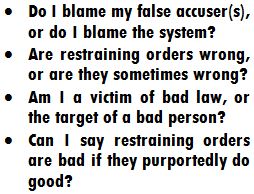 Among people who’ve been damaged by fraudulent abuse of restraining orders and related civil court procedures that are supposed to protect the defenseless, you’ve got, for instance, your liberals who’ll defend the process on principle, because they insist it must be preserved to protect the vulnerable, and they’ll fence-sit just to spite conservatives who flatly denounce the process as a governmental intrusion that undermines family.






 Copyright © 2015 RestrainingOrderAbuse.com
 I corresponded with a man last year, a man in a homosexual relationship, who was assaulted by his partner severely enough to require the ministrations of a surgeon. His boyfriend was issued a restraining order coincident to his being charged with assault. That’s how it typically works in New York: A protection order is issued following a criminal complaint.
 This means, evidently and bizarrely, that there are people dwelling under the same roof as their accusers who may be cited for criminal contempt if an accuser calls and reports them for “harassment” that occurred, for example, in the hallway or the kitchen. The implications, which are fairly stunning, bring to mind the phrase “sleeping with the enemy.” The law invests its
  A woman I’m in correspondence with and have written about was accused of abuse on a petition for a protection order last year by a scheming long-term domestic partner, a man who’d seemingly been thrilled by the prospect of publicly ruining her and having her tossed to the curb with nothing but the clothes on her back. He probably woke up each morning to find his pillow saturated with drool.
 Now her former boyfriend complains that the stir she’s caused by expressing her outrage in public media is affecting his business, and he reportedly wants to obtain a restraining order to shut her up…for exposing his last attempt to get a restraining order…which was based on fraud.
 Presuming to deny others’ pain, furthermore, because you believe you can quantify it or “imagine” what it “should” be like—that’s stepping way over the line.
 I do know what it is to be falsely accused, and the sources of pain are the same, only the suspicion and reproach aren’t an “expectation.” When you’re the target of damning fingers, suspicion and reproach inevitably ensue; they’re a given.





 TALKING BACK to restraining orders