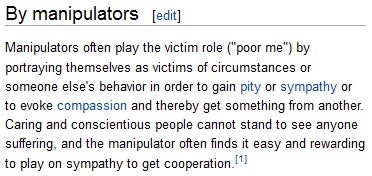
“Victim playing (also known as playing the victim or self-victimization) is the fabrication of victimhood for a variety of reasons such as to justify abuse of others, to manipulate others, a coping strategy, or attention seeking.”
—Wikipedia, “Victim playing”
Once again I’m prompted to note that Wikipedia is all over motives for restraining order abuse but squeamishly avoids confronting the subject directly.
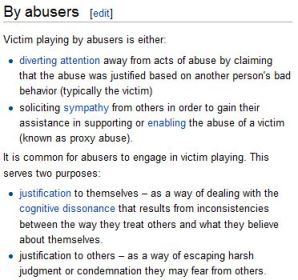 Restraining orders cater to and reward victim-playing like nothing else, because hyped or fabricated allegations made to judges aren’t subject to scrutiny or contradiction by anyone who knows the plaintiff (accuser) or defendant (accused). Procurement of a restraining order authorizes a victim-player (whether a bully, manipulator, or attention-seeker) to concoct any story s/he wants for third parties, including colleagues/coworkers, friends, and family. To the fraudster, it’s a golden ticket.
Allegations made on restraining orders are answerable to no standard of proof, are ruled on in the absence of any controverting evidence or testimony from the accused, and are made at no risk to a victim-player and at no cost beyond a few minutes of his or her time. Because lying to obtain a restraining order is child’s play for an unscrupulous accuser, and because this fact is known only to those who are lied about, a victim-player’s audience is easily convinced of his or her falsehoods, which may be extravagant. Gulled employers, for instance, may be induced to institute special security protocols to “protect” a victim-player from his or her victim. S/he doesn’t even have to be a particularly good actor. A restraining order sells itself.
 In “Rethinking ‘Don’t Blame the Victim’: The Psychology of Victimhood,” psychologist Ofer Zur observes, “The victim stance is a powerful one. The victim is always morally right, neither responsible nor accountable, and forever entitled to sympathy.” The appeal, whether to a bully or attention-seeker (or attention-seeking bully), is transparent.
Excellent explications of victim-playing to “justify abuse of others” are presented by psychologist Tara Palmatier in her “Presto, Change-o, DARVO: Deny, Attack, and Reverse Victim and Offender” and “To the Victim Go the Spoils: False Allegations, Men as Default Scapegoats, and Why Some Women Get Away with Murder.”
Vis-à-vis victim-playing as a means of manipulation or as a coping strategy, this diagnosis by Dr. Palmatier is revealing: “People who abuse others maintain their power by keeping the truth of what they do secret. When you speak the truth, they begin to lose power and control. That’s what abusive personality types are after—power and control over you.” Restraining orders are unparalleled as tools for reengineering truth and dominating and silencing resistant victims. In fact, they may be the most effective instruments of coercion and revenge we’ve come up with yet. “Emotional abuse and bullying behaviors,” Dr. Palmatier elucidates, “are typical of those who have Borderline, Narcissistic, and/or Antisocial personality traits,” and victims of restraining order fraud by victim-players are urged to investigate the traits of the personality-disordered for correspondence with their own abusers and clues to their psychological motives.
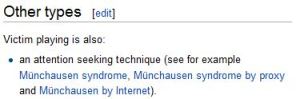 The ambition of this post isn’t to say anything new but to connect a(nother) recognized human behavior to an unrecognized and commonly exploited method of abuse: restraining order fraud. As Dr. Zur observes, there’s an “unspoken, politically correct rule [in our culture] that the role of the victim…is NOT to be explored.” In other words—following the unexamined mantra, “Don’t blame the victim”—we’re not supposed to question “victimhood”; we’re supposed to sympathize and direct opprobrium toward the “offender.” The irony, of course, is that when victimhood is shammed, the actual victim is the mislabeled “offender.” And the unwillingness of society to acknowledge the sham is the agent of the victimization. Lies don’t victimize so much as our eagerness to credit them does. Victims of false allegations are victims of the state, not victims of liars. When restraining orders are abused, victims of that abuse may be stripped of home, children, property, career/livelihood, and (consequently) identity. And the beneficiaries of these losses, which are ones that may never be recovered from, are the victim-players. The “unspoken, politically correct rule” that Dr. Zur remarks not only rewards fraud and rapine; it ensures fraudsters are treated as objects of pity.
Copyright © 2014 RestrainingOrderAbuse.com
 What I discovered was that group-bullying certainly is a recognized social phenomenon among kids, and it’s one that’s given rise to the coinage cyberbullying and been credited with inspiring teen suicide. The clinical term for this conduct is
  TALKING BACK to restraining orders