Schizo: How Judges Think about Restraining Orders

It’s often reported by recipients of restraining orders that the cops and constables who serve them recognize they’re stigmatizing.

Restraining order respondents receive court orders “around the corner” or in parking lots or other spots remote from prying eyes.

At the same time, restraining orders are dispensed by our courts as freely as supermarket circulars. They’re typically issued ex parte, which means judges never even meet the parties they’re issued against. Sometimes respondents never appear in court at all. They remain simply inked names on forms, despite the fact that the allegations made against them, which are matters of public record, may be grave.

Judges issue restraining orders and then wash their hands of them and expect them to just run their courses and evaporate. In accordance with the law, they don’t…ever. They’re permanent public records (in some states accessible by anyone, and in no states accessible by no one). They’re further entered into state and federal law enforcement databases (again, permanently).

Restraining orders cost people employment (and, in cases, employability in their chosen fields). They cost people leases. And they cost people their children, assets, social credibility, and health. These are serious consequences, and restraining orders are of course regarded seriously by anyone who learns of them—except, that is, officers of the court, who may regard them dismissively…after having regarded them as urgent, life-or-death matters.

“Obscure public records” is how some officers of the court think of restraining orders. In the age of the Internet, there are no such things. Many judges are in their 60s and 70s, however, and scarcely know the first thing about the Internet, let alone Twitter, Facebook, and YouTube. They’re still living in the days of mimeographs and microfiche.

The sternness that judges exhibit in the courtroom upon finalizing restraining orders may border on brutal. Irrespective of the allegations against them, all restraining order defendants are treated like villains. Yet though they’re often falsely accused, they’re expected to be unfazed by this treatment. Down the road, what’s more, if defendants seek damages, other judges who revisit their cases may express wonderment at what the big deal is.

“It’s only a restraining order.”

Copyright © 2014 RestrainingOrderAbuse.com

Preserving the Safety of Persecuted Cheerleaders: New Jersey’s Domestic Violence Restraining Orders Revisited

Whatever it is you thought you understood about the solemnity and significance of legal process and restraining orders, this story should disabuse you of it: “Parent-Suing Cheerleader Who Claimed ‘Ex-boyfriend Choked Her during Domestic Violence Incident’ Reaches Agreement to Drop Restraining Orders.”

What follows is the gist.

A high school cheerleader whose dad is a former chief of police had a boyfriend her parents disapproved of. The girl says her parents “threw her out” because of him; her parents say she left because she didn’t want to abide by their rules.

From her parents’ house, the 18-year-old moved into the home of an attorney. The attorney’s family then sued her parents on the girl’s behalf for child support and college costs, exciting press attention.

Then the girl got a domestic violence restraining order against her boyfriend, alleging he choked her during a spat (this is the same boyfriend her parents didn’t want her to see). Then the boyfriend got a domestic violence restraining order against her. Then both of them had their orders dismissed.

The two “independently reached the conclusion that they should enter their college years without having to worry about the possible consequences of having restraining orders on their respective records and that the actions that led to the filing of the complaints did not rise to the level of domestic violence.”

You may be thinking, does that mean judges in New Jersey approve restraining orders automatically? You may also be thinking, how nice everything got ironed out and how magnanimous of the court to acknowledge possible negative consequences to the futures of attractive (and ostensibly affluent) white teenagers and acquiesce to their wishes. Probably you’re not thinking, “I can totally identify.”

The girl dropped her lawsuit, too, reconciled with her parents, and moved back home. Her parents told USA Today “they decided not to interfere with their daughter’s love life anymore.”

The girl “graduated this spring and will be attending Western New England University as a biomedical engineering major in the fall on a $56,000 scholarship.”

No estimate to the tax-paying public of the costs incurred by the various prosecutions was reported.

Copyright © 2014 RestrainingOrderAbuse.com

Larry’s Story: Restraining Order Abuse and the Neighbor from Hell

“She habitually engages in psychological projection. She has caused me to be compelled under threat of arrest and prosecution for failure to appear to attend court on her frivolous lawsuits 25 times. Yes! Twenty-five times. The frivolous prosecutions started in 2011, and they are still raging. I have been cited back to court on her application for a new restraining order on the 12th and a criminal warrant for cyberstalking on the 17th of this month. She has tried so many times to have me jailed I have lost count.”

—Larry Smith, author of BuncyBlawg.com (2014)

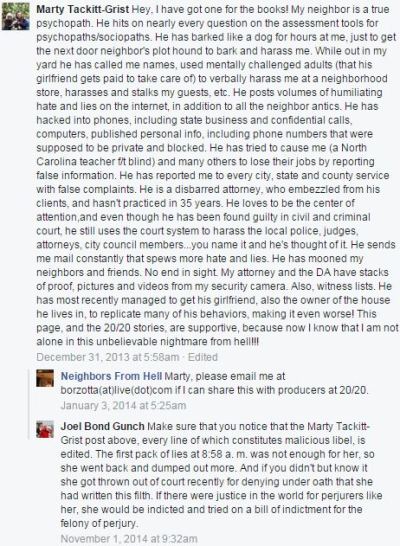
The quotation above is an excerpt from an email sent to the creator of “Neighbors from Hell” on ABC’s 20/20. The Feb. 8 email was a sorely persecuted man’s response to being fingered on Facebook as a candidate for the series by his neighbor, Marty Tackitt-Grist, who has forced him to appear before judges nearly 30 times in the span of a few years to answer “two restraining orders, three show-cause orders, two cyberstalking arrests, and a failure-to-appear arrest and jailing despite faxes from two doctors that I was too crippled, disabled, and suffering from herniated discs to be able to attend court.”

Here’s the reply the email elicited from ABC’s Bob Borzotta: “Hi Larry, I don’t seem to have heard further from her.  Sounds like quite a situation….” Cursory validations like this one are the closest thing to solace that victims of chronic legal abuses can expect.

Concern shown by the police and courts to complaints from attention-seekers can make them feel like celebrities. Random wild accusations are all it takes for the perennial extra in life to realize his or her name in lights.

Not unpredictably, the thrill is addictive.

I think I first heard from Larry, the author of BuncyBlawg.com, in 2013—or maybe it was 2012. In the artificial limbo created by “high-conflict” people like the one he describes in the epigraph, temporal guideposts are few and far between. A target like Larry can find him- or herself living the same day over and over for years, because s/he’s unable to plan, look forward to anything, or even enjoy a moment’s tranquility.

The target of a high-conflict person is perpetually on the defensive, trying to recover his or her former life from the unrelenting grasp of a crank with an extreme (and often pathological) investment in eroding that life for self-aggrandizement and -gratification.

Among Larry’s neighbor’s published allegations are that he’s a disbarred attorney who “embezzled from his clients” and a textbook psychopath, that he has “barked like a dog for hours” to provoke another neighbor’s (imaginary) dog to howl at her, that he has called her names, that he has enlisted “mentally challenged adults” to harass her while shopping, that he has cyberstalked her, that he has “hacked into phones” and computers, that he has tried to cause her (and “many others”) to lose their jobs by “reporting false information,” that he has made false complaints about her “to every city, state, and county service,” that he sends her mail “constantly,” and that he has “mooned” her neighbors and friends.

The ease with which a restraining order is obtained encourages outrageous defamations like these (Larry’s neighbor has sworn out two). Once a high-conflict person sees how readily any fantastical allegation can be put over on the police and courts, s/he’s inspired to unleash his or her imagination. That piece of paper not only licenses lies; it motivates them.

Larry’s a quiet guy with a degenerative spinal disorder who’s been progressively going deaf for 25 years. He lives for his three toy poodles and watches birds. “I grew up,” he says, “in a little Arcadian valley here in western North Carolina with the nicest people, mostly farmers; and I guess my youth just left me naïve about some people. I always saw the good in them.” Larry began practicing law in 1973 in Asheville but voluntarily withdrew from the profession in 1986, because he was disgusted by the corruption—and the irony of having his retirement years fouled by that corruption isn’t lost on him.

You might guess his accuser’s motive to be that of a woman scorned, but Larry’s association with her has never exceeded that of the usual neighborly sort. He reports, however, that she has alleged in court that he covets her and nurses unrequited longings and desires.

Compare the details of the infamous David Letterman case, and see if you don’t note the same correspondence Larry has.

Marty Tackitt-Grist, Martha Tackitt-Grist, Larry Smith, North Carolina, ABC’s 20/20, Nasty Neighbors, Neighbors from HellThat’s the horror that only the objects of high-conflict people’s fixations understand. Stalkers and “secret admirers” procure restraining orders to get attention and embed themselves in other’s lives—like shrapnel.

This writer has been in and out of court for eight years subsequent to encountering a stranger standing outside of his residence one day…and naïvely welcoming her. One respondent to this blog reported having had a restraining order issued against her by a man she sometimes encountered by her home who always made a point of noticing her but with whom she’d never exchanged a single word.

It isn’t only intimates and exes who lie to subject targets to public humiliation and punishment. Sometimes it’s lurkers and passers-by, covert observers who peer between fence slats and entertain fantasies—or, as in Larry’s case, a neighbor who feels s/he’s been slighted or wronged according to metrics that only make sense to him or her.

Larry thinks the unilateral feud that has exploded the last several years of his life originates with his complaining about cats his neighbor housed, after they savaged the fledgling birds that have always been his springtime joy to watch.

For 25 years I have lived on this street with lovely people. We always got along, although one or two you had to watch. During most of that 25 years, there have been three different owners of the house across the street. The other two we dearly loved. The last one, the incarnation of purest evil, moved here in 2005. She was a divorcée who volunteered that her divorce was especially nasty, the first red flag which I foolishly disregarded: She constantly badmouthed her ex. For the first few years, we were friends, but as time went by she became an almost insufferable mooch and just way too friendly, expecting more attention from her neighbors, and from us, than we wanted to give. Sometime in early 2011, I left her a voicemail and told her I didn’t want to be close friends with her anymore. She was a hoverer, she manipulated, she was a narcissist. And the message meant that I did not want to be called on to mow her lawn anymore, or help her trim her trees, or lend her tools, or watch her pet while she was gone, or help her move heavy loads like furniture, or listen to her constant whining. I just wanted to cool it with her.

In the spring of 2011, she had been converting her home to a sort of boarding house and brought in tenants, and [between] them they had two cats that constantly prowled, especially the tenant’s. What became very irksome to me was the tenant’s cat creeping into our yard and killing our baby birds, which we always looked forward to in the spring. And the minute I brought it up with her, she pitched a fit, and so did the tenant. So for the first two months of baby bird season, [their] cats killed all our fledglings and the mother songbirds—wrens, cardinals, robins, mockingbirds, towhees, mourning doves, even the hummingbirds, just wiped them out. I finally got in touch with our Animal Services officers, but by that time bird season was over with, and you know something, [she] began going about telling neighbors that I was a disbarred lawyer (a particularly nasty slander). One thing led to another, and finally the tenant with the marauding cat moved away, but the irreparable damage was done, and all through the summer I had been warned by other neighbors that the neighbor from hell was plotting revenge.

I went to her one day and asked her if there was anything I could do to make it so we could at least drop all the nasty hostilities. She exploded. Next thing I knew, she had three police cruisers here with a false tale that I was “harassing” her and calling her names. This was no surprise, because early on I learned not to believe a thing she said because she just made up the most unbelievable tales about her personal crises. One of the five cops who came spoke with me in the yard, and I thought this would all blow over, but in a few days a process server was banging on the door with papers to serve me. I met him in a commercial parking lot nearby and accepted the lawsuit, an application for a restraining order, a TRO, and, well, a great big wad of lies. It was a shocker. And little did I know that the very day I received this horse-choking wad of papers, at around 10:15 a.m., [she] was back in the courthouse filing another affidavit to have me ordered to show cause why I should not be jailed for contempt. In other words, before I even had notice of the TRO, she was trying to have me jailed for violating it. That’s just how damn mean that woman is.

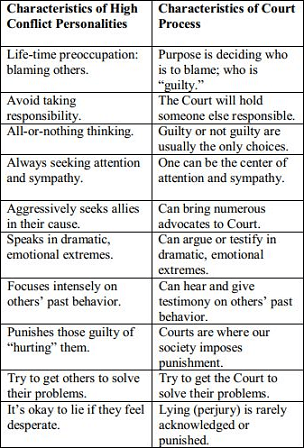
High-conflict people are driven by a lust to punish—any slight is a provocation to go to war—and their craving for attention can be boundless. Judicial process rewards both.

This table, prepared by attorneys Beth E. Maultsby and Kathryn Flowers Samler for the 2013 State Bar of Texas Annual Advanced Family Law Course, shows how high-conflict people and court process are an exquisitely infernal fit. Its authors’ characterization of high-conflict people’s willingness to lie (“if they feel desperate”) is generous. Many lie both on impulse or reflex and with deliberate cunning, though their chain of reasoning may be utterly bizarre.

Restraining orders are easily obtained, particularly by histrionic women. Once petitioners—especially high-conflict petitioners—realize how readily the state’s prepared to credit any evil nonsense they sputter or spew, and once they realize, too, the social hay they can make out of reporting to others that they “had to get a restraining order” (a five-minute affair), they can become accusation junkies.

Larry has responded in the most reasonable way he can to his situation. He’s voiced his outrage and continues to in a blog, and the vehemence of his criticisms might lead some who don’t know Larry to dismiss him as a crank. If you consulted his blog, you’d see it’s fairly rawboned and hardly suggests the craftsmanship of a technical wizard who can hack email accounts and remotely eavesdrop on telephone conversations. What the commentaries there suggest, rather, is the moral umbrage of an intelligent man who’s been acutely, even traumatically sensitized to injustice.

Here’s the diabolical beauty of our restraining order process. Judges accept allegations of abuse at face value and don’t scruple about incising them on the public records of those accused. They furthermore expect those who are defamed to pacifically tolerate public allegations that may have no relationship with reality whatever or may be the opposite of the truth, may be scandalous, and may destroy them socially, professionally, and psychologically. Judges, besides, make the accused vulnerable to any further allegations their accusers may hanker to concoct, which can land them in jail and give them criminal records. And finally judges react with disgust and contempt when the accused ventilate anger, which they may even be punished for doing.

Judicial reasoning apparently runs something like this: If you’re angry about false allegations, then they weren’t false; if you’re not angry about false allegations, then they weren’t false.

Larry’s been jailed, Larry’s been reported to the police a dozen times or more, an officer has rested the laser sight of her sidearm on him through the window of his residence, and the number of times he’s been summoned to court is closing on 30.

The allegations against him have been false. How angry should he be?

Copyright © 2014 RestrainingOrderAbuse.com

The Feminist Self-Contradiction: On the Flawed Conception of Restraining Orders and the Error of Preferring the Stick to the Carrot

Consider: At least a couple more restraining orders will have been issued in the time it takes you to read this post.

I pointed out recently that after 30 years and the issuance of millions or tens of millions of restraining orders, feminists and others continue to report that the incidence rate of domestic violence, which is the go-to rationale for restraining orders, is unchanged.

They report, in fact, that it’s “epidemic.”

Plainly restraining orders have put no dent in the problem. What’s more, it’s possible they’ve made it worse.

How this may be possible is simple. By authorizing gross and large-scale (epidemic) civil rights abuses for decades, the system has jaded the sentiment of a significant sector of the public. The punitive nature of both biased legal policies and the feminist rhetoric that has inspired them does nothing to change minds. It inspires resentment, outrage, and distrust, if not contempt.

Male victims of false restraining orders, in particular, who may well be a majority of recipients and number in the millions, can hardly be expected to sympathize with the feminist agenda. Worse yet, a goodly proportion of them may be far from sensitive to the interests of women generally, because feminism has associated itself with those interests inextricably.

Feminism doesn’t appeal to or cultivate sympathy; it largely strives to chastise and dominate, which can only foster misogyny.

Resentment toward feminist-influenced legal processes conduces to resentment toward feminists and consequently resentment toward women. Feminism works against its own mission statement and the interests of its nominated beneficiaries.

It’s certain that restraining orders have provided peace of mind to some petitioners. It’s certain, also, that they’ve compromised or devastated the lives of a significantly greater number of falsely accused defendants, who receive no compassion from feminist quarters.

On balance, the curative value of restraining orders is null if not negative. Per capita, that is, they do more harm than good. And the impact of each instance of abuse of power is chain-reactive, because every victim has relatives and friends who may be jarred by the reverberations.

Although it doesn’t occur to feminists, because they’re the darlings of the government and the media, their zeal to blame and punish is alienating instead of unifying.

The feminist m.o. is to win not win over…and nobody doesn’t hate a bully.

Thanks to kangaroo legal processes that are effectively products of their authorship, feminists’ potential supporters may number several fewer now than when you started reading this post.

Copyright © 2014 RestrainingOrderAbuse.com

Further Reflections on MSNBC’s Coverage of the First Annual International Conference on Men’s Issues

Rereading MSNBC’s article on the first annual International Conference on Men’s Issues, I have to marvel that so firmly has feminism taken hold that even reporters (whose watchword is objectivity) may respond with Pavlovian menace to an act of civil disobedience—which challenging feminism is.

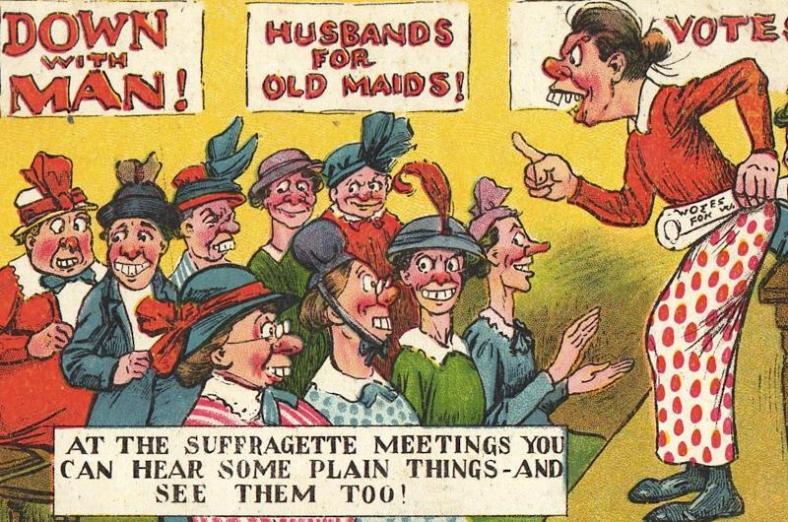
Consider that feminism originates with the 19th-century suffrage movement, that is, with some ragtag groups of women banding together to oppose second-class citizenship and demand the right to vote. Consider, too, that reactions to their early rallies to assert their rights presaged those of the MSNBC reporter who wrote about last month’s men’s conference.

His rhetorical strategies (which, like an apt pupil—or myrmidon—he lifts straight from the feminist playbook) were these:

  • Underrepresent the opposition. The MSNBC piece is surmounted by a photograph (snapped and cropped by the writer) showing a sparsely populated conference room. Some 16 people are visible if you count the odd pair of hands or feet poking into the frame. Though in a passing nod to journalistic accuracy the writer later reports attendees numbered “more than 100,” the first impression the reader is clearly meant to draw is “handful of nutters.”
  • Distort and caricature. Quotations featured in the piece were plainly culled for sensationalist impact. Commentary—for example on the phrase equity feminists, coined by a female feminist philosopher whose acumen is redoubtable—was confidently careless and pandering.
  • Distract. “The conference comes amid increased focus on women’s rights,” the writer observes saliently. Later he quotes a feminist post-grad as saying, “[D]ue to concerns for physical safety, we have decided the best way to oppose the conference that is now going on…is to keep our distance.” The source of fear was unspecified.
  • Ridicule. Pick a paragraph, any paragraph.

Attacks on the efforts of the early suffragists to have their grievances answered were…right, exactly the same.

Copyright © 2014 RestrainingOrderAbuse.com

Confusing Women’s Rights with Feminism: Some Observations on MSNBC’s Coverage of the First Annual International Conference on Men’s Issues

Apparently the first annual International Conference on Men’s Issues was held in Michigan recently. I read this fact on the MSNBC website in an article that disdained even to capitalize the title of the conference and which, for more reasons than just that one, reminded me of the days when I edited my high school paper.

My journalism adviser would’ve given the piece a C, among other reasons because it seems uncertain whether it wants to be a news story or an editorial—or an advertisement for its writer’s Twitter feed.

Its introduction, at least, was gripping to read: “At what was billed as the first annual international conference on men’s issues, feminists were ruining everything.” I was keen to hear about how the meeting was disrupted by a mob of angry women swinging truncheons.

I’ve come to expect disappointment, which expectation the reporter continued to cement over an ensuing two dozen paragraphs.

Not having attended the conference, I can’t say whether the reporter’s characterization of its presenters’ arguments as cranky is fair or not. Remarking that he failed to probe any of the topics he glosses in the article, however, does seem fair. A reporter’s job is to ask questions, not assemble a boa of plucked horsefeathers and hyperlinks.

I’m sympathetic to men’s plaints about legal mockeries that trash lives, including those of children, so I found the MSNBC coverage offensively yellow-tinged in more senses than one, but I’m not what feminists call an MRA or “men’s rights activist.” I don’t think men need any rights the Constitution doesn’t already promise them. What they need is for their government to recognize and honor those rights. The objection to feminism is that it has induced the state to act in wanton violation of citizens’ civil entitlements—not just men’s, but women’s, too.

On this subject, something useful the referenced MSNBC article does accomplish is reveal its writer’s unexamined presupposition that women’s rights and what feminists advocate for are the same thing. Probably many women are under the same illusion.

It’s understandable. Feminism still waves the same banner its pioneers sewed decades ago on which is blazoned that rainbow word EQUALITY. Today’s mainstream feminists, however, have redefined that word to mean “whatever’s best for us,” which doesn’t always mean what’s best for women.

To illustrate, take the 60-year-old woman who wrote last year to relate that she was expelled from the home she’d shared for 10 years with her invalid mother and terminally ill brother, whom she nursed, by her sister. The latter spitefully lied about her to the court—possibly because she was the executor of her mother’s will—and then destroyed her belongings, including her clothes and family memorabilia (photos, videos, etc.—a lifetime’s worth) when it was mandated that she vacate her residence. Her sister’s malicious testimony was rendered in a few minutes without the woman’s even being present. Though the fraudulent restraining order it succeeded in having issued was tossed on appeal, the woman’s record was sufficiently corrupted to cost her her job at a bank and the income and medical benefits it provided. When I last heard from her, she was living out of her car and trying to stay warm.

Or take the naïve girl who was lured away from her family, knocked up, and deserted by a twice-divorced pastor’s son. When the girl appealed to him to take an interest nine months later and moved to Virginia with her newborn on assurances from him that he’d found Jesus and wanted to do right by her, he and his family represented her as a hysteric to the court and, when last I got a status update, were in the process of seeking custody of her baby (cf. Charlotte Perkins Gilman’s “The Yellow Wallpaper”).

These aren’t merely people who “believe” they’ve been treated unfairly; these are women who’ve been used viciously and rolled into the gutter.

Women I’ve corresponded with in the three years I’ve maintained this blog have reported being stripped of their dignity and good repute, their livelihoods, their homes and possessions, and even their children according to prejudicial laws and court processes that are feminist handiworks. These laws and processes favor plaintiffs, who are typically women, so their prejudices are favored by feminists. Feminists decry inequality when it’s non-advantageous. They’re otherwise cool with it. What’s more, when victims of the cause’s interests are women, those victims are just as indifferently shrugged off—as “casualties of war,” perhaps.

I don’t know that feminists are “ruining everything,” but I do know that among the fruits of their industry has been ruining a lot of people’s lives.

Copyright © 2014 RestrainingOrderAbuse.com

The Relationship between False Allegations of Rape and Restraining Order Abuse

It’s not without regret for how they may affect victims of sexual violence that a number of journalistic reports that expose false rape allegations have been highlighted on this blog. Although the blog’s focus is restraining order abuse, the potency of restraining orders and the laxity applied to the allegations they’re based on derive from the specter of domestic and sexual violence, the shadow of which has infected and jaundiced the perceptions of our legislators and judges.

The volume of false rape allegations that have been brought to public attention this year—mostly in the U.K., which is less squeamish about acknowledging fraud of this sort—will probably make further mention excessive, because it threatens to distract from reports and explications more directly relevant to the blog’s primary concern, which is restraining order injustice (a redundant phrase). Several news stories were noted this month, and some of these stories are each but one of a series that trace the same saga of mischief.

Law Graduate Falsely Accused Boyfriend of Rape and Assault as Excuse, Jury Told” (Steven Morris, The Guardian, 2014)

Oxford Union ‘Rape Victim Knew Her Claim Was False’” (Oliver Duggan, Amelia Hamer, and James Rothwell, The Telegraph, 2014)

Woman Accused of Making Repeated False Rape Allegations(The Inquisitr, 2014)

Woman Sentenced after Falsely Accusing Two Men of Rape” (UPI, 2014) (see also commentary by attorney and former Houston Law Review editor Robert Franklin)

Woman Who Cut Herself with Razor and Claimed She’d Been Raped Is Jailed” (Michael Donnelly, Belfast Telegraph, 2014)

Victim of False Rape Accusation Seeks Compensation(The Northern Echo, 2014)

Man Wrongly Accused of Sexual Assault Sues Police” (Rachel Olding, Sydney Morning Herald, 2014)

The purpose of collecting these reports of false rape allegations hasn’t been to discount the claims of real victims or even to reveal that false allegations are made, which should be unsurprising in a sociopolitical climate that’s eager to credit allegations of violence against women; the purpose, rather, is to reveal the motives of false accusers and to emphasize that there’s no lie that a dedicated false accuser will balk at telling and holding fast to. It happens that when false accusers frame people for a crime society holds in the highest contempt, their motives become more noteworthy.

If accusers are willing to falsely allege even rape (and casually), there’s no estimating how many “lesser” false accusations are made routinely, particularly when no risk or serious investment is entailed. Civil restraining orders are had in hours if not minutes based on brief interviews with judges, and there are no repercussions to their plaintiffs if the allegations they’re based on are untrue. They can furthermore instantly gratify multiple motives for false allegations at the same time.

These motives are sorted by the Federal Bureau of Investigation (FBI) under five broad rubrics: mental illness (or aberrance), attention-seeking/sympathy, profit, alibi (blame-shifting or cover-up), and revenge (or spite).

A false restraining order litigant with a malicious yen may leave a courthouse shortly after entering it having gained sole entitlement to a residence, attendant properties, and children, possibly while displacing blame from him- or herself for misconduct, and having enjoyed the reward of an authority figure’s undivided attention won at the expense of his or her victim.

S/he may, besides, be crackerjacks.

The exposure of false allegations of rape shouldn’t be interpreted as denying the reality or brutality of sexual violence. What it should do, however, is serve as a rude awakening to those who believe (and promote the belief) that allegations of abuse should be accepted without suspicion. It should also stress that false allegations aren’t negligible, rare, or harmless.

They’re anything but.

Copyright © 2014 RestrainingOrderAbuse.com

Reporting Restraining Order Abuse to Elected Officials

“I am suffering from the effects of a fraudulent protection order in Colorado, which was filed by my female roommate and had me and my young daughter kicked out of our home.

“There appears to be no recourse for me, but I did contact 10 state representatives and senators, and I heard back from three of them. If more people report this abuse to their elected officials, maybe something will actually be done about this awful system.”

—Respondent to this blog

Writing to district and state representatives can be a lot like trying to communicate with judges. Expecting a human response isn’t unreasonable, but it’s often disappointed.

There’s nevertheless value in bringing systemic injustices to the attention of legislators (senators and congressmen and -women), because (1) they make, reform, and repeal laws, and (2) if they hear the same complaints over and over—and especially if they know other people of influence are hearing the same complaints and looking to them for action—there’s a chance some of them might step up.

The voices of women who’ve been abused by court process, particularly, need to be heard, because the procedures that are most often and easily abused are ones it’s presumed are protecting them.

Consult this site for the names and addresses/websites of elected officials with whom to register a complaint (state legislators should be first in order of importance):

Find Your Representatives

See also these tutorials:

Writing to Your Legislator

“How to Write a Letter to Your United States Senator

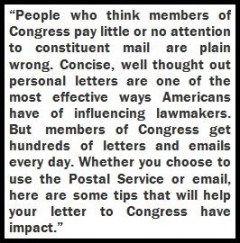
How to Write Letters to Congress

A petition that automatically forwards stories of abuses of domestic violence laws and restraining orders to legislators/administrators is here.

Copyright © 2014 RestrainingOrderAbuse.com

*See also: What to Do if You’ve Been Abused by a Judge

Restraining Orders Based on Fraud Falsely Imprison Defendants Whether They’re Incarcerated or Not

“Forensic psychiatrists and other mental health professionals must remember that although allegations are often genuine, there is an almost equal number of cases…in which they are not. Complete and objective assessment is always required, and especially so when accusations emerge in contexts such as the following:

  • Certain kinds of mental illness and character traits (particularly in allegations against clinicians). One should note poor doctor-patient relationships, whether real or perceived, patients with psychotic or delusional symptoms, certain hysterical and factitious disorders, some fragmenting or dissociative disorders, and those with substantial borderline, inadequate, and/or passive personality traits
  • Divorce proceedings
  • Child custody proceedings
  • Situations with the potential for substantial financial reward
  • Situations in which the accuser has an emotional or characterological reason to avoid discovery, prosecution, or confrontation with legal (or parental) authority (e.g., those with antisocial personality traits, some substance abusers)
  • A history of repeated past allegations, particularly if they have not been fully investigated
  • Unusual timing of the accusation or alleged event (e.g., alleged ‘date rape’ within an otherwise close and stable relationship, or accusations made only when some sort of secondary purpose or reward is evident).”

—“False Allegations: The Role of the Forensic Psychiatrist

The previous post called attention to an excerpt from a story featured in The Times of Malta this month that concluded that incidences of false allegations weren’t “one-offs,” meaning they’re not singular occurrences but more common than the public imagines.

The lawyers quoted by reporter, what’s more, refer to criminal cases in which sexual abuse is alleged and, consequently, in which the accused are afforded attorney representation.

By contrast, civil restraining order hearings are mere minutes long, defendants aren’t afforded counsel, and fraud is typically ignored by the court even if it’s perceived. There is, therefore, no accurately determining the pervasiveness or degree of lying in such adjudications.

Many authoritative sources conclude it’s rampant, and anecdotal reports concur.

The application process for restraining orders is typically free, it’s concluded in an afternoon if not within minutes, and there are no consequences for lying. Why, then, shouldn’t the process be broadly and routinely abused?

To believe that such a process wouldn’t be abused would depend on an unshakably naïve conviction in the inherent goodness of people, and such a belief would determine the process unnecessary. Anyone who believes people are capable of beastly behavior and that restraining orders are necessary—take, for example, feminists—must believe people are capable of lying hurtfully to get them.

Exposing the flaws in the belief that anyone who points a finger must necessarily be telling the truth doesn’t take a professor of philosophy.

Consider, then, that allegations made in civil court may be identical to those introduced against defendants in criminal court—and can include rape, child molestation, or even murder. The only difference between civil and criminal rulings is legal consequence.

This is the source of the cognitive disconnect exemplified by judges and, largely, everyone else. Because civil restraining orders only threaten incarceration rather than mandate it, they’re considered “no biggie.”

The conceit is that though falsely accused restraining order defendants may be denied access to their homes, money, property, and children—besides facing other privations—they aren’t denied their freedom; it’s only curtailed somewhat (“Here are your shoes—you’re free to leave”).

Faith in the conceit that restraining orders are minor impingements on defendants’ lives depends on accepting that being falsely, publically, and permanently labeled a stalker or batterer, for example, shouldn’t interfere with a person’s comfort, equanimity, or ability to realize his or her dreams. Such faith is founded, in other words, on the fantastical belief that wrongful vilification won’t exercise a detrimental influence on a person’s mental state, won’t affect his or her familial and social relationships, won’t negatively impact his or her employment and employability, etc.

Clearly such faith is beyond unreasonable; it’s inane. Being forced to live with false allegations can be crippling—for painfully obvious reasons. Whether a person is forced to agonize in a cell or is permitted to agonize in his or her place of choice is of scant significance to the psycho-emotional well-being of the sufferer. Prison isn’t just an environment, and arresting someone doesn’t require handcuffs.

Copyright © 2014 RestrainingOrderAbuse.com

Eight Years of Hell: On the Toll of False Allegations of Abuse

“Bitter separation battles and unrequited love are among the reasons why people falsely accuse others of sexual abuse, according to legal professionals.

“Lawyers contacted by The Sunday Times of Malta came across several examples of cases when people, often women, made false claims that they or their children had been abused.

“Lawyer Roberto Montalto gave the example of one situation where a woman claimed her children were abused by her husband’s colleague.

“The case dragged on for eight years and the man was acquitted after the court found that the woman lied….”

—“False Abuse Accusations Not One-Offs, Say Lawyers

To read the rest of this story, published just a couple of weeks ago, you have to subscribe to The Times of Malta. I can guess the remainder’s content, as I know many men and women who’ve visited this site can.

This excerpt is highlighted, because even today most people are under the impression that instances of false allegations’ being made repeatedly in protracted legal assaults are rare and isolated occurrences.

As attorneys and others attest, they’re not. Only hearing about them is.

Among the reasons why restraining orders are criticized on this site and elsewhere is that they’re superlative and intoxicating gateway fixes for spiteful accusers bent on gratifying malicious impulses. They can be obtained in a few hours—even a few minutes—based on allegations that require no substantiation and that are subjected to a minimum of scrutiny, if any at all.

They’re easily exploited to establish claims that can then be parlayed into interminable attacks.

False criminal allegations suggestive of sexual or violent deviancy—e.g., stalking, sexual harassment or molestation, and domestic abuse—can be just as effective and for the same reasons. The hysteria promoted by the abuse industry and the political influence it has bent to its “cause” have conditioned police, municipal prosecutors, and judges to credit allegations of abuse automatically (especially ones from women).

Eight years—that’s the term in hell the man in the epigraph had to endure before it was apparently demonstrated that the whole ordeal was based on lies: eight years lost for nothing. Nothing. More horrible yet is that the only thing that makes this story exceptional is that the fraudulent accuser was eventually exposed and acknowledged as such.

Eight years is a Ph.D. Eight years is a career. Eight years is a son or daughter’s childhood.

Copyright © 2014 RestrainingOrderAbuse.com

Victims Are Important, but They’re Not More Important than Anyone Else: Amending Priorities and Reconceiving Restraining Order Policy According to the Principle of Equality

“While some municipal court judges acknowledge that the domestic violence law can create injustices—one calls it ‘probably the most abused piece of legislation that comes to my mind’—there are counterpoints. Melanie Griffin, executive director of the Commission to Study Sex Discrimination in the Statutes, a legislative commission that drafted much of the 1991 law, says that for every individual who files a false report, ‘there are 100 women who don’t come in at all and stay there and get beaten.’”

—“N.J. Judges Told to Ignore Rights in Abuse TROs

This quotation comes from a nearly 20-year-old journalistic exposé, yet you’ll find the same starkly meretricious apology for restraining order abuse routinely voiced today.

This quotation from the proposed Equal Rights Amendment (ERA) means that all people should be treated equally under the law, not that women should be privileged. Anyone who’s for women’s being afforded special treatment by the authorities and the courts, as proponents of the Violence Against Women Act (VAWA) are, opposes the ERA.

This quotation from the proposed Equal Rights Amendment (ERA) means that all people should be treated equally under the law, not that women should be privileged. Anyone who’s for women’s being afforded special treatment by the authorities and the courts opposes the message of the ERA, as do proponents of the Violence Against Women Act (VAWA).

The argument, basically, is that it doesn’t matter if restraining order defendants’ rights are ignored, and it doesn’t matter if defendants are falsely accused, because there are many more victims of abuse who suffer in silence than there are false accusers.

The argument equates apples with orangutans. Its reasoning is partisan and purely emotion-based—and betrays ignorance of the fact that women, too, are falsely accused of domestic violence. Its thesis is that since there may be multitudes of unacknowledged victims of domestic violence, the state’s creating victims by abetting false prosecutions is of no statistical significance.

While everyone should feel for women who are “beaten” at home, no one should be forced by the state to endure “sympathy pains.” The falsely accused man or woman whose life is upturned or undone by hyped allegations or gross lies credited by careless judges is absolutely blameless for the suffering of strangers.

Life, liberty, and the pursuit of happiness are inalienable rights guaranteed to all citizens under the Constitution, and equality and fair treatment under the law are among its mandates that brook no compromise. Denying the latter to anyone, ever—even if the motive is a sympathetic one—is categorically wrong.

The statement in the epigraph says: It’s okay if you, Mr. or Ms. Doe, are falsely accused and battered by the system, and it’s okay if it deprives you of your kids and home and livelihood and dignity and sanity, because some people you don’t know and never will know are reportedly “beaten” by some other people you don’t know and never will know.

It says there are women who suffer unjustly, so never mind if we make you suffer unjustly, too.

Copyright © 2014 RestrainingOrderAbuse.com

Restraining Orders and Feminist Self-Sabotage: On the Error of Preferring the Stick to the Carrot

Consider: At least a couple more restraining orders will have been issued in the time it takes you to read this post.

I pointed out recently that after 30 years and the issuance of millions or tens of millions of restraining orders, feminists and others continue to report that the incidence rate of domestic violence, which is the go-to rationale for restraining orders, is unchanged.

They report, in fact, that it’s “epidemic.”

Plainly restraining orders have put no dent in the problem. What’s more, it’s possible they’ve made it worse.

How this may be possible is simple. By authorizing gross and large-scale (epidemic) civil rights abuses for decades, the system has jaded the sentiment of a significant sector of the public. The punitive nature of both biased legal policies and the feminist rhetoric that has inspired them does nothing to change minds. It inspires resentment, outrage, and distrust, if not contempt.

Male victims of false restraining orders, in particular, who may well be a majority of recipients and number in the millions, can hardly be expected to sympathize with the feminist agenda. Worse yet, a goodly proportion of them may be far from sensitive to the interests of women generally, because feminism has associated itself with those interests inextricably.

Feminism doesn’t appeal to or cultivate sympathy; it largely strives to chastise and dominate, which can only foster misogyny.

Resentment toward feminist-influenced legal processes conduces to resentment toward feminists and consequently resentment toward women. Feminism works against its own mission statement and the interests of its nominated beneficiaries.

It’s certain that restraining orders have provided peace of mind to some petitioners. It’s certain, also, that they’ve compromised or devastated the lives of a significantly greater number of falsely accused defendants, who receive no compassion from feminist quarters.

On balance, the curative value of restraining orders is null if not negative. Per capita, that is, they do more harm than good. And the impact of each instance of abuse of power is chain-reactive, because every victim has relatives and friends who may be jarred by its reverberations.

Although it doesn’t occur to feminists, because they’re the darlings of the government and the media, their zeal to blame and punish is alienating instead of unifying.

The feminist m.o. is to win not win over…and nobody doesn’t hate a bully.

Thanks to kangaroo legal processes that are effectively products of feminist authorship, feminists’ potential supporters may number several fewer now than when you started reading this post.

Copyright © 2014 RestrainingOrderAbuse.com

Feminist Reports Conclude Restraining Orders Don’t Work: Time to End the Experiment

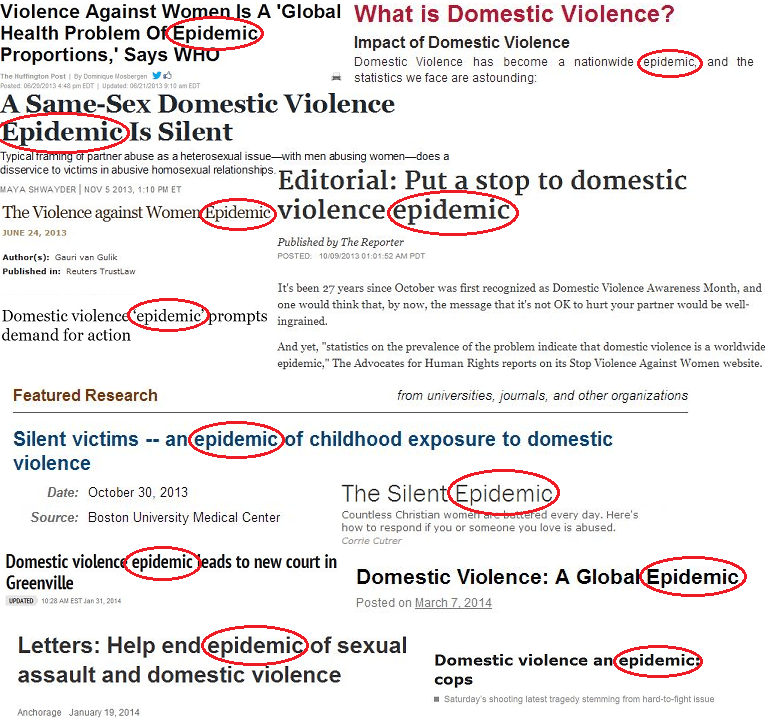
The Internet is awash with images like these.

Restraining orders are defended on the basis that they protect female victims of domestic violence.

The most recent posts on this blog have stressed the constitutional violations that are necessarily entailed by the process. One of them reprints a 1995 New Jersey Law Journal exposé: “N.J. Judges Told to Ignore Rights in Abuse TROs” by Russ Bleemer. In various of the article’s quotations, the “epidemic” nature of domestic violence is emphasized. Almost 20 years later, you’ll discover by a casual Google search that domestic violence is still broadly termed “epidemic.”

If domestic violence was “epidemic” at the start of the restraining order boom, and it’s still “epidemic” two decades later after the issuance of millions or tens of millions of restraining orders, there are only a couple possible conclusions to be drawn: (1) restraining orders aren’t doing the job, or (2) restraining orders have exacerbated the problem.

Either of these conclusions leads to an inevitable third: the dividends of restraining orders are negligible if not negative. Juxtapose their negligible effectuality against the untold suffering they’ve wrought and continue to wreak, and legislators’ duty is clear: back to the drawing board.

The manifest unfairness of restraining order policy toward individual defendants is justified according to the belief that the overall benefit of restraining orders to society excuses large-scale civil rights’ violations and the abrogation of the most basic ethical tenets of law, like impartiality, diligent deliberation, and due process.

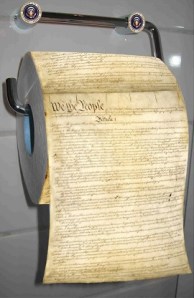
If the blanket benefit of restraining orders to the society as a whole is none, as feminists and others report—that is, if restraining orders haven’t actually downgraded the alert status of domestic violence from red after 30 years—then money is being flushed down the toilet along with the lives of restraining order defendants for no reasons but maintenance of appearances and appeasement of special interests.

No buts about it.

Copyright © 2014 RestrainingOrderAbuse.com

Mocking the Constitution for 35 Years: A Summary of Defendants’ Due Process Rights under the American Charter and How Restraining Orders Treat Them Contemptuously

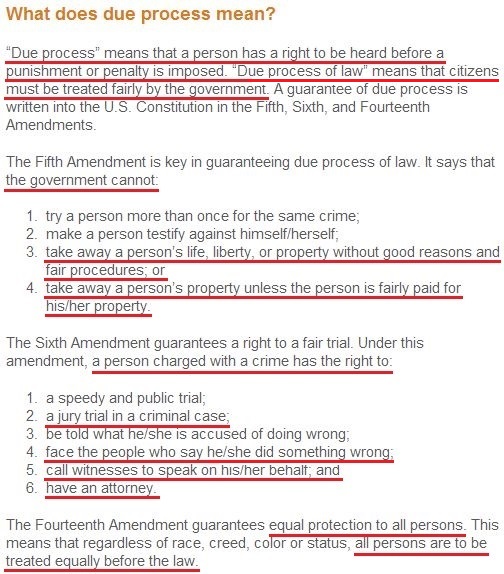
taped_mouth_cropI’ve written before about “due process,” a constitutional privilege that’s universally denied to restraining order defendants. Recently I was contacted by an intelligent 17-year-old girl who wanted to know what her rights were under the law. She didn’t stand accused of anything. Rather her adult boyfriend had been issued a mandatory (criminal) restraining order in California “on her behalf” that she didn’t seek, and she wanted to know what she could do about it.

She has a tough row to hoe, and I couldn’t provide her with much solace.

In hunting around for resources to direct her attention to, though, I came across a page prepared by the Virginia Office of the Attorney General titled, “Legal Rights of Juveniles.”

Its summation of defendants’ due process entitlements under the Constitution is worthy of the attention of anyone who’s being or who’s been put through the restraining order ringer, as well as of anyone who’s paid to craft laws that honor civil rights. Past posts on this blog have focused on the Fourteenth Amendment. This synopsis covers the Fifth and Sixth Amendments, also.

Contrast:

  • Restraining orders are issued ex parte, which means penalty is imposed upon a defendant without the court’s even knowing a thing about him or her other than his or her name—and in some jurisdictions, s/he’s not granted even the opportunity to be heard unless s/he applies for that opportunity (and the window to apply may be brief) = Sixth Amendment.
  • A defendant is deprived of liberty and often property, besides, without compensation and in accordance with manifestly unfair procedures concluded in minutes = Fifth Amendment.
  • A defendant is subject to criminal sanctions, including incarceration, without benefit of a trial by jury and consequent to a hasty civil adjudication (half an hour) that requires him or her to hire private counsel if s/he’s to be represented at all, that may not allow him or her to face his or her accuser in court, and whose pretrial preparation period affords too little time for witnesses to be gathered (two to 10 days) = Sixth Amendment.
  • Defendants are discriminated against generically, and male defendants are discriminated against specifically to mollify the special interest groups that motivated enactment of restraining orders in the first place = Fourteenth Amendment.

The restraining order process isn’t merely abusive on an epidemic scale; it treats the Constitution with contempt.

Copyright © 2014 RestrainingOrderAbuse.com

“N.J. Judges Told to Ignore Rights in Abuse TROs”: A Retrospective Look at Vicious Restraining Order Policies 20 Years Later

Among the challenges of exposing crookedness in the adjudication of restraining orders is credibility. Power rules, and the people who’ve been abused typically have none. Their plaints are discounted or dismissed.

Influential and creditworthy commentators have denounced restraining order injustice, including systemic judicial misconduct, and they’ve in fact done it for decades. But they aren’t saying what the politically entitled want to hear, so the odd peep and quibble are easily drowned in the maelstrom.

Below is a exquisite journalistic exposé that I can’t simply provide a link to because the nearly 20-year-old reportage is only preserved on the Internet by proxy hosts (for example, here).

The article, “N.J. Judges Told to Ignore Rights in Abuse TROs,” is by Russ Bleemer and was published in the April 24, 1995 edition of the New Jersey Law Journal.

New Jersey attorneys corroborate that the rigid policy it scrutinizes still obtains today. What’s more, the general prescriptions of the New Jersey training judge on whom the articles focuses arguably inform restraining order policy nationwide. The only things dated about the article are (1) judges’ being “trained on the issue of domestic violence” is no longer “unique” to New Jersey but is contractually mandated everywhere in return for courts’ receiving hefty federal grants under the Violence Against Women Act (VAWA), which grants average out at over $500,000 per; and (2) the resultant policy now injures not only men who are fingered as abusers in five-minute procedures that are often merely perfunctory.

According to the same complacently biased “standards,” it also trashes the lives of accused women, who are not infrequently prosecuted by other women (including their mothers, daughters, and sisters).

______________



Text of “N.J. Judges Told to Ignore Rights in Abuse TROs” by Russ Bleemer (Copyright © 1995 American Lawyer Newspapers Group, Inc.):

On Friday, at a training session at the Hughes Justice Complex in Trenton, novitiate municipal judged were given the “scared straight” version of dealing with requests for temporary restraining orders in domestic violence cases.

The recommendation: Issue the order, or else.

Failing to issue temporary restraining orders in domestic violence cases, the judges are told, will turn them into fodder for headlines.

They’re also instructed not to worry about the constitution.

The state law carries a strong presumption in favor of granting emergency TROs for alleged domestic violence victims, the new judges were told at the seminar run by the Administrative Office of the Courts. Public sentiment, mostly due to the O.J. Simpson case, runs even stronger.
The judges’ training is rife with hyperbole apparently designed to shock the newcomers. It sets down a rigid procedure, one that the trainers say is the judges’ only choice under a tough 1991 domestic violence law and its decade-old predecessor.

Since the Legislature has made domestic violence a top priority, municipal court judges are instructed that they can do their part by issuing temporary restraining orders pronto.

“Throw him out on the street,” said trainer and municipal court judge Richard Russell at a similar seminar a year ago, “give him the clothes on his back, and tell him, ‘See ya around.’”

This napalm approach to implementing the domestic violence statute has some state judges talking. No one disputes the presumption in the law of granting a TRO, and there have been no serious court challenges to the statute’s ex parte provisions.

The strident teaching, however, doesn’t always sit well with some judges, even those who characterize the instruction as deliberate verbal flares directed at a worthy goal.

“[It’s] one of the most inflammatory things I have ever heard,” says one municipal court judge, who asked not to be identified, about a presentation held last year. “We’re supposed to have the courage to make the right decisions, not do what is ‘safe.’”

At the same time, even former and current municipal and Superior Court judges who are critical of the seminar have words of admiration for the candor of trainers Russell, Somerset County Superior Court Judge Graham Ross and Nancy Kessler, chief of juvenile and family services for the AOC. One municipal court judge says that while the statements reflect an incorrect approach, “I wouldn’t be real keen to inhibit the trainers at these sessions from exhibiting their honest opinions.”

For their part, Russell and Kessler say they are doing what the law says they should do—protecting victims, which in turn can save lives. Ross didn’t return telephone calls about the training. He, Russell and Kessler were scheduled to conduct Friday’s program for new judges, a program Kessler says the trio has conducted for judges at least five times since the law was passed.
The law, N.J.S.A. 2C:25-17 et seq., requires judges to be trained on the issue of domestic violence, a requirement that women’s rights advocates say is unique. The TRO provisions also were reemphasized three years ago, encouraging the use of such orders after a municipal court judge hears from one complainant.

Under N.J.S.A. 2C:25-28, municipal court judges assigned to cover for their Superior Court counterparts at nights and on weekends and holidays can issue an ex parte TRO, which is subject to a hearing within 10 days in the Superior Court’s family part “when necessary to protect the life, health or well-being of a victim on whose behalf the relief is sought.”

The TRO may prohibit the defendant from returning to the scene of the alleged act, strip the defendant of firearms or weapons, and provide “any other appropriate relief.” The law also says that the emergency relief “shall be granted for good cause shown.”

Dating Relationships Included

The training, however, stresses the Legislature’s urgency in passing the law, which last year was amended again to extend possible domestic violence situations to dating relationships. The trainers encourage the judges to focus on the legislative findings, which, in emphasizing rapid law enforcement response, state “that there are thousands of persons in this State who are regularly beaten, tortured and in some cases even killed by their spouses or cohabitants.”
This, said Kessler at a training session last year, is justification for an approach advocated by Russell: Talk to the complainant, talk to the reporting officer, issue the TRO, and let the family court sort it out later.

On a tape of the April 1994 session obtained by the Law Journal, Kessler told the judges that “in that legislative findings section, people are told to interpret this law broadly in order to maximize protection for the victim. So if anybody ever came back at you and said, ‘Gee, that’s a real reach in terms of probable cause,’ you have a legislatively mandated response which is, ‘I erred on the side of caution for the victim.’”

Kessler was reacting to a question that arose during Russell’s presentation. “The statute says we should apply just cause in issuing the order,” an unidentified, new municipal judge said, adding, “You seem to be saying to grant every order.”

Russell quickly replied, “Yeah, that’s what I seem to be saying.”

Russell, a municipal court judge in Ocean City and Woodbine, as well as a partner in Ocean City’s Loveland, Garrett, Russell & Young, answered the question at last year’s seminar after he had spoken for some time on the middle-of-the-night procedures the new judges would have to follow.

At the outset, Russell said that he was on the bench when the original domestic violence act was enacted in 1982 “and that just blew up all of my learning, all my understanding, all my concept of constitutional protections and I had to acclimate myself to a whole new ball game.

“If I had one message to give you today, it is that your job is not to weigh the parties’ rights as you might be inclined to do as having been private practitioners,” Russell told the judges. “Your job is not to become concerned about all the constitutional rights of the man that you’re violating as you grant a restraining order. Throw him out on the street, give him the clothes on his back and tell him, ‘See ya around.’ Your job is to be a wall that is thrown between the two people that are fighting each other and that’s how you can rationalize it. Because that’s what the statute says. The statute says that there is something called domestic violence and it says that it is an evil in our society.”

Not all judges agree with Russell’s approach. Philip Gruccio, a former trial and Appellate Division judge, says that even orders based on ex parte requests require hearings, to a certain extent. “It involves a certain amount of judicial discretion,” he says.

Robert Penza, who retired last year after serving as a family court judge in Morris County for two years, agrees. “I could just never rubber stamp a complaint,” says Penza. “A judge has got to judge.”

Gruccio, who says he is familiar with the work of Russell and Ross on the bench and that both are top notch judges, strongly disagrees with the approach. “My view is that you just can’t say, ‘Forget about the defendant’s rights.’ You can’t say that. It is wrong to say that. It is wrong to train people that constitutional rights aren’t important.”

Gruccio, a professor at Widener University Law School in Wilmington, Del., and director of its judicial administration program, concludes, “I think what has happened is, for emphasis purposes, somebody has lost their way.”

Catering to Popular Objectives

Sitting judges interviewed for this article readily agree with Gruccio. Says one: “The constitution is being ignored in order to satisfy a particular legislative objective. And if the judiciary should feel that it is obliged to close its eyes to constitutional considerations in order to assist the Legislature in attaining a currently popular objective, it will have prostituted itself and abrogated its responsibility to maintain its independence and its primary responsibility of upholding the constitution.”
One municipal court judge who has heard the AOC lecture says, “This is throwing people out of their homes in the middle of the night,” adding, “We have an obligation under our oath of office to be fair, not to be safe.”

A problem that arises by such wholesale approvals of TROs, judges say, is that word spreads, and litigants can try to use them as a club. Kessler couldn’t provide statistics on the number of TROs that are later dismissed by the family court, but she says that the number is “significant.” She adds that more than 58,000 TROs and amended TROs were issued by New Jersey courts last year, with about 60 percent of the complaints originating in municipal courts.

While some municipal court judges acknowledge that the domestic violence law can create injustices—one calls it “probably the most abused piece of legislation that comes to my mind”—there are counterpoints. Melanie Griffin, executive director of the Commission to Study Sex Discrimination in the Statutes, a legislative commission that drafted much of the 1991 law, says that for every individual who files a false report, “there are 100 women who don’t come in at all and stay there and get beaten.”

Judges who have seen the training presentation say that if anyone objects, they keep it to themselves. Russell says that sometimes “those with no background express disbelief, until we explain the intent of the legislation.”

Moreover, Russell says there is nothing wrong with the teaching approach. Abuse victims, he says, may apply and relinquish TROs repeatedly before they finally do something about breaking away. Once they do so, he says, the Legislature’s prevention goal has been met.

Russell continues: “So when you say to me, am I doing something wrong telling these judges they have to ignore the constitutional protections most people have, I don’t think so. The Legislature described the problem and how to address it, [and] I am doing my job properly by teaching other judges to follow the legislative mandate.”

Russell disputes that the TRO training removes judicial discretion where it is needed. On the tape, Russell and Kessler emphasize that first, the judge must decide whether the domestic violence statute grants jurisdiction over the complainant and the defendant. Russell said last week that he was updating Friday’s lecture to include the 1994 expansion of the domestic violence statute to situations in which the complainant was dating the accused or alleges that the accused is a stalker. The judge also has to speak to the party or review the written material and make a decision whether to proceed. “The judge has to be guided by instinct,” Russell explains, before he or she can go ahead with the TRO.

Says one municipal court judge who also has conducted training and asked not to be named: “I would say, ‘If there is any doubt in your mind about want to do, you should issue the restraining order.’” The judge adds, “I would never approach the topic by saying, ‘Look, these people are stripped of their constitutional rights.’”

Making Headlines

Much of the seminar’s rhetoric alludes to actions that keep the judges out of the headlines, which are mentioned in the taped seminar repeatedly. Near the beginning of his presentation, Judge Graham Ross, reacting to Russell, says that dealing with domestic violence “is not something that we can take a shortcut on. Forgetting about reading your name in the paper—and that certainly is very troubling, I don’t want to read my name—but that’s really secondary.

“The bottom line is we’re trying to protect the victim,” Ross continues. “We don’t want the victim hurt. We don’t want the victim killed. So yes, you don’t want your name in the paper, but you’d feel worse than that if the victim was dead. So yeah, your name will be in the paper…if you’ve done something wrong. And I’ve said that to my municipal court judges. If you don’t follow the law after I told you what to do, I will guarantee that you will be headlines. That’s not a threat. That’s an absolute promise on my part. This is serious stuff.”

The AOC’s Kessler says the media references are a training technique, and judges aren’t influenced by public opinion polls. The focus, she says, follows the statute’s emphasis on protecting victims by dealing with the dynamics of domestic violence and the importance of intervention. “When there is a discussion about headlines,” she says, “it tends to be more in recognition of what they already are aware of and concerned about.”
One former judge agrees that judges don’t work wearing blinders, but says that if worries about bad publicity affect their work, “it defrauds the system.” A current municipal court judge who has been through the training on domestic violence says, “We have to stand back from the hysteria and the newspapers and all and do what’s right.”

But most others disagreed. The “approach isn’t bad because it’s got a shock value,” says retired judge Robert Penza.

A current municipal court judge liked the realism of the media references. “A newspaper headline can be death to a municipal court judge’s career,” says the long-time jurist, “and the prospect of an unfavorable newspaper headline is a frightening one.” The judge added, however, that attention-getting devices must not be confused with legal principles.

And the judge paid the overall approach a backhanded compliment frequently repeated in some form among the former and current judges contacted for this article. Referring to Russell, the judge declared: “What he said is valuable because he is expressing the state of affairs. He should be commended for his candor, although I must say I find his viewpoint to be anathema.”

Copyright © 2014 RestrainingOrderAbuse.com

Lip Service: What Passes for Fair and Sound Restraining Order Policy in Michigan (and, Largely, Everywhere Else)

I’ve tried in earnest to field a lot of questions about the rules and practices that apply to restraining orders. A lot of the answers don’t make any sense.

Judges and authorities don’t question the fairness or sense of the rules, because that’s not their job. Lawyers sometimes question them but may not be fully aware of them themselves. And defendants, who are terrorized and railroaded through, often have no recourse but to complain afterwards about injustices they’re not always able to explain.

Let’s shed some light on a few of these injustices with the help of the Kalamazoo County Prosecutor’s Office. Its website’s “Personal Protection Orders” page is here.

“A police officer called and informed me of a PPO [personal protection order]. Is a phone call effective without personal service upon me?” This is a question the likes of which bring visitors to this blog regularly.

Most attorneys, if asked this question, would probably say no, it isn’t sufficient—and for good reason. The average person who’s issued an order of the court has no idea what its significance is. A cop’s calling and telling him or her about it—“Hi, a protection order has been issued against you”—hardly qualifies as making him or her aware of prohibitions whose violation s/he can be arrested and jailed for without being tried before a jury for anything.

In Michigan, however, “oral notice” (lip service) is apparently deemed “good enough.”

Notice no actual confirmation that a defendant has even been orally informed of a court order is required (like a signature, for example). It’s sufficient if a police officer (or clerk) files a form that says the defendant was told of its “existence.” This say-so is called “proof.”

This “proof,” once “entered into the computer system,” authorizes a police officer to arrest the defendant for violating an order of the court that s/he may not even have been given a copy of. The defendant’s so much as saying hello to the plaintiff now qualifies as a crime for which s/he can be arrested and punished.

(The Kalamazoo website later contradicts itself with this statement: “The police might not arrest the restrained party, especially if the officer did not witness the acts violating the PPO, or if there was insufficient proof that the Respondent had been served with the PPO papers before the alleged violation occurred.” This suggests that service does require that a police officer place a copy of the order in the defendant’s hands. You see from these kinds of inconsistencies why so many people complain that officers they question seem to make up answers on the spot.)

You may be thinking that with policy’s being so wishy-washy, there’d have to be evidence that the defendant committed a violation of the order before a police officer could arrest him or her. Not so. A violation, which the defendant may not even understand to be a legal trespass, just has to be reported to a police officer once the order is in the system.

I like the phrase “warrantless arrest,” because one of the meanings of warrantless is lacking justification or proof. To be clear, the basis for hauling someone off to jail may once again be somebody’s say-so. An officer doesn’t have to witness anything.

An order itself is, of course, issued on somebody’s say-so. Consider:

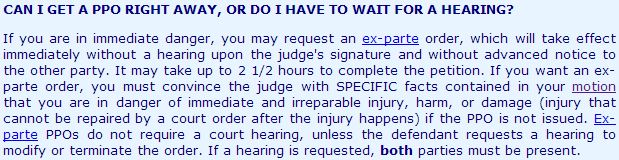
An ex parte order may be obtained by a plaintiff without the defendant’s knowing a thing about it (that’s what ex parte means), and obtaining the order is an investment of two and a half hours’ time tops. Most of this is waiting. The actual audience with a judge may only take five minutes. Observe, further, that “PPOs do not require a court hearing.” That means there’s no follow-up mandated by law. Unless the defendant knows to request a hearing to challenge the allegations against him or her—which may include anything from harassment to stalking to battery or worse—the order (possibly based on a five-minute interview) is a done deal, and those allegations remain permanently stamped on the defendant’s public record.

To repeat for emphasis: A judge may never so much as clap eyes on the defendant, who’s just a name scrawled on a form.

As if all this didn’t sound bent enough, contemplate this, finally:

This means that if the plaintiff on the order opts to contact the defendant, that’s perfectly okay. The person who goes to jail is the defendant.

Does this mean a malicious plaintiff can bait the defendant into violating a court order by calling, texting, or emailing him or her, or showing up at his or her home or place of work?

phewRight. (People report answering the phone and actually being told, “Gotcha!”)

The Kalamazoo County Prosecutor’s Office is hip to this potential source of abuse, however. It admonishes plaintiffs in the sternest terms not to “send the wrong signals.”

Copyright © 2014 RestrainingOrderAbuse.com

On Withdrawing Restraining Orders That Were Obtained Impetuously (and on the Influences That Militate against Conscience)

Since I began culling various “motions to dismiss” that allow plaintiffs in different states to vacate (cancel) restraining orders that they’ve applied for, the motion forms have attracted between 10 and 40 visitors a day.

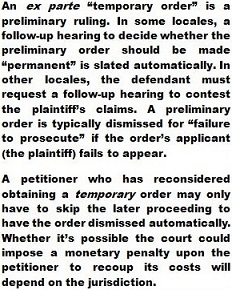
Dropping a restraining order is a straightforward process. The restraining order applicant returns to the courthouse and files an affidavit (sworn statement) explaining his or her reasons for wishing to have the order dismissed, which may require an additional hearing before a judge. On its surface, the procedure is easy-peasy (albeit inconvenient and possibly nerve-wracking).

If the restraining order was petitioned in anger or the petitioner simply acted “without thinking,” withdrawing it is furthermore an ethical no-brainer, and it may be sufficient for the petitioner to tell the court that s/he no longer considers the order necessary.
Potential complications, nevertheless, are manifold. Applications for restraining orders, even ones falsely or impetuously obtained, may have been motivated or encouraged by others, and withdrawing them must be done against their urgent disapproval. These others are often family members or girlfriends who get swept up in the drama, which can excite a frenzy approaching bloodlust.

Some minor domestic fracas or even just an expression of discontentment may become for them a point to concentrate their collective resentments toward men or toward the particular man who’s been accused (and the gender reverse isn’t inconceivable).

“Don’t do it!” plaintiffs may be told. “You’ll get in trouble for lying and go to jail!” Plaintiffs with children may moreover be terrorized with doomful predictions of harassment by child protective services: “They’ll take your kids!”

Concerns about being prosecuted by the state for falsely alleging fear are unwarranted. Concerns about the state continuing to sniff around a plaintiff’s household, however, aren’t baseless. It happens.
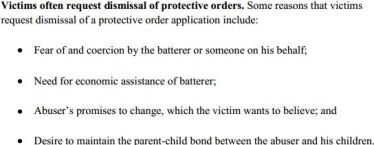

Here, for example, is how judges are prompted to proceed in Texas:

When an applicant seeks to dismiss the protective order or wants to withdraw an application for a protective order, the court should have the request investigated before ruling.

The nanny state’s presumption that plaintiffs’ fears are real and urgent makes obtaining restraining orders, even by arrant fraud, child’s play. But the same presumption means the state may be reluctant to concede that it was duped. It’s been primed, in other words, to look for mischief, and it doesn’t always passively back down.

Returning to The Texas Family Violence Benchbook (a benchbook is an instruction manual for judges):

Note that accusers are automatically nominated “victims,” and those they accuse are automatically presumed to be “batterers”/“abusers.”

Judges are told to be suspicious. No benchbook includes “pissed off” as among the motives for procuring a protective order. Acknowledging that allegations may be made impulsively or spitefully is contrary to the conceits of the system.

Women’s advocates, who are sometimes party to restraining order applications, also tend to discourage retractions, because second-guessing discredits “the cause.”

Too often decent people who reconsider impulsive acts succumb to fears of punishment or cruel scrutiny from the system, or fears of alienation or rebukes from friends, family members, or “advisers.” The choice to undo a spiteful whim, which may be fulfilled in mere minutes, is agonizing.

The petitioner who knows s/he was guided to apply for a restraining order by motives ulterior to the ones s/he alleged to a judge should even so favor conscience over personal or peripheral interests, because the defendant is certain to be in at least as much agony—and unjustly.

Copyright © 2014 RestrainingOrderAbuse.com

False Restraining Orders That Allege Emotional Abuse ARE Emotional Abuse

A theme that emerges upon consideration of restraining order abuse is lack of empathy—from impulsive or false accusers and from those who abet them. Plaintiffs who act either spitefully or viciously seldom appreciate the ramifications of their actions. They may possess what we call a normal conscience but either don’t think or, in the heat of the moment, don’t care.

The horror is that this same indifference extends not only to authorities and officers of the court but to feminist advocates for restraining orders and the public at large, who are persuaded that the gravity of violence against women trivializes all other considerations. Their indifference may in fact be unconsciousness, but when people’s livelihoods and lives are at stake, unconsciousness is no more pardonable.

It’s ironic that the focus of those who should be most sensitized to injustice is so narrow. Ironic, moreover, is that “emotional abuse” is frequently a component of state definitions of domestic violence. The state recognizes the harm of emotional violence done in the home but conveniently regards the same conduct as harmless when it uses the state as its instrument.
From “Are You a Victim of Emotional Abuse?” by Cathy Meyer:

Emotional abuse is used to control, degrade, humiliate, and punish a spouse. While emotional abuse differs from physical abuse, the end result is the same….

Note the writer’s conclusion that emotional abuse is equivalent to violence in its effects.

Her orientation, of course, is toward victims of domestic violence, but her judgment is just as applicable to false allegations, whose intent is to “control, degrade, humiliate, and punish.”

Plainly the motive of most reasonable feminist arguments and appeals, at least as that motive is understood by those making them, is to induce empathic understanding. They want people to care.

Here’s yet another irony. Too often the perspectives of those who decry injustices are partisan. Feminists themselves are liable to see only one side.

“But my side’s more important” isn’t a rebuttal but a confirmation of chauvinism.

In the explication quoted above, the writer compares the conduct of emotional abusers to that of prison guards toward prisoners of war, who use psychological torment to achieve compliance from their wards. Consider that victims of false allegations may literally be imprisoned.

Consider further some of the tactics that Ms. Meyer identifies as emotionally abusive:

  • Isolating a spouse from friends and family.
  • Discourag[ing] any independent activities such as work; taking classes or activities with friends.
  • If the spouse does not give into the control, they are threatened, harassed, punished, and intimidated by the abuser.
  • Us[ing] the children to gain control by undermining the other parent’s authority or threatening to leave and take the children.
  • Control[ling] all the financial decisions, refus[ing] to listen to their partner’s opinion, withhold[ing] important financial information and mak[ing] their spouse live on limited resources.
  • Mak[ing] all major decisions such as where to live, how to furnish the home, and what type of automobile to drive.

Now consider the motives of false allegations and their certain and potential effects: isolation, termination of employment and impediment to or negation of employability, inaccessibility to children (who are used as leverage), and being forced to live on limited means (while possibly being required under threat of punishment to provide spousal and child support) and perhaps being left with no home to furnish or automobile to drive at all.
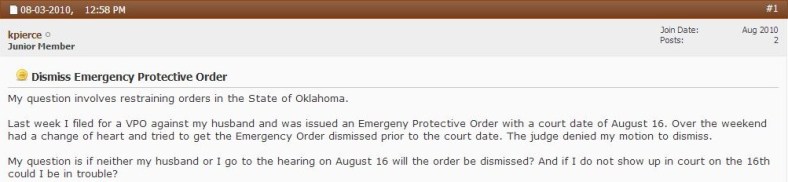
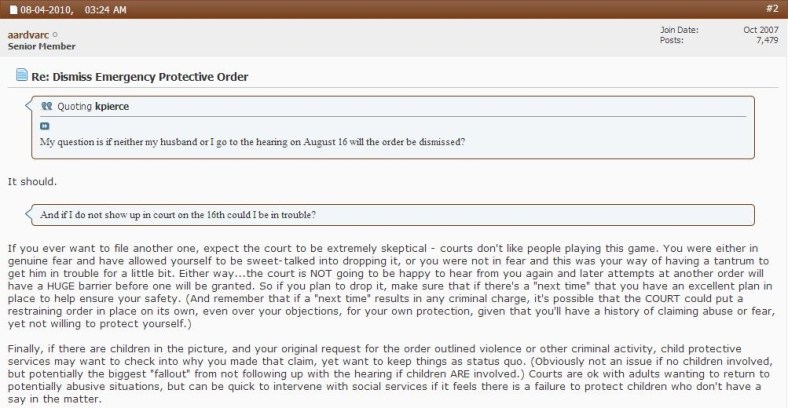
The correspondence is obvious…if you’re looking for it. Opponents of emotional abuse need to recognize it in all of its manifestations, because the expectation of empathy is only justified if it’s reciprocated.

Copyright © 2014 RestrainingOrderAbuse.com

Impulse: How Restraining Orders Encourage and Reward Tantrum Behavior and Why Feminist Advocates Should Be the First to Push for Their Reform

It’s often fairly remarked that feminists tend not to acknowledge restraining order abuse, let alone express resentment toward female offenders. There are exceptional instances, however, as you’ll see below.

It’s also remarked that rash or false allegations mock and discredit the suffering of genuine victims. The respondent in the forum exchange that follows, though she doesn’t say as much, clearly agrees.

Notable about the response, whose tone is reproving, is that its writer recognizes that restraining orders may be sought impulsively to gratify a “tantrum” and get their defendants “in trouble” (which recognition fittingly uses the language of the playground).

Notable, contrariwise, however, is that the respondent discourages the petitioner of the restraining order, who’s admitted to proceeding impulsively, from following through with her expressed intention to rectify an act that may have been motivated by spite. The respondent is the executive director of AARDVARC (An Abuse, Rape, and Domestic Violence Aid and Resource Collection), and behaviors like those the questioner owns up to undermine her endeavor’s credibility.

Notable, finally, is the respondent’s observation that once the state machine is roused, it can be tough to quiet again—like a swarm of killer bees.

The slack standards applied to the restraining order process cut both ways. Not only do they make it easy to lynch defendants undeservedly based on a few brief statements rendered in minutes; the drive-thru, come-one-come-all policy they authorize urges plaintiffs to proceed full-steam ahead without consideration of consequence to themselves and their families.

Plaintiffs shouldn’t be able to incriminate others impulsively, and those who are baited into doing so have as much reason to fault the state as they do to fault themselves.

Representatives of victims of domestic violence and rape, furthermore, are at least as keenly aware as anyone that people follow vicious impulses when there are no checks on their behavior. Logically, then, feminist proponents should be the first to perceive that if state processes have no reins, they’ll be abused. These activists should, accordingly, recognize restraining orders’ potential for abuse and be at the forefront of advocacy for more rigorous and responsible policy.

Copyright © 2014 RestrainingOrderAbuse.com

Sex, Restraining Order Abuse, and the “Dark Triad”: Narcissism, Machiavellianism, and Psychopathy

“Socially aversive personality traits such as Psychopathy, Machiavellianism, and Narcissism have been studied intensively in clinical and social psychology. […] Although each of these three constructs may have some unique features not shared by the other two, they do appear to share some common elements such as exploitation, manipulativeness, and a grandiose sense of self-importance. Accordingly, Paulhus and Williams (2002) have called these three constructs the ‘Dark Triad’ of personality….”

Kibeom Lee and Michael C. Ashton

“Members of the Dark Triad tend to be especially untrustworthy in the mating context.”

Daniel N. Jones and Delroy L. Paulhus

Restraining orders are commonly used to sever relationships. The assumption is that the applicant of a restraining order has been the victim of mistreatment. Many who’ve been implicated as abusers, however, report mistreatment by manipulative personalities who then exploited court process to dominate them, garner attention, and/or deflect blame for their own conduct—typically by lying through their teeth.

It turns out there’s a sexy phrase for the collective personality traits exhibited by manipulators of this sort: the “Dark Triad.”
Several of the posts on this blog have discussed personality-disordered and high-conflict people (who may be personality-disordered), and such people are a central focus of the work of attorney, mediator, and therapist Bill Eddy and psychologist Tara Palmatier, whom I’ve frequently quoted and who’ve written volubly about abuses of legal process by predatory personalities. Narcissism and psychopathy, two of the constituents of the Dark Triad, also qualify as “Cluster B” personality disorders.

As should be evident to anyone who’s read up on these matters, there’s a high degree of overlap among attempts to define, differentiate, and distinguish the mentally kinked.

The context in which the phrase Dark Triad is applied is interpersonal relationships that are familiarly called “romantic.” This should be of interest to victims of court process, because their abusers are more often than not current or former spouses, boy- or girlfriends, or intimates.

The concept of the Dark Triad should also be of interest to them because clinical labels may only roughly match their abusers’ conduct, conduct like deception, inexplicable betrayals, irreconcilable (mixed) messages, etc. (behaviors that “don’t make sense”). People who fall within this (subclinical) delta of personality quirks represent their interest and intentions to be sincere, and reveal them, often abruptly, to have been shallow or even sinister.

From “How the Dark Triad Traits Predict Relationship Choices” (Jonason, Luevano, & Adams):

The Dark Triad traits should be associated with preferring casual relationships of one kind or another. Narcissism in particular should be associated with desiring a variety of relationships. Narcissism is the most social of the three, having an approach orientation towards friends (Foster & Trimm, 2008) and an externally validated ‘ego’ (Buffardi & Campbell, 2008). By preferring a range of relationships, narcissists are better suited to reinforce their sense of self. Therefore, although collectively the Dark Triad traits will be correlated with preferring different casual sex relationships, after controlling for the shared variability among the three traits, we expect that narcissism will correlate with preferences for one-night stands and friend[s]-with-benefits.

In contrast, psychopathy may be characterized by an opportunistic, exploitive mating strategy (Figueredo et al., 2006; Jonason et al., 2009b; Mealey, 1995). Booty-call relationships by their very name denote a degree of exploitation. That is, individuals use others—their booty-call partner[s]—for sex by a late night phone call with the expressed or implied purpose of sex (Jonason et al., 2009). Therefore, we expect that after controlling for the shared variability among the three traits, psychopathy will be correlated with preferences for booty-call relationships. Such a relationship may be consistent with their exploitive mating strategy. Last, although prior work has linked Machiavellianism with a short-term mating style (McHoskey, 2001), more sophisticated analyses controlling for the shared correlation with psychopathy has revealed that Machiavellianism might not be central to predicting short-term mating (Jonason et al., 2011). Therefore, we expect Machiavellianism to not be correlated with preferences for any relationships.

What we’re talking about, basically, are people who exploit others for sexual attention and/or satisfaction (that is, players). The common denominator is a disinclination toward or disinterest in what’s called a “meaningful” or “serious” relationship. The motive is noncommittal, urge-driven self-pleasure (assisted masturbation, as it were). Psychologists sometimes remark in writing about narcissists in other contexts that they entertain “romantic fantasies” but conclude that these fantasies are exclusively about personal feelings and not interpersonal anything.

What we’re talking about in the context of abuse of restraining orders are people who exploit others and then exploit legal process as a convenient means to discard them when they’re through (while whitewashing their own behaviors, procuring additional narcissistic supply in the forms of attention and special treatment, and possibly exacting a measure of revenge if they feel they’ve been criticized or contemned).

Since it’s only natural that people with normally constructed minds will struggle to comprehend the motives of those with Dark Triad traits, they conveniently set themselves up for allegations of harassment or stalking, which are easily established with nothing more than some emails or text messages (that may, for example, be pleas for an explanation—or demands for one). People abused by manipulators who then abuse legal process to compound their injuries typically report that they were “confused,” “angry,” and/or “wanted to understand.”

This is the Jonason & Webster “Dirty Dozen” scale for assessing Dark Triad candidacy:

  1. I tend to manipulate others to get my way.


  2. I tend to lack remorse.
  3. I tend to want others to admire me.
  4. I tend to be unconcerned with the morality of my actions.
  5. I have used deceit or lied to get my way.
  6. I tend to be callous or insensitive.
  7. I have used flattery to get my way.
  8. I tend to seek prestige or status.
  9. I tend to be cynical.
  10. I tend to exploit others toward my own end.
  11. I tend to expect special favors from others.
  12. I want others to pay attention to me.

Victims of restraining order abuse by manipulative lovers or “romantic” stalkers will note a number of correspondences with their accusers’ personalities, as well as discern motives for their lying to the police and courts, which elicits special treatment and attention from authority figures…and subsequently every other sucker with whom they share their “ordeal.”

Copyright © 2014 RestrainingOrderAbuse.com

*Some specialist monographs on this subject are here.

WomensLaw: A Domain Name That Says All You Need to Know about Where Restraining Order Reform Needs to Start

The biggest challenge to sensitizing people to abusive restraining order policies that are readily and pervasively exploited by malicious litigants can be summed up in a single word: sex.
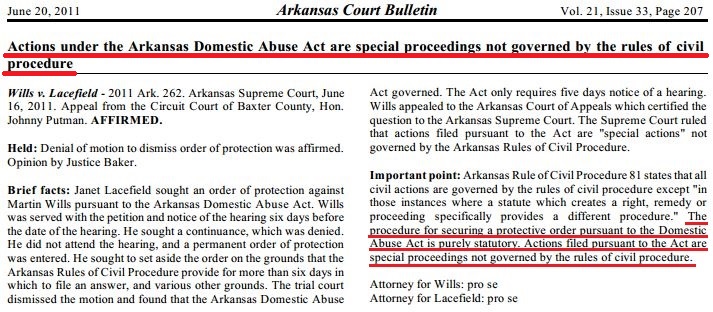
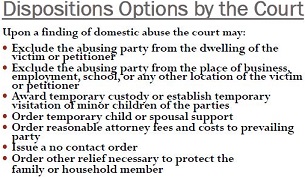

Women, who are often victims of abuse of court process, don’t want to implicate women in their injuries; they want to blame their false accusers, who are frequently men. Appreciate that this urge to blame men is the reason why restraining orders as processes of law exist in the first place.

Appreciate also that men aren’t the force behind the perpetuation of the status quo, and pointing fingers in their direction isn’t going to change that fact.

In the last month, I’ve sifted the Internet to discover what types of restraining order are available where and how to undo their misapplication. The most thorough source of information on restraining orders offered by the various states that I’ve found—and one I’ve repeatedly returned to—is WomensLaw.org.

It’ll tell you everything you ever wanted to know about restraining orders in your neck of the woods. Its domain name will also remind you why restraining orders exist and what they signify (there is no MensLaw.org).

After decades of rampant abuse’s being tolerated and with restraining orders’ having become a familiar institution, men have hopped onto the abuse industry bandwagon, and their malicious exploitation of restraining orders will probably continue to escalate with the passage of time.

The authorship of restraining orders, however, is by women, for women. Anyone with an interest in social justice or in reforming a handily abused process that fractures families and derails lives every day must acknowledge this fact and resist the reflex to divert blame from where it’s due.

The women who advocate for restraining orders don’t necessarily understand that they’re abused, why they’re abused, how they’re abused, or what the consequences of their abuse are. And they’re not going to take men’s word for it.

Copyright © 2014 RestrainingOrderAbuse.com

Ungoverned: Restraining Order Laws in Arkansas

not-governed

I’ve combed the Internet in recent weeks for motion-to-dismiss forms applicable to restraining orders issued in the 50 states. For Arkansas, there’s nothing to be found. Zip. If that weren’t suggestive enough that the process is a lock, consider the above entry excerpted from a 2011 Arkansas Court Bulletin.

This means an accuser may be awarded exclusive entitlement to the family residence; sole custody of children; a monthly stipend from the former breadwinner, who may find himself out of a job subsequent to being issued a “domestic abuse” restraining order; and reimbursement of costs. Filing for a protection order, in other words, may gain a plaintiff everything and cost her (or sometimes him) nothing—whether the allegations it’s based on are true, hyped, or lies.

The case commentary (which you’ll observe publicly discloses the names of the parties to the action) concerns a man who was served with a notice to appear in court to answer allegations of “domestic abuse” six days thence.

Rough translation: “Dear sir, you’re expected in a courtroom next week to respond to allegations that you beat your wife.”

For people who know nothing about restraining order processes, appreciate that this man was given less than a week’s time to prepare a defense against obviously serious charges with obviously serious repercussions. In six days, he was supposed to come to grips with public allegations that may have horrified him, procure an attorney’s services, gather relevant evidence and testimony, etc.

Six days.

The bulletin reports that the man “sought a continuance [postponement], which was denied.” He didn’t attend the hearing. The commentary doesn’t indicate a reason. His request to have the order set aside, because the expectation of an immediate response didn’t conform to the Arkansas Rules of Civil Procedure, was also denied. Why? Because the Arkansas Domestic Abuse Act trumps the rules of civil procedure.

This case exemplifies why restraining order adjudications strike so many people as Kafkaesque: “I move—.” “No.” “Then—.” “No.” “But—.” “The rules don’t apply in your case, sir, and we don’t negotiate our decisions.”

Defendants’ being railroaded, of course, is nothing extraordinary. “Emergency” restraining orders may allow respondents only a weekend to prepare before having to appear in court to answer allegations—very possibly false allegations—that have the potential to permanently alter the course of their lives.

Extraordinary is the Arkansas courts’ openly and nonchalantly recognizing in a bulletin that their protective order process is “not governed by the rules.”

Its proceedings are “special.”

Copyright © 2014 RestrainingOrderAbuse.com

“Redeeming Feminism”: Making It about Equality and Not Victimhood

Since the publication of this post, the feminist blog it cites and criticizes has been made private.


When criticizing injustices wrought by prejudicial, feminist-motivated laws and court procedures like the restraining order process, restraint isn’t easy to pull off.

It’s nevertheless worthy of striving for, because the gender divide that fosters the perpetuation of these prejudicial laws and procedures needs to be bridged—for the sake not just of their male victims but of their female victims, too.

I came across a blog yesterday titled, Redeeming Feminism. It arrested my attention, because its banner reads, “Equality of rights under the law shall not be denied or abridged by the United States or by any state on account of sex.”

The dramatic irony is lost on the blog’s author, but this is, of course, the argument against feminism, whose “second wave” has done at least as much to promote and enforce sexual bigotry as it has to eliminate it. (First-wave feminists, who sought to dissolve gender discrimination instead of cement it, were those who pushed for the 1972 Equal Rights Amendment from which the quotation above derives.)

Some feminists categorically can’t be reasoned with. They’re the equivalents of high-conflict courtroom litigants who reason with their feelings. But I don’t get the impression that the author of this blog is one such, and I think there are many self-styled feminists like her out there. She seems very much in earnest and without spiteful motive. Her intentions are well-meaning.



To judge from the wattage of her smile in the photograph of her on her blog, however, she’s never been stalked by someone only to have that person publicly and persuasively accuse her of stalking, or had it falsely suggested to authorities and the courts, for example, that she’s violent or a danger to children.

To quote a falsely accused woman I’ve corresponded with for the past six months, a professional nurse and mother of three who’s been through years of hell, that sort of thing “changes a person on a cellular level.” Had the blog author been subjected to what my correspondent has been—or what most of the respondents to this blog and to other blogs and petitions it links to have been—her smile would be considerably more muted (which would be a shame, because it’s a good smile).

This is the shortcoming of most vigorous feminist advocacy out there: It tends to see only what it was looking for in the first place. Its argumentation is based in the abstract. I wouldn’t wish the real on anyone, but before taking up arms, advocates of one position or another have a moral obligation to look up, down, and sideways.

The post on the referenced blog that I read is called, “Anti-Feminist Memes pt.3: ‘Domestic abuse, Men are the real victims’.” It rebuts the rhetorical strategies of counter-feminist “memes” on the Internet.

This is a meme.

This type of meme is extremely popular. In looking for memes to write about for this blog project, this theme was one of the most prevalent. Memes like these send a lot of messages simultaneously. First, they suggest that feminism is rooted in hypocrisy. They want us to assume that feminists not only support negative gender restrictions on men, but that they also encourage policy that will oppress men. A lot of these memes have phrases in them like “according to feminists,” “feminists believe,” and “feminist logic.” It’s not enough for these memes to suggest that men are oppressed more than women claim to be, the meme must also suggest that feminism causes and supports violence against men, with the aim of total male oppression.

Her criticisms, though spirited, lack balance. The “memes” she refers to don’t actually “suggest feminism is rooted in hypocrisy” (though this is certainly true of today’s feminism) or posit that “men are oppressed more than women,” nor do they appear to want anyone to “assume” anything. What they do is point out and denounce a double standard, which is an endeavor every true feminist should commend. The author of the blog doesn’t address the double standard; she takes a defensive tack and asserts that women are victims of violence and that such “memes” insensitively ignore this urgent fact.

This line of (emotional) reasoning basically says never mind if there is a double standard, because women are victims. It’s a logical bait-and-switch—and one that betrays unawareness that women are also injured by the same double standard.

meme2

These, too, are memes.

Laws that have arisen and been fortified in the last three decades in response to demands for the curtailment of violence against women are applied unequally and unfairly (which is another way of saying they disregard the most basic tenets of our Constitution). The prevalence of violence in the world is completely beside the point. John Doe isn’t his brother’s keeper and can’t justly be held to account for the actions of others. The fact is whenever anyone makes a complaint of domestic violence today, whether a woman or a man, his or her allegation may be presumed valid, especially in civil court, and the reason why this is so owes to feminist lobbying, which has engendered prejudice against defendants (who, once upon a time, were only men). When allegations of abuse are exaggerated or false, the consequences are often the same as they would have been had the allegations been true. Innocent men and women are rubbed out every day by procedures that are virtually automated. They’re criminalized, exiled from their families, stripped of property and resource, and sometimes barred from employment and even left living out of their cars or homeless.

The blog writer, a young woman, is piqued by domestic violence, as should we all be. Matters peripheral to it, like legal inequities, are lost in the shadows cast by its specter—and shouldn’t be. Even the specter itself is seldom scrutinized.

It must be considered, for example, that the authority for the statistic “1 in 4 women will experience domestic violence in her lifetime” cited by this writer (and which is commonly cited) is a pamphlet: “Domestic Violence Facts.”

Consulting its footnotes, you’ll find that this stat is derived from something called the National Violence Against Women Survey. In other words, the figure’s based on what women report on questionnaires.

Last week, I was sitting outside of a Starbucks in a posh strip mall and observed a couple standing 20 feet distant from me in the company of two others. The woman repeatedly belted the man in the shoulder and chest with a closed fist, and then proceeded to pinch him a series of good ones. He laughed and cringed from the attack. “Did you fart?” she demanded. He giggled. She punched him a few more times—good, resonant thwacks like you’d hear if you slapped a ham. She was still punching and pinching him when I turned back to my laptop.

What someone like the author of the blog I’ve cited would never conceive is that had this man called the cops and alleged that his wife assaulted him, there’s a very excellent chance that horseplay like this could cost her everything she owns, including her identity. “Did she punch him?” an officer might ask of witnesses. “Well…yeah, but….” And that might be that (criminal restraining order to ensue). It happens. Sometimes even the reports of onlookers precipitate arrests.

What everyone must be brought to appreciate is that a great deal of what’s called “domestic violence” (and, for that matter, “stalking”) depends on subjective interpretation, that is, it’s all about how someone reports feeling (or what someone reports perceiving).

Important to recognize is that how someone reports feeling about being punched or pinched may depend a lot on how that person is feeling toward the puncher or pincher at the time (or at a later time). In other words, actions that are harmless can be represented however a person wants to represent them.

When the state gets involved in private, interpersonal matters, consequences can be severe. What the “memes” the referenced blog writer confronts are concerned with is public perception that translates into law. Fervent condemnations of domestic violence don’t simply inform general opinion; they inform legislation and the application of laws by police officers and judges.

Feminist predilections, both to blame men and to perceive “violence” everywhere, encourage and, consciously or not, endorse exaggerated, impulsive, and/or false allegations. Feminism’s basic message to women today is, “You’re a victim.”

Is there any person walking the face of the planet over the age of five who hasn’t been slapped, punched, kicked, spanked, pinched, poked, or threatened? That’s a rhetorical question. Everyone has been the “victim of violence” if not the “victim of domestic violence” sometime in his or her life. The difference is not everyone is going to characterize him- or herself as a “victim.”

When someone like the author of the blog I’ve referenced uses the phrase domestic violence, she means wanton physical abuse and household terrorism, which is what the phrase used to mean. That’s not, however, how domestic violence is any longer defined by the law. The same phrase may be applied to angry phone calls—even a single angry phone call (which may easily be misrepresented or not even real). This blogger’s outrage is sympathetic; she’s just unconscious—as most people are—that the messages she’s outraged by aren’t veiled arguments in defense of battery; they’re rejections of a feminist message that has jaundiced popular perceptions and corrupted our laws and how they’re applied.

The zealousness of the public and of the authorities and courts to acknowledge people, particularly women, who claim to be “victims” as victims has produced miscarriages of justice that are far more epidemic than domestic violence is commonly said to be. Discernment goes out the window, and lives are unraveled based on finger-pointing. Thanks to feminism’s greasing the gears and to judicial procedures that can be initiated or even completed in minutes, people in the throes of angry impulses can have those impulses gratified instantly. All parties involved—plaintiffs, police officers, and judges—are simply reacting, as they’ve been conditioned to.

When everyone’s simply reacting, nobody’s actually thinking.

The road to feminism’s redemption will only be paved when feminists begin making observations like this.

Copyright © 2014 RestrainingOrderAbuse.com

You Be the Judge: On Those Who Blame for a Living, Restraining Orders, and the Golden Rule

Restraining order laws authorize lives lived decently to be discredited by judges in minutes, judges who know little or nothing about the people they presume to size up in a glance.

Defendants, men and women from all sectors of the social spectrum, report being made to feel like sex offenders based on knee-jerk character assessments and no certain facts. Parents and spouses are exiled for “offenses” alleged to be domestic violence that besides being unconfirmed may be unworthy of the label. Families are torn to pieces by accusations that may amount to no more than “name-calling, belligerent telephone calls at work, [or] a one-finger salute” (quoting DivorceSource.com, now defunct).

Judicial partiality in the restraining order arena is coyly called “paternal” by its practitioners. What it’s called by those whose lives are permanently altered by it for the worse is careless, callous, and/or cruel. Allegations that cost people their ambitions, children, life savings, and sanity may be exaggerated, cooked, or spitefully manufactured—sometimes obviously so.


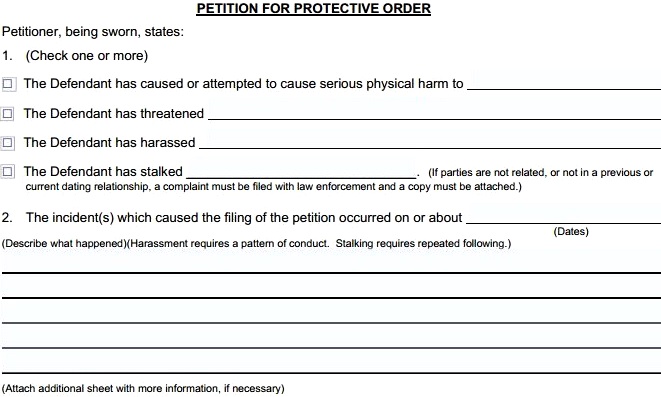
Yet rigid or even scalding denunciations from judges are commonly remarked. Social, political, and professional imperatives encourage and excuse tyrannical conduct from agents of the state who’ve been entrusted with protecting citizens’ civil rights and dignity, and these imperatives and this conduct are overdue for scrutiny, reproof, and realignment.

The superficial standards of arguably ill-conceived laws license neither judicial dereliction nor imperiousness.

Axiomatic in law is that “a judge is not the court.” This recognizes that judges are human beings, subject to foibles and flaws like everyone else, and what the law recognizes, judges must also. They, too, are imperfect parents, spouses, and people.

Here are some recent news stories that should serve as reminders that no one is above a measure of humility:

Judge ‘Tried to Frame’ Love Rival for Drugs, Assault in Years-long Scheme” (2013)

Judge’s Lawyer Husband Accused of Domestic Battery” (2009)

Judge Hits Daughter: Caught on Tape” (2011)

Alameda County Judge Charged with Elder Theft” (2013)

Illinois Judge Charged with Possession of Heroin, Guns” (2012)

Judge’s Daughter Wrecks Car, Kills Boyfriend in Drunk Driving Accident…and Sues the Driver That She Hit” (2008)

D.C.’s Top Judge Charged with Wrongdoing” (2014)

Judge Censured For Interfering In Son’s Kitten Abuse Charges” (2015)

Judge Charged with Stealing Cocaine from Evidence of Cases He Presided Over” (2013)

Broward Judge […] Charged with DUI” (2013)

Randolph County Judge Charged with Breaking Court Code because of Affair” (2014)

Judge’s Husband Sentenced for Hitting Her with Frying Pan” (2009)

Superior Court Judge Charged with Extreme DUI” (2012)

Former Philadelphia Judge Charged with Theft, Conflict of Interest” (2014)

Drug Court Judge’s Daughter among 10 Arrested on Pot Charges in Wilmette” (2013)

Federal Judge Charged with DWI, Dash-Cam Video Released” (2014)

Pennsylvania Judge Gets 28 Years in ‘Kids for Cash’ Case” (2011)

Judge’s Wife Makes Opposite Statements” (2011)

Judge’s Property Transaction Leads to a Charge of Fraud” (2013)

Judge’s Wife Charged with Attempted Murder, Accused of Poisoning Him with Antifreeze” (2013)

New Orleans Municipal Court Judge’s Wife Arrested after Biting Husband, Threatening Officers” (2014)

Judge[…]’s Son Indicted on Six Felonies, Nine Counts Overall” (2014)

Texas Judge’s Wife ‘Implicates Him’ in Triple Murder” (2013)

Judge Arrested in Connection with Wife’s Killing” (2023)

If members of the public aren’t to stereotype judges and their families according to such stories—of which the foregoing are but a smattering—then it’s only just that judges be expected to show the strangers who appear before them and whose welfare and prosperity may rest in their hands the same discernment and benefit of the doubt.

Copyright © 2014 RestrainingOrderAbuse.com

How Men Lie on Restraining Orders: A Tutorial for Feminists

The topic of this discussion is vicious men—not real men but the kind who’d make false allegations against a woman and ruin her for self-gratification or -gain.

Below is an excerpt from a standard restraining order form. Apply your imagination and consider how a man might exploit the opportunity it affords to trash a woman’s life. I’ll guide you. See the tick boxes and blanks? What he’d do is flick the cap off his Bic and write lies in the spaces provided. It only takes a few minutes.

A false complainant might allege, for example, that his girlfriend stalked him, coerced him into having sex, threatened to kill him, beat his daughter or made her smoke crack, etc. His motive might be revenge, or his motive might be to deflect blame from himself for actually engaging in the same or worse activities. Restraining order petitioners may be the real offenders, and the courts graciously provide them with the chance to compound their victims’ torment and walk away scot free. The first one up the courthouse steps is the “good guy.”

Besides a pen and a few minutes to kill, the only requisite for upending a woman’s life this way is a malicious will. For men to apply for false restraining orders against women is usually free (that is, the cost is covered by the taxpayer), as the Violence Against Women Act (VAWA) mandates it be.

All there is to making allegations on restraining orders is tick boxes and blanks, and there are no bounds imposed upon what allegations can be made. A false applicant merely writes whatever he wants in the spaces provided—and he can use additional pages if he’s feeling inspired. The basis for a woman’s being alleged to be a domestic abuser or even “armed and dangerous” is the unsubstantiated say-so of the petitioner. Can the defendant be a vegetarian single mom or an arthritic, 80-year-old great-grandmother? Sure. The judge who rules on the application won’t have met her and may never even learn what she looks like. She’s just a name.

The worst that happens is a fraudulently accused woman appears for a hearing after a week or two of sleepless nights (possibly spent living out of her car) and manages to persuade a judge that she’s not a stalker, child-beater, or whatever. Although even this won’t ensure the judge finds in her favor and dismisses the order, let’s say the judge does dismiss the order.

The false accuser is subject to no sanctions from the court and is at no risk of prosecution from the state, and it isn’t guaranteed that the dismissed restraining order will be expunged from the woman’s public record, which may be the public record of a kindergarten teacher, a therapist, or a police officer (even dismissed orders are stigmatizing and cost people jobs).

The man’s just out a little time and may still have cause to smirk.

And, anyway, he can always file for another restraining order later on. There’s no statutory ceiling on how many times he’s authorized by the state to do this. The sky’s the limit. He could even reapply for multiple restraining orders from different jurisdictions to up the fun.

High-conflict litigants can consume years of their targets’ lives like this. Between rounds of false allegations, their targets may languish in a personal hell, unable to reconcile themselves to betrayals and lies, unable to work in chosen professions because unable to rinse those lies from their public faces, and never knowing what to expect next or when. Whatever familial and social infrastructures depend on them may obviously crumble, besides.

How men lie on restraining orders and make wrecks of women’s lives—and how easily—should be clearer now.

How women lie on restraining orders and make wrecks of men’s and other women’s lives is exactly the same way.

Copyright © 2014 RestrainingOrderAbuse.com