
“Fraud is deliberately deceiving someone else [including a judge] with the intent of causing damage.”
—Cornell Legal Information Institute
“Generally, lying during trial (or any other part of litigation) is expected to come out at the time of trial. This means an action against someone for lying during a prior proceeding would fail because even lies are protected by the litigation privilege. You have to catch them at the time; you cannot attack them collaterally (in a different proceeding).”
—Attorney Catherine Elizabeth Bennett
Here are examples of restraining order fraud and repeated abuse of process (others are here and here, and comments and posts on this site are replete with them).
Here is the obstacle to obtaining relief from fraud committed by restraining order petitioners that the falsely accused face no matter how high up the judicial chain they muster the fortitude to climb:
- So-called protective orders were designed to allow battered women to apply directly to a judge for relief from household violence and intimidation. Their origin harks back to the late ’70s/early ’80s. When these orders were conceived 30 or 40 years ago, domestic violence was hush-hush, and (actual) victims faced alienation from their families for airing dirty laundry in public and rocking the boat. They faced, as well, the possibility of their claims’ being discounted by police or even ridiculed (compounding their misery and humiliation). So the middlemen (i.e., cops and prosecutors) were cut out of the process. Thus could allegations be made and ruled upon in the absence of any investigation. It seemed a reasonable stopgap at the time. Over the decades since, despite radical changes in how claims of domestic violence are received by the public and law enforcement (due in no small part to the investment of billions of federal tax dollars), the standards for substantiating an assertion of victimhood remain lenient, while what qualifies as grounds for a court injunction has steadily broadened. People now get orders against their friends, lovers, neighbors, moms, dads, kids, etc., and violence need not even be alleged; some claim of apprehension usually suffices. The process has morphed from a life-preserver for battered women with no other way out of a hellish situation to a sop to satisfy any complainant who fills out an application. Court policy pretends that anybody who walks into a courthouse with a beef (real or not) deserves a private audience with a judge to shield him or her from the terrors of public scorn or disapproval from the cops. Anyone with an ax to grind, that is, is treated like a battered woman circa 1979. So institutionalized has the process become, and so profitable to so many (both financially and politically), that no one questions whether this is ethical. So the restraining order process has become a game, a game played according to anachronistic rules. Maximum latitude is given to anyone (no fee or i.d. required) to litigate any claims s/he wants in a backroom conference with a judge, and rulings are issued ex parte, which means the person who’s accused is prejudged sight unseen. The due process rights of the accused are scotched. Grants under the Violence Against Women Act will explicitly forbid the use of lie detectors. The dictate is purely rhetorical; it’s meant to stress that what a complainant alleges shouldn’t be doubted. This expectation extends to any petitioner. Hence judicial scrutiny is minimal, and judges may actually bristle when the falsely accused allege that petitioners are lying. This is called fair and just.
- The idea behind “litigation privilege,” which basically ensures that whatever a litigant or his or her attorney alleges is protected from liability (from charges of defamation, for example), is the same: Accusers need to feel secure to air “the facts” without fear of prosecution.
The protections sketched above were not put in place to defend the right of any fraudster to falsely allege anything off the top of his or her head against a target of malice in a court of law. Perjury, after all, is a statutory crime. Lying isn’t condoned by the law, but it is swallowed by cops and defended by judges.
They’ve had their priorities impressed upon them in no uncertain terms.
So emphatic is the priority to give accusers the benefit of the doubt that people who’ve been wrongly accused have little or no credibility with judges and absolutely no recourse to sue for damages caused by false allegations (to reputation, employment, enjoyment of life, and health). The court doesn’t recognize there are any damages to being falsely accused of stalking, for instance, or violent threat, sexual harassment, assault, or even rape. False accusations that are dismissed as baseless are harmful enough (the stresses they cause are beyond quantification). When false allegations stick, the guilt of the accused is presumed, and subsequent legal actions they may venture to undertake (lawsuits and appeals) may be summarily tossed for lacking merit. In contrast, the merit of rulings that are typically the products of procedures lasting mere minutes isn’t questioned. Some judges will even hold that accusations litigated in court can’t constitute perjury because of the “litigation privilege” (i.e., because they were uttered in court instead of on, say, Facebook or the radio, they can’t be lies).
Accusers (all of them identified with battered women of 1979) must be free to claim whatever they want without fear of risk or blame—that’s the overriding precept. Translated, this means the court’s position is that people must be allowed to lie and snooker the court as they choose…and anyone who’s lied about be damned.
Copyright © 2015 RestrainingOrderAbuse.com
*From “‘Out of Left Field’: The Litigation Privilege Defense to Adverse Party Suits” by attorney Keith A. Call (emphases added):
Despite some authority characterizing the litigation privilege as “absolute,” it is certainly not without limits. There are some claims for which the litigation privilege is usually not a defense. Such claims may include malicious prosecution, fraud, criminal perjury, suborning perjury, and professional discipline. See, e.g., Hagberg v. Cal. Fed. Bank FSB, 81 P.3d 244, 259 (Cal. 2004) (the litigation privilege “operates to bar civil liability for any tort claim based upon a privileged communication, with the exception of malicious prosecution”); Bushell v. Caterpillar, Inc., 683 N.E.2d 1286, 1289 (Ill. Ct. App. 1997) (litigation privilege does not provide immunity from criminal perjury); Hawkins v. Harris, 661 A.2d 284, 288 (N.J. 1995) (litigation privilege is not bar to professional discipline or criminal perjury); Dello Russo v. Nagel, 817 A.2d 426, 433 (N.J. Super. Ct. App. Div. 2003) (litigation privilege does not insulate against malicious prosecution or professional discipline); N.Y. Cooling Towers, Inc. v. Goidel, 805 N.Y.S.2d 779, 783 (N.Y. Sup. Ct. 2005) (refusing to dismiss claims against adverse party’s attorney based on fraud and collusion); Clark v. Druckman, 624 S.E.2d 864, 870-72 (W. Va. Ct. App. 2005) (litigation privilege does not immunize attorney from claims of fraud or malicious conduct).

 The 148 search engine terms that appear below—at least one to two dozen of which concern false allegations—are ones that brought readers to this blog between the hours of 12 a.m. and 7:21 p.m. yesterday (and don’t include an additional 49 “unknown search terms”).
 Since restraining orders are “civil” instruments, however, their issuance doesn’t require proof beyond a reasonable doubt of anything at all. Approval of restraining orders is based instead on a “preponderance of evidence.” Because restraining orders are issued ex parte, the only evidence the court vets is that provided by the applicant. This evidence may be scant or none, and the applicant may be a sociopath. The “vetting process” his or her evidence is subjected to by a judge, moreover, may very literally comprise all of five minutes.
 You know, a box like you’ll find on any number of bureaucratic forms. Only this box didn’t identify her as white or single or female; it identified her as a batterer. A judge—who’d never met her—reviewed this form and signed off on it (tac), and she was served with it by a constable (toe) and informed she’d be jailed if she so much as came within waving distance of the plaintiff or sent him an email. The resulting distress cost her and her daughter a season of their lives—and to gain relief from it, several thousands of dollars in legal fees.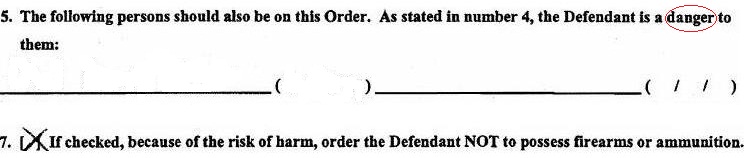
 The ethical, if facile, answer to his or her (most likely her) question is have the order vacated and apologize to the defendant and offer to make amends. The conundrum is that this would-be remedial conclusion may prompt the defendant to seek payback in the form of legal action against the plaintiff for unjust humiliation and suffering. (Plaintiffs with a conscience may even balk from recanting false testimony out of fear of repercussions from the court. They may not feel entitled to do the right thing, because the restraining order process, by its nature, makes communication illegal.)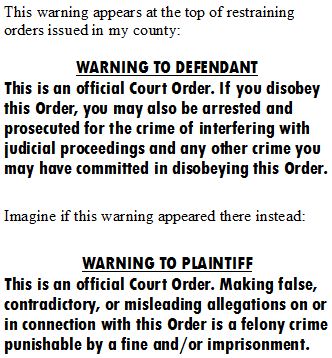
 If the courts really sought to discourage frauds and liars, the consequences of committing perjury (a felony crime whose statute threatens a punishment of two years in prison—in my state, anyhow) would be detailed in bold print at the top of page 1. What’s there instead? A warning to defendants that they’ll be subject to arrest if the terms of the injunction that’s been sprung on them are violated.
 TALKING BACK to restraining orders