How an Innocent Woman May Be Accused of Molestation, Rape, or Murder and Have to Live with It

Consider the following allegations:

“She has repeatedly exposed herself to me.”

“She told me on multiple occasions that if I wouldn’t have sex with her again she would tell the police I raped her.”

“She has stalked me since I met her. I’ve kept a dated log of all of the instances when she appeared someplace where I was. I’ve told her to leave me alone but she won’t. She says I’m her ‘destiny.’”

“She grabbed my crotch. When I pushed her hand away and ran, she laughed and called me a ‘pussy.’”

“I loaned her money. She told me if I asked for it back one more time, she and a friend of hers would hurt me. She bragged that they had killed someone before.”

“She has sent me panties covered with blood, urine, and feces. I threw them away because they were disgusting.”

“She showed me a knife and said that if I didn’t leave my girlfriend she would ‘cut her good.’”

“She said she wanted to drink my blood.”

An affidavit on a protective order application could include any or all of these statements and any number of others, including, say, alleged confessions of any act conceivable by the imagination of the accuser.

An affidavit, that is, a statement of facts alleged and sworn to be true, can usually be of any length and could include detailed descriptions of the accused’s anatomy, commentaries on his or her hygiene, and judgments of any variety, besides including an account of “what happened.”

There are no rules, and the court cannot retroactively censor what is effectively a complainant’s testimony.

Note that none of the accusations listed above could ever be ascertained as true or false, and a judge, accordingly, has no particular investment in “the truth.” His or her job, as prescribed by the law, is to decide whether the accuser is convincing.

An even cruder fact is that a judge may never read a complainant’s affidavit at all but simply ask for a verbal accounting, that’s if s/he does anything more than make sure the paperwork is filled out correctly. Once validated by a judge’s signature, unless contested and successfully quashed during a hearing that may be afforded 30 minutes on a judge’s docket, the order is a binding instrument of law and an indefinitely preserved public document that can be quoted or published.

Restraining orders are typically issued ex parte. That means based on the accuser’s say-so only. The accused may know nothing about it until a law enforcement officer or agent of the court appears at his or her door, possibly in the presence of friends, family, and/or neighbors.

The whole application and approval process may take from a few minutes to a few hours.

The latitude granted to judges in this arena of law is virtually boundless, as the politicking behind so-called “women’s law” intended it to be. A single statement from the list that heads this post, delivered persuasively enough, could suffice to make any number of allegations “stick” (whether relevant or not). Or repeated emphatic claims of terror and violation could. Or the testimony of a crony witness. Or a real or faked series of text messages or emails. Or a real or spoofed series of calls on a phone (which, if real, could have been about anything).

As Ralph Nader said, “Power has to be insecure to be responsive.” To judges, this business is just quotidian paper-shuffling, and they have no liability for their rulings, which are issued without oversight (including by judges who aren’t even judges but merely seasonal temps). Grounds for appeal, furthermore, are almost none (and “lying” is not among the few).

A reasonable person would conclude that anyone who supported laws that would allow a woman to be falsely accused of molestation, rape, or murder would have to be a monster.

The left-leaning feminist humanists and self-styled social justice advocates who do militantly support these laws emphasize their virtue: bringing relief to women in abusive relationships. This is somewhat like explaining communism’s goal is the protection of the working class citizen—while ignoring that tens of millions of working class citizens have been killed in the name of an idealistic social experiment.

Perhaps social justice crusaders who promote “women’s law” would say they’ve only ever meant for it to treat men monstrously.

Copyright © 2022 RestrainingOrderAbuse.com

*In civil lawsuits that aren’t filed for free, as restraining order applications usually are, a defendant could move the court to strike inflammatory statements that weren’t relevant and that could only serve to damage (his or) her reputation and, for example, professional standing (and health, security, interpersonal relationships, etc.). Whether this would fare any chance of success in drive-thru procedures conceived to permanently document misdeeds is less than iffy. (It would require redacting, or “blacking out,” parts of the original order, which is contrary to its purpose.)

Naked Wrestling for a Cassette Recorder: What Does a Protection Order Affidavit Look Like?

“Finally, we asked the men about other behaviors that their women partners might have used that could be considered psychologically aggressive. Specifically, 67.2% reported that their partner falsely accused them of hitting or beating her; 38.7% reported that she filed a restraining order against him under false pretenses; 48.9% of the men with children reported that their partners falsely accused them of physically abusing the children, and 15.4% reported that they were falsely accused by their partners of sexually abusing the children.”

—“A Closer Look at Men Who Sustain Intimate Terrorism by Women” (2010)

Incident rates of false allegations of family violence, it’s often casually reported, are no higher than incident rates of false allegations of other types of crimes. Figures are put somewhere between 2 and 8%. These figures are promulgated by parties who deny that lying about violence in civil and family court is significant.

The claimed correspondence between the frequency of false allegations of family violence and the frequency of false allegations of other crimes isn’t just wrong; it’s make-believe. False allegations of other types of crimes are litigated in criminal court. Often accusations of family violence (besides harassment, stalking, sexual harassment, and violent threat, among others) are not, and there are no “false allegations” in civil court. Rulings aren’t based on the truth or non-truth of allegations. They’re based on what the judges believe is probable. Allegations may be determined “baseless,” but they’re not called “false.”

Whoever says the rate of false allegations in civil court is X has just invented a convenient statistic that can’t be confirmed or confuted. Accusers aren’t going to admit it if they’d lied, so they’re not a reliable source of data, and court rulings are never stamped FALSELY ACCUSED.

The only way to estimate how much lying goes on is to ask people who’ve been accused if they’ve were lied about.

That’s what the researchers in the cited National Institutes of Health (NIH) study, Denise A. Hines and Emily M. Douglas did: They asked, and the answers they received place the figure at 67.2%, dramatically higher than 2 to 8%.

Those interviewed for the study were men in heterosexual relationships who reported being battered (i.e., men whose female partners were reportedly violent), and science forbids application of this statistic to other contexts. But it’s certainly suggestive. It could be that women who are violent lie more readily than women who abuse in other ways, but to contend that only violent women lie about fear and violence would be to beggar (or bugger) credibility.

(Men also lie about fear and violence, of course, but among complainants to the court, women outnumber men by a factor of four—80% to 20%, roughly. Also, domestic violence acts—from which restraining order laws originate—are “women’s law,” not men’s, and women’s advocates and feminist sympathizers are the political force behind it.)

We’re told that protection orders rescue women and children from environments of chronic violence. We hear that allegations of chronic violence may be false. What do allegations actually look like, and how does the process for litigating them work?

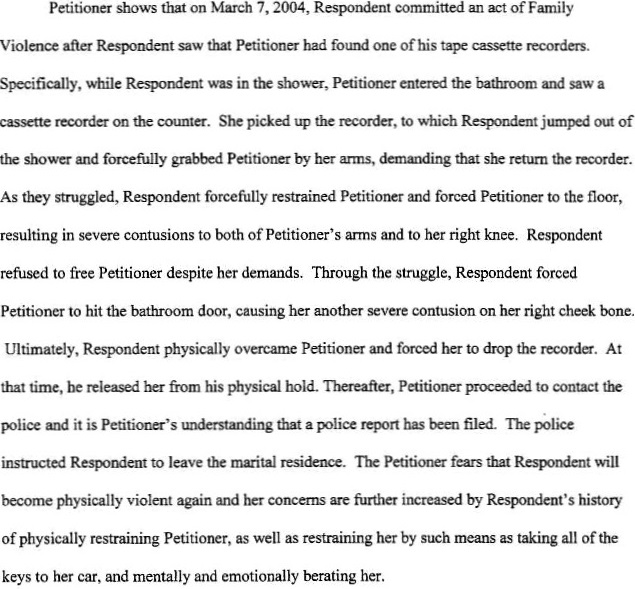
A commenter, Mark Shumate, recently reported that he was removed from his home based on this affidavit (i.e., narrative to the court), which he says was “perjured”:

protection order affidavit

According to this bizarre story, the man had “one of his cassette recorders” with him in the bathroom (maybe he was a collector of vintage tech and never went anywhere without it). His wife “found” the recorder—apparently by entering the bathroom while the man was showering. She then “picked up” the recorder her husband had in the bathroom with him. This inspired the husband to “jump” from the shower and wrestle her for it (rather than just pull it from her grasp), and the alleged tussle resulted in the wife’s sustaining “severe contusions” to both arms, her knee, and her cheek. In lay terms, that’s four bruises (contusions are bruises). What made them “severe” bruises isn’t clarified, nor is there an indication that the bruises were documented.

This is the wife’s account of something that may or may not have actually occurred.

The language is important: The wife is said to passively intrude on a private bathroom moment, while the actions of the man (who, according to the story, is presumably naked with shampoo in his eyes) are described in maximally inflammatory terms: “jumped,” “forcefully grabbed,” “struggled,” “forcefully restrained,” “forced,” “refused,” and finally “physically overcame.”

Naturally, none of what’s described was witnessed. The details are asserted; they’re not facts. The words are sufficiently gripping, however, to distract attention from the implausibility of the story they’re purported to recall (namely, that of a wrestling match in the john between a naked man and his wife over a tape recorder).

Based on this squidgy tale of an uncorroborated bathroom incident recounted in an ex parte petition for a family violence protection order prepared by a law firm, the wife was able to:

  1. have her husband removed from his home and ordered to not to come with 500 yards of it, his children, or his wife;
  2. gain “temporary and permanent” custody of the children;
  3. be granted “exclusive use and control of the marital residence”;
  4. be “awarded temporary sole possession” of the family car;
  5. request to have her husband ordered to pay alimony and child support; and
  6. request to have her husband ordered to pay her attorney fees (for having the protection order petition drafted).

On the basis of the same sketchy story, the wife was able to plausibly allege fear of “further violence,” as well as allege a “prior history” of physical restraint, withholding of car keys, and verbal abuse that caused her “mental and emotional” pain.

The number of people who know whether any of this is true are two: the woman with the house, the kids, the car, and the cash…and the man without them.

Copyright © 2015 RestrainingOrderAbuse.com