An Anagram of RationalWiki Is “A Liar—I Know It”: Talking Back to Little Sisters Who Play Big Brother

They have a network of informants. They target dissenters, lump them, and apply a label. They maintain lists. They coerce lockstep conformity with their perspectives by ridicule and censure….

No, I don’t mean the former East German secret police; I mean those liberal/feminist pretenders to enlightenment and humanism whose robotic pronouncements are so clotted with jargon they actually read like computer code: YEC, ID, MRAs, MGTOWs, PUAs, Nice Guys/Incels/AFCs, TERFs, radfems, Randroids, etc.

RationalWiki’s logo, fittingly, is a disembodied brain.

Don’t underestimate the potency of nerds, though. They have Twitter accounts…and they’re not afraid to use them.

I learned the other day that this blog had been put on one of their blacklists. If my motive for writing about reprehensible acts like fraud, corruption, perjury, betrayal, parental alienation, discrimination, legal abuse, judicial dereliction, and bullying people to suicidal despair were self-promotion instead of firsthand knowledge of the ruin they cause, I might be flattered that my desultory musings had achieved the notice of (dotdotdotDAAAAAA)…

RationalWiki.org. (Enter Chihuahua, stage left, in a tutu,)

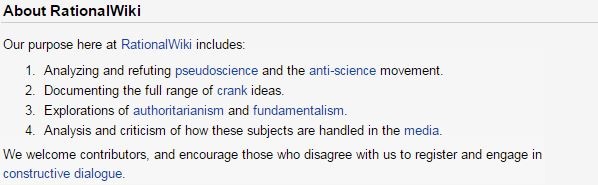
No, I didn’t know there was a RationalWiki.org, either—and after visiting the site, I’m still not sure there is. If “rational” is meant to imply “having reason and understanding,” then this is to report the domain name lacks qualification. The word rational can also mean “involving division,” however. Maybe that’s what the editors meant.
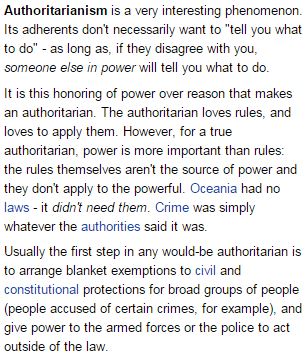
RationalWiki, “Authoritarianism”

The rhetoric of sites like this isn’t without its amusements. For example, RationalWiki invites its audience to “Check Our Entitlement.” In other words, it doesn’t want to exclude the less advantaged, or seem to talk down to them.

Considering there’s nothing on RationalWiki that doesn’t smack of pop-culture-poxed, pseudo-intellectual, East Coast establishment condescension, and that the educationally impoverished victims of racism and classism that RationalWiki purports to defend probably couldn’t track a fraction of what’s published there, the invitation to “Check Our Entitlement” deserves to be met with chorus of raspberries or a barrage of moldy tomatoes.

The page on RationalWiki that pans the blog you’re reading is charmingly titled, “Webshites.” The word is a pun that will only be understood by fans of the BBC or the novels, say, of Graham Swift—and there’s nothing elitist or alienating about that. (Shite is Anglo-Irish for shit.)

RationalWiki accuses this site of being “sexist.” Since RationalWiki is plainly a stalking-horse for feminist and otherwise PC propagandists, this site proposes it’s projecting. Since RationalWiki is blind to the wealth of pain its derelict dogma produces, this site further proposes it’s vicious.

Finally, this site’s editor dismisses RationalWiki’s editors as a collective of dorks.

Copyright © 2015 RestrainingOrderAbuse.com

*Propaganda is “the spreading of ideas, information, or rumor for the purpose of helping or injuring an institution, a cause, or a person” (Merriam-Webster’s Collegiate Dictionary). This is how information control is disguised:
This is reality:
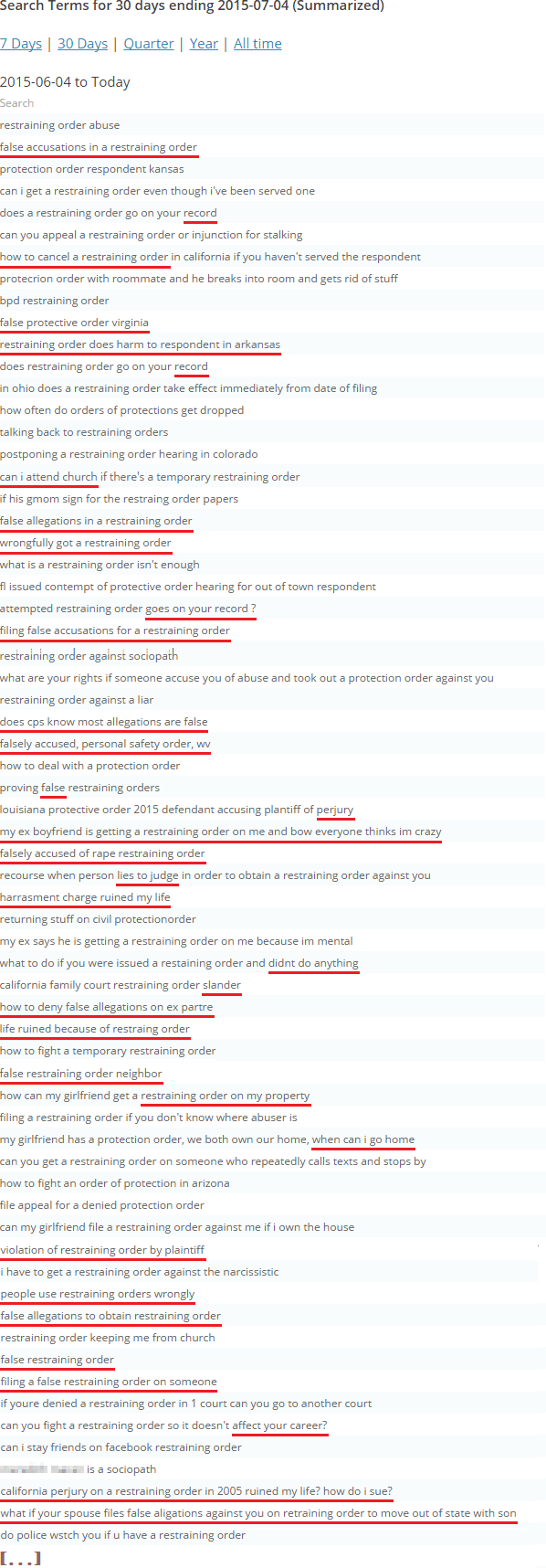
Rhetoric and Restraining Order Rampancy

“Rape culture exists because we don’t believe it does. From tacit acceptance of misogyny in everything from casual conversations with our peers to the media we consume, we accept the degradation of women and posit uncontrollable hyper-sexuality of men as the norm. But rape is endemic to our culture because there’s no widely accepted cultural definition of what it actually is.”

The Nation Magazine (February 4, 2013)

I’m not certain I even know what this means. Rhetorically, though, it’s impressive. In a single sentence, its writers “establish” that we are all of their party and that something exists, because we don’t believe it does.

I won’t pretend to know anything about The Nation, but does a position like this pass for responsible journalism? I’ve surveyed a lot of this kind of writing recently, and it alarms me for more than just the reasons that I (1) don’t believe we do “accept the degradation of women,” (2) don’t believe that rape is “endemic to our culture” any more than it is endemic to the animal kingdom, and (3) do believe the definition of rape is pretty clearly and universally understood.

What the writers mean, I guess, is that rape culture, which they haven’t established exists in the first place, continues to exist, because we unknowingly contribute to its perpetuation by saying and doing things that we are not aware reveal our unconscious hatred of women. You didn’t know you hated women? Well, you do.

We all do, apparently. And shame on us for it.

You see how this rhetoric works. It’s more than just assertive; it’s coercive. A lot of it also betrays patently false reasoning that masks what’s actually propagandist badgering. The source of its outrage is sympathetic; how it expresses that outrage is significantly less so.

Consider this line of argument: “When an instance of sexual assault makes the news and the first questions the media asks [sic]are about the victim’s sobriety, or clothes, or sexuality, we should all be prepared to pivot to ask, instead, what messages the perpetrators received over their lifetime about rape and about ‘being a man.’ Here’s a tip: the right question is not, ‘What was she doing/wearing/saying when she was raped?’ The right question is, ‘What made him think this is acceptable?’”

“During the postwar period of Radical Reconstruction (1867-1877), many white writers argued that without slavery—which supposedly contained their animalistic tendencies—blacks were reverting to criminal savagery. The brute caricature portrayed black men as threatening menaces, fiends, and sociopaths, and as hideous, terrifying predators who targeted helpless victims, especially white women.”

(Note the Freudian slip: “an instance” has “perpetrators,” plural. It’s not for nothing that some have perceived in writing like this the tacit belief that all men are rapists.)

First, how has the postulated “instance of sexual assault” been qualified as such? These writers presume that an incident is an “assault” with a “victim.” The overwhelming likelihood in a case like this is that it is what it appears to be, but it’s not the job of investigators, including journalists, to equate appearances with facts. There are no “right” questions. Some questions may be tactful, some rude or insensitive, some effective at exposing the truth, some less so. The value or “rightness” of a question can only be judged in hindsight, as writers for a news magazine should know.

If all journalists shared these writers’ jaundiced perspective or felt constrained to only ask “appropriate” questions, how many instances of false allegations should we imagine would ever be recognized, let alone sanctioned? I have an interest in false allegations, and the answer to this question disturbs me.

I’ve surveyed studies of the incidence rate of false allegations of rape, and I have no reluctance allowing for argument’s sake that rape is rarely alleged falsely. What I have a problem with is the non-recognition of the harm that’s wrought when rape is alleged falsely—and no one argues that this never happens. The life of an innocent may be destroyed. And we will have destroyed it.

A rape is a fait accompli. Before we know about it, it’s done. Falsely prosecuting someone for rape (or anything else), however, isn’t a case of a bad person doing a bad thing. It’s a case of bringing the full weight and menace of the state to bear on an innocent person. Prosecution is a choice that we are all answerable for.

Although the writers would argue the contrary (and do), society isn’t accountable for the actions of individuals. It is, however, accountable for the actions of its elected officials, agents, and representatives. We are accountable, and we collectively must be guided by a higher moral standard than any one individual. We craft laws and policy, and we have an ethical responsibility to ensure laws and policy are fair and scrupulously applied.

This blog isn’t about rape. But what it is about, restraining order abuse, is a product of the rhetoric exemplified by the article I’ve criticized. Propagandist writing about harassment isn’t what keeps eyes diverted from restraining order injustice, and it isn’t what has spawned the “abuse industry.” Writing about violence against women has.

I could argue that restraining order abuse exists because we don’t believe it does. But it’s more clearly said that it exists because we believe the propaganda—or are too intimidated to scrutinize or take exception to it.

Copyright © 2014 RestrainingOrderAbuse.com

Feminism and Gender Guilt: On Restraining Order Policy’s Encouraging Judges to Abuse Men

A police officer’s job is to enforce policy, not interpret it. And policy respecting allegations made pursuant to seeking a restraining order, in particular allegations made by women, is to take the truth of those allegations for granted.

Judges, on the other hand, are paid—and quite handsomely—to interpret evidence and testimony, and to apply policy based on deliberated conclusions.

So how is it so many men are railroaded through a process that may be initiated on no evidence at all, may strip them of their most valued investments and every bit of social and financial equity they’ve built in their lives—kids, home, money, property, business, and reputation—and may ensure that they’re never able to recover what they’ve been deprived of?

Feminists don’t acknowledge their political might, because that would be disadvantageous to their accumulating more of it. They continue to plead victimization and to promote skewed or bogus statistics like one in four women are prey to rapists or attempted rapists, women earn a mere fraction of what men do, girls are ignored by their teachers, and battery is the leading cause of birth defects and increases by 40% on Super Bowl Sunday.

Enterprising journalists like Ken Ringle and dissident feminist scholars Christina Hoff Sommers and Camille Paglia have long ago debunked all of these claims, yet they continue to circulate. The feminist propaganda machine hums right along. And its malign and maligning influence has been very effective.

(Besides the aforementioned feminist scholars, journalist Cathy Young and Elaine Epstein, former president of the Massachusetts Bar Association, have called giving attention to restraining order administration long overdue—in articles published 10 to 20 years ago.)

Judges and the judicial system proceed in matters of protection of women as father-guardians (which mainstream feminists don’t seem to find patronizing or infantilizing). The rhetoric is defendants are presumed innocent; the practice is they’re presumed guilty. Judges—more often than not male—pander to the women who come before them to beg their intervention; men are treated like police suspects.

Judges of these matters, like the women who introduce them, aren’t bound by the same ethical restrictions that obtain in other sorts of cases (especially if there are no lawyers present). A detective in the county attorney’s office I spoke with put it this way: because restraining orders grew out of a clamor to address domestic violence, judges are inclined to let their inner vigilantes off leash when a male defendant appears before them. They’re glad to have a trussed target for their frustrated wrath and to play the white knight.

The slack standards that govern restraining order administration are defended as leveling the playing field. They’re in fact engineered to level men. The judges who do the administering are predisposed by policy and propaganda to regard male defendants through jaundiced eyes and to bring the gavel down on their heads.

It’s probably very cathartic for them.

Copyright © 2013 RestrainingOrderAbuse.com