Legal Abuse and “Learned Helplessness” (Including Commentary on the Mythical Value of “Taking the High Road”)

“Learned helplessness is behavior typical of an organism (human or animal) that has endured repeated painful or otherwise aversive stimuli which it was unable to escape or avoid. After such experience, the organism often fails to learn escape or avoidance in new situations where such behavior would be effective. In other words, the organism seems to have learned that it is helpless in aversive situations, that it has lost control, and so it gives up trying. Such an organism is said to have acquired learned helplessness. Learned helplessness theory is the view that clinical depression and related mental illnesses may result from such real or perceived absence of control over the outcome of a situation.”

Wikipedia

I introduced this psychological theory to a judge in 2010 when I filed a lawsuit against a woman who falsely accused me to the police and multiple courts in 2006. The accusations began in March, and before the close of July, she had defrauded at least four judges.

To be falsely accused is bewildering; it savages the mind. To then learn that efforts to expose the truth are met by judges not with keen interest and probing questions but variably with mute indifference, scornful derision, and offhand dismissal—that’s to have it firmly impressed upon you that resistance is futile. Worse, it’s to learn that resistance compounds the frustration and pain.

The system isn’t on your side, and bucking it for many is just an invitation to be scourged afresh.

After attempting some direct appeals to people who, I reasoned, might care more about the truth than the court did (2007), then writing about the business online (2008), then employing an attorney to mediate a resolution (2009), all of which efforts were met with stony silence, I filed a lawsuit (on my own).

That was in 2010. By then, unknown to me, the statutes of limitation on the civil torts I alleged—fraud, false light, defamation, and intentional infliction of emotional distress—had flown. My accuser’s attorney, with mock ingenuousness, wondered to the court why I hadn’t filed my suit in 2006, right after having had the court twice swat down my appeals.
learned_helplessnessI offered the explanation to the judge that people who go through this become conditioned to helplessness (or hopelessness), because process militates against the proposition that a claimant of abuse has engaged in deception. The righteous indignation and outrage of the wronged defendant gradually succumb to the inevitable conclusion that facts, truth, and reason are impotent against fraud and judicial bias. (The defendant lives besides under the constant menace of unwarranted arrest.)

I didn’t know I could prosecute a lawsuit on my own until a legal assistant told me so in 2009, which I also told the judge. I might have been motivated to find out sooner if I’d had the least faith that a judge would heed my testimony.

My accuser’s attorney disdained the explanation for my tardy filing as “self-diagnosis,” and the judge eagerly echoed his assessment and dismissed the case (the court’s interest is in economy, not truth or justice). What was another six months of my life? (Letters from a physician and a therapist, along with witness affidavits, including one from a former cop, made no difference.)

I wasn’t wrong, though. People who defy a rigged system—whether restraining order defendants, domestic violence defendants, or family court defendants—can be conditioned to helplessness, and many accordingly report experiencing posttraumatic stress (which fortifies their distrust and their aversion to further rude scrutiny and contemptuous treatment from the court).

A lesson to take from this is that the “high road” (i.e., trusting in facts, truth, and reason) is a detour to hell. If I had known in 2006 what I know today, I could have extricated myself from my accuser’s false accusations in five minutes by playing the game according to her rules, which were “whatever works.”

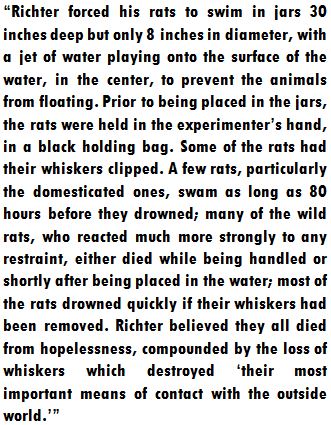
The studies from which the term “learned helplessness” emerged were studies of drowned rats and tortured dogs. Playing fair (or aspiring to saintliness by never uttering an ill word against your accuser) is noble, but nobly drowned is still drowned. If an accuser lies about you, denounce him or her as a liar. Similarly, if a process of law is bullshit, call it what it is.

Some respondents to this blog, even after they’ve been through the courthouse ringer, retain a beleaguered faith in ethics. They believe that if injustice is laid bare to a discerning audience by rhetorical appeals to reason and decency, this will spur change. “Our objective is to fix the problem, not the blame” was quoted in a recent comment.
The abstract and impersonal may be informative, but they don’t arouse curiosity, because they don’t inflame the passions; controversy does. Advocates of the “high road” eschew naming names, for example, because it’s aggressive. Avoidance of confrontation, however, accomplishes little and exemplifies “learned helplessness.” The “high road” is safe and tame, and it leads to a dead-end.

The reason restraining order abuse endures is that the abused are paralyzed by indecisiveness. They won’t knuckle down and demand that a flawed process be repealed.
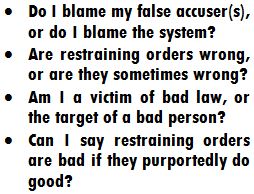
Among people who’ve been damaged by fraudulent abuse of restraining orders and related civil court procedures that are supposed to protect the defenseless, you’ve got, for instance, your liberals who’ll defend the process on principle, because they insist it must be preserved to protect the vulnerable, and they’ll fence-sit just to spite conservatives who flatly denounce the process as a governmental intrusion that undermines family.

Liberals and women who identify with legitimately victimized women feel obligated to “negotiate the gray space” and acknowledge the pros and cons of “women’s law.”

Then you have people (of whatever political allegiance or none) who believe that if you eliminated procedural inequities and ensured that defendants’ due process rights were observed, the system would work fine.

Maybe they believe a process that allows a person in Nevada to mosey into a courthouse, fill out some forms, and accuse a person in Wyoming of “stalking” or “domestic violence,” necessitating that the person in Wyoming hustle him- or herself to Nevada to present a defense within the week, can be made fair, and maybe they don’t know that the same Nevadan can prosecute the same claim over and over against the same Wyomingite (three times, six times, a dozen times, or more).

Maybe they believe that appeals to public conscience will urge the passage of laws that require free legal counsel be provided to defendants.

This would mean that if, say, a million restraining orders are petitioned a year, and legal representation for each defendant in each case could be capped at $2,000 (which might translate to a feeble defense, anyway), state governments would be required to shell out $2,000,000,000 to make everything “fair and square.” But that’s not all. If government gave free representation to “abusers,” advocates for “victims” would demand the same for them. So your $2,000,000,000 would become $4,000,000,000.

That’s per annum. (Also, the hypothetical Wyomingite would still need to travel to Nevada, and who’s paying for that?)

Others believe that if lying (perjury) were prosecuted, that would straighten things out. The costs to prosecute what may be hundreds of thousands of liars a year might be less than $4,000,000,000…or it might not be. Too, how do you prove someone is lying about an emotional state, like “fear”? How do you prove an alleged event didn’t happen?

You can’t, not conclusively, which is what a criminal prosecution requires.

More say appeal to your senator, to the president, to the press…nicely and cogently. They follow a utopian faith that basic decency will prevail if “the problem” is exposed.

As a rhetorical stance, the position has its merits. It suggests calmness and rationality, and calmness and rationality should recommend attention from others. “We’re calm and rational,” proponents of the position imply, “so when we say there’s a problem in need of fixing, it’s calmness and rationality speaking, not anger.”

The limitation is that no one who needs to be convinced has a motive to listen. No one can be made to care about abstractions like equity and due process when in the other ear they’re being cited statistics about epidemic violence.

Everything to do with the law is adversarial. If you seek to revise it without being personal or confrontational, the soonest you can expect a just reward is in the afterlife.

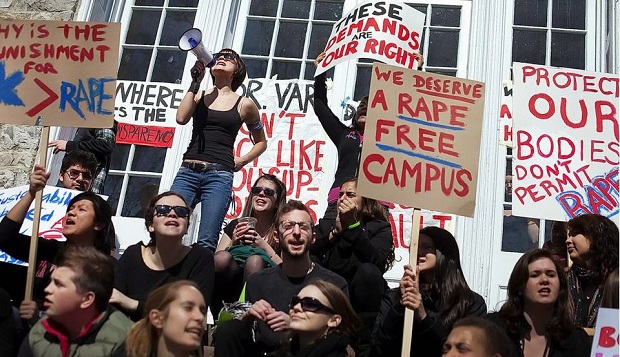
Protesters march on a SlutWalk in Newcastle

Copyright © 2015 RestrainingOrderAbuse.com

*Splendid writers, particularly Cathy Young, have responsibly and lucidly exposed “the problem” for 20 years in major news outlets. The system has responded with statutes that are broader, laxer, and more punishing.

What Do People Accused in Civil Court Have to Complain About?: Civil Prosecutions and PTSD

“Contemplating, undergoing, or having undergone a lawsuit is disruptive. The experience saps energy and distracts the litigant from the normal daily preoccupations that we call ‘life.’ Litigants, who commonly feel alone, isolated, and helpless, are challenged to confront and manage the emotional burden of the legal process. The distress of litigation can be expressed in multiple symptoms: sleeplessness, anger, frustration, humiliation, headaches, difficulty concentrating, loss of self-confidence, indecision, anxiety, despondency: the picture has much in common with the symptoms of posttraumatic stress disorder (PTSD).”

—Dr. Larry H. Strasburger (1999)

Prior posts on this blog have considered Legal Abuse Syndrome (LAS), a concept proposed by marriage and family therapist Karin Huffer that has been discounted by the courts as a “novel theory.” This post spotlights a journal monograph published almost 20 years ago by psychiatrist Larry H. Strasburger that unequivocally states Dr. Huffer isn’t wrong and the courts are.

Dr. Strasburger’s comments in “The Litigant-Patient: Mental Health Consequences of Civil Litigation” are based on his having treated the legally abused (who may include anyone who’s been exposed to litigation).

The therapist of a litigant will encounter not only the trauma that produced the lawsuit, but the distress and disruption of litigation as well, including the delays, rehashing and reliving the original trauma, and challenges to honesty and integrity. The patient may come after years of feeling frustrated and thwarted by a system that moves at a snail’s pace, preventing the litigant from putting the issue of the litigation behind him [or her] and “moving on” with life. Gutheil et al. have recently coined the term “critogenic harm” to describe these emotional harms resulting from the legal process itself.

The term “critogenic harm,” by its etymology, refers to the psychic damages that arise from judgment, i.e., the pain and humiliation of being verbally attacked and publicly disparaged.

This, the reader will note, is a blaring clinical denunciation of those self-appointed, armchair authorities who would deny the damages of false prosecution. Nearly two decades after the publication of the journal article this post examines, such deniers are everywhere, including in the mainstream press.

The deniers, according to the experts, are talking out of their blowholes. Mere accusation, ignoring the effects of protracted legal battles, drives some to suicide and multitudes more into agoraphobic withdrawal.

The adversarial system is also a threat to the maintenance of personal boundaries. Formal complaints, interrogatories, depositions, public testimony, and cross-examination are intrusive procedures that aggravate feelings previously caused by trauma. Such procedures amplify feelings that the world is an unsafe place, redoubling the litigant’s need to regain a sense of control—often in any way he or she can, including exhibiting characteristic symptoms or defenses. It is not unusual to find entries such as the following in the medical records of litigants: “Janet is hearing voices to cut herself again after talking to her lawyer today.” Similarly, a male plaintiff in a sexual harassment suit threatened violence when he was informed that he was to be deposed, and he required hospitalization.

Exposure to civil process can very literally drive people nuts, and inspire in them urges to commit violence, whether to themselves or others.

Consider Dr. Strasburger’s remarks in the context of restraining order abuse and appreciate that the strains they describe can be compounded by loss of residence (some defendants are left homeless), loss of family, loss of income, loss of employment/career, loss of property, etc. Those so deprived may accordingly become estranged from friends and relations, if not socially ostracized. (They must also live with the consciousness that they’re vulnerable to warrantless arrest at any time.)

Litigants are often further distressed as various members of their support systems “burn out.” Their need for human connection and their need to talk about their experience often exceed the tolerance of family members and friends. Embarrassment and humiliation shrink their social world.

That’s besides the discord and isolation caused by a damning accusation, which may be accepted as fact even by kith and kin. Loyalties may become divided, and the accused may be spurned based on allegations that aren’t true. The sources of outrage to the mind and emotions multiply like cancer cells.

It should come as no surprise then that many who complain of procedural abuse report they’re in therapy. If the costs weren’t prohibitive to most, they might all be. Desolating, as Dr. Strasburger points out, is that even if this were the case, the promise of “healing” isn’t necessarily good. The therapist’s role may be little more than cheerleader.

Psychotherapy for a patient involved in ongoing litigation can take on the aspects of managing a continuing crisis. The therapist, facing this need for crisis management, may be providing support more than insight.

Litigation (or its aftermath) may become consuming; normal, healthy activities are suspended. (One woman this author has corresponded with laments she hasn’t known intimate contact in years; a recent female commenter, alienated from her child, refers to herself as a living homicide.) People may become stuck in a tape loop perpetuated by interminable indeterminacy, insurmountable loss, and a galling sense of injustice.

The legal battle enables people to put their lives on “hold,” thereby avoiding other aspects of their lives (e.g., “How can I be intimate with you when I’m involved in this lawsuit?”). The patient may be so attuned to psycholegal issues and hypotheses that she focuses thereupon in resistance to dealing with significant personal conflict. As a result, she is continually “pleading her case” in the therapy hour.

This cognitive rut exemplifies Legal Abuse Syndrome, and the state may be unending.

Copyright © 2015 RestrainingOrderAbuse.com

*The journal article cited in this post may be introduced to the court by litigants in need of an authoritative voice to validate complaints of pain and suffering induced by fraudulent or vexatious prosecution.

“Shame and Stigma” and the “Mean-Spirited Cultural Response” That Efforts to Cast Them Off Provoke: Procedural Abuse and Parental Alienation

“Parental alienation is the ‘programming’ of a child by one parent to denigrate the other (targeted) parent, in an effort to undermine and interfere with the child’s relationship with that parent, and most often occurs within the context of a child custody conflict. This includes the ‘legal abuse’ of parents who have been disenfranchised from their children’s lives subsequent to sole custody and primary residence judgments. Within an adversarial legal process, non-custodial parents are often subjected to shame and stigma, lack of access to their children, and devaluation of their role as parents. And those who speak about the pain and woundedness in their lives are subjected to a mean-spirited cultural response, where their talk of woundedness is mocked.”

Edward Kruk, Ph.D.

Here’s child and family social worker Edward Kruk corroborating that parents may be the targets of “legal abuse”; that they’re subjected to shame and stigma, and to alienation from their children; and that they’re ridiculed and regarded with contempt for complaining about it: “The Impact of Parental Alienation on Parents: Post-traumatic Stress in the Rupture of Parent-Child Relationships” (2013). There are mothers who endure this, make no mistake, but as Dr. Kruk observes, “Most alienated parents are non-custodial fathers.”

Members of both genders (parents and non-parents alike) have reported on this blog that they’ve experienced (or are in the throes of) PTSD consequent to abusive legal contests, and it’s not the intent of this post to discount the plaints of mothers who face this torment. It must be emphasized, however, that the “mean-spirited cultural response” Dr. Kruk notes is predominately, if not exclusively, directed at men, and it’s because fathers’/men’s plaints are so roundly and effectively denounced and dismissed that mothers’/women’s plaints also lack a sympathetic audience.

(Feminists would prefer that female victims of legal abuse quietly recede into obscurity and accept the role of martyr for “the cause.”)

The “mean-spirited cultural response” is broad but includes highly influential voices, including law professors and esteemed advocacy groups like the Southern Poverty Law Center, which has equated men’s and fathers’ rights representatives with hate groups, asserting that they’re on a par with the Ku Klux Klan.

No kidding.

To vehemently complain about being treated prejudicially by the courts and alienated from your kids is to be caricatured as a racist wearing a bedsheet and brandishing a torch. (Few in the mainstream press, moreover, scoff at this rhetoric.) For moms (and women in general) who’ve been victimized by legal abuse to be heeded, the demonization of men’s and fathers’ advocates as mere “misogynists” must first be controverted.

Last year, a post on this blog reported the award of a $500,000 grant to a female law professor to “debunk” the claim that court procedures are abused to alienate parents from their children, and it’s this sort of (government-funded) social science research that marginalizes voices like Dr. Kruk’s.

It provides fodder to bloggers and other commentators, and it’s used to “train” judges how to rule.

The selective orientation of feminist social science ignores competing (and compelling) findings like these Dr. Kruk cites:

Suicide rates are reported to be of epidemic proportions among parents, fathers in particular, who are struggling to maintain a parenting relationship with their children (Kposowa, 2000; Kposowa, 2003); and legal abuse has been noted as a key factor in these cases.

A recent post on this blog referenced the suicide of a father who’d undergone years of legal hell and couldn’t face any more. He bled out—emotionally, morally, and financially. Feminist advocates stress the consequences and “rampancy” of domestic violence—focusing narrowly on female victims—while denying that the effects of legal abuses are grave. They trivialize those effects and often deny legal abuses occur to any extent worthy of attention or redress.

The devaluation of family and the curtailment of lives aren’t trivial.

Copyright © 2015 RestrainingOrderAbuse.com

First Amendment Rights from Beyond the Grave: Defense of a Suicide’s Publication of His Final Words by the Randazza Legal Group

“I couldn’t flee and I could not fight. I was never going to be allowed to heal or recover. I wish I were better at articulating the psychological and emotional trauma I experienced. I could fill a book with all the lies and mysterious rulings of the Court. Never have I experienced this kind of pain. I asked for help, but good men did nothing and evil prevailed.”

—Chris Mackney (1968–2013)

An emailed riposte from Las Vegas attorney Marc Randazza was introduced to my attention this week. It was an answer to a move by the “estranged wife” of a man who committed suicide in 2013 to have the man’s suicide note removed from the blog A Voice for Men.

The genesis of this dispute appears to be that Mr. Christopher Hines Machnij a/k/a Christopher Hines Mackney and his estranged wife were in an acrimonious relationship. Due to the strains of that relationship, Mr. Mackney started a blog in order to express his thoughts about his treatment in the family law system. This culminated in a suicide note, which he published to his blog from Washington, D.C., on December 29, 2013, and then he committed suicide on December 29, 2013. His writing and his suicide note were admittedly unflattering to your client. Your client then petitioned a Virginia state court to grant her some ambiguous (and questionable) intellectual property rights to the blog’s contents, which she is using to attempt to purge Mr. Mackney’s expression from every corner possible. One of those corners is my client’s blog.

[…]

It is our position that A Voice for Men’s republication of the suicide note is not copyright infringement, pursuant to 17 U.S.C. § 107. Accordingly, even if Mr. Mackney were to rise from the dead and insist upon the depublication of the suicide note, it is my client’s position that it has a right to continue publication of the letter.

Perusal of Mr. Randazza’s email, which is masterfully composed, is recommended to anyone invested in the right to redress perceived injustices by the public exercise of his or her voice.

Christopher Mackney

I’ve read Mr. Mackney’s “suicide note,” which is neither a manifesto of hate nor a farewell-cruel-world. It’s a supremely calm and sincere apology that’s all the more haunting for its quiet lucidity and resignation.

What Mr. Mackney describes in his final statement (dated four days after Christmas) will be familiar to anyone who’s endured something similar: the isolation, alienation, and paralysis; the mute indifference from anyone who could have intervened; the loss of identity, emotional decay, and financial ruin; and the hopelessness that comes from repeated confirmations that resistance is futile.

The consequences of the court’s intrusion into family and interpersonal matters—and the imposition of its judgment—are seldom viewed with the gravity they deserve.

Much of the debate of issues orbital to the events that prompted Mr. Mackney’s suicide occurs in the abstract. Commentators’ opinions (and they are legion) can rarely be seen to acknowledge the real-life strains and torments that real, live accused people suffer.

What is animating fodder for conversation to some, however, leads others to kill themselves.

Copyright © 2015 RestrainingOrderAbuse.com

*Among Mr. Mackney’s final words are an adjuration to stand up and speak out in defense of the abused (his blog resided at GoodMenDidNothing.com).