L’Oreal Stepney Vanishes!: On How Legal Abuse Hides and Legal Abusers Hide

L'Oreal Stepney, Loreal Stepney, L'Oreal Stepney TCEQ, Loreal Stepney TCEQ, L'Oreal Stepney PE, Loreal Stepney PE, TCEQ, Texas Commission on Environmental Quality, Toby Baker, Greg Abbott, Gov Greg Abbott

Has L’Oreal Stepney, a Texas Commission on Environmental Quality deputy director and the subject of a recent post on this site (here represented as a children’s entertainer), gone off and joined the circus? This post will use the disappearance of images of her from the first page of Google’s returns to exemplify how legal abuse is concealed.

Since a series of malicious prosecutions against this writer terminated in 2018 and his First Amendment rights were “restored” by a court system that never had the authority to deny them in the first place, he has endeavored to expose wrongdoing—in a majority of cases by government officials who enjoy the public’s trust undeservedly—while at the same time demonstrating to others who have endured abuses similar to those the writer has that they have the constitutionally guaranteed liberty to voice complaint.

Not meekly, not anonymously, not in prose sanitized of names and dates and allegations but pointedly and graphically. Criticism is protected speech, and it doesn’t have to be polite.

In the name of “social justice,” procedures of law that enable any adult, citizen or not, to stroll into a courthouse and upend other people’s lives according to nothing more than their own say-so have been allowed to stand for decades.  Lying is not only tolerated in court; it’s standard operating procedure, especially in civil court, which is a procedural backwater with zero accountability. The processes and how they’re conducted are farcical, which translates to cruel and indecent.

Here are a few ways, for example, that protective orders may be employed:

The gamut of abuses is only limited by accusers’ imaginations and lack of scruples.

One successful prosecution (total investiture: less than two hours’ time and sometimes mere minutes) can moreover open the door to serial mischief, including violation of constitutional rights and liberties. In the writer’s case, past false but prejudicial claims were used to deny him the freedom to speak, including by “word of mouth,” about his own travails in court. For five years. And he’s hardly alone (see for instance the case here or that of Bruce Aristeo, who remains subject to one of the most draconian speech injunctions the writer has ever seen).

The order that forbid the writer from discussing even matters of public record was eventually dissolved (after more strenuous exertions than any outsider could possibly comprehend).

So what do scofflaws do when the court is no longer willing to abet them? They get creative (or desperate, depending on your perspective).

The woman named in the title of this post, L’Oreal Stepney, has done nothing to injure the writer directly. He has merely pointed out that in her capacity as a representative of the Texas Commission of Environmental Quality, which has injured the writer directly, she falsely reported that the TCEQ doesn’t engage in censorship. Her role in anything concerning the writer was tangential only. Still, what he has reported is potentially embarrassing to her. So—

Here is the carousel of images that pop up when Google is queried with the search terms L’Oreal Stepney.

In recent weeks, this carousel hasn’t appeared on the first page of Google’s returns, as such image strips typically do when names are queried. As of this writing, it’s deep on page 2. The same is true of other TCEQ administrators the writer has criticized, Michael Honeycutt, its director of toxicology, and Stephanie Bergeron Perdue, its deputy executive director: The carousels for them disappear from the first page of Google’s returns, or they regularly plummet to the bottom.

It’s common knowledge that most people only pay attention to what emerges on page 1. I don’t know what specific underhand methods are used to accomplish this end, but this is how the game of politics works.

You don’t make wrongs right; you cover your butt.

Copyright © 2020 RestrainingOrderAbuse.com

*The writer believes the suspected agent of this suspected conduct, a disturbed woman named Tiffany Bredfeldt, currently or formerly an employee of the TCEQ, who appears to have been dumped by her husband a couple of years ago, makes search engine manipulation a dedicated part of her everyday routine since duping the court for over a decade.
Murdered Dogs: Among the Consequences of False Reports to the Police

Kansas City PD, Kansas City Police Department, KCPD

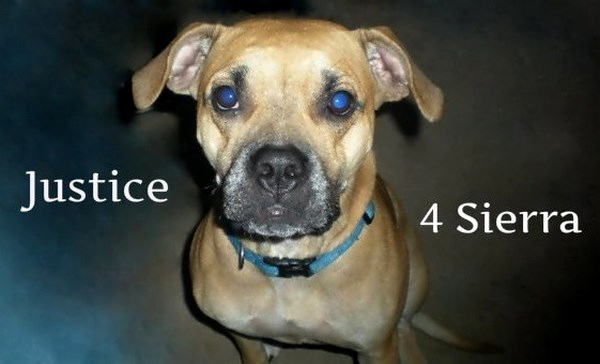
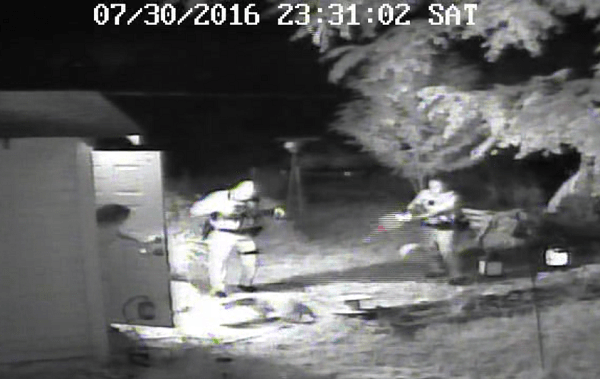
On July 30, Kansas City’s finest invaded Brandee Buschmann’s property unannounced and fatally shot her dog, Sierra, while Sierra tried to reach the safety of her house. According to Ms. Buschmann, the report that “authorized” the trespass (at close to midnight) was false. One minute she was watching TV in the security of her living room; the next, cradling her dying companion.

I signed a petition recently in support of Brandee Buschmann, a 43-year-old mother of two, whose dog, Sierra, was shot by the Kansas City police when she ran out to see who was in her yard at 11:30 at night. When Sierra was fired upon, she tried to run back inside to the safety of her family and was gunned down. Ms. Buschmann had shrieked, “Don’t shoot, don’t shoot!” One of the officers sarcastically answered, “Too late.” Then they asked if she wanted them to call Animal Services to have her friend’s body removed. Neither acknowledged fault or offered succor as Ms. Buschmann lay draped across her dying dog. Sierra was 11 years old.

Kansas City PD, Kansas City Police Department, KCPD

Brandee Buschmann’s dog, Sierra, plainly aged and unimposing, was shot and killed by Kansas City police officers at her own home in response to a report that Ms. Buschmann says was “completely false.”

Ms. Buschmann has no idea what business the cops had being on her property.

The police trespass onto my property in the middle of the night, guns drawn, fingers on the trigger, take aim at my home, my front door, taking a stance, and prepare to shoot whoever or whatever may come out the door. [They knock] on my door, failing to even announce that they were police, fire two shots in my direction with the front door open, hitting and killing Sierra at my feet with the second shot, based on a call that is completely hearsay…?

The official claim was they were responding to a reported “disturbance” involving “yelling and loud noises.” Ms. Buschmann had been watching TV; her boyfriend, Scott, was in the shower.

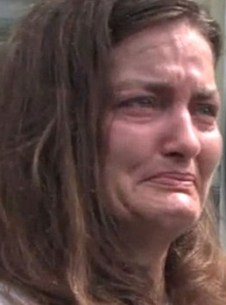
Brandee Buschmann, distraught by the senseless slaying of her dog

Below, Ms. Buschmann relates the incident to KMBC News—and makes it clear the police, who approached her door with guns drawn, had advance notice of the presence of a dog and still neglected to identify themselves (emphasis added):

“You see that he has his gun out. He has his gun out. He knocks,” said Buschmann, showing surveillance video of the incident.

She said she heard a knock at the door and her dog, Sierra, heard it, too.

She barks and I get up and we both come to the door,” Buschmann said.

A few second later, the door opened and Sierra came out toward an officer. Buschmann said that officer fired one shot to scare the dog away.

“I heard a pop and I’m, like, ‘Don’t shoot, don’t shoot,’ and I come out the rest of the way and that’s when they shot her the second time,” Buschmann said.

KCMO PD spokeswoman Sgt. Stacey Graves said the officers face no disciplinary action. “Officers are put in tough situations,” she said by way of apology. “If that officer was in fear of his personal safety [from] a large pit bull attacking him, then that’s how he felt, and that’s the decision he made.”

What the “tough position” the officers were “placed in” in this case wasn’t clarified. On the surveillance video, they’re seen loitering after the shooting like bumptious oafs embarrassed about blundering while playing commando.

Family isn’t replaceable. Nevertheless, I recommended on Ms. Buschmann’s petition that she call every personal injury lawyer in the state and find one who’ll sue, because bureaucracy doesn’t respond to reason or conscience. It only responds to negative attention—the kind that comes from substantial jury awards and social rejection.

A legal fundraiser for Sierra (in memoriam) is here.

Ms. Buschmann’s petition calls for the following:

  • Appropriate action be taken against the officers for reckless discharge of their weapon.
  • KCMO PD immediately implement a Use of Force continuum applying to pet encounters that prioritizes de-escalation, to include mandatory HANDS-ON canine encounter training, be equipped with tasers or batons, and exhaust all reasonable means in defusing situations before resorting to lethal force.
  • KCMO PD implement a policy requiring officers to intervene if they witness improper use of force by their colleagues, and to report it to their supervisors and Internal Affairs.

Ms. Buschmann seeks accountability and policy reform. Social reform is called for, also: People need to acknowledge that involving the police in other’s lives has consequences. Kicking a hornets’ nest is not something that should be done casually. Quoting Ms. Buschmann, abuse of the state’s power “rip[s] lives apart and destroy[s] public trust while…families are left to pick up the pieces for years to come.” Significantly, she says:

The call [to the police] was completely false, and I will be trying to get a lawsuit against the caller since they played a part in all this as well.

Sound familiar?

Like many visitors to this site, I’ve been falsely accused (serially, for over 10 years). My principal accuser reported to the court this year that she has accused me, besides to at least seven judges, to “multiple police departments, detectives, federal agencies, and other officials in several states.” Is that the kind of thing that could bring a swarm of cops into a person’s yard unannounced at any hour?

Of course.

False accusers never consider that or any of the other effects of legal abuse, like, for instance, the corrosive consciousness of being constantly vulnerable to police interference.

My companion dog who had been my only emotional ballast during a decade under a toxic cloud, died last year, unquestionably sooner than she should have and having been denied the rich life I had meant for us to share (and I was restrained in how aggressively I fought back by the certain knowledge that I could be incarcerated, and she would be left in the lurch). Had cops ever approached my yard at 11:30 p.m., they would never have reached the gate. She would have charged to investigate, and she would have barked maniacally. She was part Rottweiler, and I have no doubt now about how the confrontation would have concluded.

How cavalierly vocal critics of those who denounce false accusation tend to dismiss its consequences as trivial is no less reprehensible than how cavalierly false accusers lie. All critics of complaints of false accusation “understand” is that, perhaps, someone was “inconvenienced.”

Making false (or merely histrionic) claims to the police and the courts—whether of “abuse,” “disturbance,” or “danger”—authorizes hotheads with guns to interject themselves in other people’s lives.

That merits reflection, particularly from people who consider themselves “contemplative.”

Restraining orders, the go-to instrument of false or vindictive accusers (because they can be procured based on any three-minute fish tale), are registered in police databases (including federal) and subject the accused to warrantless arrest at any time…possibly for years and even possibly indefinitely. (And it’s common that people who exploit court process also lie to the police. Some respondents to this blog have reported being rousted daily. Restraining orders can provide gateway highs to people of a certain mental constitution. Accusation, far from being simply an act, can become a lifestyle. One of my accusers, who prosecuted me twice this year and whom I’ve scarcely ever met, has since 2012 been a party in four prosecutions against me and also prosecuted her own husband.)

Because they’re petitioned in civil court, even restraining orders that are tossed out aren’t expunged. They stay in those police databases, possibly under a title like “domestic violence protection order” or “stalking protection order.” That’s even if the judge berated the accuser and angrily dismissed the case. People who are accused stay in the system, and they stay accused. “Dangerous” is the implication of almost any interpersonal injunction issued by the court, even though any lawyer will tell you injunctions are commonly based on little more than he-said/she-said evidence.

For those on the fence about the morality of restraining orders—and especially for those of the liberal-PC mindset who recite by rote that they’re critical to safeguard society’s most vulnerable (and especially especially for the faction that believes the police need to be granted further poetic license)—consider how a police officer’s mind is preconditioned to interpret what s/he reads on his or her screen, how s/he’s predisposed to act if alerted to a “violation” (or even an unrelated “disturbance”), and what the possible ramifications could be.

This post highlights one.

Copyright © 2016 RestrainingOrderAbuse.com

*According to the documentary Of Dogs and Men, which quotes Laurel Mathews, a representative of the U.S. Justice Dept., 10,000 dogs are shot by U.S. law enforcement every year.

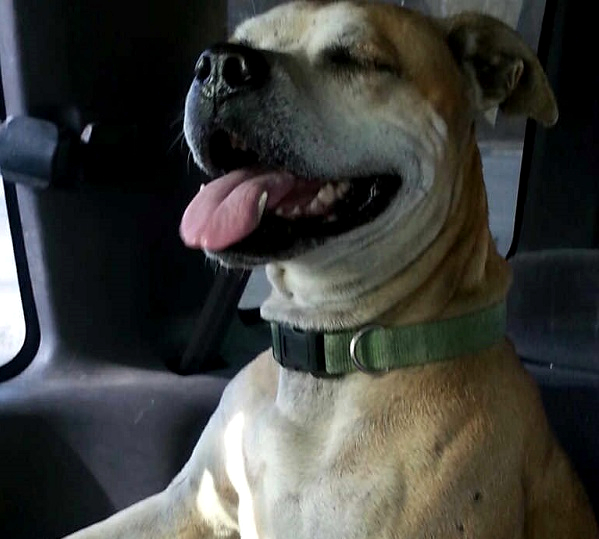
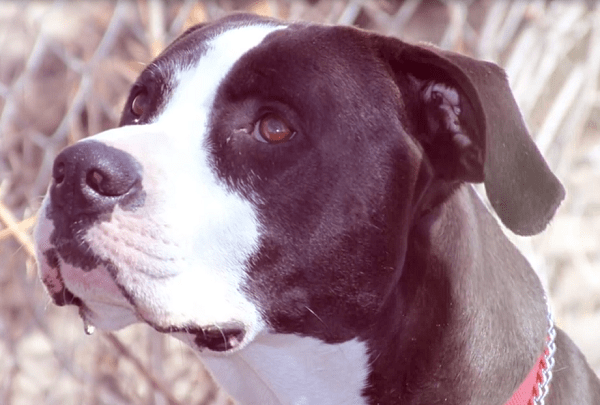
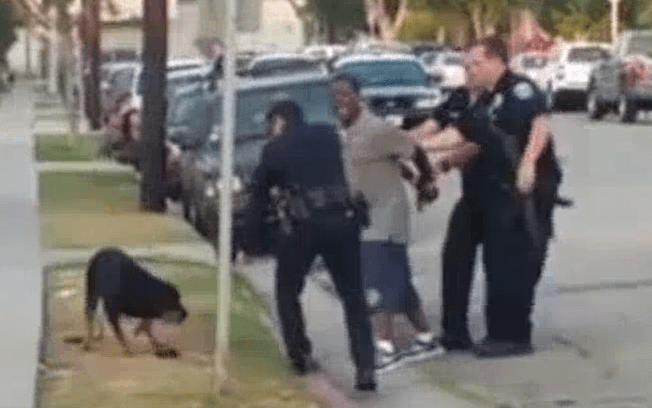
The companion animal of the restrained man in this still (who’s pleading, “Don’t shoot my dog!”) was moments later killed after being induced to lunge. The officer on the left, who leans in and provokes the dog, escalates a volatile situation and creates an excuse to fire. The dogs in the preceding images were also casualties of the police.