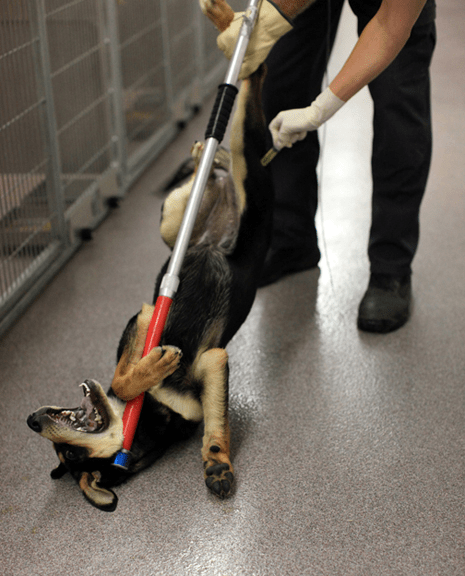
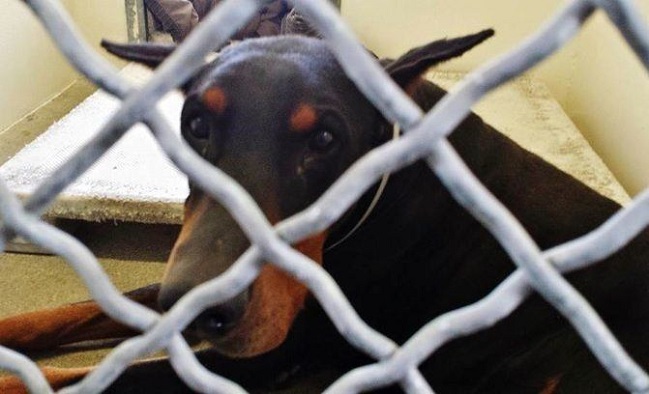
This post is the first of a projected series that will explore the rollback of advances in women’s rights, civil rights, minority rights, gay and lesbian (GLBTQ) rights, children’s rights, and animal rights by bad procedural policy, bad procedural practice, and procedural abuse. The detriment to animal rights begins the series because dogs are dear to the blog’s author and many of its friends, including fraud victims and blog authors Betty Krachey (who maintains a Facebook page dedicated to Dobermans) and Larry Smith (who dotes on three toy poodles).

Consequences of legal abuse are often invisible, and its victims may die invisibly…whether by slow deterioration or in terror.
“Pets, mostly dogs and cats, can be used as pawns to threaten and coerce people to stay in abusive situations or keep quiet about them. Women are told if they leave the relationship, their beloved pet will be harmed or killed. Abused children may be threatened into silence because they fear their pet will be hurt, too.”
—Cathy M. Rosenthal, “Preventing pets from being used as pawns” (2013)
This is the scenario the public hears about, and it’s a reality, certainly, and a horrific one.
Consequently, protection order statutes to safeguard pets from domestic abusers exist in many states. (See this 2012 survey prepared by Phil Arkow of the National Link Coalition: “Pets in Protection Orders by State.”)
A reality that’s not publicized is that pets, no less so and possibly much more so than adults and children, may be victims of false accusations and procedural abuse, which aren’t uncommon when relationships stagnate or couples’ conflict reaches a crescendo. Procedural abusers are also hostage-takers…or may relish the prospect of a pet’s demise as the decisive blow in a malicious attack based on lies.

Millions of pets are abandoned each year and subsequently killed.
Legal abuse often aims for the heart. (The author of this blog was contacted by a friend of his false accuser in 2012, while his dog was crippled and in need of a surgery. His and his dog’s lives were daily a misery. The woman strung him along for months, insisting she was an ally and promising aid as his dog’s condition worsened. She then testified against him the following year in the fifth of a series of prosecutions over a seven-year span, all based on a hoax begun in 2006. The blog author’s dog has lived her entire life in the shadow of lies.)
Naval officer Theresa Donnelly, who calls her three boxers her “fur kids,” was inspired to write about “What to do with pets when getting divorced,” because she recognizes that the stresses of separation can lead to companion animals’ being abandoned. “If you’re facing a family separation, please explore every possible option before dropping the animal off at a shelter,” she urges.
How much more likely pet abandonment is in instances of bitter and vicious legal abuse is easily imagined. Some falsely accused are left homeless and unable to provide for themselves. Shelters, besides, may not admit pets. Victims of a malicious restraining order or false allegations of domestic violence can find themselves instantly on the curb and stripped of all resource.
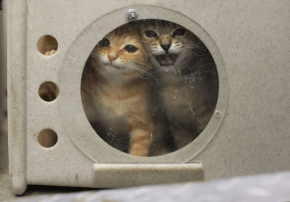 The flipside to the scenario sketched in the epigraph is the misapplication of protection order statutes designed to protect pets from abusers. Nancy Peterson, an issues specialist with the Humane Society of the United States, has been quoted as saying, “[T]he pet may become a symbol of power and control.” Since “power and control” are common motives of procedural abusers, possession of pets may be part of the grand f*-you.
Also unacknowledged by earnest dogmatists who never consider the misuse of the laws they celebrate is that domestic abusers may also abuse process—to compound the abuse and to conceal it. The protection order process, which is handily manipulated by liars and usually costs them nothing to exploit, is perfectly suited to this purpose. Accordingly pets, like children, may be awarded to abusers by the court. “Protection” orders can be instrumental in child and pet abuse.
Then there are the cases when one person in a stagnant relationship rides it out, because s/he’s concerned for the welfare of his or her animal friend(s). Betty Krachey, whose legal ordeal has been chronicled on this blog, exemplifies 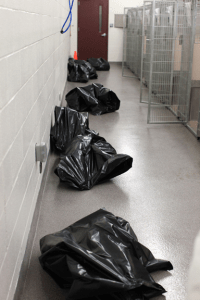 such a person. Betty postponed calling it quits with her long-term boyfriend, concerned for her dogs, only to be falsely accused and nearly left indigent. She faced the choice of living on the streets until her court date or seeking residency in a shelter that didn’t admit pets.
Only about one in 10 dogs in this country ever finds a home in the first place, according to “11 Facts about Animal Homelessness,” which also approximates that 7.6 million dogs and cats are abandoned to shelters every year and that 2.7 million dogs and cats are killed.
How pets are killed is by lethal injection, suffocation in a decompression or gas chamber, or electrocution—among other methods. Their bodies are then cremated (atypically), rendered into reusable products, or buried in a landfill.
Do formerly cherished, exuberantly joyful, trusting members of families meet such an end because of impulsive lies and petty vindictiveness?
Unquestionably they do…every day.
Copyright © 2015 RestrainingOrderAbuse.com
*Government and agents of the press are more concerned with “service dog fraud” than they are with legal fraud and its consequences.
 TALKING BACK to restraining orders