“Accounting for the discrepancy between the empirical data and current public policy has been the gender paradigm (Dutton and Nicholls 2005), also known as the patriarchal paradigm (Hamel 2007b), a set of assumptions and beliefs about domestic violence that has shaped domestic violence policy on arrest, treatment, and victim services at all levels for the past several decades. A product of feminist sociopolitical theory, the paradigm posits that the causes of domestic violence can be found in patriarchy and male dominance…. Despite data that are inconsistent with the feminist perspective…it remains a dominant influence….”
—Journal of Family Violence (2009)
In a recent post, I wrote about false allegations of domestic violence and quoted a male victim who was arrested when he reported to police that he was being assaulted. The ensuing ordeal cost him his “career, [his] name, and three years of income” before the police department copped to wrongdoing and settled with him out of court.
 Deplorably, this is what comes of asking for help from a system that’s been conditioned to perceive men as stalkers, batterers, and rapists (despite the fact that best population-based studies reveal as many as half of victims of partner violence are men).
According to findings by Dr. Denise Hines, more than a quarter of male victims of domestic violence who call the police are themselves arrested as a result (26%). Half of the time, responding police officers do nothing, and in less than one in five cases (17%) is a reported female abuser arrested.
Imagine the outrage of the National Organization of Women if half the women who reported being battered were blown off by authorities, or if one in every four women who reported being battered was herself arrested and prosecuted for assault.
This isn’t to say, of course, that the “patriarchal paradigm” promoted by feminist advocates and the Violence against Women Act (VAWA) doesn’t also brutally injure women.
Alternative to filing criminal complaints is the filing of civil protection orders—and this knife cuts both ways. Diminished standards of verification applied to allegations made in connection with restraining orders ensure that women, too, are abused by the state according to false allegations leveled against them by conniving men. The frequency of female victimization by men is lesser; the damages of that victimization are not.
Returning to the journal article quoted in the epigraph (Muller, Desmarais, and Hamel), consider:
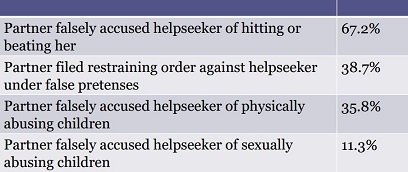
Every state in the United States now authorizes its courts to issue civil orders of protection against domestic violence. Typically, a temporary domestic violence restraining order (TRO) is issued ex parte at the request of any plaintiff who expresses an “objectively reasonable subjective fear of being injured” (Miller 2005, p. 74), without the respondent (i.e., the alleged perpetrator) having to be present in court. TROs are granted for two- to four-week periods, at which point a hearing is held to determine if a permanent order is warranted, valid in most states for a period of one to four years. In California, as of June 6, 2003, there were 227,941 active restraining orders (including temporary and permanent) issued against adults, almost all of them for domestic violence. Of the domestic violence orders, approximately 72% restrained a man from a protected woman, 19% restrained a same-sex partner, and 9% restrained a woman from a protected man (Sorenson and Shen 2005). Of particular significance to family court cases, the protected parent almost automatically obtains custody of the children, without a custody hearing or a custody decision being made (Kanuha and Ross 2004; Sorenson and Shen 2005).
Various motives for lying to the court are both obvious and confirmed.
“Many TROs and POs [protection orders],” concludes a Hawaiian task force on restraining orders, “are obtained by one party to a dispute to try to gain advantage over another party in future or ongoing divorce proceedings or a custody dispute” (Murdoch 2005, p. 17). In California, the Family Law section of the state bar expressed concern that domestic violence restraining orders “are increasingly being used in family law cases to help one side jockey for an advantage in child custody and/or property litigation and in cases involving the right to receive spousal support” (Robe and Ross 2005, p. 26). A retired Massachusetts judge revealed to the press that, in his experience, one-third of restraining orders are strategic ploys used for leverage in divorce cases (“Retiring Judge” 2001). Attorneys Sheara Friend and Dorothy Wright, the latter also a former board member of a battered women’s shelter, estimate that 40 to 50% of restraining orders are used to manipulate the system (Young 1999). In some cases, mothers secure custody despite a history of abuse against the father or the children (Cook 1997; Pearson 1997).
As I prefaced these quotations by remarking, they shouldn’t be interpreted to mean that men don’t also lie to inculpate women (who may be the actual victims of domestic violence), because they do, as the study these quotations are drawn from suggests. The rate of false allegations between the sexes may in fact be equivalent (and as high as 50%).
The difference is that women far more often make allegations (and thus false allegations) against men than vice-versa.
Absent from all analytic studies and contemplations is the toll of false allegations and victim-blaming on those devastated by them, which can’t be quantified.
Copyright © 2014 RestrainingOrderAbuse.com
 TALKING BACK to restraining orders