 “Narcissistic people do fall in love, but they usually fall in love with being in love—and not with you. They crave the excitement of love, but are quickly disappointed when it becomes a relationship—and not just a trip into fantasy.”
—Mark Banschick, M.D.
In a recent post, I surveyed some scientific literature about stalking and narcissism, probably to excess, because qualification by experts makes arguments more palatable to a certain audience. That post’s epigraph, by two distinguished researchers, concluded that the motives of stalkers could be reduced in sum to anger and jealousy, both of which emotions are ones to which the narcissistic personality is pathologically prone.
Narcissistic stalkers are anomalous in their abuse of restraining orders (as they are in most respects). Some stalkers use restraining orders serially or as part of a campaign of harassment and attention-seeking, and not always against a current or former romantic partner or love interest. The same qualifications of anger and jealousy apply to the woman who torments a former boyfriend’s or husband’s new girlfriend, fiancée, or wife with restraining orders. Only last week, one such victim wrote to report that as soon as she got one restraining order quashed, another was petitioned.
The narcissistic stalker, by contrast, may pour all of his or her venom into one consummate fraud. The point is to get revenge and discard the offending threat to his or her ego-stability once that person’s use value has been exhausted. A false restraining order may simply represent the final blow that shifts the narcissist’s pathological courtship behavior onto its target. The narcissist walks and leaves his or her victim splayed in the dust.
Essential to bear in mind is that a relationship with a narcissist is always a one-way relationship and always confusing. The only person actually trying to relate is the person the narcissist targeted or baited; the narcissist can’t relate. The narcissist’s intentions—not necessarily understood as such by the narcissist him- or herself—were never real in the first place but based on fantasy fueled by the solicited attention and interest of the other person. Once that other person ceases to mirror back to the narcissist what s/he wants to see, that person is expendable. Some psychologists suggest, moreover, that in his or her paranoia about being rejected/abandoned, s/he may be motivated to act preemptively, that is, to reject first and thereby preserve his or her ego from an imagined injury.
 Something I neglected to explicitly observe in the recent post referenced in the introduction that may merit observation is that all narcissists are stalkers (whether latent or active) insofar as the objects of narcissists’ romance fantasies are always merely objects to them (psycho-emotional gas pumps); they’re never subjects. What distinguishes the narcissistic stalker is that s/he’s seldom recognized for what s/he is, so s/he’s seldom rejected for what s/he is. Realize that the difference between normal pursuit behavior and aberrant pursuit behavior may be nothing more than how the pursued feels about it. Narcissists choose targets they perceive as vulnerable (empathic, tolerant, and pliable).
Because narcissists are extroverted, confident, aggressive, and socially commanding, “stalking” is seldom applied to their conduct. Narcissistic pursuit is by allure, false promise, and emotional coercion. The narcissist preys on the expectations of the cognitively normal, which s/he understands intuitively and manipulates with horrible proficiency. S/he often isn’t recognized as a user with no sincere investment in the other’s feelings until it’s too late.
To compound the difficulty either of making categorical pronouncements about narcissistic motives or exposing them, they’re not always known to narcissists themselves. To read most diagnostic explications of their mentality, the uninitiated would come away with the impression that narcissists are sharks, cunning, predatory automatons with false smiles and devious intentions. Anyone who’s had intimate and sustained relations with a narcissist, though, will perceive that s/he’s following what to him or her seem normal, romantic impulses in the moment. The difference is the narcissist is able to disown the moment with reptilian facility when his or her fantasy conflicts with interests of more pressing concern to the narcissist’s ego-preservation—or the interests of the other conflict with the narcissist’s fantasy.
It’s often argued that narcissists aren’t crazy, that they know what they’re doing. But this isn’t strictly so. In the throes of fantasy, narcissistic consciousness may be schizoid. Narcissists may lead parallel lives, even multiple parallel lives, like polygamists with spouses in different cities. And they may indulge an impulse with abandonment…then coldly—oh, so coldly—return to business as usual and plot the necessary steps to erase traces of the lapse. The narcissist runs either hot or cold. There is no warm.
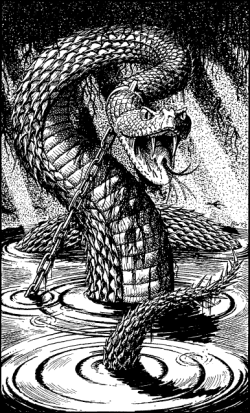 Once the other fails to satisfy the psycho-emotional needs of the narcissist, corrupts his or her fantasy, or by intimacy threatens the autonomy of the narcissist or the reality s/he’s primarily invested in, the narcissist’s pathology is such that s/he can instantly blame the other (whom the narcissist targeted in the first place) for his or her perceived “betrayal.”
It’s at this stage that the anger and jealousy, identified as the germinal motives of the stalker, rear their scaly heads. For the narcissist, a restraining order may not only satisfy his or her lust to scourge and cripple his or her target; it may also be a way to satisfy jealousy: “Now no one else will have you.”
Revenge for the narcissist, too, is an impassioned fantasy. The preternatural vehemence of the narcissist is dismaying to its target. In a sense, though, it’s just a redirection of ardor that provides a different source of narcissistic supply. The restraining order process accommodates the narcissist exquisitely, allowing him or her to summon police like a dignitary and ham it up for a judge or several of them. S/he owns the spotlight. And once in possession of a restraining order, the spotlight will follow him or her wherever s/he wants.
The monstrous caricature of the other s/he’s authorized to present to friends, family, and acquaintances current and future serves as the perfect surrogate for the other. It delivers all of the attention while being free of any of the expectations.
Copyright © 2014 RestrainingOrderAbuse.com



 The narcissist has a distorted sense of his or her own self-worth, distorts perceived slights or criticisms into monstrous proportions, and endeavors to distort others’ perceptions of those who dared to “criticize.”
 Casual charlatanism, though, is hardly an accomplishment for people without consciences to answer to. And rubes and tools are ten cents a dozen.

 A recent respondent to this blog detailed his restraining order ordeal at the hands of a woman who he persuasively alleges is a
  TALKING BACK to restraining orders