False Allegations and Restraining Orders: The Moral Snare

Someone writes: “I made false allegations to obtain a PPO [an order of protection]. What do I do?”

Disappointingly, this is the first such query this blog has received. Hearteningly, it’s something. And this person should congratulate him- or herself on having a belated pang of conscience.

The ethical, if facile, answer to his or her (most likely her) question is have the order vacated and apologize to the defendant and offer to make amends. The conundrum is that this would-be remedial conclusion may prompt the defendant to seek payback in the form of legal action against the plaintiff for unjust humiliation and suffering. (Plaintiffs with a conscience may even balk from recanting false testimony out of fear of repercussions from the court. They may not feel entitled to do the right thing, because the restraining order process, by its nature, makes communication illegal.)

The lion’s share of the blame for fraud and its damages, of course, clearly falls on the shoulders of plaintiffs—the knots are theirs to untie—but the court should also recognize culpability.

The restraining order process is a honeypot to people nursing a grudge: it’s cheap, convenient, and accommodating. Its making the means to lash out readily available to anyone with a malicious impulse might even be called entrapment. And the court neither acknowledges this process’s consequences to wrongly accused defendants nor impresses upon plaintiffs the consequences to them of making false allegations.

(One defendant I corresponded with this year—who happily succeeded in having the order against her quashed months and thousands of dollars later—was clawing her hair out and dosing herself to sleep. Her young daughter was traumatized by the episode, too. She was accused of domestic violence by a man she’d briefly renewed a friendship with. He was put up to baselessly attacking her through the courts by his wife, who felt jealous—which he admitted in court after dragging the defendant through hell.)

By definition, a civil process shouldn’t foster discord and distress. Maybe lawmakers should mandate a cooling-off period before judges are authorized to approve restraining orders, as they do with handgun purchases.

Or maybe they should put this corrupt institution on ice.

Copyright © 2012 RestrainingOrderAbuse.com
Lying and Restraining Orders: How the Justice System Doesn’t NOT Encourage Perjury

A woman writes: “What was the legislative intent of having the petitioner sign under oath in a civil TRO [temporary restraining order]…?”

The question seems ingenuous enough. The answer, obvious to anyone who’s run afoul of the restraining order racket, is that people lie.

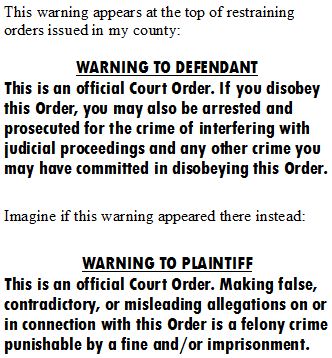
Less ingenuous is the state’s faith that a warning against perjury in fine print on the last page of a restraining order application (that its petitioner has just spent 20 minutes filling out) is going to discourage a liar from signing his or her name to the thing. (In my county this “warning” reads, “Under penalty of perjury, I swear or affirm the above statements are true to the best of my knowledge….” No explanation of perjury or its penalties is provided.)

If the courts really sought to discourage frauds and liars, the consequences of committing perjury (a felony crime whose statute threatens a punishment of two years in prison—in my state, anyhow) would be detailed in bold print at the top of page 1. What’s there instead? A warning to defendants that they’ll be subject to arrest if the terms of the injunction that’s been sprung on them are violated.

Led by the dated dictum that it should in no way discourage would-be restraining order petitioners, the state relegates its token warning against giving false testimony to the tail end of the application where it will most likely be disregarded.

And why not? Perjury is never actually prosecuted.

What this woman’s question reveals is (1) that the average petitioner doesn’t equate statements made on restraining order applications and in affidavits with sworn testimony given in a courtroom, and (2) that neither the consequences to plaintiffs of making inaccurate, misleading, or intentionally false statements to the court nor the consequences to defendants of being emotionally saddled with a restraining order are seriously weighed.

After a more complete digestion of this woman’s question, the unavoidable answer to it is that the legislative intent of having the petitioner sign under oath is plausible deniability of the process’s inviting and rewarding fraudulent abuse.

Copyright © 2012 RestrainingOrderAbuse.com
The Problems with Restraining Orders: Flaws, Flimflam, and Other F-words

Their administration is both biased and anti-feminist

The justice system takes it as axiomatic that plaintiffs who say they are victims are victims, especially when these plaintiffs are female. This policy ignores the obvious, namely, that people lie. Moreover, the court’s showing partiality toward female plaintiffs to redress a perceived inequity between the sexes only fosters reverse discrimination and exhibits contempt for the essential feminist conviction that women merit equal treatment under the law—no less and no more. This disdained expectation, the right to equal treatment, is the same one that restraining orders were originally conceived to acknowledge and validate. Women are still patronized. They’re just patronized in a more favorable way (“There, there, dear”).

They play into the fabulistic and sympathy-seeking tendencies of women

When women are in love, the objects of their affections can do no wrong. They exhale perfume. A spurned woman or one who otherwise nurses a grudge, however, will vilify a man to his toenails. A slight is an attack, a slammed phone is an act of violence, a hand balled in frustration is a death threat. Women, long habituated to the practice by conversations with other women, anatomize the smallest details of masculine conversation and conduct, and apply to them the interpretations that suit the color of their feelings. Exaggeration, embellishment, and caricature in conversation with judges, which is essentially what the brief interviews between judges and restraining order plaintiffs amount to, are to be expected. Judges, subjected to the equivalent of sensitivity training on steroids, accept statements made in these conversations as the equivalent of testimony, which, if made on a witness stand before a jury, would in fact be held to much higher standards of objectivity, accuracy, and accountability.

They’re more effective as instruments of abuse than as instruments of protection

The reliability of restraining orders as shields against violent abuse is iffy at best. Anyone dedicated to doing another harm is unlikely to be deterred by a piece of paper, which may just fan the flames. As vindictive weapons against those who never intended their plaintiffs any harm, however, restraining orders can’t be beat. They demolish lives.

Guilty verdicts are foregone conclusions

The nature of restraining orders being to silence, fetter, humiliate, and intimidate, efforts by defendants to dissuade judges from their institutionally schooled biases are enfeebled and easily disregarded. Defendants who resist are already presumed guilty, and their ability to defend themselves is compromised both by this prejudgment and their consciousness of it. Defendants (men, especially) are likely to file into appeals hearings feeling the presence of a noose around their necks: heads bowed, postures shrunken, voices pinched. Defendants, before they’ve even had a chance to hear the allegations made against them, let alone respond to them, have been confronted by a police officer at their homes and served a judgment by the state: harasser, stalker, deviant, aggressor, villain. When you feel judged, you look and sound guilty.

The system is broken

The failure of judicial oversight committees and state lawmakers and administrators to impose the expectation of fairness on the restraining order process provides judges of a certain bent the opportunity to let loose on defendants with both barrels, indiscriminately and with impunity (judges of this disposition, what is more, seem to be in the majority—maybe because they like adjudicating in this arena). This misconduct is not only sanctioned but oftentimes encouraged and applauded (“Throw the bums to the curb! Atta boy!”). No statutory consequences for plaintiffs’ giving false testimony are enforced, nor are judges held to their canons of office. The victims of abuses by plaintiffs and judges have no advocates or recourses: there’s no impartial ear within the system to turn to. Even those on the outside, journalists and civil rights advocates, shy away from the political razor wire that protects this airtight system.

Summary

The restraining order process is f*ed, and so is everyone it snares. Even the wrongly accused who manage to escape it—like bugs sucked into a vacuum cleaner and dumped from the bag—are lastingly damaged.

Copyright © 2012 RestrainingOrderAbuse.com