Why I Think TBOGG Is a DBAG: A Few Words in Defense of “Restraining-Order-Americans” (and PETA)

I’ve developed a keen loathing for pandering, puddle duck critics of men’s rights activists who can inspire half a million “likes” with a spatchcocked propaganda piece that features a misspelling in its first sentence and refers to John Donne as “a wanker.”

A quasi-intelligible graffito like Tom Boggioni’s “You too can talk like an embittered divorced white man with anger issues. Learn how now!” confirms what another literary giant once wrote: If you want to persuade, don’t invest your faith in the right argument, but in the right word, because the power of noise will always trump the power of sense.

Tom (a.k.a. TBOGG) could probably have just typed “wanker” over and over and earned the same number of plaudits from his audience of clapping seals.

His commentary, constituted of a few scurrilous lines of his own intermingled with some scurrilous quotations from others, is apparently meant to be a conclusive refutation of men’s complaints of institutionalized discrimination and abuse.

North Carolinian Neil Shelton has been denied contact with his children for over three years. He has also been jailed based on a hoax apparently concocted by his (now ex-)wife’s divorce lawyer, who is also a (female) member of the state House of Representatives.

This rhetorical sparring between chauvinists on either “side” (of what exactly, I’m not sure) is nothing more than a flaming oil slick on a sea of torment. State-sponsored abuses of men (and women) are widespread, and most victims are not hip to the pop-culture pidgin of Tom’s crowd and their opposite numbers. They’re missing their lives, their kids, and their peace of mind. The homeless guy who used to be a businessman and father couldn’t give a rip about cutesy coinages.

If polemics like Tom’s can be said to have an argument, it’s this: Manifestations of masculine anger and contempt must be unjust, because if men had a just reason to be angry and contemptuous, they wouldn’t be angry and contemptuous.

You can call the argument absurd, or you can call it stupid. Absurd or stupid, however, are the only alternatives. (A corollary of the argument seems to be that if mistreated men coolly and reasonably stated their objections, they should have every expectation that injustice would be righted—promptly and with ardent protestations of apology. It’s also absurd…or stupid. Take your pick.)

The beef against PETA—another of Tom’s targets—like the beef against “restraining-order-Americans,” seems to run like this: If you want to register your moral outrage, you should be polite about it. Like, we can totally see how it might suck to be deprived of liberty, stuck in a cage, and made the plaything of some creatures with clipboards instead of souls, but if you want us to take an urgent interest, you should make the problem easier for us to ignore.

Copyright © 2015 RestrainingOrderAbuse.com

ManBoobz and Subreddits: Why Your Abuse by the Justice System Is Less Important than a Communal Toilet


“Man Boobz has a contingent of MRA commentors, but he has never (to his knowledge) changed any of their minds.”

Kate Donovan, TeenSkepchick.org

Even at the risk of giving the impression that what the epigraph means is worth understanding, I’ll interpret: ManBoobz.com is the domain name of a website that mocks “MRAs” or “Men’s Rights activists.” (The grammar of the quoted writer, Kate Donovan, also humorously suggests “Man Boobz” is a nickname of the website’s author, David Futrelle—which, admittedly, is why I lifted the sentence.)

If you’re like me, you’ll be filing this information under the mental tab WHATEVER. So why do I bring this up?

In recent weeks, I’ve corresponded with and written about

This is besides digesting copious nauseating and desolate reports of abuse compounded by legal fraud submitted by both men and women. A respondent the other day, for example, reported she’d been chronically forced to have sex and was then issued a restraining order petitioned by her rapist, who endeavors to expel her from the life of an older woman she nurses, an older woman she loves and thinks of as her “grandmother.” The man has also cost the girl work by telling people she’s crazy. He’s apparently concerned she might pose a risk to his inheriting the older woman’s estate…besides concerned she might expose him as a rapist.

Dilettante demagogue Dave Futrelle has “document[ed] and mock[ed]” male complaints of injustice since 2010. Today a fulltime heckler, he supports himself and his cats with advertising revenues and online donations from feminist fans.

In writing about the black dad who now has an “18%” share in the lives of his two infant boys (“who go insane when I have to drop them back to their mother”), I was moved to criticize the rhetoric of the Southern Poverty Law Center, which represents itself as a civil rights advocacy group. The SPLC publishes a page called, “Misogyny: The Sites,” that suggests opposition to feminist-inspired legal travesties (for instance, the restraining order) is motivated by hatred of women, and on this page it refers approvingly to ManBoobz.com, the site introduced above.

The domain name ManBoobz.com leads to the blog We Hunted the Mammoth, whose title is apparently a lampoon of the titles of “MRM” (Men’s Rights Movement) blogs like Return of Kings. “We Hunted the Mammoth” is meant to suggest the Men’s Rights people are Neanderthals. Yuk-yuk.

If you’re a parent who’s missing his or her children, an abused (former) spouse or boy- or girlfriend who’s now homeless or living “like a hamster” consequent to misapplications of the law, or a senior who’s been bullied into cowering behind his or her blinds, this post is to make you aware of the trash talk that has cost you what you valued most; that talk is what informs pop culture sentiment and diverts awareness from your torment.

The anti-MRM crowd—of whom David Futrelle, author of We Hunted the Mammoth, is apparently a bellwether—represents the complaints of men/fathers to be unprovoked hate rhetoric (and anyone, man or woman, whose complaints are identified as corresponding to MRM complaints is simply lumped in). Calling complaints of state-sanctioned abuses “misogynist” makes them easy to dismiss. The conclusion that complaints are “misogynist” is plainly superficial but not unpredictably embraced by feminist partisans.

Here’s a snippet from a recent post on We Hunted the Mammoth (selected because I don’t have the stomach to stick my hand all the way into the bowl):

Men’s Rights Redditors agree: it’s tough to be a man. Well, a cis man, in any case. And those silly trans people are making it worse.

On the Men’s Rights subreddit, one concerned fellow has discovered a possibly insurmountable obstacle standing in the way of true gender equality: A “Women’s Room” at the University of Queensland that, as a sign on its door notes, is open to “trans*, intersex and genderqueer people as well as cis-females.” The horror!

The post concerns a sign on the door of a University of Queensland toilet. That’s right: a toilet.

(Apparently chemical prefixes are now used to distinguish different “gender types.” A “cis” is what most of us would naïvely call a heterosexual man or woman.)

Here’s an excerpt from another post:

Yep, I reported the 100% true fact that a Youtube bloviater named Aaron Clarey had written a post on Return of Kings urging men, in his words, to “not only REFUSE to see the movie, but spread the word to as many men as possible.” I described his readers on Return of Kings as misogynists, not MRAs, though clearly there is a massive overlap between those two groups.

The idea that this was specifically a Men’s Rights crusade was, to be sure, a bit of sloppiness on the part of the journalists writing about it, who are not quite as familiar as some of us are with all the different varieties of woman-hating shitheads there are in the “manosphere”—especially since their belief systems overlap considerably. As I noted in a previous post on this subject, writing about Esmay’s accusations against a writer for the Huffington Post,

It’s true that the HuffPo writer, in the original version of her piece, wrongly described the MRA-adjacent Return of Kings—which has urged a boymancott of Mad Max Fury Road—as a Men’s Rights site proper. There are in fact some differences between ROK and AVFM. For example, while AVFM writers have declared women to be “obnoxious cunts,” who control men with their vaginas, ROK writers have suggested that women are actually depraved, disloyal sheep.

You can almost forgive journalists for getting a bit mixed up.

The post has something to do with a recent movie (Mad Max: Fury Road). As of this composition, it’s been tweeted 27 times and circulated on Facebook 98 times. It was more popular than the toilet post…maybe because it has dirty words in it.

The writing is virtually indecipherable to outsiders but communicates the nature and maturity of the “discourse” (i.e., teenage). This sniping has “evolved” (or escalated unchecked by the reproofs of grownups) to the stage that it has its own jargon and insider acronyms.

Noteworthy is that Mr. Futrelle’s tirades are in each instance against a single person: “one concerned fellow” and “a YouTube bloviator.” Whether these two men represent the “Men’s Rights Movement” is clearly questionable. Here, incidentally, is a clipping that shows topics surveyed on the Men’s Rights “subreddit” (r/MensRights) that Mr. Futrelle criticizes, topics that paint a different picture from the one his writing does.

Among the members of this so-called collective of haters who posted yesterday are a “self-reflective feminist,” a defender of an elderly man with dementia who was reportedly assaulted, and a father who alleges he was falsely accused of child abuse.

Issues these posts purport to concern seem no less worthy than those feminists raise. Mr. Futrelle nevertheless categorically calls contributors a “hate group,” as does the Southern Poverty Law Center. Ms. Donovan, the girl or woman quoted in the epigraph, offers this interpretation:

MRA stands (loosely, and inaccurately) for the Men’s Rights Activists. More correctly, the MRA movement has enveloped a terrifying sector of the population that feels women and particularly feminists are devoted to squashing the given rights of men in every way. This ranges from belief that women deserve abuse to abusing evolutionary psychology to claim that women are just genetically inferior and will remain that way.

While you, the reader of this post, perhaps sit huddled in a dark corner wondering at the maliciousness of Fate, wondering whether your estranged child or children are safe, wondering if you’ll ever vigorously embrace life again—this is how your pain is perceived (or at least represented) by the feminist “smart set,” which celebrates specialized toilets and mocks you as a “misogynist” and a crybaby.

Copyright © 2015 RestrainingOrderAbuse.com

*Consider this woman’s post to the “subreddit” r/AskFeminists: “Why do Feminists hate ‘MRAs’ and portray them poorly?

The Question of “Angry White Men” and Complaints of Procedural Abuse

I started to include the contents of this post in the last one, “Why More Falsely Accused Don’t Speak Out.” Then I thought the topic of angry white men might be due some room of its own.

The previous post outlined reasons why men and women who’ve been victimized by false accusations and procedural abuse are subdued from voicing their outrage publicly. This post criticizes how victims who have expressed their pain and fury have been perceived and treated.

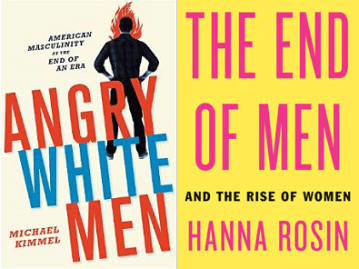
What complaints have emerged in the past couple of decades have been derogated as the rants of “angry white men” (Google this phrase, and you’ll see what I mean; it’s even the title of a 2014 book). Complaints have been dismissed, that is, as nothing worthier of consideration than the cranky kvetches of the disenfranchised “patriarchy,” yesterday’s top dogs said to resent their loss of dominion.

What members of angry white men’s and fathers’ groups are said to object to really is not their being unjustly vilified, kicked to the curb, impoverished, and stripped of roles in their children’s lives (pfft) but their loss of power and status.

It’s an attractively tidy idea and syncs up with feminist dogma nicely, but it’s critically shallow, besides ethically and empathically vacuous.

One thing the conclusion ignores is culture. Consider the Jews you may know, or the Koreans or the Pakistanis. Do you reckon restraining orders, for example, or domestic abuse allegations are as commonly brought against Jews or East Asians as they are against whites? Would the action be as countenanced in these ethnic communities, whose members may be more accountable to the judgment of other members and whose community conscience may forbid the public airing of familial discord?

Now it could be true that entitled white men, as members of the patriarchy or former patriarchy, are meaner and feel freer to be abusive than Jews and East Asians. Certainly that’s arguable, but it’s not necessarily arguable on the basis of reports of abuse, because it could also be true that entitled white women, as the usurpers of patriarchy (and as white women), feel freer to exploit feminine advantage and cry wolf than Jews and East Asians do.

Consider that feminism—the origin of the characterization angry white men—is criticized even within its ranks as ethnocentric, i.e., Whitey McWhite. If white women are those who are preponderantly pro-litigation, thanks to white feminist indoctrination into the culture of victimhood and “empowerment,” then who would you expect to be a majority of the targets of procedural abuse?

Those who posit that complainants of courthouse dirty dealings are predominately angry white men aren’t necessarily wrong, but they may be right for reasons they haven’t considered.

Another one of these reasons is entitlement.

Has it occurred to them, I wonder, that only white people may feel entitled to complain publicly? Do they really imagine that certain minorities aren’t that much more vulnerable to legal abuse, or that they’re not invisible and mute because of their self-perceived or actual lack of entitlement? People who’ve traditionally been the system’s goats aren’t people eager to stick their necks out. They never had faith in social justice.

If you allow that a majority of entitled victims of procedural abuses are white men, then it stands to reason that a majority of complainants of procedural abuses will be white men.

It further stands to reason that these white men, who had been conditioned to the expectation of justice, should feel disappointed…and angry.

Copyright © 2015 RestrainingOrderAbuse.com

*The book Angry White Men: American Masculinity at the End of an Era (2014) is by sociologist Michael Kimmel. Dr. Kimmel is a New York Jew with a Ph.D. from Berkeley. His book was reviewed in The New York Times by Hanna Rosin, a Stanford grad, a senior editor at The Atlantic, and the author of The End of Men and the Rise of Women. Ms. Rosin is also Kimmel-Rosina New York Jew. While neither one’s conclusions can be dismissed offhand, their cultural and class remove from the subjects of Dr. Kimmel’s book makes their identification with those subjects suspect, and Ms. Rosin’s objectivity and access are plainly dubious. From Ms. Rosin’s review: “Kimmel’s balance of critical distance and empathy works best in his chapter on the fathers’ rights movement, a subset of the men’s rights movement. Members of this group are generally men coming out of bitter divorce proceedings who believe the courts cheated them out of the chance to be close to their children.” Contrast this confidently categorical interpretation of men’s and fathers’ complaints to this firsthand account by a father who was ruined by “bitter divorce proceedings”: “The ‘Nightmare’ Neil Shelton Has Lived for Three Years and Is Still Living: A Father’s Story of Restraining Order Abuse.” A comment on Amazon.com credits Ms. Rosin with being sensitive to “real women’s experience.” The story highlighted in the previous sentence chronicles a real (angry white) man’s—whose telephone number is provided in a comment beneath the post.

Big Money v. No Money: VAWA and the Men’s Rights Movement

The previous post was a response to research conclusions published this year by Dr. Kelly Behre, director of the UC Davis Law School’s Family Protection and Legal Assistance Clinic.

In a paper titled, “Digging beneath the Equality Language: The Influence of the Fathers’ Rights Movement on Intimate Partner Violence Public Policy Debates and Family Law Reform,” Dr. Behre asserts there’s an absence of empirical evidence to support various arguments and statistical estimates published by men’s rights advocates respecting false restraining orders, false allegations of domestic violence, and judicial bias against men in family courts.

Ironic is that Dr. Behre’s denial of men’s groups’ position that men aren’t treated fairly is itself unfair.

When Dr. Behre says there’s no “empirical support” for estimates like 60 to 80% of restraining orders are unnecessary or based on falsehood, she means there are no formal audits of the process to back them up. She further examines studies that have been pointed to and finds those studies “problematic.”

Dr. Behre may well be right that empirical support for the claims of men’s groups is scant, shaky, or at best anecdotal. It’s disturbing, though, that Dr. Behre doesn’t find the dearth of studies that could be cited as empirical support a source of concern.

Clearly she has interests in both justice and human welfare.

A truism in law is that those with no money have no voice. Men’s rights groups are not lavishly funded teams of crack Ph.D.’s (they may in fact represent ragtag groups of man-on-the-street volunteers), and many if not most of those represented by such groups are themselves on the outside of the system looking in.

In contrast, consider these facts from the chart “Comparison of VAWA 1994, VAWA 2000, and VAWA 2005 Reauthorization Bill” compiled by the National Coalition Against Domestic Violence (NCADV) eight years ago.

  • Grand total of [federal] money allocated [under the Violence Against Women Act] from 1994 to 2011: $9.43 billion, including:
  • STOP (Services and Training for Officers and Prosecutors) Grants: $2.85 billion
  • Grants to Encourage Arrest Policies: $886 million
  • Rural Domestic Violence and Child Abuse Enforcement Grants: $555 million
  • Civil Legal Assistance for Victims of Violence: $588 million
  • Sexual Assault Services: $250 million
  • Education and Training for Judges and Court Personnel: $35 million

If battered women’s advocates like Dr. Behre find little empirical support for the plaints of men’s groups, they might at least find ample motive in these figures for systemic prejudice against men—and by extension all defendants who find themselves the targets of allegations of abuse (male and female).

While it’s noteworthy that comparatively little federal money has been approved for allocation to research studies, the magnitude of investment toward countering domestic violence is a clear pronouncement of priority, and this investment alone should suggest to a mind as trained and astute as Dr. Behre’s that allegations like “family courts discriminate against men and…mothers frequently and successfully make false allegations against men to obtain custody of children” entirely plausible.

Dr. Behre would call this observation a “commonsense argument” (“implying that the truth…is intuitively evident”).

Fair enough.

Copyright © 2014 RestrainingOrderAbuse.com

Responding to a Feminist Professor Kelly Behre’s Perspectives on Men’s Rights Activism

Since the publication of this post, the “research paper” it responds to has been removed from the Internet.


“I had a false allegation of domestic violence ordered against me on June 19, 2006. It was based on lies, but the local sheriff’s office and state attorney’s office didn’t care that he was a covert, lying narcissist. I doubt they ever heard of the term, in fact. I made the mistake of moving back in with him in September 2008.

“Last year, on July 23, 2013, he, with the help of his conniving sister, literally abandoned me. Left me without transportation and tried to have the electricity cut off. However, the electric company told him it was unlawful to do so. I am disabled, because of him, and have been fighting to get my life, reputation, and sanity restored. It has been over a year, and while life goes on for him, I am still struggling from deep scars of betrayal, lies, and his continued smear campaign against me.

“I thank you for the opportunity to speak out and stand with other true victims of abuse. You see, it isn’t just women who abuse the system, but men, as well.”

—Female e-petition respondent (August 30, 2014)

Contrast this woman’s story with this excerpt from a UC Davis Law Prof. Kelly Behre’s 2014 research paper:

At first glance, the modern fathers’ rights movement and law reform efforts appear progressive, as do the names and rhetoric of the “father’s rights” and “children’s rights” groups advocating for the reforms. They appear a long way removed from the activists who climbed on bridges dressed in superhero costumes or the member martyred by the movement after setting himself on fire on courthouse steps. Their use of civil rights language and appeal to formal gender equality is compelling. But a closer look reveals a social movement increasingly identifying itself as the opposition to the battered women’s movement and intimate partner violence advocates. Beneath a veneer of gender equality language and increased political savviness remains misogynistic undertones and a call to reinforce patriarchy.

The professor’s perceptions aren’t wrong. Her perspective, however, is limited, because stories like the one in the epigraph fall outside of the boundaries of her focus and awareness (and her interest and allegiance, besides).
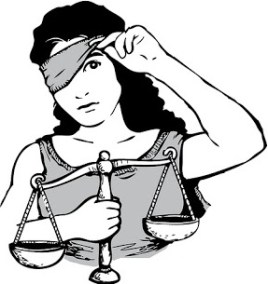
What isn’t appreciated by critics of various men’s rights advocacy groups is that these groups’ own criticisms are provoked by legal inequities that are inspired and reinforced by feminist groups and their socially networked loyalists. These feminist groups arrogate to themselves the championship of female causes, among them that of battered women. Feminists are the movers behind the “battered women’s movement.”

Those who criticize unfair laws and policies that purport to protect battered women are not “pro-domestic violence”; they’re anti-injustice, which may well mean they’re anti-feminist, and this can be construed as “opposition to the battered women’s movement.” The opposition, however, is to what the feminist movement has wrought. No one is “for” the battery of women or “against” the protection of battered women.

To put this across in a way a feminist can appreciate, to believe women should have the right to abort a fetus is not the same thing as being “pro-abortion.” No one is “for” abortion, and no one is “for” domestic violence. (“Yay, abortion” is never a sign you’ll see brandished by a picketer at a pro-choice demonstration.)
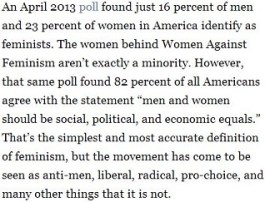
The Daily Beast op-ed this excerpt is drawn from criticizes a group called “Women Against Feminism” and asserts that feminism is defined by the conviction that “men and women should be social, political, and economic equals.” If this were strictly true, then inequities in judicial process that favor female complainants would be a target of feminism’s censure instead of its vigorous support.

The “clash” the professor constructs in her paper is not, strictly speaking, adversarial, and thinking of it this way is the source of the systemic injustices complained of by the groups she targets. Portraying it as a gender conflict is also archly self-serving, because it represents men’s rights groups as “the enemy.” Drawing an Us vs. Them dichotomy (standard practice in the law) promotes a far more visceral opposition to the plaints of men’s groups than the professor’s 64-page evidentiary survey could ever hope to (“Oh, they’re against us, are they?”).

The basic, rational argument against laws intended to curb violence against women is that they privilege women’s interests and deem women more (credit)worthy than men, which has translated to plaintiffs’ being regarded as more “honest” than defendants, and this accounts for female defendants’ also being victimized by false allegations.

(Women, too, are the victims of false restraining orders and fraudulent accusations of domestic abuse. Consequently, women also lose their jobs, their children, their good names, their health, their social credibility, etc.)

The thesis of the professor’s densely annotated paper (“Digging beneath the Equality Language: The Influence of the Father’s Rights Movement on Intimate Partner Violence Public Policy Debates and Family Law Reform”) is that allegations of legal inequities by men’s groups shouldn’t be preferred to facts, and that only facts should exercise influence on decision-making. This assertion is controverted by the professor’s defense of judicial decisions that may be based on no ascertainable facts whatever—and need not be according to the law. The professor on the one hand denounces finger-pointing from men’s groups and on the other hand defends finger-pointing by complainants of abuse, who are predominately women.

In the arena of law this post concerns, the courts typically follow the dictum that the person pointing the finger is right (and this person is usually female). In other words, the courts judge allegations to be facts. In many instances, what’s more, state law authorizes this formulation. It grants judges the authority “at their discretion” to rule according to accusations and nothing more. Hearsay is fine (and, for example, in California where the professor teaches, the law explicitly says hearsay is fine). The expression of a feeling of danger (genuinely felt or not) suffices as evidence of danger.

The professor’s defense of judicial decision-making based on finger-pointing rather undercuts the credibility of her 64-page polemic against decision-making based on finger-pointing by men’s groups that allege judicial inequities. The professor’s arguments, then, reduce to this position: women’s entitlement to be heeded is greater than men’s.

The problem with critiques of male opposition to domestic violence and restraining order statutes is that those critiques stem from the false presuppositions that (1) the statutes are fair and constitutionally conscientious (they’re not), (2) adjudications based on those statutes are even-handed and just (they’re not), and (3) no one ever exploits those statutes for malicious or otherwise self-serving ends by lying (they do—because they can, for the reasons enumerated above).
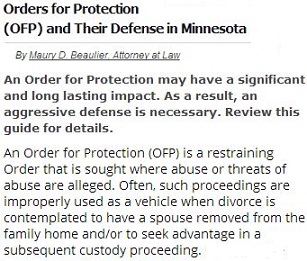
Attorneys acknowledge procedural abuses are common.

Many critiques of men’s, father’s, and children’s rights groups fail to even recognize that motives for lying exist. What presupposition underlies this? That everyone’s an angel? If everyone were an angel, we wouldn’t need laws at all. Or is the presupposition that women are angels? A woman should know better.

A casual Google query will turn up any number of licensed, practicing attorneys all over the country who acknowledge restraining orders and domestic violence laws are abused and offer their services to the falsely accused. Surely the professor wouldn’t allege that these attorneys are fishing for clients who don’t exist—and pretending there’s a problem that doesn’t exist—because they, too, are part of the “anti-battered-women conspiracy.”

The professor’s evidentiary pastiche is at points compelling—it’s only natural that a lot of rage will have been ventilated by people who’ve had their lives torn apart—but her paper’s arguments are finally, exactly like those they criticize, tendentious.

It’s obvious what the professor’s “side” is.

(She accordingly identifies her opposition indiscriminately. For example, the blog you’re right now reading was labeled the product of a father’s rights group or “FRG” in the footnotes of the professor’s paper. This blog is authored by one person only, and he’s not a father. Wronged dads have this writer’s sympathies, but this blog has no affiliation with any groups.)
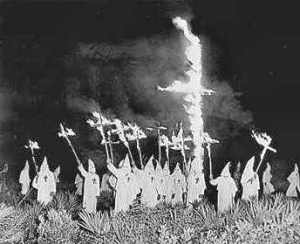
The professor carefully prefaces her points with phrases like “Researchers have noted,” which gives them the veneer of plausibility but ignores this obvious question: where do the loyalties of those “researchers” lie? The professor cites, for example, the Southern Poverty Law Center’s equation of SAVE Services with a hate group. An attentive survey of SAVE’s reportage, however, would suggest little correspondence. The professor doesn’t quote any of SAVE’s reports; she simply quotes an opposing group’s denunciation of them as being on a par with white supremacist propaganda.

(What the professor does quote are some statistics generated by SAVE that she contends are dubious, like estimates of the number and costs of false and frivolous prosecutions. Such estimates must necessarily be speculative, because there are no means of conclusively determining the degree or extent of false allegations. Lies are seldom if ever acknowledged by the courts even if they’re detected. This fact, again, is one that’s corroborated by any number of attorneys who practice in the trenches. Perjury is rarely recognized or punished, so there are no ironclad statistics on its prevalence for advocacy groups to adduce.)

Besides plainly lacking neutrality, insofar as no comparative critical analysis of feminist rhetoric is performed, the professor’s logocentric orientation wants compassion. How much of what she perceives (or at least represents) as bigoted or even crazy would seem all too human if she were to ask herself, for instance, how would I feel if my children were ripped from me by the state in response to lies from someone I trusted, and I were falsely labeled a monster and kicked shoeless to the curb? Were she to ask herself this question and answer it honestly, most of the outraged and inflammatory language she finds offensively “vitriolic” and incendiary would quite suddenly seem understandable, if not sympathetic.

The professor’s approach is instead coolly legalistic, which is exactly the approach that has spawned the heated actions and language she finds objectionable.

Copyright © 2014 RestrainingOrderAbuse.com