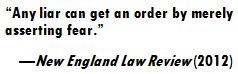
 In the last post, I discussed how lying is generally gotten away with beneath the radar. What people who’ve blessedly had no personal experience with fraudulent abuse of legal process fail to grasp is (1) there’s no incentive to expose untruths except (perhaps) when they’re used to frame people for crimes for which they stand to be convicted, (2) lies are much more commonly used to re-frame the truth into one favorable to the image or malicious intentions of fraudsters than they are to send people to prison, (3) lies don’t have to succeed in false criminal convictions to be damning or ruinous, and (4) lies may be of sorts that are impossible to discredit yet may permanently corrupt the public records and lives of the falsely accused.
 Writers, for instance, who confront false allegations of domestic violence don’t actually invite their imaginations to conceive what such false allegations might be. Perhaps they vaguely suppose they’re of this nature: “He beats me with a belt buckle” or “She locks me in the pantry.” False allegations like these may certainly be made, but lies may be much more subtle or vaporous: “I live in a constant state of fear” or “She said she was going to kill me while I sleep.” Is the truth or falsity of these latter claims possible to ascertain? No. Police reports and restraining orders may be based on allegations like these, however, and anyone who imagines maliciously motivated people are incapable of making false statements to this effect have lived enviably sheltered lives.
False claims of stalking are as easily manufactured: “He creeps around my neighborhood late at night” or “She cut me off in traffic, almost running me off the road.” Allegations like these may not only be the substance of false police reports (which may—and do—gnaw at the sanity of their victims) but may be grounds for false restraining orders (which are far more nightmarish). In fact, the latter allegation was the basis of an emergency restraining order reported to this blog, which was petitioned against a college girl, in or just out of her teens, by her female counselor. The girl and her mom had a weekend to prepare her defense, and she wasn’t fully exonerated of her accuser’s litany of “terror-inspiring misconduct” (which included the girl’s greeting her accuser a few times in chance public encounters in a town of 2,000 residents and seeing her at church).
 False allegations of sexual harassment? “He‘s repeatedly told me he wants me to [X] him” or “She keeps propositioning me”—try disproving allegations like these, which may be much more explicit and include claims of physical molestation. The consequences, if it’s necessary to enumerate them, could include termination of employment, marital dissolution, peer or social isolation, and the emotional and thus physical decay that accompany each or all. False claims like these, which take mere seconds to articulate, may never be recovered from.
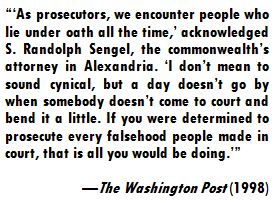
For making such false allegations to the authorities and courts, there are no consequences, except to their victims. There are statutory penalties on the books for making false claims (committing perjury), but they’re rarely if ever enforced and couldn’t be enforced consistently within governmental budgetary constraints, so commonplace is lying. Are such false claims going to end up in some statistical database? Of course not. Ask an honest district attorney, though, why lying isn’t prosecuted, and s/he’ll tell you it’s because lying is an everyday occurrence.
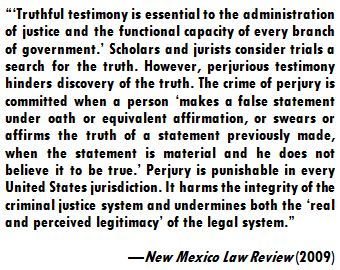 This is the invisible irony that escapes everyone who tackles consideration of rates of false allegations: the fact that lying isn’t prosecuted is the indicator of its rampancy (prosecution of frauds on the police and courts would overwhelm the system). And because lying isn’t prosecuted, it’s in the interest of maintaining the dignity of the legal system and the semblance of just and orderly process that judges not acknowledge even flagrant lies as such. To acknowledge them in all their plenitude, yet not punish them, would be to call into question the legitimacy of the system itself. Restraining order frauds, moreover, may be rewarded with favorable verdicts in spite of lies, making the concealment of those lies by judges that much more urgent.
Society has been conditioned, in the decades since the advent of the restraining order, to be hyper-vigilant and -reactive toward allegations of domestic violence, stalking, and sexual harassment—behaviors associated with male abuse of women, which the restraining order was conceived to curb, if not remedy. These offenses are ones to which the population has been vigorously, even coercively, sensitized. The justice system is consequently poised to descend upon those accused of such behaviors (including women), as is the public poised to believe allegations of such behaviors to be true, especially when validated by the courts.
 False accusers are certainly aware of these prejudices and may easily exploit them—and should hardly be expected not to. Agents of the system may, in fact, goad them on, even while salting the wounds of those who report that they’re victims of false allegations by telling them they have no legal recourse (which, practically speaking, they don’t). Judges, furthermore, may scourge such victims in the courtroom based on allegations that their accusers leveled in one-sided, five- or 10-minute auditions.
To recap: Liars aren’t prosecuted, so lies aren’t acknowledged as lies, but the civil procedure that’s most eagerly and impulsively abused by liars, the restraining order process, is supremely lax, instantly gratifying, and universally promoted. This procedure, what’s more, indelibly fouls a falsely accused defendant’s public record; may deny him or her entitlement to home, children, and property; and may cost him or her, besides, employment and employability in his or her chosen field of endeavor.
If this weren’t infernal enough, the outrage and misery expressed by victims who’ve found themselves in the eye of this perfect storm of unreason, some of whom are left impoverished of everything that gave their lives meaning, are credibly denounced or even mocked as crackpot.
Copyright © 2014 RestrainingOrderAbuse.com

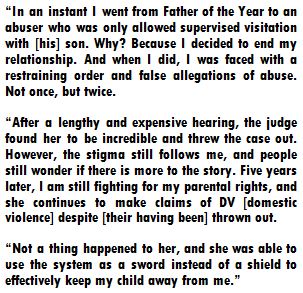
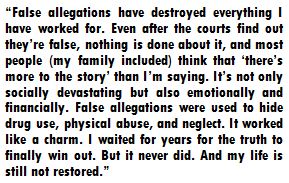
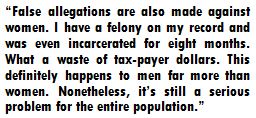
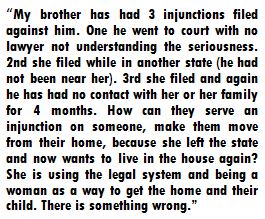

 Rape and domestic violence happen. There’s no question about it. There’s likewise no question that their effects may be damaging beyond either qualification or quantification.
 A significant number, if not the majority, of respondents to this blog who report being the victims of false allegations on restraining orders—particularly the ones who detail their stories at length—are women. This doesn’t mean that women, who represent less than 20% of restraining order defendants, are more commonly the victims of false allegations. It’s indicative, rather, of women’s disposition to socially connect and express their pain, indignity, and outrage. (Women, furthermore, aren’t perceived as dangerous and deviant, so they feel less insecure about publicly declaiming their innocence; they have the greater expectation of being believed and receiving sympathy.)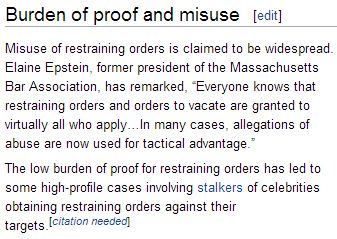
 No topic defies neutral qualification, and since Wikipedia’s own “Restraining order” page recognizes that restraining orders are widely claimed to be misused, and since restraining orders are furthermore issued against millions of people every year across the globe, restraining order abuse can hardly be dismissed as a trivial topic or one unworthy of attention and elucidation. That’s its being disregarded owes to avoidance of a sensitive subject is a more credible explanation.
 Many restraining order recipients are brought to this site wondering how to recover damages for false allegations and the torments and losses that result from them. Not only is perjury (lying to the court) never prosecuted; it’s never explicitly acknowledged. The question arises whether false accusers
  The phrase restraining order fraud, too, needs to gain more popular currency, and I encourage anyone who’s been victimized by false allegations to employ it. Fraud in its most general sense is willful misrepresentation intended to mislead for the purpose of realizing some source of gratification. As fraud is generally understood in law, that gratification is monetary. It may, however, derive from any number of alternative sources, including attention and revenge, two common motives for restraining order abuse. The goal of fraud on the courts is success (toward gaining, for example, attention or revenge).
 This means defendants can be denied access to the family pet(s), besides.
 This question pops up a lot.
 The 148 search engine terms that appear below—at least one to two dozen of which concern false allegations—are ones that brought readers to this blog between the hours of 12 a.m. and 7:21 p.m. yesterday (and don’t include an additional 49 “unknown search terms”).
 Since restraining orders are “civil” instruments, however, their issuance doesn’t require proof beyond a reasonable doubt of anything at all. Approval of restraining orders is based instead on a “preponderance of evidence.” Because restraining orders are issued ex parte, the only evidence the court vets is that provided by the applicant. This evidence may be scant or none, and the applicant may be a sociopath. The “vetting process” his or her evidence is subjected to by a judge, moreover, may very literally comprise all of five minutes.
 You know, a box like you’ll find on any number of bureaucratic forms. Only this box didn’t identify her as white or single or female; it identified her as a batterer. A judge—who’d never met her—reviewed this form and signed off on it (tac), and she was served with it by a constable (toe) and informed she’d be jailed if she so much as came within waving distance of the plaintiff or sent him an email. The resulting distress cost her and her daughter a season of their lives—and to gain relief from it, several thousands of dollars in legal fees.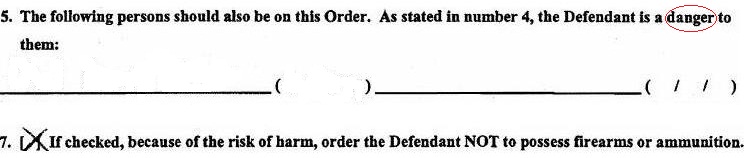
 The ethical, if facile, answer to his or her (most likely her) question is have the order vacated and apologize to the defendant and offer to make amends. The conundrum is that this would-be remedial conclusion may prompt the defendant to seek payback in the form of legal action against the plaintiff for unjust humiliation and suffering. (Plaintiffs with a conscience may even balk from recanting false testimony out of fear of repercussions from the court. They may not feel entitled to do the right thing, because the restraining order process, by its nature, makes communication illegal.)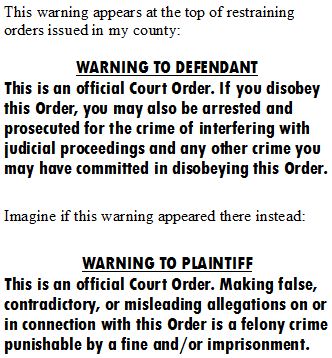
 If the courts really sought to discourage frauds and liars, the consequences of committing perjury (a felony crime whose statute threatens a punishment of two years in prison—in my state, anyhow) would be detailed in bold print at the top of page 1. What’s there instead? A warning to defendants that they’ll be subject to arrest if the terms of the injunction that’s been sprung on them are violated.
 TALKING BACK to restraining orders