How Blindness to the Consequences of False Accusation Is Perpetuated

The last post highlighted the murder of a woman’s cherished dog by police officers responding to a false report.

First thing, then, let’s acknowledge that false accusation can do more than “inconvenience” the accused: It can kill.

Why then isn’t it roundly criticized? Why aren’t multitudes clamoring for accountability? Answer: politics.

Few who are sympathetic to the effects of false accusation are induced to crusade against it, journalists who appreciate the consequences of lying tend to believe that nothing short of being false accused of rape is even worthy of complaining about in the first place, and vociferous critics of complaints of false accusation deny it’s ever a big deal (if they even allow it occurs).

The latter position, particularly, assumes that the falsity of false allegations is always detected before any real harm can be done (always wrong), and that the falsely accused therefore are only ever “hassled” and will recover after a shower and a Xanax.

The result of this wanton idiocy is that citizens (traditionally men) who’ve been falsely accused of “lesser” violations of catastrophic significance to them (like “domestic violence” or “stalking”) find reasons to question the validity of rape claims (and there certainly are some legitimate ones), because only false rape claims pique press attention (and maybe they think that exposing false rape claims will make people scratch their chins and say, “Hey, if people lie about rape, what don’t they lie about?”). They’re also provoked to hit back against a virulently sexist advocacy base where they know it will sting most.

This, in turn, confirms to the false-allegations-are-no-big-deal crowd (which is a powerful and noisy contingent) that complainants of false accusation are simply misogynistic cranks (“See?”) who should not only be discounted but denounced.

This finally translates to the inane formula: Critics of false accusation and its consequences are rape deniers.

Accordingly, for example, innocent citizens must continue to have to watch impotently as their dogs are gunned down by the police at their own homes. (The cops are criticized; the false accusers escape notice.)

Copyright © 2016 RestrainingOrderAbuse.com

*However objectionable mainstream feminists may find the phrase false accusation culture, there’s no denying that a culture that tolerates false accusation is a culture that fosters it. (Exasperatingly, deniers of false accusation culture point out that rarely is anyone prosecuted for lying and assert that fact to be “proof” that lying rarely occurs…even as they bombard government with objections to prosecuting anyone for lying.)

If Restraining Order Cases Are Only about Narrative, How Do You Beat a Liar in Court?

pawn-triumphs

The next to last post stressed the importance of narrative in restraining order cases.

Stories complainants tell pursuant to obtaining a restraining order don’t particularly matter. “I’m afraid” may suffice.

In contrast, defendants’ narratives are critical.

Strategic defense is not about “telling the truth.” It’s about telling the better story. Competing narratives are universally regarded as “he-said/she-said” (so to speak: Restraining orders are not strictly procured by women against men). The only thing that counts is whose story a judge favors when the end-of-the-round bell dings. (Significantly, there’s only one round, and it’s often only a few minutes long.)

Fraudulent claims in restraining order affidavits are commonplace—and what restraining orders do, especially ones whose grounds include false allegations, is inspire those who’ve been accused to register betrayal, indignation, and outrage. Since opportunities to defend may come and go in a few days’ time, those emotions aren’t likely to settle (and may be compounded by many others: fear, bewilderment, uncertainty, vulnerability, etc.).

The urge of defendants will be to stress in court how they’ve been wronged: “It’s really [him or her] who’s the bad guy, Judge.” This urge must be resisted.

The judge couldn’t care any less if s/he were paid to—and s/he is paid to.

Defendants need to defuse whatever has been alleged against them. Merely relating a meandering history (or “history”) of mistreatment can work great for plaintiffs; it does nothing for defendants.

This may seem unfair. It is, and that doesn’t matter—and that’s what a defendant must focus on: what matters.

Sometimes what matters is the law. For example, many recent posts here concern allegations that writing about someone online is “harassment” or “stalking.” One-to-many speech (online or otherwise) is neither, and it’s protected by the First Amendment. To qualify as “harassment” or “stalking,” someone has to contact someone else, repeatedly, after being told not to. Contact must be one-to-one or through a middleman. No confrontation, emails, texts, phone calls, letters, or relayed messages means no contact, and that means no grounds for court interference. Cases in which a constitutional defense is strictly applicable, however, are rare.

(The author of this post is in such a case right now with a woman who he has been told has been diagnosed with a mental illness. The law is clear: The woman has admitted I’ve had no contact with her in years; therefore there were no grounds to authorize an injunction. Making the law clear to a municipal trial judge is a different story. Do I start by playing a voicemailU that this woman, who claims I’ve stalked her since I met her in 2005, left me in 2012, in which she urges me to call her? Maybe. That kind of evidence makes a good first impression. It says—without saying it—that she’s lying. It upsets her narrative. Do I start by saying, “She’s crazy”? No. That’s aggressive and makes a poor impression. It would only get the judge’s hackles up.)

What makes a good narrative? First, follow the creative writer’s maxim: Show, don’t tell. Sometimes defendants have contradictory evidence to present; sometimes there is none. If there is evidence, it must be framed with care (and defendants are recommended to read it aloud in court and not to depend upon a judge to “get it.”) Legal method proceeds from evidence to conclusion. Defendants shouldn’t start with the conclusion, for example, “He’s lying.” They should present a story that gives a convincing impression. Then they can say, “He’s lying.” Attorney Gregory Hession, a specialist in restraining order defense, would call this highlighting plaintiffs’ “ulterior motives” (their real reasons) for petitioning a restraining order. These may include malice, for example, or cover-up.

Defendants shouldn’t rile the judge. What riles a judge is defending by accusing the other guy. Defendants’ narratives should do that. Judges actually think it’s incomprehensible that defendants should be irate, even defendants who’ve been lied about. Expressions of anger by defendants inspire theirs. Misrepresented defendants must seem misrepresented. (No normal human reactions should be expected from judges, furthermore, and normal human reactions from judges should not be relied upon. Judges will often be very civil even as they insert the knife. Defendants should never be lulled into thinking judges are on their side until after the gavel falls in their favor.)

Narratives must be organized, coherent, and taut: no jangly pockets to upset the seams.

Obviously, they should be rehearsed.

Narratives, too, shouldn’t be one-sided. Defendants should cross-examine (ask questions of) their accusers with the aim of tripping them up, and they should anticipate accusers’ answers. If an accuser has made contradictory claims to the police, for example, a way to obviate an outright denial is to phrase a question like this: “Would it surprise you to know that Officer [A] recorded that you said [X] on [date], and Officer [B] recorded that you said [Y] on [later/earlier date]?” (Any defendant who has been accused to the police should obtain the complete file and scour it. It’s there for the asking.) The objective is not to show that plaintiffs are capable of lying but that they have lied about something material (that is, about something that would tend to influence the judge’s understanding and verdict). Exposed details or contradictions should be relevant and significant details or contradictions.

Defendants with documents that corroborate their narratives and contradict their accusers’ should bring them to court in triplicate. Trial judges are seldom sage; they’re just people doing a job. Anything that appears to be “evidence” should be exploited.

Restraining order trials are storytelling competitions. Whether or how defendants embellish the facts is a question for their consciences. In a criminal trial, a defense attorney will flatly deny anything that can’t be proved by the plaintiff, even if the attorney knows the denial isn’t “the truth.” The attorney’s job is to exculpate his or her client: “Can you prove my client even knows you?”

Being storytelling competitions, restraining order trials are not won by telling “truer” stories. They’re won by telling stories that are more appealing to the listener.

Copyright © 2016 RestrainingOrderAbuse.com

Restraining Order Cases Are about One Thing: NARRATIVE

narrative

The universal conviction is that the court involves itself in a citizen’s life because the citizen did something wrong. Even judges are inclined to believe this.

It’s wrong, and they’re wrong—and it’s very wrong of them to be wrong about something so important.

The court involves itself in a citizen’s life because someone (automatically designated a “victim”) told it a narrative, one that characterized the citizen as a miscreant. Someone told it a story.

That’s it. It would accordingly be swell if administrators, legislators, the judiciary, the general public, and the press recognized this.

If a story the court is told is true, there are consequences. If a story the court is told is untrue, there are consequences. The consequences, however, are always borne by the accused, that is, the person the story is about, irrespective of whether the story is true.

The accuser may be rewarded, or s/he may not be rewarded: “No harm, no foul.

This goes a long way toward explaining why the universal conviction is that the court involves itself in a citizen’s life because the citizen did something wrong: S/he’s the only one who’s ever implicated in wrongdoing (and, whatever the circumstances, s/he is never called a “victim”).

The inequity is obvious. This inequity is magnified in restraining order cases, because stories are subject to minimal or no scrutiny in procedures that may be mere minutes long.

The “standard of proof” is how trial judges feel, and that may actually be reflected in states’ statutes, which in cases explicitly authorize judges to do as they “deem appropriate.” (Who determines whether they actually do what they think is right? They do.)

This is why it’s impossible to answer questions like this: “Can someone get a restraining order on you for calling her a bitch?” The law says one thing (no); a judge may feel otherwise.

“Justice” in this arena is freewheeling, as First Amendment authority Aaron Caplan has remarked.

In other sorts of cases, defendants may appeal a judge’s decision. Not only are few able or inclined to do so in restraining order cases (which can cost a defendant $5,000 based on a three-minute fish tale that’s swallowed hook, line, and sinker—or force him or her to cross the country to answer charges in a 10-minute hearing); there may be no point. The standard applied by appellate judges, barring arguments like violation of civil rights, is “clear abuse of discretion.” Since trial judges’ discretion is without limit, satisfying the “clear abuse of discretion” standard isn’t strictly possible. Post-trial defense is almost always an exercise in futility.

A narrative that works…works. It doesn’t matter if it was false. That had to have been proved at trial, and it had to have made an impression on the judge, who isn’t obligated to dismiss a complaint that’s fraudulent. S/he doesn’t have to justify his or her decision. It’s indisputable.

A narrative that works…works.

Copyright © 2016 RestrainingOrderAbuse.com

*The process is derisible for many more reasons than this. Significant to take from this post is that restraining order cases are storytelling competitions. There is no justice or accountability. All a defendant can do is endeavor to tell the better story. To be continued….

You Can’t Sue for Perjury: Why Targets of Restraining Order Fraud and Other Procedural Abuses Based on Lies Get Screwed and Stay Screwed

The postscript (P.S.) to a series of comments left on the blog this week by the stepmother of a man who was falsely accused of violence asks whether he could sue his ex-girlfriend for lying.

The details, as the stepmother reports them, are these:

  1. Man and woman, who aren’t married, were together for four years and have a one-year-old daughter.
  2. During the term of their relationship, no reports of any kind of domestic conflict were made to authorities.
  3. The woman has heart disease (diagnosed as “congestive heart failure”) and can only perform minimally stressful activities, so this had typified the couple’s daily life: The man “gets up [at] 5 a.m., feeds [the] daughter, changes [her] diaper, makes his lunch, and heads to work. [He] gets home around 4­–4:30, and she is still in bed [and the] baby is still in [the] same diaper from that morning. […] He cleans, cooks, [does the] dishes [and] laundry, bathes [the] child, and heads to bed—and [the woman] bitches ‘cause he rolls over and goes to sleep.”
  4. On or about December 13, 2014, the couple “got in an argument, and she moved out, taking [their] child with her. She then texted [the child’s father] saying she was taking [the] child and moving to Oregon and he [would] never see [his] daughter again.”
  5. The woman then returned home to retrieve her belongings, “and when she went downstairs, he went out [the] door with [the] child. She freaked out. [Two] days later she filed a protection order saying all these lies about him…and he had to give [the] daughter back.”
  6. The woman, with her dad’s help, then relocated to Oregon with the child.

Among the woman’s allegedly false statements, apparently made to the police before she prepared to abscond with the child, was that the man pushed her into a fish tank, which it’s reported she actually slammed with her fist in a fit of rage while the man’s back was turned. Since the woman’s knuckles were plainly lacerated from punching glass, no arrest ensued. According to the man’s stepmother, the woman lied similarly to procure a protection order a couple of days later.

The stepmom wants to know if her stepson can sue his girlfriend for lying under oath. The answer, which is no, exposes why lying to the court is so effective, besides being easy.

Quoting “The Rule against Civil Actions for Perjury in Administrative Agency Proceedings: A Hobgoblin of Little Minds” (University of Pennsylvania Law Review, 1983):

“No action lies to recover damages caused by perjury.” If A is injured by the false or misleading testimony of B in a judicial proceeding, A cannot maintain an action for damages against B; A can obtain relief only by a direct attack on the judgment. So it was at common law, and although some observers have called for its abandonment, courts today are unanimous in following that ancient rule.

Tennessean and fraud victim Betty Krachey has launched a petition to urge her state to punish lying.

Appreciate that a corollary of that “ancient rule” is that if someone who’s lied about in a judicial proceeding lapses into suicidal despondency and kills him- or herself, his or her loved ones have no legal recourse. If you publicly mislabel someone a stalker, child molester, or batterer, for instance, outside of court, and that person kills him- or herself, you can be sued. But if the same end results from false allegations you make in court, you get away scot free.

Perjury—that is, knowingly lying to the court about influential facts—is a “serious criminal offense,” as a law student from South Africa recently remarked in a comment about a case of restraining order fraud that emerged in her country’s popular press. In many if not most jurisdictions in the U.S., perjury is a felony.

Punishment for it, however, can only follow its prosecution by the district attorney’s office, which rarely initiates perjury proceedings and only does so in slam-dunk cases of prominent interest like misconduct by public officials. Private litigants can sue for damages caused by the commission of other crimes—murder, for example—and they can sue for slanders and libels made outside of court. They can’t, though, sue for damages caused by lies told in judicial proceedings, no matter how injurious those lies might be.

The reason why, basically, is that the system likes closure. Once it rules on something, it doesn’t want to think about it again.

Consider what would happen if Person A lied about Person B, and Person B were authorized to sue Person A for lying. This would open the door for Person A to turn around and claim Person B lied in the second proceeding and sue Person B back. Person B could then pursue another action that alleged Person A lied about Person B in the third proceeding, and on and on ad infinitum.

While this would force the court to pay more than a lick of attention to the facts and also motivate it to drop the hammer on liars, it’s messy and time-consuming. So it’s rejected in the name of economy—and damn the consequences to people who are lied about.

This policy is among the reasons why restraining orders should be repealed.

Temporary orders are issued upon a few minutes’ prejudicial deliberation (really none at all). A petitioner goes to the courthouse, fills out some paperwork, and has a chitty-chat. If the accused doesn’t appeal, the court’s entire application to the case will have been those few minutes (sandwiched between stifled yawns). Even when a defendant does appear in court to contest allegations against him or her, judicial “review” of the matter may be less than 30 minutes.

On the basis of this brief “review” (which is often merely theater), a person like the man in the story above can be branded a “domestic abuser,” have his or her name entered into state and national police databases (permanently), and be denied contact with his or her child (besides potentially being denied credit, leases, and jobs, and having to indefinitely endure the agony and humiliation of being re-judged for something s/he didn’t do). S/he can also be made to pay court costs for having his or her life torn apart by lies.

A person like him, who can be male or female, can attack the false judgment in a further appeal—provided s/he has the emotional and financial resource—but s/he can’t seek redress for fraudulent testimony given in evidence against him or her.

That would inconvenience the court.

Copyright © 2014 RestrainingOrderAbuse.com

Blame, No Shame: Restraining Order Abuse by High-Conflict, Personality-Disordered Plaintiffs

“Court is perfectly suited to the fantasies of someone with a personality disorder: There is an all-powerful person (the judge) who will punish or control the other [person]. The focus of the court process is perceived as fixing blame—and many with personality disorders are experts at blame. There is a professional ally who will champion their cause (their attorney—or if no attorney, the judge) […]. Generally, those with personality disorders are highly skilled at—and invested in—the adversarial process.

“Those with personality disorders often have an intensity that convinces inexperienced professionals—counselors and attorneys—that what they say is true. Their charm, desperation, and drive can reach a high level in this very emotional bonding process with the professional. Yet this intensity is a characteristic of a personality disorder, and is completely independent from the accuracy of their claims.”

—William (Bill) Eddy (1999)

Contemplating these statements by therapist, attorney, and mediator Bill Eddy should make it clear how perfectly the disordered personality and the restraining order click. Realization of the high-conflict person’s fantasies of punishment and control is accomplished as easily as making some false or histrionically hyped allegations in a few-minute interview with a judge.

Contemplating these statements should also make clear the all-but-impossible task that counteracting the fraudulent allegations of high-conflict people can pose, both because disordered personalities lie without compunction and because they’re intensely invested in domination, blaming, and punishment.

Lying may be justified in their eyes—possibly to bring a reconciliation. (This can be quite convoluted, like the former wife who alleged child sexual abuse so that her ex-husband’s new wife would divorce him and he would return to her—or so she seemed to believe.) Or lying may be justified as a punishment in their eyes.

As Mr. Eddy explains in a related article (2008):

Courts rely heavily on “he said, she said” declarations, signed “under penalty of perjury.” However, a computer search of family law cases published by the appellate courts shows only one appellate case in California involving a penalty for perjury: People v. Berry (1991) 230 Cal. App. 3d 1449. The penalty? Probation.

Perjury is a criminal offense, punishable by fine or jail time, but it must be prosecuted by the District Attorney, who does not have the time. [J]udges have the ability to sanction (fine) parties but no time to truly determine that one party is lying. Instead, they may assume both parties are lying or just weigh their credibility. With no specific consequence, the risks of lying are low.

High-conflict fraudsters, in other words, get away with murder—or at least character assassination (victims of which eat themselves alive). Lying is a compulsion of personality disorders and is typical of high-conflict disordered personalities: borderlines, antisocials, narcissists, and histrionics.

When my own life was derailed eight years ago, I’d never heard the phrase personality disorder. Five years later, when I started this blog, I still hadn’t. My interest wasn’t in comprehension; it was to recover my sanity and cheer so I could return to doing what was dear to me. I’m sure most victims are led to do the same and never begin to comprehend the motives of high-conflict abusers.

slanderI’ve read Freud, Lacan, and some other abstruse psychology texts, because I was trained as a literary analyst, and psychological theories are sometimes used by textual critics as interpretive prisms. None of these equipped me, though, to understand the kind of person who would wantonly lie to police officers and judges, enlist others in smear campaigns, and/or otherwise engage in dedicatedly vicious misconduct.

What my collegiate training did provide me with, though, is a faculty for discerning patterns and themes, and it has detected patterns and themes that have been the topics of much of the grudging writing I’ve done in this blog.

Absorbing the explications of psychologists and dispute mediators after having absorbed the stories of many victims of abuse of court process, I’ve repeatedly noticed that the two sources mutually corroborate each other.

Not long ago, I approached the topic of what I called “group-bullying,” because it’s something I’ve been subject to and because many others had reported to me (and continue to report) being subject to the same: sniping by multiple parties, conspiratorial harassment, derision on social media, false reports to employers and rumor-milling, fantastical protestations of fear and apprehension, etc.

The other day, I encountered the word mobbing applied by a psychologist to the same behavior, a word that says the same thing much more crisply.

Quoting Dr. Tara Palmatier (see also the embedded hyperlinks, which I’ve left in):

If you’re reading this, perhaps you’ve been or currently are the Target of Blame of a high-conflict spouse, girlfriend, boyfriend, ex, colleague, boss, or stranger(s). Perhaps you’ve been on the receiving end of mobbing (bullying by a group instigated by one or two ringleaders) and/or a smear campaign or distortion campaign of a high-conflict person who has decided you’re to blame for her or his unhappiness. It’s a horrible position to be in, particularly because high-conflict individuals don’t seem to ever stop their blaming and malicious behaviors.

A perfect correspondence. And what more aptly describes the victim of restraining order abuse than “Target of Blame”?

This phrase in turn is found foremost on the website of the High Conflict Institute, founded by Bill Eddy, whom I opened this post by quoting:

high_conflict_yellow

Restraining orders are seldom singled out or fully appreciated for the torture devices they are by those who haven’t been intensively made aware of their unique potential to upturn or trash lives, but the victims who comment on this and other blogs, petitions, and online forums are saying the same things the psychologists and mediators are, and they’re talking about the same perpetrators.

Judges understand blaming. That’s their bailiwick and raison d’être. They may even understand false blaming much better than they let on. What they don’t understand, however, is false blaming as a pathological motive.

Quoting “Strategies and Methods in Mediation and Communication with High Conflict People” by Duncan McLean, which I highlighted in the last post:

Emotionally healthy people base their feelings on facts, whereas people with high conflict personalities tend to bend the facts to fit what they are feeling. This is known as “emotional reasoning.” The facts are not actually true, but they feel true to the individual. The consequence of this is that they exhibit an enduring pattern of blaming others and a need to control and/or manipulate.

There are no more convenient expedients for realizing the compulsions of disordered personalities’ emotional reasoning and will to divert blame from themselves and exert it on others than restraining orders, which assign blame before the targets of that blame even know what hit them.

Returning to the concept of “mobbing” (and citing Dr. Palmatier), consider:

The group victimization of a single target has several goals, including demeaning, discrediting, alienating, excluding, humiliating, scapegoating, isolating and, ultimately, eliminating the targeted individual.

Group victimization can be the product of a frenzied horde. But it can also be accomplished by one pathologically manipulative individual…and a judge.

Copyright © 2014 RestrainingOrderAbuse.com

Disdain for a Feminist Institution of Law Isn’t the Same as Disdain for Women

“I am the victim of false accusations [by] a female with sociopathic tendencies. She stabbed my husband [and] threatened to kill me, but for whatever reason filed for a domestic violence protective order on me. I value respect from people, so I do and act morally to maintain my relationships, but because any given person, whether sane or not, can go file a petition with its being granted depending on how it’s worded, I was treated like a criminal and not one time given the opportunity to inform even the judge that the petitioner had committed perjury. Only in [West Virginia] a felony can be committed and go unpunished. This is [an overlooked] flaw that needs immediate attention!!!! This not only jeopardizes my future, but my kids’ future, because if the petitioner wouldn’t have dropped it, it would [have been] filed in a national database, popping up whenever a background check is done on me, including [by] my college for my admission into Nuclear Medicine Technology…and this is all based on a drug-addicted, manipulating, vindictive person’s false accusations.”

—Female e-petition respondent

“Dangerous law easily used as a sword instead of shield. A Butte man died over this. His girlfriend, after making the false allegations, cleaned out his bank account. He committed suicide. His mother, Ruth, had no money to bury him. The girlfriend depleted his assets partying.”

—Female e-petition respondent

“I can relate to this topic, because I once made false allegations against my lover because I was a woman scorned and wanted to get even with him and make him feel the same level of pain that he made me feel. Luckily for him and me, I was convicted in my spirit and confessed to the court that I’d lied, and the matter was dropped. If I’d not been led to do that, my lie could have ruined this man’s life….”

—Female e-petition respondent

“It makes me sick that there are so many families affected by false allegations. The children [who] are affected break my heart. We have been living this nightmare for over a year now—over $40 thousand dollars spent, and this woman still keeps us in court with her false allegations…. At what point will the courts make these people accountable???”

—Female e-petition respondent

A recent comment to this blog from a female victim of restraining order abuse (by her husband) expressed the perception that criticism of feminist motives and the restraining order process, a feminist institution of law, seemed vitriolic toward women.

Her reaction is understandable.

What isn’t perceived generally, including by female victims of fraudulent abuse of process, is that the restraining order was prompted by feminist lobbying just a few decades ago and that its manifest injustices are sustained by feminist lobbying. It’s not as though reform has never been proposed; it’s that reform is rejected by those with a political interest in preserving the status quo.

Political motives, remember, aren’t humanitarian motives; they’re power motives.

So enculturated has the belief that women are helpless victims become that no one recognizes that feminist political might is unrivaled—unrivaled—and it’s in the interest of preserving that political might and enhancing it that the belief that women are helpless victims is vigorously promulgated by the feminist establishment that should be promoting the idea that women aren’t helpless.

It’s this belief and this political might that make restraining order abuses, including abuses that trash the lives of women, possible. Not only does the restraining order process victimize women; it denies that women have personal agency.

Nurturance of the belief that women are helpless victims puts a lot of money in a lot of hands, and very few of those hands belong to victims.

The original feminist agenda, one that’s been all but eclipsed, was inspiring women with a sense of personal empowerment and dispelling the notion that they’re helpless. The restraining order process is anti-feminist as is today’s mainstream feminist agenda, which equity feminists have been saying for decades.

Restraining orders continue to be doled out (in the millions per annum) on the basis of meeting a civil standard of evidence (which means no proof is necessary), pursuant to five- or 10-minute interviews between plaintiffs and judges, from which defendants are excluded.

So certainly has the vulnerability and helplessness of women been universally accepted that the state credits claims of danger or threat made in civil restraining order applications on reflex, including by men, because our courts must be perceived as “fair.” Consequently, fraudulent claims are both rampant and easily put over.

Restraining orders aren’t pro-equality and don’t contribute to the advancement of social justice. They do, though, put a lot of people’s kids through college, like lawyers’ and judges’.

Copyright © 2014 RestrainingOrderAbuse.com
Who BS-es the Police and Court? Who Doesn’t.

“Everyone lies to me.”

—University of Arizona police officer

The willingness of false accusers to lie to authorities and the courts—and of some authorities and officers of the court to lie—is a tough pill to swallow, especially for those who learn about it the hard way, as have many of those who visit or have responded to this blog.

Scholars, members of the clergy, and practitioners of disciplines like medicine, science, and the law, among others from whom we expect scrupulous truthfulness and a contempt for deception, are furthermore no more above lying (or actively or passively abetting fraud) than anyone else.

The false accusers from whom I’ve seen and been informed the most devious and unmitigated frauds originate, in fact, are the self-entitled, those who imagine they’re distinguished from the crowd and therefore exempt from its rules. They lie smoothly, righteously, and with an air of affronted dignity. That such people typically enjoy the security and reassuring presence of an attorney by their sides no doubt factors largely into their confidence.

M.D., Ph.D., Th.D., LL.D.—no one is above lying, and the fact is the better a liar’s credentials are, the more ably s/he expects to and can pull the wool over the eyes of judges, because in the political arena judges occupy, titles carry weight: might makes right.

Like most of us are prone to, judges presume a superior standard of integrity from people with advanced degrees or other tokens of accomplishment who practice in areas of influence. The court takes the ethics of such people on faith. It’s a prejudice as old as human hierarchies. Those who have power or its semblance aren’t to be held accountable for abuses of power.

The court shouldn’t presume integrity from these people; it should demand it and hold such people accountable to the high standards to which it presently and wrongly presumes such people hold themselves.

Copyright © 2014 RestrainingOrderAbuse.com

“a restraining order ruined my life”: A Partial Catalog of Search Engine Queries Leading to This Blog on a Single Day

The 148 search engine terms that appear below—at least one to two dozen of which concern false allegations—are ones that brought readers to this blog between the hours of 12 a.m. and 7:21 p.m. yesterday (and don’t include an additional 49 “unknown search terms”).
Were it the case that only 12 of the thousands of restraining orders issued on a given day were based on false allegations, the number of fraudulent restraining orders generated by our courts in a single year would be 4,380 (the recipients of which may have to live, for example, with false allegations of stalking or domestic violence on their public records, and may besides have been forcibly evicted from their homes, possibly at gunpoint). This absurdly conservative casualty toll of restraining order abuse ignores lives peripherally affected by it, including those of spouses, boy- and girlfriends, and children and other family members.

It’s in fact estimated by extrapolation from government studies that a majority of the two to three million restraining orders issued each year are either “unnecessary” (that is, frivolous) or grounded on trumped-up allegations. Statistics concerning restraining orders (for example, the number of them that are thrown out on appeal, often at a cost of thousands of dollars to their defendants) either aren’t compiled or aren’t made readily available to the public by our judicial system—nor is there any way of determining the incident rates of depression, stress-related injury and disease, alcoholism and drug abuse, job and income loss, suicide or premature death, etc. linked to restraining order abuse.

The number of plaintiffs prosecuted for committing felony perjury to obtain restraining orders is zero.

  • due process in restraining order
  • can a police officer work in a town if someone has a restraining order against them
  • dated a manipulator whose threatening me with a restraining order
  • how much does it cost to heat a restraining order
  • state puts restraining order
  • fighting exparte maryland
  • does my husband have the right to slander my name to my doctor
  • wisconsin consequences of false accuse get t restraining order harrassing non-violent
  • can u beat pfa in ohio if you have prior mental issues
  • can you get a protective order cause of a threatening phone call
  • can i include my girlfriend in a restraining order
  • court order protected party lets restrained party contact
  • my friend called the police and gave a false statement. this person owes me money and now i cant call or talk to him. how do i get my money?
  • ex abusive restraining order broken uk
  • can he make a restraining order against me
  • court order to stop me being approached
  • if someone files a police report on me for saying i would slap them but i didn’t and they threw a book at the door i was exiting out of who would get charged
  • how long do you have to wait to file a restraining order from the time you filed a police report?
  • is posting pictures of someone on facebook who has a pfa illegal?
  • can you put a restraining order on your mom
  • a restraining order ruined my life
  • wife filed restraining order against me
  • odds of getting a restraining order
  • can a restraining order be filed against an officer
  • what happens if i violate my restraing order in the us
  • if i dont want to press charges will they drop the restraining order
  • i was violent ny girlfriend wont take me back
  • restraining order aginst crazy ex boyfriend houston texas law
  • peace order in new york for a church’s
  • how does a lawyer handle a defendant for restraining order in pennsylvania
  • what happens if someone avoids being served a restraining order
  • order of protection for stalking-does it go on your record
  • can my adult son take legal action if i try to call him?
  • what happens if you run from the cops while they’re trying to serve you a restraining order
  • is there a protective order against me without being served
  • what type of attorney do i hire to prosecute malicious prosecution
  • can i email to offer a settlmeent to someone who has a tro on me
  • pressing charges againstfraudulent restraining order
  • how to get a restraining order against someone who has one against me
  • can you charge someone with fraud without concrete evidence ny
  • expunging ex parte orders missouri
  • how to stop someone from filing false lawsuit
  • restraining order in washington can i my attorney represent me?
  • how to protect yourself against false accusations protective order hearing
  • how long before a ppo expires if u never get served with it
  • can i send a email to someone who issued me a tro offering a settlement
  • defemding yourself against a civill harrassemnt order ca
  • can i get in trouble for responding to my ex if there is a no contact order
  • counter restraining order
  • my wife is the plaintiff and broke her own protection order in kansas is it still in effect?
  • if u never physically harmed someone can they put a restraining order on you
  • can you appeal a protective order entered against you
  • do you have to notify your job you have a ppo against someone
  • is it put defendant in better position if plaintiff dies?
  • what to do if served with an order of protection arizona
  • what happens when a restraining order is dropped
  • restraining orders cause women to get hurt
  • can a restraining order be issued if charges are dropped
  • narcissistic friends and family
  • court ordered protective order for minor expires
  • should i notify my job about peace order
  • is it legal for a lawyer to call me and say i have a court date but not serve me by paper?
  • can i file a pfa against an exlovers new girlfriend
  • is it easy to ask for more distance in a restraining order
  • can you report protection order based on suspicion only
  • how to get a court order lifted off my child, i dunno if social had it on all my girlfriend
  • do they put date i went on restraining orders
  • husband under protection order rules
  • can i file protective order on someone who has filed one on me
  • my wife wanted temporary support and my lswyer was able to fight it and let the status quo remain
  • can an order of protection be placed without pressing charges in nys
  • my husbands girlfriend filed a restraining order against me so they can try to take my baby away what can i do
  • tro was dropped but i want to prove she lied
  • if i call someone a name can they get a restraining order against me
  • how to sue my daughters mother for filing a false claim
  • what to do if someone files a false restraining order against you
  • can i speak to the judge for a restraining order before my court date?
  • can court provide lawyer for defendant with restraining order
  • what to do if ex girlfriend files ppo an
  • does continued unwanted third party contact violate a protection order
  • is requesting the pettiontioner on face valate restrainign order
  • how do you get a restraining order in arkansas against my daughters boyfriend
  • can employers find out about restraining order
  • can i sue someone for a false order of protection
  • can i lay charges against someone who says im having aids?
  • what if i’m threatened with libel and slander
  • how can i pick up my belongings from ex wife that hit me with restraining order
  • how to defeat a pfa
  • restraining order served me
  • fighting false restraining order in illinois
  • can i report someone breaking restraining order even if its not against me
  • if someone files a says they police report against you saying you hit someone
  • can a person get a false restraining order
  • is telling someone’s boyfriend that he can do better than his present girlfriend a defamation of character
  • what to write on removing a restraining order
  • slander in restraining order violation
  • how to vacate a protection order in massachusetts
  • bogus criminal protection orders
  • maryland protection order petitioner does not show
  • washington state legal action against texting harassment
  • how to cancel injunction for self but keep kids on?
  • canmy ex husband get a restraining order to stop me sending letters to my kids
  • are az injunction against harassment ever thrown out on appeal
  • can my husband file a restraining order without cause in california
  • can you file a restraining order against someone who has posted a video of you
  • can you sue someone for put a restraining order on you
  • how to cancel a protective order in ok
  • how to stop a restraining order against me
  • how to take off a restraining order in missouri
  • my fiance dad keeps attacking my fiance by sending him to court
  • what if a person files a false tro in california
  • “civil restraining order” alberta
  • the police called me on phone restraining order
  • vacating restraining order when alleged victin is incarcerated
  • how much trouble for braking protection order
  • what would happen if you don’t follow protective order
  • what possibility could happen if the judge findss out allegations of harrassing are false accusation
  • if someone keeps taking communictain threats warrants out on me and dropping them is that slander
  • drop restraining order before
  • person using dishonest restraining order to intimidate
  • is my husband post new pictures online and then put the disclaimer that i can’t copy them will it be illegal for me to copy them
  • can they file a restraining order for making phone call
  • which is the hr theory where one is defending oneself just because he is telling other do the same and no action it taken against him
  • what to say on a restraining order to get it dropped
  • can a email someone with a settlement offer if i have a tro
  • what happens to the plaintiff if she is caught with the defendant in a restraining order
  • beating a narcissistic sociopath
  • what happens if i have a restraining order and at same party
  • what happens if a family court order of protection is broken through phone calls
  • nm law on appealing an order of protection
  • npd father won’t accept no contact keeps calling to my house
  • can i call my spouse’s girlfriend without getting into trouble
  • how much will an attorney cost me to represent me in a restraining order hearing
  • courts won’t honor my request to drop restraining order
  • sue wife for defromation of charchter after restraing order
  • can a police officer work in a town if someone has a restraining order
  • expungement arrest for restraining order alabama
  • im charging someone with abuse
  • will police pursue criminal charges based on a restraining order
  • if i have a hearing in court for a temporary restraining order can i go in and see the judge early
  • knotty
  • what if i don’t go to court to enforce restraining order
  • when the mother of a child file a restraining order and is lying
  • defamation of character and wrongful dismissal because of spousal dispute
  • penalty for lying on a restraining order
  • when temporary restraining order expires does come back
  • defending a restaining order from your own home
  • ex-girlfriend served restraining order falsely

Copyright © 2013 RestrainingOrderAbuse.com

Knotty, Knotty: False Allegations and Restraining Orders

Whoever came up with restraining orders must have been a marvel at Twister.

Though they’re billed as civil instruments, restraining orders threaten their recipients with criminal consequences and may be based on allegations of a criminal nature, for example, stalking, sexual harassment, the threat of violence, or assault.

The standard of substantiation applied to criminal allegations is “proof beyond a reasonable doubt.”

Since restraining orders are “civil” instruments, however, their issuance doesn’t require proof beyond a reasonable doubt of anything at all. Approval of restraining orders is based instead on a “preponderance of evidence.” Because restraining orders are issued ex parte, the only evidence the court vets is that provided by the applicant. This evidence may be scant or none, and the applicant may be a sociopath. The “vetting process” his or her evidence is subjected to by a judge, moreover, may very literally comprise all of five minutes.

Based on allegations leveled in this hiccup of time by a person with an obvious interest in seeing you suffer, you are now officially recognized as a stalker, batterer, and/or violent crank and will be served at your home with a restraining order (and possibly evicted from that home) by an agent of the nanny state: “Sign here, please” (“and don’t let the door hit you on your way out”).

The application of a standard of proof to restraining order allegations is circumvented entirely: what a plaintiff claims you are becomes the truth of you. The loophole is neatly conceived (and it’s exploited thousands of times a day). Your record may be corrupted by criminal allegations like those enumerated above based on crocodile tears and arrant lies spilled on a boilerplate bureaucratic form. And these allegations may tear your life apart.

Abuse of restraining orders for malicious ends is a court-catered cakewalk.

How easily it’s exploited for foul purposes, in fact, is the restraining order process’s claim to distinction from other judicial procedures. Even by veteran officers of the court, false allegations made in restraining order petitions are routinely accepted at face value. The reasons for this are manifold:

  1. Judges are trained to regard women’s plaints as legitimate and may never question this prejudice, because it’s shared by the society at large. And to appear to be fair, a judge may apply the same prejudice to allegations brought by men against women.
  2. No judge wants to be the one who refused a restraining order to someone who later comes to harm, because (a) he will have failed a constituent in need and be perceived as having had a hand in her (or his) injury; and (b) because he will be publicly vilified, likely fired or forced to resign, and possibly sued.
  3. Innocent defendants never succeed in making a stink that would put a judge’s career in jeopardy: erring on the side of a plaintiff poses no threat to a judge’s job security, while erring on the side of a defendant may cost him not only his job but considerably more.
  4. It’s in the financial interests of local jurisdictions and their judges to appear to be “cracking down” on society’s bad eggs.

Lying to obtain a restraining order, therefore, is a cinch. Any lowlife can do it.

Disinterest (a.k.a. objectivity, fairness, impartiality, yadda-yadda-yadda) is the essential canon of judicial ethics. Since it’s one that clearly doesn’t obtain in the restraining order process, this judicial procedure is also distinguished from others by its inherent corruptness.

This corruptness is obscured from public awareness by yet another knot. Innocent defendants, in endeavoring to extricate themselves from false allegations—for example, as this author has by clamoring in a blog—cannot help but appear to be the fixated “deviants” that those false allegations represent them to be. The more they resist the allegations, the more they seem to corroborate them.

Appearances are not only the predominant grounds for restraining orders; appearances are what motivated their sketchy conception in the first place (“We’ve got to show we care”), and appearances are what preserve the corrupt process from which they issue from being recognized for the disgrace that it is.

Copyright © 2013 RestrainingOrderAbuse.com

“Take That!”: On Restraining Orders’ Catering to Hurtful Impulses

Someone asks: “Can I be charged for talking to someone I put a protective order against?”

Someone else asks: “What to do when [the] petitioner contacts you under a restraining order to tell you she loves you?”

Search engine queries like these regularly lead readers to this blog. Along similar lines, one reader reports his girlfriend moved back in with him after filing a restraining order to forbid him from coming near her. Another reports his girlfriend’s subsequently moving in up the street from him after doing the same. Yet another reports his girlfriend’s stalking him after successfully petitioning for a restraining order against him. Such questions and reports prompt an unavoidable conclusion: restraining orders are obtained impulsively.

Which leads to a further obvious conclusion, namely, that they’re urged too readily by authorities and gotten too easily.

This is the scenario as I’ve seen it play out in the restraining order cases I’ve personally been privy to: party goes to the police to register a complaint, police solicitously “suggest” a restraining order, party—feeling righteously supported by the system and possibly obligated to it—immediately goes to the courthouse and obtains one (which in my state is free and takes less than an hour to acquire).

I’m sure that restraining orders are sometimes taken out by people with very real concerns for their safety and that some of these probably accomplish what they’re meant to (which is to provide their plaintiffs with a sense of security).

I’m unconvinced, however, that this recommendation validates the restraining order process’s annual $4-billion-dollar-plus price tag (and that’s just its cost to the United States). Or the untold costs to defendants of frivolous and fraudulent restraining orders.

After a year of monitoring queries to this blog by restraining order plaintiffs and defendants, this is what I am convinced of: that restraining orders are commonly petitioned in hot blood by plaintiffs who are ushered (or goaded) through the procedure and who neither weigh the consequences of their actions on defendants or ever have the gravity or expense of this action impressed upon them. I’m further convinced that danger is only rarely a legitimate factor in restraining order cases and that motives for petitioning restraining orders are commonly ulterior to those stated—typically boiling down to “Take that!”

Worse, I’m convinced that officers of the court—lawyers and judges—know this very well and are by and large content to play along and profit on the discord and misery they abet.

Oh, and to the man who writes, “Does she still love me if she got a restraining order on me?” the answer, disturbingly, may be yes.

Copyright © 2012 RestrainingOrderAbuse.com

Mind the Gender Gap: On Coming Together against Restraining Orders

This blog was “liked” this week by a blogger whose collegiate disciplines are criminology and sociology. In her own blogs, she tracks news of interest to students of these fields that relates especially to social justice and gender-based violence and oppression (phrases that are often mistaken as exclusively concerning the same thing).

Contrasting her blogs’ contents with those of sites that monitor and editorialize on issues of concern to this blog highlights a divide that must be spanned if progress is to be made toward achieving genuine social justice (the word social being inclusive of both sexes). Informed and objectively critical minds like hers—sensitive both to the needs for civil equality and recognition and redress of violence toward women—are out there, and cultivating their advocacy is vital to reforming the defective restraining order process.

I’m a day laborer and would-be children’s humorist who doesn’t even have Internet service at home. The time I’m able and willing to devote to keeping tabs on movements in the blogosphere is scant. But I have perforce become familiar with many of the sites that focus on restraining order injustice, and the preponderance of respondents to most if not all of them are men whose views on this injustice and the issues that orbit it typically derive from one ideological bias or another: post-70’s misandry, the political favoritism shown to women in the West, the courts’ attack on the family, etc.

I don’t challenge the merits of their beefs, which far from lacking legitimacy are very defensible; but these forums leave little room for unification of awareness and purpose among activists and socially conscientious members of the community at large.

The advocacy rift is often crudely genital: boys siding with boys and girls either seeing the boys as villainous, uncompromising, or exclusionary. Men, reared as and genetically engineered to be rule-oriented beings, equate unfair with wrong (plain and simple). Women, pragmatic and historically the holders of the short end of the stick, aren’t immune to the difference between fair and unfair but know the impetus behind the advent of restraining orders to be an urgent and well-grounded one: men are violent.

Men aren’t going to quit being violent if the restraining order process is dissolved, and the process isn’t going to trend toward fairness if it isn’t. Herein lies the rub.

Both sides of this divide are naturally reactionary, and the mediated space—that occupied by those sensitive to both truth-born positions—is narrow and sparsely populated.

It’s a manifest and uncontestable fact that the restraining order process is biased, unconstitutional, and injurious to both men and women who find themselves on its receiving end. It caters to and rewards fraud, and liars come in both sexes. The process’s flaws will only become clear to the mainstream when proponents of one team or the other stop being opponents.

The split in perspective is as much Cartesian as sexual: body vs. mind. Violence can in fact be of either sort, physical or psycho-emotional. Even rape isn’t strictly a physical act. Many violations, equally traumatic and enduringly oppressive, are perpetrated by men and women who never touch their victims. A false allegation of rape, for example, is a rape. The notion that physical violence is necessarily worse is facile and unexamined. Physical violence is loud and dramatic; psychological violence is invisible and insidiously corrosive. Both can be catastrophic. Calumnious lies are just as likely to drive victims to despair or even conceivably suicide, and the pain of these violations is magnified manyfold in the case of false allegations made in restraining order cases, because victims (men, especially) can’t expect social sympathy, as victims of violence may, but quite the opposite: condemnation. (This was the horror that kept a lid on abuses by Catholic priests for so long. Adults molested as boys were constrained from coming forward by fear of further shame, humiliation, and social indictment. Damages finally awarded to these victims weren’t for their being manhandled so much as their being scarred to the extent that they failed to thrive.)

Mob mentality is what sustains the crooked restraining order process; it won’t be what leads to its revision. A problem is that those who speak against it have never been a direct party to it (except in the case of activist attorneys), and those who have been victimized aren’t talking at all, because they’ve been intimidated into silence. Advocates tend to subscribe to one dogma or the other: good/bad, pro/con. Good or bad, useful or not—these are natural but misleading inquiries. The restraining order process is flawed and destructively pernicious, being both subject to and permissive of wanton abuse. To bring this fact and its poignancy across to a political consensus, the partisan gap must be closed. Finger-pointing is fruitless and even erroneous, because the real culprit is a faceless bureaucratic machine that has no oversight.

And it’s going to take a plurality of arms to pull the lever that stills its gears.

Copyright © 2012 RestrainingOrderAbuse.com

Don’t Let a False Restraining Order Crush Your Spirit: Reach Out and Talk Back

Someone writes (in reply to an earlier commenter): “I too am a victim of a false order of protection and have the same judge. My story is an unbelievable loss of rights with no possible outcome of justice. As I am fearful that publicly telling my story would result in retribution from the judge, I must stay quiet until after I can get out of the court system.”

In the year or so that I’ve maintained this blog, it has received thousands of queries from people abused by restraining orders but considerably fewer actual comments from victims. Most of these comments are anonymous, and many victims seeking answers or consolation have instead emailed me to avoid subjecting themselves to further public scrutiny—understandably. They’re wounded, humiliated, and intimidated and have had it impressed upon them by the state that they if they don’t shut up they’ll be locked up (or suffer more permanent privations).

The restraining order process is sustained on shame and fear and perpetuated because of its political value not its social value, which is dubious at best. The agents of its perpetuation, the courts, are very effective at subduing resistance. Defendants are publicly condemned and threatened with police interference and further forfeitures of rights, and are saddled with allegations that make them afraid besides of social recrimination and rejection—even if those allegations are fraudulent. Avenues of relief are narrow and by and large only available to defendants of means, who, if they prevail, are glad to put the ordeal behind them and move on. The rest are put to flight. And so it goes…on.

First Amendment. Amendment to U.S. Constitution guaranteeing basic freedoms of speech, religion, press, and assembly and the right to petition the government for redress of grievances. The various freedoms and rights protected by the First Amendment have been held applicable to the states through the due process clause of the Fourteenth Amendment (Black’s Law Dictionary, sixth ed.).

Due process clause. Two such clauses are found in the U.S. Constitution, one in the [Fifth] Amendment pertaining to the federal government, the other in the [Fourteenth] Amendment which protects persons from state actions. There are two aspects: procedural, in which a person is guaranteed fair procedures and substantive which protects a person’s property from unfair governmental interference or taking. Similar clauses are in most state constitutions. See Due process of law (Black’s Law Dictionary, sixth ed.).

Glaring to anyone who peruses these entries in Black’s Law Dictionary and who’s been put through the restraining order wringer is that the process flouts the very principles on which our legal system was established (when I recall one of the judges in my own case referring to his courtroom as “the last bastion of civilization,” I don’t know whether to laugh or cry). It mocks the guarantee of fair procedures and the protection of a person’s property from unfair governmental interference or seizure—and it does a pretty decent job of convincing defendants that if they complain about it they’ll go from the frying pan into the fire. (For those who don’t have an intimate familiarity with the process, a restraining order case may receive no more than 10 minutes of deliberation from a judge—without ever meeting or hearing from the defendant—and even if appealed, no more than 20 or 30 minutes. That’s minutes. On allegations that often include stalking, battery, or violent threat; that may result in a defendant’s being denied access to home, property, family, and assets, and/or forfeiting his or her job and/or freedom; and that are publicly accessible and may be indefinitely stamped on a defendant’s record. It takes a judge many times longer to digest a meal than a restraining order case.)

If you’re a restraining order defendant, recognize these facts: (1) no matter what truth there is to allegations made against you in a restraining order, your civil rights have been violated by the state (all restraining order defendants are blindsided if not railroaded); (2) the restraining order process’s being constitutionally unsupportable makes it unworthy of respect; and (3) impressions by menacing rhetoric notwithstanding, you have every right to challenge the legitimacy of an unfair procedure (in fact, doing so makes you the last bastion of civilization).

Reject the impulse the process inspires to withdraw and hide. Seek counsel (consult with an attorney—or three—even if you can’t afford to employ one). Get information. Harry court clerks until your questions are answered. Ask others for help in the form of character and witness testimony and affidavits, advice, legwork, or just moral support. Get familiar with a local law library (university librarians, in particular, are very helpful). Request a postponement from the court if you need more time to prepare a defense. File a motion to see a judge if your appeal is normally conducted in writing only. Be assertive. Make the plaintiff work for it.

The restraining order process is a specter that feeds on fear. Switch on the light. Remember that as horrible as the accusations against you may seem or feel to you, they’re not likely to be credited by those who know you—especially if those accusations are completely unfounded. And chances are lawyers you explain them to will yawn rather than wag their fingers at you. They’ve heard it all before and know to take allegations made in restraining orders with a shaker of salt. So don’t hesitate to reach out, particularly if the case against you is trumped up. The last thing you want to do is give it credibility by behaving as though it’s legitimate. Don’t violate a restraining order but do resist its tearing your life apart.

And if one has compromised your life and you’re “out of the court system” as the commenter in the epigraph awaits becoming, recognize that your freedom of speech is sacrosanct. This nation was founded on the blood of men who died to guarantee your right to express yourself.

This travesty, the restraining order process, is a breach of the contract between the state and its citizens, and it endures because defendants feel impotent, helpless, and vulnerable (even after their cases are long concluded). This is how you’re meant to feel, and the effectiveness of this emotional coercion is what ensures that the cogs of the meat grinder stay greased.

Don’t give ’em the satisfaction.

Copyright © 2012 RestrainingOrderAbuse.com

Tic-Tac-Toe: The Vulgar Game of Restraining Orders

I corresponded this year with a woman who was accused of domestic violence by a man against whom the most aggressive act she had made was giving him a friendly hug at a class reunion. This woman was a former city official who walked dogs to raise money for animal shelters and had once volunteered to donate a kidney to a boy in need she had no relation to. She’d dedicated much of her adult life to the service and welfare of others. She was a vegetarian who kept a garden and was rearing a young daughter by herself. They donated $100 to a fundraiser for a surgery needed by my dog to run again (she’s now mending).

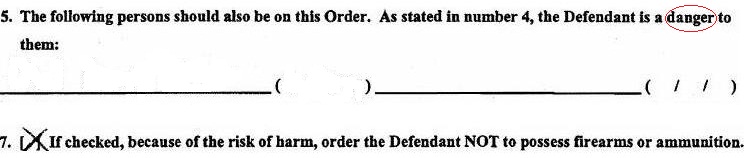
How was the accusation against this woman registered with the courts and stamped on her public record? By marking a box on a restraining order application: tic.

You know, a box like you’ll find on any number of bureaucratic forms. Only this box didn’t identify her as white or single or female; it identified her as a batterer. A judge—who’d never met her—reviewed this form and signed off on it (tac), and she was served with it by a constable (toe) and informed she’d be jailed if she so much as came within waving distance of the plaintiff or sent him an email. The resulting distress cost her and her daughter a season of their lives—and to gain relief from it, several thousands of dollars in legal fees.
After requesting that it be postponed, her accuser eventually confessed at her appeals hearing (under cross-examination by her two attorneys) that his allegations were a fraud urged by his wife, who was jealous of his renewed relationship with a former flame. The innocent victim in this story was one of several they had brought restraining orders against. The false allegations cost them nothing: tic, tic, tic.

The lines below from the restraining order application used in my home jurisdiction illustrate how easily serious allegations may be brought against a person the judge approving that application has never met and knows absolutely nothing about. Allegations that may be utterly fraudulent and that take mere seconds to make may cause an innocent defendant years of torment—or even dismantle his or her life.

In a country that prides itself on its system of law, maybe leveling allegations of violence and threat shouldn’t be a kindergarten game of tic-tac-toe. If you agree, get ticked off and say so.

Tic.

Copyright © 2012 RestrainingOrderAbuse.com

False Allegations and Restraining Orders: The Moral Snare

Someone writes: “I made false allegations to obtain a PPO [an order of protection]. What do I do?”

Disappointingly, this is the first such query this blog has received. Hearteningly, it’s something. And this person should congratulate him- or herself on having a belated pang of conscience.

The ethical, if facile, answer to his or her (most likely her) question is have the order vacated and apologize to the defendant and offer to make amends. The conundrum is that this would-be remedial conclusion may prompt the defendant to seek payback in the form of legal action against the plaintiff for unjust humiliation and suffering. (Plaintiffs with a conscience may even balk from recanting false testimony out of fear of repercussions from the court. They may not feel entitled to do the right thing, because the restraining order process, by its nature, makes communication illegal.)
The lion’s share of the blame for fraud and its damages, of course, clearly falls on the shoulders of plaintiffs—the knots are theirs to untie—but the court should also recognize culpability.

The restraining order process is a honeypot to people nursing a grudge: it’s cheap, convenient, and accommodating. Its making the means to lash out readily available to anyone with a malicious impulse might even be called entrapment. And the court neither acknowledges this process’s consequences to wrongly accused defendants nor impresses upon plaintiffs the consequences to them of making false allegations.

(One defendant I corresponded with this year—who happily succeeded in having the order against her quashed months and thousands of dollars later—was clawing her hair out and dosing herself to sleep. Her young daughter was traumatized by the episode, too. She was accused of domestic violence by a man she’d briefly renewed a friendship with. He was put up to baselessly attacking her through the courts by his wife, who felt jealous—which he admitted in court after dragging the defendant through hell.)

By definition, a civil process shouldn’t foster discord and distress. Maybe lawmakers should mandate a cooling-off period before judges are authorized to approve restraining orders, as they do with handgun purchases.

Or maybe they should put this corrupt institution on ice.

Copyright © 2012 RestrainingOrderAbuse.com

Lying and Restraining Orders: How the Justice System Doesn’t NOT Encourage Perjury

A woman writes: “What was the legislative intent of having the petitioner sign under oath in a civil TRO [temporary restraining order]…?”

The question seems ingenuous enough. The answer, obvious to anyone who’s run afoul of the restraining order racket, is that people lie.

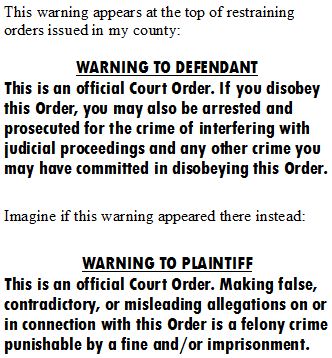
Less ingenuous is the state’s faith that a warning against perjury in fine print on the last page of a restraining order application (that its petitioner has just spent 20 minutes filling out) is going to discourage a liar from signing his or her name to the thing. (In my county this “warning” reads, “Under penalty of perjury, I swear or affirm the above statements are true to the best of my knowledge….” No explanation of perjury or its penalties is provided.)

If the courts really sought to discourage frauds and liars, the consequences of committing perjury (a felony crime whose statute threatens a punishment of two years in prison—in my state, anyhow) would be detailed in bold print at the top of page 1. What’s there instead? A warning to defendants that they’ll be subject to arrest if the terms of the injunction that’s been sprung on them are violated.

Led by the dated dictum that it should in no way discourage would-be restraining order petitioners, the state relegates its token warning against giving false testimony to the tail end of the application where it will most likely be disregarded.

And why not? Perjury is never actually prosecuted.

What this woman’s question reveals is (1) that the average petitioner doesn’t equate statements made on restraining order applications and in affidavits with sworn testimony given in a courtroom, and (2) that neither the consequences to plaintiffs of making inaccurate, misleading, or intentionally false statements to the court nor the consequences to defendants of being emotionally saddled with a restraining order are seriously weighed.

After a more complete digestion of this woman’s question, the unavoidable answer to it is that the legislative intent of having the petitioner sign under oath is plausible deniability of the process’s inviting and rewarding fraudulent abuse.

Copyright © 2012 RestrainingOrderAbuse.com

The Problems with Restraining Orders: Flaws, Flimflam, and Other F-words

Their administration is both biased and anti-feminist

The justice system takes it as axiomatic that plaintiffs who say they are victims are victims, especially when these plaintiffs are female. This policy ignores the obvious, namely, that people lie. Moreover, the court’s showing partiality toward female plaintiffs to redress a perceived inequity between the sexes only fosters reverse discrimination and exhibits contempt for the essential feminist conviction that women merit equal treatment under the law—no less and no more. This disdained expectation, the right to equal treatment, is the same one that restraining orders were originally conceived to acknowledge and validate. Women are still patronized. They’re just patronized in a more favorable way (“There, there, dear”).

They play into the fabulistic and sympathy-seeking tendencies of women

When women are in love, the objects of their affections can do no wrong. They exhale perfume. A spurned woman or one who otherwise nurses a grudge, however, will vilify a man to his toenails. A slight is an attack, a slammed phone is an act of violence, a hand balled in frustration is a death threat. Women, long habituated to the practice by conversations with other women, anatomize the smallest details of masculine conversation and conduct, and apply to them the interpretations that suit the color of their feelings. Exaggeration, embellishment, and caricature in conversation with judges, which is essentially what the brief interviews between judges and restraining order plaintiffs amount to, are to be expected. Judges, subjected to the equivalent of sensitivity training on steroids, accept statements made in these conversations as the equivalent of testimony, which, if made on a witness stand before a jury, would in fact be held to much higher standards of objectivity, accuracy, and accountability.

They’re more effective as instruments of abuse than as instruments of protection

The reliability of restraining orders as shields against violent abuse is iffy at best. Anyone dedicated to doing another harm is unlikely to be deterred by a piece of paper, which may just fan the flames. As vindictive weapons against those who never intended their plaintiffs any harm, however, restraining orders can’t be beat. They demolish lives.

Guilty verdicts are foregone conclusions

The nature of restraining orders being to silence, fetter, humiliate, and intimidate, efforts by defendants to dissuade judges from their institutionally schooled biases are enfeebled and easily disregarded. Defendants who resist are already presumed guilty, and their ability to defend themselves is compromised both by this prejudgment and their consciousness of it. Defendants (men, especially) are likely to file into appeals hearings feeling the presence of a noose around their necks: heads bowed, postures shrunken, voices pinched. Defendants, before they’ve even had a chance to hear the allegations made against them, let alone respond to them, have been confronted by a police officer at their homes and served a judgment by the state: harasser, stalker, deviant, aggressor, villain. When you feel judged, you look and sound guilty.

The system is broken

The failure of judicial oversight committees and state lawmakers and administrators to impose the expectation of fairness on the restraining order process provides judges of a certain bent the opportunity to let loose on defendants with both barrels, indiscriminately and with impunity (judges of this disposition, what is more, seem to be in the majority—maybe because they like adjudicating in this arena). This misconduct is not only sanctioned but oftentimes encouraged and applauded (“Throw the bums to the curb! Atta boy!”). No statutory consequences for plaintiffs’ giving false testimony are enforced, nor are judges held to their canons of office. The victims of abuses by plaintiffs and judges have no advocates or recourses: there’s no impartial ear within the system to turn to. Even those on the outside, journalists and civil rights advocates, shy away from the political razor wire that protects this airtight system.

Summary

The restraining order process is f*ed, and so is everyone it snares. Even the wrongly accused who manage to escape it—like bugs sucked into a vacuum cleaner and dumped from the bag—are lastingly damaged.

Copyright © 2012 RestrainingOrderAbuse.com

“I Felt Like a Sex Offender”: More Stories of Restraining Order Abuse

“I’ve never been treated like that in my life! I felt like a sex offender.”

That was the reaction of a Georgia man, a former English teacher and aspiring songwriter who speaks with a gentle drawl, after his appeals hearing for a restraining order spitefully filed by his on-again, off-again girlfriend (whose mental stability was also on-again, off-again: he had turned to find her pointing a gun at him not long before). “We were like a married couple,” he told me. He was reeling from being publicly berated by the judge, a complete stranger, whose condemnation was based on an evidentiary review as lengthy and thoughtful as a trip to the men’s room.

“It was all over in about 10 minutes,” he said. He was rattled and still riding a wave of adrenaline. Barely out of the courthouse, he was concerned that the restraining order would pop up every time he was stopped for a routine traffic violation and that it would cling to his record forever and foul his ambitions.

Rightly.

All of those who’ve contacted me in the past year about their own cases have been identically tormented. They’re chafed and gnawed at not only by the injustice of this karaoke process—scripted score, add voice—but by the implications of having a restraining order on their permanent records, which implications are exactly as this man characterizes them: aggression, violence, sexual deviancy, etc.

In recent weeks and months, I’ve been contacted by an entrepreneur and Ph.D. whose entire life has been dismantled by assaults made through the courts both on him and his business—along with maliciously anonymous peripheral attacks like phony Craigslist ads and a webpage pornographically parodying a site crafted by his children. He says there have even been attempts on his life, compelling his wife and him to separate from their kids and relocate them to another part of the country for their safety. These assaults—including falsified restraining orders and bogus legal motions by a corrupt attorney (a phrase that may be redundant)—dominate his every waking moment. “I fight for my life every day,” he writes.

Another man, the victim of his ex-wife, a serial restraining order abuser intent to deny him access to his children, writes that he’s tempted to forfeit his visitation rights just to protect them from the fallout. “Recently she called me and asked if she could change some things on our parenting plan. I didn’t agree with the changes,” he writes, “and she told me I would regret it if I didn’t. Two weeks later I was being served with a restraining order. I didn’t show up to court, because this was the third time she had done this, and I was just tired of fighting.”

One woman, a young attorney barely out of law school who was seduced by an older, married peer (also an attorney), was issued an emergency restraining order petitioned on fraudulent grounds, the motive for which was no doubt to discard her and hastily shut her up. She aspires to work in federal law enforcement, a career ambition that stands to be permanently derailed by this man’s viciously selfish manipulations. “Please help,” she closes.

Yet another man, whose ex-wife is an attorney whose new husband is also attorney, has been hit with two restraining orders (the first dismissed as groundless; the second in effect pending appeal) since his ex-wife heard four months ago that he planned to remarry. “They are trying to ruin my wedding and my relationship with my fiancée,” he writes. “They thrive on using the kids as pawns. How do I protect myself from this?” He and his ex-wife have been divorced for 10 years.

Most recently a woman reports she’s been cattily threatened with a restraining order by her neighbor, a disturbed woman who monitors her every move and had physically assaulted her years before. She’s waiting apprehensively for the other shoe to drop.

The themes that run through these accounts are common ones: abuses by attorneys who know how to bend the system to their own self-serving ends, abuses by vindictive lovers and ex-lovers, abuses by the deranged, abuses by the parasitic.

The victims in these stories are the casualties who get whisked under the rug, purportedly in the interest of serving the greater public good.

Many more stories of restraining order abuses can found among the comments on various posts in this blog, and hundreds if not thousands more on this e-petition (the number of respondents to which has nearly trebled since the summer of 2011 when this blog was conceived and published).

Not surprisingly, most of the fraction of fraudulent restraining order victims who do summon the courage to share their stories withhold their names.

The restraining order process remains a crude, unprincipled, and stigmatizing one. Abuse is rampant and largely abetted by the courts, and the tide shows few signs of turning—though one recent visitor indicates that judges in his or her district have imposed a moratorium on issuing protection orders (no reason was given).

If the momentum of this runaway steamroller is finally arrested, it won’t be the result of studies, statistics, or reasoned appeals to social conscience. This debauched institution is all but immune to facts, as any of its victims can well attest. Change will only occur, because victims who refuse to quietly tolerate unjust punishments and public excoriation defiantly talk back.

Copyright © 2012 RestrainingOrderAbuse.com