Michael Honeycutt, TCEQ Tox Director, Lies under Oath

Michael Honeycutt, Ph.D., whom this post tersely exposes, is the director of toxicology of the Texas Commission on Environmental Quality (TCEQ). He is also the current chairman of the Environmental Protection Agency’s Science Advisory Boards but, amid some controversy concerning his ethics, reportedly will not be seeking reappointment when his term ends next month.

Readers may consult “What TCEQ Exec L’Oreal Stepney Would Ask Michael Honeycutt if She Cared Whether the Directors Her Agency Employed Were Unscrupulous Stooges” and its attendant links for specifics concerning this post.

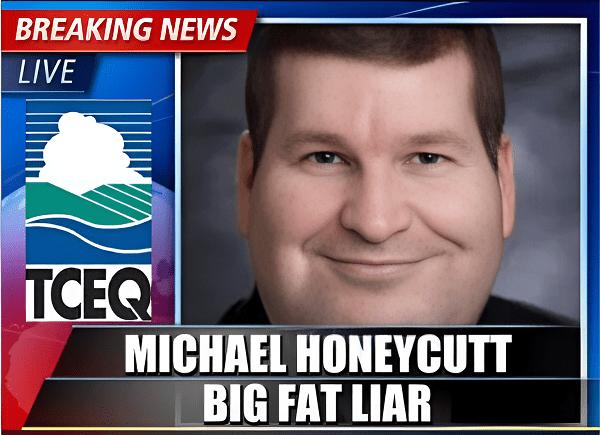
Note: The writer’s publication of satirical images like the one below is not meant to suggest to the reader who has been victimized by court process that people who lie in court or abet liars in court deserve to be lampooned merely. It is the writer’s conviction, rather, that they deserve to be harshly censured in court, like those who are lied about, threatened in court, like those who are lied about, and sent to jail, like those who are lied about too often are. The deplorable fact is that liars like Honeycutt are almost always rewarded for their misconduct with the court’s thanks. Criticism and satiric commentary are thus victims’ only lawful recourse.

Michael Honeycutt, Michael Honeycutt PhD, Michael Honeycutt TCEQ, Michael Honeycutt EPA, false testimony, L'Oreal Stepney, L'Oreal Stepney TCEQ, Toby Baker, Greg Abbott, Tiffany Bredfeldt, Tiffany Bredfeldt PhD, Tiffany Bredfeldt TCEQ, Bredfeldt TG

Michael Honeycutt, Ph.D., director of toxicology of the Texas Commission on Environmental Quality (TCEQ), represented as an even fatter big fat liar


WHAT MICHAEL HONEYCUTT DID:

Lied under oath in a lawsuit in which he phoned in an appearance to help a colleague who had lied under oath deprive the writer of his First Amendment liberty to report their lies.

WHAT MICHAEL HONEYCUTT COUNTED ON:

That his and his colleague’s testimony could never be published.

HOW MICHAEL HONEYCUTT DID IT:

By testifying that I had called his colleague a “fraudulent scientist” because I told him she was a liar.

Honeycutt also reported secondhand fictive tales of sexual harassment/aggression that he acknowledged under oath he had made no attempt to clarify let alone verify.

WHY MICHAEL HONEYCUTT DID IT:

Because he had an inappropriate relationship with his colleague, who was and continues to be his employee. Whether that inappropriate relationship went beyond willing service to her as an agent in an enterprise that was later deemed unlawful, the writer can’t say. (Honeycutt did, however, testify that he had provided his colleague with a private office with a door that locked, and the woman was nominated to a post at the EPA coincident with Honeycutt’s nomination.)

WHAT THE CONSEQUENCES WERE:

An unconstitutional censorship order prohibiting the writer from reporting years of false testimony by Honeycutt’s colleague, a married woman who had indulged an infatuation at the writer’s home in 2005. The writer lived under the order for five years, sustaining himself by manual labor, before it was dissolved in 2018, when the woman’s accusations were dismissed, and a mutual order was entered by the court prohibiting her from ever revisiting them publicly (though the writer is certain they continue to circulate privately). While the writer lived hand-to-mouth, Honeycutt was paid a generous six-figure salary for performing in an air-conditioned facility what is reportedly held by many to be suspect science for the Texas Commission on Environmental Quality (TCEQ).

The illegal order Honeycutt was instrumental in coercing from a since disgraced judge was only dissolved after a protracted two-year contest following his colleague’s seeking to have the writer imprisoned, which Honeycutt apparently supported, and her false allegations continue to be preserved as public documents that can only serve to impede the writer and that have galled and gnawed at him, to the diminishment of his and others’ lives, for nearly 15 years.

WHAT MICHAEL HONEYCUTT HAS DONE SINCE 2018:

Relished his moment in the spotlight as the EPA’s chief science advisor by all appearances.

Copyright © 2020 RestrainingOrderAbuse.com

Retracting False Allegations to the Court

Apologies are offered upfront to the reader expecting a tutorial on how to recant false testimony (though here is an explication about how a restraining order may be dismissed by a petitioner who has reconsidered).

The reason this post must disappoint is that to withdraw false allegations would be to confess to lying to the court and would, as well, be to require that the court acknowledge it was snookered. Hence is copping to lies a doubly taboo subject.

A thorough scouring of the Internet for a simple how-to on retracting false allegations to the court will reward an earnest inquirer with virtually nothing.

The fact is that in America, Land of the Brave Knave, the most fundamental legal precept is admit nothing. Application of that precept apparently extends to the court itself, whose officers may practice moral contortionism sooner than own on record that lies are ever detected.

Their reflex, when no amount of revision can redeem a false allegation, is to talk around it or reach for a nonjudgmental word like unfounded or baseless. Complainants never lie; at worst, they err.

The question remains, however, of how “errant” testimony may be retracted.

This writer proposes that since judges provide false accusations with the agency to work their pernicious effects on untold people’s lives, a judge should be the one to fill the informational void presently under consideration.

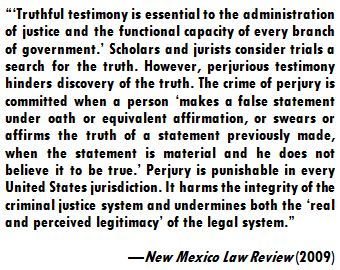
The judicial impulse to frame rulings according to personal conceptions of “right behavior” must surely reject the qualification of lying as conscionable conduct. Arrogating to themselves the right to prescribe rules for how others should behave, besides, presumes judges have faith in their intelligence. They must therefore know false accusations are made even if it’s against policy to say so. It’s not for nothing, after all, that statutes nominating perjury a crime exist.

Since only ignorant people could innocently deny lying occurs, and since we’ve established judges don’t regard themselves as ignorant, to them is this question humbly put: “How may false allegations to the court be simply taken back?”

Copyright © 2014 RestrainingOrderAbuse.com

PERJURY: BS-ing the Court, the Frequency of False Allegations, and the Fraudulent Abuse of the Civil Restraining Order

In the last post, I discussed how lying is generally gotten away with beneath the radar. What people who’ve blessedly had no personal experience with fraudulent abuse of legal process fail to grasp is (1) there’s no incentive to expose untruths except (perhaps) when they’re used to frame people for crimes for which they stand to be convicted, (2) lies are much more commonly used to re-frame the truth into one favorable to the image or malicious intentions of fraudsters than they are to send people to prison, (3) lies don’t have to succeed in false criminal convictions to be damning or ruinous, and (4) lies may be of sorts that are impossible to discredit yet may permanently corrupt the public records and lives of the falsely accused.

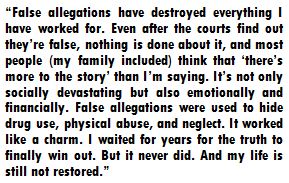
Writers, for instance, who confront false allegations of domestic violence don’t actually invite their imaginations to conceive what such false allegations might be. Perhaps they vaguely suppose they’re of this nature: “He beats me with a belt buckle” or “She locks me in the pantry.” False allegations like these may certainly be made, but lies may be much more subtle or vaporous: “I live in a constant state of fear” or “She said she was going to kill me while I sleep.” Is the truth or falsity of these latter claims possible to ascertain? No. Police reports and restraining orders may be based on allegations like these, however, and anyone who imagines maliciously motivated people are incapable of making false statements to this effect have lived enviably sheltered lives.

False claims of stalking are as easily manufactured: “He creeps around my neighborhood late at night” or “She cut me off in traffic, almost running me off the road.” Allegations like these may not only be the substance of false police reports (which may—and do—gnaw at the sanity of their victims) but may be grounds for false restraining orders (which are far more nightmarish). In fact, the latter allegation was the basis of an emergency restraining order reported to this blog, which was petitioned against a college girl, in or just out of her teens, by her female counselor. The girl and her mom had a weekend to prepare her defense, and she wasn’t fully exonerated of her accuser’s litany of “terror-inspiring misconduct” (which included the girl’s greeting her accuser a few times in chance public encounters in a town of 2,000 residents and seeing her at church).

False allegations of sexual harassment? “He‘s repeatedly told me he wants me to [X] him” or “She keeps propositioning me”—try disproving allegations like these, which may be much more explicit and include claims of physical molestation. The consequences, if it’s necessary to enumerate them, could include termination of employment, marital dissolution, peer or social isolation, and the emotional and thus physical decay that accompany each or all. False claims like these, which take mere seconds to articulate, may never be recovered from.

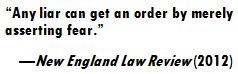
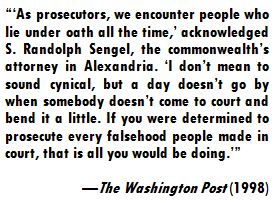
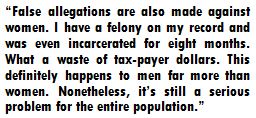
For making such false allegations to the authorities and courts, there are no consequences, except to their victims. There are statutory penalties on the books for making false claims (committing perjury), but they’re rarely if ever enforced and couldn’t be enforced consistently within governmental budgetary constraints, so commonplace is lying. Are such false claims going to end up in some statistical database? Of course not. Ask an honest district attorney, though, why lying isn’t prosecuted, and s/he’ll tell you it’s because lying is an everyday occurrence.

This is the invisible irony that escapes everyone who tackles consideration of rates of false allegations: the fact that lying isn’t prosecuted is the indicator of its rampancy (prosecution of frauds on the police and courts would overwhelm the system). And because lying isn’t prosecuted, it’s in the interest of maintaining the dignity of the legal system and the semblance of just and orderly process that judges not acknowledge even flagrant lies as such. To acknowledge them in all their plenitude, yet not punish them, would be to call into question the legitimacy of the system itself. Restraining order frauds, moreover, may be rewarded with favorable verdicts in spite of lies, making the concealment of those lies by judges that much more urgent.

Society has been conditioned, in the decades since the advent of the restraining order, to be hyper-vigilant and -reactive toward allegations of domestic violence, stalking, and sexual harassment—behaviors associated with male abuse of women, which the restraining order was conceived to curb, if not remedy. These offenses are ones to which the population has been vigorously, even coercively, sensitized. The justice system is consequently poised to descend upon those accused of such behaviors (including women), as is the public poised to believe allegations of such behaviors to be true, especially when validated by the courts.

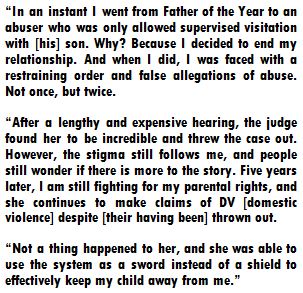
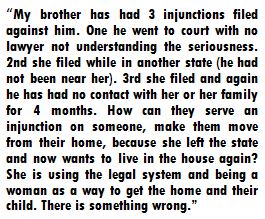
False accusers are certainly aware of these prejudices and may easily exploit them—and should hardly be expected not to. Agents of the system may, in fact, goad them on, even while salting the wounds of those who report that they’re victims of false allegations by telling them they have no legal recourse (which, practically speaking, they don’t). Judges, furthermore, may scourge such victims in the courtroom based on allegations that their accusers leveled in one-sided, five- or 10-minute auditions.

To recap: Liars aren’t prosecuted, so lies aren’t acknowledged as lies, but the civil procedure that’s most eagerly and impulsively abused by liars, the restraining order process,  is supremely lax, instantly gratifying, and universally promoted. This procedure, what’s more, indelibly fouls a falsely accused defendant’s public record; may deny him or her entitlement to home, children, and property; and may cost him or her, besides, employment and employability in his or her chosen field of endeavor.

If this weren’t infernal enough, the outrage and misery expressed by victims who’ve found themselves in the eye of this perfect storm of unreason, some of whom are left impoverished of everything that gave their lives meaning, are credibly denounced or even mocked as crackpot.

Copyright © 2014 RestrainingOrderAbuse.com

The Truth about the Frequency of False Allegations ISN’T to Be Found in Statistics: On How Fraudulent Abuse of Civil Restraining Orders Escapes Recognition

I’ve earnestly and objectively examined posited rates of false allegations in recent months, because statistics and analytics are what we soonest regard as estimates of the truth. It’s typical of writers hostile to the notion that false allegations are rampant, as well as of legal analysts and social scientists, to cite such rates, particularly official approximations of the incidence of false claims of rape and domestic violence.

What even very balanced and cogent analyses of these rates fail to observe, however, is that not all false allegations are of crimes and not all false allegations of crimes are criminally alleged, that is, false allegations of crimes may very conveniently be made through the civil court on restraining/protection order applications (as may be false allegations of every other kind). The number of criminal claims rejected or discredited by the police, then, is not an accurate measure or reflection of the prevalence, nature, or magnitude of false allegations.

It doesn’t, in fact, scratch the surface.

Allegations made pursuant to the procurement of a civil restraining order are never dismissed by the police (and plaintiffs may bypass the police entirely). Unless a complainant seeks to have someone criminally charged, the police have nothing to do with it. Their role is simply that of usher. They steer the complainant toward the courthouse. And if a restraining/protection order is obtained (or possibly just alleged to have been obtained) by a complainant, police inclination is to credit his or her allegations on reflex, because they’ve been conditioned to accept restraining order applicants’ claims at face value, that is, as legitimate.

Because the truth or falsity of allegations is irrelevant in civil proceedings, there are no comprehensive statistics relating to false allegations made on restraining orders. The awarding of restraining orders is grounded on the forcefulness of plaintiffs’ allegations and judicial discretion. It might be possible to determine how many restraining order applications nationwide were rejected in a given period; it’s impossible, however, to determine how many were rejected because judges determined their allegations to be false (rather than just insufficient), or how many were approved in spite of false allegations.

There is no accurate assessment of the volume or degree of lying in civil court. Significantly, too, false allegations made in civil court may easily evolve into criminal allegations that stick, despite those criminal allegations’ original premises’ having been trumped-up.

Journalists who address the subject of false allegations, typically focusing on rape, are prone to dismiss the charge that false allegations are commonplace based on how few plaintiffs are prosecuted for bringing fraudulent allegations. The false assumption of these investigators is that fraudulent allegations are necessarily prosecuted when detected. The fact is that even false allegations of rape may only rarely be prosecuted (see, for example, this case, in which allegations were determined to be unfounded and cost their plaintiff $55,000 but weren’t deemed grounds for the plaintiff’s being prosecuted for perjury). False allegations of sorts other than rape may never be acknowledged as false by judges, let alone deemed grounds for prosecution by district attorneys’ offices (which couldn’t care less). So the equation prosecutions for false allegations are rare = false allegations are rare is flatly wrong.

Isolated, regional studies have been performed by governmental agencies, including one in West Virginia that famously concluded that four out of five (domestic violence) restraining orders were either “unnecessary” or fraudulently based. Since an estimated two to three million restraining orders are issued each year in the United States alone, however, even national scrutiny of every restraining order issued in a given week for false allegations would be impracticable.

Restraining order rulings—disregarding how they’re perceived by the accused and how others perceive the accused because of them—aren’t determinations of guilt or innocence, as criminal rulings are. Restraining order rulings are at best kinda-sorta judgments based on plaintiffs’ persuasiveness.

Even that’s overly dignifying a process that’s initiated on the basis of a brief, one-sided interview of five or 10 minutes that results in the issuance of an order of the court that its defendant may be granted only a half-hour hearing to challenge (and only half of that 30 minutes is afforded to the defendant’s presentation). The idea that restraining order rulings are the products of scrupulous deliberation is beyond absurd.

To repeat, there is no accurate assessment of the volume or degree of lying in civil court. And it’s worthy of repeated observation, moreover, that when false allegations succeed in restraining order adjudications, defendant susceptibility to false criminal allegations increases exorbitantly, so prejudicially is the procurement of a restraining order regarded. How handily restraining orders are obtained and how carelessly their merits are ruled upon are conveniently disregarded after the fact. The next judge down the line is authorized to assume that the original allegations validated by the previous judge were in effect “true.”

The system is rigged both to guillotine the falsely accused and to ensure that false allegations are never discerned or acknowledged as such. The conception is marvelously diabolical, and its effectiveness is witnessed by the fact that the restraining order process has hummed along without a hitch for decades in spite of its being outrageously slack and tendentious (even while levying monstrous sanctions).

Where honest parties with an interest in social justice should seek an estimate of the volume, degree, and consequence of lying is in the testimonies of defendants and the lawyers who (sometimes) represent them—who, in the latter case, if they’re honest (and many are), will readily own that exploitive and malicious use of restraining orders is unexceptional, particularly in family court.

That statistics themselves lie shouldn’t be a novel proposition to anyone. The truly desolating fact to everyone who’s been lied about is that purveyors of statistics of false allegations may not have the least idea that their denial of the rampancy of lying invalidates the trials and torments of multitudes of victims.

Copyright © 2014 RestrainingOrderAbuse.com