Why Lying Women Don’t Cry Rape All the Time

A rhetorical catfight has been waged for years on the Internet between injured men and injured women or people who advocate on behalf of injured women. It’s a logical mare’s nest. Untold men (and women) have been wronged by casually abused and abusive procedures of law whose genesis owes to rabid feminist politicking at the end of the last century. These men (and women) have, again in untold because incalculable numbers, been unjustly deprived of children, home, property, livelihood, security, dignity, and/or liberty, and that fact has largely gone disregarded. A perusal of the quotations in the margin of this blog will satisfy any conscientious reader that this is a fact and not merely an allegation. The laws themselves are bent. Injured men (their predominant victims) have, sensibly or not, accordingly sought to draw attention to lying by women by emphasizing that women will lie even about rape (the specter in the room, incidentally, during any legal proceeding based on an allegation of abuse). There have, of course, been many documented cases of false rape allegations’ being made by women. Feminist advocates deny false accusation of rape “occurs” to any significant degree, ignoring the underlying male plaint, namely, that women lie in heinously vengeful, passive-aggressive, attention-seeking, destructive ways—and contrary to what some apologists for feminine lying would have the public believe, unscrupulous women (and men) don’t lie because they’re crazy, per se. They lie because it’s effective, just as diverting the “conversation” away from lying to lying about rape is effective at denying either one merits consideration.


These are not people.

“Feminism is the radical notion that women are people.”

—Marie Shear

Far from suggesting that women are Barbie dolls or marble angels, a proposition that may even have offended its speaker, this quotation, oft brandished by feminists today, promotes the idea that women are people. And people, unlike Barbie dolls or marble angels, lie. They lie about anything it serves them to lie about.

So much then for the myth of the faultless woman—which is one you’re unlikely to find debunked on Jezebel.com.

The question this post considers is that if women are willing to lie to cops and judges (and they are, as are men), why pussyfoot and not just accuse any target of malice of sexual violation? It’s a potent allegation.

Well, it comes with a host of complications is why. In civil court, a false (or possibly real but baseless) claim of fear is all it takes to procure a protective order and turn a person’s life on its head. It can win a perfect stranger the exclusive entitlement to a person’s home and property while possibly landing him or her in jail. Unless a lying plaintiff aims to drive her victim to suicide, falsely alleging rape is overkill and pointlessly invites exposure.
A criminal claim of rape, on the other hand, both figuratively and literally invites strangers’ noses into uncomfortable places. Government wants specifics and evidence. Girlfriends and family members may gently inquire about details.

This is the kind of claim, if false, that requires a great deal of determination to pull off and carries a heavy risk of tattering under scrutiny.

Let’s not deceive ourselves that unscrupulous women are too virtuous to lie about rape. Rather let’s be honest: Lying about rape is demanding and dicey.

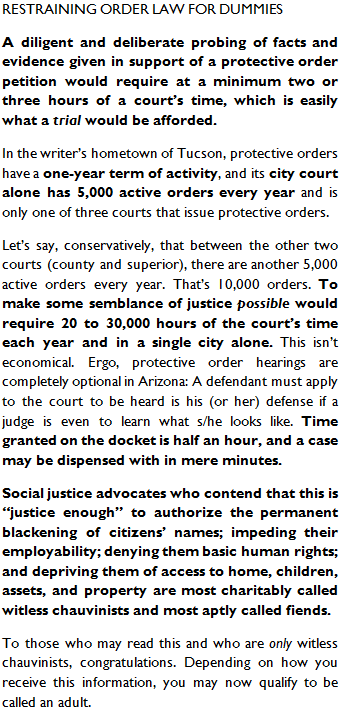
That said, it’s really not that tough in civil court, which doesn’t require “proof beyond a reasonable doubt.” In civil court, it’s just he-said-she-said. A defendant doesn’t even have to be heard in court for a “default” judgment to be entered against him. And even if he does appear, there’s no guarantee the plaintiff will be required to or that the accused will have the opportunity to cross-examine her, making a mockery of the adversarial process. A judgment in civil court doesn’t represent a finding that a rape was committed, necessarily, but it’s not a denial that a rape was committed, either, and the accusation is what’s preserved.

The injustice is glaring but note that it’s legally no worse than that any other allegation that works can be made and can accomplish the same damaging consequences.

People have to live with this shit. Their families have to live with this shit. Their children have to live with this shit.

This is what men’s rights advocates would be saying if there were anyone who would listen or have the least capacity to comprehend the breadth and depth of injuries that instead tend to be casually batted aside (while accounts of groping or sexual harassment are gravely highlighted on NPR).

Most of these men have not been accused of rape, which doesn’t mean they couldn’t also have been accused of rape had their accusers been gutsy enough or that it wasn’t implied (point 1). And it doesn’t mean they have nothing to complain about (point 2).

Injustice is always something to complain about (point 3).

Copyright © 2019 RestrainingOrderAbuse.com

*I think I even read that on a liberal yard sign.

A Story of Female Sterilization That Should Stress to Those Who’ve Been Violated by Fraudulent Abuse of Legal Process Why Reporting Judicial Tyranny and False Accusers Is by Itself Pointless (You Must Demand Change)

The point of sharing the explication below is to emphasize how forlorn prospective recourses for redressing rights violations stemming from false restraining order and similar prosecutions are. Accountability is zero, across the board.

If you’ve ever wondered why a judge may be censured for rude conduct but not for ignoring lies or misrepresenting evidence, here’s why.

Quoted from “The Plumb Line: So What Else is New?” (Murray N. Rothbard, Libertarian Review, 1978), reprinted on LewRockwell.com as “The Tyranny of the Bench”:

The United States Supreme Court ruled, in 1872, that judges were immune from any damage suits for any “judicial acts” that they had performed—regardless of how wrong, evil, or unconstitutional those acts may have been. When clothed in judicial authority, judges can do no wrong. Period. Recently a case of an errant judge has come up again—because his action as a judge was considered generally to be monstrous and illegal. In 1971, Mrs. Ora Spitler McFarlin petitioned Judge Harold D. Stump of the DeKalb County, Indiana, Circuit Court to engage in a covert, compulsory sterilization of her 15-year-old daughter, Linda Kay Spitler. Although Linda was promoted each year with her class, Mrs. McFarlin opined that she was “somewhat retarded” and had begun to stay out overnight with older youths. And we all know what that can lead to.

Judge Stump quickly signed the order, and the judge and mamma hustled Linda into a hospital, telling her it was for an appendicitis operation. Linda was then sterilized without her knowledge. Two years later, Linda married a Leo Sparkman and discovered that she had been sterilized without her knowledge. The Sparkmans proceeded to sue mamma, mamma’s attorney, the doctors, the hospital, and Judge Stump, alleging a half-dozen constitutional violations.

All of these people, in truth, had grossly violated Linda’s rights and aggressed against her. All should have been made to pay, and pay dearly, for their monstrous offense. But the federal district court ruled otherwise. First, it ruled that mamma, her lawyer, and the various members of the “healing professions” were all immune because everything they did had received the sanction of a certified judge. And second, Judge Stump was also absolutely immune, because he had acted in his capacity as a judge, even though, the district court acknowledged, he had had “an erroneous view of the law.” So, not only is a judge immune, but he can confer his immunity in a king-like fashion even onto lowly civilians who surround him.

The U.S. Court of Appeals, Seventh Circuit, unaccountably didn’t understand the program, and so it reversed the district court, claiming that Judge Stump had forfeited his immunity “because of his failure to comply with elementary principles of due process,” and had therefore in a sense “not acted within his jurisdiction.” To allow Stump’s action to stand, said the appeals court, would be to sanction “tyranny from the bench.”

Now this was pretty flimsy stuff, and besides it opened an entertaining wedge toward holding judges accountable to the law and to the protection of rights like everyone else. But this would have shaken the foundations of our monopoly archist legal system. And so the U.S. Supreme Court, on March 28, set the matter straight. In a 5–3 decision in this illuminating case of Stump v. Sparkman, Justice Byron R. (“Whizzer”) White, speaking for the majority, sternly reminded the appellate court of the meaning of the 1872 ruling:

A judge will not be deprived of immunity because the action he took was in error, was done maliciously, or was in excess of his authority. Rather, he will be subject to liability only when he has acted in the “clear absence of all jurisdiction.”

Justice White conceded that no state law or court ruling anywhere could be said to have authorized Judge Stump’s action; but the important point, he went on, is that there was no statute or ruling which prohibited such an action by the judge.

Those interested in reading more are urged to click the link to Mr. Rothbard’s article at the top of the post.

What all of this should make clear is that for redress of rights violations stemming from false allegations made in restraining order and related prosecutions to be possible, the laws themselves must be rectified—and legislative reform will only be urged when more people loudly demand it.

For rights abuses to be capable of remedy by process of law, they must be illegal, which means the processes that authorize those abuses must be revamped or repealed by lawmakers (your state representatives). So long as the standard applied to restraining orders is merely a discretionary one, judges can rule however they want (that’s the statutory latitude they’ve been given), and they’re accountable for those rulings to no one.

Copyright © 2014 RestrainingOrderAbuse.com

Facts and Fairness: Using Arizona’s Policies to Expose Restraining Order Iniquity

I live in Arizona where I was issued a restraining order in 2006 petitioned by a woman I nightly encountered hanging around outside of my house. The restraining order said I was a danger to her husband and shouldn’t be permitted to approach or talk to him.

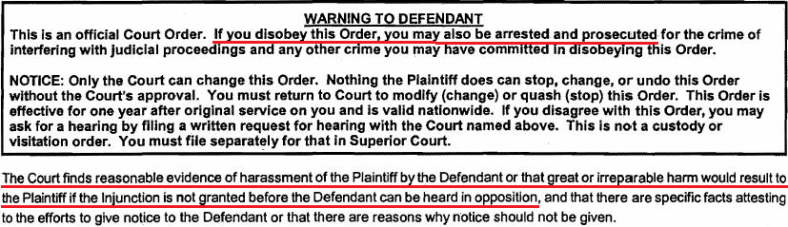
If you receive a restraining order in my home state, here’s the first thing that greets your eye:

On the basis of the form this warning captions—which looks like it was drafted by someone using a pizza crust as a straightedge—citizens are recorded in state and national police databases as stalkers and violent abusers.

Consider that the immediate impression this warning is meant to give is beware. It naturally excites fear—and if you’ve been falsely accused, a host of other emotions, besides, none of which conduces to calm and lucid thinking.

Something you wouldn’t guess from this “Warning to Defendant” is that if a defendant “disagrees” with an order issued in Arizona, s/he has the statutory right to apply for an appeals hearing at any time during the order’s effectiveness. For example, if the duration of the order is one calendar year, the defendant can take 11 months to assemble his or her appeal and save up, if necessary, to have an attorney represent that appeal.

Here’s the law:

At any time during the period during which the injunction is in effect, the defendant is entitled to one hearing on written request. No fee may be charged for requesting a hearing. A hearing that is requested by a defendant shall be held within ten days from the date requested unless the court finds compelling reasons to continue the hearing. The hearing shall be held at the earliest possible time. An ex parte injunction that is issued under this section shall state on its face that the defendant is entitled to a hearing on written request and shall include the name and address of the judicial office where the request may be filed. After the hearing, the court may modify, quash or continue the injunction.

The statute says the court’s order must inform the defendant that s/he’s entitled to a hearing, but it doesn’t require that the order inform the defendant that s/he has a year (or possibly years) in which to prep and apply for that hearing, that the hearing is free, or that the defendant may be represented by an attorney.

Restraining orders are rhetorical psych-outs. Their language is overtly menacing, and neither the law nor the issuing courthouse gives any consideration to apprising defendants of their rights.

The stress is on apprising defendants, who are presumed to suck (sight unseen), of what rights they’re no longer deemed worthy of.

Appreciate that the court’s basis for issuing the document capped with the “Warning” pictured above is nothing more than some allegations from the order’s plaintiff, allegations scrawled on a form and typically made orally to a judge in four or five minutes.

In the courthouse where the order issued against me was obtained, restraining order petitioners file into a room like a small bus station terminal, submit their applications, wait for an audience with a judge, chat with him or her for a few minutes, and leave.

That’s it.

Consequences of receiving an order of the court whose merits are determined on this basis include registration in state and national law enforcement databases, and may also include loss of entitlement to home, children, and possessions, and loss of employment.

In contravention of due process, orders are issued against defendants that may deny them liberties and property without the court’s hearing from them at all.

Ever.

In Arizona, unless a defendant requests a hearing before a judge, that’s an end on the process. No judge will even have learned what s/he looks like, and the truth of the plaintiff’s claims will never have been controverted—claims, to reiterate, that were made in a few minutes and could include anything from annoyance to physical or sexual violence.

Such claims often amount to nothing more certain than finger-pointing.

(Docket time afforded by the court to the testimony of defendants who go to the trouble of appealing rulings based on such claims, incidentally, is about 15 minutes. The cost of attorney representation at an appeals hearing may be $2,000 to $5,000.)

The only provision the law or the court makes for discouraging false testimony (some motives for which are here) is this one, which predictably appears at the very end of the application form:

The plaintiff signs below.

Applicants aren’t of course told what “perjury” is, and they’re certainly not told it’s a felony crime that carries a prison term (as it is and does in Arizona and many other states). Lying to the court is never sanctioned or prosecuted, anyway.

Recent posts on this blog were answers to dismissal by a doctor of laws of criticisms that the restraining order process is unfair. The process would have to be far more deliberative than it is, in fact, to be merely “unfair.”

The process is automated.

Copyright © 2014 RestrainingOrderAbuse.com