Retracting False Allegations to the Court

Apologies are offered upfront to the reader expecting a tutorial on how to recant false testimony (though here is an explication about how a restraining order may be dismissed by a petitioner who has reconsidered).

The reason this post must disappoint is that to withdraw false allegations would be to confess to lying to the court and would, as well, be to require that the court acknowledge it was snookered. Hence is copping to lies a doubly taboo subject.

A thorough scouring of the Internet for a simple how-to on retracting false allegations to the court will reward an earnest inquirer with virtually nothing.

The fact is that in America, Land of the Brave Knave, the most fundamental legal precept is admit nothing. Application of that precept apparently extends to the court itself, whose officers may practice moral contortionism sooner than own on record that lies are ever detected.

Their reflex, when no amount of revision can redeem a false allegation, is to talk around it or reach for a nonjudgmental word like unfounded or baseless. Complainants never lie; at worst, they err.

The question remains, however, of how “errant” testimony may be retracted.

This writer proposes that since judges provide false accusations with the agency to work their pernicious effects on untold people’s lives, a judge should be the one to fill the informational void presently under consideration.

The judicial impulse to frame rulings according to personal conceptions of “right behavior” must surely reject the qualification of lying as conscionable conduct. Arrogating to themselves the right to prescribe rules for how others should behave, besides, presumes judges have faith in their intelligence. They must therefore know false accusations are made even if it’s against policy to say so. It’s not for nothing, after all, that statutes nominating perjury a crime exist.

Since only ignorant people could innocently deny lying occurs, and since we’ve established judges don’t regard themselves as ignorant, to them is this question humbly put: “How may false allegations to the court be simply taken back?”

Copyright © 2014 RestrainingOrderAbuse.com

Beating up Disabled Girls: False Allegations and Judicial Dishonor

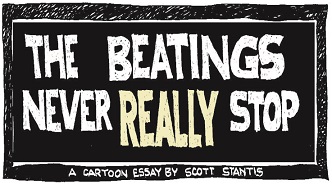
“There is no normal. The rational has been torn away from your ability to grasp it.”

Cartoonist Scott Stantis (on growing up in an abusive household)

This is the sentiment shared by everyone who’s been wrongly blamed—and abused and condemned for it.

Consider that current restraining order and domestic violence legislation and policy are defended as protecting battered women and children. Consider further that honor is not only represented as the guiding principle of judicial conduct but that it’s the title that judges are expected to ceremoniously be addressed by.

Now consider this appeal posted three weeks ago (September 30, 2014) to the e-petition “Stop False Allegations of Domestic Violence” by Phoenicia W. of Springfield, Missouri:

Hi im disabled 28 year old women. And just. Because. I was sick of being. Beat by my exboyfrend I kicked him out and he put fales charges on my cost me 10.000 dollars and I lost. Alot. How can his lies be taken. Off my record. Please. IV never. Even. Could. Hurt a fly please. I cry every. Nite. Help me.im incident I swere.

I’ve edited copy since I was teenager. Here’s what Phoenicia means:

Hi, I’m a disabled 28-year-old woman, and just because I was sick of being beaten by my ex-boyfriend [and] kicked him out…he put false charges on me that cost me $10,000—and I lost. A lot. How can his lies be taken off my record? Please. I’ve never even (and couldn’t) hurt a fly. Please. I cry every night. Help me. I’m innocent, I swear.

The gist of Mr. Stantis’s cartoon essay is that when you’re punished for something you didn’t do, and there’s no way to make sense of your situation or escape it, it “mangles the soul.”

My tidied version makes Phoenicia sound very able and together. Look again at the unedited script, though, which is a poem of pain.

Does it look and sound like it was authored by someone who could capably represent herself in court? For that matter, does it look and sound like it was authored by someone dangerous? Finally, how honorable is beating up (or beating down, if you prefer) a disabled girl and leaving her crying herself to sleep each night—a disabled girl, what’s more, who says she was beaten by the man who accused her of violence?

Feminists are urged to ask themselves which they think will have a more lasting consequence on this woman’s psyche: having been hit by an ex-boyfriend or living day and night with the court’s judgment? Which obviously haunts her? Which has healed, and which can’t heal? (When the court acts on lies by abusers, it compounds the abuse many times and makes it gnawing and constant: “There is no normal.” Ever. Again.)

You can’t relate pain like Phoenicia’s with a lurid picture of a black eye. Her pain and its source are invisible—and count on it that all traces of either have been carefully concealed beneath layers of judicial impression management.

If you’re not familiar with the phrase impression management, here’s an example: “She’ll be okay. She just ran into a door.”

Copyright © 2014 RestrainingOrderAbuse.com