 It’s hard not to hate judges who issue rulings that may be based on misrepresentations or outright fraud when those rulings (indefinitely) impute criminal behavior or intentions to defendants, may set defendants up for further (or serial) malicious prosecutions by the same false accuser (and possibly land them in jail), and may finally inflict severe privations, including loss of income, employment, and/or access to children, pets, home, and property.
It’s especially hard not to hate judges when you’ve told them the truth, pronounced it politely and respectfully, and nevertheless been scorned, humiliated, and demeaned…with gusto.
Judges tend to be hubristic, condescending, and willfully menacing (even when they’re smiling at you).
To compound the outrage, it’s only their station that licenses their haughtiness. More often than not, their authority doesn’t come from learnedness in the law but is simply a perk of the job.
Though there have been some motions in recent years to amend this situation, most bottom-rung judges who issue restraining orders aren’t qualified lawyers, that is, they don’t have law degrees. They were just elected or appointed to the position and sent to “judicial boot camp.” Judges are trained to execute specific duties; they’re not necessarily educated in jurisprudence.
Some have no education beyond high school.
This may either be a reason to resent them all the more for their audacity or a reason to see them as mere tools of a system that conditions their bigoted behavior. Restraining order judges are told—possibly quite explicitly—how they’re expected to rule. That’s a significant part of their “training.”
This hardly excuses conduct that obviously contravenes judicial ethics. It does, though, make that conduct understandable.
Certainly judges aren’t to blame for the state of things, including the shambles they unjustly make of people’s lives. They don’t level the allegations, nor do they formulate the rules, draft the laws, or influence the political and public opinions that do determine rules and laws.
Sure, judges of conscience could vocalize qualms or defy the system. They could martyr themselves for principle. Whether this would effectively alter the status quo, however, is debatable.
Remember, they’re not legal scholars, by and large; they’re just referees who’ve had certain priorities impressed upon them. It’s not theirs to comment on the laws—and being unqualified to do so, they may genuinely believe they’re acting righteously.
There’s no particular reason not to hate judges if one or more have wronged you. If you step back, though, you’ll see that they’re more like ants that bite because they’ve been tasked with defending the colony according to certain marching orders than they are like people we should reasonably expect to treat us with dignity and charity.
Judges are often power-corrupt—it comes of sitting above others who must kowtow to them—but they’re basically people doing a job they may be scarcely better equipped to do than you or I.
Copyright © 2015 RestrainingOrderAbuse.com
 Pols and corporations engage in flimflam to win votes and increase profit shares. Science, too, seeks acclaim and profit, and judicial motives aren’t so different. Judges know what’s expected of them, and they know how to interpret information to satisfy expectations.
 Since judges can rule however they want, and since they know that very well, they don’t even have to lie, per se, just massage the facts a little. It’s all about which facts are emphasized and which facts are suppressed, how select facts are interpreted, and whether “fear” can be reasonably inferred from those interpretations. A restraining order ruling can only be construed as “wrong” if it can be demonstrated that it violated statutory law (or the source that that law must answer to:
  Feminism’s foot soldiers in the blogosphere and on social media, finally, spread the “good word,” and John and Jane Doe believe what they’re told—unless or until they’re torturously disabused of their illusions. Stories like those you’ll find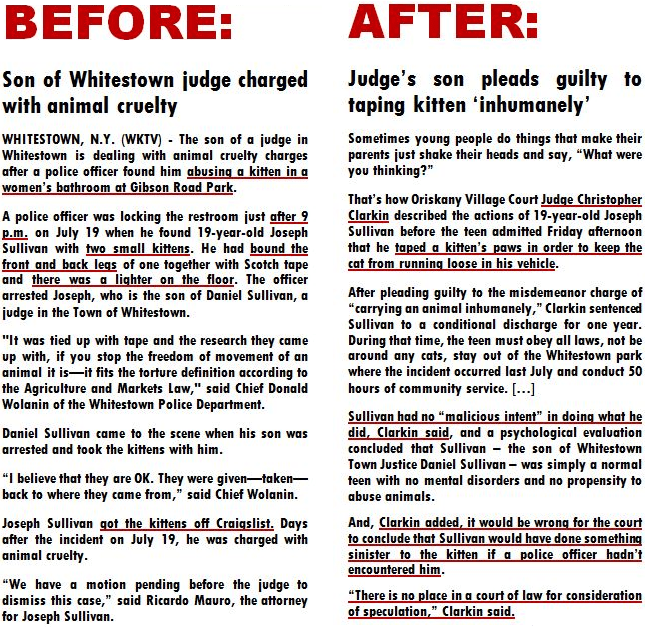
 A theme that emerges upon consideration of
  It’s ironic that the focus of those who should be most sensitized to injustice is so narrow. Ironic, moreover, is that “emotional abuse” is frequently a component of state definitions of domestic violence. The state recognizes the harm of emotional violence done in the home but conveniently regards the same conduct as harmless when it uses the state as its instrument.
 Here’s yet another irony. Too often the perspectives of those who decry injustices are partisan. Feminists themselves are liable to see only one side.
 Now consider the motives of false allegations and their certain and potential effects: isolation, termination of employment and impediment to or negation of employability, inaccessibility to children (who are used as leverage), and being forced to live on limited means (while possibly being required under threat of punishment to provide spousal and child support) and perhaps being left with no home to furnish or automobile to drive at all.
 TALKING BACK to restraining orders