Diddly: What Judges Who Issue Restraining Orders May Know about the Law

I should go back and edit out whatever grudging credit I’ve given to judges for their knowledge of the law in posts past. It turns out that if you’ve been calling the guy or gal who issued you a restraining order—and then scorned and humiliated you when you tried to defend yourself—a “clown,” a “petty tyrant,” or a “mouth-breathing wannabe,” you may have better grounds for your assessment of his or her character and qualifications than you imagine.

A client I talked with this week, a retired criminal defense attorney who started out as a county prosecutor, set me straight about what legal credentials are required to ascend to a seat on the court’s lowest tier in my home state of Arizona.

None. At all. These “judges” don’t have to know jack about the law.

Arizona isn’t known for progressivism, of course. We still have “justices of the peace.” On the other hand, so, too, do New York and the United Kingdom.

The majority of JPs (or “magistrates,” as they’re sometimes called) aren’t qualified lawyers, that is, they don’t have law degrees. It may be the case, what’s more, that bottom-rung municipal and county judges in many or most places are laypeople whose only grounding in the law may be a bit of mandated “judicial training.”

(When I was a graduate teaching assistant, I was required to meet with a panel of professors once a week for a “colloquium.” The point was to familiarize up-and-coming professors with what the business of professorship entailed. I’ve witnessed no evidence that “judicial training” is any more intensive than this was.)

Restraining orders, it should be noted, may issue from a diversity of courts. Their typical sources, however, are judges at the dirt end of the totem pole, the same people who hear traffic cases and officiate over marriages for tips (they can make, incidentally, $100–$200K, depending on the size of the jurisdiction they preside in and the docket it generates). All that may distinguish JPs or their equivalents from anybody else (excepting their lavish salaries) is that they got elected or appointed to office. In Arizona and places elsewhere, they’re minor politicians, like schoolboard members and city councilmen and -women.

(In 2014, nearly 50 JPs elected in my state of Arizona ran unopposed; they didn’t even have to be good politicians to “earn” their judicial posts. Amusing story: In 2011 or 12, after I’d just started writing about procedural abuses, I chanced to bump into a friend from the University of Arizona English Department. She hollered at me across the parking lot of a public library. It happened that she was dating a judge and wanted me to sign her boyfriend’s petition for reelection. He seemed like a nice guy—I’d never met him before—and I didn’t think twice about lending my support and shaking his hand. I only realized as I was driving away that he’d been one of the four judges involved in my own case in 2006. I made the connection because his promotional gimmick was a chip bag clip with his name embossed on it. It’s probably still in my truck somewhere under the string cheese wrappers.)

All this is to say that the “reverend pontiffs” we’re required to bow and scrape to when we appear in court (“Yes, Your Honor!”) may have been former McDonald’s shift managers. These are the same guys, mind you, whose offhand judgments may spur protracted domestic wars whose financial tolls can run to the five or six digits (and ruin families)—and that’s besides the thousands or tens of thousands that serial litigations (from one couple) may cost the taxpaying public.

(“Can I interest you in a large drink to go with your order?”)

Rulings by these men and women, who may have no collegiate training in the law, may moreover drive some defendants to commit suicide or to do violence to others.

(“You wanna supersize that?”)

Several people who’ve registered complaints about restraining order decisions on this site have J.D.’s—law degrees—and are or were licensed attorneys. (Larry Smith is a former lawyer who’s been subject to and who blogs about restraining order and other procedural abuses.) As if the restraining order process weren’t already a sham owing to the slack standards authorized by lawmakers, the mere minutes-long (“drive-thru”) hearings, and the preferential treatment shown to plaintiffs, the process is also administered by folks who may have less background in the law than the people they pronounce judgment upon.

This isn’t to say these guys don’t know “the rules” and what the statutes say. There’s more, though, to the law than laws. You or I could learn those with a few nights of study. The point is they may have no footing in the principles of jurisprudence or have ever taken a freshman level course in legal ethics. All they may know is what they’re “supposed” to do.

(“Does everything look right on your screen?”)

Judges higher up the ladder, like superior court justices, do have to have degrees and must have passed the bar, according to the former lawyer I talked with this week (for whom I removed an aged tree with hands I’d meant to do other things with—I did also offer to help him with a book he’s writing). But even superior court judges need not necessarily have practiced the law significantly before assuming a position on the bench. It’s sort of like naming a greenhorn architecture professor to be the foreman of a construction site.

The snarky zinger often aimed at teachers applies at least as aptly to the court: Those who can’t do, judge.

Not only did my client (the former lawyer) opine that some judges were “complete idiots”; he felt some of them weren’t even sane (and he named names, which I have to be cautious about doing). “God,” I said, “it’s like the Wild West.” He agreed.

Copyright © 2015 RestrainingOrderAbuse.com

*To make matters more shameful yet, restraining orders may be issued by judges pro tem—temporary help hired by the court to cover for JPs or their ilk. These courthouse temps may have no judicial experience (and no particular investment in doing their jobs well). The restraining order this writer was issued in 2006, which had been petitioned by a married woman who hung around his house at night in 2005 (minus both her husband and her wedding ring), was approved by a judge pro tem. On appeal, the order was determined by a JP to have been “incorrectly issued,” because the woman had included her husband on the order (her motive for the order was plainly to have me prohibited from speaking to him). The judge, who had a black cowboy mustache that screamed dye, ruled to affirm the order despite its sketchiness after he “allowed” me to testify for 15 minutes. What a guy. (In conversation with the client I’ve mentioned in this post, I was told he’d ironically helped to get this particular judge elected. He shared some gossip with me, too. He said the man liked to tell people he was a former member of Special Forces. My client quipped he was probably the cook. Not long after I stood before him in 2006, “Judge Commando”—who had declared during my hearing that he considered his courtroom the “last bastion of civilization”—was nominated to head up my county’s domestic violence court. Who better to sensitively negotiate disputes that fracture families than a fella who fancies himself Rambo? As you might guess, he’s very popular with female plaintiffs.)

Cognitive Distortions and Restraining Orders: On How Judicial Method Corresponds with Automatic Thinking

My previous post concerned distortion, specifically by those with narcissistic personality disorder (one of a number of personality disorders that may lead a person to make false allegations, that is, to distort the truth). Restraining order fraud, whether committed by pathological liars or the garden variety, tends to go over smashingly, because judges’ biases (perceptual and otherwise) predispose them to credit and reward fraud.

Below is a list of cognitive distortions (categories of automatic thinking) drawn from Wikipedia interspersed with commentaries. Many if not most of these cognitive distortions are applicable to restraining order decisions and clarify how it is that slanted, hyperbolic, or false allegations made through the medium of the restraining order stick.
(Cognitive distortion or automatic thinking is pathological thinking associated with neurological disorders.)

All-or-nothing thinking: seeing things in black or white as opposed to shades of gray; thinking in terms of false dilemmas. Splitting involves using terms like “always,” “every,” or “never” when this is neither true, nor equivalent to the truth.

Restraining order rulings are categorical. They don’t acknowledge gradations of culpability, nor do they address the veracity of individual allegations. Rulings are “yea” or “nay,” with “yea” predominating. That some, most, or all of what a plaintiff alleges is unsubstantiated makes no difference, nor does it matter if some or most of his or her allegations are contradictory or patently false. Restraining order adjudications are zero-sum games.

Overgeneralization: making hasty generalizations from insufficient experiences and evidence.

Restraining order applications are approved upon five or 10 minutes of “deliberation” and in the absence of any controverting testimony from their defendants (who aren’t invited to the party). All rulings, therefore, are arguably hasty and necessarily generic. (They may in fact be mechanical: a groundless restraining order was famously approved against celebrity talk show host David Letterman because its applicant filled out the form correctly.)

Filtering: focusing entirely on negative elements of a situation, to the exclusion of the positive. Also, the brain’s tendency to filter out information which does not conform to already held beliefs.

Judicial attention is only paid to negative representations, and plaintiffs’ representations are likely to be exclusively negative. Judges seek reasons to approve restraining orders sooner than reasons to reject them, and it’s assumed that plaintiffs’ allegations are valid. In fact, it’s commonly mandated that judges presume plaintiffs are telling the truth (despite their possibly having any of several motives to lie).

Disqualifying the positive: discounting positive events.

Mitigating circumstances are typically discounted. Plaintiffs’ perceptions, which may be hysterical, pathologically influenced, or falsely represented, are usually all judges concern themselves with, even after defendants have been given the “opportunity” to contest allegations against them (which opportunity may be afforded no more than 10 to 20 minutes).

Jumping to conclusions: reaching preliminary conclusions (usually negative) from little (if any) evidence.

All conclusions in restraining order cases are jumped-to conclusions. Allegations, which are leveled during brief interviews and against defendants whom judges may never meet, need be no more substantial than “I’m afraid” (a representation that’s easily falsified).

Magnification and minimization: giving proportionally greater weight to a perceived failure, weakness or threat, or lesser weight to a perceived success, strength or opportunity, so the weight differs from that assigned to the event or thing by others.

Judicial inclination is toward approving/upholding restraining orders. In keeping with this imperative, a judge will pick and choose allegations or facts that can be emphatically represented as weighty or “preponderant.” (One recent respondent to this blog shared that a fraudulent restraining order against him was upheld because the judge perceived that he “appear[ed] to be controlling” and that the plaintiff “seem[ed] to have some apprehension toward [him].” While superficial, airy-fairy standards like “appeared” and “seemed” would carry little weight in a criminal procedure, they’re sufficient qualifications to satisfy and sustain a civil restraining order judgment, which is based on judicial discretion.)

Emotional reasoning: presuming that negative feelings expose the true nature of things, and experiencing reality as a reflection of emotionally linked thoughts. Thinking something is true, solely based on a feeling.

The grounds for most restraining orders are alleged emotional states (“I’m afraid,” for example), which judges typically presume to be both honestly represented and valid (that is, reality-based). Consequently, judges may treat defendants cruelly according with their own emotional motives.

Should statements: doing, or expecting others to do, what they morally should or ought to do irrespective of the particular case the person is faced with. This involves conforming strenuously to ethical categorical imperatives which, by definition, “always apply,” or to hypothetical imperatives which apply in that general type of case. Albert Ellis termed this “musturbation.”

All restraining order judgments are essentially generic (and all restraining order defendants are correspondingly treated generically = badly). Particulars are discounted and may well be ignored.

Labeling and mislabeling: a more severe type of overgeneralization; attributing a person’s actions to their character instead of some accidental attribute. Rather than assuming the behavior to be accidental or extrinsic, the person assigns a label to someone or something that implies the character of that person or thing. Mislabeling involves describing an event with language that has a strong connotation of a person’s evaluation of the event.

The basis of a defendant’s “guilt” may be nothing more than a plaintiff’s misperception.

Personalization: attributing personal responsibility, including the resulting praise or blame, for events over which a person has no control.

The restraining order process is entirely geared toward assigning blame to its defendant, regardless of the actual circumstances, of which a judge has only a plaintiff’s representation, a representation that may be false or fantastical. A circumstance a defendant may be blamed for that s/he has no control over, for example, is a plaintiff’s being neurotic, delusional, or deranged.

Blaming: the opposite of personalization; holding other people responsible for the harm they cause, and especially for their intentional or negligent infliction of emotional distress on us.

  • Fallacy of change: Relying on social control to obtain cooperative actions from another person.
  • Always being right: Prioritizing self-interest over the feelings of another person.

This last category of automatic thinking sums up a judge’s role and m.o. to a T. And, at least in the latter instance (“Always being right”), shouldn’t. If, to the contrary, judges always assumed their first impressions and impulses were wrong, any number of miscarriages of justice might be avoided.

Copyright © 2013 RestrainingOrderAbuse.com

Turnabout is Fair Play: Scrutinizing the Character and Conduct of Officers of the Court

Fair is a word that appears prominently in ethical canons drafted to define the methodologies and behaviors expected of judges (which canons are consolidated into states’ codes of judicial conduct, compendia of rules and principles that in the administration of restraining orders are more often paid lip service than scrupulous attention). An obligation of using the word fair is tolerating having done to you what you do to others.

Among the unfair aspects of how restraining orders are administered is the judicial application of a generic standard to defendants (that is, recipients of restraining orders). Positive matches are facilely constructed (sight unseen) between any John or Jane Doe who’s had a finger pointed at him or her—very possibly by a malicious accuser—and some paradigmatic caricature bad guy, the “Grim Creeper,” the original template for whose debauched and demonic dimensions was the much-hyped domestic batterer of 30 years ago.

Anyone targeted by this process, based on real allegations as innocuous as texting too much or on completely false allegations, is treated like the Grim Creeper.

By this standard, the scorn and ignominy earned by some judges should be borne by all of them, that is, if judicial logic is that because some restraining order defendants are bad eggs, all restraining order defendants should be regarded as bad eggs and publicly vilified, it only follows that if some judges are rotten egg omelets, all judges should be suspect. Fair is fair.

This is all a very circumspect introduction to my sharing that in randomly Googling “crazy judge,” I stumbled upon a page on “5 Shockingly Crazy Judges Who Presided Over Modern Courts.” It answered my query with the following case studies:

  • A Michigan judge, who reportedly handled sexual misconduct cases and was married, is distinguished for having texted a shirtless photo of himself to one of his female bailiffs and later responding to the alleged impropriety, “Yep, that’s me. No shame in my game.” He went on to sleep with a defendant who appeared before him to settle a child support dispute (and, she says, knock her up), allegedly repaying her sexual favors with preferential treatment.
  • An Oklahoma judge attained infamy by repeatedly exposing himself in his courtroom over a period of years and using a penis pump on a number of occasions during jury trials. Semen stains were turned up not only on his robes but on the carpet and the chair behind his bench.
  • A Florida judge responded to a threatening comment made by a defendant by producing a .38-caliber revolver and declaring, “There’s one bullet in the cylinder. Do you want to take your best shot? If you’re going to take a shot, you had better score, because I don’t miss.” He then rested the gun on his bench for the remainder of the proceeding.
  • A Georgia judge pulled a firearm during a trial and prompted a witness, the alleged victim of a sexual assault whose attacker had held a gun to her head, to shoot her attorney.
  • An Illinois judge whose tenure on the bench had already spanned 18 years, 18 years marked by allegations of mental illness, was reelected in 2012 despite being found “legally insane” by a psychiatrist. She was in court the next day on charges of shoving a court deputy (following her being ejected from her courtroom for engaging in a 45-minute rant and followed by her throwing a set of keys at a security checkpoint). Her annual salary: $182,000.

And the list goes on.

Consider that all restraining order defendants may feel treated like sex offenders, violent menaces, and nuts irrespective of what they have or haven’t done, and consider it in light of these judges’ actual conduct.

Two of these judges were suspended (only one without pay), one was transferred, and one resigned. Only one of these judges was sentenced to prison. And none were issued restraining orders, which make millions of people vulnerable to incarceration every year based merely on finger-pointing.

Aside from this quibble, do these cases really signify anything but that no occupation is immune from attracting the odd screwball?

Yes, in fact they do. Significant is that in more than one of these cases, the behaviors that eventually drew censure were allowed to continue for a period of many years (and were obviously known to members of their staff). This fact highlights the laxity of judicial oversight. A more significant implication of these cases is that only extreme judicial misconduct really gets zeroed in on. Practitioners of rhetoric (essay writers, for example) will use extreme or even wildly fictional scenarios (hyperbole) to emphasize implications, because we perceive best what’s writ large and luridly, and seeing the big implications allows us to grasp the smaller ones. If judges are capable of engaging in and getting away with the extreme misbehaviors exemplified in the cases enumerated above, possibly for years, it follows that less sensational infractions and lapses occur all the time and are winked at. This is not only significant but significant to hundreds or thousands of peoples’ lives every day.

Get it?

Having now concluded this excursion, let us return, shall we, to that never-never land we’re supposed to occupy where defendants have black mustachios they twist between their fingers, and judges, properly tasked with corralling the bad guys, have gleaming teeth, flaxen motives, and minds as white and wide as the Lone Ranger’s Stetson.

Copyright © 2013 RestrainingOrderAbuse.com

Psychopaths at Law: On the Likelihood That the Psychopath in the Courtroom ISN’T the Defendant

“In the courtroom, I have literally rubbed people out, crucified them in the witness box. I have absolutely no problem at all reducing an alleged rape victim to tears on the stand. You know why? Because that’s my job. That’s what my client pays me to do. At the end of the day, I can hang up my wig and gown, go out to a restaurant with my wife, and not give a damn. Even though I know that what happened earlier might possibly have ruined her life.”

—From The Wisdom of Psychopaths

Last year on NPR I heard about a book titled, The Wisdom of Psychopaths. I also heard an interview with its author, Kevin Dutton, an Oxford don who’s the most implausibly professorial person I’ve ever listened to. He was cool. And funny.

The quotation above is from a British barrister (attorney) questioned for the book that appears on its interactive website.

I mentioned Professor Dutton’s book in a page on this blog titled, “What Is a Sociopath (or Psychopath)?” The reason I mentioned it is because in it Dr. Dutton identifies the proportion of the population who qualify as psychopaths as being much broader than most people reckon. Dr. Dutton also differentiates psychopathy from homicidal mania. Psychopaths do like exerting power over others, but it’s only the rare psychopath who’s violent and only the statistical freak of nature who keeps human organs in his icebox.

I took a test on the webpage for the book that assesses how psychopathic visitors are (“The Psychopath Challenge”). It’s highly unlikely that I’ll end my days in a straitjacket and a hockey mask. In fact several of the jobs I’ve had or plied myself at are ones said to be least attractive to psychopaths: teacher, craftsman, and creative artist (I earn my crust today as an arborist and gardener).

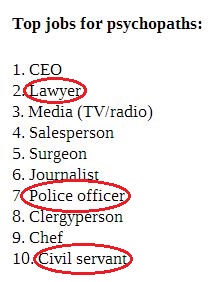
The reason I’m revisiting Dr. Dutton’s book in this post is that several of the jobs it identifies as most likely to draw psychopaths are ones in the legal profession and government.


Everyone’s quick to quip that lawyers are psychopaths. What’s useful for anyone to know who’s contesting restraining order injustice, or government or legal abuses in general, is that lawyers are psychopaths. To qualify that, understand that there are clinical psychopaths (individuals who might be diagnosed as psychopaths under rigorous examination by psychologists), and there are those with psychopathic qualities. There’s no perfect paradigm: “psychopathy” is defined according to particular traits and tendencies like ruthlessness, fearlessness, single-mindedness, confidence, a lack of conscience and empathy, and mental toughness, any number or all of these combined with charisma. (Dr. Dutton opens his book by identifying his own father, a huckster who was immune to the slings and arrows of outrageous fortune, as a psychopath.)

I’ve never read a book about how to succeed as a lawyer, but it would surprise me if these traits weren’t ones such a book urged baby attorneys to cultivate.

Besides lawyer, police officer and civil servant are listed among the top jobs for psychopaths.

Judges are at least two of these and may seem like all three rolled into one. I’ve known a retired judge who was a very kindly man who doted on his grandkids and their poodle. And I’ve met some exceptionally decent cops. I even know a couple extremely humane attorneys (both of whom left the law for academic posts). Clearly there can be dramatic departures from any attempt at categorization.

My encounters with judges generally, though, tells me that they do tend to esteem themselves exorbitantly, do lack empathy (or resist it unjustly), are prone to consider themselves above the rules, and do evince more than a little gratification from talking down to those who stand before them and even from making those parties blanch and cower (justly or not). Even judges I’ve met in casual encounters have come across to me as alpha types. (If you reach out to shake the hand of one, check twice that it’s his hand that’s being extended to you—this warning goes double for attorneys.)

Ted Bundy: psychopath, serial killer, and law student.

Law is a very political arena, that is, one that’s all about power and jockeying for position. Its daily practitioners—even the ones who aren’t immune to human feeling—lose perspective on the consequences of their actions on real lives. Or don’t give a damn (an attorney’s favorite word is prevail). There’s a lot of gamesmanship present and rarely any fellowship at all (except among one another).

Since I’ve never met a practitioner of law who was particularly gifted at critical reasoning, anyway, I think less emphasis on this aptitude on qualifying tests for admission to law school and more attention to psychological screening would be worthy of consideration. If officers of the court can’t relate to plaintiffs and defendants, and if power holds more appeal for them than serving the cause of justice, they’re not only in the wrong job; they’re dangerous.

Legal decisions have real and lasting consequences on real and lasting lives. And lives aren’t things that should be toyed with.

Copyright © 2013 RestrainingOrderAbuse.com

A Liar’s Dream Medium: On Why Fraudulent Restraining Orders Are So Effective

vivid imagination

Restraining order allegations defy physics. They can self-sustain indefinitely fueled on nothing more than human credulity and their gratification of our appetite for the unseemly. They’re paid the same intently lurid curiosity as a wreck on the side of the road.

Auditors can’t avert their ears.

I read stories about the horrors endured by victims of false restraining orders every week, and I’d still listen with sensitivity to someone’s telling me s/he “had to get a restraining order.” It’s an irresistible impulse.

Just the phrase restraining order prompts a preconditioned reflex in the hearer. Live Pavlov’s dinner bell. It’s certainly one of the most prejudicial phrases in the English language, surpassing even “Beware of Dog.”

That’s why the restraining order offers liars a dream medium: whatever they write on one becomes “true.”

It’s that Pavlovian conditioning. We presume that someone who applies for a restraining order has a genuine need. Even police officers and judges, who encounter the unscrupulous and the scheming on a daily basis, take this for granted. They’ve been trained to. Hefty federal grants are provided to local police departments and courts in return for their mandating that their officers submit to that training and consent to accept allegations pursuant to obtaining a restraining order as factual.

And since restraining orders are approved by judges on the spot without the people whom they’re issued against even knowing about them, there aren’t any naysayers to interrupt or object to a liar’s allegations.

A fraud has a captive audience and can just let ’er rip.

The more outrageous a fraud’s lies, furthermore, the more effective they usually are. They’re not only that much likelier to bias police officers and judges but anyone else they’re told to. Where there’s smoke there’s fire, it’s assumed, and frauds who lie big blow a whole lot of smoke.

Counterintuitively, the broader the fraud, the more certain it is to go over.

Upon convincing a judge of his or her need for a restraining order—child’s play—a liar has an official document that says s/he’s a victim who’s weathered a grievous ordeal, and s/he can get even freer with the details when relating his or her “travail” to others. Say you “had to get a restraining order,” and all heads tilt in your direction, keen for the salacious details. Applying for a restraining order—which entails considerably less nuisance, for example, than applying for a driver’s license—creates a sensation (and waves of positive feedback and attention to nourish a liar’s ego).

And the damage to the liar’s victim is done possibly before s/he’s even had the restraining order brought to his or her attention.

To counteract a false restraining order requires that a recipient convince a second judge that the first one (his or her peer) screwed up or was hoodwinked. Not an obstacle easily surmounted. What a wanton fraud can accomplish in a 45-minute excursion to the courthouse may preoccupy and torment his or her victim for years to come.

A restraining order based on lies carefully, or even carelessly, stitched together is like Frankenstein’s monster: once a judge throws the switch, “It’s Alive!” And calamitous.

Unlike Frankenstein’s monster, burning a fraudulent restraining order won’t make it go away.

Copyright © 2013 RestrainingOrderAbuse.com

Restraining Order Administration and Money, Money, Money, Money, Money

“The restraining order law is perhaps the second most unconstitutional abomination in our legal system, after our so-called child protection (DSS) laws. The restraining order process is designed to allow an order to be issued very easily, and to be appealed, stopped, or vacated only with the utmost difficulty….

“The motives for this law are legion. First, it makes the Commonwealth a bunch of money by allowing it to leverage massive Federal grants. It makes feminist victim groups a lot of money by providing millions in state and federal grants to stop ‘domestic violence.’ It makes lawyers and court personnel a lot money as they administer the Godzilla-sized system they have built to deal with these orders. It makes police a lot of money, as they are able to leverage huge grants for arrests of violators. It makes mental health professionals a lot of money dealing with the mandatory therapy always required in these situations. It makes thousands of social workers a lot of money providing social services for all the families that the law destroys. It makes dozens of men’s batterers programs a lot of money providing anger management treatment ordered by courts in these proceedings.”

Attorney Gregory Hession

The aggregation of money is not only the dirty little secret behind the perpetuation of constitutionally insupportable restraining order laws that are a firmly rooted institution in this country and in many others across the globe; money is also what ensures that very few mainstream public figures ever voice dissenting views on the legitimacy and justice of restraining orders.

Lawyers and judges I’ve talked to readily own their disenchantment with restraining order policy and don’t hesitate to acknowledge its malodor. It’s very rare, though, to find a quotation in print from an officer of the court that says as much. Job security is as important to them as it is to the next guy, and restraining orders are a political hot potato, because the feminist lobby is a powerful one and one that’s not distinguished for its temperateness or receptiveness to compromise or criticism.


I’m not employed as an investigative journalist. I’m a would-be kids’ humorist who earns his crust as a manual laborer and sometime editor of student essays and flier copy. My available research tools are a beater laptop and Google.

What a casual search engine query returned to me in terms of numbers and government rhetoric that substantiate the arguments made in this post’s epigraph is this (emphases in the excerpts below are added):

Grants to Encourage Arrest Policies and Enforcement of Protection Orders Program

Number: 16.590
Agency: Department of Justice
Office: Violence Against Women Office

Program Information

Authorization:

Violence Against Women and Department of Justice Reauthorization Act of 2005, Title I, Section 102, Public Law 109-162; Violence Against Women Act of 2000, Public Law 106-386; Violent Crime Control and Law Enforcement Act of 1994, 42 U.S.C. 3796hh, as amended.

Objectives:

To encourage States, Indian tribal governments, State and local courts (including juvenile courts), tribal courts, and units of local government to treat domestic violence, dating violence, sexual assault, and stalking as serious violations of criminal law.

Types of Assistance:

PROJECT GRANTS

Uses and Use Restrictions:

Grants may be used for the following statutory program purposes: (1) To implement proarrest programs and policies in police departments, including policies for protection order violations. (2) To develop policies, educational programs, protection order registries, and training in police departments to improve tracking of cases involving domestic violence, dating violence, sexual assault, and stalking. Policies, educational programs, protection order registries, and training described in this paragraph shall incorporate confidentiality, and privacy protections for victims of domestic violence, dating violence, sexual assault, and stalking. (3) To centralize and coordinate police enforcement, prosecution, or judicial responsibility for domestic violence, dating violence, sexual assault, and stalking cases in teams or units of police officers, prosecutors, parole and probation officers, or judges. (4) To coordinate computer tracking systems to ensure communication between police, prosecutors, parole and probation officers, and both criminal and family courts. (5) To strengthen legal advocacy service programs for victims of domestic violence, dating violence, sexual assault, and stalking, including strengthening assistance to such victims in immigration matters. (6) To educate judges in criminal and civil courts (including juvenile courts) about domestic violence, dating violence, sexual assault, and stalking and to improve judicial handling of such cases. (7) To provide technical assistance and computer and other equipment to police departments, prosecutors, courts, and tribal jurisdictions to facilitate the widespread enforcement of protection orders, including interstate enforcement, enforcement between States and tribal jurisdictions, and enforcement between tribal jurisdictions. (8) To develop or strengthen policies and training for police, prosecutors, and the judiciary in recognizing, investigating, and prosecuting instances of domestic violence and sexual assault against older individuals (as defined in section 3002 of this title) and individuals with disabilities (as defined in section 12102(2) of this title). (9) To develop State, tribal, territorial, or local policies, procedures, and protocols for preventing dual arrests and prosecutions in cases of domestic violence, dating violence, sexual assault, and stalking, and to develop effective methods for identifying the pattern and history of abuse that indicates which party is the actual perpetrator of abuse. (10) To plan, develop and establish comprehensive victim service and support centers, such as family justice centers, designed to bring together victim advocates from non-profit, non-governmental victim services organizations, law enforcement officers, prosecutors, probation officers, governmental victim assistants, forensic medical professionals, civil legal attorneys, chaplains, legal advocates, representatives from community-based organizations and other relevant public or private agencies or organizations into one centralized location, in order to improve safety, access to services, and confidentiality for victims and families. Although funds may be used to support the colocation of project partners under this paragraph, funds may not support construction or major renovation expenses or activities that fall outside of the scope of the other statutory purpose areas. (11) To develop and implement policies and training for police, prosecutors, probation and parole officers, and the judiciary in recognizing, investigating, and prosecuting instances of sexual assault, with an emphasis on recognizing the threat to the community for repeat crime perpetration by such individuals. (12) To develop, enhance, and maintain protection order registries. (13) To develop human immunodeficiency virus (HIV) testing programs for sexual assault perpetrators and notification and counseling protocols.

Applicant Eligibility:

Grants are available to States, Indian tribal governments, units of local government, and State, tribal, territorial, and local courts.

Beneficiary Eligibility:

Beneficiaries include criminal and tribal justice practitioners, domestic violence, dating violence, sexual assault and stalking victim advocates, and other service providers who respond to victims of domestic violence, dating violence, sexual assault, and stalking.

Credentials/Documentation:

According to 42 U.S.C. § 3796hh(c), to be eligible to receive funding through this Program, applicants must:
(1) certify that their laws or official policies
(A) encourage or mandate arrests of domestic violence offenders based on probable cause that an offense has been committed; and
(B) encourage or mandate arrest of domestic violence offenders who violate the terms of a valid and outstanding protection order;
(2) demonstrate that their laws, policies, or practices and their training programs
discourage dual arrests of offender and victim;
(3) certify that their laws, policies, or practices prohibit issuance of mutual restraining orders of protection except in cases where both spouses file a claim and the court makes detailed findings of fact indicating that both spouses acted primarily as aggressors and that neither spouse acted primarily in self-defense; and
(4) certify that their laws, policies, and practices do not require, in connection with the prosecution of any misdemeanor or felony domestic violence offense, or in connection with the filing, issuance, registration, or service of a protection order, or a petition for a protection order, to protect a victim of sexual assault, domestic violence, or stalking, that the victim bear the costs associated with the filing of criminal charges against the offender, or the costs associated with the filing, issuance, registration, or service of a warrant, protection order, petition for a protection order, or witness subpoena, whether issued inside or outside the State, Tribal or local jurisdiction; and
(5) certify that their laws, policies, or practices ensure that
(A) no law enforcement officer, prosecuting officer or other government official shall ask or require an adult, youth, or child victim of a sex offense as defined under Federal, Tribal, State, Territorial, or local law to submit to a polygraph examination or other truth telling device as a condition for proceeding with the investigation of such an offense; and
(B) the refusal of a victim to submit to an examination described in subparagraph (A) shall not prevent the investigation of the offense.

Range and Average of Financial Assistance:

Range: $176,735–$1,167,713
Average: $571,816.

That’s a pretty fair lump of dough, and what it’s for—among other things as you’ll notice if you read between the lines—is to “educate” our police officers and judges about what their priorities should be.

Note that eligibility requirements for receiving grants through this program include (1) the prohibition of counter-injunctions, that is, restraining orders counter-filed by people who have had restraining orders issued against them; (2) the issuance of restraining orders at no cost to their applicants; and (3) the acceptance of plaintiffs’ allegations on faith. Note, also, that one of the objectives of this program is to promote the establishment of registries that make the names of restraining order recipients conveniently available to the general public.

The legitimacy of these grants (“grants” having a more benevolent resonance to it than “inducements”) goes largely uncontested, because who’s going to say they’re “for” crimes against women and children?

The rhetorical design of all things related to the administration of restraining orders and the laws that authorize them is ingenious and, on its surface, unimpeachable.

By everyone, that is, except the victims of a process that is as manifestly and multifariously crooked as a papier-mâché flagpole.

Paying authorities and the judiciary to assume a preferential disposition toward restraining order applicants completely undermines the principles of impartiality and fair and equal treatment that our system of laws was established upon.

It isn’t cash this process needs. It’s change.

Copyright © 2013 RestrainingOrderAbuse.com

“Do I Need a Lawyer?”: On Combating Restraining Orders

nutcracker
“Do I need a lawyer?” is a question that commonly brings restraining order defendants to this blog and other sites like it.

No one wants to shell out thousands for an attorney to bat away allegations made on a restraining order that may have been concocted in a fit of pique by an embittered friend, a jealous ex, or a crazy neighbor. Too, it’s often the case that allegations leveled by restraining order plaintiffs are of a kind no one wants to advertise to strangers, let alone friends and family. Just the implications of the phrase restraining order are enough to make most people recoil.

I know someone who applied to the mayor for a character reference after she was falsely accused of domestic violence—on a restraining order—by a married friend she’d briefly renewed an association with. Sounds insane, right? The judge ultimately tossed the case after observing that the allegation wasn’t even applicable, because the plaintiff and the defendant weren’t in a domestic relationship. But that didn’t cause a judge any hesitation in approving the restraining order in the first place, and imagine what it cost this woman emotionally to have to explain the matter and ask for help. Imagine further if she had been a he, and you can appreciate the horror of fighting these kinds of allegations, which are validated by judges on a modicum of evidence, if any, and which neither cost nor risk their plaintiffs anything to make. Restraining orders are cheap or free to get, and no one is ever actually jailed for lying to get them.

I did a quick scan today of top Google returns for the term “lying to the court.” Most commenters weighed in that lying = perjury, which is a crime, so beware. It’s true that lying about a material fact in court (a fact, that is, that’s likely to influence a judge’s opinion) is a statutory crime. A felony, no less. Equally true, though, and much more pertinent is that lying isn’t prosecuted. So there’s nothing really for a fraudulent plaintiff to have to be wary of except maybe a little embarrassment if actually caught in a lie (and most plaintiffs, of course, aren’t aware that lying to a judge is a crime, so it’s not even on their minds).

Someone who’s morally bankrupt enough to lie to a judge in the first place isn’t going to hesitate because of the risk of shame if s/he’s caught. Shame is an emotion to which s/he’s obviously immune, anyway.

In the administration of restraining orders, the ideal of justice isn’t given priority. Restraining orders are issued ex parte, which means they’re approved without the judge’s having the faintest idea who s/he’s issuing a restraining order against. The only person the judge hears from is the plaintiff, and hearings to obtain restraining orders are typically 10-minute affairs.

Talk show host David Letterman was famously issued a restraining order petitioned by a stranger who lived in another part of the country. The judge didn’t think twice about rubber-stamping the thing and moving on to the next applicant.

Defendants don’t need attorneys; it’s perfectly lawful for them to defend themselves in an appeals hearing. Whether defendants need attorneys to better their chances of a favorable verdict is a different question entirely. David Letterman, it should go without saying, had a team of them. And it should come as no surprise that they shredded the restraining order to confetti.

A cynical answer to the question of whether defendants need attorneys to improve their odds of beating a bum rap is that defendants who can afford attorneys are perceived as deserving greater consideration than ones who can’t (or who don’t know enough to seek counsel—or who are hoping they can just quietly make the whole thing go away on their own). This answer doesn’t jibe with the judicial canon that everyone should be treated the same, but that doesn’t mean it isn’t true. Because restraining orders are issued ex parte, the idea that fairness obtains at any stage of the process is clearly dubious.

Truth and falsehood in judicial proceedings are, besides, very relative things. For truth to even exercise its power to dispel lies depends on how effectively a defendant can make it plain to the judge. As straightforward as a naïve defendant might believe this to be, it’s not as simple as stating facts that contradict fraudulent testimony or producing some evidence that’s expected to be conclusive. The judge might decide that that evidence is irrelevant or that the lie it exposes is immaterial to the case. Or s/he might decide s/he doesn’t like the defendant period. Can you lose a case because the judge doesn’t like you or likes the plaintiff better? Sure. Does that have anything to do with the truth of the plaintiff’s allegations against you? No.

Representation by an attorney isn’t a guarantee of success. The mere presence of one, though, will give you a degree of credibility you wouldn’t otherwise have. An attorney with courtroom experience, furthermore, has presentational skills that you lack. Restraining order appeals hearings are very brief, judges tend to be skeptical of defendants (particularly men), and even a self-styled Perry Mason may find him- or herself stammering and squirming once s/he’s in the hot seat under the glare of the judge.

There’s the possibility, too, that the plaintiff will have an attorney, and attorneys aren’t known either for playing fair or for showing mercy to their opponents. Some attorneys—gasp—are even professional liars. Several respondents to this blog, in fact, have had false restraining orders petitioned against them by attorneys who were ex-lovers or -spouses or—in one case—a parent. The restraining order process, more than any other, brings out the worst in human nature.

If you’re the defendant in a restraining order case, especially one grounded on fraud, get an attorney.

Now.

Copyright © 2013 RestrainingOrderAbuse.com

Addressing the Judge: What to Expect at a Restraining Order Appeals Hearing…and What Not To

Judges famously tend to be an inscrutable lot.

Defendants who expect a judge to leap from the bench with indignation upon being shown evidence of lies by the plaintiff are bound to be disappointed.

Far more likely the judge will evince bemused or stoic indifference. You may even wonder if s/he registered what you said at all.

Don’t be nonplussed. This is how s/he’s supposed to act. Keep on trucking until s/he interrupts or redirects your presentation.

What you want to focus on is triage. Triage means presenting the points of your defense in order of importance (triage is a wartime medical term that means privileging patients with the best chance of recovery over those who are sure goners). What will positively doom you in a hearing is rambling, speaking off the point, or carefully qualifying everything to the extent that the judge completely misses what you’re driving at.

Don’t waffle or be mealymouthed.

Bullets. Present your case in brief staccato bursts. Everything should be short and sweet (so to speak). Time is always a limited commodity, and a restraining order hearing may be granted no more than a handful of minutes. People—and judges are people like anyone else—tend to remember best what they hear first and last and/or what’s stated to them emphatically.

Like bullets, everything you say should be pointed and intended to inflict damage. Pare down everything you want to say to its most elemental, and state facts in the light that most favorably represents you.

And absolutely speak to your conduct (or the conduct you’ve been accused of, anyway), because that’s what’s being ruled upon. In other words, don’t try to defend your own actions (or “actions”) by merely speaking to misconduct by the plaintiff like a little kid would: “She started it!” or “She’s a liar!”

It’s often if not usually the case that restraining order plaintiffs and defendants are lovers, spouses or ex-spouses, friends, or family members: people, in other words, who are or have been close. There’s a temptation, therefore, for defendants to explain the context of their statements or even to show sympathy or generosity toward their accusers. There’s also, of course, a tendency to feel betrayed, ashamed at being exposed to public censure, or humiliated by allegations that may be beastly misrepresentations of the truth.

Don’t yield to these impulses and emotions.

What you learn after you’ve been put through this ringer is that your opponent is going to show you no mercy and may very well lie heinously to ensure that you’re “defeated.” Even people you considered friends may turn out to be rats and side with your accuser and lie for him or her.

Combat analogies are very aptly applied to this process: the courtroom is an arena. “Bloodsport” isn’t a bad metaphor.

The judge is there to ensure that no one actually brawls, but his or her role otherwise is less as an arbiter or referee than as a spectator (who, like a Roman emperor at the Colosseum, gives a thumbs up or down when the dust settles).

Your goal isn’t to appeal to his or her sympathies; it’s to make a decisive impression. The judge’s impression will be based on your manner, composure, confidence, directness, and the cogency of your presentation, that is, how well it sticks together and how well it conveys your points (and, of course, how good those points are). The standard in civil cases is a “preponderance of evidence.” You want your evidence and testimony to have more heft and credibility than the plaintiff’s.

If the plaintiff’s allegations are a fraud, start by saying, “The plaintiff’s allegations, Judge, are a fraud.” Triage. Get the big points in—the general—then move to the specifics in short order. Directly address and contradict the allegations you can. The more evidence (“proof”) you can support your points with the better.

What attorneys do is this: they present their clients’ cases in the light most favorable to them (and most damning to their opponents), not balking at distorting the truth or outright lying, and ignore everything material that they can’t spin doctor.

I can’t advocate lying. Otherwise, though, thinking like an attorney isn’t a bad idea.

Translated into practical terms, this means a shove is an “assault,” a shout is “verbal abuse,” a demand is “harassment,” something that happened twice is “serial misconduct,” a touch is a “grope,” etc.: cold, cruel, categorical, and coarse.

Male judges have a chivalrous bent—and most judges are male—which is among the reasons why so many restraining orders sought by women against men are approved even on evidence or testimony that’s tenuous at best. If you’re a man defending yourself against a woman, bear this in mind. A woman can spout the most incendiary evil she can muster, and it’s not going to be held against her, because she’s a “girl.” Whatever a man counter-alleges against a woman needs to be presented reasonably and decently. He should choose his words carefully, avoid vigorous gestures, and keep cool.

If you’re a man defending yourself against a woman, you start with your hands tied and two strikes against you. That’s in the nature of this travesty of justice.

Bat with your head. There’s no surviving this process without some fractures.

Copyright © 2013 RestrainingOrderAbuse.com

*Unrepresented restraining order defendants, incidentally, should pour everything they’ve got into their appeals hearings, because the rules and expectations that obtain in Superior Court—should the case progress up the judicial ladder—are much more exacting and only capably negotiated by veteran attorneys (or shysters, a word that means unethical lawyers and fittingly derives from the German for “defecators,” because much of what comes out of their mouths is feces).