Mixed Loyalties: Why the Only One Looking Out for the Victim of Restraining Order Abuse is the Victim of Restraining Order Abuse, or, Why You’re on Your Own

A recent commenter observed that the “abuse industry” is a goldmine that no one who benefits from it has any motive to oppose, including judges and lawyers.

There are exceptions—attorneys Gregory Hession and David Heleniak are examples—but in general the commenter is right. Civil rights groups like the ACLU and the Southern Poverty Law Center have a defining investment in women’s rights, and restraining orders are “women’s law.” So their sensitivity to procedural abuse is profoundly limited, also.

The Academy is feminist-dominated. You’ll find no open sympathy there. Feminists hold political sway, whatever their numbers actually are and regardless of whether theirs are majority positions or minority ones. Higher education is a political milieu. Professors who publicly voice qualms with feminist doctrine are few. (Not that long ago, a Harvard president was driven out of office for candidly proposing that men and women were different.) Mainstream media are pressured into conformity with the favored views of the “intelligentsia” (or what’s sometimes called the “East Coast establishment”), and these favored views are feminist views.

Outspoken female critics who represent your side—and there are several stellar ones—may have personal motives, like affiliation with a set of political/family values, cornering a market demographic to enhance sales of books they’ve authored or services they offer,  or carving out a literary niche for themselves in the popular press. Alternatively, they may be intellectually offended by the direction feminism has taken; they may feel betrayed by a cause they formerly championed. They oppose the source of your injury, and they’re to be esteemed for that, but they can’t afford to make an investment in you.

Finally, even forums on the Internet that address restraining order and other types of prosecutorial abuses may be jealous of “competing” voices; they have a brand that they’ve invested in and a particular ideology they espouse.

These are among the reasons why there is no common front.

None of this means that any or all of the aforementioned couldn’t be moved to take up your cause, but to attract their interest, you would need to make a splash. This requires loud action that attains a measure of legitimacy, and this is probably only possible if individuals unify—in a campaign, for example, or a class action.

The solitary complainant who can’t brandish a court judgment that exonerates him or her of foul accusations is an iffy investment. Nobody knows you. Too, the person who understands where you’re coming from but is mired in his or her own hell will only have a modicum of attention to spare you. Alliance toward a common goal that raises the hopes of all those involved could reward the individual, but to realize such an alliance requires action, and it requires action that aims to attract power to itself.

There is value in registering your complaint, anywhere and in any way, because more stories translate to greater awareness (which also encourages others to step forward and share their travails). To break the chokehold of ambivalence and resignation, though, requires the kind of action that grabs headlines, and that requires community and a concerted effort.

Only success attracts popular support.

Copyright © 2015 RestrainingOrderAbuse.com

*Here is an example of a campaign that resonated.

What Do People Accused in Civil Court Have to Complain About?: Civil Prosecutions and PTSD

“Contemplating, undergoing, or having undergone a lawsuit is disruptive. The experience saps energy and distracts the litigant from the normal daily preoccupations that we call ‘life.’ Litigants, who commonly feel alone, isolated, and helpless, are challenged to confront and manage the emotional burden of the legal process. The distress of litigation can be expressed in multiple symptoms: sleeplessness, anger, frustration, humiliation, headaches, difficulty concentrating, loss of self-confidence, indecision, anxiety, despondency: the picture has much in common with the symptoms of posttraumatic stress disorder (PTSD).”

—Dr. Larry H. Strasburger (1999)

Prior posts on this blog have considered Legal Abuse Syndrome (LAS), a concept proposed by marriage and family therapist Karin Huffer that has been discounted by the courts as a “novel theory.” This post spotlights a journal monograph published almost 20 years ago by psychiatrist Larry H. Strasburger that unequivocally states Dr. Huffer isn’t wrong and the courts are.

Dr. Strasburger’s comments in “The Litigant-Patient: Mental Health Consequences of Civil Litigation” are based on his having treated the legally abused (who may include anyone who’s been exposed to litigation).

The therapist of a litigant will encounter not only the trauma that produced the lawsuit, but the distress and disruption of litigation as well, including the delays, rehashing and reliving the original trauma, and challenges to honesty and integrity. The patient may come after years of feeling frustrated and thwarted by a system that moves at a snail’s pace, preventing the litigant from putting the issue of the litigation behind him [or her] and “moving on” with life. Gutheil et al. have recently coined the term “critogenic harm” to describe these emotional harms resulting from the legal process itself.

The term “critogenic harm,” by its etymology, refers to the psychic damages that arise from judgment, i.e., the pain and humiliation of being verbally attacked and publicly disparaged.

This, the reader will note, is a blaring clinical denunciation of those self-appointed, armchair authorities who would deny the damages of false prosecution. Nearly two decades after the publication of the journal article this post examines, such deniers are everywhere, including in the mainstream press.

The deniers, according to the experts, are talking out of their blowholes. Mere accusation, ignoring the effects of protracted legal battles, drives some to suicide and multitudes more into agoraphobic withdrawal.

The adversarial system is also a threat to the maintenance of personal boundaries. Formal complaints, interrogatories, depositions, public testimony, and cross-examination are intrusive procedures that aggravate feelings previously caused by trauma. Such procedures amplify feelings that the world is an unsafe place, redoubling the litigant’s need to regain a sense of control—often in any way he or she can, including exhibiting characteristic symptoms or defenses. It is not unusual to find entries such as the following in the medical records of litigants: “Janet is hearing voices to cut herself again after talking to her lawyer today.” Similarly, a male plaintiff in a sexual harassment suit threatened violence when he was informed that he was to be deposed, and he required hospitalization.

Exposure to civil process can very literally drive people nuts, and inspire in them urges to commit violence, whether to themselves or others.

Consider Dr. Strasburger’s remarks in the context of restraining order abuse and appreciate that the strains they describe can be compounded by loss of residence (some defendants are left homeless), loss of family, loss of income, loss of employment/career, loss of property, etc. Those so deprived may accordingly become estranged from friends and relations, if not socially ostracized. (They must also live with the consciousness that they’re vulnerable to warrantless arrest at any time.)

Litigants are often further distressed as various members of their support systems “burn out.” Their need for human connection and their need to talk about their experience often exceed the tolerance of family members and friends. Embarrassment and humiliation shrink their social world.

That’s besides the discord and isolation caused by a damning accusation, which may be accepted as fact even by kith and kin. Loyalties may become divided, and the accused may be spurned based on allegations that aren’t true. The sources of outrage to the mind and emotions multiply like cancer cells.

It should come as no surprise then that many who complain of procedural abuse report they’re in therapy. If the costs weren’t prohibitive to most, they might all be. Desolating, as Dr. Strasburger points out, is that even if this were the case, the promise of “healing” isn’t necessarily good. The therapist’s role may be little more than cheerleader.

Psychotherapy for a patient involved in ongoing litigation can take on the aspects of managing a continuing crisis. The therapist, facing this need for crisis management, may be providing support more than insight.

Litigation (or its aftermath) may become consuming; normal, healthy activities are suspended. (One woman this author has corresponded with laments she hasn’t known intimate contact in years; a recent female commenter, alienated from her child, refers to herself as a living homicide.) People may become stuck in a tape loop perpetuated by interminable indeterminacy, insurmountable loss, and a galling sense of injustice.

The legal battle enables people to put their lives on “hold,” thereby avoiding other aspects of their lives (e.g., “How can I be intimate with you when I’m involved in this lawsuit?”). The patient may be so attuned to psycholegal issues and hypotheses that she focuses thereupon in resistance to dealing with significant personal conflict. As a result, she is continually “pleading her case” in the therapy hour.

This cognitive rut exemplifies Legal Abuse Syndrome, and the state may be unending.

Copyright © 2015 RestrainingOrderAbuse.com

*The journal article cited in this post may be introduced to the court by litigants in need of an authoritative voice to validate complaints of pain and suffering induced by fraudulent or vexatious prosecution.

If It’s Okay to Tell the Falsely Accused How They Should Feel, Then It’s Cool to Tell Victims of Rape How They Should Feel, Right?

That’s a rhetorical question.

Plainly it’s not cool to tell victims of rape how they should feel, particularly if you’re not one yourself. I don’t say that because it’s un-PC to criticize rape victims; I say that because it’s wrong.

Yet goddamn if there’s no shortage of people who have no context to relate either to rape victims or victims of false accusations who presume to defend the former’s right to be basket cases and deny the latter any right to complain.

The previous post examined the vehement rhetoric of one of these self-appointed arbiters of anguish (whose argument seems to run: “I’ll tell you how you’re entitled to feel”).

Pause here for a point of clarification: False accusations can be of a great many acts besides sexual assault, and the phrase false accusation in this post refers to any false accusation.

There’s nothing, of course, to reproach about someone’s sympathizing with victims of sexual assault, as the writer scrutinized in the last post does; it’s compassionate. Presuming to “relate” to the pain of women who’ve been raped, however, is presuming a lot.

Presuming to deny others’ pain, furthermore, because you believe you can quantify it or “imagine” what it “should” be like—that’s stepping way over the line.

Look at enough feminist rhetoric, though, and something becomes starkly clear: The basic contention is that “our” pain is worse than yours. (One gets the distinct impression that all feminist writers consider themselves rape victims by association or genital identification.)

I don’t discount rape victims’ torment, but I do believe this pain “rating scale” is due to be dispassionately tested.

The approach of those who presume to criticize complainants of false accusation is to reduce their trials to something like this: generally speaking, (1) you’re accused, and (2) maybe you lose some friends and your job. Also, (3) if you’re exonerated, you don’t have anything to bitch about, so shut up and go away.

Now here’s what you get when you apply to rape victims the same obscenely reductive analysis: generally speaking, (1) your body is penetrated without your consent or against your express objection, and (2) you’re possibly, if not probably, left with some tissue damage.

Both of these sketchy assessments are about equivalent in their insensitivity (and according to them, the privations of the falsely accused may well be more enduring than the injuries of the victim of rape).

So why is the former assessment popularly conceived to be “fair” while the latter would be denounced as “cruel”?

Is it because false accusation inflicts a psychic trauma and that rape has a physical component? I’ve been run down in the road by a 4 x 4 while on foot. Bones were splintered and crushed. I spent five days in an intensive care ward, and my skeleton and joints will never be the same. I almost lost an eye, and the hemorrhaging came with its own host of consequences. Entire swaths of my body were without sensation. Some months later, I had a cerebral episode and was aphasic for a day (I couldn’t remember, for example, the word October or repeat “no ifs, ands, or buts”). I’d wager the physical trauma I sustained exceeds that of an overwhelming majority of rape victims. Does that make me “more worthy” of sympathy?

Apples and oranges, right? Why? Because the affront to my body was impersonal.

It makes a difference, then, when our dignity and humanity are violated, and we’re treated with intimate disregard.

I don’t know what it is to be raped. I do know, though, what complainants of rape report, and reported sources of pain are shame, outrage, fear, betrayal, a lingering and possibly insurmountable distrust, and ambivalence about reporting the violation based on the expectation of suspicion and reproach from authorities (as well as others) and having to relive the horror, possibly without hope of realizing any form of justice.

gavels-gavelsI do know what it is to be falsely accused, and the sources of pain are the same, only the suspicion and reproach aren’t an “expectation.” When you’re the target of damning fingers, suspicion and reproach inevitably ensue; they’re a given.

There’s a misconception about accusation that isn’t really a misconception at all; it’s an empathic dereliction. Facile commentators say people are “accused” as if that’s all there is to it. (I’ve been falsely accused by the same person in multiple court procedures spanning seven years, and I’ve lived with the accusations daily for nine. A man I know has been summoned to court dozens of times; a woman I recently heard from, over 100 times—in both cases, by a single vexatious litigant.)

To be accused is to have the state knocking on your door. It’s to be sent menacing notices in the mail or to have them tacked to your residence (endure this long enough, and you stop looking in the mailbox or even answering the phone). It’s to be hauled into a police precinct—if not arrested and jailed—and to be subjected to invasive questioning, if not physically invasive, involuntary examinations. It’s to be treated with hostility and contempt, like a thing of disgust. It’s to become the fodder of gossip and the target of threats. Judgment is a palpable thing, and it’s far worse than a body blow (or even being steamrolled by an onrushing vehicle).

The outrage, moreover, of being blamed falsely isn’t something that can be “intuited.” Here’s how one woman I’ve corresponded with puts it, a woman who was accused by a man who had abused her both physically and otherwise (yes, sometimes the accuser simply reverses roles with his or her victim—and, yes, if you missed it in the parenthetical remark above, sometimes the falsely accused isn’t a man):

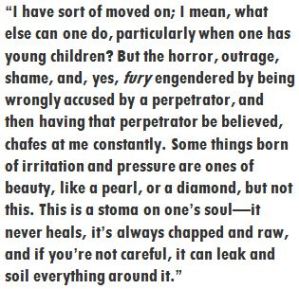
There is no “coming out the other side” of a public, on-the-legal-record character assassination. It gnaws at me on a near-daily basis like one of those worms that lives inside those Mexican jumping beans for sale to tourists on the counters of countless cheesy gift shops in Tijuana.

I have sort of moved on; I mean, what else can one do, particularly when one has young children? But the horror, outrage, shame, and, yes, fury engendered by being wrongly accused by a perpetrator, and then having that perpetrator be believed, chafes at me constantly. Some things born of irritation and pressure are ones of beauty, like a pearl, or a diamond, but not this. This is a stoma on one’s soul—it never heals, it’s always chapped and raw, and if you’re not careful, it can leak and soil everything around it.

Would a feminist sympathize with this person? Probably…grudgingly and without making a to-do about it.

Why? If the answer is because she’s a woman, then we’re getting somewhere. The blindness to the damages of legal abuse has a great deal to do with sex. Most of the vehement objectors to legal violations are men—they being the majority of the victims—and they’ve been demonized…because they’re men. This has led to the dim formulation that “falsely accused” equals “male” equals f* ’em.

Absurd, besides, is that arguments like those scrutinized in the last post on the one hand posit that men shouldn’t feel their own pain but on the other hand should show sympathy to women’s. Men are oxymoronically supposed to be stoic and insensitive, er, “empaths.”

Yeah, but not really. Really the conclusion is their pain doesn’t matter. It’s “insignificant” because (tum-tum-tum-TUMMM)…

To whom? Society? It certainly isn’t a bigger problem to its falsely accused constituents. This is a democracy, not an ant colony, and pain isn’t a competition or a zero-sum game. No one’s pain is more “valid” or “virtuous” than the next’s. What the sentiment in headlines like this really means is that the lives of the falsely accused are (politically) insignificant—and the sentiment is a sick one.

Abuse of people is abuse of people, and life-wrecking torment is life-wrecking torment.

Copyright © 2015 RestrainingOrderAbuse.com

*Though its psychic fallout may be indelible, rape ends. False accusation and legal abuse may be continually renewed. People report being in legal contests for years, even many, many years. They report running through tens or hundreds of thousands of dollars. They report being left penniless and in cases homeless. They report living “like a hamster.” They report being in therapy, on meds, and sometimes being unable to work even if their careers haven’t been ruined, and often they have been. They report losing their children, and they report losing the right to work with or be around children. Accusation isn’t an “inconvenience.”

Abandon All Hope Ye Who Enter Here: The Hell of Legal Abuse Syndrome

This is the third sequential post on this blog about Legal Abuse Syndrome (LAS), a condition proposed by marriage and family therapist Karin P. Huffer “that develops in individuals assaulted by ethical violations, legal abuses, betrayals, and fraud” and that’s exacerbated by “abuse of power and authority and a profound lack of accountability in our courts.” This post surveys accounts of affliction (and its sources) drawn from various websites.

abandon all hope
Editorial intrusions and commentary in this post have been kept to a minimum, but some grammatical polishing is acknowledged.

You May Be Suffering from Legal Abuse Syndrome if You Have Been a Victim of DCF”:

I have been doing some reading on LAS (Legal Abuse Syndrome) and PTSD since I have begun to fear my own shadow. I hate the doorbell to ring. I run to the window to try to see who it might be, and rarely answer. If someone knocks on the door with any force, I am paralyzed. I do not like to answer the phone and thank God for caller ID. When I go out of the house, heaven help me if I see a child who reminds me of what we have lost. I cannot tell you the number of times I have vomited in public toilets. A police car in the rearview mirror leads to deep breathing and panic attacks. The thought of walking into a courtroom is enough to reduce me to a shaking mess. Certain names…can cause me to feel a sense of violation like no other. Sleep rarely happens and is often interrupted by nightmares, or even worse, waking and screaming for my child. No one cares; all of those I thought would protect us have not only failed us but willingly allowed misconduct and lies. Those I held in high regard due to their positions of trust and power I have found to have let their power corrupt their values and morals. Do I think I am ill? Yes, I know I am. I have a good doctor who is trying to help, a church to support me, and my husband and children who have stood by me, but I also know I will never be the same person I was. I will never trust in the “system” and have been totally disillusioned by what I always thought were my constitutional rights as an American citizen not only being disregarded but willfully being trampled on by those sworn to protect them.

Sufferer Legal Abuse Syndrome” (MyPTSD.com):

I was just diagnosed with PTSD from a prolonged and nasty legal battle (10 years). It was my understanding that PTSD was only for vets coming back from war. I guess there are other ways to fight wars. Mine was in the courtroom trying to fight off the onslaught of unethical attorneys and judges. I believe I fought for a good cause, but it has taken its toll on me. My nerves are shot; I have anxiety from the minute I wake up until I go to bed. Thoughts of what they did and the power they had over me and my children are with me always. I want to have a life, but I still deal with the consequences every day. I feel guilty for feeling this way as there are so many other people who have been through much worse. I think the feeling of being powerless and abused by a system I had faith in has shaken my foundation. My feelings about people and the world have changed forever, and my trust level is very low. A psychologist involved in the battle betrayed me and my family with lies, along with two other professionals in this field, all my attorneys, and the judges. You might discount my viewpoint as overboard. It took a long time to see it myself, but my investigations proved correct.

Legal Abuse Syndrome” (Caught.net):

I became depressed, physically ill, and seriously suicidal after experiencing the insanity of litigation. I lost my home and was sent to the street with nothing but the clothes on my back. Literally everything I owned was gone for several years. I fought my fight to points of exhaustion where all I could do was stare into space. Friends had left; I was emotionally isolated, and normal living activities were no longer normal. Rage doesn’t come close to describing the feelings I lived with for years. Even this is not the full story of how bad it got.

Posttraumatic Stress Disorder Legal Abuse Syndrome”:

I was diagnosed about two years ago with LAS [Legal Abuse Syndrome]. Protracted litigation and corrupt court decisions not only exacerbated my fibromyalgia but caused me to begin a whole new set of debilitating symptoms which have rendered me unable to sleep properly, hold a job, succeed in relationships, enjoy life, maintain goals, dreams, and hope. I suffer from what I call “spinal cord attacks,” which feel like rushes of adrenaline or cortisol permeating my spine, making me feel paralyzed, causing severe pain, lasting for 30 seconds to two minutes, and resulting in complete exhaustion and distress.

My once beautiful life as a drama and music teacher, writer and producer of children’s musicals, and fledgling writer has all but vanished. I am so debilitated from extensive legal research, useless and destructive attorneys and judges, horrendous living conditions imposed upon me by corrupt judges who denied me due process, the loss of my beautiful family home to my ex (which I had been paying for but couldn’t qualify for), the purging of all my earthly belongings, a now transient lifestyle, and increasing medical problems like high blood pressure, anxiety attacks, and hopelessness.

Massachusetts Mother Calling for Family Court Justice in Domestic Abuse Cases”:

I have missed all of my three daughters’ birthdays, first days of school, first dances, holidays, vacations, and school volunteering since 2007. My youngest daughter, Kelly, is nine. That means I have already missed out on half her life. I am not a drug addict. I am not an alcoholic.  I was and still am an upstanding citizen in the community despite Attorney Arabasz and his clients’ attempts to cause deliberate and malicious harm to me. I do my best to volunteer in the community, including hospice and domestic abuse, and have won numerous awards for my volunteerism over the years, which tends to bring me a renewed sense of healing from my own traumas. My children and I cannot get back those formative years we have missed. They are gone forever, never to return.  I am speechless in my ability to describe the pain and anguish I feel over this injustice alone.

Over that time, as documented through the courts, I have endured numerous, repeated, serious abuses that I have come to the court pleading for help with to no avail.  I am a human being who can take being abused only for so long.  I have suffered serious, repeated, unrelenting, undue stresses, many of which are criminal in nature, that have caused health issues. When the trial arrived, I prayed and hoped for justice to finally prevail for the sake of my children.

I have been severed from my children’s lives with little to no contact since August 3, 2011, and even longer since September 2007. The verdict of August 2012 from the trial was devastating to me and I worried about the long-term negative impact it would have on my children….

As a result, I am currently being treated for ADHD, Legal Abuse Syndrome, and trauma-related stress, and my treatment since trial has increased. Symptoms of trauma-related stress include gastrointestinal issues; anxiety and fear, especially when exposed to situations reminding me of the many repeated traumatic events; trouble sleeping; trouble eating; low energy; memory problems, including difficulty remembering aspects of the trauma; a “scattered” feeling and inability to focus on work or daily activities;  emotional “numbness,” which causes me to feel withdrawn, disconnected, or different from others; and protectiveness of loved ones or fear for their safety.

I did not suffer any of these symptoms until after I married an abusive partner and endured years of abuse. I was a victim that the system failed to protect, and now I suffer greatly. I was a fantastic mother, and even the father never questioned my ability to care for or mother these children until he got what he wanted and stole financially through the divorce.  However, the system has stripped away all my ability to love, nurture, and parent my three daughters who need me greatly.

The foregoing first-person accounts are hardly comprehensive; they were culled because they’re evocative. Notably, they echo numerous comments submitted by visitors to this blog, who have reported everything from homelessness and hopelessness to living “like a hamster” to contemplating suicide. Many respondents to the e-petition “Stop False Allegations of Domestic Violence” have reported the same.

The third-person account below, though it leaves the victim’s torment to the reader’s imagination, is certainly no less sympathetic than those above. It speaks, particularly, to how blind or indifferent others may be to the effects of legal abuse.

How academia betrayed and continues to betray Aaron Swartz”:

As news spread last week that digital rights activist Aaron Swartz had killed himself ahead of a federal trial on charges that he illegally downloaded a large database of scholarly articles with the intent to freely disseminate its contents, thousands of academics began posting free copies of their work online, coalescing around the Twitter hashtag #pdftribute.

This was a touching tribute: a collective effort to complete the task Swartz had tried—and many people felt died trying—to accomplish himself. But it is a tragic irony that the only reason Swartz had to break the law to fulfill his quest to liberate human knowledge was that the same academic community that rose up to support his cause after he died had routinely betrayed it while he was alive.

This survey concludes with an impersonal commentary from a woman who’s still embroiled in legal strife and fears the consequences of speaking about it too candidly in a public medium. She has removed herself to another state to escape a malicious accuser’s clutches but remains in the crosshairs, despite having been deprived of everything she once took for granted—including her sense of self.

‘White Collar’ Domestic Violence Sanctioned by the State”:

The fraudulently obtained protective order is the new tool of abuse for abusers to obtain total power and control over their victims. The protective order is obtained using false allegations of domestic violence and abuse against the victim in an open court of law without due process or an evidentiary hearing. The protective order is then used as a state-sanctioned license to stalk, harass, intimidate, and continue to abuse the victim. The victim lives in constant fear that s/he will be arrested and incarcerated any time the abuser chooses to place him or her in jail. The accuser plays the victim of his or her own crime [cf. Dr. Tara Palmatier’s “Presto, Change-o, DARVO: Deny, Attack, and Reverse Victim and Offender”].

This is the new “white collar” form of domestic violence and abuse. It is a tactic used by both men and women to gain the upper hand in a divorce or custody battle, or to have a domestic partner simply removed from a lease and ejected from his or her own home. In the case of a victim’s terrible misfortune of coupling with a psychopath or sociopath suffering from a narcissistic or borderline personality disorder, the protective order is fraudulently obtained by means of false accusations of domestic abuse simply to gain total power and control over him or her while simultaneously inflicting emotional distress to hurt and humiliate him or her and publicly harm his or her reputation. This in and of itself allows the abuser to compromise the integrity of his or her victim with a permanent public record, thereby impugning the victim’s character. This not only serves to satisfy the malicious intent of the abuser; it also renders the victim helpless in any and all attempts to plead innocence and defend him- or herself to law enforcement and the courts.

Acts of malicious intent by way of falsifying police reports, manufacturing evidence, and committing perjury in a court of law—all crimes at a felony offense level—go criminally unprosecuted because restraining order courts are of a civil nature, held by low level officials with no due process. Any attempts by the victim to file complaints or police reports of his or her own are useless and futile attempts at self-protection, because probable cause cannot be proven; a victim simply cannot prove with tangible evidence the intent or motive of the abuser. All attempts by the victim to file complaints or police reports to protect him- or herself do is embolden and provoke the abuser to escalate the abusive behavior toward the victim to the point that the victim cannot attend school, go to work, or even leave his or her own home out of living in a constant state of fear that the abuser will have him or her arrested on a whim.

Without due process and without protection, the victim is ultimately under the total power and control of the abuser. Law enforcement and the legal system (the courts, the judges, the attorneys) are all simply pawns in the sociopath’s sick game of abuse of process. A carefully constructed web of lies is in itself so complex that the victim is powerless to prove s/he is the victim of abuse, not its perpetrator. Over time, after the victim is professionally and academically destroyed, publicly humiliated, and ultimately alienated and completely isolated from his or her community, from friends, and even from family, s/he begins to doubt him- or herself and eventually loses all sense of human identity. Many victims commit suicide as a result of the abuse.

Copyright © 2015 RestrainingOrderAbuse.com

*See also this post about the death of Christopher Mackney, which contains links to his suicide note: “First Amendment Rights from Beyond the Grave: Defense of a Suicide’s Publication of His Final Words by the Randazza Legal Group.” The circumstances that conduced to Mr. Mackney’s taking his life are chronicled in a forthcoming book by investigative journalist Michael Volpe, which is titled, Bullied to Death: The Chris Mackney Story.

Why Women Who Are Falsely Implicated as Abusers Have No Defenders

Women who are ravaged by false allegations of domestic violence or “violence-related” offenses—whether in civil restraining order prosecutions, or in domestic violence or family court cases—are a minority among the targets of lies.

Hunt up comments by female victims on the e-petition “Stop False Allegations of Domestic Violence,” and there’s a good chance those comments will contain an emphatic line like “This happens to women, too.”

Men who’ve been falsely accused may be unaware that the community of the damned includes members of both sexes. The women who support those men—e.g., girlfriends, wives, sisters, or mothers—may also be unaware. Alternatively, their compassion may be numbed by the consciousness that restraining order, stalking, and domestic violence laws exist for women, or their compassion may be jaded by the conviction that when women are falsely accused of abuse, the implications aren’t as severe, which may be true.

This doesn’t mean, however, that the women who are falsely impugned feel any less anguished, betrayed, mortified, or indignant. Psychic pain is subjective, and the privations than ensue from false allegations of abuse—loss of access to children, property, home, employment, etc.—may be exactly the same, whether the accused is male or female.

What we call “society” doesn’t care to acknowledge that laws enacted to curb violence against women are ever abused to inflict harm (this “society” is really the people who mold public opinion, like government reps, journalists, and various talking heads on TV; society proper only knows what it’s told). Men who’ve complained of judicial crookedness and mistreatment for years or decades are still widely discounted, dismissed, or openly derogated in accordance with established dogma.

The phrase men’s rights continues to be framed with quotation marks (often contemptuously), and that includes in the mainstream press. Those who advocate for “men’s rights” may be called “rape deniers,” “anti-feminists,” or simply “misogynists.” Men’s rights activists have achieved some sympathetic traction, particularly recently, but popular admission that “women’s law” is easily and widely exploited by fraud is still a ways off.

Admitting, then, that women are destroyed by laws that are supposed to protect them is, for a host of reasons, taboo. Acknowledgment that the laws are doing the opposite of protecting women would mean their justification is false. It would besides implicate the system itself in the abuse of women, and be politically embarrassing and compromising,

If it were admitted, finally, that processes for women can be abused to falsely incriminate them, this question would inevitably follow: How much easier must it be for those processes to be abused to falsely incriminate men?

Feminists and feminist-oriented rights advocacy groups like the ACLU can’t afford to speak on behalf of female victims of procedural abuses, because that would be to call attention to the lax standards, inherent biases, and general corruptness of policies they’ve championed (and for which they congratulate themselves). It would be to discredit “all they’ve accomplished.” Criticizing victimized women would likewise be to their discredit. So they just avert their eyes.

Men who complain of procedural abuses are broadly lumped together and demonized as a group; women who complain of the same are exiled to their own private hells.

Copyright © 2014 RestrainingOrderAbuse.com

A Scratch, a Push, a Pinch: “Domestic Violence,” False Allegations, and Restraining Order Abuse

The subject of this excursion is “domestic violence,” which phrase is placed in quotation marks because it’s a suspect term that’s become so broadly inclusive as to mean virtually anything a user wants it to.

This is how domestic violence is defined by the American Psychiatric Association—and by many states’ statutes, as well:

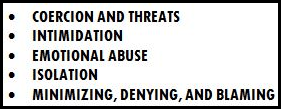
Domestic violence is control by one partner over another in a dating, marital, or live-in relationship. The means of control include physical, sexual, emotional, and economic abuse, threats, and isolation.

Emphatically noteworthy at the outset of this discussion is that false allegations of domestic violence have the same motive identified by the APA that domestic violence has: “control”; have the same consequences: “psychological and economic entrapment [and] physical isolation”; use the same methods to abuse: “fear of social judgment, threats, and intimidation”; have the same mental health effects on victims: “depression, anxiety, panic attacks, substance abuse, and post-traumatic stress disorder”; and can also “trigger suicide attempts [and] homelessness.”

A domestic violence factsheet published by the National Coalition Against Domestic Violence features a “Power and Control” pie chart. These segments of it are ALSO among the motives and effects of false allegations.

Accordingly, then, making false allegations of domestic violence is domestic violence.

When I was a kid, domestic violence meant something very distinct. It meant serial violence, specifically the habitual bullying or wanton battery by a man of his wife. The phrase represented a chronic behavior, one that gave rise to terms like battered-wife syndrome and to domestic violence and restraining order statutes.

These days, however, domestic violence, which is the predominant grounds for the issuance of civil protection orders, can be a single act, an act whose qualification as “violence” may be highly dubious, and an act not only of a man but of a woman (that can be alleged on a restraining order application merely by ticking a box).

As journalist Cathy Young observed more than 15 years ago, the War on Domestic Violence, which was “[b]orn partly in response to an earlier tendency to treat wife-beating as nothing more than a marital sport,” has caused the suspension of rational standards of discernment and introduced martial law into our courtrooms. “[T]his campaign treats all relationship conflict as a crime. The zero-tolerance mentality of current domestic violence policy means that no offense is too trivial, not only for arrest but for prosecution.” Reduced standards of judicial discrimination inspired by this absolutist mentality further mean that even falsely alleged minor offenses are both credited and treated as urgent and damnable.

Consider this recent account posted to the e-petition Stop False Allegations of Domestic Violence:

My boyfriend accused me of DV after an argument about separating and my 18-month-old…. The officer arrested me in front of my daughter, and when I asked why, he said he had a scratch on his arm.

A scratch.

The woman goes on to report that she spent two days in jail, had to post a $5,000 bond to get out, and that she was subsequently “displaced” from her former life.

Here’s another:

My ex-husband told the police that I pushed him, even though a witness had called the police on him for pushing me. He was completely drunk…but I got arrested instead. Right in front of my stunned family.

And another:

I was accused of domestic violence because I pinched my ex-husband when he pinned me and my son between two trucks. He ruined my life.

A scratch, a push, a pinch—which may not even have been real but whose allegation had real enough consequences.

I’ve also heard from and written about a man who caught his wife texting her lover and tried to take her phone. The two rowed for an hour, wrestling for it. The upshot was that the man was arrested and tried for domestic violence and ended up having to forfeit the home they shared to his wife, into which she had already moved her boyfriend.

(This week, I was contacted by a man trying to vacate an old restraining order whose story is identical: “[T]he only incident was in 2008 when I caught her cheating and tried to grab her phone.”)

False allegations to shift blame for misconduct are common, as are stories like these—stories of lives turned upside down by acts of “violence” that are daily tolerated by little kids—and they’re the motive of my politically incorrect two cents.

I read a feminist bulletin about domestic violence not long ago that featured for its graphic a woman who had very conspicuously been punched in the eye. Her injury was certainly more serious than a scratch or a pinch, but it, too, may have represented a single occurrence and was an injury that would heal within a month or two at the outside.

The gravity with which a single act of assault like this is regarded by the justice system can’t be overstated. The perpetrator is liable to have the book thrown at him.

By contrast, false allegations of domestic violence—or any number of other disreputable offenses—aren’t regarded by the courts or the public with any gravity at all, and their injuries don’t go away.

I work outside with my hands most days—which I wouldn’t be doing if I hadn’t had my own aspirations curtailed by the courts years ago (not based on allegations of domestic violence but on ones sufficiently crippling). I bang, stab, and gash myself routinely. From stress, besides, I’m prone to the occasional ruptured capillary in one of my eyes. I wouldn’t tolerate someone’s hurting a woman—or anyone else—in my presence, but at the same time, if I were offered the chance to recover my name, my peace of mind, and the years I’ve lost by taking a punch in the eye, I’d take the punch. In fact, I’d take many more than one.

I think other targets of false allegations who’ve had their lives wrung dry by them would say the same.

In my 20s, I was run down in the road when I left my vehicle to go to the help of a maimed animal. A 35-year-old guy, driving on a lit street under a full moon, smashed into me hard enough to lift me out of my shoes. The consequences of my injuries are ones I still live with, but a few surgeries and a year later, I was walking without a noticeable limp. I haven’t given the driver another thought since and couldn’t tell you his last name today. I think it started with an M.

Not only do I dispute the idea that physical injuries are worse than injuries done by fraudulent abuse of legal process; I don’t believe most physical injuries even compare.

And I think victims of domestic terrorism, whose torments are ridiculed by false accusers, would acknowledge that the lasting damage of that terrorism is psychic, which further corroborates my point.

Such violation promotes insecurity, distrust, and a state of constant anxiety—exactly as false allegations to authorities and the courts do, which may besides strip from a victim everything s/he has, everything s/he is, and possibly everything that s/he hoped to have and be.

There are no support groups for victims like this—nor shelters, nor relief, nor sympathy. Victims of lies aren’t even recognized as victims.

I’ve written recently about the abuse of restraining orders by fraudulent litigants to punish. What needs observation is that the laws themselves, that is, restraining order and domestic violence statutes, are corrupted by the same motive: to punish. Their motive is not simply to protect (a fact that’s borne out by the prosecution of alleged pinchers).

Reforms meant to apply perspective to these statutes and reduce miscarriages of justice from their exploitation have been proposed; they’ve just been vehemently resisted by the feminist establishment.

Laws that were conceived decades ago to redress a serious societal problem have not only been let out at the seams but are easily contorted into tools of domestic violence. This hasn’t been accomplished by fraudulent manipulators of legal process, who merely take advantage of a readily available weapon; it’s rather the product of a dogmatic will to punish exerted by advocates who wouldn’t concede that even real scratches, pushes, or pinches are hardly just grounds for having people forcibly detained, tried, and exiled.

Copyright © 2014 RestrainingOrderAbuse.com

Bullying: A Proposition for Psychological Study Inspired by Accounts of Restraining Order Abuse and Fraud

I’ve just corresponded with another victim of tag-teaming involving false allegations made to authorities and the court that were augmented and exacerbated by false rumors and group threats made on Facebook, hyped protestations of fear and danger circulated among friends and family, etc.

This moved me to investigate whether there’s a label for this kind of misconduct and if group-bullying is a recognized social phenomenon.

What I discovered was that group-bullying certainly is a recognized social phenomenon among kids, and it’s one that’s given rise to the coinage cyberbullying and been credited with inspiring teen suicide. The clinical term for this conduct is relational aggression, and one of the forms it takes is defamation by spreading rumors and gossiping about its victim, or publicly humiliating him or her. We’re talking about the vulgar mischief most of us thought we’d escaped when we graduated from high school.

The restraining order process is paternal and infantilizing, and its use mirrors children’s running to adults to adjudicate a perceived or claimed injustice (which is among the reasons why such processes are objected to and derogated as demeaning to women by equity feminists like Camille Paglia). Among the consequences of the availability of restraining orders is the promotion of developmental reversion, a regression into adolescent or even pre-adolescent modes of behavior.

Explications of group-bullying don’t identify one gender or the other as the likelier abuser, though relational aggression is said (by Wikipedia) to have been primarily observed and studied among girls.

Bullies, despite being quite morally competent, tend to engage in morally wrong behaviors because of several reasons, including a lack of moral compassion. In general, bullies seem to engage in a kind of cold cognition and have a good theory of mind. They also have an average to good social intelligence. These skills seem to be especially important in order to use relational aggression in an instrumental manner—for achieving specific social goals. As mentioned previously, male and female bullies usually score differently on sociometric measures. Male bullies often fall in the socially rejected category while female bullies tend to fall in the controversial category. They can be popular yet not liked.

According to the group-bullying paradigm, you have the bully, or ringleader, and a number of orbital “bully-reinforcers and assistants,” besides peripheral outsiders who are less committal but may nevertheless participate.

Bully-reinforcers and assistants do not normally initiate aggressive actions themselves, but they support, reinforce, and/or assist the bully. They often have rather large friendship networks when compared to outsiders, victims, and their defenders. These individuals are similar to bullies in regards of their personal characteristics. Female bully-reinforcers and assistants usually score low on social acceptance and high on rejection by their peers while male bully assistants have average scores on both, and bully-reinforcers are often quite popular among their peers. The characteristic that is common among all these individuals across both genders is low level of empathy.

(I’ve been subject to this misconduct, including by two women who claim their own brothers were victims of false allegations by other women. Interestingly, this didn’t deter these “bully-reinforcers” from participating in the identical misconduct. I’m curious now to learn whether it’s the case that morally diminished or vacuous people tend to gravitate toward one another.)

It’s noteworthy, of course, that upon consideration of the personality-disordered, sociopaths, and bullies (in this context vis-à-vis restraining order abuse), the underlying character qualification that’s repeatedly echoed is “low level of empathy” (and clearly there may be overlap between these types, that is, an offender may be all three in one—in fact, I just learned a single person can have multiple personality disorders). It’s disturbingly noteworthy, what’s more, that though the quoted typologies in this discussion are meant to apply to children, adults will have no difficulty in recognizing other “adults” to whom they’re equally applicable. Deplorably, the “social goals” that motivate bullying by adults may be little different from those that inspire teens: revenge, self-exaltation or -advancement by alienation of another, dominance, attention-seeking, and/or sport.

The restraining order merits special inquiry by psychological researchers, because it (1) allows a bully or false accuser to make allegations outside of normal channels to judges who are, effectively, parental strangers (nullifying any potential for in-group contradiction or negative social fallout, including in work settings); (2) authorizes the bully or false accuser (and his or her minions) to then spread false rumors within normal channels that have received external and official validation; and (3) enables the bully or false accuser to many times more effectively arouse attention and third-party (outsider) participation, because his or her allegations have been officially (parentally) legitimated.

Because of its innate procedural prejudices and low evidentiary threshold (in cases, zero), the restraining order as a medium of lying is uniquely disinhibiting even while promising exorbitant rewards to a bully or false accuser. Incidence rates of false allegations derived from other contexts are therefore wrongfully expected to cross-apply to this medium and are extravagantly low by contrast.

That the recognized by-products of adolescent bullying, furthermore, including depression, difficulties in academic performance, and undermined feelings of competence may likewise manifest in adult victims of bullying but with the additional consequences of loss of employment or employability and familial disruption or dissolution makes the need for critical scrutiny of adult bullying facilitated and authorized by restraining order abuse that much more urgent.

Copyright © 2014 RestrainingOrderAbuse.com