Restraining Orders Are Not Solutions People Should Be Told They Can Stake Their Lives On

A couple of weeks ago, a correspondent of mine, whose brother is in the service, brought my attention to a National Review story that underlines the sort of political contradictions that are bound to drive any thinking person up the wall.

It’s about a 39-year-old hairdresser, Carol Browne, who “had become increasingly nervous about her ex-boyfriend. Convinced that he intended to do her physical harm, she took out a restraining order, had security cameras installed at her home, and purchased an alarm system.”

She also applied for a permit to buy a gun, which she should have received (or at least had some word about) within a month. About six weeks after her application, she was stabbed to death in her driveway.

Defending his tardiness, the local police chief explained that the application process usually takes more than two months, and that when Bowne died, his team was still waiting for her fingerprints to be processed. Perhaps so. But this should serve as no acceptable excuse. By state law, New Jersey is required to get back to permit petitioners within 30 days. It didn’t.

It almost never does. Instead, would-be gun owners report waiting for three, four, six, and even nine months for permission to exercise what the Second Amendment makes clear is an unalienable individual right. The rules do not apply to the government.

Sure, the story makes a good case for easing restrictive firearm policies (or at least making them no more restrictive than the law prescribes), but what it saliently stresses is that liberal/feminist perspectives and the public safety policies they coerce are incoherent. Easy access to restraining orders is fiercely defended, and domestic and sexual violence are promoted as “epidemic.” Complainants of “whatever” are emboldened to represent their situations as dire and seek state protections. It’s estimated that millions of these orders are dispensed every year, and violence is the justification—and violence is always implicit in judicial rulings in this arena of law.

At the same time, the most obvious deterrents to violence, guns, are denounced—also in accordance with party positions. Okay, but which is it? Are multitudes of people in immediate danger…or aren’t they? Are their needs desperately important…or aren’t they?

(What wonder if police officers exhibit a degree of cynicism?)

Corollary to millions of restraining orders’ being granted to people is that millions of restraining orders are issued to people, and those people are publicly represented as threats. If they’re not really regarded as threats, then this is wrong. If they are regarded as threats, then there are a lot of people at risk, and denying them the means to defend themselves is wrong.

What the story in this post emphasizes above all is that restraining orders aren’t armor; they can’t live up to their promises and may enrage violent aggressors to extremity.

The perspectives outlined above persist in spite of obvious and outrageous contradictions because the leftist ideologues who hold them don’t get falsely accused…or stabbed to death in their driveways on their way to restock their larders with croissants and cat litter.

Copyright © 2015 RestrainingOrderAbuse.com

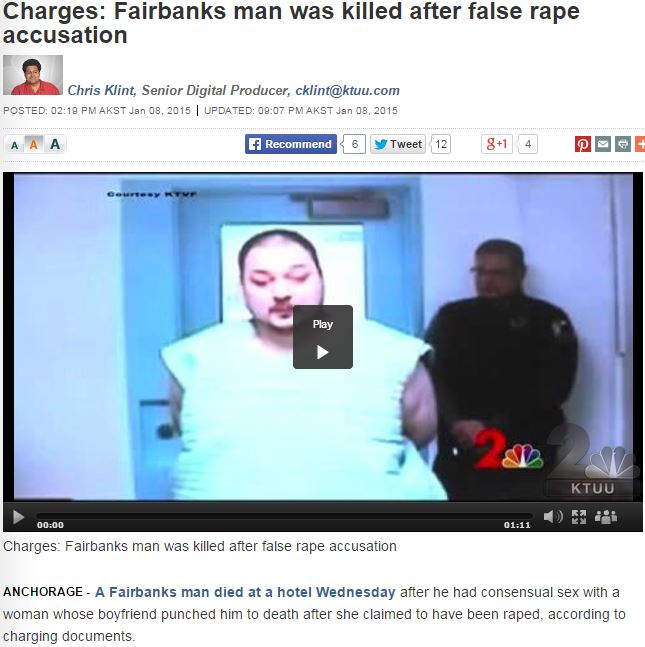
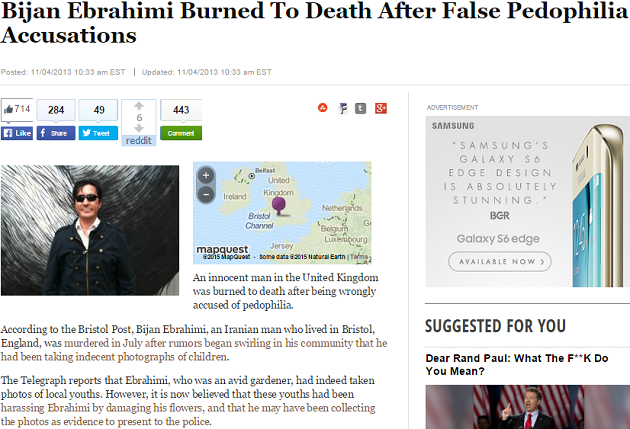
False Accusations and Murder: More Headlines about the Effects of Finger-Pointing and Legal Abuse

“[W]hy would someone lie about being sexually assaulted? What could be gained from that? Nothing, really.”

Tracie Egan Morrissey, Jezebel (Feb. 28, 2014)

The quotation above derives from a piece titled, “Rape, Lies and the Internet: The Story of Conor Oberst and His Accuser.” It’s spotlighted because it echoes the sentiment expressed by the writer of the prior post’s epigraph, who’s also a feminist and who betrays the same blindness.

What’s disturbing to the author of the blog you’re reading is that feminists who ask questions like Ms. Morrissey’s make a strong case for rape denial, because it might just as unreasonably be asked, “Why would someone sexually assault anyone? What could be gained from that?”

What could be “gained” from raping someone is the same thing that could be “gained” from lying about being raped—or lying about any number of other offenses: the exultation of control (i.e., power, dominance).

Other reasons for lying suggested by Ms. Morrisey’s own reportage are attention-seeking, self-aggrandizement, and mythomania. There have also been a number of publicized cases about false rape accusations’ being used for concealment of sexual infidelity. Two hyperlinks in this post lead to stories exemplifying this motive. Of course (and significantly), none of these motives applies exclusively to false rape claims. Besides avarice and malice, they’re common motives among false accusers (of all types). People hurt people…to hurt people. Appetites, least of all vicious ones, don’t answer to sense.

The previous post emphasized the emotional trauma of accusation, particularly false accusation, by highlighting a number of suicides reported in the news.

Suicide is a recognized consequence of bullying; name-calling and public humiliation are recognized as among the forms that bullying takes; and falsely branding someone a stalker, rapist, child abuser, or killer, for example, certainly qualifies as publicly humiliating name-calling.

Whether someone is disparaged on the playground, on Facebook, in a courtroom, or in the headlines makes absolutely no difference; the effect is the same, and it may be unbearable.

This stuff shouldn’t need to be pointed out to grown-ups. But since the fatal consequences of false accusation don’t support any dominant political agendas—and may undermine them—they’re ignored. That people are harried and hectored by lies, sometimes to death, is an inconvenient truth.

At least it is here. Many of the news clippings featured in the last post notably originate from the U.K., as do two of the clippings below. Journalism is far more balanced there, and it’s less taboo to call a jade a jade. A Jezebel reporter might denounce this as “misogynistic,”  but truth isn’t misogynistic; it’s just the truth, and it doesn’t play favorites (nor should its purveyors).

This post looks at the other lethal upshot of false accusation: murder. The stories that follow are about people who existed and now do not.

The point of introducing these stories isn’t to assert incidents like these are common; the point is to reveal the emotions that are inspired by false accusations, whether by women, by men, or by mobs. It’s also to reveal their consequences…writ large and lurid. These same emotions are aroused in cops and judges no less than they are in anyone else. False accusers know what reactions they can expect, and they know how to manipulate their audience—and bending others to do their will is thrilling.

Nothing makes the emotions provoked by accusation more manifest than when accusation inspires others to beat someone to death—or set him ablaze.

This is nevertheless typically lost on reporters and their viewers and readers. The details that are stressed and eagerly sought are who got it, and how. Why, which is always the more speculative aspect, is in its broader implications the most important one, however.

Gore is sexy. It’s what gets airplay and column space. It’s an attention-grabber and a ratings booster. Nothing draws the eye like the color red.

What sensation eclipses, though, is that for every false accusation that ends in red, thousands or hundreds of thousands end in gray, an interminable state of disquiet, disease, and dolor.

Copyright © 2015 RestrainingOrderAbuse.com

*Jezebel, if I’m remembering my Bible stories right, was a mass murderer who was condemned for promoting a false dogma. (Among her victims was a man she had judicially executed.)

STINKIER: Not Only Do the Courts Toss Most Restraining Order Petitions, a Lot of the Ones That Are Finalized Are Later Withdrawn by Their Petitioners

stinkier
A couple available rejection rates for restraining order petitions filed with the courts were scrutinized in the last post. Those rates, based on news reports out of Colorado (1998) and Connecticut (2014) were high: roughly 82% (lowball calculation) and 72%, respectively. That’s how many restraining order petitions may be denied or dismissed by our courts. They’re either rejected at first glance, or they’re preliminarily approved and then vacated on review.

They’re judged to be stinky.

Yesterday, I came across this: “Many abuse victims request protection orders then have them dismissed” (March 26, 2015). How many? Almost half (in the cited county, anyhow).

The headline and slant of the story pain me, and I’m compelled to comment on them before broaching the meat of the article.

Note that the typical journalistic bias is in evidence: accusers are termed “abuse victims.” This bias accounts significantly for why the bad odor of the restraining order process is obscured. It stinks, too—of Glade aerosol.

My criticism may seem cold—many accusers assuredly are abuse victims—but a journalist’s brief is to report what he’s investigated, and it’s a safe bet that the “many abuse victims” referenced in the headline aren’t people whose cases the writer looked into. At all. He assumes they’re “abuse victims,” apparently because why else would they have claimed to be?

This is smelly news reporting, and Journalism 101 urges a revision: “Many who are granted protection orders then have them dismissed.” There’s a difference, and the journalist who doesn’t discern that difference is in the wrong line of work.

The writer also begins his story with an account of a woman who’d obtained a protection order against her husband only to be subsequently shot to death by that husband. Then the reader is informed:

Though [the homicide victim] had not asked for her protection order to be dismissed, many other victims do and some of them end up coming back and asking for additional protection orders.

In other words, the reported tragedy has absolutely nothing to do with people who “request protection orders then have them dismissed.” I studied journalism in high school under the tutelage of a man who was the real deal, so lurid and careless journalism offends me.

What do we know from what’s related by Matt Elofson, the crime and courts reporter for Alabama’s Dothan Eagle? We know people apply for restraining orders, get them, and then reconsider (and sometimes re-reconsider). And we know that one person, who never reconsidered the restraining order she was granted, was fatally shot (possibly as a consequence of seeking the state’s protection). These are facts; the rest is rhetoric and specious connections, which are journalistic no-nos.

The reportage of Mr. Elofson’s that isn’t corrupt, however, is telling.

Roughly 40 percent of the petitions for protection from abuse filed in Houston County over the past year were dismissed upon request of the victim.

Houston County Circuit Clerk Carla Woodall said 223 petitions for protection from abuse were filed in Houston County from March 2014 to March of this year. She said 90 of the 223 petitions were later dismissed upon request by the victim.

For “victim,” substitute “petitioner” (pretend, in other words, that it’s a news story that’s been quoted) and then note that it says nearly half of orders that are approved and finalized are afterwards withdrawn by their petitioners.

Nearly half.

Here’s what a journalist (somewhere, someday) should observe: Most restraining orders are denied or dismissed by our courts, and an arresting proportion of those that aren’t denied or dismissed are withdrawn. That’s a whole lot of “sound and fury signifying nothing” except a whole lot of misery for a whole lot of accused people.

This, furthermore, ignores that a majority of orders that are approved and not withdrawn may be false.

We’re not allowed to call the restraining order process a farce, because—as Mr. Elofson reminds us—sometimes people who procure restraining orders are legitimately at risk.

How, though, does Mr. Elofson remind us that restraining orders are necessary and vital to the protection of women? He reminds us by citing an instance in which a restraining order may have gotten its petitioner killed.

Copyright © 2015 RestrainingOrderAbuse.com