A Brief Introduction to Feminist Rape Culture

“For those who don’t know, rape culture is an environment in which rape is highly prevalent, normalized and excused by the society’s media, popular culture, and political figures.”

—Ashley Jordan, The Humanist


Copyright © 2018 RestrainingOrderAbuse.com

*Omitted from this collage, its author realizes belatedly, is the acronym VAWA, which stands for a vector of evil. A chronicle of what this collage summarizes is here.

What Feminist Writer Sandra Newman Gets Right about False Accusation and Why That Disarms Her Contention That It “Almost Never [Has] Serious Consequences”

In a recent Quartz.com article titled, “What kind of person makes false rape accusations?” (commented on here), novelist Sandra Newman answers that, among others, people with (Cluster B) personality disorders do (sociopaths, narcissists, histrionics, and borderlines), which is true. People who exhibit the traits associated with these disorders, whether clinically or subclinically, are identified in the law as “high-conflict people.” Court process perfectly syncs with their drive to blame, and they may lie without compunction.

Here’s the problem: While psychological motives may be discerned in major criminal investigations, they are never detected in any “lesser” type of prosecution, particularly in civil court. “Investigators” like Ms. Newman, whose agenda is clearly to challenge the notion that false rape accusations are a serious matter, must discredit that notion while relying on the legitimacy of “lesser” so-called “epidemic” violations like stalking and domestic violence, which may also be alleged (and to a much greater extent) by high-conflict litigants. No one can know what quotient of violence hysteria is based on lies or distortions, and the Sandra Newmans out there have no interest in dispelling that hysteria or promoting a balanced perspective. Sympathy for “the adversary” is unthinkable.

The goal is to emphasize the victimization of women and to dismiss the victimization of the falsely accused (who include women, which is a fact that’s also ignored).

The title of Pulitzer-prize-winning columnist Dorothy Rabinowitz’s book, No Crueler Tyrannies: Accusation, False Witness, and Other Terrors of Our Times, characterizes (false) accusation much more squarely, that is, damningly.

Here are some stories about false accusation and its effects:

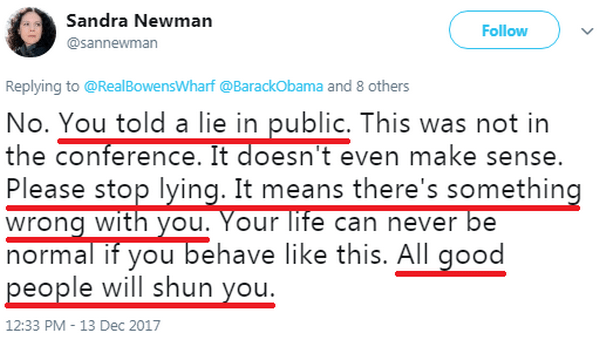
Ms. Newman has elsewhere acknowledged what she thinks of liars and expressed how she feels society should regard them:

Yet the thrust of her Quartz arguments is not that liars are monstrous and should be stopped. It’s that lying, even about rape and even to people with guns and gavels, is unworthy of remark, because it “almost never [has] serious consequences.”

Copyright © 2018 RestrainingOrderAbuse.com

*The link on Ms. Newman’s Twitter remark is broken because her account has been suspended since the publication of this post.

Borderline Personality Disorder, Procedural Abuse, and Feminism: A Victim’s Reckoning of Their Tolls

YY_mural

“I hate this world and almost everybody in it. People use each other. I find most of you disgusting. My brothers are disgusting. The people I used to work with are disgusting. You’re shallow, you’re two-faced and hypocritical, you’re judgmental, you cause me more pain than you could ever possibly know. You don’t want me around? Guess what? I don’t want to be around you ugly motherf[—]ers, either. You cause all of your own problems, heap them onto other people, and then blame those people for your problems. You bitch about the amount of pain you’re in, then tell other people to get over their pain.

“I am done with all of you. I am done with your lies and your shitty society, and most of all, I am done kissing your ass.”

—Mrs. Nathan Larson (May 9, 2014)

Virginian Nathan Larson has had a tumultuous year.

He married a woman he met online (April 23, 2014); then she moved out (June 21, 2014) and accused him, among other things, of rape (August 2014 through January 2015); then they divorced; then he learned he was a father when the news reached him that his ex-wife had committed suicide.

The quotation above is from an online post of his former wife’s published between their marriage and their separation. Below is an excerpt from a digital diary entry of hers written when she was a teen (which included a “hit list”):

I hate the students at […]. They are arrogant and foolish. My one dream, my passion is to achieve a machine gun or something and shoot every f[—]er in the school. I want to pump them full of metal, their blood splattered on the tiles. I want to make a massacre that becomes the worst in American history. There are only a few people who I would spare. Everyone else…I would love to see them writhing on the ground in pain, blood oozing out of a million holes in their body.

Nathan’s wife, who was an arguably troubled woman, abruptly terminated their relationship of “75 days total” and then informed him she had miscarried their child. In August 2014, she accused him of rape to the police, but he declined to talk with them and was never charged. In November 2014, she began to accuse him to the courts.

This wasn’t a trial run, either. The accusations brought against Nathan by his wife mirrored charges she had made against a previous partner, also to damning effect.

She petitioned three ex parte (temporary) restraining orders before successfully obtaining a permanent order against Nathan in January of this year (by default). Its alleged bases were “domestic abuse, stalking, sexual assault, and physical assault.” The order was petitioned in Colorado, and Nathan would have had to travel a significant distance to be heard in his defense. “Not wanting to invest money and emotional energy in fighting it, and knowing it would be hard for me to successfully contest it, I didn’t show up to the hearing,” he says. He elected to “move on.”

The two were divorced in April 2015, and that seemed to be an end on it.

Two months later, Nathan was told his (then) wife had given birth to a child in February, presumably the one she had told him she had miscarried. This information reached him along with the news that his former wife had killed herself following her commitment for “suicidal depression” and allegedly hearing voices compelling her “to hurt or kill the Child.”

Nathan must now contest a “dependency and neglect petition” in Colorado asserting he’s an unfit parent.

What follows are his reflections on his marriage to a woman who he alleges had untreated borderline personality disorder, on feminism, and on “abuse culture” and its damages.

Nathan Larson (with his new fiancée’s infant cousin)

Having the benefit of distance from the situation and more calmness about it (especially now that she’s dead), I would say that we both made a lot of mistakes during and after the relationship. There are some people who say that it’s a mistake to enter into a relationship with someone with untreated borderline personality, because it simply won’t work, no matter what you do. Unfortunately, once you get into a relationship like that, your sense of reality can get distorted because you’re so in love, and they’re so convincing, and they get so many other people to agree with them, that you too start to believe it if you don’t have enough of an understanding of BPD to realize what’s happening and why.

For example, suppose you used to argue with your BPD partner, and occasionally lost your temper and had to apologize for saying something unkind. Because they’re so sensitive to minor betrayals, they might claim that you horribly emotionally abused and bullied them to get your way, and then tried to be sweet to them and make up, just like in the classic model we’ve been taught of the cycle of abuse. If you’re still thinking this person is the most wonderful person in the world, then logically you might think that you really did emotionally abuse them, because why would such a wonderful person say it if it weren’t true? Plus, they are clearly very upset over how you treated them, and they broke up the relationship over it, and now they’ve told everyone in your circle of friends and family about it, and many of them are telling you they agree that the breakup was your fault because of your emotional abuse.

These are people you respect and trust, and therefore this could not possibly be happening unless you really were abusive!

You start to blame yourself and even tell people, “She left me because I was emotionally abusive” (which of course attracts more criticism, because who would admit that if it weren’t true?). Eventually, you run into someone who hears your account of what was actually said and done, and challenges your interpretation, saying you’re being too hard on yourself, and that this chick is not as great as you seem to think she is. (To which, of course, you may think, “He just doesn’t know and understand her and our deep and beautiful relationship! We were soulmates! What are the chances I will ever find another woman like that? I searched my whole life, and she was the only one like that I’ve ever met who loved and appreciated me so much.”)

If you have good friends, they’ll awaken you to the fact that someone who truly loved you that much would be willing to forgive and come back to you, or at least treat you decently, rather than holding a grudge and trying to make you suffer.

Also, there’s the fact to consider that people with borderline personality disorder idealize and devalue, and they view people as either completely good or completely bad. This means that once they’re faced with the inescapable reality that you’re not perfect, they have to view you as completely evil. They also have to deny any blame at all for the end of the relationship, lest they have to conclude that they too are flawed, which would cause them to view themselves as completely evil. They can’t handle any feelings of guilt; they have to deflect all blame, including the blame for their own emotionality.

Feminists, of course, are not thinking about all this psychology going on behind the scenes.

They’re busy calculating whether being skeptical of the claims of someone like that will make the public more likely to be skeptical of the claims of someone with legitimate, serious complaints, and make those victims more reluctant to come forward. So the innocent who was accused gets sacrificed for the greater good.

Some women with borderline personality disorder are attracted to the feminist movement and voraciously read all of their materials about abuse, patriarchy, rape culture, etc. because it helps them view themselves as a helpless victim of powerful sociopaths, and thus deflect blame.

They can find a community of people who will give them the benefit of the doubt by believing their stories, and confirm their interpretation of what happened. Borderlines also sometimes struggle to find a sense of identity, and the feminist movement can provide that as well. Their victimhood actually makes them useful to someone, since it’s a story they can tell and retell to those who need to be persuaded that political change is necessary to stop these abuses. (Feminists, like advocates for most other political movements, would bristle at any suggestion that their ideology attracts mentally ill people, since that would tend to discredit them.)

Yet what the feminist movement can never satisfactorily explain to them is why, despite all this training in recognizing red flags of abusers, and despite all the tools the system has provided for punishing abusers (e.g., restraining orders, prison sentences, etc.), they keep getting “abused” by partner after partner, while many other women seem to have successful, happy relationships.

The only possible answer is that it’s a combination of sociopaths’ finding them particularly attractive for some reason (maybe they sense they’ve been abused and think it’ll be easy to re-victimize them) combined with the fact that the patriarchy is still strong, abused women are still not being believed, and therefore we need to punish abusers more harshly and give the accusers even more benefit of the doubt.

Then, finally, when we have a world where all you need to do to get a man locked away for life is cry rape without any supporting evidence, rational men will finally stop raping. Except, even if such a system were put in place, these insecure women would still feel victimized by their partners, and they would attribute the “abuse” to these guys’ acting impulsively without regard to the certain punishment.

Copyright © 2015 RestrainingOrderAbuse.com

*An excellent explication of procedural abuse by “high-conflict” people (who are associated with personality disorders like BPD) and why court procedure is attractive to them is here.

Courtroom Fraud and Smear Campaigns: The Full Machiavelli

Cheryl Lyn Walker PhD, Dr. Cheryl Lyn Walker, Dr. Cheryl L. Walker PhD, M.D. Anderson Cancer Center, Michael Honeycutt PhD, Michael Honeycutt TCEQ

“False Accusations, Distortion Campaigns, and Smear Campaigns can all be used with or without a grain of truth, and have the potential to cause enormous emotional hurt to the victim or even impact [his or her] professional or personal reputation and character.”

—“False Accusations and Distortion Campaigns

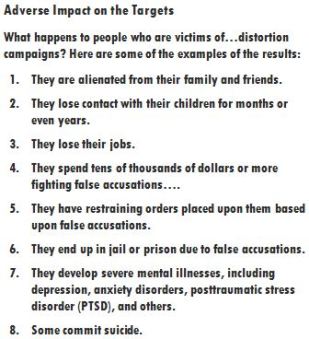
There are several fine explications on the Internet about the smear campaigns of false accusers. Some sketch method and motive generally; some catalog specific damages that ensue when lies are fed to the police and courts.

This survey of “adverse impacts” is credited to lies told by people with borderline personality disorder. Conducting “distortion campaigns” isn’t exclusive to BPDs, however, and the “adverse impacts” are the same, irrespective of campaigners’ particular cognitive kinks.

The valuable role of the police and courts in the prosecution of campaigns to slander, libel, and otherwise bully and defame can’t be overstated. They’re instrumental to a well-orchestrated character assassination.

Lies can be told to anyone, of course, and lies told to anyone can have toxic effects. The right lie told in a workplace, for example, can cost someone a job and impair or imperil a career.

Lies told to police and judges—especially judges—they’re the real wrecking balls, though. False allegations of threat or abuse are handily put over in restraining order or domestic violence procedures, and they endure indefinitely (and embolden accusers to tell further lies, which are that much more persuasive).

Among the motives of false accusation are blame-shifting (cover-up), attention, profit, and revenge (all corroborated by the FBI). Lying, however, may become its own motive, particularly when the target of lies resists. The appetite for malice, once rewarded, may persist long after an initial (possibly impulsive) goal is realized. Smear campaigns that employ legal abuse may go on for years, or indefinitely (usually depending on the stamina of the falsely accused to fight back).

Legitimation of lies by the court both encourages lying and reinforces lies told to others. Consider the implications of this pronouncement: “I had to take out a restraining order on her.” Who’s going to question whether the grounds were real or the testimony was true? Moreover, who’s going to question anything said about the accused once that claim has been made? It’s open season.

In the accuser’s circle, at least—which may be broad and influential—no one may even entertain a doubt, and the falsely accused can’t know who’s been told what and often can’t safely inquire.

Judgments enable smear and distortion campaigners to slander, libel, and otherwise bully with impunity, because their targets have been discredited and left defenseless (judges may even punish them for lawfully exercising their First Amendment rights and effectively gag them). The courts, besides, may rule that specific lies are “true,” target_of_blamethereby making the slanders and libels impervious to legal relief. Statements that are “true” aren’t defamatory. The man or woman, for instance, who’s wrongly found guilty of domestic violence (and entered into a police database) may be called a domestic abuser completely on the up and up (to friends, family, or neighbors, for example, or to staff at a child’s school).

Lies become facts that may be shared with anybody and publicly (court rulings are public records). Smear campaigners don’t limit themselves to court-validated lies, either, but it seldom comes back to bite them once a solid foundation has been laid.

Some so-called high-conflict people, the sorts described in the epigraph, conduct their smear or distortion campaigns brazenly and confrontationally. Some poison insidiously, spreading rumors behind closed doors, in conversation and private correspondence. As Dr. Tara Palmatier has remarked, social media also present them with attractive and potent platforms (and many respondents to this blog report being tarred on Facebook or even mobbed, i.e., bullied by multiple parties, including strangers).

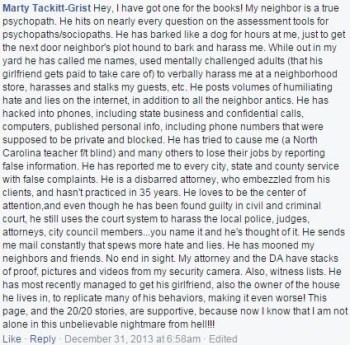
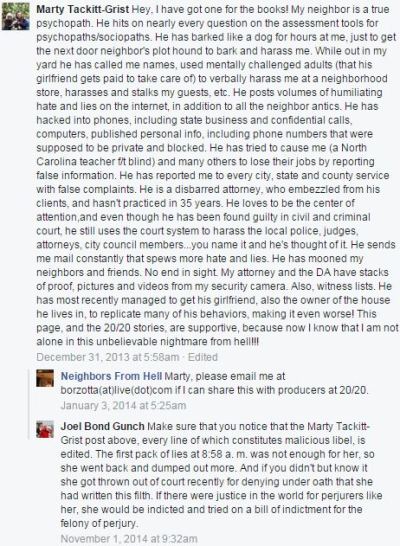
Even when false accusers’ claims are outlandish and over the top, like these posted on Facebook by North Carolinian Marty Tackitt-Grist, they’re rarely viewed with suspicion—and almost never if a court ruling (or rulings) in the accusers’ favor can be asserted. The man accused in this comment to ABC’s 20/20 is a retiree with three toy poodles and a passion for aviation who couldn’t “hack” firewood without pain, because his spine is deformed. He is a retired lawyer, but he wasn’t “disbarred” and hasn’t “embezzled” (or, for that matter, “mooned” anyone). He has, however, been jailed consequent to insistent and serial falsehoods from his patently disturbed neighbor…who’s a schoolteacher.

For Crazy, social media websites are an endless source of attention, self-promotion, self-aggrandizement, and a sophisticated weapon. Many narcissists, histrionics, borderlines, and other self-obsessed, abusive personality types use Facebook, Twitter, and the like to run smear campaigns, to make false allegations, to perpetrate parental alienation, and to stalk and harass their targets while simultaneously portraying themselves as the much maligned victim, superwoman, and/or mother of the year.

(A respondent to this blog who’s been relentlessly harried by lies for two years, who’s consequently homeless and penniless, and who’s taken flight to another state, recently reported that a woman who’d offered her aid suddenly and inexplicably defriended her on Facebook and shut her out without a word. Her “friend” had evidently been gotten to.)

(An advocate for legal reform who was falsely accused in court last year by her husband and succeeded in having the allegations against her dismissed reports that he afterwards circulated it around town that she tried to kill him.)

I was falsely accused in 2006 by a woman who had nightly hung around outside of my house for a season. She was married and concealed the fact. Then she lied to conceal the concealment and the behavior that motivated the concealment. She has sustained her fictions (and honed them) for nearly 10 years. People like this build tissues of lies, aptly and commonly called webs.

Their infrastructures are visible, but many strands may not be…and the spinners never stop spinning.

The personality types associated with chronic lying are often represented as serpentine, arachnoid, or vampiric. This ironically feeds into some false accusers’ delusions of potency. Instead of shaming them, it turns them on.

I know from corresponding with many others who’ve endured the same traumas I have that they’ve been induced to do the same thing I did: write to others to defend the truth and hope to gain an advocate to help them unsnarl a skein of falsehoods that propelled them face-first into a slough of despond. (Why people write, if clarification is needed, is because there is no other way to articulate what are often layered and “bizarre” frauds.)

I know with heart-wrenching certainty, also, that these others’ honest and plaintive missives have probably been received with exactly the same suspicion, contempt, and apprehension that mine were. It’s a hideous irony that attempts to dispel false accusations are typically perceived as confirmations of them, including by the court. To complain of being called a stalker, for example, is interpreted as an act of stalking. There’s a kind of awful beauty to the synergy of procedural abuse and lies. (Judges pat bullies on the head and send them home with smiles on their faces.)

Smear campaigns wrap up false accusations authorized by the court with a ribbon and a bow.

Copyright © 2015 RestrainingOrderAbuse.com

*The name Machiavelli, referenced in the title of this post, is associated with the use of any means necessary to obtain political dominion (i.e., power and control). Psychologists have adapted the name to characterize one aspect of a syzygy of virulent character traits called “The Dark Triad.”

Chicken Sh*t from Rotten Eggs: Rosemary’s Story of Restraining Order Abuse

The account below, by Rosemary Anderson of Australia, was submitted to the e-petition End Restraining Order Abuses (since terminated by its host) and is highlighted here to show (1) that restraining orders are abused not only by intimates but by neighbors and strangers, (2) that the ease with which they’re applied for entices vexatious litigants (especially once their appetite has been whetted), and (3) that restraining orders are abused in countries other than the United States.

Assuredly due to language barriers, most visitors to this blog are from predominately English-speaking countries (England, Canada, and Australia, in particular, among nations abroad), and for whatever reason, over 90% of visitors are American.

Foreign complainants of restraining order abuse, however, shouldn’t hesitate to report their stories and share their criticisms on blogs like this one or on petitions like the one Rosemary used, because the value of those stories and criticisms, ultimately, is to expose injustice. The civil restraining order is common to countries across the globe, as are its abuses.

Rosemary’s story (with minor editorial tweaks):

We have had several restraining order summons served upon us by our neighbours, and on one occasion a worker whom I had reported to police for exposing himself to me (evidenced in photos) tried to take a VRO out against my husband (VRO = violence restraining order). To date they haven’t gone the distance thanks to our lawyer, but we know they will never stop trying.

The allegations are false, though we admit to giving them the finger from time to time in retaliation for being abused or watched.

The matter began when we opposed the expansion of their egg farm. We did so through the appropriate channels and in the appropriate manner. They have a CCW on their property and for reasons unknown were allowed to build the egg farm far too close to our boundary and house.

Their settlement to buy their property went through in January (2011). Ours was delayed and went through in February. They keep telling people they were there and had already built and were running their egg farm before we bought our property. The egg farm did not end up how it was supposed to and has been poorly managed, creating unpleasant issues for us. To expand any farther, they need our property and have indicated they would like to purchase but are not willing to pay what it is worth.

Every time they are overstocked or doing something wrong, they will make some sort of false allegation against us, cost us thousands of dollars, and generally make our lives unpleasant. On one occasion, we had the police come out and accuse us of stealing their dog after we had to catch it to stop it from chasing our horses. On another occasion, they rang the ranger and accused us of shooting their dog after it had gone missing. It turned up two days later alive and well in the dog pound.

The woman is about the same age as me, in her 50s and supposedly religious. She married a disabled man, and she uses these things to gain sympathy. She will lie and first turn on the tears, and if that doesn’t work she will become aggressive and threaten, and get others to threaten.

She once threatened my employer to get me sacked. I had luckily recorded several previous incidents that proved to my boss the lies they tell. They once took us to court over the boundary fence even though we had evidence in the form of letters and photos. Miraculously they won as they brought the non-professional fencing person with them as a witness. We weren’t given the appropriate notice by the court of their witness and could have selected several witnesses of our own to prove the fencing contractor assisted our neighbours to make a false insurance claim. The summons for this also came 18 months after we had given them what we had considered an appropriate payment. They had cashed the cheque and never contacted us in between to dispute it.

I found the behaviour of the local magistrate and the local court registrar very suspicious, and seriously wonder if they are members of their church. I wish I had more time to explain. I have had people ring us on our silent phone number and abuse us as well as had threatening letters sent to our PO box and which also contained our pet names.

Rosemary’s accuser fits the profile of many others characterized by visitors who’ve left comments on this blog and is prototypical of the serial-accuser-cum-neighbor. Almost without exception, people like this are triggered by some petty grievance.

Restraining orders, because they’re issued on one party’s word alone, are addictive gateway drugs for vexatious litigants, who are induced to abuse process continuously once they see how conveniently it’s accomplished. There are no consequences for filing false or frivolous complaints. Not only do the courts never motivate serial accusers to stop; they often reward sniping and treachery.

It’s good for business.

Copyright © 2014 RestrainingOrderAbuse.com

J’s Story: Restraining Order Abuse and the “Dreaded Crazy”

J, a single dad who lives in Texas with his two kids, submitted his story as a comment to the blog in September, prefacing it: “I am writing this to share [it] with the rest of my fellow male victims [who] fall in with the dreaded Crazy.”

The “dreaded Crazy” in J’s case manifested as an Arkansas woman J began a romance with online, a high-conflict person whom a clinician might diagnose with borderline personality disorder (BPD).

(For an elucidation of BPD, see psychologist Tara Palmatier’s “In His Own Words: Dangerous Crazy Bitch Ahead,” which chronicles a case similar to J’s. See also any of Dr. Palmatier’s detailed explications of personality disorders.)

Here’s J’s story in his own words (lightly edited):

I met a beautiful, sexy, well-educated woman online. We met in person, and I was smitten. We shared our life stories with each other and began to see each other more. Although she lived over 500 miles away with her two children, I visited her every chance I could.

Her past was fraught will evil men who had taken advantage of her. She told me she was a young widow and that her first husband died suddenly of heart failure at a very early age, leaving her and her first child all alone. She said she remarried shortly after and had her second child. Unfortunately the second husband turned out to be a quite the carouser and left suddenly for Europe to be with another woman.

I felt so bad for her. I had two children of my own as a single father, so I was able to connect with how hard it was. She told me how she loved children and had always wanted a big family. She lamented feeling that her own family had deserted her, shunning her because she wasn’t a devout Christian.

There were so many twists and turns to her story. How could all this happen to such a wonderful and beautiful woman? She was such a nice and giving person….

Because it was all complete bullsh*t.

I won’t go into the details of my awakening. Let’s just say dates didn’t match up. Her kids’ (Fruit Loops’) stories didn’t match up. As a matter of fact, just about everything she told me didn’t match up. But I was smitten. So this went on for a long time until one day I just flatly called her on it. Suddenly my little scoop of heaven turned into a raging, clawing, screaming harpy. She accused me of being like every other son of a bitch in her life. Then she was swinging at me and screaming at me to get out.

I was already sprinting backwards, car keys in hand, toward my car. I got inside and sped off as she was chasing me. I was outta there, heading back to Texas never to return.

I did not see, speak, or talk to that woman again for over six months. Then one day a constable walks into my office and says, “Are you so-and-so?” I said yes. “Well, I have a restraining order for you from Arkansas.” Confused, I took it and read it. The constable then said as he was leaving, “I normally don’t read those. But looks like one crazy bitch to me. Better stay away. Ha-ha. Have a nice day.”

I was blown away.

The order claimed that I had snuck inside her house the weekend prior and forced her to call some other guy to tell this other guy (whom I don’t know, never met or heard of) that she was madly in love with me. Then her statement said I “roughed [her] up” then vanished into the night. Damn I was stunned. I did not know what to do. The order stated that I had 14 days to show up in Arkansas! I wasn’t even there. I lived in another state! I had not seen or heard from this woman in six months!

So I called an attorney friend of mine. He jokingly asked, “Did you do it”? I replied, “Hell no!” He then asked me to fax over the order. After he reviewed it, he called back and said, “Yep, it’s a restraining order, and you have 14 days. In the meantime, you have to stay away from her and her children.”

I replied, “This is bullsh*t! What if I just ignore it?” He said, “Well, if you ignore it and don’t show up in court on that day, you will automatically be found guilty. The charge will stay on your record, and you may not be able to buy a firearm.” “What the f—!” I yelled. “Can’t you just send a letter to the court explaining I wasn’t there and live 500 miles away?” He said no. “If you want to fight the charge, you have to show up.” He said he would have gone for me but wasn’t licensed in Arkansas.

He gave me the number of an attorney friend who worked in Little Rock. Next thing I knew, I’m having to fax or email every record I kept that shows my whereabouts on that day: gas receipts, store receipts, etc. I had to get a list of movies that I watched from the video download company we use. Cell phone calls. Text messages. (By the way, they really do monitor those. They can pinpoint your exact location, but you have to send a written request.) All of this to prove I was not there. Once I gave that attorney everything, he told me he would go to court that day and ask for an extension of 60 days. And I would still have to show up in Arkansas. Sh*t!

I cannot express the worry I endured during this time. Here I was falsely accused of something I did not do and was guilty until I proved otherwise in another state!

Prior to my court date, the attorney hired a private detective to run police reports on this woman’s current and former addresses. All you really have to do is call the local police department, and for a small copy fee it will give you all of the police reports related to a specific address for a specified time period. It’s really quite easy to do.

I was shocked when I saw them.

This woman, over a period of five years, had called the police over 20 times between two different addresses claiming either an assault or attempted break-in. All the police reports were noted as unfounded. One was a claim of rape. On that claim, she took some poor guy all the way to a grand jury, which promptly dismissed it. (Grand jury decisions are sealed, but the defendant’s name and attorney were listed. My attorney called that guy’s attorney and got a few details.)

The file on her sordid past was pretty thick. I thought that this was going to be over. Nope! I couldn’t use this information in court. It didn’t pertain to this incident. It was still her word against mine.

The day of the court hearing came. I drove out of state to be there. She actually showed in up in court that day. I suspect she didn’t expect I would show. The judge called out our docket. She sat on one side of the courtroom. My attorney and I sat on the other.

Seconds before the hearing, my attorney asked to briefly speak just to the prosecutor. They met in front of the bench, and my attorney handed him the file with prior police reports and my receipts and information as to my whereabouts on the day in question. The prosecutor then asked the judge if he could take a few minutes with the plaintiff. The prosecutor walked over to her with the file and whispered in her ear as he let her review the contents of the file. You could see the blood drain from her face. She whispered something to him. The prosecutor then stood up and said, “Your Honor, the plaintiff requests to withdraw her charge.” The judge just laughed and said, “Case dismissed.” That was it. It was over, no questions asked: $3,800 bucks and a long drive back home.

I did return to the local sheriff’s office and file an amended police report to state I was falsely accused and the case was dismissed on this date. You can have the dismissal form put in the police record.

I also had a cease-and-desist letter drafted by my attorney stating basically, “Don’t ever do this again, or I will sue you for liability.” You can put that in the police record, as well.

I had a copy of that letter sent to her by certified mail. I also had a copy personally delivered to her place of work by the same investigator who ran the background check. He went to her office and told the receptionist that he had a “special delivery” letter for her and that he needed to deliver it in person.

The receptionist called her to the front office. When she did, the investigator introduced himself and informed her that he had a letter to present. He pulled the letter out and proceeded to read the cease-and-desist letter out loud to her in the crowded waiting room. Then he handed it to her and left. He reported back that she appeared to have been in shock.

That’s it. Haven’t heard from her to date.

Copyright © 2014 RestrainingOrderAbuse.com

Living in the Crosshairs: Crackpot Neighbors, False Reports, and Restraining Order Abuse

I bonded with a client recently while wrestling a tough job to conclusion. I’ll call him “Joe.” Joe and I were talking in his backyard, and he confided to me that his next-door neighbor was “crazy.” She’d reported him to the police “about a 100 times,” he said, including for listening to music after dark on his porch.

His neighbor had never been punished for her mischief, only indulged and rewarded. This is behavior the police and court have been conditioned to treat as urgent. The woman’s husband refused to participate in her sniping—but didn’t interfere with it, either. He had to live with her. Others in the vicinity just tried to stay off her radar.

The neighboring house was dim and still as Joe related the woman’s pranks, which spanned a period of years. “She’s probably listening to us now,” he remarked.

I commiserated but didn’t share with Joe that I wrote about such things and heard about them monthly from people whose lives were sometimes crippled by hyped allegations of fear and danger.

Joe told me, unsurprisingly, that his neighbor had twice sworn out restraining orders against him. The first was laughed out of court on appeal; the second he didn’t bother to contest. He gestured as if to say, “What would’ve been the point?” Maybe Joe intuited that high-conflict people like his neighbor live for strife and attention, and decided to deny her the satisfaction of a fight.

(Many respondents to this blog report they’ve had multiple false restraining orders petitioned against them. One e-petition respondent recently reported being the recipient of seven fraudulent restraining orders obtained by a “diagnosed narcissist.”)

Joe informed me, with a hint of sarcasm, that his neighbor was a professional psychic. Surveillance cameras nevertheless hung from the corners of her home’s roofline. I guess she couldn’t see everything coming.

(Among people who report being stalked or serially accused by neighbors through the courts, the presence of security cameras is commonly mentioned. The neighbors also tend to be of middle or advanced age and female—as are their victims, sometimes. One 60-year-old woman, chronically accused by a female neighbor, has reported having to abandon her house and flee to forestall further allegations. Men who are spies, peepers, and cranks are more likely to be the recipients of restraining orders than the petitioners of them: women accuse sooner than men do—and they do it more effectively.)

Joe didn’t get too explicit, but he told me he’d been photographed fooling around with his wife in the hot tub, which he’d since removed. In Arizona, at least, it’s apparently legal to monitor your neighbor over a bordering fence.

Joe said after he and his wife divorced, his neighbor told his ex-wife he was having an affair. He took in a male roommate. His neighbor photographed him, too—through the window adjacent to her backyard.

Joe shifted an arbor from one side of his patio to the other after getting approval (but no compensation) from the homeowners’ association. Two massive Tombstone rosebushes interwove to form a decent privacy screen.

I asked Joe whether he’d ever tried to get the woman off his back. He told me, unrepentant, that he’d once shot her with the garden hose while she was peeping. To this day, he says, she circulates it that he “assaulted her with a high-pressure hose.” He may have said this was the grounds for one of the restraining orders.

His neighbor has reported her other neighbors, too. The neighbor across the street knew of her particular “sensitivities” and informed her in advance that she was having a birthday party for her little girl at 2 in the afternoon on a weekend. The neighbor from hell reported it, anyway—on principle, I guess. The kids’ party was disrupted by cops.

Joe says his neighbor’s record is seven calls to the sheriff’s department in a single day (just on him). Deputies finally told her that if she called again, they’d cite her.

Joe works as a chef and didn’t appear to have any kids. With a few beers in him, he seemed to take the whole thing in stride.

I wonder if a feminist would be as tolerant.

Copyright © 2014 RestrainingOrderAbuse.com

Larry’s Story: Restraining Order Abuse and the Neighbor from Hell

“She habitually engages in psychological projection. She has caused me to be compelled under threat of arrest and prosecution for failure to appear to attend court on her frivolous lawsuits 25 times. Yes! Twenty-five times. The frivolous prosecutions started in 2011, and they are still raging. I have been cited back to court on her application for a new restraining order on the 12th and a criminal warrant for cyberstalking on the 17th of this month. She has tried so many times to have me jailed I have lost count.”

—Larry Smith, author of BuncyBlawg.com (2014)

The quotation above is an excerpt from an email sent to the creator of “Neighbors from Hell” on ABC’s 20/20. The Feb. 8 email was a sorely persecuted man’s response to being fingered on Facebook as a candidate for the series by his neighbor, Marty Tackitt-Grist, who has forced him to appear before judges nearly 30 times in the span of a few years to answer “two restraining orders, three show-cause orders, two cyberstalking arrests, and a failure-to-appear arrest and jailing despite faxes from two doctors that I was too crippled, disabled, and suffering from herniated discs to be able to attend court.”

Here’s the reply the email elicited from ABC’s Bob Borzotta: “Hi Larry, I don’t seem to have heard further from her.  Sounds like quite a situation….” Cursory validations like this one are the closest thing to solace that victims of chronic legal abuses can expect.

Concern shown by the police and courts to complaints from attention-seekers can make them feel like celebrities. Random wild accusations are all it takes for the perennial extra in life to realize his or her name in lights.

Not unpredictably, the thrill is addictive.

I think I first heard from Larry, the author of BuncyBlawg.com, in 2013—or maybe it was 2012. In the artificial limbo created by “high-conflict” people like the one he describes in the epigraph, temporal guideposts are few and far between. A target like Larry can find him- or herself living the same day over and over for years, because s/he’s unable to plan, look forward to anything, or even enjoy a moment’s tranquility.

The target of a high-conflict person is perpetually on the defensive, trying to recover his or her former life from the unrelenting grasp of a crank with an extreme (and often pathological) investment in eroding that life for self-aggrandizement and -gratification.

Among Larry’s neighbor’s published allegations are that he’s a disbarred attorney who “embezzled from his clients” and a textbook psychopath, that he has “barked like a dog for hours” to provoke another neighbor’s (imaginary) dog to howl at her, that he has called her names, that he has enlisted “mentally challenged adults” to harass her while shopping, that he has cyberstalked her, that he has “hacked into phones” and computers, that he has tried to cause her (and “many others”) to lose their jobs by “reporting false information,” that he has made false complaints about her “to every city, state, and county service,” that he sends her mail “constantly,” and that he has “mooned” her neighbors and friends.

The ease with which a restraining order is obtained encourages outrageous defamations like these (Larry’s neighbor has sworn out two). Once a high-conflict person sees how readily any fantastical allegation can be put over on the police and courts, s/he’s inspired to unleash his or her imagination. That piece of paper not only licenses lies; it motivates them.

Larry’s a quiet guy with a degenerative spinal disorder who’s been progressively going deaf for 25 years. He lives for his three toy poodles and watches birds. “I grew up,” he says, “in a little Arcadian valley here in western North Carolina with the nicest people, mostly farmers; and I guess my youth just left me naïve about some people. I always saw the good in them.” Larry began practicing law in 1973 in Asheville but voluntarily withdrew from the profession in 1986, because he was disgusted by the corruption—and the irony of having his retirement years fouled by that corruption isn’t lost on him.

You might guess his accuser’s motive to be that of a woman scorned, but Larry’s association with her has never exceeded that of the usual neighborly sort. He reports, however, that she has alleged in court that he covets her and nurses unrequited longings and desires.

Compare the details of the infamous David Letterman case, and see if you don’t note the same correspondence Larry has.

Marty Tackitt-Grist, Martha Tackitt-Grist, Larry Smith, North Carolina, ABC’s 20/20, Nasty Neighbors, Neighbors from HellThat’s the horror that only the objects of high-conflict people’s fixations understand. Stalkers and “secret admirers” procure restraining orders to get attention and embed themselves in other’s lives—like shrapnel.

This writer has been in and out of court for eight years subsequent to encountering a stranger standing outside of his residence one day…and naïvely welcoming her. One respondent to this blog reported having had a restraining order issued against her by a man she sometimes encountered by her home who always made a point of noticing her but with whom she’d never exchanged a single word.

It isn’t only intimates and exes who lie to subject targets to public humiliation and punishment. Sometimes it’s lurkers and passers-by, covert observers who peer between fence slats and entertain fantasies—or, as in Larry’s case, a neighbor who feels s/he’s been slighted or wronged according to metrics that only make sense to him or her.

Larry thinks the unilateral feud that has exploded the last several years of his life originates with his complaining about cats his neighbor housed, after they savaged the fledgling birds that have always been his springtime joy to watch.

For 25 years I have lived on this street with lovely people. We always got along, although one or two you had to watch. During most of that 25 years, there have been three different owners of the house across the street. The other two we dearly loved. The last one, the incarnation of purest evil, moved here in 2005. She was a divorcée who volunteered that her divorce was especially nasty, the first red flag which I foolishly disregarded: She constantly badmouthed her ex. For the first few years, we were friends, but as time went by she became an almost insufferable mooch and just way too friendly, expecting more attention from her neighbors, and from us, than we wanted to give. Sometime in early 2011, I left her a voicemail and told her I didn’t want to be close friends with her anymore. She was a hoverer, she manipulated, she was a narcissist. And the message meant that I did not want to be called on to mow her lawn anymore, or help her trim her trees, or lend her tools, or watch her pet while she was gone, or help her move heavy loads like furniture, or listen to her constant whining. I just wanted to cool it with her.

In the spring of 2011, she had been converting her home to a sort of boarding house and brought in tenants, and [between] them they had two cats that constantly prowled, especially the tenant’s. What became very irksome to me was the tenant’s cat creeping into our yard and killing our baby birds, which we always looked forward to in the spring. And the minute I brought it up with her, she pitched a fit, and so did the tenant. So for the first two months of baby bird season, [their] cats killed all our fledglings and the mother songbirds—wrens, cardinals, robins, mockingbirds, towhees, mourning doves, even the hummingbirds, just wiped them out. I finally got in touch with our Animal Services officers, but by that time bird season was over with, and you know something, [she] began going about telling neighbors that I was a disbarred lawyer (a particularly nasty slander). One thing led to another, and finally the tenant with the marauding cat moved away, but the irreparable damage was done, and all through the summer I had been warned by other neighbors that the neighbor from hell was plotting revenge.

I went to her one day and asked her if there was anything I could do to make it so we could at least drop all the nasty hostilities. She exploded. Next thing I knew, she had three police cruisers here with a false tale that I was “harassing” her and calling her names. This was no surprise, because early on I learned not to believe a thing she said because she just made up the most unbelievable tales about her personal crises. One of the five cops who came spoke with me in the yard, and I thought this would all blow over, but in a few days a process server was banging on the door with papers to serve me. I met him in a commercial parking lot nearby and accepted the lawsuit, an application for a restraining order, a TRO, and, well, a great big wad of lies. It was a shocker. And little did I know that the very day I received this horse-choking wad of papers, at around 10:15 a.m., [she] was back in the courthouse filing another affidavit to have me ordered to show cause why I should not be jailed for contempt. In other words, before I even had notice of the TRO, she was trying to have me jailed for violating it. That’s just how damn mean that woman is.

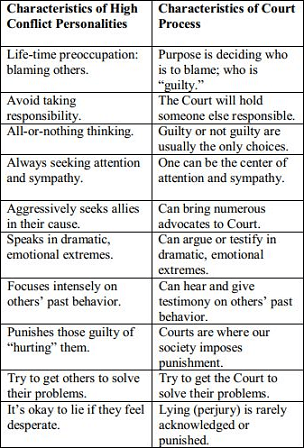
High-conflict people are driven by a lust to punish—any slight is a provocation to go to war—and their craving for attention can be boundless. Judicial process rewards both.

This table, prepared by attorneys Beth E. Maultsby and Kathryn Flowers Samler for the 2013 State Bar of Texas Annual Advanced Family Law Course, shows how high-conflict people and court process are an exquisitely infernal fit. Its authors’ characterization of high-conflict people’s willingness to lie (“if they feel desperate”) is generous. Many lie both on impulse or reflex and with deliberate cunning, though their chain of reasoning may be utterly bizarre.

Restraining orders are easily obtained, particularly by histrionic women. Once petitioners—especially high-conflict petitioners—realize how readily the state’s prepared to credit any evil nonsense they sputter or spew, and once they realize, too, the social hay they can make out of reporting to others that they “had to get a restraining order” (a five-minute affair), they can become accusation junkies.

Larry has responded in the most reasonable way he can to his situation. He’s voiced his outrage and continues to in a blog, and the vehemence of his criticisms might lead some who don’t know Larry to dismiss him as a crank. If you consulted his blog, you’d see it’s fairly rawboned and hardly suggests the craftsmanship of a technical wizard who can hack email accounts and remotely eavesdrop on telephone conversations. What the commentaries there suggest, rather, is the moral umbrage of an intelligent man who’s been acutely, even traumatically sensitized to injustice.

Here’s the diabolical beauty of our restraining order process. Judges accept allegations of abuse at face value and don’t scruple about incising them on the public records of those accused. They furthermore expect those who are defamed to pacifically tolerate public allegations that may have no relationship with reality whatever or may be the opposite of the truth, may be scandalous, and may destroy them socially, professionally, and psychologically. Judges, besides, make the accused vulnerable to any further allegations their accusers may hanker to concoct, which can land them in jail and give them criminal records. And finally judges react with disgust and contempt when the accused ventilate anger, which they may even be punished for doing.

Judicial reasoning apparently runs something like this: If you’re angry about false allegations, then they weren’t false; if you’re not angry about false allegations, then they weren’t false.

Larry’s been jailed, Larry’s been reported to the police a dozen times or more, an officer has rested the laser sight of her sidearm on him through the window of his residence, and the number of times he’s been summoned to court is closing on 30.

The allegations against him have been false. How angry should he be?

Copyright © 2014 RestrainingOrderAbuse.com

How Men Lie on Restraining Orders: A Tutorial for Feminists

The topic of this discussion is vicious men—not real men but the kind who’d make false allegations against a woman and ruin her for self-gratification or -gain.

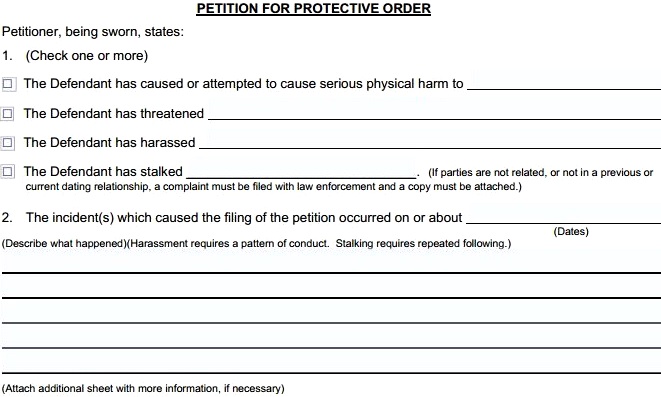
Below is an excerpt from a standard restraining order form. Apply your imagination and consider how a man might exploit the opportunity it affords to trash a woman’s life. I’ll guide you. See the tick boxes and blanks? What he’d do is flick the cap off his Bic and write lies in the spaces provided. It only takes a few minutes.

A false complainant might allege, for example, that his girlfriend stalked him, coerced him into having sex, threatened to kill him, beat his daughter or made her smoke crack, etc. His motive might be revenge, or his motive might be to deflect blame from himself for actually engaging in the same or worse activities. Restraining order petitioners may be the real offenders, and the courts graciously provide them with the chance to compound their victims’ torment and walk away scot free. The first one up the courthouse steps is the “good guy.”

Besides a pen and a few minutes to kill, the only requisite for upending a woman’s life this way is a malicious will. For men to apply for false restraining orders against women is usually free (that is, the cost is covered by the taxpayer), as the Violence Against Women Act (VAWA) mandates it be.

All there is to making allegations on restraining orders is tick boxes and blanks, and there are no bounds imposed upon what allegations can be made. A false applicant merely writes whatever he wants in the spaces provided—and he can use additional pages if he’s feeling inspired. The basis for a woman’s being alleged to be a domestic abuser or even “armed and dangerous” is the unsubstantiated say-so of the petitioner. Can the defendant be a vegetarian single mom or an arthritic, 80-year-old great-grandmother? Sure. The judge who rules on the application won’t have met her and may never even learn what she looks like. She’s just a name.

The worst that happens is a fraudulently accused woman appears for a hearing after a week or two of sleepless nights (possibly spent living out of her car) and manages to persuade a judge that she’s not a stalker, child-beater, or whatever. Although even this won’t ensure the judge finds in her favor and dismisses the order, let’s say the judge does dismiss the order.

The false accuser is subject to no sanctions from the court and is at no risk of prosecution from the state, and it isn’t guaranteed that the dismissed restraining order will be expunged from the woman’s public record, which may be the public record of a kindergarten teacher, a therapist, or a police officer (even dismissed orders are stigmatizing and cost people jobs).

The man’s just out a little time and may still have cause to smirk.

And, anyway, he can always file for another restraining order later on. There’s no statutory ceiling on how many times he’s authorized by the state to do this. The sky’s the limit. He could even reapply for multiple restraining orders from different jurisdictions to up the fun.

High-conflict litigants can consume years of their targets’ lives like this. Between rounds of false allegations, their targets may languish in a personal hell, unable to reconcile themselves to betrayals and lies, unable to work in chosen professions because unable to rinse those lies from their public faces, and never knowing what to expect next or when. Whatever familial and social infrastructures depend on them may obviously crumble, besides.

How men lie on restraining orders and make wrecks of women’s lives—and how easily—should be clearer now.

How women lie on restraining orders and make wrecks of men’s and other women’s lives is exactly the same way.

Copyright © 2014 RestrainingOrderAbuse.com

A Legislated License to Lie: Nothing CAN’T Be Falsely Alleged on a Restraining Order

OK

Battery, rape, child molestation—any heinous allegation imaginable can be made in a petition for a restraining order, and it can be made falsely without consequence to the accuser.

Victims of false allegations often ask incredulously, “Can somebody say that?”

There’s nothing that can’t be alleged to the courts (or, for that matter, to the police). There’s no such thing as “can’t allege.” A judge might view allegations of genocide or conspiracy with aliens to achieve global domination as suspect—or s/he might not. Certainly there’s nothing to stop a restraining order applicant from making these allegations, and there’s nothing to stop a judge from crediting them. Neither accusers nor judges are answerable to a literal burden of proof.

As the infamous David Letterman case shows, even the most outlandish allegations easily duck judicial radar. For anyone unfamiliar with the case, here’s Massachusetts attorney Gregory Hession’s synopsis and commentary (quoted from “Restraining Orders Out of Control”):

One day in December of 2005, Colleen Nestler came to Santa Fe County District Court in New Mexico with a bizarre seven-page typed statement and requested a domestic-abuse restraining order against late-night TV host David Letterman.

She stated, under oath, that Letterman seriously abused her by causing her bankruptcy, mental cruelty, and sleep deprivation since 1994. Nestler also alleged that he sent her secret signals “in code words” through his television program for many years and that he “responded to my thoughts of love” by expressing that he wanted to marry her.

Judge Daniel Sanchez issued a restraining order against Letterman based on those allegations. By doing so, it put Letterman on a national list of domestic abusers, gave him a criminal record, took away several of his constitutionally protected rights, and subjected him to criminal prosecution if he contacted Nestler directly or indirectly, or possessed a firearm.

Letterman had never met Colleen Nestler, and this all happened without his knowledge. Nonetheless, she requested that the order include an injunction requiring him not to “think of me, and release me from his mental harassment and hammering.” Asked to explain why he had issued a restraining order on the basis of such an unusual complaint, Judge Sanchez answered that Nestler had filled out the restraining-order request form correctly. After much national ridicule, the judge finally dismissed the order against Letterman. Those who don’t have a TV program and deep pockets are rarely so fortunate.

If allegations like these don’t trip any alarms, consider how much easier putting across plausible allegations is, plausible allegations that may be egregiously false and may include battery, rape, child molestation, or the commission of any other felony crimes.

What recent posts to this blog have endeavored to expose is that false allegations on restraining orders are very effective, because the “standard of evidence” applied to restraining order allegations both tolerates and rewards lying. The only thing that keeps false allegations reasonably in check is the fear that malicious litigants may have of their lies’ being detected. Normal people at least understand that lying is “bad” and that you don’t want to get caught doing it.

To some degree at least, this understanding restricts all but the mentally ill, who may be delusional, and high-conflict litigants, who may have personality disorders and have no conscience, or whose thinking, like that of personality-disordered people’s, is overruled by intense emotions, self-identification as victims, and an urgent will to blame. Normal people may lie cunningly or viciously; high-conflict people may lie cunningly, viciously, compulsively, outrageously, and constantly.

The fear of getting caught in a lie is in fact baseless, because perjury (lying to the court) is prosecuted so rarely as to qualify as never. Most false litigants, however, don’t know that, so their lies are seldom as extravagant as they could be.

Often, though, their lies are extravagant enough to unhinge or trash the lives of those they’ve accused.

Appreciate that false allegations on restraining orders of battery, rape, child molestation, or their like don’t have to be proved. Restraining orders aren’t criminal prosecutions. Allegations just have to persuade a judge that the defendant is a sick puppy who should be kenneled. An allegation of battery, rape, or child molestation is just a contributing influence—except to the people who have to bear its stigma.

More typical than utterly heinous lies are devious misrepresentations. Accusations of stalking and untoward contact or conduct, which may simply be implied, are a common variety. The alleged use merely of cruel language may be very effective by itself. Consider how prejudicial a female plaintiff’s accusing someone (male or female) of forever calling her a “worthless bitch” could be. Substantiation isn’t necessary. Restraining order judges are already vigilantly poised to whiff danger and foul misconduct everywhere. In processes that are concluded in minutes, false or malicious accusers just have to toss judges a few red herrings.

Irrespective of the severity of allegations, the consequences to the fraudulently accused are the same: impediment to or loss of employment and employability, humiliation, distrust, gnawing outrage, depression, and despondency, along with possibly being menacingly barred access to home, children, property, and financial resource. This is all besides being forced to live under the ever-looming threat of further state interference, including arrest and incarceration, should additional false allegations be brought forth.

Even if no further allegations are made, restraining orders, which are public records accessible by anyone, are recorded in the databases of state and federal police…indefinitely.

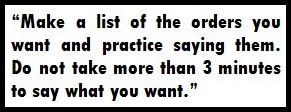
This “advice,” which urges restraining order applicants to rehearse, comes from the California court system and is offered on a page titled, “Ask for a Restraining Order.” The page’s title is not only invitational but can be read as an order itself: Do it. Note, also, that finalization of a restraining order may be based on less than “3 minutes” of testimony and that the court prefers it to be.

Recourses available to the falsely accused are few, and even lawsuits that allege abuse of process may face hurdles like claim preclusion (res judicata), which prohibits previously adjudicated facts from being reexamined. Never mind that the prior rulings may have been formulated in mere minutes based on fantasy and/or cooked allegations. Victims of defamation, fraud on the police and courts, and intentional infliction of emotional distress may moreover face stony indifference from judges, even if their lives have been entirely dismantled. And it should be stressed that attempting to rectify and purge their records of fraudulent allegations, which are established in minutes, can consume years of falsely accused defendants’ lives.

Recognizing that there are no bounds placed upon what false accusers may claim and that there are no consequences to false accusers for lying, the wonder is that more victims of lies aren’t alleged to be “batterers,” “rapists,” and “child molesters.”

Copyright © 2014 RestrainingOrderAbuse.com

Rethinking “Stalking”: When Sociopathic Stalkers Apply for Restraining Orders

“Stalking acts are engaged in by a perpetrator for different reasons: to initiate a relationship (i.e., Some call it stalking; [he or] she calls it courtship); to persuade/coerce a former partner to reconcile; to punish, frighten, or control the victim; to feel a sense of personal power; to feel a ‘connection’ to the victim; or some combination of all of the above. Stalking is a form of abuse, and most abusers ultimately want control over their victims. Therefore, stalking is about controlling a love object, a hate object, or a love/hate object. Both love and hate can inspire obsession.

“Abusive personalities and stalkers often lack or have selective empathy for their victims. In fact, a characteristic of stalking is that the stalker objectifies [his or] her victim. If you don’t see your victim as another human being with feelings, needs, and rights, it becomes very easy to perpetrate any number of cruel, crazy, malicious, spiteful, and sick behaviors upon him or her. What about stalkers who believe they’re in love with their victims? Again, this is about possession and control; not love. They want to possess and control you regardless of what you want.”

Dr. Tara J. Palmatier, Psy.D.

Laws tend to define stalking as the exhibition of unwanted behaviors that alarm people.

What a broader yet nuanced definition of stalking like Dr. Palmatier’s reveals is that what makes someone a stalker isn’t how his or her target perceives him or her; it’s how s/he perceives his or her target: as an object (what stalking literally means is the stealthy pursuit of prey—that is, food).

Who perceives others as objects? The sociopath. Mention sociopath and restraining order in the same context, and the assumption will be that the victim of a coldblooded abuser will have sought the court’s protection from him or her.

The opposite, however, may as easily be the case.

Appreciate that stalking is about coercion, punishment, domination, and control of a target who’s viewed as an object, and it’s easy to see why the stalker in a relationship might be the petitioner of a restraining order, an instrument of coercion, punishment, domination, and control.

(“[T]o feel a sense of personal power,” furthermore, is a recognized reward motive for the commission of fraud. Pulling one over on other people, particularly those in authority, feels gooood.)

Appreciate, also, that a stalker’s motives for “courtship” (i.e., what s/he stands to gain from a relationship) may not be recognized by his or her target as abnormal at all. Nor, of course, will they be understood as abnormal by the stalker. What this means is, stalking isn’t always recognized as stalking (predator behavior), and correspondingly isn’t always repelled.

The Psychology of Stalking: Clinical and Forensic Perspectives notes that the majority of stalkers manifest Cluster B personality disorders, which I’ve talked about in the previous two posts, citing various authorities. People like this—borderlines, antisocials, narcissists, and histrionics—often pass as normal (“neurotypical”). They’re around us all the time…and invisible. Dr. Palmatier, a psychologist from whose writings the epigraph is drawn, has posited that Cluster B personality disorders “form a continuum” and “stem from sociopathy,” a trait of which is viewing others as objects, not subjects. Not only may others be unconscious of personality-disordered people’s motives; such people may be unconscious of their motives themselves.

(Out of respect for the author of the epigraph, I should note that my application of the word stalker in the context of this post departs from hers. The position of this post is that the person who pursues an objectified target and then displaces blame for aberrant behavior onto that target to “punish, frighten, or control” him or her is no less a stalker than the person who relentlessly seeks to possess his or her target. The topic of Dr. Palmatier’s exposition is attachment pathology of the latter sort.)

Contrary to the popular conception that stalkers are wallflower weirdos who obsessively trail dream lovers from a distance with the aid of telescopic lenses, stalkers may be socially aggressive and alluring—or at least sympathetic—and may exhibit no saliently weird qualities whatever.

Returning to Dr. Palmatier’s definition of stalking, what makes someone a stalker isn’t how s/he acts, per se, it’s why she acts the way s/he does. What makes an act an act of stalking is the motive of that act (the impulse behind it), which isn’t necessarily evident to a stalker’s quarry.

Placed in proper perspective, then, not all acts of stalkers are rejected or alarming, because their targets don’t perceive their motives as deviant or predatory. The overtures of stalkers, interpreted as normal courtship behaviors, may be invited or even welcomed by the unsuspecting.

The author of the blog Dating a Sociopath astutely limns the course of a relationship with a stalker (someone who views the other as a means, not an end with “feelings, needs, and rights”).

The sociopath wears a mask. But [s/he] will only wear that mask for as long as it is getting him [or her] what [s/he] wants. The sociopath is not emotionally connected, to you or anybody else. Whilst the sociopath might show connection, this would only be a disguise, to serve his [or her] own needs.

When the sociopath realises that [s/he] can have better supply elsewhere, or if [s/he] feels that supply with you is coming to an end, [s/he] will leave you without warning. The sociopath would have sourced a new victim for supply, but this would have been done behind your back and without your knowledge.

To do so, it is likely that the sociopath needed to play victim to the new source. Often [s/he] would have made complaints about you to gain sympathy and win support. Again, this will be something that you have absolutely no knowledge of, until later.

Consider her conclusion that a sociopath may “play victim” to acquire new narcissistic supply, and you’ll perceive how perfectly lies to the police and/or the courts (donning a new mask) may assist him or her in realizing his or her pathological wishes.

The blog post from which this quoted material is drawn concerns being abruptly discarded by a sociopath, which the writer notes may leave the sociopath’s quarry feeling:

  • Confused
  • Bewildered
  • Lost
  • Desperate for answers
  • A longing and neediness to understand
  • Wanting back the honeymoon stage
  • Unsure if the relationship is actually over or not?
  • Self-blame
  • Manipulated, conned, and deceived

Expressions of these feelings, whose motives are not those of stalkers but of normal people prompted by a need to understand the inexplicable, may take the form of telephone calls, emails, or attempts at direct confrontation—all of which lend themselves exquisitely to misrepresentation by stalkers as the behaviors of stalkers.

The personality-disordered answer primal urges, and among those urges is the will to blame others when their bizarre expectations aren’t satisfied—and they inevitably aren’t—or when others express natural expectations of their own that defy disordered personalities’ fantasized versions of how things are supposed to go.

The author of this blog, a formerly private man who had a restraining order petitioned against him characterizing him as a stalker (and who has been back to court three times since to respond to the same allegation, the least of several), has been monitored for eight years by a stranger he naïvely responded to whom he found standing outside of his house one day as he went to climb into his car.

I was a practicing writer for kids.

The first correspondent I had when I began this blog three years ago was a woman who’d been pursued and discarded by a pathological narcissist, who subsequently obtained a restraining order against her (by fraud), representing her as a stalker (cf. Dr. Palmatier’s “Presto, Change-o, DARVO: Deny, Attack, and Reverse Victim and Offender”).

She taught music to kids.

Last fall, I exchanged numerous emails with a woman who’d fallen for a man with borderline personality disorder, who abused her, including violently, then did the same thing after she sought a restraining order against him, which was denied.

She was a nurse who had three kids.

You’ll note that those labeled “stalkers” by the state in these cases—and they’re hardly exceptions—confound the popular stalker profile that’s promoted by restraining order advocates.

An irony of this already twisted business is that injuries done to people by their being misrepresented to the authorities and the courts by disordered personalities as stalkers ignite in them the need to clear their names, on which their livelihoods may depend (never mind their sanity); and their determination, which for obvious reasons may be obsessive, seemingly corroborates stalkers’ false allegations of stalking.

This in turn further feeds into the imperative of personality-disordered stalkers to divert blame from themselves and exert it on their targets. People like this fatten on drama and conflict, and legal abuses gratify their appetites like no other source, both because the residue of legal abuses never evaporates and because those abuses can be refreshed or repeated, setting off further chain reactions ad infinitum.

The agents of processes that were conceived to arrest social parasitism and check the conduct of stalkers are no less susceptible to believing the false faces and frauds of predatory people than their victims are.

Copyright © 2014 RestrainingOrderAbuse.com

Blame, No Shame: Restraining Order Abuse by High-Conflict, Personality-Disordered Plaintiffs

“Court is perfectly suited to the fantasies of someone with a personality disorder: There is an all-powerful person (the judge) who will punish or control the other [person]. The focus of the court process is perceived as fixing blame—and many with personality disorders are experts at blame. There is a professional ally who will champion their cause (their attorney—or if no attorney, the judge) […]. Generally, those with personality disorders are highly skilled at—and invested in—the adversarial process.

“Those with personality disorders often have an intensity that convinces inexperienced professionals—counselors and attorneys—that what they say is true. Their charm, desperation, and drive can reach a high level in this very emotional bonding process with the professional. Yet this intensity is a characteristic of a personality disorder, and is completely independent from the accuracy of their claims.”

—William (Bill) Eddy (1999)

Contemplating these statements by therapist, attorney, and mediator Bill Eddy should make it clear how perfectly the disordered personality and the restraining order click. Realization of the high-conflict person’s fantasies of punishment and control is accomplished as easily as making some false or histrionically hyped allegations in a few-minute interview with a judge.

Contemplating these statements should also make clear the all-but-impossible task that counteracting the fraudulent allegations of high-conflict people can pose, both because disordered personalities lie without compunction and because they’re intensely invested in domination, blaming, and punishment.

Lying may be justified in their eyes—possibly to bring a reconciliation. (This can be quite convoluted, like the former wife who alleged child sexual abuse so that her ex-husband’s new wife would divorce him and he would return to her—or so she seemed to believe.) Or lying may be justified as a punishment in their eyes.

As Mr. Eddy explains in a related article (2008):

Courts rely heavily on “he said, she said” declarations, signed “under penalty of perjury.” However, a computer search of family law cases published by the appellate courts shows only one appellate case in California involving a penalty for perjury: People v. Berry (1991) 230 Cal. App. 3d 1449. The penalty? Probation.

Perjury is a criminal offense, punishable by fine or jail time, but it must be prosecuted by the District Attorney, who does not have the time. [J]udges have the ability to sanction (fine) parties but no time to truly determine that one party is lying. Instead, they may assume both parties are lying or just weigh their credibility. With no specific consequence, the risks of lying are low.

High-conflict fraudsters, in other words, get away with murder—or at least character assassination (victims of which eat themselves alive). Lying is a compulsion of personality disorders and is typical of high-conflict disordered personalities: borderlines, antisocials, narcissists, and histrionics.

When my own life was derailed eight years ago, I’d never heard the phrase personality disorder. Five years later, when I started this blog, I still hadn’t. My interest wasn’t in comprehension; it was to recover my sanity and cheer so I could return to doing what was dear to me. I’m sure most victims are led to do the same and never begin to comprehend the motives of high-conflict abusers.

slanderI’ve read Freud, Lacan, and some other abstruse psychology texts, because I was trained as a literary analyst, and psychological theories are sometimes used by textual critics as interpretive prisms. None of these equipped me, though, to understand the kind of person who would wantonly lie to police officers and judges, enlist others in smear campaigns, and/or otherwise engage in dedicatedly vicious misconduct.

What my collegiate training did provide me with, though, is a faculty for discerning patterns and themes, and it has detected patterns and themes that have been the topics of much of the grudging writing I’ve done in this blog.

Absorbing the explications of psychologists and dispute mediators after having absorbed the stories of many victims of abuse of court process, I’ve repeatedly noticed that the two sources mutually corroborate each other.

Not long ago, I approached the topic of what I called “group-bullying,” because it’s something I’ve been subject to and because many others had reported to me (and continue to report) being subject to the same: sniping by multiple parties, conspiratorial harassment, derision on social media, false reports to employers and rumor-milling, fantastical protestations of fear and apprehension, etc.

The other day, I encountered the word mobbing applied by a psychologist to the same behavior, a word that says the same thing much more crisply.

Quoting Dr. Tara Palmatier (see also the embedded hyperlinks, which I’ve left in):

If you’re reading this, perhaps you’ve been or currently are the Target of Blame of a high-conflict spouse, girlfriend, boyfriend, ex, colleague, boss, or stranger(s). Perhaps you’ve been on the receiving end of mobbing (bullying by a group instigated by one or two ringleaders) and/or a smear campaign or distortion campaign of a high-conflict person who has decided you’re to blame for her or his unhappiness. It’s a horrible position to be in, particularly because high-conflict individuals don’t seem to ever stop their blaming and malicious behaviors.

A perfect correspondence. And what more aptly describes the victim of restraining order abuse than “Target of Blame”?

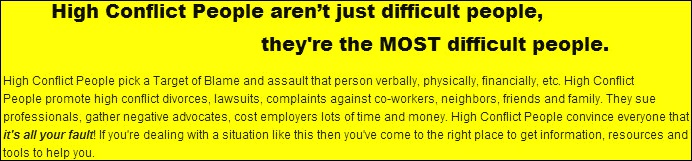
This phrase in turn is found foremost on the website of the High Conflict Institute, founded by Bill Eddy, whom I opened this post by quoting:

high_conflict_yellow

Restraining orders are seldom singled out or fully appreciated for the torture devices they are by those who haven’t been intensively made aware of their unique potential to upturn or trash lives, but the victims who comment on this and other blogs, petitions, and online forums are saying the same things the psychologists and mediators are, and they’re talking about the same perpetrators.

Judges understand blaming. That’s their bailiwick and raison d’être. They may even understand false blaming much better than they let on. What they don’t understand, however, is false blaming as a pathological motive.

Quoting “Strategies and Methods in Mediation and Communication with High Conflict People” by Duncan McLean, which I highlighted in the last post:

Emotionally healthy people base their feelings on facts, whereas people with high conflict personalities tend to bend the facts to fit what they are feeling. This is known as “emotional reasoning.” The facts are not actually true, but they feel true to the individual. The consequence of this is that they exhibit an enduring pattern of blaming others and a need to control and/or manipulate.

There are no more convenient expedients for realizing the compulsions of disordered personalities’ emotional reasoning and will to divert blame from themselves and exert it on others than restraining orders, which assign blame before the targets of that blame even know what hit them.

Returning to the concept of “mobbing” (and citing Dr. Palmatier), consider:

The group victimization of a single target has several goals, including demeaning, discrediting, alienating, excluding, humiliating, scapegoating, isolating and, ultimately, eliminating the targeted individual.

Group victimization can be the product of a frenzied horde. But it can also be accomplished by one pathologically manipulative individual…and a judge.

Copyright © 2014 RestrainingOrderAbuse.com

The Restraining Order Plaintiff from Hell: Malicious Prosecution and the “High-Conflict Person”

“The term ‘high conflict person’ has been popularised relatively recently in legal texts and general discourse to describe those people with certain behavioural clusters who are often observed in legal disputes. This is not meant to suggest that it is a new phenomenon. On the contrary, vexatious individuals and difficult clients are not new to agencies of accountability, lawyers, or mediators, especially those working in highly emotive legal dispute areas such as family law.”

Duncan McLean

Since I’m neither a psychologist nor an attorney, I’m free to say politically incorrect things. Layman’s license authorizes me to clarify, for instance, that the high-conflict people referred to in the epigraph can be monstrous. A clinician might hesitate to call the conduct of high-conflict people sick, and a mediator would reject such labeling as counterproductive to compromise. Nevertheless, that conduct can be extremely sick and far exceed the bounds of words like contrary, vexatious, and difficult.

If you’ve been attacked serially by someone you trusted who’s abused legal process to hurt you, spread false rumors about you, made false allegations against you, and otherwise manipulated others to join in bullying you (possibly over a period spanning years and despite your reasonable attempts to settle the situation), your persecutor is an example of the high-conflict person to whom the epigraph refers, and understanding his or her motives may be of value to your self-protection.

What the author of the monograph from which the quotation above is excerpted means by “behavioral clusters” (switching to the American spelling) is a set of traits and patterns of habitual conduct. High-conflict people, people with personality disorders (or who at least manifest some of their maladaptive traits), are defined by clusters of observable characteristics that guide them to instigate and sustain conflict, including conflict through abuse of legal process. Borderline, antisocial, narcissistic, and histrionic personality disorder (collectively, the “Cluster B disorders”) are defined by such characterological clusters.

Personality disorders are grouped into clusters based on their predominant features, and it is the Cluster B disorders which typically present with high expression of emotions, neuroticism, dramatization, and hostility.

Cluster B disorders are categorised into the following four sub-types:

  1. Borderline Personality – marked by instability of mood and intense anger, self-destructiveness, a poor sense of self, fears of abandonment, and manipulative behaviour.
  2. Antisocial Personality – a disregard for, and violation of, the rights of others and the rules of society; a lack of empathy and remorse; exploitative, reckless, and irresponsible behaviour.
  3. Narcissistic Personality – a pattern of grandiosity, self-love, and a need for admiration; a sense of entitlement and haughty, arrogant attitudes; preoccupation with success, power, brilliance.
  4. Histrionic Personality – pervasive and excessive emotionality and attention-seeking behaviour; shallow or insincere emotions; inappropriately seductive or provocative behaviour; impressionistic and flamboyant speech.

Note that a single individual may possess traits of more than one personality disorder (or may have more than one personality disorder) and that these definitions are not impervious to overlap. “The people diagnosed with these four disorders are known for their frequent and dramatic interpersonal conflicts and crises. Their personality characteristics often bring them into disputes which involve many others to resolve—including the courts” (Cheryl Cohen, Jack Mahler, and Gwen Jones, “Managing High Conflict Personalities in Mediation”).

If a reader of this post takes nothing else away from the epigraph, s/he should at least note Mr. McLean’s remark that high-conflict, personality-disordered people are “often observed in legal disputes,” a remark echoed by the quotation immediately above, which comes from a different source. Although high-conflict personalities are a minority respective to the population as a whole, they’re disproportionately commonplace among complainants to the courts and other “agencies of accountability” (like child protective services and the police, to offer but a couple of examples).

[P]eople with Cluster B personality disorders are more likely to escalate their disputes to satisfy their underlying need for dominance, blame, denial of responsibility and, sometimes, revenge.

High-conflict people, plainly, are your false accusers and vexatious litigants from hell. They’re driven to divert blame from themselves and exert it on others (who may be their victims).

Restraining orders, due to their low evidentiary threshold and ease of procurement, are ideal media for abuse by those with no scruples about lying or manipulating others and a keen interest in exciting drama and mayhem.

Mediators are circumspect in their judgments, because their role is to pacify strife and facilitate bridge-building between disputants. Effectively doing their work depends on possessing an empathic understanding of the motives of high-conflict people, which may also be worthwhile to those who’ve been victimized by them.

Cognitive distortions, thoughts that are based on a false premise, are a significant feature of high conflict personalities’ thinking style. Often as a consequence of disrupted attachment or a dysfunctional or abusive upbringing, sufferers will develop cognitive distortions and defence mechanisms in an attempt to make sense of the world and to make their experiences fit their own emotions.

Emotionally healthy people base their feelings on facts, whereas people with high conflict personalities tend to bend the facts to fit what they are feeling. This is known as “emotional reasoning.” The facts are not actually true, but they feel true to the individual. The consequence of this is that they exhibit an enduring pattern of blaming others and a need to control and/or manipulate.

The mediator’s position is that high-conflict people are in a sense “unconscious” of their lies and manipulations. More accurate might be that such people aren’t self-critical; they rationalize their conduct, which may be much more impulsive than premeditated but is always relentless and nonetheless destructive. Certainly many psychologists are less generous in their estimations of how unaware the personality-disordered are of their deceits and manipulations—as their victims are bound to be.

That notwithstanding, the appearance of monographs like the one I’ve highlighted in this post is a big deal, because our courts and other “agencies of accountability” are pretty much clueless about personalities like the ones on which it focuses attention (as in fact are most victims of such people).

That’s not to say Mr. McLean’s observations are new. His paper, which was published last year, shadows the professional writing of therapist, attorney, and mediator William (Bill) Eddy, who’s been elucidating the challenges posed by people with personality disorders in the court system (particularly family court) for decades. The monograph, moreover, cites Mr. Eddy’s work more than once. More recently, psychologist Tara Palmatier, whose online explications of the behaviors of the personality-disordered also draw on the pioneering observations of Mr. Eddy, has written volubly, accessibly, and explicitly about abuses, including legal abuses, committed by high-conflict people (as have a number of other psychologists who zero in on the narcissist personality). Many, if not most, of Dr. Palmatier’s patients have been the victims of such abuses and/or abusers, and some of their personal accounts (“In His Own Words”) appear on her blog.

Returning to Mr. McLean’s paper (which, again, echoes summations of both Mr. Eddy and Dr. Palmatier):

High conflict behavior…can be broadly described as behaviour which escalates rather than minimises conflict. The individual tends to escalate because they receive some kind of secondary gain from the dispute, but contrarily, they are inclined to blame others whilst perceiving themselves as the victim. The displayed emotion is often disproportionate to the dispute in question, and often there is the presence of poorly regulated emotions in the form of anger, impulsivity, and criticism of others, whilst it is not uncommon to observe controlling and manipulative behaviours.

High-conflict personalities are worse than liars; they’re liars who delude themselves that their lies are justified. They don’t reconsider or back down, and they’re capable of fomenting and sustaining conflict for years, including (especially in the case of narcissists) by gross fraud, smear tactics, and the enlistment of third parties to abet their frauds or participate in bullying their victims.

Because high conflict people tend to distort facts to suit their emotions, they often put a lot of energy into blaming other people for their cognitive distortions. The need to release internal distress results in reality-distorting defence mechanisms, such as projection and denial, which results in [their] failing to recognise their part in conflict. These cognitive distortions (also known as emotional facts) are frequently transferred to other people, which in turn often enables and exacerbates the behaviour.

In his paper, which I urge readers to consult, Mr. McLean includes actual transcript excerpts from cases heard in court that are both enlightening and impressive, and should encourage anyone in a legal clash with a high-conflict person who’s capable of obtaining the aid and representation of a mediator to consider it.

It’s deplorably the case that “rapport-building” is never an option in the drive-thru arena that is the restraining order process.

Examination of Mr. McLean’s professional insights into the specific personality disorders underscores how vexed resolving legal conflicts in this arena may be. He notes, for instance, that exposing a narcissist’s misconduct by confronting him or her with that misconduct or making him or her “look bad” will only fan the flames. He’s no doubt right, but in hearings that last mere minutes, painstaking assuagement of a narcissist’s ego isn’t practicable. Similarly he observes that among histrionics, “[e]xaggerated emotions and phoniness may be common initially.”

In a court process that’s concluded almost as soon as it’s begun, like a restraining order hearing, exaggerations and phoniness can’t be exposed through methodical cross-examination. The severity of a plaintiff’s allegations of apprehension may in fact excuse him or her from attending a hearing, altogether scotching the opportunity to expose his or her falsehoods by questioning.

Emphatically noteworthy, then, is the virtual absence from any but very lengthy and deliberate trials that are influenced by expertise like Mr. McLean’s of any chance to prosecute a capable defense against the frauds of high-conflict people.

Copyright © 2014 RestrainingOrderAbuse.com