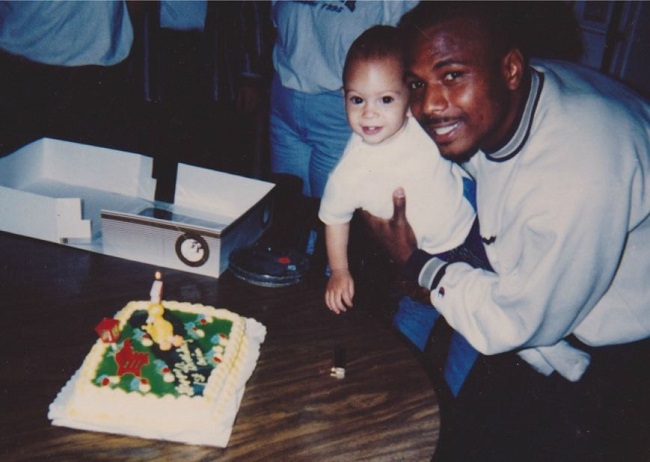
“Asia’s Law”: A Bereaved Father’s Proposal to End Parental Alienation

“Parental Alienation is an act of child abuse, and an attempt by one parent to sever [a] child’s ties with the other parent.”

Steven Foxworth, DaddysHeart.com

Steven Foxworth had a beautiful daughter, a beautiful daughter whose life he had been excluded from for 12 years, and a beautiful daughter he will never see again.

Nor will anyone else.

Asia Danielle was killed in a car accident in 2011 at the age of 16, and Mr. Foxworth didn’t learn of his daughter’s death until eight months later. Even if he had chanced to see the headline of his daughter’s obituary, published in another state, he may not have recognized it as hers, because his daughter’s name had been changed, which is why his attempts to find her over the years proved fruitless.

Asia Danielle Foxworth a.k.a. Danielle Westbrook was tragically killed in a car accident in 2011. Her father, Steven Foxworth, was informed of his daughter’s death by a mailed notice asserting that he had no entitlement to her estate. Mr. Foxworth was unlawfully denied any contact with his daughter for 12 years and wasn’t told her name had been changed.

For most of her brief life, the girl Mr. Foxworth had known as Asia Danielle Foxworth was Danielle (“Danni”) Westbrook.

After Mr. Foxworth separated from Asia’s mother in 1998, he was “threatened to stay away from his own child’s daycare that he enrolled her in.” Mr. Foxworth petitioned the court and succeeded in having his parental rights acknowledged “concerning phone/standard physical visitation, and full access to all pertinent info, i.e., school and medical records,” but Asia’s mother, Rusty Dawn Skipper, was granted full custody, and she moved to North Carolina and, according to Mr. Foxworth, declined to observe the court’s order that Asia be brought to Georgia for visitation with her father. She furthermore provided Mr. Foxworth no contact information and in 2000 changed Asia’s surname to Westbrook, that of her then fiancé, without Mr. Foxworth’s consent.

Though he paid child support, never knowing if it reached its intended recipient, the only communication Mr. Foxworth received from Asia’s mother concerning his daughter in 12 years was a legal notice, sent after his daughter’s death, apprising him that he had no claim to her estate.

That’s how the mother of his daughter informed Mr. Foxworth that his daughter was gone.

Mr. Foxworth reports that even seven months after Asia was killed, her maternal grandparents represented her as living when he contacted them, which he had faithfully done for years, even annually singing “Happy Birthday” on their answering machine, hoping the song would be shared with his estranged daughter.

Mr. Foxworth’s is a poignant story of a father’s alienation from his child that includes collusion by family members and the state. A more detailed version can be found on Mr. Foxworth’s tribute to Asia, DaddysHeart.com, under the tab “Asia’s Law.”

“Asia’s Law” is Mr. Foxworth’s proposal to stop parental alienation.

“Asia’s Law” will stand on the principle that no one parent has the right to infringe upon the legal parental rights of another parent.

“Asia’s Law” will promote the enforcement of standard child visitation for noncustodial parents as rigorously as child support is enforced for custodial parents. There will be a governmental arm that works with Child Support Enforcement Services that regards court-ordered visitation as seriously as child support arrearage. In the current construct, the message is sent that the value of money to take care of a child is more important than the value of a child’s having the love, affection, and guidance of his or her other parent.

“Asia’s Law” will also make it illegal for a custodial parent to change the name of a minor without the other natural parent’s consent—in any state.

Additionally, “Asia’s Law” will mandate that a non-custodial parent give blood (except in cases of religious exemption) so that if a child needs blood for any medical reason, it will be there for him or her.

“Asia’s Law” will save lives—emotionally and physically. We need this law passed to protect families.

My daughter, Asia Danielle Foxworth (“Danielle Westbrook”), is no longer here, but if there had been a law like this in place while she was living, she could not have been kept from me—under the radar for 12 years. Further, her “name change”—save legal adoption (which I would not have consented to)—could never have been permitted. Lastly, if my daughter would have survived her fatal car accident and needed blood, she could have had mine, providing it was stored for her. There are also children who have natural ailments; blood donation from a natural parent could save their lives, even if that other parent lived in another state. Too many are suffering. We need “Asia’s Law” passed. I have my story, but there are countless others. Parental Alienation is an age-old phenomenon and stereotypes typecast parents, especially fathers. The bottom line is no child should be kept from a loving parent—illegally and/or out of spite. If through “Asia’s Law” families are reunited, the rights of noncustodial parents respected, and lives saved, my daughter’s transition will not have been in vain.

~Steven Foxworth

Copyright © 2015 RestrainingOrderAbuse.com

*Compare Mr. Foxworth’s story of parental alienation to that of estranged father Neil Shelton: “The ‘Nightmare’ Neil Shelton Has Lived for Three Years and Is Still Living: A Father’s Story of Restraining Order Abuse.” Attention to Steven Foxworth’s story was brought to the author of this blog by the Georgia-based Kayden Jayce Foundation, a nonprofit devoted to remedying parental alienation and legal abuse.

A Victory for Free Speech: Matthew Chan Prevails in His First Amendment Appeal of a Lifetime Restraining Order

Several posts on this blog in the past year have concerned the case of Matthew Chan, a Georgia entrepreneur who blogs and administers a forum for victims of “copyright extortion” (i.e., people who’ve been threatened with lawsuits for unsanctioned use of a copyright holder’s original material and may be intimidated into paying thousands to avoid being taken to court—this for posting a photo online, for example, or using a snippet of text without proper acknowledgment or without having paid a fee or otherwise obtained the author’s consent).

Matthew S. Chan

The blog has also featured a guest post by Mr. Chan.

This post reports that the Georgia Supreme Court returned a virtually unanimous ruling in his favor Friday, after many months of deliberation, that lifted a lifetime protection order prohibiting Mr. Chan from criticizing a woman he characterized as a “copyright troll.”

The basis of Mr. Chan’s appeal, prosecuted by New York attorney Oscar Michelen, was that the trial court that issued the order misconstrued and misapplied the law. Forcing a procrustean interpretation onto the facts, it determined Mr. Chan had harassed, intimidated, and “stalked” the plaintiff in the case, Linda Ellis. Accordingly, it imposed a “prior restraint” on Mr. Chan’s freedom of expression, barring him indefinitely from writing about her.

First Amendment authorities, Profs. Eugene Volokh and Aaron Caplan, submitted an amicus brief to the court in Mr. Chan’s favor, arguing that the First Amendment—with some exceptions—authorizes speech about a person, even if that speech isn’t polite or flattering.

Justice Keith Blackwell, writing for the Georgia Supreme Court, summarized the case in the court’s March 27 ruling:

Matthew Chan has a website on which he and others publish commentary critical of copyright enforcement practices that they consider predatory. Linda Ellis is a poet, and her efforts to enforce the copyright in her poetry have drawn the ire of Chan and his fellow commentators. On his website, they have published nearly 2,000 posts about Ellis, many of which are mean-spirited, some of which are distasteful and crude, and some of which publicize information about Ellis that she would prefer not to be so public. […] It is undisputed that Chan never caused any of these posts to be delivered to Ellis or otherwise brought to her attention. But it also is undisputed that Chan anticipated that Ellis might see the commentary on his website, and he may have even intended that she see certain of the posts, including the open letter to her.

Ellis eventually did learn of the posts, and she sued Chan for injunctive relief under the Georgia stalking law, OCGA § 16-5-90 et seq., alleging that the electronic publication of the posts was a violation of OCGA § 16-5-90 (a) (1), which forbids one to “contact” another for certain purposes without the consent of the other. Following an evidentiary hearing, the trial court agreed that the electronic publication of posts about Ellis amounted to stalking, and it entered a permanent injunction against Chan, directing him to, among other things, delete “all posts relating to Ms. Ellis” from his website. Chan appeals, contending that the evidence simply does not show that the publication of posts about Ellis on his website amounts to the sort of “contact” that is forbidden by OCGA § 16-5-90 (a) (1). With that contention, we agree, and we reverse the judgment of the trial court.

New York entertainment and intellectual property attorney Oscar Michelen, who represented Matthew Chan before the Georgia Supreme Court

To summarize the summary, Mr. Chan and members of his forum ventilated outrage toward what they perceived as legal terrorism (letters from Ms. Ellis’s attorney threatening civil prosecution for “copyright infringement” and reportedly offering to settle out of court for $7,500), and Ms. Ellis successfully represented the online remarks to the trial judge as tantamount to “stalking.” The statute, however, requires that an alleged “stalker” have actually contacted the “victim,” and no such contact was ever made.

For purposes of the statute, one “contacts another person” when he “communicates with another person” through any medium, including an electronic medium. See OCGA § 16-5-90 (a) (1).4 See also Johnson v. State, 264 Ga. 590, 591 (1) (449 SE2d 94) (1994) (as used in OCGA § 16-5-90, “[t]o ‘contact’ is readily understood by people of ordinary intelligence as meaning ‘to get in touch with; communicate with” (citation and punctuation omitted)). Although one may “contact” another for the purposes of the statute by communicating with the other person through any medium, it nevertheless is essential that the communication be directed specifically to that other person, as opposed to a communication that is only directed generally to the public.

There was no contact to satisfy the statutory definition of stalking.

Similarly, allegations of harassment and intimidation were deemed insufficient in the Georgia Supreme Court’s ruling, because no contact had been made with the plaintiff, so no contact had been made against her wishes.

The evidence shows that Ellis visited the website herself—it appears, in fact, that she registered herself as an authorized commentator on the website—and that she had others visit the website and report back to her about the commentary published there. Generally speaking, our stalking law forbids speech only to the extent that it is directed to an unwilling listener, and even if Ellis did not like what she heard, she cannot be fairly characterized as an unwilling listener. Ellis failed to prove that Chan “contacted” her without her consent, and the trial court erred when it concluded that Chan had stalked Ellis. See OCGA § 16-5-90 (a)(1).

Other commenters on this blog, who hadn’t the wherewithal to appeal their cases to the high courts, report having had similar judgments entered against them, typically subsequent to an earlier restraining order. This blog’s author is among them. He was issued a restraining order based on false claims in 2006 and was sued for libel and harassment fully seven years later by its petitioner, who had since moved to another state, after he criticized her publicly, this despite his having had no contact with the woman in the intervening period. The court imposed a lifetime restraining order upon him barring him from exposing the woman (a professional scientist) in anything he publishes.

Mr. Chan’s case highlights that lower-tier judges, presiding over abbreviated procedures spanning mere minutes and according to their personal lights, arbitrarily exercise the broad latitude they’ve been granted by lawmakers. It’s the rare restraining order case like Mr. Chan’s, one that ascends through the courts, that exposes the degree to which bottom-rung judges do what they want without regard to the letter of the law.

Mr. Chan’s victory is shared by all of those who’ve been wronged by the court—and if I know my friend Matthew, his advocacy is going to be all the louder for it.

Copyright © 2015 RestrainingOrderAbuse.com