Rape and Restraining Order Fraud: On How Men Betray Women, How Women Betray Men, and How the Courts and the Feminist Establishment Betray Them Both

I had an exceptional encounter with an exceptional woman this week who was raped as a child (by a child) and later violently raped as a young adult, and whose assailants were never held accountable for their actions. It’s her firm conviction—and one supported by her own experiences and those of women she’s counseled—that allegations of rape and violence in criminal court can too easily be dismissed when, for example, a woman has voluntarily entered a man’s living quarters and an expectation of consent to intercourse has been aroused.

Her perception of judicial bias against criminal plaintiffs is one shared by many and not without cause.

By contrast, I’ve heard from hundreds of people (of both genders) who’ve been violated by false accusers in civil court and who know that frauds are readily and indifferently accepted by judges. (Correspondingly, more than one female victim of civil restraining order abuse has characterized her treatment in court and by the courts as “rape.”)

Their perception of judicial bias against civil defendants is equally validated.

Lapses by the courts have piqued the outrage of victims of both genders against the opposite gender, because most victims of rape are female, and most victims of false allegations are male.

The failures of the court in the prosecution of crimes against women, which arouse feminist ire like nothing else, are largely responsible for the potency of restraining order laws, which are the product of dogged feminist politicking, and which are easily abused to do malice (or psychological “rape”).

In ruminating on sexual politics and the justice system, I’m inexorably reminded of the title of a book by psychologist R. D. Laing that I read years ago: Knots.

In the first title I conceived for this piece, I used the phrase “can’t see eye to eye.” The fact is these issues are so incendiary and prejudicial that no one can see clearly period. Everyone just sees red.

Under the Violence Against Women Act (VAWA), federal funds are doled out to police precincts and courts in the form of grants purportedly intended to educate police officers and judges and sensitize them to violations against women, which may have the positive effect of ensuring that more female victims of violent crimes see justice but simultaneously ensures that standards applied to the issuance of civil restraining orders slacken still further, allowing casual abuse of a free process to run rampant and destroy lives. The victim toll of false restraining orders negates strides made toward achieving justice for female victims in criminal prosecutions. What is more, though restraining orders are four times more often applied for by women than men, making women their predominant abusers, the laxity of restraining order administration allows women to be violated by men, too.

Not only was a woman I’ve recently been in correspondence with repeatedly assaulted by her short-term boyfriend, a charming and very cunning guy; he also succeeded in petitioning a false restraining order against her, alleging, among other things, violence. She had even applied for a restraining order against him first, which was dismissed:

There are no words for how I felt as I walked to my car that afternoon. To experience someone I had cared deeply about lying viciously in open court, to have a lawyer infer that I’m a liar, and to be told by a judge that, basically, he didn’t believe me (i.e., again, that I’m a liar), filled me with a despair so intense that I could hardly live with it. You know how, in trauma medicine, doctors will sometimes put grossly brain-injured patients into medically-induced comas so as to facilitate healing? That afternoon, I needed and longed for a medically-induced emotional coma to keep my skull from popping off the top of my head. I don’t know how else to describe it. It was that day that I learned that the justice system is rotten, that the truth doesn’t mean shit, and that to the most depraved liar go the spoils.

As many people who’ve responded to this blog have been, this woman was used and abused then publicly condemned and humiliated to compound the torment. She’s shelled out thousands in legal fees, lost a job, is in therapy to try to maintain her sanity, and is due back in court next week. And she has three kids who depend on her.

The perception that consequences of civil frauds are no big deal is wrong and makes possible the kind of scenario illustrated by this woman’s case: the agony and injury of physical assault being exacerbated by the agony and injury of public shame and humiliation, a psychological assault abetted and intensified by the justice system itself.

The consequences of the haywire circumstance under discussion are that victims multiply, and bureaucrats and those who feed at the bureaucratic trough (or on what spills over the side) thrive. The more victims there are and the more people there are who can be represented as victims, the busier and more prosperous grow courts, the police, attorneys, advocacy groups, therapists, etc.

What’s glaringly absent in all of this is oversight and accountability. Expecting diligence and rigor from any government apparatus is a pipedream. So is expecting people to be honest when they have everything to gain from lying and nothing to lose from getting caught at it, because false allegations to civil courts are never prosecuted.

Expecting that judges will be diligent, rigorous, and fair if failing to do so hazards their job security, and expecting civil plaintiffs to be honest if being caught in a lie means doing a stint in prison for felony perjury—that, at least, is reasonable.

The obstacle is that those who hold political sway object to this change. The feminist establishment, whose concern for women’s welfare is far more dogmatic than conscientious, has a strong handhold and no intention of loosening its grip.

Typically both criminal allegations of assault or rape and civil allegations in restraining order cases (which may be of the same or a similar nature) boil down to he-said-she-said. In criminal cases, the standard of guilt is proof beyond a reasonable doubt, a criterion that may be impossible to establish when one person is saying one thing and the other person another, evidence is uncertain, and there are no witnesses. In civil cases, no proof is necessary. So though feminist outrage is never going to be fully satisfied, for example, with the criminal prosecution of rapists, because some rapists will always get off, feminists can always boast success in the restraining order arena, because the issuance of restraining orders is based on judicial discretion and requires no proof at all; and the courts have been socially, politically, and monetarily influenced to favor female plaintiffs. However thwarted female and feminist interests may be on the criminal front, feminists own the civil front.

And baby hasn’t come a long way only to start checking her rearview mirror for smears on the tarmac now.

Copyright © 2013 RestrainingOrderAbuse.com
What to Do if You’ve Been Abused by a Judge

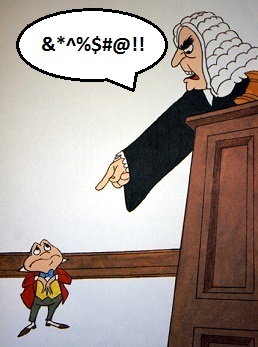
Judicial misbehavior is often complained of by defendants who’ve been abused by the restraining order process. Cited instances include gross dereliction, judge-attorney cronyism, gender bias, open contempt, and warrantless verbal cruelty. Avenues for seeking the censure of a judge who has engaged in negligent or vicious misconduct vary from state to state. In my own state of Arizona, complaints may be filed with the Commission on Judicial Conduct. Similar boards, panels, and tribunals exist in most other states.

Citizens of other countries are encouraged to hunt up the equivalent regulatory bodies in their own provinces or nation-states.

Such commissions won’t retry a case. Complainants looking for fairer treatment or relief from an unjust decision by an independent body of arbiters will be disappointed. These panels will, though, investigate allegations of ethical violations by judges. Those readily responded to are glaring ones: slovenliness, for example, or drunkenness or the use of vulgarities or racial epithets. Misbehaviors like these are indefensible and reflect poorly on the dignity of the courts.

Favorable treatment toward one party or the other (that is, preferentialism or sexual bias), abuse of power, disparagement, and slackness, however, also contravene judicial performance expectations, and they are equally valid reasons for censure. Defendants’ feeling scorned by judges of restraining orders is common and a frequently expressed source of gnawing outrage. Odds are complaints about such treatment will be discounted or even offhandedly dismissed. But complainants cannot be punished for reporting judicial misconduct, and there’s always a chance that a compelling petition may be heeded (especially if the same allegations have been made against a particular judge previously).

There may be value, too, in more abused defendants voicing beefs and thereby arousing awareness among oversight commissions of the breadth and severity of judicial malfeasance, misfeasance, and nonfeasance in the restraining order arena, because it’s complacency, ignorance, and indifference by those empowered to make a difference that preserves the status quo.

Copyright © 2013 RestrainingOrderAbuse.com

Mind the Gender Gap: On Coming Together against Restraining Orders

This blog was “liked” this week by a blogger whose collegiate disciplines are criminology and sociology. In her own blogs, she tracks news of interest to students of these fields that relates especially to social justice and gender-based violence and oppression (phrases that are often mistaken as exclusively concerning the same thing).

Contrasting her blogs’ contents with those of sites that monitor and editorialize on issues of concern to this blog highlights a divide that must be spanned if progress is to be made toward achieving genuine social justice (the word social being inclusive of both sexes). Informed and objectively critical minds like hers—sensitive both to the needs for civil equality and recognition and redress of violence toward women—are out there, and cultivating their advocacy is vital to reforming the defective restraining order process.

I’m a day laborer and would-be children’s humorist who doesn’t even have Internet service at home. The time I’m able and willing to devote to keeping tabs on movements in the blogosphere is scant. But I have perforce become familiar with many of the sites that focus on restraining order injustice, and the preponderance of respondents to most if not all of them are men whose views on this injustice and the issues that orbit it typically derive from one ideological bias or another: post-70’s misandry, the political favoritism shown to women in the West, the courts’ attack on the family, etc.

I don’t challenge the merits of their beefs, which far from lacking legitimacy are very defensible; but these forums leave little room for unification of awareness and purpose among activists and socially conscientious members of the community at large.

The advocacy rift is often crudely genital: boys siding with boys and girls either seeing the boys as villainous, uncompromising, or exclusionary. Men, reared as and genetically engineered to be rule-oriented beings, equate unfair with wrong (plain and simple). Women, pragmatic and historically the holders of the short end of the stick, aren’t immune to the difference between fair and unfair but know the impetus behind the advent of restraining orders to be an urgent and well-grounded one: men are violent.

Men aren’t going to quit being violent if the restraining order process is dissolved, and the process isn’t going to trend toward fairness if it isn’t. Herein lies the rub.

Both sides of this divide are naturally reactionary, and the mediated space—that occupied by those sensitive to both truth-born positions—is narrow and sparsely populated.

It’s a manifest and uncontestable fact that the restraining order process is biased, unconstitutional, and injurious to both men and women who find themselves on its receiving end. It caters to and rewards fraud, and liars come in both sexes. The process’s flaws will only become clear to the mainstream when proponents of one team or the other stop being opponents.

The split in perspective is as much Cartesian as sexual: body vs. mind. Violence can in fact be of either sort, physical or psycho-emotional. Even rape isn’t strictly a physical act. Many violations, equally traumatic and enduringly oppressive, are perpetrated by men and women who never touch their victims. A false allegation of rape, for example, is a rape. The notion that physical violence is necessarily worse is facile and unexamined. Physical violence is loud and dramatic; psychological violence is invisible and insidiously corrosive. Both can be catastrophic. Calumnious lies are just as likely to drive victims to despair or even conceivably suicide, and the pain of these violations is magnified manyfold in the case of false allegations made in restraining order cases, because victims (men, especially) can’t expect social sympathy, as victims of violence may, but quite the opposite: condemnation. (This was the horror that kept a lid on abuses by Catholic priests for so long. Adults molested as boys were constrained from coming forward by fear of further shame, humiliation, and social indictment. Damages finally awarded to these victims weren’t for their being manhandled so much as their being scarred to the extent that they failed to thrive.)

Mob mentality is what sustains the crooked restraining order process; it won’t be what leads to its revision. A problem is that those who speak against it have never been a direct party to it (except in the case of activist attorneys), and those who have been victimized aren’t talking at all, because they’ve been intimidated into silence. Advocates tend to subscribe to one dogma or the other: good/bad, pro/con. Good or bad, useful or not—these are natural but misleading inquiries. The restraining order process is flawed and destructively pernicious, being both subject to and permissive of wanton abuse. To bring this fact and its poignancy across to a political consensus, the partisan gap must be closed. Finger-pointing is fruitless and even erroneous, because the real culprit is a faceless bureaucratic machine that has no oversight.

And it’s going to take a plurality of arms to pull the lever that stills its gears.

Copyright © 2012 RestrainingOrderAbuse.com

Don’t Let a False Restraining Order Crush Your Spirit: Reach Out and Talk Back

Someone writes (in reply to an earlier commenter): “I too am a victim of a false order of protection and have the same judge. My story is an unbelievable loss of rights with no possible outcome of justice. As I am fearful that publicly telling my story would result in retribution from the judge, I must stay quiet until after I can get out of the court system.”

In the year or so that I’ve maintained this blog, it has received thousands of queries from people abused by restraining orders but considerably fewer actual comments from victims. Most of these comments are anonymous, and many victims seeking answers or consolation have instead emailed me to avoid subjecting themselves to further public scrutiny—understandably. They’re wounded, humiliated, and intimidated and have had it impressed upon them by the state that they if they don’t shut up they’ll be locked up (or suffer more permanent privations).

The restraining order process is sustained on shame and fear and perpetuated because of its political value not its social value, which is dubious at best. The agents of its perpetuation, the courts, are very effective at subduing resistance. Defendants are publicly condemned and threatened with police interference and further forfeitures of rights, and are saddled with allegations that make them afraid besides of social recrimination and rejection—even if those allegations are fraudulent. Avenues of relief are narrow and by and large only available to defendants of means, who, if they prevail, are glad to put the ordeal behind them and move on. The rest are put to flight. And so it goes…on.

First Amendment. Amendment to U.S. Constitution guaranteeing basic freedoms of speech, religion, press, and assembly and the right to petition the government for redress of grievances. The various freedoms and rights protected by the First Amendment have been held applicable to the states through the due process clause of the Fourteenth Amendment (Black’s Law Dictionary, sixth ed.).

Due process clause. Two such clauses are found in the U.S. Constitution, one in the [Fifth] Amendment pertaining to the federal government, the other in the [Fourteenth] Amendment which protects persons from state actions. There are two aspects: procedural, in which a person is guaranteed fair procedures and substantive which protects a person’s property from unfair governmental interference or taking. Similar clauses are in most state constitutions. See Due process of law (Black’s Law Dictionary, sixth ed.).

Glaring to anyone who peruses these entries in Black’s Law Dictionary and who’s been put through the restraining order wringer is that the process flouts the very principles on which our legal system was established (when I recall one of the judges in my own case referring to his courtroom as “the last bastion of civilization,” I don’t know whether to laugh or cry). It mocks the guarantee of fair procedures and the protection of a person’s property from unfair governmental interference or seizure—and it does a pretty decent job of convincing defendants that if they complain about it they’ll go from the frying pan into the fire. (For those who don’t have an intimate familiarity with the process, a restraining order case may receive no more than 10 minutes of deliberation from a judge—without ever meeting or hearing from the defendant—and even if appealed, no more than 20 or 30 minutes. That’s minutes. On allegations that often include stalking, battery, or violent threat; that may result in a defendant’s being denied access to home, property, family, and assets, and/or forfeiting his or her job and/or freedom; and that are publicly accessible and may be indefinitely stamped on a defendant’s record. It takes a judge many times longer to digest a meal than a restraining order case.)

If you’re a restraining order defendant, recognize these facts: (1) no matter what truth there is to allegations made against you in a restraining order, your civil rights have been violated by the state (all restraining order defendants are blindsided if not railroaded); (2) the restraining order process’s being constitutionally unsupportable makes it unworthy of respect; and (3) impressions by menacing rhetoric notwithstanding, you have every right to challenge the legitimacy of an unfair procedure (in fact, doing so makes you the last bastion of civilization).

Reject the impulse the process inspires to withdraw and hide. Seek counsel (consult with an attorney—or three—even if you can’t afford to employ one). Get information. Harry court clerks until your questions are answered. Ask others for help in the form of character and witness testimony and affidavits, advice, legwork, or just moral support. Get familiar with a local law library (university librarians, in particular, are very helpful). Request a postponement from the court if you need more time to prepare a defense. File a motion to see a judge if your appeal is normally conducted in writing only. Be assertive. Make the plaintiff work for it.

The restraining order process is a specter that feeds on fear. Switch on the light. Remember that as horrible as the accusations against you may seem or feel to you, they’re not likely to be credited by those who know you—especially if those accusations are completely unfounded. And chances are lawyers you explain them to will yawn rather than wag their fingers at you. They’ve heard it all before and know to take allegations made in restraining orders with a shaker of salt. So don’t hesitate to reach out, particularly if the case against you is trumped up. The last thing you want to do is give it credibility by behaving as though it’s legitimate. Don’t violate a restraining order but do resist its tearing your life apart.

And if one has compromised your life and you’re “out of the court system” as the commenter in the epigraph awaits becoming, recognize that your freedom of speech is sacrosanct. This nation was founded on the blood of men who died to guarantee your right to express yourself.

This travesty, the restraining order process, is a breach of the contract between the state and its citizens, and it endures because defendants feel impotent, helpless, and vulnerable (even after their cases are long concluded). This is how you’re meant to feel, and the effectiveness of this emotional coercion is what ensures that the cogs of the meat grinder stay greased.

Don’t give ’em the satisfaction.

Copyright © 2012 RestrainingOrderAbuse.com

Tic-Tac-Toe: The Vulgar Game of Restraining Orders

I corresponded this year with a woman who was accused of domestic violence by a man against whom the most aggressive act she had made was giving him a friendly hug at a class reunion. This woman was a former city official who walked dogs to raise money for animal shelters and had once volunteered to donate a kidney to a boy in need she had no relation to. She’d dedicated much of her adult life to the service and welfare of others. She was a vegetarian who kept a garden and was rearing a young daughter by herself. They donated $100 to a fundraiser for a surgery needed by my dog to run again (she’s now mending).

How was the accusation against this woman registered with the courts and stamped on her public record? By marking a box on a restraining order application: tic.

You know, a box like you’ll find on any number of bureaucratic forms. Only this box didn’t identify her as white or single or female; it identified her as a batterer. A judge—who’d never met her—reviewed this form and signed off on it (tac), and she was served with it by a constable (toe) and informed she’d be jailed if she so much as came within waving distance of the plaintiff or sent him an email. The resulting distress cost her and her daughter a season of their lives—and to gain relief from it, several thousands of dollars in legal fees.
After requesting that it be postponed, her accuser eventually confessed at her appeals hearing (under cross-examination by her two attorneys) that his allegations were a fraud urged by his wife, who was jealous of his renewed relationship with a former flame. The innocent victim in this story was one of several they had brought restraining orders against. The false allegations cost them nothing: tic, tic, tic.

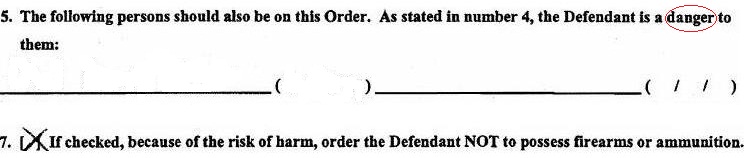
The lines below from the restraining order application used in my home jurisdiction illustrate how easily serious allegations may be brought against a person the judge approving that application has never met and knows absolutely nothing about. Allegations that may be utterly fraudulent and that take mere seconds to make may cause an innocent defendant years of torment—or even dismantle his or her life.

In a country that prides itself on its system of law, maybe leveling allegations of violence and threat shouldn’t be a kindergarten game of tic-tac-toe. If you agree, get ticked off and say so.

Tic.

Copyright © 2012 RestrainingOrderAbuse.com

False Allegations and Restraining Orders: The Moral Snare

Someone writes: “I made false allegations to obtain a PPO [an order of protection]. What do I do?”

Disappointingly, this is the first such query this blog has received. Hearteningly, it’s something. And this person should congratulate him- or herself on having a belated pang of conscience.

The ethical, if facile, answer to his or her (most likely her) question is have the order vacated and apologize to the defendant and offer to make amends. The conundrum is that this would-be remedial conclusion may prompt the defendant to seek payback in the form of legal action against the plaintiff for unjust humiliation and suffering. (Plaintiffs with a conscience may even balk from recanting false testimony out of fear of repercussions from the court. They may not feel entitled to do the right thing, because the restraining order process, by its nature, makes communication illegal.)
The lion’s share of the blame for fraud and its damages, of course, clearly falls on the shoulders of plaintiffs—the knots are theirs to untie—but the court should also recognize culpability.

The restraining order process is a honeypot to people nursing a grudge: it’s cheap, convenient, and accommodating. Its making the means to lash out readily available to anyone with a malicious impulse might even be called entrapment. And the court neither acknowledges this process’s consequences to wrongly accused defendants nor impresses upon plaintiffs the consequences to them of making false allegations.

(One defendant I corresponded with this year—who happily succeeded in having the order against her quashed months and thousands of dollars later—was clawing her hair out and dosing herself to sleep. Her young daughter was traumatized by the episode, too. She was accused of domestic violence by a man she’d briefly renewed a friendship with. He was put up to baselessly attacking her through the courts by his wife, who felt jealous—which he admitted in court after dragging the defendant through hell.)

By definition, a civil process shouldn’t foster discord and distress. Maybe lawmakers should mandate a cooling-off period before judges are authorized to approve restraining orders, as they do with handgun purchases.

Or maybe they should put this corrupt institution on ice.

Copyright © 2012 RestrainingOrderAbuse.com

Lying and Restraining Orders: How the Justice System Doesn’t NOT Encourage Perjury

A woman writes: “What was the legislative intent of having the petitioner sign under oath in a civil TRO [temporary restraining order]…?”

The question seems ingenuous enough. The answer, obvious to anyone who’s run afoul of the restraining order racket, is that people lie.

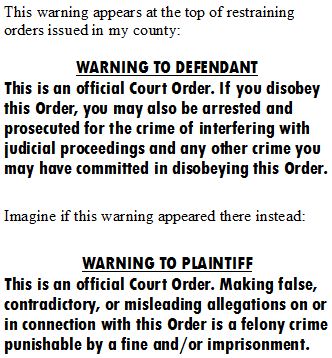
Less ingenuous is the state’s faith that a warning against perjury in fine print on the last page of a restraining order application (that its petitioner has just spent 20 minutes filling out) is going to discourage a liar from signing his or her name to the thing. (In my county this “warning” reads, “Under penalty of perjury, I swear or affirm the above statements are true to the best of my knowledge….” No explanation of perjury or its penalties is provided.)

If the courts really sought to discourage frauds and liars, the consequences of committing perjury (a felony crime whose statute threatens a punishment of two years in prison—in my state, anyhow) would be detailed in bold print at the top of page 1. What’s there instead? A warning to defendants that they’ll be subject to arrest if the terms of the injunction that’s been sprung on them are violated.

Led by the dated dictum that it should in no way discourage would-be restraining order petitioners, the state relegates its token warning against giving false testimony to the tail end of the application where it will most likely be disregarded.

And why not? Perjury is never actually prosecuted.

What this woman’s question reveals is (1) that the average petitioner doesn’t equate statements made on restraining order applications and in affidavits with sworn testimony given in a courtroom, and (2) that neither the consequences to plaintiffs of making inaccurate, misleading, or intentionally false statements to the court nor the consequences to defendants of being emotionally saddled with a restraining order are seriously weighed.

After a more complete digestion of this woman’s question, the unavoidable answer to it is that the legislative intent of having the petitioner sign under oath is plausible deniability of the process’s inviting and rewarding fraudulent abuse.

Copyright © 2012 RestrainingOrderAbuse.com

The Problems with Restraining Orders: Flaws, Flimflam, and Other F-words

Their administration is both biased and anti-feminist

The justice system takes it as axiomatic that plaintiffs who say they are victims are victims, especially when these plaintiffs are female. This policy ignores the obvious, namely, that people lie. Moreover, the court’s showing partiality toward female plaintiffs to redress a perceived inequity between the sexes only fosters reverse discrimination and exhibits contempt for the essential feminist conviction that women merit equal treatment under the law—no less and no more. This disdained expectation, the right to equal treatment, is the same one that restraining orders were originally conceived to acknowledge and validate. Women are still patronized. They’re just patronized in a more favorable way (“There, there, dear”).

They play into the fabulistic and sympathy-seeking tendencies of women

When women are in love, the objects of their affections can do no wrong. They exhale perfume. A spurned woman or one who otherwise nurses a grudge, however, will vilify a man to his toenails. A slight is an attack, a slammed phone is an act of violence, a hand balled in frustration is a death threat. Women, long habituated to the practice by conversations with other women, anatomize the smallest details of masculine conversation and conduct, and apply to them the interpretations that suit the color of their feelings. Exaggeration, embellishment, and caricature in conversation with judges, which is essentially what the brief interviews between judges and restraining order plaintiffs amount to, are to be expected. Judges, subjected to the equivalent of sensitivity training on steroids, accept statements made in these conversations as the equivalent of testimony, which, if made on a witness stand before a jury, would in fact be held to much higher standards of objectivity, accuracy, and accountability.

They’re more effective as instruments of abuse than as instruments of protection

The reliability of restraining orders as shields against violent abuse is iffy at best. Anyone dedicated to doing another harm is unlikely to be deterred by a piece of paper, which may just fan the flames. As vindictive weapons against those who never intended their plaintiffs any harm, however, restraining orders can’t be beat. They demolish lives.

Guilty verdicts are foregone conclusions

The nature of restraining orders being to silence, fetter, humiliate, and intimidate, efforts by defendants to dissuade judges from their institutionally schooled biases are enfeebled and easily disregarded. Defendants who resist are already presumed guilty, and their ability to defend themselves is compromised both by this prejudgment and their consciousness of it. Defendants (men, especially) are likely to file into appeals hearings feeling the presence of a noose around their necks: heads bowed, postures shrunken, voices pinched. Defendants, before they’ve even had a chance to hear the allegations made against them, let alone respond to them, have been confronted by a police officer at their homes and served a judgment by the state: harasser, stalker, deviant, aggressor, villain. When you feel judged, you look and sound guilty.

The system is broken

The failure of judicial oversight committees and state lawmakers and administrators to impose the expectation of fairness on the restraining order process provides judges of a certain bent the opportunity to let loose on defendants with both barrels, indiscriminately and with impunity (judges of this disposition, what is more, seem to be in the majority—maybe because they like adjudicating in this arena). This misconduct is not only sanctioned but oftentimes encouraged and applauded (“Throw the bums to the curb! Atta boy!”). No statutory consequences for plaintiffs’ giving false testimony are enforced, nor are judges held to their canons of office. The victims of abuses by plaintiffs and judges have no advocates or recourses: there’s no impartial ear within the system to turn to. Even those on the outside, journalists and civil rights advocates, shy away from the political razor wire that protects this airtight system.

Summary

The restraining order process is f*ed, and so is everyone it snares. Even the wrongly accused who manage to escape it—like bugs sucked into a vacuum cleaner and dumped from the bag—are lastingly damaged.

Copyright © 2012 RestrainingOrderAbuse.com