
Restraining order allegations defy physics. They can self-sustain indefinitely fueled on nothing more than human credulity and their gratification of our appetite for the unseemly. They’re paid the same intently lurid curiosity as a wreck on the side of the road.
Auditors can’t avert their ears.
I read stories about the horrors endured by victims of false restraining orders every week, and I’d still listen with sensitivity to someone’s telling me s/he “had to get a restraining order.” It’s an irresistible impulse.
Just the phrase restraining order prompts a preconditioned reflex in the hearer. Live Pavlov’s dinner bell. It’s certainly one of the most prejudicial phrases in the English language, surpassing even “Beware of Dog.”
That’s why the restraining order offers liars a dream medium: whatever they write on one becomes “true.”
It’s that Pavlovian conditioning. We presume that someone who applies for a restraining order has a genuine need. Even police officers and judges, who encounter the unscrupulous and the scheming on a daily basis, take this for granted. They’ve been trained to. Hefty federal grants are provided to local police departments and courts in return for their mandating that their officers submit to that training and consent to accept allegations pursuant to obtaining a restraining order as factual.
And since restraining orders are approved by judges on the spot without the people whom they’re issued against even knowing about them, there aren’t any naysayers to interrupt or object to a liar’s allegations.
A fraud has a captive audience and can just let ’er rip.
The more outrageous a fraud’s lies, furthermore, the more effective they usually are. They’re not only that much likelier to bias police officers and judges but anyone else they’re told to. Where there’s smoke there’s fire, it’s assumed, and frauds who lie big blow a whole lot of smoke.
Counterintuitively, the broader the fraud, the more certain it is to go over.
Upon convincing a judge of his or her need for a restraining order—child’s play—a liar has an official document that says s/he’s a victim who’s weathered a grievous ordeal, and s/he can get even freer with the details when relating his or her “travail” to others. Say you “had to get a restraining order,” and all heads tilt in your direction, keen for the salacious details. Applying for a restraining order—which entails considerably less nuisance, for example, than applying for a driver’s license—creates a sensation (and waves of positive feedback and attention to nourish a liar’s ego).
And the damage to the liar’s victim is done possibly before s/he’s even had the restraining order brought to his or her attention.
To counteract a false restraining order requires that a recipient convince a second judge that the first one (his or her peer) screwed up or was hoodwinked. Not an obstacle easily surmounted. What a wanton fraud can accomplish in a 45-minute excursion to the courthouse may preoccupy and torment his or her victim for years to come.
A restraining order based on lies carefully, or even carelessly, stitched together is like Frankenstein’s monster: once a judge throws the switch, “It’s Alive!” And calamitous.
Unlike Frankenstein’s monster, burning a fraudulent restraining order won’t make it go away.
Copyright © 2013 RestrainingOrderAbuse.com

 I was recently emailed by a 50-year-old woman who desperately wants to see her mother before her mother dies. This woman, whom I’ll call Natasha, has been restrained by court injunction from entering, calling, or nearing her childhood home.
 A person who obtains a fraudulent restraining order or otherwise abuses the system to bring you down with false allegations does so because you didn’t bend to his or her will like you were supposed to do.
 I’ve recently tried to debunk some of the
 What most people don’t get about restraining orders is how much they have in common with Mad Libs. You know, that party game where you fill in random nouns, verbs, and modifiers to concoct a zany story? What petitioners fill in the blanks on restraining order applications with is typically more deliberate but may be no less farcical.



 I this week came across an online monograph with the unwieldy (and very British) title, “Drama Queens, Saviours, Rescuers, Feigners, and Attention-Seekers: Attention-Seeking Personality Disorders, Victim Syndrome, Insecurity, and Centre of Attention Behavior,” which pointedly speaks to a number of behaviors identified by victims of restraining orders who have written in to this blog or alternatively contacted its author concerning the plaintiffs in their cases.
 A recent respondent to this blog detailed his restraining order ordeal at the hands of a woman who he persuasively alleges is a
 The 148 search engine terms that appear below—at least one to two dozen of which concern false allegations—are ones that brought readers to this blog between the hours of 12 a.m. and 7:21 p.m. yesterday (and don’t include an additional 49 “unknown search terms”).
 Since restraining orders are “civil” instruments, however, their issuance doesn’t require proof beyond a reasonable doubt of anything at all. Approval of restraining orders is based instead on a “preponderance of evidence.” Because restraining orders are issued ex parte, the only evidence the court vets is that provided by the applicant. This evidence may be scant or none, and the applicant may be a sociopath. The “vetting process” his or her evidence is subjected to by a judge, moreover, may very literally comprise all of five minutes.
 You know, a box like you’ll find on any number of bureaucratic forms. Only this box didn’t identify her as white or single or female; it identified her as a batterer. A judge—who’d never met her—reviewed this form and signed off on it (tac), and she was served with it by a constable (toe) and informed she’d be jailed if she so much as came within waving distance of the plaintiff or sent him an email. The resulting distress cost her and her daughter a season of their lives—and to gain relief from it, several thousands of dollars in legal fees.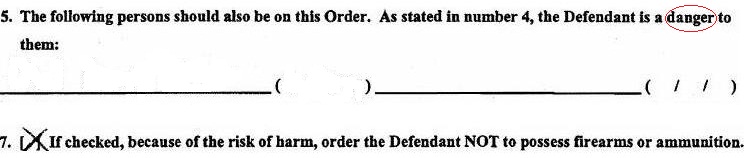
 The ethical, if facile, answer to his or her (most likely her) question is have the order vacated and apologize to the defendant and offer to make amends. The conundrum is that this would-be remedial conclusion may prompt the defendant to seek payback in the form of legal action against the plaintiff for unjust humiliation and suffering. (Plaintiffs with a conscience may even balk from recanting false testimony out of fear of repercussions from the court. They may not feel entitled to do the right thing, because the restraining order process, by its nature, makes communication illegal.)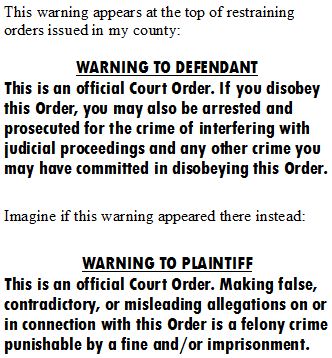
 If the courts really sought to discourage frauds and liars, the consequences of committing perjury (a felony crime whose statute threatens a punishment of two years in prison—in my state, anyhow) would be detailed in bold print at the top of page 1. What’s there instead? A warning to defendants that they’ll be subject to arrest if the terms of the injunction that’s been sprung on them are violated.
 TALKING BACK to restraining orders