States that MAY Allow Records of “Protective Orders” to be Expunged…and Why They’re So Few

“The consequences that arise once a protective order is entered against a person (the respondent) are substantial. Though technically considered civil proceedings, protective orders have a close relationship to criminal law. The consequences of having a protective order entered often include restrictions on constitutional rights in addition to financial obligations. Violations of protective orders bring about serious criminal charges.”

Attorney Misha Lopez

“I have been fighting for 10 years to clear my son’s name from a false restraining order that [was] dismissed and vacated by the court. But to clear themselves, [officers of] the judicial system turn their heads to the wrongdoing and cause this young man to be [defamed], not able to continue his education, etc. His [access to] life has, it seems like, forever been barred.”

Blog respondent

The remark above by a criminal lawyer on the “consequences of protective orders” echoes those of many other attorneys (which may observe that restraining order records limit job opportunities and can interfere with the lease of a home, getting government housing, or obtaining credit). I could find you a quotation along the same lines from a law firm in any state of the Union. The woman whose remark follows the lawyer’s, Lena Bennett, identifies herself as a “concerned mother who needs to be heard,” and this post is dedicated to her and her son.
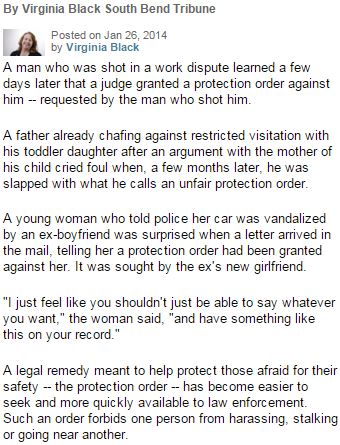
Black_debateA former trial attorney, Larry Smith, who knows the law in this arena better than he wishes he did, responded to Lena:  “I doubt that you can get an expired order expunged in most states because the restraining order, although it has may components of the criminal law, is said to be civil.”

As usual, Larry gets right to the heart of the matter. The fact is there are laws on the books that allow a person who’s been convicted in a criminal court of, say, harassment, stalking, terroristic threats, or assault to later have the charges expunged.

But if a person is baselessly accused of any or all of these acts on a civil restraining order, there’s no legislation in place (except in Tennessee) to enable him or her to have the accusations removed from his or her public record even if a judge determined them to be baseless and dismissed the order.

Note: People who have actually committed crimes can relieve themselves of the onus of a court record (that may hobble their employment opportunities), while people who’ve merely been accused on an ex parte order of the court (30 minutes in and out) are incriminated for life without ever having been tried for a crime, and that, again, is even if a judge formally decreed them innocent and tossed the accusations.

The paper trail, which may include multiple false reports to police officers and registration in police and publicly accessible state databases, is indefinitely preserved.

(Let’s say you’re an employer screening a male job applicant, and you see a restraining order record on which a woman has indicated that he stalked or sexually assaulted her. Let’s even say the court dismissed the case as lacking any foundation. Will you or won’t you be influenced by that record?)

Excuses for preserving restraining order records, which emerge from anti-domestic-violence dogmatists, are anachronistic. Typical of the law, statutes are about 20 years behind social trends.

Consider:
MD_bill

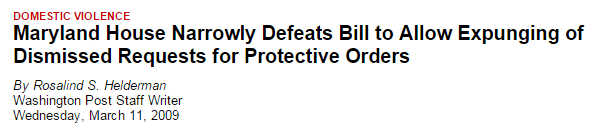
The bill whose defeat is reported in the headline above would have allowed citizens of Maryland who had been accused of domestic violence on a dismissed restraining order petition to have the allegations completely expunged (erased). It was shot down.

Supporters of the measure argued that abuse accusations carry such a stigma that allowing records to remain public in cases that have been deemed unfounded unfairly hurts innocent people as they seek employment or housing.

Opponents contended that requests for protective orders are often dismissed because battered victims, usually women, are too scared or intimidated to pursue the matter. They said records are not expunged in other kinds of civil cases, even when allegations are unproved.

Never mind that these opponents are well aware that restraining order cases are not like “other kinds of civil cases.” Their implications are plainly criminal and highly prejudicial. They’re recorded in police databases.

MD_bill2A year later, another bill is proposed to the same legislature. This one wouldn’t expunge anything, but it would “hide” restraining order records from public view.

“Shielding” is possible in Maryland today and only requires a clerk to sign off on it. It removes the record of a dismissed order from Maryland’s Judiciary Case Search. The record still exists, however, and can be easily accessed by anyone who swings by the courthouse.

In the whole of the nation, as revealed by a Google search performed yesterday, these are the only states in which there are reportedly means to have a restraining order expunged:

Of these, only Tennessee has an actual statute (law) enabling a person who’s been accused on a restraining order petition that was later dismissed to move the court to expunge the record.

And in only a handful of states (again, according to a casual Google search) has legislation been proposed that would offer the same opportunity to their citizens:

That’s it.

Copyright © 2016 RestrainingOrderAbuse.com

Smile, You’re on Candid Camera: Bringing a Measure of Accountability to Restraining Order Trials

Many if not most of the posts on this blog concern the absence of accountability in the restraining order process. Accusers lie, and so may judges.

State law often designates lying in court a felony offense punishable by a term in prison, and there are ethical canons that prescribe how judges should behave.

With regard to the honest representation of facts in court, however, both accusers and judges fudge (and that’s putting it mildly). Each may frame facts to produce a favored impression.


Lying in court, even if it’s discerned, is never called “lying”—which isn’t to say judges never tacitly express disdain or disgust. Frowns, scoffs, and scowls, though, aren’t picked up by microphones or preserved in trial transcripts.

Judges know the system would fall apart if they began acknowledging in the record that accusers lie, so lies are generally talked around if they’re remarked at all. No one, furthermore, reviews testimony afterwards to detect lies or material contradictions (which constitute “perjury by inconsistent statements”).

Consider how different things might be if courtroom procedures were recorded on video. Just consciousness of scrutiny puts people on notice. It triggers a primal alarm.

The knowledge or fear that we’re being watched exerts a disciplining influence on how we behave. Park an empty cop car on a street corner, and suddenly people are mindful of traffic signs. Rules are obeyed without anyone’s having to tell us to obey them.

Park a camera in a courtroom, and count on it that judges would be a lot more conscious of their performance and how their acumen stood to be perceived by others. Liars, too, would likely be a good deal warier of being caught out.

Making frauds visible, what’s more, and available for airplay would pressure district attorneys to treat lying like the serious crime it is. The concern wouldn’t be that some shaming video soundbite would appear; the concern would be what if.

Exceptions to video-recording testimony could be made in criminal trials when a witness might be inhibited or endangered by it. Since civil restraining order trials are regarded as no big deal, anyway, however, there’s much to recommend this simple, inexpensive measure to enhance accountability without having to do anything at all.

True, a possible negative consequence of cameras in court might be that the bench would only attract hams and blowhards.

Would anyone, though, notice a difference?

Copyright © 2014 RestrainingOrderAbuse.com

“Predator” v. “Porn Star”: Restraining Order Fraud, False Allegations, and Suing for Defamation

destroyPeople falsely alleged to be abusers on restraining order petitions, particularly men, are treated like brutes, sex offenders, and scum by officers of the court and its staff, besides by authorities and any number of others. Some report their own relatives remain suspicious—often based merely on finger-pointing that’s validated by some judge in a few-minute procedure (and that’s when relatives aren’t the ones making the false allegations).

The social alienation and emotional distress felt by the falsely accused may be both extreme and persistent.

The urge to credit accusations of abuse has been sharpened to a reflex in recent decades by feminist propaganda and its ill begot progeny, the Violence Against Women Act. No one thinks twice about it.

Using four-letter words in court is strictly policed. Even judges can’t do it without risking censure. Falsely implicating someone, however, as a stalker, for example, or a child molester—that isn’t policed at all. Commerce in lies, whether by accusers, their representatives, or even judges themselves is unregulated. No one is answerable for sh* s/he makes up.

Accordingly, false allegations and fraud are rewarding and therefore commonplace.

It should be noted that false allegations and fraud can be distinctly different. For example, David Letterman famously had a restraining order petitioned against him by a woman who was seemingly convinced he was communicating to her through her TV, and her interpretations of his “coded messages” probably were genuinely oppressive to her. David Letterman lived in another state, had never met her, and assuredly had no idea who she was. Her allegations of misconduct weren’t true, but they weren’t intended to mislead (and the fact that they did mislead a judge into signing off on her petition only underscores the complete absence of judicial responsibility in this legal arena).

Fraud, in contrast, is manipulative and deceptive by design. It occurs when an accuser intentionally lies (or spins the facts) to give a false impression and steer a judge toward a wrong conclusion that serves the interests of the fraudster.

Regardless, though, of whether false allegations are made knowingly or unknowingly, they’re rarely discerned as false by the court, are seldom acknowledged as false even if recognized as such, and are always destructive when treated as real, urgent, and true, which they commonly are.

The falsely accused (often private citizens who’ve never had a prior brush with the law) are publicly humiliated and shamed, which by itself is predictably traumatizing. They are besides invariably (and indefinitely) entered into police databases, both local and national, and may be entered into one or more domestic violence registries, too (also indefinitely). These facts pop up on background checks, and defendants in some states may even appear in registries accessible by anyone (including friends, neighbors, family members, boy- and girlfriends, employers, colleagues, students, patients, and/or clients).

This costs the falsely accused leases, loans, and jobs (being turned down for which, of course, aggravates the gnawing indignity and outrage they already feel). Those falsely accused of domestic violence may further be prohibited from attending school functions or working with or around children (permanently). Defendants of false restraining orders may besides be barred from their homes, children, assets, and possessions. Some (including salaried, professional men and women) are left ostracized and destitute. Retirees report having to live out of their cars.

This, remember, is the result of someone’s lodging a superficial complaint against them in a procedure that only requires that the accuser fill out some paperwork and briefly talk to a judge. A successful fraud may be based on nothing more substantive, in fact, than five “magic” words: “I’m afraid for my life” (which can be directed against anyone: a friend, a neighbor, an intimate, a spouse, a relative, a coworker—even a TV celebrity their speaker has never met).

This incantation takes a little over a second to utter (and its speaker, who can be a criminal or a mental case, need not even live in the same state as the accused).

Accordingly, people’s names and lives are trashed—and no surprise if they become unhinged. (Those five “magic” words, what’s more, may be uttered by the actual abusers in relationships to conceal their own misconduct and redirect blame. That includes, for example, stalkers. Those “magic” words may also be used to cover up any nature of other misbehavior, including criminal. They instantly discredit anything the accused might say about their speakers.)

The prescribed course of action to redress slanders and libels is a defamation suit, but allegations of defamation brought by those falsely accused on restraining orders or in related prosecutions are typically discounted by the court. Perjury (lying to the court) can’t be prosecuted by a private litigant (only by the district attorney’s office, which never does), and those who allege defamation are typically told the court has already ruled on the factualness of the restraining order petitioner’s testimony and that it can’t be reviewed (the facts may not even be reviewed by appellate judges, who may only consider whether the conduct of the previous judge demonstrated “clear abuse of discretion”). The plaintiff’s testimony, they’re told, is a res judicata—an already “decided thing.” (Never mind that docket time dedicated to the formation of that “decision” may literally have been a couple of minutes.)

So…slanders and libels made by abuse of court process aren’t actionable, slanders and libels that completely sunder the lives of the wrongly accused, who can’t even get them expunged from their records to simply reset their fractured lives to zero.


Such slanders and libels may include false allegations of stalking, physical or sexual aggression, assault, child abuse, or even rape. In the eyes of the court, someone’s being falsely implicated as a monster, publicly and for life, is no biggie.

In contrast, it was reported last month that the court awarded a Kansas woman $1,000,000 in a defamation suit brought against a radio station that falsely called her a “porn star.”

When violated people speak of legal inequities, this exemplifies what they’re talking about: Falsely and publicly implicating someone as a sex offender is fine and no grounds for complaint in the eyes of the justice system, but for the act of falsely and publicly calling someone a mere sex performer, someone may be fined a million bucks.

Copyright © 2014 RestrainingOrderAbuse.com

Battering Women to Protect Battered Women: Using Massachusetts’s Policies to Examine Restraining Order Publicity and Its Damages

“In the event a Restraining Order is issued for any period of time (initial 10 days or subsequent extension/dismissal), you will be listed in the statewide Domestic Violence Registry system. This could impact your ability to obtain or maintain employment in government, law enforcement, certain medical fields, or social services, or to work with/coach children. Impoundment of the restraining order does not expunge your listing on the statewide domestic violence registry, as certain government agencies and private companies with significant government contracts still have access to the registry system.”

—“Massachusetts Restraining Orders Procedure and Ramifications

I’ve just been corresponding with a Florida woman named Ally who had a domestic violence (209A) protection order petitioned against her in Massachusetts alleging she was a danger to a former boyfriend (these kinds of instruments can be obtained by plaintiffs who don’t even live in the same state or country as their defendants).

Ally contends the allegations against her are false and has been living in hell for over a year.

She’s surviving day to day and can’t afford to procure the services of an attorney. Ally’s trying to defend herself and clear her name with no money and from another time zone. She’s preparing a motion on her own (very possibly ill-fated) to request that the order against her be expunged, because it has ruined her employability.

Note: As the epigraph explains, even were Ally to succeed in having the order simply dismissed (which is itself unlikely), she would still remain registered as a domestic abuser.

From a draft of Ally’s “Motion to Expunge”:

Defendant was refused jobs, [is] not allowed to attend [or] volunteer [at] her daughter’s school events, [and has had] numerous other rights taken away due to Plaintiff’s Abuse of Process and Fraudulent Allegations and written Affidavit to the Court. This continues today.

Note: To successfully combat prosecutions like this requires money…which prosecutions like this prevent their defendants from earning.

A recent post on this blog observed the court’s schizophrenic regard toward restraining orders. On the one hand, they’re viewed by judges as urgent, potentially life-or-death matters; on the other hand, they’re viewed as inconsequential as long as defendants mind their prohibitions for the prescribed period of time.

Ignored is that adjudications both initiated and finalized in minutes yield rulings that are entered into state and national law enforcement databases indefinitely. Orders become “inactive” once they expire, but they don’t disappear. A woman like Ally remains for the rest of her life marked as a perpetrator of domestic violence.

In contrast—and the contrast is a telling one—consider this excerpt from a “Memoradum” issued by the Massachusetts Supreme Court last year on “Internet Dissemination of Personal Protection Order Information.”

As transparency and improved access remain court goals, it is important that we not unknowingly or unintentionally release victims’ personally identifiable information through the Internet, recognizing that this information is easily accessed and that access to such information could be dangerous to victims. Additionally, it has been brought to our attention that current federal law prohibits providing information over the Internet about personal protection orders (PPOs) that would be likely to reveal the identity or location of the petitioner (“PPO Information”).

18 USC 2265(d)(3) states:

A State, Indian tribe, or territory shall not make available publicly on the Internet any information regarding the registration, filing of a petition for, or issuance of a protection order, restraining order, or injunction in either the issuing or enforcing State, tribal or territorial jurisdiction, if such publication would be likely to publicly reveal the identity or location of the party protected under such order. A State, Indian tribe, or territory may share court-generated and law enforcement-generated information contained in secure, governmental registries for protection order enforcement purposes.

The privacy of restraining order plaintiffs (who are nominated “victims”) is to be tightly guarded.

Note: Based on “determinations” formed in minutes and possibly based on nothing more substantial than accusation, a plaintiff is deemed a “victim” whose identity and privacy must be protected, and the defendant is deemed a “violent threat” whose privacy is accordingly due no consideration. After the term of the restraining order has flown, the “danger” to the accuser is assumed to have been resolved, but the accuser continues to enjoy anonymity while the accused must go on bearing the implications of the restraining order for the rest of his or her life, exactly as if those implications were a criminal sentence.

Only in the recent past, in fact, did it even become possible to remove a Massachusetts restraining order defendant’s name from the domestic violence registry if it were found that allegations against him or her were substantially or totally false. (Remember that such allegations are made ex parte in the time it takes to place an order at McDonald’s.)

Until recently, it was almost impossible to expunge a person’s record with the domestic violence registry once the initial entry was made. In the 2006 case of Commissioner of Probation v. Adams, it was recognized that a judge has the inherent authority to expunge a record of an abuse [from the] violence registry system in the rare and limited circumstance that the judge finds the order was obtained through fraud on the court.

Note: The phrase rare…circumstance (of fraud) is emphasized in the original document quoted above (“Massachusetts Restraining Orders Procedure and Ramifications”), which was authored by an all-female law firm (Mavrides Law of Boston). Allegations of rampant restraining order misuse in Massachusetts have actually been the subject of press coverage and at least one law review monograph, and one of the most outspoken critics of restraining orders, attorney Gregory Hession, practices in Massachusetts and has for many years reported that restraining orders are “out of control.”

The previous two posts on this blog were responses to allegations that those who criticize restraining orders and domestic violence laws are “opposed to the battered women’s movement.” Defenders of these laws are urged to ask themselves how Ally’s wanting to be able to provide for her daughter and one day attend her daughter’s graduation has anything to do with battered women at all.

They’re also urged to ask themselves how denying Ally these opportunities isn’t itself an act of brutality.

Copyright © 2014 RestrainingOrderAbuse.com

Who BS-es the Police and Court? Who Doesn’t.

“Everyone lies to me.”

—University of Arizona police officer

The willingness of false accusers to lie to authorities and the courts—and of some authorities and officers of the court to lie—is a tough pill to swallow, especially for those who learn about it the hard way, as have many of those who visit or have responded to this blog.

Scholars, members of the clergy, and practitioners of disciplines like medicine, science, and the law, among others from whom we expect scrupulous truthfulness and a contempt for deception, are furthermore no more above lying (or actively or passively abetting fraud) than anyone else.

The false accusers from whom I’ve seen and been informed the most devious and unmitigated frauds originate, in fact, are the self-entitled, those who imagine they’re distinguished from the crowd and therefore exempt from its rules. They lie smoothly, righteously, and with an air of affronted dignity. That such people typically enjoy the security and reassuring presence of an attorney by their sides no doubt factors largely into their confidence.

M.D., Ph.D., Th.D., LL.D.—no one is above lying, and the fact is the better a liar’s credentials are, the more ably s/he expects to and can pull the wool over the eyes of judges, because in the political arena judges occupy, titles carry weight: might makes right.
Like most of us are prone to, judges presume a superior standard of integrity from people with advanced degrees or other tokens of accomplishment who practice in areas of influence. The court takes the ethics of such people on faith. It’s a prejudice as old as human hierarchies. Those who have power or its semblance aren’t to be held accountable for abuses of power.

The court shouldn’t presume integrity from these people; it should demand it and hold such people accountable to the high standards to which it presently and wrongly presumes such people hold themselves.

Copyright © 2014 RestrainingOrderAbuse.com

PERJURY: BS-ing the Court, the Frequency of False Allegations, and the Fraudulent Abuse of the Civil Restraining Order

In the last post, I discussed how lying is generally gotten away with beneath the radar. What people who’ve blessedly had no personal experience with fraudulent abuse of legal process fail to grasp is (1) there’s no incentive to expose untruths except (perhaps) when they’re used to frame people for crimes for which they stand to be convicted, (2) lies are much more commonly used to re-frame the truth into one favorable to the image or malicious intentions of fraudsters than they are to send people to prison, (3) lies don’t have to succeed in false criminal convictions to be damning or ruinous, and (4) lies may be of sorts that are impossible to discredit yet may permanently corrupt the public records and lives of the falsely accused.

Writers, for instance, who confront false allegations of domestic violence don’t actually invite their imaginations to conceive what such false allegations might be. Perhaps they vaguely suppose they’re of this nature: “He beats me with a belt buckle” or “She locks me in the pantry.” False allegations like these may certainly be made, but lies may be much more subtle or vaporous: “I live in a constant state of fear” or “She said she was going to kill me while I sleep.” Is the truth or falsity of these latter claims possible to ascertain? No. Police reports and restraining orders may be based on allegations like these, however, and anyone who imagines maliciously motivated people are incapable of making false statements to this effect have lived enviably sheltered lives.

False claims of stalking are as easily manufactured: “He creeps around my neighborhood late at night” or “She cut me off in traffic, almost running me off the road.” Allegations like these may not only be the substance of false police reports (which may—and do—gnaw at the sanity of their victims) but may be grounds for false restraining orders (which are far more nightmarish). In fact, the latter allegation was the basis of an emergency restraining order reported to this blog, which was petitioned against a college girl, in or just out of her teens, by her female counselor. The girl and her mom had a weekend to prepare her defense, and she wasn’t fully exonerated of her accuser’s litany of “terror-inspiring misconduct” (which included the girl’s greeting her accuser a few times in chance public encounters in a town of 2,000 residents and seeing her at church).

False allegations of sexual harassment? “He‘s repeatedly told me he wants me to [X] him” or “She keeps propositioning me”—try disproving allegations like these, which may be much more explicit and include claims of physical molestation. The consequences, if it’s necessary to enumerate them, could include termination of employment, marital dissolution, peer or social isolation, and the emotional and thus physical decay that accompany each or all. False claims like these, which take mere seconds to articulate, may never be recovered from.

For making such false allegations to the authorities and courts, there are no consequences, except to their victims. There are statutory penalties on the books for making false claims (committing perjury), but they’re rarely if ever enforced and couldn’t be enforced consistently within governmental budgetary constraints, so commonplace is lying. Are such false claims going to end up in some statistical database? Of course not. Ask an honest district attorney, though, why lying isn’t prosecuted, and s/he’ll tell you it’s because lying is an everyday occurrence.

This is the invisible irony that escapes everyone who tackles consideration of rates of false allegations: the fact that lying isn’t prosecuted is the indicator of its rampancy (prosecution of frauds on the police and courts would overwhelm the system). And because lying isn’t prosecuted, it’s in the interest of maintaining the dignity of the legal system and the semblance of just and orderly process that judges not acknowledge even flagrant lies as such. To acknowledge them in all their plenitude, yet not punish them, would be to call into question the legitimacy of the system itself. Restraining order frauds, moreover, may be rewarded with favorable verdicts in spite of lies, making the concealment of those lies by judges that much more urgent.

Society has been conditioned, in the decades since the advent of the restraining order, to be hyper-vigilant and -reactive toward allegations of domestic violence, stalking, and sexual harassment—behaviors associated with male abuse of women, which the restraining order was conceived to curb, if not remedy. These offenses are ones to which the population has been vigorously, even coercively, sensitized. The justice system is consequently poised to descend upon those accused of such behaviors (including women), as is the public poised to believe allegations of such behaviors to be true, especially when validated by the courts.

False accusers are certainly aware of these prejudices and may easily exploit them—and should hardly be expected not to. Agents of the system may, in fact, goad them on, even while salting the wounds of those who report that they’re victims of false allegations by telling them they have no legal recourse (which, practically speaking, they don’t). Judges, furthermore, may scourge such victims in the courtroom based on allegations that their accusers leveled in one-sided, five- or 10-minute auditions.

To recap: Liars aren’t prosecuted, so lies aren’t acknowledged as lies, but the civil procedure that’s most eagerly and impulsively abused by liars, the restraining order process,  is supremely lax, instantly gratifying, and universally promoted. This procedure, what’s more, indelibly fouls a falsely accused defendant’s public record; may deny him or her entitlement to home, children, and property; and may cost him or her, besides, employment and employability in his or her chosen field of endeavor.

If this weren’t infernal enough, the outrage and misery expressed by victims who’ve found themselves in the eye of this perfect storm of unreason, some of whom are left impoverished of everything that gave their lives meaning, are credibly denounced or even mocked as crackpot.

Copyright © 2014 RestrainingOrderAbuse.com

Lies AREN’T a Game Leg: On Recognizing That False Allegations Only HAVE to Be Tolerated, Because They’re Not Retracted

I have a crippled leg.

It’s hardly the impediment it would have been if a surgeon hadn’t reconstructed it, but there’s only so much I can expect from it, and barring some advances in orthopedic science and my winning the lottery, its limitations are ones I’ll have to live with.

A recent comment from a very generous woman moved to express sympathy for a fellow victim of false allegations brought something to my attention. She said she was trying to get past her pain.

I understand her very well, but at the risk of pointing out the obvious, she shouldn’t have to. False allegations aren’t a withered limb, a ruptured disc, or an autoimmune disease. These latter things are real and unavoidable. Lies aren’t real, and their pain is easily relieved. The lies just have to be rectified.
That lies were made to the court doesn’t somehow convert them to truths that necessarily must be lived with. Lies don’t become authenticated or authorized because they work. The court isn’t God, and its rulings aren’t ineluctable verities etched on stone tablets. The pains of false allegations are artificially induced and nothing the wrongly accused should have to bear.

I’ve known people who were participants in compound hoaxes on the court. They, too, convinced themselves that false allegations were something that the victims of those allegations had to live with. One of the people I’m thinking of is a parent. She’s probably commanded her children to apologize for lying more than once, because she recognizes it’s wrong and wants to impress that fact upon her kids.

Lies by adults only have to be borne, because those adults aren’t equal to the expectations placed on infants. This fact isn’t changed because the lies were made to judges (who may be unequal to those expectations themselves).

The civil in civil process (from the Latin for citizen) is you and I. “The court” is a concept that society (also you and I) made up and invested with meaning. It stands for a collection of procedures that are supposed to preserve brotherly (and sisterly) harmony. The common denominator here—and the only real part—is you and I. The court’s agents are merely more infinitely fallible you’s and I’s.

It’s certainly pragmatic to accept that liars who don’t have to recant their lies probably won’t. But lies are never irreversible impositions of divine will.

They’re just the acts of liars, and there’s nothing lowlier and less divine than them. The only ones who should have to live with lies are their perpetrators.

Copyright © 2014 RestrainingOrderAbuse.com

Repeat after Me: RESTRAINING ORDER and FRAUD May Mean the Same Thing

Judge: “Are you afraid of her?”

Man: “No, I….”

Judge: “Are you afraid of her?”

Man: “No, it’s not that. It’s—”

Judge: “I can’t award a restraining order unless you tell me you’re afraid of her. I’m going to ask you one more time: Are you afraid of her?”

Man: “Okay, yes, I’m very afraid of her.”

The above isn’t satire but an exchange between a plaintiff and a judge whose equivalent may be heard any weekday, particularly in Midwestern states like Illinois and Ohio. While this sort of ritual litany might have its place in church, it has no place in a courtroom.

The restraining order process has become a perfunctory routine verging on a skit, a scripted pas de deux between a judge and a complainant. Exposure of the iniquity of this procedural farce hardly requires commentary.
Upon the basis of a manifestly crooked “adjudication of facts” like this one, a defendant will be confronted at his or her home by an officer of the state and presented with a minatory order of the court alleging anything from harassment to stalking to threatening conduct or battery and warning him or her that s/he’ll be subject to arrest and incarceration for violation of that order.

This alone is excruciatingly humiliating and nerve-wracking, and brings a defendant’s life to an abrupt halt. These allegations become all s/he can think about—and this state of emotional anarchy may be one that a defendant is forced to live in for years (while everything around him or her deteriorates). Restraining orders expire but never wither and fall off the books unless vacated. All this horror may be based on allegations that are false and/or coerced.

It’s no wonder that some defendants refer to the restraining order process as “domestic terrorism.”

Once a plaintiff, by contrast, sees how eager the state is to play along, s/he may transform from a child of spite into a monster of menace, and a few impulsive lies may rapidly blossom into a protracted and layered assault.

Alleging a defendant violated an order of the court may be as farcical an exchange as the one sketched above, only this time it will be between the plaintiff and a cop: “Did she?” “Um.” “Did she?” “Er.” “DID SHE?” “YES!” A plaintiff may alternatively bait a defendant into actually violating a restraining order’s proscriptions by conveying the message that s/he had the order canceled, cold-calling him or her, or approaching him or her and provoking a scene.

A few posts ago, I stressed that the restraining order racket wasn’t the product of a conspiracy, and I keep finding myself having to qualify that. Police officers and officers of the court follow an established protocol, possibly knowing goddam well that its basis is a sham. They don’t perceive this as a collusive act, but an outsider’s perceiving it that way is certainly reasonable.

What restraining orders and their policies do is authorize these public servants to act. Though the grounds for action may be arbitrary, those grounds can be represented as sound and just. Policy is clear-cut and easily executed with no risk of repercussions to its agents.

That execution may spell the devastation of a life (or several), but it fills the day and ensures that there’ll be plenty more to do tomorrow.

Copyright © 2013 RestrainingOrderAbuse.com

The Word for Restraining Order Abuse is FRAUD

So complacent toward lying have judges become that restraining order fraud goes over without raising an eyebrow. I’ve known one judge to scoff at the use of the word perjury on reflex, despite being ignorant of the facts he’d been called upon to adjudicate. And, though careless, he wasn’t a dim man.

Perjury, a felony crime, is the false (i.e., fraudulent) representation of a material fact to a judge (including on a sworn document like a restraining order application). A material fact is one that’s likely to influence a judicial decision. To falsely allege you’ve been sexually harassed or assaulted, for instance, is to commit perjury. Perjury is a word all defendants who’ve been falsely accused should know. Chances are they’re victims of more than one materially factual misrepresentation to the court.

The phrase restraining order fraud, too, needs to gain more popular currency, and I encourage anyone who’s been victimized by false allegations to employ it. Fraud in its most general sense is willful misrepresentation intended to mislead for the purpose of realizing some source of gratification. As fraud is generally understood in law, that gratification is monetary. It may, however, derive from any number of alternative sources, including attention and revenge, two common motives for restraining order abuse. The goal of fraud on the courts is success (toward gaining, for example, attention or revenge).

People who are victimized by the restraining order process are rarely students of law and often have had no prior exposure to legal procedure whatever. Words like perjury and fraud, while possibly familiar from having been heard in TV courtroom dramas or read in novels, are mostly alien concepts to the uninitiated. Restraining order recipients have mere days to prepare a defense—if they know they can contest an order of the court at all—and it’s unlikely that they’ll have concepts like these at their command. (I’m a student of words, and it took a lawyer’s familiarizing me with the significance of these two, among others, for me to gain a reasonably firm grasp of their meaning—and this was years after my own day in court. I was a practicing kids’ poet, and words like these weren’t ones I’d ever had call to use. And I’d prefer I were still ignorant of them today.)

Fraud isn’t commonly applied to restraining order abuse (itself an uncommonly used phrase), and it certainly should be, because the restraining order process is assuredly the most common motivator of frauds on the court. This process is usually employed impulsively, is free, and is completed in a matter of moments. Those motivated to use it maliciously—and they’re legion—typically do so in the throes of spiteful passion. They say whatever they believe they need to to achieve their desired ends.

However lacking their stories may be of scrupulous premeditation, though, they’re nevertheless frauds. And they nevertheless work.

The reason for the court’s failure to perceive restraining order fraud derives from its failure to perceive how damaging false allegations are to defendants. Judges aren’t likely to associate fraud with restraining order allegations, believing the term more aptly applied to cases that inflict “real” harm. Restraining order fraud, even when it doesn’t cost a defendant access to his or her home, property, and children, does real harm: anxiety, gnawing outrage, despondency, and depression, which may predictably lead to insomnia, deterioration of health, loss of productivity, and behavioral changes, and may conceivably induce drug or alcohol abuse and homicidal or suicidal ideation. Defendants may lose jobs or job opportunities. They may end up homeless. And these consequences ignore those inflicted on peripheral parties like children, who may also be lastingly traumatized.

The judicial disconnect between restraining order and harm is one defendants against false restraining orders must endeavor to bridge, because even a judge who’s nobody’s fool isn’t likely to get there on his or her own. The restraining order process is virtually automated. Judges know they don’t have to apply a great deal of diligent attention to particulars and consequently rarely do.

Use of the words perjury and fraud aren’t likely to avail restraining order defendants. Of probable value, though, is understanding them. And of definite value to arousing awareness of restraining order abuse and promoting reform of the restraining order process is leading others to understand them.

Copyright © 2013 RestrainingOrderAbuse.com

Narcissism: A Study in Distortion

The narcissist is a study in distortion.

You’d think someone as intently preoccupied with mirrors as the narcissist is would be brutally self-critical. You’d be mistaken, though. The narcissist exalts him- or herself, very possibly in defiance of a host of reasons not to. This isn’t to say the narcissist is immune to negative judgments; it’s to say that instead of responding to reproaches as normal people do and adapting or modifying his or her behavior and perspectives accordingly, the narcissist resents and would have others adapt their perspectives to match his or hers instead.

The narcissist has a distorted sense of his or her own self-worth, distorts perceived slights or criticisms into monstrous proportions, and endeavors to distort others’ perceptions of those who dared to “criticize.”


The temptation is to say that narcissists are masters of both deception and self-deception. “Mastery,” however, implies skill. Narcissists can’t help lying. It’s a propensity to which they’re enslaved. It can therefore hardly be called a talent.

Increasing numbers of visitors to this blog are brought here because they’ve had a brush with one of these piteous people, and it’s damaged them badly.

There’s an attractiveness to detecting mental illness or personality disorders in people who’ve injured us, because it provides us with a label, a way to quantify and qualify misconduct that’s otherwise inexplicable to a normal mind. Typically visitors to this blog have been victims of false allegations leveled publicly, often through the courts, and they’ve discovered the difficulty of exposing the motives of frauds committed by the mentally aberrant: they don’t make sense.

Distortion is very effective at poisoning the minds of others, particularly authorities and judges, because they in particular have no reason to suspect and have been trained to chasten any suspicions they might naturally have of accusers. Suspicion is what they’re supposed to reserve for the accused.

If this sounds backwards, that’s because it is.

Everything to do with narcissists distills to distortion. Narcissists evince all outward signs of plausibility, and outward signs are all most people attend to. Hence narcissists readily induce others to join them in their altered perspectives.

Scrutinize a photograph of a narcissist, and what you may detect in his or her eyes is not only a consciousness of being looked at but a degree of excitement approaching sexual thrill. Those eyes are hotly relishing the attention and may almost seem prehensile, as if they’re not just trying to make an impression but trying to grab the viewer by the collar. A significant measure of what’s called a narcissist’s “magnetism” borders on coercion.

Narcissists have the power of utter faith in their convictions, and they’re no less convinced of falsehoods than normal people are of truths. Their faith in their own frauds is contagious, because most people only perceive lies that are told abashedly, and narcissists are immune to shame and self-rebuke. The mentally ill (i.e., crazy people) are correspondently convincing, because to them illusions of the mind are real. The parallel is telling.

I once read a biography of Ayn Rand that cited an instance of the philosopher’s being thrown into a fit of pique, because someone had caused her to doubt her perceptions (she called her method Objectivism, a word based on objectivity, which means perception of the world honestly and without preconceived notions). Had she ever fallen prey to a narcissist, she’d have probably throttled the mendacious wretch purple.

Copyright © 2013 RestrainingOrderAbuse.com

“A Nightmare That Won’t End”: Dealing with False Allegations

A person who obtains a fraudulent restraining order or otherwise abuses the system to bring you down with false allegations does so because you didn’t bend to his or her will like you were supposed to do.
To contest the restraining order (or whatever other state process was abused) is to once more defy the will of your accuser.

No surprise then that such an accuser will up the stakes on you. Defy subsequent allegations, and your accuser will escalate them further. This is especially the case when your accuser is female. It’s not for nothing that the (mis)quotation, “Hell hath no fury like a woman scorned,” has become immortal. (And it’s not only men who have to fear this wrath; women can be at least as vehemently and doggedly brutal to other women.)

It’s rare for a false accuser to relent.

This is partly due to psychology and partly due to how easily the processes we’re talking about are abused. Restraining order issuance, for example, pretty much follows a revolving-door policy: plaintiffs are in and out in minutes.

Once a foothold is attained, and the paperwork starts mounting in the plaintiff’s favor, she’s committed and feels ten feet tall, and the snowball begins rolling downhill on its way to becoming an avalanche.

One success (that first rubber-stamped round of allegations) assures that a repeat performance will be that much easier. And it is. Both police officers and judges have been “educated” to react paternally to allegations leveled by women, and the worse those allegations are, the more hastily they’re swallowed. Initial allegations once validated by a judge’s signature, moreover, make future allegations that much more credible and future judges’ eyes that much narrower.

Each added strand strengthens and sustains the web of lies and makes it that much more lethal a snare.

Any number of men and women have written to this blog reporting that they never had a run-in with the law in their lives, and now, in the span of a few months, they’ve been transmogrified into Attila the Hun.

And no one gazing down the tunnel from the far end—whether an employer, a neighbor, or a judge—can perceive that it originates with some calculated lies scrawled on a bureaucratic form: “Hey, can I borrow your pen for a sec? I’ll give it right back.”

Lies like these, upon multiplying like cancer cells and having as they do the full force of public policy behind them, can take over lives.

And, relentlessly chewing, chewing, chewing like the parasitic agents they are, destroy them.

Processes that are supposed to defend people from abuse provide liars with the perfect media to make their wildest vengeance fantasies come true.

Copyright © 2013 RestrainingOrderAbuse.com

Ordure in the Court: On False Restraining Orders and What It Means to Get One

I’ve recently tried to debunk some of the myths that surround the administration of restraining orders. This post is about what it’s like to actually be the recipient of one, particularly a fraudulent one.

Among the uninitiated, there’s a belief that there’s some kind of prelude to the moment a constable shows up at your door. There isn’t. Restraining orders are as foreseeable as a shovel to the back of the head.

Constables, incidentally, are nice guys. Like process servers, they’re quick to assert that they’re just the messengers—and they are, of course: they otherwise have nothing to do with anything.

The motive forces behind the issuance of a restraining order are two people: the plaintiff (the person who drops by the courthouse to allege that you’re a fiend) and the judge who interviews him or her for a few minutes before validating his or her allegations with a signature.

Application for a restraining order is a fast-food process designed so that a plaintiff legitimately in need of urgent relief from a stressful situation can obtain that relief quickly and easily. The humor of this is only appreciated by recipients of fraudulent restraining orders petitioned by plaintiffs who are willful manipulators of a system primed to take them at their word.

Restraining orders are issued ex parte: a judge never sees or knows a thing about the person s/he approves a restraining order against. What this means in practical terms is that whatever a plaintiff alleges against you, no matter how damningly untrue, is all a judge has to go on. In other words, you’re guilty until proven innocent. And there’s really no ceiling on what a plaintiff can allege: battery, sexual violations, stalking, theft—you name it. (Plaintiffs who can’t squeeze all of their allegations into the blanks on the restraining order form are allowed to use a separate piece of paper.)

The plaintiff doesn’t have to actually prove anything. The burden is entirely upon you to discredit whatever the plaintiff alleges, and what s/he alleges is only limited by his or her ethics if s/he has any. Otherwise what s/he alleges is only limited by his or her imagination and malice.

Consider what your worst enemy might relish having permanently stamped on your public record. At the moment a restraining order is applied for against you, it’s a fair bet its plaintiff is your worst enemy.

Judges, who should know better than anyone the lengths people will go to to injure one another, have been instructed to react mechanically in the presence of certain criteria like claims of threat or danger. They don’t know the plaintiff. They don’t know the defendant. They’re often just responding to cues without letting much deliberation interfere. They don’t have to worry about professional censure, because this is established practice.

So. A plaintiff waltzes into a courthouse, takes a number and fills out a form, waits to see a judge, makes his or her plea, and more than likely leaves the courthouse feeling validated by the judge’s approval of his or her restraining order, regardless of whether the allegations on that order bear any correspondence to the truth. S/he’s feeling high and righteous (and possibly wickedly gratified).

The defendant is greeted the next day by an officer—at his or her home and possibly in front of friends, family, and/or neighbors—and served with an order from the court that may accuse him or her of violence, stalking, or other perversions and that warns him or her in no uncertain terms that s/he’ll be arrested for any perceived violations of that order. (S/he may alternatively be forcibly removed from that home on the same basis with nothing but the clothes on his or her back and denied access to children, pets, property, money, and transportation—for a year, a number of years, or indefinitely.)

It’s estimated, based on statistics extrapolated from government studies, that one in five recipients of restraining orders is pretty much the person his or her accuser has represented him or her to be, has pretty much done what s/he’s been accused of doing, and that whatever that is is bad enough that s/he shouldn’t be much surprised by a knock on the door from a person in uniform.

For the other 80% of restraining order defendants—recipients of orders that were either dubiously necessary or based on false allegations—their lives may well come to an abrupt halt. Recipients of fraudulent restraining orders, especially, may be traumatized by feelings of gnawing outrage, betrayal, mortification, and impending doom. The rhetoric of restraining orders is calculated to inspire dread—maybe so most recipients simply slink away into a gloomy corner. It reflects better on the court and its statistics if restraining orders stick.

Insomnia, persistent feelings of vulnerability and distrust, anxiety, depression, retreat—the stress responses people report are predictable and are ones, obviously, that can lead to physical and psychological illness, sidetracked careers, and neglected, scarred, or broken relationships. In most cases, restraining orders that do stick—and that’s most of them—never come unstuck. The stink follows you wherever you go.

Even the rare few who manage to extricate themselves from trumped-up allegations, usually with the help of a competent attorney, are never the same. What may have been an attention-seeking stunt performed by some pathetic schemer over a lunch break leaves a permanent impression.

Like a shovel to the back of the head.

Copyright © 2013 RestrainingOrderAbuse.com

The Real Obstacle to Exposing Restraining Order Fraud: Blind, Gullible Faith

What most people don’t get about restraining orders is how much they have in common with Mad Libs. You know, that party game where you fill in random nouns, verbs, and modifiers to concoct a zany story? What petitioners fill in the blanks on restraining order applications with is typically more deliberate but may be no less farcical.


Consult any online exposition about restraining orders or a similar legal remedy for harassment or threat like the law against telephone (or “telephonic”) harassment, and you’ll find it’s taken on faith that someone seeking such a remedy has a legitimate need.

And it’s not just taken on faith by expository writers but by cops and judges, too, who’ve been trained to react paternally, especially to allegations of threat made by women—as, in the age of feminist ascendency, we all have to some extent by dint of cultural osmosis and conformity.

I mention the law against telephone harassment, because its ease of abuse was recently brought to my attention by a respondent to this blog. What this law is meant to do is provide relief from harassing callers like cranks, heavy breathers, or hangup pranksters—or to get people off your back who are threatening you.

How, you might ask, does someone prove what was said or exchanged during certain telephone calls? S/he doesn’t. Unless the calls were recorded, there’s no way a third party can know what transpired. It’s presumed that someone who complains is telling the truth (and what’s supposed to be presumed, of course, is that the person who stands accused is innocent).

The insurmountable unh-duh factor here is that someone with an ax to grind and no scruples about lying to cops and judges can make up any story s/he wants: “He said he was going to burn my house down!”

Now, let’s say you have to defend yourself against an allegation like this and what you really said was, “Hey, Sally. I just called to say thanks. That fondue you sent over was delicious!” And maybe you called back later to get the recipe. And maybe you really thought the fondue—or whatever it was—was revolting, and you think Sally is certifiably bats, but your sister said to be nice to her. And maybe Sally asked you over to see her collection of porcelain ballerinas, and you politely declined and inadvertently hurt her feelings, and now Sally feels spurned and hates your guts.

How do you prove you didn’t threaten to burn Sally’s house down? Or to eat her cat with some fava beans and a nice Chianti?

You can’t. The burden of proof that should be your accuser’s is yours. Justice, which is supposed to be blind, is instead blindly credulous: “Yeah, yeah, and then what happened?”

Restraining orders work the same way and are just as easily abused by wanton frauds (in fact, they too can be based on telephone calls). Police officers and judges have very literally been trained to accept the stories they’re told like baby birds awaiting a regurgitated meal.

Any number of people have written in to this blog whose lives have been highjacked by vengeful liars, attention-seekers, embittered (ex-)spouses or (ex-)lovers, psychopaths, or flat out predators. Many, targeted by the particularly and devotedly malicious, have even been jailed on false allegations. Their personal and professional lives have been scarred if not derailed or demolished.

They plan to sue. They plan to seek media attention. They plan to write a book (or, um, start a blog). Being vindicated from obscene lies validated by a complacent judge or earnest cop becomes their mission in life.

Sound mad? If it does, that’s because the same thing hasn’t happened to you.

Copyright © 2013 RestrainingOrderAbuse.com

Some Myths about Restraining Orders

FALSE: Restraining orders are mostly sought against batterers.

Redress of domestic violence was the original impetus behind the conception of restraining orders 30 years ago. Today, however, violence is seldom a factor in restraining order cases. This isn’t because violence has been stamped out—far from it—but because relative to the vast number of restraining orders petitioned from our courts each year in which violence plays no part at all, those involving violence or allegations of violence are few. As many restraining orders may now be based on Facebook annoyances as on domestic assault.

FALSE: Restraining order fraud happens only occasionally.

Fraud of a greater or lesser kind is probably more the rule than the exception. Allegations made on restraining orders are rarely without a subjective element: I feel harassed, I feel afraid, I feel in danger. Judges are responding more like advice columnists when they sign off on restraining orders than they are like criminal scientists, that is, they’re responding to alleged emotional states more than anything concrete. “I feel afraid” may in fact be the only allegation needed for an applicant to have a restraining order approved. Disregarding whether this assertion should be sufficient grounds for a restraining order’s being issued, allegations of fear can be falsified, obviously, or greatly exaggerated to mask any number of ulterior motives. Maybe someone is really just peeved and feeling spiteful. Maybe one domestic partner has designs on the other’s property or wants to gain sole custody of the kids. Maybe a dissatisfied boyfriend or girlfriend doesn’t want to make a difficult break-up call. Maybe an adulterer doesn’t want news of an affair getting back to his or her spouse. Maybe someone has a pathological need for attention (“Save me!”). Or maybe someone just wants to trash someone else’s life for the sheer wicked satisfaction of it. Neither restraining order applications nor their applicants receive any special scrutiny. An applicant is in and out of the courthouse door in less than an hour. And most of that time is spent filling out the form(s) and hanging around to rap with a judge for five or 10 minutes.

FALSE: Only residents of trailer parks receive restraining orders.

Restraining orders are issued to people in all economic brackets and fields of employ and who have achieved any level of scholastic or professional success. Those who’ve responded to this blog over the past two years are people with advanced degrees (and students seeking them), teachers, police officers, attorneys, public officials, and businessmen and -women, among others. In fact most respondents who allege they’re victims of false restraining orders are both highly sensitive and highly literate.

FALSE: Only guttersnipes defraud the courts to obtain restraining orders.

Casual lying or sensationalizing of allegations cuts across all economic and social divides. Truly committal and calculated lying, though, seems more common among the intelligent, educated, and socially successful—whose credentials, moreover, make a fraud that much more plausible in the eyes of a judge. Remember we’re talking here about a five- or 10-minute screen test. A successful performance in a restraining order interview doesn’t have to be Oscar-worthy. With intelligence, education, and social success, also, come a surer faith in one’s personal value and entitlement to special treatment. The greater someone’s sense of entitlement, the greater his or her sense of being above the law. Movers and shakers are accustomed to viewing others as competitors who either need to be wooed, subdued, or eliminated. Cut-throat comes easier and more naturally to them than it does to soccer moms. The politically oriented are more practiced at, adept at, and indifferent to lying to achieve their desired ends. They perceive life and the manipulation of others as a game.

FALSE: The issuance of restraining orders is fact/evidence-based.

Though they invariably criminalize their recipients by mere implication, restraining orders are civil not criminal instruments. Consequently no standard of proof is applied to them at all. Because they’re issued ex parte, furthermore, their sole basis is the word of their applicants and those applicants’ representations/interpretations of whatever evidence they may provide to the judge during a few-minute interview. Restraining order recipients are completely in the dark until a constable shows up on the lawn, and if they don’t immediately appeal, no contradictory testimony or evidence is so much as heard by the court, let alone considered. A judge doesn’t even know what the person looks like whom s/he’s issued a restraining order against.

FALSE: Having a restraining order on your record is no biggie.

Restraining orders routinely implicate their recipients as serial harassers, violent threats, sexual deviants, and stalkers (in sum, sickos). Allegations of this sort don’t have to be made explicitly; there are little tick boxes on the forms that allow them to be made implicitly. And just the phrase restraining order conveys these connotations, irrespective of what’s alleged. Not only are restraining orders public record and subject to discovery by employers or would-be employers, significant others, authorities, and officers of the court; there are also movements afoot to have restraining order recipients cataloged in registries like sex offenders, and some such registries already exist. These registries don’t just make the names of restraining order recipients conveniently available to the public; they make finding them out enticing. Those falsely accused on restraining orders of the behaviors identified above are psychologically traumatized and may be indefinitely tormented by fraudulent allegations that endure on public record to corrupt all aspects of their lives, in extreme cases causing social isolation tantamount to false imprisonment. Respondents to this blog have wondered if they’re allowed to relocate, to travel, to do volunteer work, to become police officers, to adopt, or even to talk to other people.

I’ll debunk other misconceptions concerning restraining orders in time, possibly by making additions to this post. One of the most common of these is manifested in the question, “Why would someone lie to get a restraining order?” Below is a brief response to this question lifted from this blog’s Q & A page (see also here):

There are many [reasons]. Here are some: to spitefully subject the defendant to public humiliation and/or to ruin him or her personally or professionally (petty revenge), to gain custody of children or possession of property from a domestic partner, to terminate an illicit relationship (or gag an extramarital friend or lover so s/he feels intimidated and can’t speak to your spouse), to lame or discredit a romantic or business rival (exes’ new spouses or love interests are popular targets), to gain power or leverage over someone (stalkers have obtained restraining orders against their victims), or simply to get attention.

In short, there are no limits on the ways people can suck when they’re handed a golden ticket to.

Copyright © 2013 RestrainingOrderAbuse.com

“Do I Need a Lawyer?”: On Combating Restraining Orders

nutcracker
“Do I need a lawyer?” is a question that commonly brings restraining order defendants to this blog and other sites like it.

No one wants to shell out thousands for an attorney to bat away allegations made on a restraining order that may have been concocted in a fit of pique by an embittered friend, a jealous ex, or a crazy neighbor. Too, it’s often the case that allegations leveled by restraining order plaintiffs are of a kind no one wants to advertise to strangers, let alone friends and family. Just the implications of the phrase restraining order are enough to make most people recoil.

I know someone who applied to the mayor for a character reference after she was falsely accused of domestic violence—on a restraining order—by a married friend she’d briefly renewed an association with. Sounds insane, right? The judge ultimately tossed the case after observing that the allegation wasn’t even applicable, because the plaintiff and the defendant weren’t in a domestic relationship. But that didn’t cause a judge any hesitation in approving the restraining order in the first place, and imagine what it cost this woman emotionally to have to explain the matter and ask for help. Imagine further if she had been a he, and you can appreciate the horror of fighting these kinds of allegations, which are validated by judges on a modicum of evidence, if any, and which neither cost nor risk their plaintiffs anything to make. Restraining orders are cheap or free to get, and no one is ever actually jailed for lying to get them.

I did a quick scan today of top Google returns for the term “lying to the court.” Most commenters weighed in that lying = perjury, which is a crime, so beware. It’s true that lying about a material fact in court (a fact, that is, that’s likely to influence a judge’s opinion) is a statutory crime. A felony, no less. Equally true, though, and much more pertinent is that lying isn’t prosecuted. So there’s nothing really for a fraudulent plaintiff to have to be wary of except maybe a little embarrassment if actually caught in a lie (and most plaintiffs, of course, aren’t aware that lying to a judge is a crime, so it’s not even on their minds).

Someone who’s morally bankrupt enough to lie to a judge in the first place isn’t going to hesitate because of the risk of shame if s/he’s caught. Shame is an emotion to which s/he’s obviously immune, anyway.

In the administration of restraining orders, the ideal of justice isn’t given priority. Restraining orders are issued ex parte, which means they’re approved without the judge’s having the faintest idea who s/he’s issuing a restraining order against. The only person the judge hears from is the plaintiff, and hearings to obtain restraining orders are typically 10-minute affairs.

Talk show host David Letterman was famously issued a restraining order petitioned by a stranger who lived in another part of the country. The judge didn’t think twice about rubber-stamping the thing and moving on to the next applicant.

Defendants don’t need attorneys; it’s perfectly lawful for them to defend themselves in an appeals hearing. Whether defendants need attorneys to better their chances of a favorable verdict is a different question entirely. David Letterman, it should go without saying, had a team of them. And it should come as no surprise that they shredded the restraining order to confetti.

A cynical answer to the question of whether defendants need attorneys to improve their odds of beating a bum rap is that defendants who can afford attorneys are perceived as deserving greater consideration than ones who can’t (or who don’t know enough to seek counsel—or who are hoping they can just quietly make the whole thing go away on their own). This answer doesn’t jibe with the judicial canon that everyone should be treated the same, but that doesn’t mean it isn’t true. Because restraining orders are issued ex parte, the idea that fairness obtains at any stage of the process is clearly dubious.

Truth and falsehood in judicial proceedings are, besides, very relative things. For truth to even exercise its power to dispel lies depends on how effectively a defendant can make it plain to the judge. As straightforward as a naïve defendant might believe this to be, it’s not as simple as stating facts that contradict fraudulent testimony or producing some evidence that’s expected to be conclusive. The judge might decide that that evidence is irrelevant or that the lie it exposes is immaterial to the case. Or s/he might decide s/he doesn’t like the defendant period. Can you lose a case because the judge doesn’t like you or likes the plaintiff better? Sure. Does that have anything to do with the truth of the plaintiff’s allegations against you? No.

Representation by an attorney isn’t a guarantee of success. The mere presence of one, though, will give you a degree of credibility you wouldn’t otherwise have. An attorney with courtroom experience, furthermore, has presentational skills that you lack. Restraining order appeals hearings are very brief, judges tend to be skeptical of defendants (particularly men), and even a self-styled Perry Mason may find him- or herself stammering and squirming once s/he’s in the hot seat under the glare of the judge.

There’s the possibility, too, that the plaintiff will have an attorney, and attorneys aren’t known either for playing fair or for showing mercy to their opponents. Some attorneys—gasp—are even professional liars. Several respondents to this blog, in fact, have had false restraining orders petitioned against them by attorneys who were ex-lovers or -spouses or—in one case—a parent. The restraining order process, more than any other, brings out the worst in human nature.

If you’re the defendant in a restraining order case, especially one grounded on fraud, get an attorney.

Now.

Copyright © 2013 RestrainingOrderAbuse.com

Crying Wolf: On Attention-Seeking Personality Disorders and Restraining Order Abuse

I this week came across an online monograph with the unwieldy (and very British) title, “Drama Queens, Saviours, Rescuers, Feigners, and Attention-Seekers: Attention-Seeking Personality Disorders, Victim Syndrome, Insecurity, and Centre of Attention Behavior,” which pointedly speaks to a number of behaviors identified by victims of restraining orders who have written in to this blog or alternatively contacted its author concerning the plaintiffs in their cases.

What caught my eye, especially, is that this monograph appears on a site titled, BullyOnline.org (now defunct).

The popular perception of restraining orders is that they’re sought by plaintiffs to remedy bullying. The monograph I’ve referenced doesn’t speak to restraining orders, per se, but its revelations about attention-seeking personality disorders are very applicable to abuses of restraining orders and are interesting because they turn the popular perception of restraining order plaintiffs’ motives on its head.

Victims of false restraining orders are urged to consult this monograph for language that may be of assistance both in defining the motives of fraudulent plaintiffs and in cementing an understanding of the psychological exigencies that underlie those motives. Of particular relevance to the subject of this blog are the following personality types sketched by the monograph’s author:

The manipulator: she may exploit family relationships, manipulating others with guilt and distorting perceptions; although she may not harm people physically, she causes everyone to suffer emotional injury. Vulnerable family members are favourite targets. A common attention-seeking ploy is to claim she is being persecuted, victimised, excluded, isolated, or ignored by another family member or group, perhaps insisting she is the target of a campaign of exclusion or harassment.

The mind-poisoner: adept at poisoning people’s minds by manipulating their perceptions of others, especially against the current target.

The drama queen: every incident or opportunity, no matter how insignificant, is exploited, exaggerated, and if necessary distorted to become an event of dramatic proportions. Everything is elevated to crisis proportions. Histrionics may be present where the person feels she is not the centre of attention but should be. Inappropriate flirtatious behaviour may also be present.

The feigner: when called to account and outwitted, the person instinctively uses the denial-counterattack-feigning victimhood strategy to manipulate everyone present, especially bystanders and those in authority. The most effective method of feigning victimhood is to burst into tears, for most people’s instinct is to feel sorry for them, to put their arm round them or offer them a tissue. There’s little more plausible than real tears, although as actresses know, it’s possible to turn these on at will. Feigners are adept at using crocodile tears. From years of practice, attention-seekers often give an Oscar-winning performance in this respect. Feigning victimhood is a favourite tactic of bullies and harassers to evade accountability and sanction. When accused of bullying and harassment, the person immediately turns on the waterworks and claims they are the one being bullied and harassed—even though there’s been no prior mention of being bullied or harassed. It’s the fact that this claim appears after and in response to having been called to account that is revealing. Mature adults do not burst into tears when held accountable for their actions.

The abused: a person claims they are the victim of abuse, sexual abuse, rape, etc. as a way of gaining attention for themselves. Crimes like abuse and rape are difficult to prove at the best of times, and their incidence is so common that it is easy to make a plausible claim as a way of gaining attention.

The victim: she may intentionally create acts of harassment against herself, e.g., send herself hate mail or damage her own possessions in an attempt to incriminate a fellow employee, a family member, neighbour, etc. Scheming, cunning, devious, deceptive, and manipulative, she will identify her “harasser” and produce circumstantial evidence in support of her claim. She will revel in the attention she gains and use her glib charm to plausibly dismiss any suggestion that she herself may be responsible. However, a background check may reveal that this is not the first time she has had this happen to her.

Many respondents to this blog—victims of lovers, spouses or ex-spouses, friends, coworkers, neighbors, or family members—have reported serial behaviors of the aforementioned sorts, and some have discovered that plaintiffs who have sought restraining orders against them are not first-time applicants. One or more of these personality types (or a merger of them) is likely recognizable to most victims of restraining order abuse.

Separate profiles on the “serial bully,” the “attention-seeker,” “narcissistic personality disorder,” and “bullies in the family” appear on the referenced site, and its author estimates that 1/30 people fit its profiles.

Hold this statistic up beside the one propounded by psychologist Martha Stout in her book, The Sociopath Next Door, that an estimated 1/25 people fit the clinical definition of “sociopath”—someone, that is, who’s devoid of moral compunction/empathic identification altogether—and it’s a reasonable proposition that an abundance of allegations made to officers of our courts derive from calculated hokum and that a goodly percentage of restraining orders, far from being sought out of a need for remedial relief, are in fact exploited as instruments of abuse or employed to gratify their plaintiffs’ need to have all eyes focused on them.

Copyright © 2013 RestrainingOrderAbuse.com

“perjury and sociopaths”: On the Challenges of Contesting Restraining Orders Sought by the Mentally Aberrant, Deranged, or Ill

A recent respondent to this blog detailed his restraining order ordeal at the hands of a woman who he persuasively alleges is a sociopath. He says this label is generally scoffed at by people he explains the matter to and wonders how he could convince a judge of its accuracy.

Since this blog was published nearly two years ago, hundreds have been led to it by search terms that include words and phrases like “sociopath,” “mental illness,” “narcissist,” and “personality disorder” or “borderline personality disorder” (“bpd”).

This should hardly be a source of surprise.

Restraining order applicants aren’t screened based on their psychiatric histories. Sociopaths and narcissists, who are seldom clinically diagnosed in the first place, are moreover cunning liars and manipulators. Obtaining restraining orders—which are issued solely on the basis of brief interviews between petitioners and judges—is not only a simple matter for them but rewards their pathological drives for dominance and revenge.

Characterized generously, the restraining order process is fast-food justice. The ability and opportunity of most defendants to qualify allegations of sociopathy or insanity against their accusers—assuming these defendants even recognize these conditions—is effectively none at all. And unless a restraining order applicant is completely off the wall, his or her allegations won’t even cause a judge to arch an eyebrow. Applicants are in and out of restraining order interviews in a matter of minutes. Sociopaths are the smoothest liars you’ll ever meet, and the insane may be more convincing yet if they wholeheartedly believe their allegations in spite of those allegations’ possibly having no relationship to reality at all.

The imperceptibility of mental disorders is what makes them so difficult to expose (on this subject, see also these related posts).

I could go on about how easily the restraining order process is abused by sociopaths or the otherwise mentally aberrant. And I could describe to you the devastating effects their false allegations have on the lives of those they abuse. Instead I’ll close with some of the relevant search terms that have brought readers here since this blog’s inception. Identical search terms have been eliminated (“beating a narcissistic sociopath,” for example, rolls in regularly).

  • “beating a narcissistic sociopath”
  • “emotional crimes” “sociopathy”
  • #beating a narcissistic sociopath
  • a crazy person filed a restraining order on me
  • a mentally ill sister files false charges in virginia
  • a narcissist filing pfa
  • a narcissist that plays the victim role
  • abuse by a nsrcisistic sociopath restraining order
  • abusice narcissist ruined my life erased
  • antisocial personality disorder and self-victimizing statements
  • antisocial personality mom filed abuse charges against
  • are narcissists con artists?” for order of protection
  • attention seeker false abuse
  • attorneys lawyer in san jose for emotionally abused men by bpd wife
  • attribute mental illness false allegations
  • bdp, false charges,revenge
  • beating a narcissistic sociopath in court false accusations
  • beating a narcissistic sociopath restraining order
  • bi polar ex gets restraining order
  • bipolar and getting a protection order against me
  • borderline ex got ppo
  • borderline ex ruining my reputation
  • borderline false restraining orders
  • borderline mother making false accusations
  • borderline personality and false restraining order
  • borderline personality and restraining order
  • borderline personality boyfriend call the cops with false alligations
  • borderline personality disorder and denied restraining orders
  • borderline personality disorder and false accusations and restraining orders
  • borderline personality disorder and restrainig orders
  • borderline personality disorder and restraining order police
  • borderline personality disorder false accusations
  • borderline personality disorder false allegations restraining order
  • borderline personality disorder false harrassment claims
  • borderline personality disorder false pfa
  • borderline personality disorder getting a restraining order against me
  • borderline personality disorder restraining order
  • borderline personality false domestic violence
  • borderline personality perjury custody
  • borderline personality restraining order
  • borderline personality wife how to stop her ruining my reputation?
  • borderline restraining order
  • borderline teen making false accusations
  • borderline trying to ruin reputation
  • borderline woman and restraining order
  • borderline woman out to ruin my reputation
  • borderline women false accusations of violence
  • borderlines and protection orders
  • borderlines and restrainging orders
  • bpd “false accusations” police
  • bpd and false accusations
  • bpd and restraining order
  • bpd and restraining orders
  • bpd and slander
  • bpd destroying other peoples false allegations, police, court, arrested, crazy
  • bpd ex boyfriend wanting revenge
  • bpd ex filed restraining order
  • bpd ex got ppo
  • bpd ex ruined my reputation
  • bpd false accusations and jealousy
  • bpd false accusations legal process
  • bpd false harassment claims
  • bpd false protective orders
  • bpd false stalking
  • bpd filing protection of abuse order to spouse
  • bpd gf abused me
  • bpd how to deal with false allegations california
  • bpd protective order children
  • bpd restraining order dropped
  • bpd restraining orders
  • bpd restraining orders fraudulent
  • bpd spouse ruined my life
  • bpd threatening to call cops
  • bpd why do they make false accusations
  • bpd wife filing for restraining order based on false accusations
  • bpd wife put restraining order on husband
  • bpd wife ruined my life
  • bpd woman and restraining order
  • california domestic violence false allegations borderline disorder
  • can you secretly videotape a narcissist for proof of perjury
  • civil harassment and narcissistic personality disorder in california
  • crazy ex girlfriend filing fake assault charges on me
  • crazy girlfriend filing fake domestic violence charges
  • crazy girlfriend pfa
  • crazy girlfriend who makes false police reports
  • crazy neighbor got a restraining order on me
  • darvo + bpd
  • darvo and the bpd
  • dealing with sociopaths in court
  • defeating a sociopath
  • defense of false allegations and maryland and personality disorder
  • defense says plaintiff is sociopath
  • destroyed by a narcissis sociopath
  • destroyed by a narcissist sociopath
  • do abusive narcassists like reatraining orders
  • does the bpd woman return after making false allegations
  • ex wife is a bpd and keeps filing bogus restraining orders how to stop this
  • exposing a sociopath narcissist in court
  • false accusations police borderline personality
  • false charges of child sexual abuse and narcissistic personality
  • false police report made in missouri due to mental illness
  • false report by mentallt ill girlfriend az
  • false restraining orders and personality disorders
  • female narcissist revenge
  • female sociopaths family court
  • fighting a sociopath ex husband in court
  • fighting back against false claims made by borderline personality disordered women
  • fighting tro placed on you by a person with bpd
  • fraud narcissist
  • god’s plan for me after bpd wife restraining order
  • harrassment sociopath courts
  • help me, i got punished at work psychopath due incapable work and fraud
  • how can i beat my bpd wife in court
  • how can my narcassist husband that said loved me file and go through with false exparte now all i had is gone
  • how to beat a narcissistic in court
  • how to beat a narcissistic sociopath
  • how to beat a narcissitic sociopath
  • how to beat my sociopath ex gf in court pfa
  • how to beat narcissistic mother in court
  • how to deal with sociopath in court
  • how to deal with mentally ill making false reports against you to the police
  • how to expose a sociopath
  • how to expose a sociopath in court
  • how to fight a psychopath in court protection order
  • how to get rid of a sociopath ex wife + filing false restraining orders
  • how to outsmart a sociolpath in divorce fraud
  • how to protect yourself against false allegations by bpd ex wife
  • how to stop a sociopath from filing false restraining orders + family court
  • how to win against a narcissistic sociopath in court
  • how to win against a sociopath in court
  • husband refusal to submit to bpd false accusations
  • is wise to take back a bipolar daughter that put on me a restraint order but the judge exonerate me?
  • lies and false accusations sociopath ex husband custody
  • malicious sociopathic sister
  • mental and personality disorders
  • mental help dealing with sociopath restraining order
  • mental history restraining order
  • mental illness gets restaining order
  • mental illness protective order
  • mental illness restraining order
  • mental illness took out false ppo against me
  • mental illness, extended family, and restraining order
  • mental+illness+&+no+contact+orders
  • mentally disabled wife files false restraining order
  • mentally ill and restraining order
  • mentally ill daughter filed restraining order
  • mentally ill exwife harassing
  • mentally ill false protective order
  • mentally ill filing false ppo michigan
  • mentally ill keeps makng false allegations
  • mentally ill spouse filed false orders of protection
  • mentally ill stalker filing false police reports
  • michigan ppo put on me by crazy sister
  • my bipolar gf filed a restraining order
  • my bpd ex girlfriend had me served with a tro
  • my mentally unstable daughter mad a false police report what should she do
  • my narcissistic ex put a restraining order on me
  • my wife has mental illness lied on restraing order
  • narcassist and restraining order
  • narcisist court orders
  • narcisist puts restraining order on me , will he come back?
  • narcissism and criminal fraud
  • narcissism and restrainig orders
  • narcissism and restraining order
  • narcissism restraining order
  • narcississ threatens restraining order
  • narcississtic man filing false police reports
  • narcissist above the law
  • narcissist abuse of legal system
  • narcissist an drestraining order
  • narcissist and a civil protection order
  • narcissist and false police reports
  • narcissist and falsifying police reports
  • narcissist and final restraining orders
  • narcissist and lying fabricating lies
  • narcissist and personal protective order
  • narcissist and protective order
  • narcissist and restraining orders
  • narcissist convincing
  • narcissist darvo
  • narcissist ex boyfriend falsely accused me of domestic violence
  • narcissist ex finally got what she want filed restraning order against me
  • narcissist ex girlfriend filed sexual harassment
  • narcissist ex girlfriend puts a restraining violent order on me
  • narcissist exwife put restraining order on me
  • narcissist false allegations
  • narcissist false allegations of stalking
  • narcissist filed a false pfa on me
  • narcissist filed bogus pfa against me
  • narcissist filed bogus pfa against me and it was denied
  • narcissist filed pfa agains me
  • narcissist files for order of protection for revenge
  • narcissist files restraining order
  • narcissist got a restraining order against me
  • narcissist got restraining order against me
  • narcissist has filed restraning order
  • narcissist has restraining order
  • narcissist husband filed fake restrainig order on me
  • narcissist husband filed for divorce and served me a restraining order
  • narcissistic in the civil courts how to beat
  • narcissist lied and got restraining order
  • narcissist lied to police and had me arrested
  • narcissist lies
  • narcissist lying on court affidavit
  • narcissist playing the victim
  • narcissist plays the victim
  • narcissist put restraining order on me
  • narcissist restraining order
  • narcissist restraining order child custody
  • narcissist restraining order on me
  • narcissist restraining order still talking to me
  • narcissist seeking sole custody filed tro
  • narcissist spouse discards
  • narcissist threatened me with a restraining order
  • narcissist wife files assault charge
  • narcissist’s false accusers
  • narcissistic abuse order of protection
  • narcissistic abusive sociopath
  • narcissistic borderline restraining order
  • narcissist domestic abuse
  • narcissistic ex filed restraining order against me for finding out her lies
  • narcissistic mother restraining order
  • narcissistic personality disorder and restraining order
  • narcissistic personality disorder in the family court system
  • narcissistic personality disorder injunction for harassment
  • narcissistic personality disorder restraining order
  • narcissistic revenge
  • narcissistic revenge tactics
  • narcissistic sociopath
  • narcissistic sociopath false accusations
  • narcissistic sociopath in court
  • narcissistic sociopath restraining order
  • narcissistic sociopath women restraining orders
  • narcissistic sociopaths
  • narcissistic spouse accused you of domestic abuse
  • narcissistic threatens restraining order
  • narcissistic woman false domestic violence
  • narcissistic women and false accusations of “stalking”
  • narcissistic women making false statement
  • narcissists accuse me of harsment
  • narcissists and misuse of restraining orders
  • narcissists and restraining orders
  • narcissists are evil
  • narcissists breaking protective orders
  • narcissists make their children lie
  • narcissists restraining order
  • narcissists restraining orders
  • narcissists ruin lives
  • narcissists who try to get protective orders
  • narcissit grudge
  • narcissitic bastard filed a false restraining order on me
  • narcissitic ex husband slandering new husband
  • narcisstic men and restraining orders
  • narcisstic personality disorder and restraining order
  • narcisstists restraining order abuse
  • narrcassist use restraini.comg orders
  • narrcissist and false restraining orders
  • narrsim and not letting go even with a restraining otder
  • neighbor harassment mental illness maryland
  • new petition for change of custody based on false accuasations by exhusband with bpd
  • npd and protection orders
  • npd and restraining order
  • npd disordered people will they threaten to have you arrested on false charges
  • npd restraining order
  • npd sister “restraining order”
  • obssive vindictive narcissist and a restraining order
  • pathological liar and restrainig orders
  • perjury & narcissist
  • perjury and sociopaths
  • personality disorder order protection illinois
  • personality disorders and restraining orders
  • physcopath husband filed false dv
  • protective order mental illness
  • psychopath free restraining order
  • psychopath lied to get restraining order
  • psychopath manipulating a woman to make a false allegations against me
  • psychopath narcissist abuse
  • psychopath put restraining order against me took my house
  • psychopath restraining order pennsylvania
  • psychopath targets roomate for false arrest
  • psychopathic husband had me arrested for dv
  • psychopaths and restraining orders
  • psychopaths entrap their victims
  • psychopaths: what attorneys and judges should know.
  • psyphopath and perjury
  • recourse mental ill ex-spouse slandering
  • restraining order and mental illness
  • restraining order and narcissist
  • restraining order appeal personality disorder
  • restraining order mental illness
  • restraing orders and sociopaths
  • restraining orders borderline personality disorder
  • restraining orders from sociopaths
  • restraining orders in ma for mentally ill
  • restraining orders sociopath and narcissist
  • restrasingn ordre and psycopath
  • revenge of a narcissist after divorce
  • self exaltation and lying by bpd
  • signs of mental illness false accusations against people
  • sociapathic narcissistic ex boyfriend filed restraining order, how do i fight it
  • sociopath & restrainig order
  • sociopath accusing me of harassment
  • sociopath and court orders
  • sociopath and false abuse
  • sociopath and perjury
  • sociopath and restraining order
  • sociopath and restraining orders
  • sociopath as vexatious litigant
  • sociopath behavior perjury
  • sociopath civil perjury
  • sociopath daughter put a restraining order on me
  • sociopath fake police report
  • sociopath false domestic abuse charges
  • sociopath game restraing order
  • sociopath made vile false accusations about me
  • sociopath makes false allegation and forgets
  • sociopath mom files restraining order on her child
  • sociopath narcissist bogus protective order
  • sociopath order protection
  • sociopath perjury
  • sociopath restraining order
  • sociopath restraining order abuse
  • sociopath tricks restraining orders
  • sociopath with a restraining order
  • sociopath narcissist bogus protective order
  • sociopath women restraining orders
  • sociopathic boyfriend threatens with restraining order
  • sociopathic narcissist violence domestic and he had me falsely arrested for self defense
  • sociopaths and orders of protections
  • sociopaths and protective orders
  • sociopaths and restraining orders
  • sociopaths restraining orders
  • socipath protective orders
  • son’s psychopath ex girlfriend keeps harassing him
  • stop narcissist filing motions
  • the narcissist and false accusations of stalking
  • the narcissistic wife and false accusations of abuse
  • the sociopath is making me the victim mentally sick
  • the teenage sociopath and false accusations of abuse
  • type of personality disorder restraining order
  • uk divorce “narcissistic spouse” “false accusations”
  • victims rights and narcissist
  • what do i do about mother of my grandchild having me investigated .she is one with persnality disorder lying to dept of childrens services
  • what to do against falst accusations from a borderline personality disorder
  • what type of person does a sociopathic narcissist target?
  • when a crazy person tries to put a restraining order on you
  • when a narcissist files a restraining order on you
  • when a narcissist files false charges against someone
  • when a narcissist puts a restraining order against you
  • when a wife leaves a husband and then claims false tro bpd
  • who can help with narcissist exhusband knowing everyrhing i do calling filing bogus xharges on me
  • why do bpd women ruin lives
  • why do narcissists play the victim
  • why do sociopaths file restraining orders
  • why has the narcissist put a restrianing order on me
  • win court against narcissist
  • winning an epo hearing against mentally ill wife
  • woman narcissistic sociopath no contact orders abuse
  • women with mental illness that file pfa’s
  • youtube when a narcissist call police with false statment

Copyright © 2013 RestrainingOrderAbuse.com

“Are You Serious?”: One Commenter’s Experience of Restraining Order Corruption

A commenter on this blog’s Q&A page recently submitted an update on his own ordeal that illumines the contradictions, corruption, and chaos that mar the restraining order process. His story, which I’ve edited for clarity, is worthy of the attention of legislators and should be of interest to anyone who has a stake in these matters or is curious to know how the restraining order process has been debauched since its advent decades ago.

As I mentioned before, I made an attempt to file an order of protection against the scorned sociopathic woman who put one on me. I was told I could not, yet nobody was able to tell me what statute prohibits this or what the law says except, “You cannot put an order of protection on anyone who has one on you.” I did, however, file a motion to dismiss/vacate.

One day last week I was going to visit my mother for lunch—her house is one of the few places I will go. She lives downtown. While on the way to visit her, I decided to make another attempt to file this order of protection. The court building is very close to where my mother lives. I went to the main courthouse and was ultimately told by a clerk (as well as lawyer who had overheard me) that to file a restraining order, I had to go to another building specifically for this. This new courthouse is about three years old. I took a taxi to the new building, made it into the area to file, gave my info, signed in, and waited. Ninety percent of the people there were women, most of whom looked like trouble. There were no secretaries. Questions and answers were audible to everyone. There were some very legitimate people, though I could see a lot of these people were simply looking for trouble. Not one was turned away.

They should get a revolving door put in soon.

There were about 20 forms to fill out. I was handed examples of how to fill them out with arrows, underlines, and check marks to indicate where everything went. I had already filled mine out in advance, using an online PDF. I handed the paperwork in, and it was gone over with me before the helper entered it into the computer. A short while later, a woman called my name. She asked me if had a case with this woman. I said yes. She said she sees I’m in the computer for filing a motion to vacate. She asked, “Vacate what?” I said, “Restraining order.” She told me, “You cannot put an order of protection on a person who has one on you.” I said, “I have not been out of my house in a year. I am the one who needs this. This woman is a scorned sociopath, and she is looking to get me in trouble.” She said a judge usually won’t hear a case like this. I said, “The constitution says we have equal protection under the law.” She said, “Let me see what I can do.” A short while later another woman called me and said the judge will see you at 2. I sat around and phoned my mother to say lunch was off. Two o’clock rolled around. I headed to the courtroom and saw the youngest female judge I have ever encountered (my fourth female judge). I thought to myself, she looks like a nice woman; I think she will be unbiased.

I honestly think people become possessed by demons when they put that black robe on. Most of them, anyway.

While I waited to be called, I did witness a couple of cases that were legit. I also saw some are-you-serious? cases. One woman just wanted her ex-boyfriend to stop calling and bugging her. I thought, no way is she getting one. The judge asked her, “Are you afraid he will hurt you?” She answered, “No.” The judge said, “I cannot issue one if you have no fear of him.” She said, “I don’t think he will hurt me…I don’t want him to bug me,” and fumbled for what else to say. The judge again leaned in, stuck her head forward and said, “I am going to ask you one more time: Do you fear him?” She said, “Yes.” Bingo! You just won a restraining order. Congrats!

Now I was called.

The judge had thought my order was up in a couple weeks, though that was the motion to dismiss. She said, “I cannot give an order of protection to anyone who has one on them from the other party.” I said, “What about the U.S. Constitution and the Illinois Constitution that state citizens have equal protection under the law?” She was cocky and said, “Oh, really. Where exactly does it say that?” I went into my carrier, which has a stack of paperwork for this case, and I pulled out the full constitution and said, “Article1, Section 2: ‘nor be denied the equal protection of the laws.’” I heard gasps at the back of the courtroom. She said, “Well, it is law I cannot give you one.” (By the way, this was the fastest talker I had ever encountered in my life—Adderall added, I’m guessing.) I grabbed my pen and said, “I have looked all over for such laws and cannot find any. Can you give me that statute?” She grabbed a book and said it was in the Illinois restraining order law book (I missed the page number), statute 750:60/215. I tried to find this book or that statute and had no luck. I must have written it down wrong, or she made it up, because she found it as fast as I could put pen to paper.

The good news is she made the restraining order “pending,” and it will be heard the same day as the motion. Her final words were, “You’ve made all the proper steps so far.” Like a game, eh? If that book does exists (I’m sure it does), I’d love to buy a copy!

The statute the judge quoted to him does exist (750 ILCS 60/215):

Mutual orders of protection; correlative separate orders. Mutual orders of protection are prohibited. Correlative separate orders of protection undermine the purposes of this Act and are prohibited unless both parties have properly filed written pleadings, proved past abuse by the other party, given prior written notice to the other party unless excused under Section 217, satisfied all prerequisites for the type of order and each remedy granted, and otherwise complied with this Act. In these cases, the court shall hear relevant evidence, make findings, and issue separate orders in accordance with Sections 214 and 221. The fact that correlative separate orders are issued shall not be a sufficient basis to deny any remedy to petitioner or to prove that the parties are equally at fault or equally endangered.

This statute is over 25 years old and derives from the Illinois Domestic Violence Act of 1986. The commenter above was not a batterer, nor, it’s very likely, were most of the men (and possibly women) who were slated to be issued restraining orders as a consequence of allegations made against them on the afternoon the commenter visited the courthouse (allegations, it’s worthy to note, that may have been coerced by the presiding judge: judicial subornation of perjury). The language of the statute (“protection,” “abuse,” “endangered”) along with the title of the act that instituted it into law plainly suggest that a much narrower application of it was intended by lawmakers than obtains in the administration of restraining orders today.

I find this commenter’s account very credible, as I hope any legislators who may read it will. “Are you serious?” is right.

Copyright © 2013 RestrainingOrderAbuse.com

“a restraining order ruined my life”: A Partial Catalog of Search Engine Queries Leading to This Blog on a Single Day

The 148 search engine terms that appear below—at least one to two dozen of which concern false allegations—are ones that brought readers to this blog between the hours of 12 a.m. and 7:21 p.m. yesterday (and don’t include an additional 49 “unknown search terms”).
Were it the case that only 12 of the thousands of restraining orders issued on a given day were based on false allegations, the number of fraudulent restraining orders generated by our courts in a single year would be 4,380 (the recipients of which may have to live, for example, with false allegations of stalking or domestic violence on their public records, and may besides have been forcibly evicted from their homes, possibly at gunpoint). This absurdly conservative casualty toll of restraining order abuse ignores lives peripherally affected by it, including those of spouses, boy- and girlfriends, and children and other family members.

It’s in fact estimated by extrapolation from government studies that a majority of the two to three million restraining orders issued each year are either “unnecessary” (that is, frivolous) or grounded on trumped-up allegations. Statistics concerning restraining orders (for example, the number of them that are thrown out on appeal, often at a cost of thousands of dollars to their defendants) either aren’t compiled or aren’t made readily available to the public by our judicial system—nor is there any way of determining the incident rates of depression, stress-related injury and disease, alcoholism and drug abuse, job and income loss, suicide or premature death, etc. linked to restraining order abuse.

The number of plaintiffs prosecuted for committing felony perjury to obtain restraining orders is zero.

  • due process in restraining order
  • can a police officer work in a town if someone has a restraining order against them
  • dated a manipulator whose threatening me with a restraining order
  • how much does it cost to heat a restraining order
  • state puts restraining order
  • fighting exparte maryland
  • does my husband have the right to slander my name to my doctor
  • wisconsin consequences of false accuse get t restraining order harrassing non-violent
  • can u beat pfa in ohio if you have prior mental issues
  • can you get a protective order cause of a threatening phone call
  • can i include my girlfriend in a restraining order
  • court order protected party lets restrained party contact
  • my friend called the police and gave a false statement. this person owes me money and now i cant call or talk to him. how do i get my money?
  • ex abusive restraining order broken uk
  • can he make a restraining order against me
  • court order to stop me being approached
  • if someone files a police report on me for saying i would slap them but i didn’t and they threw a book at the door i was exiting out of who would get charged
  • how long do you have to wait to file a restraining order from the time you filed a police report?
  • is posting pictures of someone on facebook who has a pfa illegal?
  • can you put a restraining order on your mom
  • a restraining order ruined my life
  • wife filed restraining order against me
  • odds of getting a restraining order
  • can a restraining order be filed against an officer
  • what happens if i violate my restraing order in the us
  • if i dont want to press charges will they drop the restraining order
  • i was violent ny girlfriend wont take me back
  • restraining order aginst crazy ex boyfriend houston texas law
  • peace order in new york for a church’s
  • how does a lawyer handle a defendant for restraining order in pennsylvania
  • what happens if someone avoids being served a restraining order
  • order of protection for stalking-does it go on your record
  • can my adult son take legal action if i try to call him?
  • what happens if you run from the cops while they’re trying to serve you a restraining order
  • is there a protective order against me without being served
  • what type of attorney do i hire to prosecute malicious prosecution
  • can i email to offer a settlmeent to someone who has a tro on me
  • pressing charges againstfraudulent restraining order
  • how to get a restraining order against someone who has one against me
  • can you charge someone with fraud without concrete evidence ny
  • expunging ex parte orders missouri
  • how to stop someone from filing false lawsuit
  • restraining order in washington can i my attorney represent me?
  • how to protect yourself against false accusations protective order hearing
  • how long before a ppo expires if u never get served with it
  • can i send a email to someone who issued me a tro offering a settlement
  • defemding yourself against a civill harrassemnt order ca
  • can i get in trouble for responding to my ex if there is a no contact order
  • counter restraining order
  • my wife is the plaintiff and broke her own protection order in kansas is it still in effect?
  • if u never physically harmed someone can they put a restraining order on you
  • can you appeal a protective order entered against you
  • do you have to notify your job you have a ppo against someone
  • is it put defendant in better position if plaintiff dies?
  • what to do if served with an order of protection arizona
  • what happens when a restraining order is dropped
  • restraining orders cause women to get hurt
  • can a restraining order be issued if charges are dropped
  • narcissistic friends and family
  • court ordered protective order for minor expires
  • should i notify my job about peace order
  • is it legal for a lawyer to call me and say i have a court date but not serve me by paper?
  • can i file a pfa against an exlovers new girlfriend
  • is it easy to ask for more distance in a restraining order
  • can you report protection order based on suspicion only
  • how to get a court order lifted off my child, i dunno if social had it on all my girlfriend
  • do they put date i went on restraining orders
  • husband under protection order rules
  • can i file protective order on someone who has filed one on me
  • my wife wanted temporary support and my lswyer was able to fight it and let the status quo remain
  • can an order of protection be placed without pressing charges in nys
  • my husbands girlfriend filed a restraining order against me so they can try to take my baby away what can i do
  • tro was dropped but i want to prove she lied
  • if i call someone a name can they get a restraining order against me
  • how to sue my daughters mother for filing a false claim
  • what to do if someone files a false restraining order against you
  • can i speak to the judge for a restraining order before my court date?
  • can court provide lawyer for defendant with restraining order
  • what to do if ex girlfriend files ppo an
  • does continued unwanted third party contact violate a protection order
  • is requesting the pettiontioner on face valate restrainign order
  • how do you get a restraining order in arkansas against my daughters boyfriend
  • can employers find out about restraining order
  • can i sue someone for a false order of protection
  • can i lay charges against someone who says im having aids?
  • what if i’m threatened with libel and slander
  • how can i pick up my belongings from ex wife that hit me with restraining order
  • how to defeat a pfa
  • restraining order served me
  • fighting false restraining order in illinois
  • can i report someone breaking restraining order even if its not against me
  • if someone files a says they police report against you saying you hit someone
  • can a person get a false restraining order
  • is telling someone’s boyfriend that he can do better than his present girlfriend a defamation of character
  • what to write on removing a restraining order
  • slander in restraining order violation
  • how to vacate a protection order in massachusetts
  • bogus criminal protection orders
  • maryland protection order petitioner does not show
  • washington state legal action against texting harassment
  • how to cancel injunction for self but keep kids on?
  • canmy ex husband get a restraining order to stop me sending letters to my kids
  • are az injunction against harassment ever thrown out on appeal
  • can my husband file a restraining order without cause in california
  • can you file a restraining order against someone who has posted a video of you
  • can you sue someone for put a restraining order on you
  • how to cancel a protective order in ok
  • how to stop a restraining order against me
  • how to take off a restraining order in missouri
  • my fiance dad keeps attacking my fiance by sending him to court
  • what if a person files a false tro in california
  • “civil restraining order” alberta
  • the police called me on phone restraining order
  • vacating restraining order when alleged victin is incarcerated
  • how much trouble for braking protection order
  • what would happen if you don’t follow protective order
  • what possibility could happen if the judge findss out allegations of harrassing are false accusation
  • if someone keeps taking communictain threats warrants out on me and dropping them is that slander
  • drop restraining order before
  • person using dishonest restraining order to intimidate
  • is my husband post new pictures online and then put the disclaimer that i can’t copy them will it be illegal for me to copy them
  • can they file a restraining order for making phone call
  • which is the hr theory where one is defending oneself just because he is telling other do the same and no action it taken against him
  • what to say on a restraining order to get it dropped
  • can a email someone with a settlement offer if i have a tro
  • what happens to the plaintiff if she is caught with the defendant in a restraining order
  • beating a narcissistic sociopath
  • what happens if i have a restraining order and at same party
  • what happens if a family court order of protection is broken through phone calls
  • nm law on appealing an order of protection
  • npd father won’t accept no contact keeps calling to my house
  • can i call my spouse’s girlfriend without getting into trouble
  • how much will an attorney cost me to represent me in a restraining order hearing
  • courts won’t honor my request to drop restraining order
  • sue wife for defromation of charchter after restraing order
  • can a police officer work in a town if someone has a restraining order
  • expungement arrest for restraining order alabama
  • im charging someone with abuse
  • will police pursue criminal charges based on a restraining order
  • if i have a hearing in court for a temporary restraining order can i go in and see the judge early
  • knotty
  • what if i don’t go to court to enforce restraining order
  • when the mother of a child file a restraining order and is lying
  • defamation of character and wrongful dismissal because of spousal dispute
  • penalty for lying on a restraining order
  • when temporary restraining order expires does come back
  • defending a restaining order from your own home
  • ex-girlfriend served restraining order falsely

Copyright © 2013 RestrainingOrderAbuse.com

Knotty, Knotty: False Allegations and Restraining Orders

Whoever came up with restraining orders must have been a marvel at Twister.

Though they’re billed as civil instruments, restraining orders threaten their recipients with criminal consequences and may be based on allegations of a criminal nature, for example, stalking, sexual harassment, the threat of violence, or assault.

The standard of substantiation applied to criminal allegations is “proof beyond a reasonable doubt.”

Since restraining orders are “civil” instruments, however, their issuance doesn’t require proof beyond a reasonable doubt of anything at all. Approval of restraining orders is based instead on a “preponderance of evidence.” Because restraining orders are issued ex parte, the only evidence the court vets is that provided by the applicant. This evidence may be scant or none, and the applicant may be a sociopath. The “vetting process” his or her evidence is subjected to by a judge, moreover, may very literally comprise all of five minutes.

Based on allegations leveled in this hiccup of time by a person with an obvious interest in seeing you suffer, you are now officially recognized as a stalker, batterer, and/or violent crank and will be served at your home with a restraining order (and possibly evicted from that home) by an agent of the nanny state: “Sign here, please” (“and don’t let the door hit you on your way out”).

The application of a standard of proof to restraining order allegations is circumvented entirely: what a plaintiff claims you are becomes the truth of you. The loophole is neatly conceived (and it’s exploited thousands of times a day). Your record may be corrupted by criminal allegations like those enumerated above based on crocodile tears and arrant lies spilled on a boilerplate bureaucratic form. And these allegations may tear your life apart.

Abuse of restraining orders for malicious ends is a court-catered cakewalk.

How easily it’s exploited for foul purposes, in fact, is the restraining order process’s claim to distinction from other judicial procedures. Even by veteran officers of the court, false allegations made in restraining order petitions are routinely accepted at face value. The reasons for this are manifold:

  1. Judges are trained to regard women’s plaints as legitimate and may never question this prejudice, because it’s shared by the society at large. And to appear to be fair, a judge may apply the same prejudice to allegations brought by men against women.
  2. No judge wants to be the one who refused a restraining order to someone who later comes to harm, because (a) he will have failed a constituent in need and be perceived as having had a hand in her (or his) injury; and (b) because he will be publicly vilified, likely fired or forced to resign, and possibly sued.
  3. Innocent defendants never succeed in making a stink that would put a judge’s career in jeopardy: erring on the side of a plaintiff poses no threat to a judge’s job security, while erring on the side of a defendant may cost him not only his job but considerably more.
  4. It’s in the financial interests of local jurisdictions and their judges to appear to be “cracking down” on society’s bad eggs.

Lying to obtain a restraining order, therefore, is a cinch. Any lowlife can do it.

Disinterest (a.k.a. objectivity, fairness, impartiality, yadda-yadda-yadda) is the essential canon of judicial ethics. Since it’s one that clearly doesn’t obtain in the restraining order process, this judicial procedure is also distinguished from others by its inherent corruptness.

This corruptness is obscured from public awareness by yet another knot. Innocent defendants, in endeavoring to extricate themselves from false allegations—for example, as this author has by clamoring in a blog—cannot help but appear to be the fixated “deviants” that those false allegations represent them to be. The more they resist the allegations, the more they seem to corroborate them.

Appearances are not only the predominant grounds for restraining orders; appearances are what motivated their sketchy conception in the first place (“We’ve got to show we care”), and appearances are what preserve the corrupt process from which they issue from being recognized for the disgrace that it is.

Copyright © 2013 RestrainingOrderAbuse.com

“Take That!”: On Restraining Orders’ Catering to Hurtful Impulses

Someone asks: “Can I be charged for talking to someone I put a protective order against?”

Someone else asks: “What to do when [the] petitioner contacts you under a restraining order to tell you she loves you?”

Search engine queries like these regularly lead readers to this blog. Along similar lines, one reader reports his girlfriend moved back in with him after filing a restraining order to forbid him from coming near her. Another reports his girlfriend’s subsequently moving in up the street from him after doing the same. Yet another reports his girlfriend’s stalking him after successfully petitioning for a restraining order against him. Such questions and reports prompt an unavoidable conclusion: restraining orders are obtained impulsively.

Which leads to a further obvious conclusion, namely, that they’re urged too readily by authorities and gotten too easily.

This is the scenario as I’ve seen it play out in the restraining order cases I’ve personally been privy to: party goes to the police to register a complaint, police solicitously “suggest” a restraining order, party—feeling righteously supported by the system and possibly obligated to it—immediately goes to the courthouse and obtains one (which in my state is free and takes less than an hour to acquire).

I’m sure that restraining orders are sometimes taken out by people with very real concerns for their safety and that some of these probably accomplish what they’re meant to (which is to provide their plaintiffs with a sense of security).

I’m unconvinced, however, that this recommendation validates the restraining order process’s annual $4-billion-dollar-plus price tag (and that’s just its cost to the United States). Or the untold costs to defendants of frivolous and fraudulent restraining orders.

After a year of monitoring queries to this blog by restraining order plaintiffs and defendants, this is what I am convinced of: that restraining orders are commonly petitioned in hot blood by plaintiffs who are ushered (or goaded) through the procedure and who neither weigh the consequences of their actions on defendants or ever have the gravity or expense of this action impressed upon them. I’m further convinced that danger is only rarely a legitimate factor in restraining order cases and that motives for petitioning restraining orders are commonly ulterior to those stated—typically boiling down to “Take that!”

Worse, I’m convinced that officers of the court—lawyers and judges—know this very well and are by and large content to play along and profit on the discord and misery they abet.

Oh, and to the man who writes, “Does she still love me if she got a restraining order on me?” the answer, disturbingly, may be yes.

Copyright © 2012 RestrainingOrderAbuse.com

Mind the Gender Gap: On Coming Together against Restraining Orders

This blog was “liked” this week by a blogger whose collegiate disciplines are criminology and sociology. In her own blogs, she tracks news of interest to students of these fields that relates especially to social justice and gender-based violence and oppression (phrases that are often mistaken as exclusively concerning the same thing).

Contrasting her blogs’ contents with those of sites that monitor and editorialize on issues of concern to this blog highlights a divide that must be spanned if progress is to be made toward achieving genuine social justice (the word social being inclusive of both sexes). Informed and objectively critical minds like hers—sensitive both to the needs for civil equality and recognition and redress of violence toward women—are out there, and cultivating their advocacy is vital to reforming the defective restraining order process.

I’m a day laborer and would-be children’s humorist who doesn’t even have Internet service at home. The time I’m able and willing to devote to keeping tabs on movements in the blogosphere is scant. But I have perforce become familiar with many of the sites that focus on restraining order injustice, and the preponderance of respondents to most if not all of them are men whose views on this injustice and the issues that orbit it typically derive from one ideological bias or another: post-70’s misandry, the political favoritism shown to women in the West, the courts’ attack on the family, etc.

I don’t challenge the merits of their beefs, which far from lacking legitimacy are very defensible; but these forums leave little room for unification of awareness and purpose among activists and socially conscientious members of the community at large.

The advocacy rift is often crudely genital: boys siding with boys and girls either seeing the boys as villainous, uncompromising, or exclusionary. Men, reared as and genetically engineered to be rule-oriented beings, equate unfair with wrong (plain and simple). Women, pragmatic and historically the holders of the short end of the stick, aren’t immune to the difference between fair and unfair but know the impetus behind the advent of restraining orders to be an urgent and well-grounded one: men are violent.

Men aren’t going to quit being violent if the restraining order process is dissolved, and the process isn’t going to trend toward fairness if it isn’t. Herein lies the rub.

Both sides of this divide are naturally reactionary, and the mediated space—that occupied by those sensitive to both truth-born positions—is narrow and sparsely populated.

It’s a manifest and uncontestable fact that the restraining order process is biased, unconstitutional, and injurious to both men and women who find themselves on its receiving end. It caters to and rewards fraud, and liars come in both sexes. The process’s flaws will only become clear to the mainstream when proponents of one team or the other stop being opponents.

The split in perspective is as much Cartesian as sexual: body vs. mind. Violence can in fact be of either sort, physical or psycho-emotional. Even rape isn’t strictly a physical act. Many violations, equally traumatic and enduringly oppressive, are perpetrated by men and women who never touch their victims. A false allegation of rape, for example, is a rape. The notion that physical violence is necessarily worse is facile and unexamined. Physical violence is loud and dramatic; psychological violence is invisible and insidiously corrosive. Both can be catastrophic. Calumnious lies are just as likely to drive victims to despair or even conceivably suicide, and the pain of these violations is magnified manyfold in the case of false allegations made in restraining order cases, because victims (men, especially) can’t expect social sympathy, as victims of violence may, but quite the opposite: condemnation. (This was the horror that kept a lid on abuses by Catholic priests for so long. Adults molested as boys were constrained from coming forward by fear of further shame, humiliation, and social indictment. Damages finally awarded to these victims weren’t for their being manhandled so much as their being scarred to the extent that they failed to thrive.)

Mob mentality is what sustains the crooked restraining order process; it won’t be what leads to its revision. A problem is that those who speak against it have never been a direct party to it (except in the case of activist attorneys), and those who have been victimized aren’t talking at all, because they’ve been intimidated into silence. Advocates tend to subscribe to one dogma or the other: good/bad, pro/con. Good or bad, useful or not—these are natural but misleading inquiries. The restraining order process is flawed and destructively pernicious, being both subject to and permissive of wanton abuse. To bring this fact and its poignancy across to a political consensus, the partisan gap must be closed. Finger-pointing is fruitless and even erroneous, because the real culprit is a faceless bureaucratic machine that has no oversight.

And it’s going to take a plurality of arms to pull the lever that stills its gears.

Copyright © 2012 RestrainingOrderAbuse.com

Don’t Let a False Restraining Order Crush Your Spirit: Reach Out and Talk Back

Someone writes (in reply to an earlier commenter): “I too am a victim of a false order of protection and have the same judge. My story is an unbelievable loss of rights with no possible outcome of justice. As I am fearful that publicly telling my story would result in retribution from the judge, I must stay quiet until after I can get out of the court system.”

In the year or so that I’ve maintained this blog, it has received thousands of queries from people abused by restraining orders but considerably fewer actual comments from victims. Most of these comments are anonymous, and many victims seeking answers or consolation have instead emailed me to avoid subjecting themselves to further public scrutiny—understandably. They’re wounded, humiliated, and intimidated and have had it impressed upon them by the state that they if they don’t shut up they’ll be locked up (or suffer more permanent privations).

The restraining order process is sustained on shame and fear and perpetuated because of its political value not its social value, which is dubious at best. The agents of its perpetuation, the courts, are very effective at subduing resistance. Defendants are publicly condemned and threatened with police interference and further forfeitures of rights, and are saddled with allegations that make them afraid besides of social recrimination and rejection—even if those allegations are fraudulent. Avenues of relief are narrow and by and large only available to defendants of means, who, if they prevail, are glad to put the ordeal behind them and move on. The rest are put to flight. And so it goes…on.

First Amendment. Amendment to U.S. Constitution guaranteeing basic freedoms of speech, religion, press, and assembly and the right to petition the government for redress of grievances. The various freedoms and rights protected by the First Amendment have been held applicable to the states through the due process clause of the Fourteenth Amendment (Black’s Law Dictionary, sixth ed.).

Due process clause. Two such clauses are found in the U.S. Constitution, one in the [Fifth] Amendment pertaining to the federal government, the other in the [Fourteenth] Amendment which protects persons from state actions. There are two aspects: procedural, in which a person is guaranteed fair procedures and substantive which protects a person’s property from unfair governmental interference or taking. Similar clauses are in most state constitutions. See Due process of law (Black’s Law Dictionary, sixth ed.).

Glaring to anyone who peruses these entries in Black’s Law Dictionary and who’s been put through the restraining order wringer is that the process flouts the very principles on which our legal system was established (when I recall one of the judges in my own case referring to his courtroom as “the last bastion of civilization,” I don’t know whether to laugh or cry). It mocks the guarantee of fair procedures and the protection of a person’s property from unfair governmental interference or seizure—and it does a pretty decent job of convincing defendants that if they complain about it they’ll go from the frying pan into the fire. (For those who don’t have an intimate familiarity with the process, a restraining order case may receive no more than 10 minutes of deliberation from a judge—without ever meeting or hearing from the defendant—and even if appealed, no more than 20 or 30 minutes. That’s minutes. On allegations that often include stalking, battery, or violent threat; that may result in a defendant’s being denied access to home, property, family, and assets, and/or forfeiting his or her job and/or freedom; and that are publicly accessible and may be indefinitely stamped on a defendant’s record. It takes a judge many times longer to digest a meal than a restraining order case.)

If you’re a restraining order defendant, recognize these facts: (1) no matter what truth there is to allegations made against you in a restraining order, your civil rights have been violated by the state (all restraining order defendants are blindsided if not railroaded); (2) the restraining order process’s being constitutionally unsupportable makes it unworthy of respect; and (3) impressions by menacing rhetoric notwithstanding, you have every right to challenge the legitimacy of an unfair procedure (in fact, doing so makes you the last bastion of civilization).

Reject the impulse the process inspires to withdraw and hide. Seek counsel (consult with an attorney—or three—even if you can’t afford to employ one). Get information. Harry court clerks until your questions are answered. Ask others for help in the form of character and witness testimony and affidavits, advice, legwork, or just moral support. Get familiar with a local law library (university librarians, in particular, are very helpful). Request a postponement from the court if you need more time to prepare a defense. File a motion to see a judge if your appeal is normally conducted in writing only. Be assertive. Make the plaintiff work for it.

The restraining order process is a specter that feeds on fear. Switch on the light. Remember that as horrible as the accusations against you may seem or feel to you, they’re not likely to be credited by those who know you—especially if those accusations are completely unfounded. And chances are lawyers you explain them to will yawn rather than wag their fingers at you. They’ve heard it all before and know to take allegations made in restraining orders with a shaker of salt. So don’t hesitate to reach out, particularly if the case against you is trumped up. The last thing you want to do is give it credibility by behaving as though it’s legitimate. Don’t violate a restraining order but do resist its tearing your life apart.

And if one has compromised your life and you’re “out of the court system” as the commenter in the epigraph awaits becoming, recognize that your freedom of speech is sacrosanct. This nation was founded on the blood of men who died to guarantee your right to express yourself.

This travesty, the restraining order process, is a breach of the contract between the state and its citizens, and it endures because defendants feel impotent, helpless, and vulnerable (even after their cases are long concluded). This is how you’re meant to feel, and the effectiveness of this emotional coercion is what ensures that the cogs of the meat grinder stay greased.

Don’t give ’em the satisfaction.

Copyright © 2012 RestrainingOrderAbuse.com

Tic-Tac-Toe: The Vulgar Game of Restraining Orders

I corresponded this year with a woman who was accused of domestic violence by a man against whom the most aggressive act she had made was giving him a friendly hug at a class reunion. This woman was a former city official who walked dogs to raise money for animal shelters and had once volunteered to donate a kidney to a boy in need she had no relation to. She’d dedicated much of her adult life to the service and welfare of others. She was a vegetarian who kept a garden and was rearing a young daughter by herself. They donated $100 to a fundraiser for a surgery needed by my dog to run again (she’s now mending).

How was the accusation against this woman registered with the courts and stamped on her public record? By marking a box on a restraining order application: tic.

You know, a box like you’ll find on any number of bureaucratic forms. Only this box didn’t identify her as white or single or female; it identified her as a batterer. A judge—who’d never met her—reviewed this form and signed off on it (tac), and she was served with it by a constable (toe) and informed she’d be jailed if she so much as came within waving distance of the plaintiff or sent him an email. The resulting distress cost her and her daughter a season of their lives—and to gain relief from it, several thousands of dollars in legal fees.
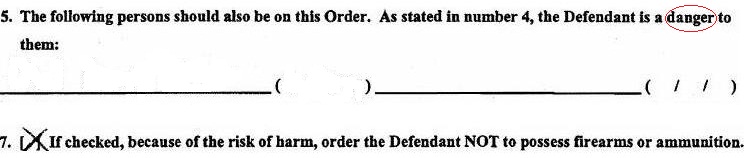
After requesting that it be postponed, her accuser eventually confessed at her appeals hearing (under cross-examination by her two attorneys) that his allegations were a fraud urged by his wife, who was jealous of his renewed relationship with a former flame. The innocent victim in this story was one of several they had brought restraining orders against. The false allegations cost them nothing: tic, tic, tic.

The lines below from the restraining order application used in my home jurisdiction illustrate how easily serious allegations may be brought against a person the judge approving that application has never met and knows absolutely nothing about. Allegations that may be utterly fraudulent and that take mere seconds to make may cause an innocent defendant years of torment—or even dismantle his or her life.

In a country that prides itself on its system of law, maybe leveling allegations of violence and threat shouldn’t be a kindergarten game of tic-tac-toe. If you agree, get ticked off and say so.

Tic.

Copyright © 2012 RestrainingOrderAbuse.com

False Allegations and Restraining Orders: The Moral Snare

Someone writes: “I made false allegations to obtain a PPO [an order of protection]. What do I do?”

Disappointingly, this is the first such query this blog has received. Hearteningly, it’s something. And this person should congratulate him- or herself on having a belated pang of conscience.

The ethical, if facile, answer to his or her (most likely her) question is have the order vacated and apologize to the defendant and offer to make amends. The conundrum is that this would-be remedial conclusion may prompt the defendant to seek payback in the form of legal action against the plaintiff for unjust humiliation and suffering. (Plaintiffs with a conscience may even balk from recanting false testimony out of fear of repercussions from the court. They may not feel entitled to do the right thing, because the restraining order process, by its nature, makes communication illegal.)

The lion’s share of the blame for fraud and its damages, of course, clearly falls on the shoulders of plaintiffs—the knots are theirs to untie—but the court should also recognize culpability.

The restraining order process is a honeypot to people nursing a grudge: it’s cheap, convenient, and accommodating. Its making the means to lash out readily available to anyone with a malicious impulse might even be called entrapment. And the court neither acknowledges this process’s consequences to wrongly accused defendants nor impresses upon plaintiffs the consequences to them of making false allegations.

(One defendant I corresponded with this year—who happily succeeded in having the order against her quashed months and thousands of dollars later—was clawing her hair out and dosing herself to sleep. Her young daughter was traumatized by the episode, too. She was accused of domestic violence by a man she’d briefly renewed a friendship with. He was put up to baselessly attacking her through the courts by his wife, who felt jealous—which he admitted in court after dragging the defendant through hell.)

By definition, a civil process shouldn’t foster discord and distress. Maybe lawmakers should mandate a cooling-off period before judges are authorized to approve restraining orders, as they do with handgun purchases.

Or maybe they should put this corrupt institution on ice.

Copyright © 2012 RestrainingOrderAbuse.com