
The postscript (P.S.) to a series of comments left on the blog this week by the stepmother of a man who was falsely accused of violence asks whether he could sue his ex-girlfriend for lying.
The details, as the stepmother reports them, are these:
- Man and woman, who aren’t married, were together for four years and have a one-year-old daughter.
 During the term of their relationship, no reports of any kind of domestic conflict were made to authorities.
- The woman has heart disease (diagnosed as “congestive heart failure”) and can only perform minimally stressful activities, so this had typified the couple’s daily life: The man “gets up [at] 5 a.m., feeds [the] daughter, changes [her] diaper, makes his lunch, and heads to work. [He] gets home around 4–4:30, and she is still in bed [and the] baby is still in [the] same diaper from that morning. […] He cleans, cooks, [does the] dishes [and] laundry, bathes [the] child, and heads to bed—and [the woman] bitches ‘cause he rolls over and goes to sleep.”
- On or about December 13, 2014, the couple “got in an argument, and she moved out, taking [their] child with her. She then texted [the child’s father] saying she was taking [the] child and moving to Oregon and he [would] never see [his] daughter again.”
- The woman then returned home to retrieve her belongings, “and when she went downstairs, he went out [the] door with [the] child. She freaked out. [Two] days later she filed a protection order saying all these lies about him…and he had to give [the] daughter back.”
- The woman, with her dad’s help, then relocated to Oregon with the child.
Among the woman’s allegedly false statements, apparently made to the police before she prepared to abscond with the child, was that the man pushed her into a fish tank, which it’s reported she actually slammed with her fist in a fit of rage while the man’s  back was turned. Since the woman’s knuckles were plainly lacerated from punching glass, no arrest ensued. According to the man’s stepmother, the woman lied similarly to procure a protection order a couple of days later.
The stepmom wants to know if her stepson can sue his girlfriend for lying under oath. The answer, which is no, exposes why lying to the court is so effective, besides being easy.
Quoting “The Rule against Civil Actions for Perjury in Administrative Agency Proceedings: A Hobgoblin of Little Minds” (University of Pennsylvania Law Review, 1983):
“No action lies to recover damages caused by perjury.” If A is injured by the false or misleading testimony of B in a judicial proceeding, A cannot maintain an action for damages against B; A can obtain relief only by a direct attack on the judgment. So it was at common law, and although some observers have called for its abandonment, courts today are unanimous in following that ancient rule.

Tennessean and fraud victim Betty Krachey has launched a petition to urge her state to punish lying.
Appreciate that a corollary of that “ancient rule” is that if someone who’s lied about in a judicial proceeding lapses into suicidal despondency and kills him- or herself, his or her loved ones have no legal recourse. If you publicly mislabel someone a stalker, child molester, or batterer, for instance, outside of court, and that person kills him- or herself, you can be sued. But if the same end results from false allegations you make in court, you get away scot free.
Perjury—that is, knowingly lying to the court about influential facts—is a “serious criminal offense,” as a law student from South Africa recently remarked in a comment about a case of restraining order fraud that emerged in her country’s popular press. In many if not most jurisdictions in the U.S., perjury is a felony.
Punishment for it, however, can only follow its prosecution by the district attorney’s office, which rarely initiates perjury proceedings and only does so in slam-dunk cases of prominent interest like misconduct by public officials. Private litigants can sue for damages caused by the commission of other crimes—murder, for example—and they can sue for slanders and libels made outside of court. They can’t, though, sue for damages caused by lies told in judicial proceedings, no matter how injurious those lies might be.
 The reason why, basically, is that the system likes closure. Once it rules on something, it doesn’t want to think about it again.
Consider what would happen if Person A lied about Person B, and Person B were authorized to sue Person A for lying. This would open the door for Person A to turn around and claim Person B lied in the second proceeding and sue Person B back. Person B could then pursue another action that alleged Person A lied about Person B in the third proceeding, and on and on ad infinitum.
While this would force the court to pay more than a lick of attention to the facts and also motivate it to drop the hammer on liars, it’s messy and time-consuming. So it’s rejected in the name of economy—and damn the consequences to people who are lied about.
This policy is among the reasons why restraining orders should be repealed.
Temporary orders are issued upon a few minutes’ prejudicial deliberation (really none at all). A petitioner goes to the courthouse, fills out some paperwork, and has a chitty-chat. If the accused doesn’t appeal, the court’s entire application to the case will have been those few minutes (sandwiched between stifled yawns). Even when a defendant  does appear in court to contest allegations against him or her, judicial “review” of the matter may be less than 30 minutes.
On the basis of this brief “review” (which is often merely theater), a person like the man in the story above can be branded a “domestic abuser,” have his or her name entered into state and national police databases (permanently), and be denied contact with his or her child (besides potentially being denied credit, leases, and jobs, and having to indefinitely endure the agony and humiliation of being re-judged for something s/he didn’t do). S/he can also be made to pay court costs for having his or her life torn apart by lies.
A person like him, who can be male or female, can attack the false judgment in a further appeal—provided s/he has the emotional and financial resource—but s/he can’t seek redress for fraudulent testimony given in evidence against him or her.
That would inconvenience the court.
Copyright © 2014 RestrainingOrderAbuse.com
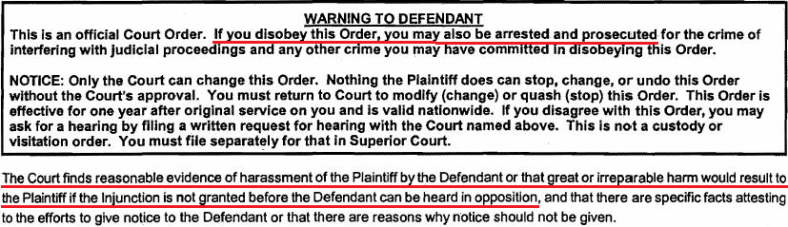
 Appreciate that the court’s basis for issuing the document capped with the “Warning” pictured above is nothing more than some allegations from the order’s plaintiff, allegations scrawled on a form and typically made orally to a judge in four or five minutes.
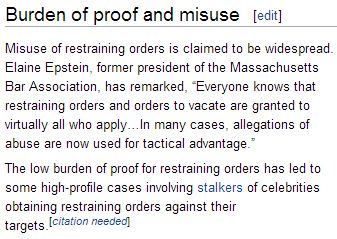
 No topic defies neutral qualification, and since Wikipedia’s own “Restraining order” page recognizes that restraining orders are widely claimed to be misused, and since restraining orders are furthermore issued against millions of people every year across the globe, restraining order abuse can hardly be dismissed as a trivial topic or one unworthy of attention and elucidation. That’s its being disregarded owes to avoidance of a sensitive subject is a more credible explanation.
 TALKING BACK to restraining orders