Daughter: “He hits me, Ma.”
Mother: “Well…I can’t say I’m surprised. What’d ya do?”
Daughter: “Whaddya mean, what’d I do?”
Mother: “What’d ya do to make him angry? He didn’t just hit ya outta the blue.”
Daughter: “I guess I didn’t do what he wanted me to.”
This exchange is extracted from a recent Hollywood movie set in the 1970s immediately preceding the advent of the restraining order and illustrates the social mindset that ’70s-era feminists sought to counteract, namely, one that tolerated spousal abuse and placed the blame for it on its victims.
Living in an environment of insecurity and intimidation is a daily torment no one should have to bear, and no one can deny that the motives that led to restraining order legislation’s being drafted were very sympathetic ones.
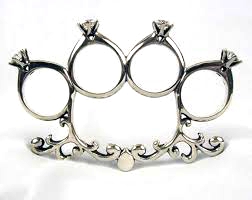 What this blog and others like it seek to bring to light is that restraining orders have become the arbitrarily brutal hand that they were originally conceived to check—and they’ve put brass knuckles on it.
Restraining orders’ abuses arise from the same impulse: anger, jealousy, or control, for instance; but they’re much worse in many ways than slaps and threats, because their consequences are more exacting, enduring, and inescapable.
As in the exchange above, the answer to why someone had a restraining order petitioned against him or her is too often: “I guess I didn’t do what [s/he] wanted me to.” The motive for the abuser’s action may be identical. Only the means of abuse are different.
Because those means may, and often do, include lying and lying publicly and savagely, abuses accomplished with restraining orders don’t fade like bruises do. A man falsely accused of domestic violence, for example, is publicly recognized as a batterer for the rest of his life, and that label may follow him from job to job or relationship to relationship. Years of his life may pass in agony before his ordeal in the courts has even concluded. A lie impulsively told to a judge in a few minutes may be something its victim has to continue to counteract forever, and though counseling may help him reconcile himself to the lie and its injuries, no amount of it will ever erase that lie, because it’s branded on his public face.
And while women alleged to be batterers may not be perceived as harshly as men accused of domestic violence, women, too, may be abused by restraining orders in exactly the same way, making a process that was designed to protect women a convenient means of brutalizing them that has the sanction of both the government and the feminist establishment.
Fraudulent allegations, furthermore, don’t need to be of domestic violence to lay victims low. Falsely characterizing them as stalkers or sources of sexual harassment or threat may be just as damning and damaging, both socially and psychologically. The implications of the phrase “protection order” or “restraining order” are alone sufficient enough, because their resonance never diminishes. It and its ramifications persist indefinitely.
The horror of the woman in the domestic situation suggested in the scene recited above was that she was stuck in an untenable situation, a situation she was powerless to correct or extricate herself from. Thirty years ago, a woman might have had nowhere to turn. Even mom and dad might turn her away and remind her that she swore a vow of fidelity she was obligated to honor (which is what the mother in this scene does).
Today, a (female) victim of spousal abuse has options. Public and familial reactions to her plaints are liable to be very different. She can move out and divorce without any stigma affixing itself to her, and if she lacks the wherewithal, there are shelters that may take her in until she’s able to provide for herself.
For the victim of restraining order abuse, there are no escapes. The stigma, which may be debilitating, is permanent and may be accompanied besides by his or her being denied access to home, kids, pets, property, and money. In other words, s/he may find him- or herself robbed by the state of all resources and values on top of having to bear a psychic wound there’s no staunching.
Restraining order frauds go over easily, because three decades later authorities and the courts are still responding to what they imagine are scenarios like the one sketched in the scene above. Irrespective of the actual circumstances, it’s what sparks and fuels the indignation that meets many defendants on the faces and in the conduct of judges they’re brought before, conduct that verges on retributive vigilantism.
It’s time to dust off the misperceptions and the process itself. Restraining order laws, which originated in the 1970s, have “evolved” retrospectively, seemingly aiming to amend injustices that occurred before many or most recipients of restraining orders today even drew breath.
The sins of our fathers and forefathers, however villainous (and they assuredly were), aren’t anyone’s but theirs.
Copyright © 2013 RestrainingOrderAbuse.com
 I had an exceptional encounter with an exceptional woman this week who was raped as a child (by a child) and later violently raped as a young adult, and whose assailants were never held accountable for their actions. It’s her firm conviction—and one supported by her own experiences and those of women she’s counseled—that allegations of rape and violence in criminal court can too easily be dismissed when, for example, a woman has voluntarily entered a man’s living quarters and an expectation of consent to intercourse has been aroused.
 Lapses by the courts have piqued the outrage of victims of both genders against the opposite gender, because most victims of rape are female, and most victims of false allegations are male.
 As many people who’ve responded to this blog have been, this woman was used and abused then publicly condemned and humiliated to compound the torment. She’s shelled out thousands in legal fees, lost a job, is in therapy to try to maintain her sanity, and is due back in court next week. And she has three kids who depend on her.
 TALKING BACK to restraining orders