Disdain for a Feminist Institution of Law Isn’t the Same as Disdain for Women

“I am the victim of false accusations [by] a female with sociopathic tendencies. She stabbed my husband [and] threatened to kill me, but for whatever reason filed for a domestic violence protective order on me. I value respect from people, so I do and act morally to maintain my relationships, but because any given person, whether sane or not, can go file a petition with its being granted depending on how it’s worded, I was treated like a criminal and not one time given the opportunity to inform even the judge that the petitioner had committed perjury. Only in [West Virginia] a felony can be committed and go unpunished. This is [an overlooked] flaw that needs immediate attention!!!! This not only jeopardizes my future, but my kids’ future, because if the petitioner wouldn’t have dropped it, it would [have been] filed in a national database, popping up whenever a background check is done on me, including [by] my college for my admission into Nuclear Medicine Technology…and this is all based on a drug-addicted, manipulating, vindictive person’s false accusations.”

—Female e-petition respondent

“Dangerous law easily used as a sword instead of shield. A Butte man died over this. His girlfriend, after making the false allegations, cleaned out his bank account. He committed suicide. His mother, Ruth, had no money to bury him. The girlfriend depleted his assets partying.”

—Female e-petition respondent

“I can relate to this topic, because I once made false allegations against my lover because I was a woman scorned and wanted to get even with him and make him feel the same level of pain that he made me feel. Luckily for him and me, I was convicted in my spirit and confessed to the court that I’d lied, and the matter was dropped. If I’d not been led to do that, my lie could have ruined this man’s life….”

—Female e-petition respondent

“It makes me sick that there are so many families affected by false allegations. The children [who] are affected break my heart. We have been living this nightmare for over a year now—over $40 thousand dollars spent, and this woman still keeps us in court with her false allegations…. At what point will the courts make these people accountable???”

—Female e-petition respondent

A recent comment to this blog from a female victim of restraining order abuse (by her husband) expressed the perception that criticism of feminist motives and the restraining order process, a feminist institution of law, seemed vitriolic toward women.

Her reaction is understandable.

What isn’t perceived generally, including by female victims of fraudulent abuse of process, is that the restraining order was prompted by feminist lobbying just a few decades ago and that its manifest injustices are sustained by feminist lobbying. It’s not as though reform has never been proposed; it’s that reform is rejected by those with a political interest in preserving the status quo.

Political motives, remember, aren’t humanitarian motives; they’re power motives.
So enculturated has the belief that women are helpless victims become that no one recognizes that feminist political might is unrivaled—unrivaled—and it’s in the interest of preserving that political might and enhancing it that the belief that women are helpless victims is vigorously promulgated by the feminist establishment that should be promoting the idea that women aren’t helpless.

It’s this belief and this political might that make restraining order abuses, including abuses that trash the lives of women, possible. Not only does the restraining order process victimize women; it denies that women have personal agency.

Nurturance of the belief that women are helpless victims puts a lot of money in a lot of hands, and very few of those hands belong to victims.

The original feminist agenda, one that’s been all but eclipsed, was inspiring women with a sense of personal empowerment and dispelling the notion that they’re helpless. The restraining order process is anti-feminist as is today’s mainstream feminist agenda, which equity feminists have been saying for decades.

Restraining orders continue to be doled out (in the millions per annum) on the basis of meeting a civil standard of evidence (which means no proof is necessary), pursuant to five- or 10-minute interviews between plaintiffs and judges, from which defendants are excluded.

So certainly has the vulnerability and helplessness of women been universally accepted that the state credits claims of danger or threat made in civil restraining order applications on reflex, including by men, because our courts must be perceived as “fair.” Consequently, fraudulent claims are both rampant and easily put over.

Restraining orders aren’t pro-equality and don’t contribute to the advancement of social justice. They do, though, put a lot of people’s kids through college, like lawyers’ and judges’.

Copyright © 2014 RestrainingOrderAbuse.com
Victim-Blaming: The “Patriarchal Paradigm,” Discrimination against Male Victims of Domestic Violence, the Frequency of False Allegations, and Abuses of Men and Women by Restraining Order Fraud

“Accounting for the discrepancy between the empirical data and current public policy has been the gender paradigm (Dutton and Nicholls 2005), also known as the patriarchal paradigm (Hamel 2007b), a set of assumptions and beliefs about domestic violence that has shaped domestic violence policy on arrest, treatment, and victim services at all levels for the past several decades. A product of feminist sociopolitical theory, the paradigm posits that the causes of domestic violence can be found in patriarchy and male dominance…. Despite data that are inconsistent with the feminist perspective…it remains a dominant influence….”

Journal of Family Violence (2009)

In a recent post, I wrote about false allegations of domestic violence and quoted a male victim who was arrested when he reported to police that he was being assaulted. The ensuing ordeal cost him his “career, [his] name, and three years of income” before the police department copped to wrongdoing and settled with him out of court.

DV1Deplorably, this is what comes of asking for help from a system that’s been conditioned to perceive men as stalkers, batterers, and rapists (despite the fact that best population-based studies reveal as many as half of victims of partner violence are men).

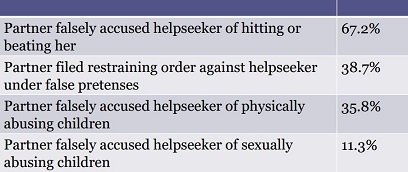
According to findings by Dr. Denise Hines, more than a quarter of male victims of domestic violence who call the police are themselves arrested as a result (26%). Half of the time, responding police officers do nothing, and in less than one in five cases (17%) is a reported female abuser arrested.

Imagine the outrage of the National Organization of Women if half the women who reported being battered were blown off by authorities, or if one in every four women who reported being battered was herself arrested and prosecuted for assault.

This isn’t to say, of course, that the “patriarchal paradigm” promoted by feminist advocates and the Violence against Women Act (VAWA) doesn’t also brutally injure women.

Alternative to filing criminal complaints is the filing of civil protection orders—and this knife cuts both ways. Diminished standards of verification applied to allegations made in connection with restraining orders ensure that women, too, are abused by the state according to false allegations leveled against them by conniving men. The frequency of female victimization by men is lesser; the damages of that victimization are not.

Returning to the journal article quoted in the epigraph (Muller, Desmarais, and Hamel), consider:

Every state in the United States now authorizes its courts to issue civil orders of protection against domestic violence. Typically, a temporary domestic violence restraining order (TRO) is issued ex parte at the request of any plaintiff who expresses an “objectively reasonable subjective fear of being injured” (Miller 2005, p. 74), without the respondent (i.e., the alleged perpetrator) having to be present in court. TROs are granted for two- to four-week periods, at which point a hearing is held to determine if a permanent order is warranted, valid in most states for a period of one to four years. In California, as of June 6, 2003, there were 227,941 active restraining orders (including temporary and permanent) issued against adults, almost all of them for domestic violence. Of the domestic violence orders, approximately 72% restrained a man from a protected woman, 19% restrained a same-sex partner, and 9% restrained a woman from a protected man (Sorenson and Shen 2005). Of particular significance to family court cases, the protected parent almost automatically obtains custody of the children, without a custody hearing or a custody decision being made (Kanuha and Ross 2004; Sorenson and Shen 2005).

Various motives for lying to the court are both obvious and confirmed.

“Many TROs and POs [protection orders],” concludes a Hawaiian task force on restraining orders, “are obtained by one party to a dispute to try to gain advantage over another party in future or ongoing divorce proceedings or a custody dispute” (Murdoch 2005, p. 17). In California, the Family Law section of the state bar expressed concern that domestic violence restraining orders “are increasingly being used in family law cases to help one side jockey for an advantage in child custody and/or property litigation and in cases involving the right to receive spousal support” (Robe and Ross 2005, p. 26). A retired Massachusetts judge revealed to the press that, in his experience, one-third of restraining orders are strategic ploys used for leverage in divorce cases (“Retiring Judge” 2001). Attorneys Sheara Friend and Dorothy Wright, the latter also a former board member of a battered women’s shelter, estimate that 40 to 50% of restraining orders are used to manipulate the system (Young 1999). In some cases, mothers secure custody despite a history of abuse against the father or the children (Cook 1997; Pearson 1997).

As I prefaced these quotations by remarking, they shouldn’t be interpreted to mean that men don’t also lie to inculpate women (who may be the actual victims of domestic violence), because they do, as the study these quotations are drawn from suggests. The rate of false allegations between the sexes may in fact be equivalent (and as high as 50%).

The difference is that women far more often make allegations (and thus false allegations) against men than vice-versa.

Absent from all analytic studies and contemplations is the toll of false allegations and victim-blaming on those devastated by them, which can’t be quantified.

Copyright © 2014 RestrainingOrderAbuse.com
Who or What Can’t Be Published on CafeMom?: On Ad Hominem Attacks, Feminist Hatemongering, and the Victimization of Moms by Both

I was concerned to see that someone was brought to this site recently by the search term “Tara Palmatier [X].” I’ve omitted the final word of the phrase not because it’s vulgar but because I don’t want an anomalous Google query to put an idea into the head of some crank with too much time on her hands.

Dr. Tara J. Palmatier is a psychotherapist whose writing I’ve come to admire and respect, and which I’ve consequently quoted many times. She has what distinguishes the brilliant from the intelligent: bold candor. I did a hasty Google search of my own to see what would have prompted someone to use the keywords cryptically quoted above and nothing correspondent appeared except a page that appeared to be a spoof.

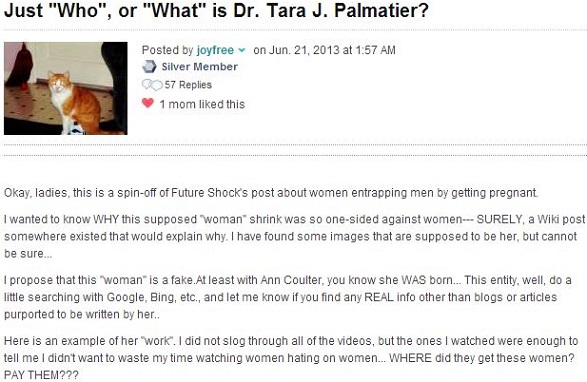
I did, however, notice this post, published eight months ago, on CafeMom: “Just ‘Who’ or ‘What’ is Dr. Tara J. Palmatier?” (which was deleted subsequent to the publication of this post).

In several pieces I’ve published over the last couple of months, I’ve given critical scrutiny to feminist rhetoric, because I believe the gross civil injustices this blog concerns owe their ontological debt and perpetuation to such rhetoric.

Consider the rhetorical strategies of this writer, who identifies herself with a picture of a kitty cat and the alias “joyfree” (prompting this writer to wonder whether she’d be less catty if she were more joy-ful).

Note first that the question that titles the post disdains to recognize Dr. Palmatier as human. Why? Apparently because she wrote about women’s entrapping men by getting pregnant. Assuming she did, how this observation could be “one-sided against women” is baffling, not for the least of reasons because it’s impossible for men to entrap women by getting pregnant. The actual source of the beef, of course, isn’t its writer’s perception of Dr. Palmatier as unfair; it’s kneejerk resentment of a woman’s criticizing women. That’s why instead of offering a reasoned critical response, the writer simply denounces a (“supposed”) woman with a doctorate in clinical psychology as a “fake.” (William Buckley called this “rebuttal by epithet.”)

There’s little point in my spending an hour parsing (and thereby dignifying) the facile hatemongering of an anonymous writer who probably invested half that time cobbling her post together. What I would bring to the attention of this blog’s audience (particularly its female readers) is that this vitriol was published on a site called CafeMom. This isn’t a forum of radical feminist academicians; these are your everyday householders. And the question I would hope scrutiny of public statements like this arouses is when did it become okay to attack someone’s sexuality and qualification as a human being, because she voiced an eminently informed, professional opinion that wasn’t favorable to female exaltation?

If Dr. Palmatier were black, would it still be okay to suggest she wasn’t human? Not so much, right? Observe, though, that this writer’s rhetorical strategies (like those of any number of like-minded writers) pretty much mirror those of racial bigots of centuries past.

And it slides under the radar.

What shouldn’t slide under the radar of this blog’s readers is that the acceptability of these kinds of views is an indicator of the breadth of feminist influence, and it’s this coercive influence by women that allows this to continue (quoted from the e-petition “Stop False Allegations of Domestic Violence”):

“My ex has used the law and the justice system, and destroyed my life and those of my minor children! He lied and said he had a witness to testify to his false accusations and bullied me into a deal with the devil eight months ago, and has filed five emergency ex parte motions to remove my kids…. He has put me in debt. I lost my job. I have no money, no friends. Therapists will not help my children as they are afraid he will ruin their lives, too…. Lawyers drop the case because of the constant verbal abuse he does to me and eventually to them, too. I have no friends left. Everyone has left me, and my family is far away, and their hands are tied. He has told teachers and principals and camp counselors these horrible accusations and caused me to have to move to a different town. My five-year-old told me his mind is telling him to die because his mommy is never happy. So what about the [woman] who [doesn’t] cry wolf and [leaves] an unhealthy marriage to save [her] kids and [has] a scorned, mentally ill, narcissistic ex-husband who is torturing every single day and using the law to harass [her]? He is a doctor and has deep pockets, and I am now in debt with no income. Had they been ethical the day of the hearing and admitted that they had no witness anymore, this would never have happened. So what about the tortured women?”

Over to you, CafeMom.

Copyright © 2014 RestrainingOrderAbuse.com

False Allegations of Rape: A Digression into Taboo Territory from Talking back to the Usual Sorts of False Allegations Made on Restraining Orders

=The prevalence of false allegations of rape is contested. What isn’t contested by anyone is that false allegations of rape are made, and what shouldn’t be contested by anyone is that false allegations of rape (and any number of other offenses) are heinous lies that may end life as they knew it for the falsely accused.

The specter invoked by “rape culture” is what informs public perceptions of allegations of fear and violence made on restraining orders, and has prompted the operant conditioning to which authorities and judges have been subjected for decades and which translates to an accused’s being presumed guilty on little or no more basis than that an accusation was made. So influential has rhetoric like this been that most or all allegations made on restraining orders are perceived as valid, urgent, and sinister, whether they’re made against men or women. Police officers and judges have been conditioned to react reflexively instead of critically in these cases, and they’ve been authorized, moreover, to view and treat the accused with contempt.

Acknowledging that false allegations are made doesn’t discount the reality and trauma of rape, nor does it excuse the act; it isn’t a concession to the “enemy.” Not acknowledging that false allegations are made, however, does make light of human torment and is inexcusable. Also, it’s false accusers, more than anyone, who discredit and mock the trauma of real victims; and for this reason, they should be the targets of feminist ire, instead of those who advocate for the victims of false accusers.

Statistics reported by Cathy Young, whose journalistic integrity is unimpeachable, conservatively put false allegations of rape at 9% (as computed by the FBI). It’s often posited that many more rapes occur than are reported, which is no doubt true. So the percentage of false allegations relative to the number of actual rapes may be less than 9%. This, though, is a misleading observation that mixes apples and oranges. Unreported rapes have nothing to do with the fact that a conservatively estimated 9% of alleged rapes are falsely alleged rapes.

A consideration that isn’t statistically irrelevant, furthermore, is that some false allegations of rape aren’t recognized as false.

To a feminist, even a 9% false-allegation rate is deemed negligible. Maybe it’s statistically negligible—and that’s a BIG maybe—but people aren’t statistics. That nine in a hundred represents nine people. In 1,000 cases, that’s 90 people. In 10,000 cases, that’s 900 people.

According to Wikipedia, “Nearly 90,000 people reported being raped in the United States in 2008.”

What’s evident in the slant of writing that discounts false allegations of rape is that the lives of the falsely accused are somehow less important than the lives of rape victims. Categorically, they are not, and concluding otherwise betrays what psychologists call “emotional reasoning.” The falsely accused have no relationship either to the victims or perpetrators of rape whatsoever.

Falsely accused = innocent.

What’s implicit in the slant of writing that discounts false allegations of rape is that the victims of those allegations are men, and men having it coming to them anyway.

This manner of thinking is wrong. Like a rape victim, someone falsely accused of rape (or anything else) is someone who is guiltless. Period. (S)he is not accountable, by any sane standard, for the actions of rapists (or other offenders). Period.

Thinking to the contrary has infected the perceptions of our administrators, legislators, judges, and police officers to the lasting detriment of every man who’s falsely accused of anything. And not just every man who’s falsely accused. The propagandist rhetoric generated by this thinking is lethal, and it has corrupted our system and our social conscience to their marrows.

Victims of false allegations are casualties—casualties—not trivia.

Copyright © 2014 RestrainingOrderAbuse.com

The Modern-Day Witch Trial: On Using a Restraining Order to Accuse a Mother of Rape

The last post addressed the case of a mom who’s been accused of serial rape by the father of one of her children.

Ignore whether it’s okay to allow a man’s record to be contaminated with an uncorroborated allegation of rape scrawled on a restraining order application—an allegation, incidentally, that will ruin his life (there’s not an employer on the face of the planet who’s going to respond to “She accused me of rape” with “Oh, fiddlesticks. When can you start?”).

Ignore that and consider what judge, in the “bad old days” before restraining orders existed, would have allowed a woman to be publicly labeled a rapist, merely by implication.

Now consider how far back in history we’d have to reach to find a time when such an unfounded allegation would previously have been taken seriously. I’m not a historian, but my guess would be during the period when we last had witch trials.

It was probably possible, say, as recently as the 1600s to have a woman tried as a succubus (a demon in female form who forcibly copulated with men while they slept) just based on “persuasive” testimony like “She consorts with the devil!”

Our modern-day witch trials, restraining order adjudications, which proceed from the same non-evidentiary basis, don’t threaten penalties like drowning or incineration. I wonder, though, whether their draconian punishments were the only aspects of the original witch trials that were unjust.

Copyright © 2014 RestrainingOrderAbuse.com

Restraining Orders Are Heroin: On Feminists, “Rape Culture,” and Affliction Addiction

“I have known my ex since 2007, and our relationship was never easy. I stood with him during the affairs, the lies, whatever…. We had a child in 2009, and then the violence started…. After the last failed mediation in Nov[ember] 2012, he again wanted to get back together, [and] I was hit with a new motion to change the parenting time for our child, and he stated that I was harming or endangering our child.

“In Jan[uary] 2013, he again wanted us to work [things] out, and I again agreed…. I began to assist with bills, his house, [and] accommodating his requests with our child. Fast forward to Oct[ober] 2013…after learning once again there were other women involved and accepting his apology at dinner one night, the next day I was served with a temp[orary] restraining order. It was filled with a whole lot of false allegations and a report that he filed with the police. The report with the police came back unfounded, and shortly after that report was put into evidence, he filed an addendum to his original…restraining order in Nov[ember] 2013, adding on 38 more individual allegations dating back to 2007 from when we first met.

“In mid-Nov[ember] 2013, he then filed an additional complaint against [me] through military channels…. He has also filled more in [on] our parenting-time case against me.

“He is now stating that since 2007, he feels I have been forcing him into sex, and he may now need to seek therapy after learning how often he has been raped.

“Since the restraining order has been in effect, my ex has contacted my family, has [had] his new [girlfriend] file complaints with me at my job, has filed additional allegations with my job, and is now saying I am an unfit parent.

“I just am unsure where to turn…or what to do. If this restraining order is found to go permanently against me, I have more to lose with my career and way of providing for my children, and though he is aware of this, he is also not backing down. And now with his new allegations in court about the forced sexual encounters for years, his feelings of being afraid, and his claim that he will need to seek therapy, I am not sure how all of this will play out against me.”

 Blog respondent

I recently acquainted myself with rape culture,” a term used ubiquitously in feminist screeds, and observed that there’s a contrary case to be made for its being applied to the defenders of court-mediated villainies that emotionally scourge innocents and cripple their lives.

The woman whose story serves as epigraph to this discussion is one such victim. Here’s a woman, a mother, moreover, who has endured beastly treatment with the patience of Job only to be labeled a rapist, terrorist, unfit mother, etc., etc. and who now faces the prospect of having her entire existence tweezed apart.

With regard to so-called rape culture, consider that this woman’s story shows that not only may false allegations of rape be readily put over on the courts through restraining order abuse; it isn’t just men who can be falsely accused.

Maybe feminist readers of this woman’s saga of pain would only conclude that it wasn’t impressed upon her early enough that women need men like fish need bicycles. Or maybe they’d conclude that it just goes to show how awful men can be, disregarding that the woman has also been persecuted by her ex’s new girlfriend.

In fact, what it and any number of others’ ordeals show is that when you offer people an easy means to excite drama and conflict, they’ll exploit it.

There’s a reason why opiates are carefully controlled substances that aren’t freely handed out to everyone who claims to need them for pain relief. If they were, a lot of people would welcome a cheap high.

Process abusers need to be recognized for what they are: substance abusers. Restraining orders, whose injustices persist because they’re vehemently championed by ideologues, are dispensed gratuitously and used gratuitously. For too many users, what’s more, they’re gateway drugs that whet an insatiable, predatory appetite.

Drama and attention junkies are no different from any other kind. Offer them a free narcotic, and they’ll take it and jones for more.

Defenders of restraining orders, who think of them as fixes, don’t realize how right they are.

Copyright © 2014 RestrainingOrderAbuse.com

“Truth,” Ms. Magazine, and Restraining Order Allegations

In a recent post, I commented on a 2010 entry on the Ms. Magazine Blog whose writer evinced no awareness either of how false allegations work or how damaging they can be, and that advocated for laxer restraining order laws in Maryland. Even if this writer were capable of conceding that false allegations are made, it’s unlikely that she could intuit a subtlety like this: allegations don’t even have to be lies to be frauds. It’s for this reason, not least of all, that higher standards and expectations of verification, equity, and deliberation must be applied to the civil restraining order process.

Consider this scenario:

A man eyes a younger, attractive woman at work every day. She’s impressed by him, also, and reciprocates his interest. They have a brief sexual relationship that, unknown to her, is actually an extramarital affair, because the man is married. The younger woman, having naïvely trusted him, is crushed when the man abruptly drops her, possibly cruelly, and she then discovers he has a wife. Maybe she openly confronts him at work. Maybe she calls or texts him. Maybe repeatedly. The man, concerned to preserve appearances and his marriage, applies for a restraining order alleging the woman is harassing him, has become fixated on him, is unhinged. As evidence, he provides phone records, possibly dating from the beginning of the affair—or pre-dating it—besides intimate texts and emails. He may also provide tokens of affection she’d given him, like a birthday card the woman signed and other romantic trifles, and represent them as unwanted or even (implicitly) disturbing. “I’m a married man, Your Honor,” he testifies, admitting nothing, “and this woman’s conduct is threatening my marriage, besides my status at work.”

Question: Where’s the lie?

The woman, who had fallen for this man, may have been desperate for an explanation for his betrayal, reasonably expecting the man who had courted her with flowers and sweet nothings to reemerge. Maybe she becomes incensed by his disowning his deception, and angrily takes him to task. He may genuinely feel harassed and alarmed by her not simply going away after giving him what he wanted from the relationship, because his marriage and reputation are at stake. His evidence is real. He doesn’t explicitly use the word “stalker”; he just lets the facts speak for him. In a literal sense, he’s telling the truth.

Not so cut-and-dried, is it?

This scenario isn’t fantasy. It roughly corresponds to a story that was shared with me by a woman who had just begun a promising career in law and had bright and lofty ambitions she’d toiled many years to realize. The job she aspired to have is one from which she’s been permanently disqualified by the man’s having (very easily) obtained a restraining order against her to mask his own misconduct and punish her for not minding her place.

In 10 years, the woman, a 20-something attorney who had set her sights on working for the FBI, may instead be a recovering alcoholic working for Legal Aid. Her lover, by contrast, may have made partner at her former law firm. The seniors there may sometimes jokingly speculate, sipping from lowballs and puffing on stogies, about what became of “that crazy stalker who used to work here.”

If this is the justice Ms. Magazine advocates for, it needs a new name.

Copyright © 2014 RestrainingOrderAbuse.com

If You’re not Part of the Solution, You’re Part of the Problem: On Why Restraining Order Abuses Have Persisted for So Long and How to Do Something about It

“Men are bastards!”

“Women are cun[ning]!”

I could end this editorial here, and I would have summed up the problem, which originates with hearts but owes its infinitude to different organs entirely.

Predictably, since most restraining orders are sought against a member of the opposite sex, online forums about dirty divorces, domestic abuse, treacherous lovers, vengeful exes, predatory or parasitic whackjobs, etc. often boil down to cross-gender sniping and “team camaraderie.” Women just want to be pissed with men and bitch about them with other women, and men just want to be pissed with women and bitch about them with other men.

Both genders have limitless potential to suck; sex is beside the point.

Those who profit politically and monetarily by the misery inflicted through court processes that are easily abused by the “morally unencumbered” love all this conflict and misdirected rage, which only ensure that these corrupt processes continue to thrive.
They’ve already hummed along without a hitch for over 30 years. In fact, they’ve gained momentum, despite reasoned and articulately critical pans from distinguished members of the legal, journalistic, academic/philosophic, and public policy communities.

Not only does cross-gender bitching by victims of state abuses distract from the actual source of the problem, which is bad laws; it makes those victims sound like the cranks and nuts everyone else is glad to assume they are.

True, the person who betrayed you and lied about you should be subjected to medieval punishment. True, the judge you got may be worthy of the same for his or her cruelty or carelessness or cluelessness. But…the reason either was entitled to abuse and humiliate, rob and defame you was THE LAW.

Except for the statutes that authorized your injuries, those injuries wouldn’t have been possible.

Passive aggression isn’t going to accomplish anything. I can’t imagine venting even makes anyone feel better for very long.

Aggressive aggression holds a lot more promise. If you’ve been wronged, tell your story, and tell it in a way that will count. Sign a petition and add a comment about your own circumstances. You don’t even have to expose your name. Sign several and tweet them, too (a few are below). Start a petition of your own. Tweet that also and post it here. Start a Facebook page. Connect and consolidate forces.

STOP FALSE ALLEGATIONS OF DOMESTIC VIOLENCE

THE SUPREME COURT: FEATHER FOR THE FALSELY ACCUSED

RESTRAINING ORDER LAWS ARE DANGEROUS AND UNFAIR TO MEN

This may seem unthinkable to you, especially if your wounds are fresh, but appreciate that the impulse to conceal shame only potentiates that shame. If you’ve been wronged, the shame isn’t yours. Re-channel your emotions in constructive ways. You’re not alone.

No one wants to do this. No one should have to. I wanted to write humor for kids. Though not a big dream, it contented me, and I think I would have been successful at it by now and that other doors would have opened. I was dragged from my interior world and away from the life I might have enjoyed. Not only am I not a political person; I don’t even like board games.

I do, though, hate bullies, especially ones with gangs behind them.

Recognize that the ringleader of the gang that assaulted you isn’t that petty lowlife you mistakenly invested your trust in; he’s an invisible man who’s represented in posters wearing red, white, and blue, and his gang is everybody.

The only way you can beat him and attain some satisfaction is by taking away his gang and making it yours.

Copyright © 2014 RestrainingOrderAbuse.com

The New Domestic Violence: Restraining Order Abuse

Daughter: “He hits me, Ma.”

Mother: “Well…I can’t say I’m surprised. What’d ya do?”

Daughter: “Whaddya mean, what’d I do?”

Mother: “What’d ya do to make him angry? He didn’t just hit ya outta the blue.”

Daughter: “I guess I didn’t do what he wanted me to.”

This exchange is extracted from a recent Hollywood movie set in the 1970s immediately preceding the advent of the restraining order and illustrates the social mindset that ’70s-era feminists sought to counteract, namely, one that tolerated spousal abuse and placed the blame for it on its victims.

Living in an environment of insecurity and intimidation is a daily torment no one should have to bear, and no one can deny that the motives that led to restraining order legislation’s being drafted were very sympathetic ones.

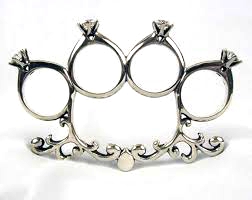
What this blog and others like it seek to bring to light is that restraining orders have become the arbitrarily brutal hand that they were originally conceived to check—and they’ve put brass knuckles on it.

Restraining orders’ abuses arise from the same impulse: anger, jealousy, or control, for instance; but they’re much worse in many ways than slaps and threats, because their consequences are more exacting, enduring, and inescapable.

As in the exchange above, the answer to why someone had a restraining order petitioned against him or her is too often: “I guess I didn’t do what [s/he] wanted me to.”  The motive for the abuser’s action may be identical. Only the means of abuse are different.

Because those means may, and often do, include lying and lying publicly and savagely, abuses accomplished with restraining orders don’t fade like bruises do. A man falsely accused of domestic violence, for example, is publicly recognized as a batterer for the rest of his life, and that label may follow him from job to job or relationship to relationship. Years of his life may pass in agony before his ordeal in the courts has even concluded. A lie impulsively told to a judge in a few minutes may be something its victim has to continue to counteract forever, and though counseling may help him reconcile himself to the lie and its injuries, no amount of it will ever erase that lie, because it’s branded on his public face.

And while women alleged to be batterers may not be perceived as harshly as men accused of domestic violence, women, too, may be abused by restraining orders in exactly the same way, making a process that was designed to protect women a convenient means of brutalizing them that has the sanction of both the government and the feminist establishment.

Fraudulent allegations, furthermore, don’t need to be of domestic violence to lay victims low. Falsely characterizing them as stalkers or sources of sexual harassment or threat may be just as damning and damaging, both socially and psychologically. The implications of the phrase “protection order” or “restraining order” are alone sufficient enough, because their resonance never diminishes. It and its ramifications persist indefinitely.

The horror of the woman in the domestic situation suggested in the scene recited above was that she was stuck in an untenable situation, a situation she was powerless to correct or extricate herself from. Thirty years ago, a woman might have had nowhere to turn. Even mom and dad might turn her away and remind her that she swore a vow of fidelity she was obligated to honor (which is what the mother in this scene does).

Today, a (female) victim of spousal abuse has options. Public and familial reactions to her plaints are liable to be very different. She can move out and divorce without any stigma affixing itself to her, and if she lacks the wherewithal, there are shelters that may take her in until she’s able to provide for herself.

For the victim of restraining order abuse, there are no escapes. The stigma, which may be debilitating, is permanent and may be accompanied besides by his or her being denied access to home, kids, pets, property, and money. In other words, s/he may find him- or herself robbed by the state of all resources and values on top of having to bear a psychic wound there’s no staunching.

Restraining order frauds go over easily, because three decades later authorities and the courts are still responding to what they imagine are scenarios like the one sketched in the scene above. Irrespective of the actual circumstances, it’s what sparks and fuels the indignation that meets many defendants on the faces and in the conduct of judges they’re brought before, conduct that verges on retributive vigilantism.

It’s time to dust off the misperceptions and the process itself. Restraining order laws, which originated in the 1970s, have “evolved” retrospectively, seemingly aiming to amend injustices that occurred before many or most recipients of restraining orders today even drew breath.

The sins of our fathers and forefathers, however villainous (and they assuredly were), aren’t anyone’s but theirs.

Copyright © 2013 RestrainingOrderAbuse.com

Rape and Restraining Order Fraud: On How Men Betray Women, How Women Betray Men, and How the Courts and the Feminist Establishment Betray Them Both

I had an exceptional encounter with an exceptional woman this week who was raped as a child (by a child) and later violently raped as a young adult, and whose assailants were never held accountable for their actions. It’s her firm conviction—and one supported by her own experiences and those of women she’s counseled—that allegations of rape and violence in criminal court can too easily be dismissed when, for example, a woman has voluntarily entered a man’s living quarters and an expectation of consent to intercourse has been aroused.

Her perception of judicial bias against criminal plaintiffs is one shared by many and not without cause.

By contrast, I’ve heard from hundreds of people (of both genders) who’ve been violated by false accusers in civil court and who know that frauds are readily and indifferently accepted by judges. (Correspondingly, more than one female victim of civil restraining order abuse has characterized her treatment in court and by the courts as “rape.”)

Their perception of judicial bias against civil defendants is equally validated.

Lapses by the courts have piqued the outrage of victims of both genders against the opposite gender, because most victims of rape are female, and most victims of false allegations are male.

The failures of the court in the prosecution of crimes against women, which arouse feminist ire like nothing else, are largely responsible for the potency of restraining order laws, which are the product of dogged feminist politicking, and which are easily abused to do malice (or psychological “rape”).

In ruminating on sexual politics and the justice system, I’m inexorably reminded of the title of a book by psychologist R. D. Laing that I read years ago: Knots.

In the first title I conceived for this piece, I used the phrase “can’t see eye to eye.” The fact is these issues are so incendiary and prejudicial that no one can see clearly period. Everyone just sees red.

Under the Violence Against Women Act (VAWA), federal funds are doled out to police precincts and courts in the form of grants purportedly intended to educate police officers and judges and sensitize them to violations against women, which may have the positive effect of ensuring that more female victims of violent crimes see justice but simultaneously ensures that standards applied to the issuance of civil restraining orders slacken still further, allowing casual abuse of a free process to run rampant and destroy lives. The victim toll of false restraining orders negates strides made toward achieving justice for female victims in criminal prosecutions. What is more, though restraining orders are four times more often applied for by women than men, making women their predominant abusers, the laxity of restraining order administration allows women to be violated by men, too.

Not only was a woman I’ve recently been in correspondence with repeatedly assaulted by her short-term boyfriend, a charming and very cunning guy; he also succeeded in petitioning a false restraining order against her, alleging, among other things, violence. She had even applied for a restraining order against him first, which was dismissed:

There are no words for how I felt as I walked to my car that afternoon. To experience someone I had cared deeply about lying viciously in open court, to have a lawyer infer that I’m a liar, and to be told by a judge that, basically, he didn’t believe me (i.e., again, that I’m a liar), filled me with a despair so intense that I could hardly live with it. You know how, in trauma medicine, doctors will sometimes put grossly brain-injured patients into medically-induced comas so as to facilitate healing? That afternoon, I needed and longed for a medically-induced emotional coma to keep my skull from popping off the top of my head. I don’t know how else to describe it. It was that day that I learned that the justice system is rotten, that the truth doesn’t mean shit, and that to the most depraved liar go the spoils.

As many people who’ve responded to this blog have been, this woman was used and abused then publicly condemned and humiliated to compound the torment. She’s shelled out thousands in legal fees, lost a job, is in therapy to try to maintain her sanity, and is due back in court next week. And she has three kids who depend on her.


The perception that consequences of civil frauds are no big deal is wrong and makes possible the kind of scenario illustrated by this woman’s case: the agony and injury of physical assault being exacerbated by the agony and injury of public shame and humiliation, a psychological assault abetted and intensified by the justice system itself.

The consequences of the haywire circumstance under discussion are that victims multiply, and bureaucrats and those who feed at the bureaucratic trough (or on what spills over the side) thrive. The more victims there are and the more people there are who can be represented as victims, the busier and more prosperous grow courts, the police, attorneys, advocacy groups, therapists, etc.

What’s glaringly absent in all of this is oversight and accountability. Expecting diligence and rigor from any government apparatus is a pipedream. So is expecting people to be honest when they have everything to gain from lying and nothing to lose from getting caught at it, because false allegations to civil courts are never prosecuted.

Expecting that judges will be diligent, rigorous, and fair if failing to do so hazards their job security, and expecting civil plaintiffs to be honest if being caught in a lie means doing a stint in prison for felony perjury—that, at least, is reasonable.

The obstacle is that those who hold political sway object to this change. The feminist establishment, whose concern for women’s welfare is far more dogmatic than conscientious, has a strong handhold and no intention of loosening its grip.

Typically both criminal allegations of assault or rape and civil allegations in restraining order cases (which may be of the same or a similar nature) boil down to he-said-she-said. In criminal cases, the standard of guilt is proof beyond a reasonable doubt, a criterion that may be impossible to establish when one person is saying one thing and the other person another, evidence is uncertain, and there are no witnesses. In civil cases, no proof is necessary. So though feminist outrage is never going to be fully satisfied, for example, with the criminal prosecution of rapists, because some rapists will always get off, feminists can always boast success in the restraining order arena, because the issuance of restraining orders is based on judicial discretion and requires no proof at all; and the courts have been socially, politically, and monetarily influenced to favor female plaintiffs. However thwarted female and feminist interests may be on the criminal front, feminists own the civil front.

And baby hasn’t come a long way only to start checking her rearview mirror for smears on the tarmac now.

Copyright © 2013 RestrainingOrderAbuse.com

Also, Restraining Orders Don’t Work

“Few lives, if any, have been saved, but much harm, and possibly loss of lives, has come from the issuance of restraining orders.”

—Justice Milton Raphaelson (upon his retirement)

There’s no denying that the restraining order is a forceful instrument and a nasty one to be on the receiving end of, especially when the behaviors alleged against you are trumped up. The question is, what good are restraining orders when they’re used legitimately?

Dr. Charles Corry, president of the Equal Justice Foundation, has compiled a horror-show list of examples in support of his thesis that court orders that purport to protect women only exacerbate the male rage they promise to defuse or avert.

In The Gift of Fear, Gavin de Becker cites two government investigations that support Corry’s conclusions: “In a study of 179 stalking cases sponsored by the San Diego District Attorney’s Office, about half of the victims who had sought restraining orders felt their cases were worsened by them. In a study done for the U.S. Department of Justice, researchers concluded that restraining orders were ‘ineffective in stopping physical violence.’” De Becker, whose book was published 16 years ago, offers this perspective: “Lawyers, police, TV newspeople, counselors, psychologists, and even some victims’ advocates recommend restraining orders wholesale. They are a growth industry in this country. We should, perhaps, consider putting them on the New York Stock Exchange, but we should stop telling people that a piece of paper will automatically protect them, because…it may do the opposite.”

How many women who trusted in the protection of restraining orders, I wonder, have been maimed, lamed, scarred, or killed since de Becker’s book was printed?

The restraining order’s advent arose in response to feminist outcry for legislative redress of domestic violence. It has since become a judicial quick fix for any complaint involving an allegation of harassment or even vague apprehension. Its original purpose, one for which it has never adequately served, has been obscured; and the ends to which it’s often wielded today are starkly less sympathetic.

Feminist scholars Camille Paglia, Christina Hoff Sommers, and Daphne Patai have publicly criticized the feminist influence that squelches a reasoned consideration of these issues; and conservative commentator Phyllis Schlafly  has published columns openly deriding the value and validity of restraining orders and the judicial processes from which they originate.

(I was unsurprised to find a page on Wikipedia entitled, “Restraining order abuse,” that had been deleted. The explanation for its removal reads, “No indication that this article…covers a notable and/or neutral topic.” A related article, “Restraining order,” did acknowledge that abuse of restraining orders “is claimed to be widespread.” That verbiage has been redacted. When I began this blog in 2011, it included these stats, also, which have since been edited out: “A 1995 study conducted by the Massachusetts Trial Court that reviewed domestic restraining orders issued in the state found that less than half of the orders involved even an allegation of violence [note that over 15 years have gone by since then]. Similarly a West Virginia study found eight out of 10 orders were unnecessary or false.” Once you could find an eHow article explaining, “How to Avoid Becoming a Victim of Restraining Order Abuse.” Its URL now redirects to “How to Get a Harassment Restraining Order in Chicago.”)

My own contempt for restraining order laws and how they’re applied couldn’t be keener. But I’m also angry for women legitimately at risk. Not only are restraining orders prone to casual abuse—making them a mockery—they don’t answer the problem for which they were enacted.

The dominant political influence in the perpetuation of the status quo in all matters related to restraining order legislation is that exerted by dogmatic feminists (a.k.a. “gender feminists”). And money talks. Feminism’s representatives have received billions in federal funding under the Violence Against Women Act (VAWA). A cynic might propose that the interests of the cause are being protected over the welfare of the victims of restraining orders, male and female.

If vengeance for past injustices and leverage over men are feminists’ intent, then defense of current restraining order policies certainly has a lot to recommend it (just ask any attorney who practices family law). Here’s where honest self-examination of motives by feminists, specifically those of the academic stripe (a.k.a. “The Sorority”), is due.

Feminists should realize, being in the main acutely intelligent women, that sexual discrimination and role reversals—however spitefully gratifying they may be—don’t signify an advance toward gender equality but rather a resignation to its unattainability that parades as social progress. Encouraging women to crouch behind the legs of parental policies, policies both biased and in some cases dangerously or even fatally ineffectual, isn’t encouraging them to stand on their own two feet. Feminist used to mean brassy and independent.

Let’s be clear here: assault is already a crime. The answer to it is a barred cage.

Let’s be honest, too. The common function of restraining orders is tactical terrorism. They don’t empower women; they just diminish men (and feminist and judicial credibility). They’re exploited as expedients—and often for ends ulterior to the ones their petitioners profess.

Turnabout may be fair play, but it’s still just gamesmanship that we’re talking about, not equity. If feminists are sincere when they say they want to be taken seriously, their aim should be nobler than dominance of the sandbox by baseball bat.

You know something’s gone very wrong when the question becomes, who’s battering whom?

Copyright © 2013 RestrainingOrderAbuse.com

Why Judges Are Scared of Girls: On Sexual Politics and Restraining Order Injustice

A not insignificant reason for judges’ pandering to women who claim to be afraid of this man or that man is their consciousness of the impact that a feminist backlash would have on their careers if they were to discount a woman’s allegation of fear and then that fear were to be proved valid. So long robe and gavel.

It’s happened.

Knee-jerk feminists, to quote philosopher and feminist scholar Christina Hoff Sommers, are “brilliant work-shoppers, networkers, [and] organizers…. There has never been a more effective army of busybodies. And they know how to work the system.” They’re a political force to be reckoned with and one today’s society has been conditioned to truckle to. Seven or eight years ago, Harvard President Larry Summers was given the bum’s rush for making statements construed as derogatory to women at a conference on gender imbalances in science. And a judge is no less vulnerable to the feminist chopping block than a university president.

In theory, civil rulings are based on a preponderance of evidence. In practice, at least in the fast and loose arena of restraining order administration, they observe the rule that it’s better to err on the side of caution.

And it isn’t only men who suffer the consequences of this dereliction. Because the court must be seen to be fair and balanced, women are conversely victimized by unscrupulous men in accordance with the same politically slackened evidentiary standard. (In fact, though only one in five restraining orders is issued to a woman, at least as many women as men have submitted comments to this blog chronicling torturous restraining order ordeals—and some of these women even report they’ve been victimized by other women.)

The rationale echoes that of the witch trials: if a person was never a threat at all and doesn’t violate the restraining order, s/he appears to have been tamed by it, and the court can congratulate itself; if s/he was a threat and violates the restraining order, the court was right to intervene…and can congratulate itself.

Bottom line: We did our job.

Which is of course untrue. The court’s job isn’t to protect and serve the public. That’s the job of the police, which is why it says so on their cars. And it certainly isn’t the court’s job to protect and serve the career interests of its judges. The court’s job is to protect the dignity of our legal system and to impartially and diligently serve the cause of justice.

And none other.

Copyright © 2013 RestrainingOrderAbuse.com

Feminism and Gender Guilt: On Restraining Order Policy’s Encouraging Judges to Abuse Men

A police officer’s job is to enforce policy, not interpret it. And policy respecting allegations made pursuant to seeking a restraining order, in particular allegations made by women, is to take the truth of those allegations for granted.

Judges, on the other hand, are paid—and quite handsomely—to interpret evidence and testimony, and to apply policy based on deliberated conclusions.

So how is it so many men are railroaded through a process that may be initiated on no evidence at all, may strip them of their most valued investments and every bit of social and financial equity they’ve built in their lives—kids, home, money, property, business, and reputation—and may ensure that they’re never able to recover what they’ve been deprived of?

Feminists don’t acknowledge their political might, because that would be disadvantageous to their accumulating more of it. They continue to plead victimization and to promote skewed or bogus statistics like one in four women are prey to rapists or attempted rapists, women earn a mere fraction of what men do, girls are ignored by their teachers, and battery is the leading cause of birth defects and increases by 40% on Super Bowl Sunday.

Enterprising journalists like Ken Ringle and dissident feminist scholars Christina Hoff Sommers and Camille Paglia have long ago debunked all of these claims, yet they continue to circulate. The feminist propaganda machine hums right along. And its malign and maligning influence has been very effective.

(Besides the aforementioned feminist scholars, journalist Cathy Young and Elaine Epstein, former president of the Massachusetts Bar Association, have called giving attention to restraining order administration long overdue—in articles published 10 to 20 years ago.)

Judges and the judicial system proceed in matters of protection of women as father-guardians (which mainstream feminists don’t seem to find patronizing or infantilizing). The rhetoric is defendants are presumed innocent; the practice is they’re presumed guilty. Judges—more often than not male—pander to the women who come before them to beg their intervention; men are treated like police suspects.

Judges of these matters, like the women who introduce them, aren’t bound by the same ethical restrictions that obtain in other sorts of cases (especially if there are no lawyers present). A detective in the county attorney’s office I spoke with put it this way: because restraining orders grew out of a clamor to address domestic violence, judges are inclined to let their inner vigilantes off leash when a male defendant appears before them. They’re glad to have a trussed target for their frustrated wrath and to play the white knight.

The slack standards that govern restraining order administration are defended as leveling the playing field. They’re in fact engineered to level men. The judges who do the administering are predisposed by policy and propaganda to regard male defendants through jaundiced eyes and to bring the gavel down on their heads.

It’s probably very cathartic for them.

Copyright © 2013 RestrainingOrderAbuse.com

Restraining Order Fraud and Female Victimization of Men

It shouldn’t be any mystery why with millions of restraining orders being issued each year in the Internet age complaints of abuses aren’t louder and more numerous: stigma.


A woman’s having taken out a restraining order against him—particularly one alleging violence or fear of violence—isn’t something a man is apt to broadcast, even if the order was grounded on sheer lies (and especially if those lies aren’t ones he’s able to expose as such). Allegations of fear or threat by women aren’t held to any standard of substantiation. They can be completely vaporous (pardon the oxymoron), and judges are cool with that.

Also, the experience of being publicly shamed is a harrowing one and one a man isn’t likely to want to revisit. (There’s always, besides, the apprehension of incurring further malice from the courts. For many injunction defendants, ever again having access to home, property, or children is entirely subject to judicial impulse.)

An unscrupulous woman not only enjoys the gratification of being rewarded for her fraud by a paternal system that regards her as a fragile fledgling in need of special protections; she also enjoys the impunity guaranteed by her victim’s fear of humiliation and social and professional condemnation.

Society today condescends to give a sympathetic ear to women’s plaints; men are still expected to suck it up. Feminists promote a double standard they profess to oppose to reap the benefit: not gender equity but political advantage.

There are a number of sites on the Internet that advocate for “men’s rights” (see how even the phrase sounds absurd?) like A Voice for Men and Men’s Activism News Network. You’re unlikely to hear them cited on NPR. Feminism is chic and trendy: VAWA! NOW! AAUW! The Vagina Monologues!

“Masculinism” isn’t a word.

Copyright © 2013 RestrainingOrderAbuse.com

“A Nightmare That Won’t End”: Dealing with False Allegations

A person who obtains a fraudulent restraining order or otherwise abuses the system to bring you down with false allegations does so because you didn’t bend to his or her will like you were supposed to do.

To contest the restraining order (or whatever other state process was abused) is to once more defy the will of your accuser.

No surprise then that such an accuser will up the stakes on you. Defy subsequent allegations, and your accuser will escalate them further. This is especially the case when your accuser is female. It’s not for nothing that the (mis)quotation, “Hell hath no fury like a woman scorned,” has become immortal. (And it’s not only men who have to fear this wrath; women can be at least as vehemently and doggedly brutal to other women.)

It’s rare for a false accuser to relent.

This is partly due to psychology and partly due to how easily the processes we’re talking about are abused. Restraining order issuance, for example, pretty much follows a revolving-door policy: plaintiffs are in and out in minutes.

Once a foothold is attained, and the paperwork starts mounting in the plaintiff’s favor, she’s committed and feels ten feet tall, and the snowball begins rolling downhill on its way to becoming an avalanche.

One success (that first rubber-stamped round of allegations) assures that a repeat performance will be that much easier. And it is. Both police officers and judges have been “educated” to react paternally to allegations leveled by women, and the worse those allegations are, the more hastily they’re swallowed. Initial allegations once validated by a judge’s signature, moreover, make future allegations that much more credible and future judges’ eyes that much narrower.

Each added strand strengthens and sustains the web of lies and makes it that much more lethal a snare.

Any number of men and women have written to this blog reporting that they never had a run-in with the law in their lives, and now, in the span of a few months, they’ve been transmogrified into Attila the Hun.

And no one gazing down the tunnel from the far end—whether an employer, a neighbor, or a judge—can perceive that it originates with some calculated lies scrawled on a bureaucratic form: “Hey, can I borrow your pen for a sec? I’ll give it right back.”

Lies like these, upon multiplying like cancer cells and having as they do the full force of public policy behind them, can take over lives.

And, relentlessly chewing, chewing, chewing like the parasitic agents they are, destroy them.

Processes that are supposed to defend people from abuse provide liars with the perfect media to make their wildest vengeance fantasies come true.

Copyright © 2013 RestrainingOrderAbuse.com

“You Mean It Isn’t All about Me?”: On Women and Restraining Orders

A woman writes: “I got a TRO, and he got a lawyer.” (TRO abbreviates “temporary restraining order.”)

What’s the first thing that strikes you about this search engine query? The first thing that strikes me is that this woman seems surprised. You can almost hear the exclamation point that was left off the Google search.

Her incredulity at having her restraining order challenged seems to suggest that its defendant shouldn’t regard it as a big deal, which would suggest that she doesn’t regard it as one.

Which would suggest that she’s either careless of the consequences of her action or very self-preoccupied—or both.

Over the past three decades, feminist advocates have succeeded in making restraining orders more and more punitive and more and more public. The current push is to have restraining order recipients recorded in public registries like sex offenders. Some such registries already exist.

It shouldn’t be any wonder that men are loath to be criminalized by the “civil” restraining order process.

The query that led this woman to this blog underscores a schizophrenic rift that obtains in the way women regard restraining orders. On the one hand, they expect women’s plaints to be considered grave and urgent and restraining order allegations to be taken very seriously; on the other hand, they expect defendants to take their licks and forge ahead in spite of those publicly recorded allegations’ permanently compromising their futures. Maybe women want to have their cake and eat it, too—or maybe they don’t really think about the consequences to defendants at all.

Civil equality—the insistence upon which was the original motive for the legislative enactment of restraining orders—means uniform regard for the rights, value, and well-being of all citizens, irrespective of gender. With the social ascendancy of women in recent decades has come instead an unexamined assumption that what’s important to them should be what’s important to everyone.

Restraining orders aren’t a game, a fact that’s contradicted by the ease with which they’re sought, the carelessness with which they’re issued, and the apparent expectation from plaintiffs that they should be upheld based on their word alone. All restraining order plaintiffs should have to face cross-examination in court. Social conscience should demand it.

Either restraining orders should be taken seriously, or they should be taken off the books.

Copyright © 2012 RestrainingOrderAbuse.com

Mind the Gender Gap: On Coming Together against Restraining Orders

This blog was “liked” this week by a blogger whose collegiate disciplines are criminology and sociology. In her own blogs, she tracks news of interest to students of these fields that relates especially to social justice and gender-based violence and oppression (phrases that are often mistaken as exclusively concerning the same thing).

Contrasting her blogs’ contents with those of sites that monitor and editorialize on issues of concern to this blog highlights a divide that must be spanned if progress is to be made toward achieving genuine social justice (the word social being inclusive of both sexes). Informed and objectively critical minds like hers—sensitive both to the needs for civil equality and recognition and redress of violence toward women—are out there, and cultivating their advocacy is vital to reforming the defective restraining order process.

I’m a day laborer and would-be children’s humorist who doesn’t even have Internet service at home. The time I’m able and willing to devote to keeping tabs on movements in the blogosphere is scant. But I have perforce become familiar with many of the sites that focus on restraining order injustice, and the preponderance of respondents to most if not all of them are men whose views on this injustice and the issues that orbit it typically derive from one ideological bias or another: post-70’s misandry, the political favoritism shown to women in the West, the courts’ attack on the family, etc.

I don’t challenge the merits of their beefs, which far from lacking legitimacy are very defensible; but these forums leave little room for unification of awareness and purpose among activists and socially conscientious members of the community at large.

The advocacy rift is often crudely genital: boys siding with boys and girls either seeing the boys as villainous, uncompromising, or exclusionary. Men, reared as and genetically engineered to be rule-oriented beings, equate unfair with wrong (plain and simple). Women, pragmatic and historically the holders of the short end of the stick, aren’t immune to the difference between fair and unfair but know the impetus behind the advent of restraining orders to be an urgent and well-grounded one: men are violent.

Men aren’t going to quit being violent if the restraining order process is dissolved, and the process isn’t going to trend toward fairness if it isn’t. Herein lies the rub.

Both sides of this divide are naturally reactionary, and the mediated space—that occupied by those sensitive to both truth-born positions—is narrow and sparsely populated.

It’s a manifest and uncontestable fact that the restraining order process is biased, unconstitutional, and injurious to both men and women who find themselves on its receiving end. It caters to and rewards fraud, and liars come in both sexes. The process’s flaws will only become clear to the mainstream when proponents of one team or the other stop being opponents.

The split in perspective is as much Cartesian as sexual: body vs. mind. Violence can in fact be of either sort, physical or psycho-emotional. Even rape isn’t strictly a physical act. Many violations, equally traumatic and enduringly oppressive, are perpetrated by men and women who never touch their victims. A false allegation of rape, for example, is a rape. The notion that physical violence is necessarily worse is facile and unexamined. Physical violence is loud and dramatic; psychological violence is invisible and insidiously corrosive. Both can be catastrophic. Calumnious lies are just as likely to drive victims to despair or even conceivably suicide, and the pain of these violations is magnified manyfold in the case of false allegations made in restraining order cases, because victims (men, especially) can’t expect social sympathy, as victims of violence may, but quite the opposite: condemnation. (This was the horror that kept a lid on abuses by Catholic priests for so long. Adults molested as boys were constrained from coming forward by fear of further shame, humiliation, and social indictment. Damages finally awarded to these victims weren’t for their being manhandled so much as their being scarred to the extent that they failed to thrive.)

Mob mentality is what sustains the crooked restraining order process; it won’t be what leads to its revision. A problem is that those who speak against it have never been a direct party to it (except in the case of activist attorneys), and those who have been victimized aren’t talking at all, because they’ve been intimidated into silence. Advocates tend to subscribe to one dogma or the other: good/bad, pro/con. Good or bad, useful or not—these are natural but misleading inquiries. The restraining order process is flawed and destructively pernicious, being both subject to and permissive of wanton abuse. To bring this fact and its poignancy across to a political consensus, the partisan gap must be closed. Finger-pointing is fruitless and even erroneous, because the real culprit is a faceless bureaucratic machine that has no oversight.

And it’s going to take a plurality of arms to pull the lever that stills its gears.

Copyright © 2012 RestrainingOrderAbuse.com

False Allegations and Restraining Orders: The Moral Snare

Someone writes: “I made false allegations to obtain a PPO [an order of protection]. What do I do?”

Disappointingly, this is the first such query this blog has received. Hearteningly, it’s something. And this person should congratulate him- or herself on having a belated pang of conscience.

The ethical, if facile, answer to his or her (most likely her) question is have the order vacated and apologize to the defendant and offer to make amends. The conundrum is that this would-be remedial conclusion may prompt the defendant to seek payback in the form of legal action against the plaintiff for unjust humiliation and suffering. (Plaintiffs with a conscience may even balk from recanting false testimony out of fear of repercussions from the court. They may not feel entitled to do the right thing, because the restraining order process, by its nature, makes communication illegal.)
The lion’s share of the blame for fraud and its damages, of course, clearly falls on the shoulders of plaintiffs—the knots are theirs to untie—but the court should also recognize culpability.

The restraining order process is a honeypot to people nursing a grudge: it’s cheap, convenient, and accommodating. Its making the means to lash out readily available to anyone with a malicious impulse might even be called entrapment. And the court neither acknowledges this process’s consequences to wrongly accused defendants nor impresses upon plaintiffs the consequences to them of making false allegations.

(One defendant I corresponded with this year—who happily succeeded in having the order against her quashed months and thousands of dollars later—was clawing her hair out and dosing herself to sleep. Her young daughter was traumatized by the episode, too. She was accused of domestic violence by a man she’d briefly renewed a friendship with. He was put up to baselessly attacking her through the courts by his wife, who felt jealous—which he admitted in court after dragging the defendant through hell.)

By definition, a civil process shouldn’t foster discord and distress. Maybe lawmakers should mandate a cooling-off period before judges are authorized to approve restraining orders, as they do with handgun purchases.

Or maybe they should put this corrupt institution on ice.

Copyright © 2012 RestrainingOrderAbuse.com

Lying and Restraining Orders: How the Justice System Doesn’t NOT Encourage Perjury

A woman writes: “What was the legislative intent of having the petitioner sign under oath in a civil TRO [temporary restraining order]…?”

The question seems ingenuous enough. The answer, obvious to anyone who’s run afoul of the restraining order racket, is that people lie.

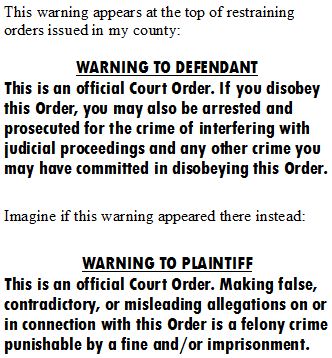
Less ingenuous is the state’s faith that a warning against perjury in fine print on the last page of a restraining order application (that its petitioner has just spent 20 minutes filling out) is going to discourage a liar from signing his or her name to the thing. (In my county this “warning” reads, “Under penalty of perjury, I swear or affirm the above statements are true to the best of my knowledge….” No explanation of perjury or its penalties is provided.)

If the courts really sought to discourage frauds and liars, the consequences of committing perjury (a felony crime whose statute threatens a punishment of two years in prison—in my state, anyhow) would be detailed in bold print at the top of page 1. What’s there instead? A warning to defendants that they’ll be subject to arrest if the terms of the injunction that’s been sprung on them are violated.

Led by the dated dictum that it should in no way discourage would-be restraining order petitioners, the state relegates its token warning against giving false testimony to the tail end of the application where it will most likely be disregarded.

And why not? Perjury is never actually prosecuted.

What this woman’s question reveals is (1) that the average petitioner doesn’t equate statements made on restraining order applications and in affidavits with sworn testimony given in a courtroom, and (2) that neither the consequences to plaintiffs of making inaccurate, misleading, or intentionally false statements to the court nor the consequences to defendants of being emotionally saddled with a restraining order are seriously weighed.

After a more complete digestion of this woman’s question, the unavoidable answer to it is that the legislative intent of having the petitioner sign under oath is plausible deniability of the process’s inviting and rewarding fraudulent abuse.

Copyright © 2012 RestrainingOrderAbuse.com

The Problems with Restraining Orders: Flaws, Flimflam, and Other F-words

Their administration is both biased and anti-feminist

The justice system takes it as axiomatic that plaintiffs who say they are victims are victims, especially when these plaintiffs are female. This policy ignores the obvious, namely, that people lie. Moreover, the court’s showing partiality toward female plaintiffs to redress a perceived inequity between the sexes only fosters reverse discrimination and exhibits contempt for the essential feminist conviction that women merit equal treatment under the law—no less and no more. This disdained expectation, the right to equal treatment, is the same one that restraining orders were originally conceived to acknowledge and validate. Women are still patronized. They’re just patronized in a more favorable way (“There, there, dear”).

They play into the fabulistic and sympathy-seeking tendencies of women

When women are in love, the objects of their affections can do no wrong. They exhale perfume. A spurned woman or one who otherwise nurses a grudge, however, will vilify a man to his toenails. A slight is an attack, a slammed phone is an act of violence, a hand balled in frustration is a death threat. Women, long habituated to the practice by conversations with other women, anatomize the smallest details of masculine conversation and conduct, and apply to them the interpretations that suit the color of their feelings. Exaggeration, embellishment, and caricature in conversation with judges, which is essentially what the brief interviews between judges and restraining order plaintiffs amount to, are to be expected. Judges, subjected to the equivalent of sensitivity training on steroids, accept statements made in these conversations as the equivalent of testimony, which, if made on a witness stand before a jury, would in fact be held to much higher standards of objectivity, accuracy, and accountability.

They’re more effective as instruments of abuse than as instruments of protection

The reliability of restraining orders as shields against violent abuse is iffy at best. Anyone dedicated to doing another harm is unlikely to be deterred by a piece of paper, which may just fan the flames. As vindictive weapons against those who never intended their plaintiffs any harm, however, restraining orders can’t be beat. They demolish lives.

Guilty verdicts are foregone conclusions

The nature of restraining orders being to silence, fetter, humiliate, and intimidate, efforts by defendants to dissuade judges from their institutionally schooled biases are enfeebled and easily disregarded. Defendants who resist are already presumed guilty, and their ability to defend themselves is compromised both by this prejudgment and their consciousness of it. Defendants (men, especially) are likely to file into appeals hearings feeling the presence of a noose around their necks: heads bowed, postures shrunken, voices pinched. Defendants, before they’ve even had a chance to hear the allegations made against them, let alone respond to them, have been confronted by a police officer at their homes and served a judgment by the state: harasser, stalker, deviant, aggressor, villain. When you feel judged, you look and sound guilty.

The system is broken

The failure of judicial oversight committees and state lawmakers and administrators to impose the expectation of fairness on the restraining order process provides judges of a certain bent the opportunity to let loose on defendants with both barrels, indiscriminately and with impunity (judges of this disposition, what is more, seem to be in the majority—maybe because they like adjudicating in this arena). This misconduct is not only sanctioned but oftentimes encouraged and applauded (“Throw the bums to the curb! Atta boy!”). No statutory consequences for plaintiffs’ giving false testimony are enforced, nor are judges held to their canons of office. The victims of abuses by plaintiffs and judges have no advocates or recourses: there’s no impartial ear within the system to turn to. Even those on the outside, journalists and civil rights advocates, shy away from the political razor wire that protects this airtight system.

Summary

The restraining order process is f*ed, and so is everyone it snares. Even the wrongly accused who manage to escape it—like bugs sucked into a vacuum cleaner and dumped from the bag—are lastingly damaged.

Copyright © 2012 RestrainingOrderAbuse.com

Restraining Orders Are Hurting You, Too (A Call to Moderate Feminists)

Some reject the notion that moderate feminists exist, a misapprehension that arises from labeling. I know many, though they don’t readily identify themselves as feminists. Their agenda isn’t the subjugation of men. “Equity feminists” is what philosopher and feminist scholar Christina Hoff Sommers calls them, a term she applies to women who promote (and justly expect) equal rights, representation, and recognition to distinguish them from “gender feminists,” her term for embittered female chauvinists. Ms. Sommers makes the distinction, because she believes feminism has since the eighties been coopted by influential extremists. And she’s right.

This post isn’t directed at them.

Its subject is the reform of restraining order legislation, and it’s a subject that should be of concern to the liberal feminist majority. Rampant abuse of restraining orders has now been allowed to persist for decades. The number of restraining orders issued is estimated at two to three million a year in the United States alone, and as many as 80% of these are said to be frivolous at best and at worst utterly fraudulent. Consider then the proportion of the voting constituency who have been abused and alienated by a process originally conceived by the state to appease feminist activists.

Take a second to do the math.

This number swells by two citizens a minute. One of these guys (or gals) may be a sociopathic creep. But at least one will be a normal, law-abiding Joe who will have had his faith in government permanently compromised and may feel very jaded toward any measure advocating social change on behalf of women, no matter how worthy.

Add to this the friends and family members of victims of restraining order abuse who’ve been lastingly affected, and the number may double, treble, or quadruple.

That restraining orders are routinely abused isn’t a secret. With tens of millions of them having been issued in the last 30 years, chances are you encounter people every day who’ve received one or who know someone who has. Two women I’ve corresponded with recently—one of them an anonymous critic of this blog—have brothers whose lives have been ruined by false allegations of violence made by women. And this fact was completely coincidental to the reason for their contacting me.

Moderate feminists take note: the crimped convictions of the influential minority that preserves this persecutory status quo are actively eroding the sympathy you rely on (and should be able to rely on). The solution is reform. The same activist zeal you apply to advancing worthy feminist aims must be brought to bear on ensuring that down the road there’s still going to be someone listening to you.

Copyright © 2012 RestrainingOrderAbuse.com