If You’re Silent, You’re Guilty: Take a Page from the Feminist Playbook and Register Your Complaint

It was impressed upon me by a new mentor—who possesses a much more practical mind than mine—that I don’t want to still be writing about this stuff when I’m old and gray (and that, besides, if I keep trying to “make a difference” by myself, “old and gray” will be just around the corner).

What these statistics reflect is that (1) confusion about restraining orders, if not fraudulent abuse of restraining orders, is epidemic; and (2) complainants of procedural abuses are intimidated into silence. No one wants to own humiliating or demonizing accusations against him or her, even if they’re false. This is, perhaps ironically, why fraudulent abuse of process continues unabated: Too few people talk back, so no one in a position to reform the status quo realizes there’s a problem in need of urgent remedy.

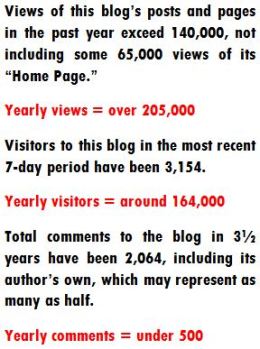
In the week leading up to Friday the 13th, 2015, WordPress reports that over 3,000 people visited this site (a few of them probably the same people on different days, but nevertheless…). Of that 3,000-plus, maybe 20 left comments or responded to petitions this site links to.

Maybe.

To one of the people who did submit a comment, a woman who was charged with assaulting her husband because she inadvertently scratched his arm while she was appealing to him to be nicer to her (during a verbal attack), I remarked that more people need to speak up about what they’ve been put through.

This woman, Izabella, has a restraining order against her, based on “all sorts of allegations,” that she reports her husband got to dominate and control her (to bully her, plain and simple). She says he’s never been an “involved dad” but uses their children now to “blackmail” her, because she had the temerity to “stand up to him.” The kids are pawns in a petty power game.

This is the kind of thing feminists deny happens (and adamantly deny happens to men). They insist restraining orders are there to protect women like Izabella.

Feminists are often wrong but never uncertain.

Their rigid advocacy is actually what makes scenarios like this possible, and for that reason, among others, I seldom find cause to sing their praises (though I’m not closed to the idea). One of their constant refrains, however, that victims will only speak up if they feel confident they’ll be believed, is right (and it’s why restraining orders exist to begin with).

Victims of procedural abuses need to speak up so that others will.

Respondents to this blog don’t need to identify themselves; they don’t even have to provide their email addresses if they don’t want to, though that information isn’t made public and allows them to be notified of others’ responses to their comments. It also lets them have dialogues among themselves.

Provided everyone plays nice, this writer is glad to take a backseat. (He’s been informed that nothing anyone else says is his responsibility, anyway.)

“Outing” yourself isn’t necessary, per se, to motivate change. But the public only understands what it sees and hears. If it sees and hears nothing, then that’s exactly what it will understand.

Copyright © 2015 RestrainingOrderAbuse.com

Granting Anonymity to “Men Wrongly Accused of Rape” Is Not about Anything but Protecting the Innocent: Talking Back to Joan Smith, Chair of the Mayor of London’s Violence Against Women and Girls Panel

“There is a scandal around rape in this country. But it isn’t about a handful of men who have been wrongly accused, no matter how justifiably angry they are. Compared to the number of cases that never see the light of day, their experience is, I’m afraid, a drop in the ocean. It is about the many thousands of victims who don’t get justice at all—and the main effect of giving anonymity to accused men would be to make that situation even worse.”

—Joan Smith, The Guardian (Jan. 7, 2015)

It shouldn’t require observation that the headline of Joan Smith’s op-ed, “Men wrongly accused of rape mustn’t be granted anonymity,” makes no sense.

Probably the headline meant to read, minus the word wrongly:Men accused of rape musn’t be granted anonymity.” Disturbing, though, is that no one notices a difference between the two versions, so conditioned has the equation of accusation with guilt (and allegations with facts) become. “Wrongly accused”/“accused”—the distinction doesn’t seem to matter. The implication of that irrelevance is that they’re all guilty really.

In a democratic society, if anyone is a “drop in the ocean,” then everyone is.

When a reported case of rape becomes prominently publicized and then discredited, such as the “Jackie case” printed in Rolling Stone a few months ago, its female subject is not regarded as a “drop in the ocean,” and many feminist writers have exhorted their readers to “remember Jackie” whatever the truth of the circumstances might have been.

Why are purported victims of rape due compassionate recognition but actual victims of false allegations to be written off? Is it too superficial to answer, Because the latter are men? Maybe…and maybe not.

In a commentary in Time Magazine last month, Cathy Young makes a case for “A Better Feminism in 2015.” Toward that worthy goal, feminist advocates must start exercising their faculty for sympathy less selectively.

The perception of pervasive, one-sided male power and advantage can create a disturbing blindness to injustices toward men—even potentially life-ruining ones such as false accusations of rape. A true equality movement should address all gender-based wrongs, not create new ones.

The crux of Ms. Smith’s position is this: “The truth is that our criminal justice system is failing to protect victims. And the reasons for that failure present a very powerful case against anonymity for those accused.”

Her position, blame and the innocent be damned, in turn makes a very powerful case for apathy to the “truth…that our criminal justice system is failing to protect victims [of sexual violence].” False allegations impact the lives of far more than “a handful of men who have been wrongly accused [of rape],” and the deficient empathy exemplified by supposing false allegations even of rape do no more than cause some to be “justifiably angry” is why a lot more than some are “justifiably angry.” False allegations don’t merely rankle; they maim.

The tone set by writers like Ms. Smith informs the direction of social science research and legislation, and prejudices authorities and judges (especially toward lesser allegations with overtones of violence like stalking and domestic abuse, whose defendants—male and female—are most vulnerable to vigilantism from the justice system). It, besides, prejudices the broader public.

The vehement imperative to expose exemplified by Ms. Smith’s commentary translates to federal cases’ being made of mere allegations of harassment—literally. In the U.S., restraining order defendants, who may only be accused of “harassment” or purportedly causing someone to “fear” (in civil not criminal hearings), are registered with the FBI, as well as entered into statewide police databases, to their lasting detriment.

While it may be the duty of the state to respond to complaints of abuse, it is not the duty of the state to invite complaints, let alone to urge them, by exposing the merely accused to scorn and revilement. In a society of equals, no one is a “drop in the ocean.”

Copyright © 2015 RestrainingOrderAbuse.com

Feminism and False Accusation Culture

“The idea that—as pandering anti-feminist goon Christina Hoff Sommers asserted over the weekend—university campuses have a ‘false accusation culture’ is as ludicrous as the idea that Sommers herself is a feminist. Not only do we not have a ‘false accusation culture’ anywhere on earth, we don’t have an accusation culture at all. Most victims never say a word. The price is too high. And, if their joy at the outing, harassment and supposed ‘discrediting’ of Jackie is any indication, Sommers and her cohort would like to keep it that way.”

Lindy West, The Guardian (Dec. 9, 2014)

Alongside the headline of Lindy West’s op-ed, “Rolling Stone threw a rape victim to the misogynist horde,” is a tag that reads, “Comment is free.” It’s a fitting commentary on Ms. West’s commentary, which is cheaper than just cheap.

Not only is false accusation culture real; it extends beyond the quad.

Ms. West’s piece centers on the “Jackie story,” a Rolling Stone “exposé” that ran a couple of months ago about a purported gang rape at the University of Virginia whose details have since proved unreliable.

According to Ms. West, “The result was swift, frightening and predictable [italics added]. Jackie became an anti-feminist rallying point—incontrovertible ‘proof’ that women maliciously (or recreationally, even) lie about rape to ruin men’s lives, and that ‘rape culture’ is nothing but hysterical feminist propaganda.”

Ms. West’s diagnosis is itself hysterical feminist propaganda that’s swift and predictable…and shopworn. Writers like her incite rhetorical food fights. They tweak and pique, and this excites a flood of comments, some of them earnest, some of them dismissive or disgusted, and all of them leading to nothing.

This is a constructive formula: thesis + antithesis = synthesis. There is no synthesis, though. Provocateurs like Ms. West never relent and are only egged on by criticism, even if it’s coolly reasoned. They’re looking for conflict, not a conversation. Their arguments are purposefully outrageous to ignite attention, a motive that not coincidentally underlies many false accusations, especially ones made by women.

The quotation from Ms. West at the top of this post is stressed because it exemplifies the flatfooted feminist m.o.: nonsensical but snarky.

Ignoring the slight to Dr. Sommers, whose discernment Windy Lindy’s doesn’t hold a candle to, here’s a quickie analysis of Ms. West’s assertion that there’s no “‘false accusation culture’ anywhere on earth” (an assertion that only merits a quickie analysis):

  1. Ms. West says there’s no “false accusation culture.”
  2. The proof, she says, is there’s no “accusation culture.”
  3. The evidence of this is that “most victims never say a word” (i.e., most victims never make accusations).

The only victims of a false accusation culture are the falsely accused; false accusers aren’t victims. A false accusation culture doesn’t require that actual victims of abuse ever report anything. Therefore whether actual victims “never say a word” is completely irrelevant to the existence of a false accusation culture. Feminists are encouraged to read this paragraph again and to look up words they may misunderstand, such as false.

There is a false accusation culture, and feminists like Ms. West are the reason why. They’ve made it attractive and rewarding (even ennobling) for people to style themselves “victims.” They’re also, consequently, the authors of what they label “rape denial.”

The culture of false accusation they’ve inspired is why there are so-called rape deniers. Sure, there may actually be people who deny “rape!” is ever rape, but it’s a fair deduction that most resistance to feminist social indictment that’s called “rape denial” is really a manifestation of resentment toward what feminist rhetoric has wrought. Men who’ve wrongly been treated like brutes and sex offenders over the decades since the enactment of the Violence Against Women Act (VAWA), which ensures all men are regarded by the system prejudicially, are pained animals. (Appreciate that while prosecuting rape may be rare and difficult in criminal court, implicating someone as a violent offender in civil court, including falsely, is cake.) What do pained animals do? They snarl and claw at what hurt them (and whatever they associate with it).

Feminists provoke animosity—which rightly or wrongly may be directed toward all women—and then they denounce that animosity as misogyny…which provokes more animosity…which is denounced as misogyny (and on and on). “Rape deniers” may simply be people who’ve been conditioned to distrust accusations of violence from women and to hate feminists.

Unconscious of this, along comes someone like Megan Carpentier, who writes in the same commentary section of The Guardian as Ms. West, “I’m a victim of sexual assault and the law failed. How many of us must speak out for you to believe?” She describes a harrowing experience, to which response is mostly sympathetic, and responses that are guarded don’t challenge the accuracy of her account; they reasonably point out that “these constant calls for automatic belief of accusers signal a desire to move away from the presumption of innocence.” This challenge is what’s commonly represented as “rape denial,” and it’s the challenge of minds jaded by a culture that tolerates and rewards—and thus encourages—false accusations.

Ms. Carpentier says that “of every 100 sexual assaults in the United States, only 40 are reported to the police, only 10 result in arrests, only eight get prosecuted and only four result in a felony conviction,” not appreciating that this can only touch as it should the person (particularly the man) who has never been falsely implicated or known someone who was. Snipes like this one, besides, don’t win over any fence-sitters: “Too many women who are sexually assaulted are not considered sexual assault victims in the eyes of the law—and in the words of more than a few bloviating bystanders.”

The irony of her statement is that feminists are the original “bloviating bystanders,” and it’s their call for selective accountability instead of universal accountability that has aroused skepticism toward allegations of violence against women, including sexual violence.

Feminists blame reactions they themselves have provoked by fostering a climate of false accusation.

Copyright © 2015 RestrainingOrderAbuse.com

Why Women Who Are Falsely Implicated as Abusers Have No Defenders

Women who are ravaged by false allegations of domestic violence or “violence-related” offenses—whether in civil restraining order prosecutions, or in domestic violence or family court cases—are a minority among the targets of lies.

Hunt up comments by female victims on the e-petition “Stop False Allegations of Domestic Violence,” and there’s a good chance those comments will contain an emphatic line like “This happens to women, too.”

Men who’ve been falsely accused may be unaware that the community of the damned includes members of both sexes. The women who support those men—e.g., girlfriends, wives, sisters, or mothers—may also be unaware. Alternatively, their compassion may be numbed by the consciousness that restraining order, stalking, and domestic violence laws exist for women, or their compassion may be jaded by the conviction that when women are falsely accused of abuse, the implications aren’t as severe, which may be true.

This doesn’t mean, however, that the women who are falsely impugned feel any less anguished, betrayed, mortified, or indignant. Psychic pain is subjective, and the privations than ensue from false allegations of abuse—loss of access to children, property, home, employment, etc.—may be exactly the same, whether the accused is male or female.

What we call “society” doesn’t care to acknowledge that laws enacted to curb violence against women are ever abused to inflict harm (this “society” is really the people who mold public opinion, like government reps, journalists, and various talking heads on TV; society proper only knows what it’s told). Men who’ve complained of judicial crookedness and mistreatment for years or decades are still widely discounted, dismissed, or openly derogated in accordance with established dogma.

The phrase men’s rights continues to be framed with quotation marks (often contemptuously), and that includes in the mainstream press. Those who advocate for “men’s rights” may be called “rape deniers,” “anti-feminists,” or simply “misogynists.” Men’s rights activists have achieved some sympathetic traction, particularly recently, but popular admission that “women’s law” is easily and widely exploited by fraud is still a ways off.

Admitting, then, that women are destroyed by laws that are supposed to protect them is, for a host of reasons, taboo. Acknowledgment that the laws are doing the opposite of protecting women would mean their justification is false. It would besides implicate the system itself in the abuse of women, and be politically embarrassing and compromising,

If it were admitted, finally, that processes for women can be abused to falsely incriminate them, this question would inevitably follow: How much easier must it be for those processes to be abused to falsely incriminate men?

Feminists and feminist-oriented rights advocacy groups like the ACLU can’t afford to speak on behalf of female victims of procedural abuses, because that would be to call attention to the lax standards, inherent biases, and general corruptness of policies they’ve championed (and for which they congratulate themselves). It would be to discredit “all they’ve accomplished.” Criticizing victimized women would likewise be to their discredit. So they just avert their eyes.

Men who complain of procedural abuses are broadly lumped together and demonized as a group; women who complain of the same are exiled to their own private hells.

Copyright © 2014 RestrainingOrderAbuse.com

Scapegoating: All Violence against Women, Including Rape, IS Punished—It’s Just Not the Guilty Who Necessarily Bear the Blame

Many of the posts published here in 2014 concern how we talk about violence against women.

Criticism of anti-violence rhetoric and policies is sternly denounced or dismissed, including by mainstream, populist writers. Toeing the line of political correctness, they call such criticism “denialist.” To criticize anti-rape zealotry, for instance, is said to mean a critic is a “rape denier.”

This is what the late William F. Buckley called rebuttal by epithet.

Name-calling isn’t an argument. But it’s easier than thinking—and when it identifies you with the in-crowd, it’s congenial, besides. Using epithets like “rape denier” is PC; it makes you one of the team.

The fact is the people who are said to “deny” rape are often the people who bear the blame for all of the rapists and domestic tyrants who never receive the punishment they’re due, and never will.

I had a brief but enlightening conversation years ago with a detective in my local county attorney’s office. I called to report perjury (lying to the court) by a restraining order petitioner. He sympathized but said his office was too preoccupied with prosecuting more pressing felonies, like murder, to investigate allegations of perjury.

His evasion wasn’t the enlightening part.

The enlightening part was this: He opined that the reason why judges so eagerly gibbet restraining order defendants is that they’re straw targets. They’re available scapegoats.

Realize that judges have been told for decades that physical and sexual violence against women is “epidemic,” and the alert status has never been downgraded from red. Judges, furthermore, are hardly insensitive to the expectation placed upon the justice system to arrest violence against women—or to statistics that say a majority of rapes are never reported, let alone punished.

Judges can’t act independently of allegations; they can only exercise wrath upon those who are implicated as abusers…and they do. Physical and sexual violence that’s said to go unpunished is punished—by proxy.

Proving rape in a criminal proceeding is exceedingly hard. There are seldom witnesses, and evidence can be highly uncertain, besides being ephemeral. Because rape is a serious crime punishable by a lengthy prison sentence, the evidentiary bar is high, so rulings can predictably disappoint. Rapists, even when they are reported, may escape justice.

Those accused in civil court, though, are fish in a barrel. Judges are authorized to decide restraining order cases according to personal whim. There’s no “proof beyond a reasonable doubt” criterion to satisfy, and they know they have the green light to rule however they want.

How they’re predisposed to rule shouldn’t be a mystery.

Restraining order defendants aren’t exclusively male, but most of them are of the demonized sex. Courts, what’s more, proceed by precedent, and judges act habitually. So female restraining order defendants face judicial vigilantism by association. Restraining order recipients are trussed targets, and they bear the brunt of society’s lust for vengeance, because they can be made to.

Criticism here and elsewhere of how we talk about rape and domestic violence doesn’t deny that they occur. It urges, rather, that the influence of rhetoric be recognized and that its fervor be tempered. Violent rhetoric, no less than physical violence, destroys lives.

The person who believes otherwise is the one in denial.

Copyright © 2014 RestrainingOrderAbuse.com

Yes, Virgil, There Is a Santa Claus: In a Month, Not Only Has Feminism Received Stern Scrutiny from Distinguished Members of the Press…So Has the Press

This is what an anti-feminist looks like.

Feminism may not know it yet, but 2014 will mark the year when patrons whose sympathies it has enjoyed for decades stopped taking a knee.

There were intimations of a climate change last summer. An intrepid band of men’s rights activists staged an International Conference on Men’s Issues in June. Turnout was slim, MSNBC mocked its presenters, and its reverberations were seemingly minor. It nevertheless inaugurated a shift. People were talking back—and not just anonymously from behind cartoon avatars on blogs and in forums.

Women Against Feminism’s Tumblr page drew hundreds of submissions like the one above.

Results of a Time Magazine poll urged a ban on the the word feminist (until Time was bullied into begging feminists’ pardon and pulling the word from its list).

This week, things came to a head.

One of those lightning rod stories feminist advocates rally around, a November Rolling Stone article about a purported frat house gang rape, turned out to be sketchy at best, and besides being roundly criticized has started journalists questioning what they’ve been taking for granted.

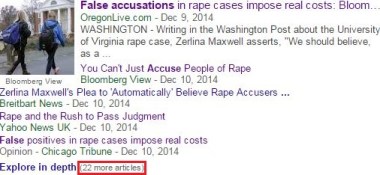
Feminist attorney and writer Zerlina Maxwell opined in a Washington Post piece days ago that the Rolling Stone story’s failings shouldn’t deter “us” from continuing to accept allegations of sexual violence at face value. She, too, has been taken to task by her peers, many of whom are asking, “What do you mean ‘us’?”

Quite suddenly, denunciations of feminist excesses are emerging from other than fringe sources, which means they won’t be so easily discounted. Yesterday, Philip Terzian of The Weekly Standard panned the press for feeding into PC prejudices, and Bloomberg columnist Megan McArdle, bless her heart, produced an op-ed that ran Tuesday under the title, “You Can’t Just Accuse People of Rape.”

Next thing you know, writers will be saying you can’t just accuse people…period.

Copyright © 2014 RestrainingOrderAbuse.com


Judicial Impression Management: What Makes False Allegations “True” and True Allegations “False” (and Drives Victims of Procedural Abuses to Despair)

“Politics, corporate bullshit—it’s all the same game of impression management.”

House of Lies

What do political spin-doctoring, corporate PR, government-sponsored science, and judicial rulings have in common?

Each is about impression management, the selective representation of facts to create a composite “truth” that suits a particular set of social, political, and/or economic imperatives.

Pols and corporations engage in flimflam to win votes and increase profit shares. Science, too, seeks acclaim and profit, and judicial motives aren’t so different. Judges know what’s expected of them, and they know how to interpret information to satisfy expectations.

The general context of discussions on this blog is the issuance of restraining orders, an arena of law that receives little scrutiny either from within the system or from the public; there is no oversight. Judges are moreover licensed to rule according to their discretion, so their latitude for impression management is broad. Any set of facts or plausible fictions can be rendered damning with a little rhetorical footwork, which needn’t be subtle—skewed rulings more often suggest clog dancing than ballet.

Nobody’s paying attention anyhow, except to make sure judges are fulfilling their mandate to make government look good and keep special interest groups mollified.

Since judges can rule however they want, and since they know that very well, they don’t even have to lie, per se, just massage the facts a little. It’s all about which facts are emphasized and which facts are suppressed, how select facts are interpreted, and whether “fear” can be reasonably inferred from those interpretations. A restraining order ruling can only be construed as “wrong” if it can be demonstrated that it violated statutory law (or the source that that law must answer to: the Constitution). There are no “mistakes,” only the very exceptional “over-reach.”

The restraining order process is the product of lobbying by special interest groups (collectively called “feminism”), which have secured government favor in recent decades, and this favor has conditioned how judges manage impressions. Favoring special interest groups has translated into the investment of billions, which has directed trends in social science research (including monetarily), swayed public opinion, and besides conditioned police and judicial impulses and priorities, thereby determining how allegations ranging from harassment to violent and/or sexual assault are credited and acted upon by officers of the justice system.

A crude evolutionary précis (not necessarily chronological) might look something like this:

  • Feminism gets the nod;
  • legislation is passed enacting restraining orders;
  • further legislation is passed making them more stringent and punitive;
  • additional legislation is passed: domestic violence acts and statutes, stalking statutes, etc.;
  • the definition of “domestic violence” is broadened to be inclusive of almost anything that can be construed as “abusive” according to judicial discretion;
  • the Violence Against Women Act (VAWA) is passed;
  • a special office of the Justice Department is established;
  • billions of dollars of federal monies are doled out in the form of grants to police departments and the courts to beef up arrest policies and “train” judges and police officers how to interpret allegations of violence or merely “fear”;
  • and the popular press is enlisted, knowingly or not, to flak the whole business.

Impression management marks the standard operating procedure from top to bottom.

Feminism’s foot soldiers in the blogosphere and on social media, finally, spread the “good word,” and John and Jane Doe believe what they’re told—unless or until they’re torturously disabused of their illusions. Stories like those you’ll find here are often the stories of average people who’ve been publicly maligned and have maddeningly discovered that “the truth” is whatever the system chooses to enter into the record.

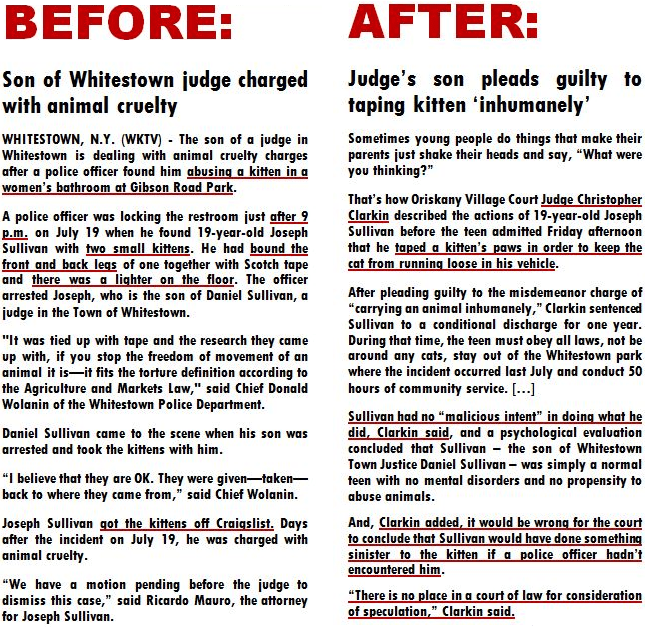
To conclude this abstract litany with a concrete illustration, consider these stories, published six months apart (“Son of Whitestown judge charged with animal cruelty” and “Judge’s son pleads guilty to taping kitten ‘inhumanely’”):

The difference you’ll detect between the two versions of the facts and how they’re interpreted exemplifies impression management.

Copyright © 2014 RestrainingOrderAbuse.com

Stepford Syndrome: Why Feminist Rape Rhetoric Is Both Tiresome and Disturbing (and How It Hurts Not Only Men, but Women, Too)

“A U.S. law professor, who will be speaking at the Commons, said the UK’s stance on false allegations [of rape] is more aggressive than in countries such as the United States, Canada, and Australia. Prof. Lisa Avalos, of the University of Arkansas, said false allegations in the U.S. were dealt with as a misdemeanour offence, not a felony—and most women were not jailed if found guilty.

“‘In the course of my research, I have not found any country that pursues these cases against women rape complainants in the way the UK does. The UK has an unusual approach, and I think their approach violates human rights,’ she said.”

The Guardian (December 1, 2014)

This quotation about rape “complainants” is drawn from a story that appeared in The Guardian this week (“109 women prosecuted for false rape claims in five years, say campaigners”), a story that’s mirrored on a number of other sites, including Jezebel.com and Salon.com.

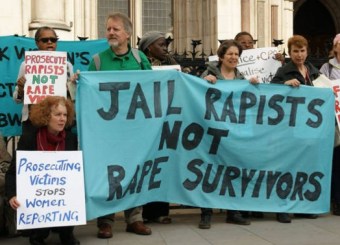
Picketers object to the prosecution of 109 British women in recent years for perverting the course of justice by falsely alleging rape. According to the protesters’ signs, all female accusers are “victims” and “rape survivors,” and the men they accuse are all “rapists” (ipso facto).

The story concerns outrage expressed by activist representatives of the charity Women Against Rape, or WAR, whose assertions require no elucidation; they’re clockwork.

Whether WAR’s outrage has merit is difficult to discern.

Obviously lost in the uproar, however, is what the (female) American law professor who’s quoted in the epigraph actually says, which is this: Falsely accusing someone of rape in the United States is merely a misdemeanor offense and one for which an accuser is rarely punished and may never be prosecuted at all.

This fact isn’t perceived as unfair by feminist activists—far from it. It’s touted, rather, as a reason why it’s a “human rights violation” for the United Kingdom to mete out sterner justice.

This writer, for one, would be more sympathetic to the denouncements of WAR if there were any headline-grabbing activist groups tabulating how many men are arrested and/or prosecuted each year for being falsely accused of rape.

In the fictional community of Stepford, all the women have been replaced by robots whose responses are programmed.

Even allowing that the 2 to 8% false allegation rate commonly cited by feminists were true (and it isn’t), the number of men falsely accused of rape is many times greater than the number of women prosecuted for false allegations, in the UK and everywhere else (for analysis of the rate of false allegations of rape, see Cathy Young’s 2014 Slate.com article, “Crying Rape: False rape accusations exist, and they are a serious problem,” and Emily Bazelon and Rachel Larimore’s 2009 piece, “How Often Do Women Falsely Cry Rape?” published in the same outlet).

Feminist outcry is reflexive, even arguably robotic, and invariably insensitive to male victimization. The argument that a majority of rapes goes unpunished in no way (logically, morally, or otherwise) excuses the unjust implication or punishment of even a single person, ever.

Besides being insensitive to male victimization, moreover, feminists evince no awareness that women, too, are victimized by their furor’s trickle-down effect. Feminists’ making an international case of the prosecution of 109 women works a very real influence on how rulings on charges “lesser” than rape are formed by the courts—charges made in restraining order, stalking, domestic violence, and related cases—and the defendants in these cases are far from exclusively men.

False allegations made against women in prosecutions involving or implying violence may only be a fraction of those made against men, but with those prosecutions’ numbering in the millions each year, that fraction is hardly inconsiderable and easily dwarfs a figure like 109. To posit, as activist groups like WAR tacitly do, that accusers’ allegations should be credited on faith means a lot of women (globally) will continue to be falsely implicated or punished based on judicial impulses that have been conditioned by feminist rhetoric. Much of the “social science” that’s used to “train” judges how to rule in prosecutions predicated on allegations of violence or the fear of violence is inspired by groups like WAR.

To illustrate how feminists’ gears turn (and why those gears need retooling), contemplate this letter printed in The Guardian recently that was composed by a 21-year-old man who was accused of rape as a boy: “A letter to…the girl who accused me of rape when I was 15.”

Now consider this steely response to it by Lucia Osborne-Crowley published almost simultaneously (buzz…whir…click) on WomensAgenda.com: “Why did the Guardian publish this letter about false rape accusations?

Need any more really be said?

Copyright © 2014 RestrainingOrderAbuse.com

Restraining Orders as “Revenge Porn”

In the second season of HBO’s The Newsroom, a lead character is exposed on a website called Revenge Porn by a man with whom she’d had a brief fling.

After sitting huddled in a corner and pronouncing, “I want to die,” she rallies and confronts her former lover while he’s conducting a business meeting. Without much prelude, she kicks him in the testicles and bloodies his nose.

It makes for engaging TV.

If only an ex-intimate’s exploitation of the legal equivalent of Revenge Porn could be so briskly requited and resolved.

What I’m referring to, of course, is treacherously defamatory representations to the court on a civil restraining order, representations intended to publicly humiliate and satisfy a scorned lover’s urge to wound. The restraining order is an invitation for the system to poke its nose into the crevices, one it’s glad to accept.

The TV show character wasn’t able to sue the man who betrayed her, because she posed for the pictures. She even bought the camera for him.

Had the man surreptitiously shot the photos and aired them without her consent, she could have taken him to the cleaners. The courts do more than frown upon that kind of thing, especially when the photos are nudies.

Non-photographic representations that use the justice system as their porn site, though, are embraced as compelling causes of action.

Stalking, indecent exposure, assault, child molestation, bestiality, rape—no pubic allegation, however scandalous, is off the table, and there are no consequences for falsely portraying someone as a lewd and lascivious beast. It’s not defamation; it’s testimony. This distinction sublimates obscene slanders and libels into protected speech, and denies defendants any recourse for realizing compensation for the damage they inflict, psychological, physical, financial, and material.

The court hosts the site, and judges, the site’s administrators, are only answerable to the law, which licenses the site.

This revenge porn is legal—and has the feminist stamp of approval.

Copyright © 2014 RestrainingOrderAbuse.com

Feminist Response Invited: Mom Gives up after Spending $25,000 to Fight a False Restraining Order and Regain Custody of Her Son Only to Have Her Ex-Husband Start the Whole Thing over Again

Feminists who identify with the “battered women’s movement” (the domestic violence lobby) insist fathers’ claims that women lie about abuse are false or overblown. This writer wonders whether they feel the same about mothers’ claims that men lie about abuse.

Here’s one mom’s account (submitted yesterday):

My ex-husband’s family just filed their second bogus restraining order against me to overturn custody of our 13-year-old. The first one, three years ago, I spent three months and $25,000 to fight, and got my son back. This one? I promised myself not to fight if they tried again, and I didn’t and lost today in court. They upheld the emergency order of protection and extended a restraining order against me for no contact with my own son for nothing I did at all—for two years. My son wants to be with them, so I’m not fighting. I just don’t want him to grow up thinking I did anything wrong and that’s why they took him from me. I don’t need to lose any more money and get fired from any more jobs trying to fight…. I’m done.

Restraining orders suck when used for ulterior motives. Unfortunately, they’re used to legally kidnap children, and I wish anyone who’s going through what I’m going through strength and health.

For those who don’t know how an “emergency order of protection” works, it’s this simple: the petitioner goes to court and files some allegations (“under oath”) that the defendant has to respond to a few days later. Typically the window to respond is far too narrow to make it possible for a defendant to retain legal counsel even if she weren’t resigned to defeat, as the mom whose story appears above was (after running up $25,000 in costs fighting a previous prosecution, losing jobs, and possibly being emotionally harried to the brink of insanity).

Feminists are encouraged to respond to this mom’s story, whether with sympathy or criticism. The court process she’s a victim of isn’t one this writer condones. Let’s hear from some people who do condone it.

This writer is tired and has no words of solace. The mother whose story this post concerns is prohibited contact with her son for two years, which may mean she’ll never have a normal, healthy relationship with him again.

Feminists out there—and I know you’re out there—are invited to remind her why this is as it should be.

Perhaps you could tell her how the courts never swallow lies, so she must be lying. Perhaps you could tell her how a process comprising two hearings mere days apart, a process that’s initiated and concluded in minutes, is fair and just. Perhaps you could reassure her that her sacrifice is ensuring the protection of abused women she’ll never meet. Don’t, however, let me put words in your mouths.

Ladies?

Copyright © 2014 RestrainingOrderAbuse.com

A Circle of Moms Reports on False Allegations to CPS (and Says the Same Things That Father’s Groups Say about the Abuse of Restraining Orders and Domestic Violence Laws)

Here’s a group of women on a forum for mothers with school-aged kids responding to a conversational prompt that deserves the attention of those who believe false allegations made out of spite are rare and that the report of such allegations is overblown and only originates from father’s rights groups (or what one notable polemicist calls “FRGs”).

Has someone ever called CPS on you out of spite? Have you called on someone? Why?

Not surprising to this writer, a number of respondents commented in the affirmative. Also worthy of note in this context is that the site FightCPS.com is authored by a woman.

Here are a few of the topmost comments on the Circle of Moms thread:

Yes, twice I’ve had CPS called on me out of spite. Both times a social worker came to my house. I had nothing to hide, so I let them in and they both said, “I can’t tell you who called us, but I can tell you this is absolutely ludicrous for us to even come to your house, because we can’t find a single thing wrong. Sounds like a false allegation to me.” I was like, “I know, right. Thank you.” They couldn’t tell me who called, but I already knew who was behind it. The person who did it was just mad because I wouldn’t pay them money I didn’t even owe! This person was my babysitter, who is the most manipulative, money hungry witch. I just didn’t know it until now.

[M]y mom and sister have been calling and making false accusations about me ever since I told them they’re not my children’s mom—I am. They thought they were just going to tell me how to [rear my] kids, and I told them both, sorry about your luck, I’m their mom, and that’s final. I’ve never gotten a break from CPS since. Especially because my mom didn’t raise us—we did ourselves. And then she thought she was going to take mine and my husband’s first daughter and raise her as her [own] to try to fix mistakes that couldn’t be fixed. UH-UH, she wasn’t getting my daughter. Not till she called my sick, demented sister in to plot against me for 16 years and stole my life, my soul, my heart, my babies. Don’t trust no one.

The person [who] called them on me and my two children knew my mom was very sick and did not have much time to live. My mom died four days ago. Six days before she died, CPS came out. The person who called them on me wanted to add even more pain to my life—and fear. I went and picked up the report. It said [no] on every one of the allegations. I think CPS should let you know who called so you can file a lawsuit. I mean, if they do not do anything, then we should have a choice. We should have the right to know so we can stay away from those who called on us. It should be up to us to tell CPS to press charges or let us do it ourselves, and if we do not know who did call, then we have not got the right kind of privacy or peace throughout our lives.

According to a brochure published by the U.S. Department of Health and Human Services’ Children’s Bureau:

Approximately 29 States carry penalties in their civil child protection laws for any person who willfully or intentionally makes a report of child abuse or neglect that the reporter knows to be false. In New York, Ohio, Pennsylvania, and the Virgin Islands, making false reports of child maltreatment is made illegal in criminal sections of State code.

Nineteen states and the Virgin Islands classify false reporting as a misdemeanor or similar charge. In Florida, Illinois, Tennessee, and Texas, false reporting is a felony, while in Arkansas, Illinois, Indiana, Missouri, and Virginia, second or subsequent offenses are upgraded to felonies.

In Michigan, false reporting can be either a misdemeanor or a felony, depending on the seriousness of the alleged abuse in the report. No criminal penalties are imposed in California, Maine, Montana, Minnesota, and Nebraska; however, immunity from civil or criminal action that is provided to reporters of abuse or neglect is not extended to those who make a false report.

Eleven States and the Virgin Islands specify the penalties for making a false report. Upon conviction, the reporter can face jail terms ranging from 90 days to 5 years or fines ranging from $500 to $5,000. Florida imposes the most severe penalties: In addition to a court sentence of 5 years and $5,000, the Department of Children and Family Services may fine the reporter up to $10,000. In six States, the reporter may be civilly liable for any damages caused by the report.

Based on the anecdotal reports in the referenced Circle of Moms thread, consider how likely it is any of the reported mischief was ever prosecuted. This kind of sniping, which is impossible to fend off, exactly corresponds to that perpetrated by abusers of the restraining order process, which is also exempted from the exacting standards of police and judicial scrutiny that are supposed to be applied when allegations have criminal overtones or can lead to serious privations or criminal consequences.

The women responding in this forum aren’t “anti-feminists,” and they’re certainly not motivated to report malicious exploitation of state process because they’re “for” child abuse: They’re moms.

Yet despite that under the Violence Against Women Act (VAWA), billions of dollars have been invested over the past 20 years toward conditioning authorities and the courts to take allegations of violence and abuse on faith, when fathers allege identical exploitation of restraining orders and domestic violence laws according to the spiteful motives alleged by the mothers cited in this post, they’re dismissed as cranks by feminists and their partisans.

Disinterested parties and feminist sympathizers are urged to recognize that if mothers and fathers are saying the same things, then the claim that allegations of procedural abuses are nothing more than the baseless rants of angry men is flatly wrong.

Copyright © 2014 RestrainingOrderAbuse.com

Big Money v. No Money: VAWA and the Men’s Rights Movement

The previous post was a response to research conclusions published this year by Dr. Kelly Behre, director of the UC Davis Law School’s Family Protection and Legal Assistance Clinic.

In a paper titled, “Digging beneath the Equality Language: The Influence of the Fathers’ Rights Movement on Intimate Partner Violence Public Policy Debates and Family Law Reform,” Dr. Behre asserts there’s an absence of empirical evidence to support various arguments and statistical estimates published by men’s rights advocates respecting false restraining orders, false allegations of domestic violence, and judicial bias against men in family courts.

Ironic is that Dr. Behre’s denial of men’s groups’ position that men aren’t treated fairly is itself unfair.

When Dr. Behre says there’s no “empirical support” for estimates like 60 to 80% of restraining orders are unnecessary or based on falsehood, she means there are no formal audits of the process to back them up. She further examines studies that have been pointed to and finds those studies “problematic.”

Dr. Behre may well be right that empirical support for the claims of men’s groups is scant, shaky, or at best anecdotal. It’s disturbing, though, that Dr. Behre doesn’t find the dearth of studies that could be cited as empirical support a source of concern.

Clearly she has interests in both justice and human welfare.

A truism in law is that those with no money have no voice. Men’s rights groups are not lavishly funded teams of crack Ph.D.’s (they may in fact represent ragtag groups of man-on-the-street volunteers), and many if not most of those represented by such groups are themselves on the outside of the system looking in.

In contrast, consider these facts from the chart “Comparison of VAWA 1994, VAWA 2000, and VAWA 2005 Reauthorization Bill” compiled by the National Coalition Against Domestic Violence (NCADV) eight years ago.

  • Grand total of [federal] money allocated [under the Violence Against Women Act] from 1994 to 2011: $9.43 billion, including:
  • STOP (Services and Training for Officers and Prosecutors) Grants: $2.85 billion
  • Grants to Encourage Arrest Policies: $886 million
  • Rural Domestic Violence and Child Abuse Enforcement Grants: $555 million
  • Civil Legal Assistance for Victims of Violence: $588 million
  • Sexual Assault Services: $250 million
  • Education and Training for Judges and Court Personnel: $35 million

If battered women’s advocates like Dr. Behre find little empirical support for the plaints of men’s groups, they might at least find ample motive in these figures for systemic prejudice against men—and by extension all defendants who find themselves the targets of allegations of abuse (male and female).

While it’s noteworthy that comparatively little federal money has been approved for allocation to research studies, the magnitude of investment toward countering domestic violence is a clear pronouncement of priority, and this investment alone should suggest to a mind as trained and astute as Dr. Behre’s that allegations like “family courts discriminate against men and…mothers frequently and successfully make false allegations against men to obtain custody of children” entirely plausible.

Dr. Behre would call this observation a “commonsense argument” (“implying that the truth…is intuitively evident”).

Fair enough.

Copyright © 2014 RestrainingOrderAbuse.com

Responding to a Feminist Professor Kelly Behre’s Perspectives on Men’s Rights Activism

Since the publication of this post, the “research paper” it responds to has been removed from the Internet.


“I had a false allegation of domestic violence ordered against me on June 19, 2006. It was based on lies, but the local sheriff’s office and state attorney’s office didn’t care that he was a covert, lying narcissist. I doubt they ever heard of the term, in fact. I made the mistake of moving back in with him in September 2008.

“Last year, on July 23, 2013, he, with the help of his conniving sister, literally abandoned me. Left me without transportation and tried to have the electricity cut off. However, the electric company told him it was unlawful to do so. I am disabled, because of him, and have been fighting to get my life, reputation, and sanity restored. It has been over a year, and while life goes on for him, I am still struggling from deep scars of betrayal, lies, and his continued smear campaign against me.

“I thank you for the opportunity to speak out and stand with other true victims of abuse. You see, it isn’t just women who abuse the system, but men, as well.”

—Female e-petition respondent (August 30, 2014)

Contrast this woman’s story with this excerpt from a UC Davis Law Prof. Kelly Behre’s 2014 research paper:

At first glance, the modern fathers’ rights movement and law reform efforts appear progressive, as do the names and rhetoric of the “father’s rights” and “children’s rights” groups advocating for the reforms. They appear a long way removed from the activists who climbed on bridges dressed in superhero costumes or the member martyred by the movement after setting himself on fire on courthouse steps. Their use of civil rights language and appeal to formal gender equality is compelling. But a closer look reveals a social movement increasingly identifying itself as the opposition to the battered women’s movement and intimate partner violence advocates. Beneath a veneer of gender equality language and increased political savviness remains misogynistic undertones and a call to reinforce patriarchy.

The professor’s perceptions aren’t wrong. Her perspective, however, is limited, because stories like the one in the epigraph fall outside of the boundaries of her focus and awareness (and her interest and allegiance, besides).
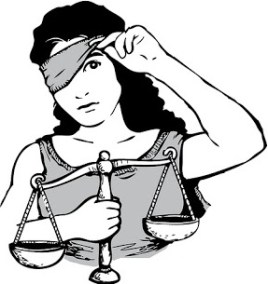
What isn’t appreciated by critics of various men’s rights advocacy groups is that these groups’ own criticisms are provoked by legal inequities that are inspired and reinforced by feminist groups and their socially networked loyalists. These feminist groups arrogate to themselves the championship of female causes, among them that of battered women. Feminists are the movers behind the “battered women’s movement.”

Those who criticize unfair laws and policies that purport to protect battered women are not “pro-domestic violence”; they’re anti-injustice, which may well mean they’re anti-feminist, and this can be construed as “opposition to the battered women’s movement.” The opposition, however, is to what the feminist movement has wrought. No one is “for” the battery of women or “against” the protection of battered women.

To put this across in a way a feminist can appreciate, to believe women should have the right to abort a fetus is not the same thing as being “pro-abortion.” No one is “for” abortion, and no one is “for” domestic violence. (“Yay, abortion” is never a sign you’ll see brandished by a picketer at a pro-choice demonstration.)
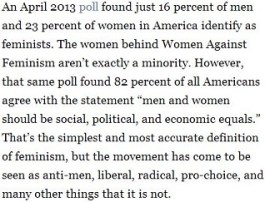
The Daily Beast op-ed this excerpt is drawn from criticizes a group called “Women Against Feminism” and asserts that feminism is defined by the conviction that “men and women should be social, political, and economic equals.” If this were strictly true, then inequities in judicial process that favor female complainants would be a target of feminism’s censure instead of its vigorous support.

The “clash” the professor constructs in her paper is not, strictly speaking, adversarial, and thinking of it this way is the source of the systemic injustices complained of by the groups she targets. Portraying it as a gender conflict is also archly self-serving, because it represents men’s rights groups as “the enemy.” Drawing an Us vs. Them dichotomy (standard practice in the law) promotes a far more visceral opposition to the plaints of men’s groups than the professor’s 64-page evidentiary survey could ever hope to (“Oh, they’re against us, are they?”).

The basic, rational argument against laws intended to curb violence against women is that they privilege women’s interests and deem women more (credit)worthy than men, which has translated to plaintiffs’ being regarded as more “honest” than defendants, and this accounts for female defendants’ also being victimized by false allegations.

(Women, too, are the victims of false restraining orders and fraudulent accusations of domestic abuse. Consequently, women also lose their jobs, their children, their good names, their health, their social credibility, etc.)

The thesis of the professor’s densely annotated paper (“Digging beneath the Equality Language: The Influence of the Father’s Rights Movement on Intimate Partner Violence Public Policy Debates and Family Law Reform”) is that allegations of legal inequities by men’s groups shouldn’t be preferred to facts, and that only facts should exercise influence on decision-making. This assertion is controverted by the professor’s defense of judicial decisions that may be based on no ascertainable facts whatever—and need not be according to the law. The professor on the one hand denounces finger-pointing from men’s groups and on the other hand defends finger-pointing by complainants of abuse, who are predominately women.

In the arena of law this post concerns, the courts typically follow the dictum that the person pointing the finger is right (and this person is usually female). In other words, the courts judge allegations to be facts. In many instances, what’s more, state law authorizes this formulation. It grants judges the authority “at their discretion” to rule according to accusations and nothing more. Hearsay is fine (and, for example, in California where the professor teaches, the law explicitly says hearsay is fine). The expression of a feeling of danger (genuinely felt or not) suffices as evidence of danger.

The professor’s defense of judicial decision-making based on finger-pointing rather undercuts the credibility of her 64-page polemic against decision-making based on finger-pointing by men’s groups that allege judicial inequities. The professor’s arguments, then, reduce to this position: women’s entitlement to be heeded is greater than men’s.

The problem with critiques of male opposition to domestic violence and restraining order statutes is that those critiques stem from the false presuppositions that (1) the statutes are fair and constitutionally conscientious (they’re not), (2) adjudications based on those statutes are even-handed and just (they’re not), and (3) no one ever exploits those statutes for malicious or otherwise self-serving ends by lying (they do—because they can, for the reasons enumerated above).
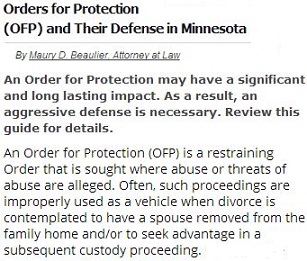
Attorneys acknowledge procedural abuses are common.

Many critiques of men’s, father’s, and children’s rights groups fail to even recognize that motives for lying exist. What presupposition underlies this? That everyone’s an angel? If everyone were an angel, we wouldn’t need laws at all. Or is the presupposition that women are angels? A woman should know better.

A casual Google query will turn up any number of licensed, practicing attorneys all over the country who acknowledge restraining orders and domestic violence laws are abused and offer their services to the falsely accused. Surely the professor wouldn’t allege that these attorneys are fishing for clients who don’t exist—and pretending there’s a problem that doesn’t exist—because they, too, are part of the “anti-battered-women conspiracy.”

The professor’s evidentiary pastiche is at points compelling—it’s only natural that a lot of rage will have been ventilated by people who’ve had their lives torn apart—but her paper’s arguments are finally, exactly like those they criticize, tendentious.

It’s obvious what the professor’s “side” is.

(She accordingly identifies her opposition indiscriminately. For example, the blog you’re right now reading was labeled the product of a father’s rights group or “FRG” in the footnotes of the professor’s paper. This blog is authored by one person only, and he’s not a father. Wronged dads have this writer’s sympathies, but this blog has no affiliation with any groups.)
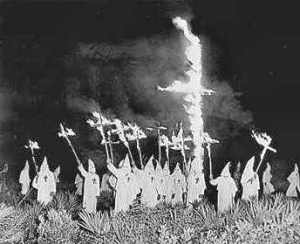
The professor carefully prefaces her points with phrases like “Researchers have noted,” which gives them the veneer of plausibility but ignores this obvious question: where do the loyalties of those “researchers” lie? The professor cites, for example, the Southern Poverty Law Center’s equation of SAVE Services with a hate group. An attentive survey of SAVE’s reportage, however, would suggest little correspondence. The professor doesn’t quote any of SAVE’s reports; she simply quotes an opposing group’s denunciation of them as being on a par with white supremacist propaganda.

(What the professor does quote are some statistics generated by SAVE that she contends are dubious, like estimates of the number and costs of false and frivolous prosecutions. Such estimates must necessarily be speculative, because there are no means of conclusively determining the degree or extent of false allegations. Lies are seldom if ever acknowledged by the courts even if they’re detected. This fact, again, is one that’s corroborated by any number of attorneys who practice in the trenches. Perjury is rarely recognized or punished, so there are no ironclad statistics on its prevalence for advocacy groups to adduce.)

Besides plainly lacking neutrality, insofar as no comparative critical analysis of feminist rhetoric is performed, the professor’s logocentric orientation wants compassion. How much of what she perceives (or at least represents) as bigoted or even crazy would seem all too human if she were to ask herself, for instance, how would I feel if my children were ripped from me by the state in response to lies from someone I trusted, and I were falsely labeled a monster and kicked shoeless to the curb? Were she to ask herself this question and answer it honestly, most of the outraged and inflammatory language she finds offensively “vitriolic” and incendiary would quite suddenly seem understandable, if not sympathetic.

The professor’s approach is instead coolly legalistic, which is exactly the approach that has spawned the heated actions and language she finds objectionable.

Copyright © 2014 RestrainingOrderAbuse.com
When Girls’ Being Girls Isn’t Cute: False Allegations of Violence and Rape

I was just contemplating what I’ve come to think of as “estrogen rage”—a peculiarly feminine mode of violence that orbits around false allegations to authority figures. Furious men do violence, which is why domestic violence and restraining order laws exist. Furious women delegate violence (by lying), which is why the abuse of domestic violence and restraining order laws is rampant.

I was distracted from this rumination by two accounts that emerged in the press recently of women accusing men of rape to conceal affairs:

Ex-Counselor Gets up to 18 Months in Prison for False Reports of Abduction, Assault” (Bellefonte, Pennsylvania)

Sheriff: Woman Files False Rape Report to Cover up Affair” (Athens, Alabama)

Their motive wasn’t rage; it was selfishness. That same theme is present, however: using others (cops and judges) as tools of violence.

When stories like this are bruited, it’s always to show that, hey, women lie about rape: See! That’s not what people should find disturbing about these stories, though.

whateverWhat people should find disturbing about these stories is how feminine false accusers think about lying, including lying about physical and sexual violence (or their threat). They think it’s no big deal—or they don’t think about it at all.

If false accusers regard lying about rape as no biggie, then what does that say not only about how they regard other types of false allegations but about how they regard rape itself? Right, they regard rape as no biggie.

This is what no one ever confronts head-on.

Even feminists who regard false allegations of physical and sexual violence as insignificant must regard acts of physical and sexual violence as insignificant. You can’t say the acts are ghastly and in the same breath say being falsely accused of them isn’t.

Either both are consequential, or neither is.

Feminists are more prone to denounce even the falsely accused (that is, to blame the victims) than they are to denounce false accusers (their “sisters”). Feminists’ denunciations, then, aren’t ultimately of (sexual) violence; their denunciations are of men. Here we come back to the topic of estrogen.

Feminine and feminist psychology are due more scrutiny than they receive. I can’t count the number of times I’ve read even sympathetic reporters of false allegations say they recognize that the more urgent problem is (sexual) violence against women—a sentiment that, intentionally or not, motivates false allegations. False accusers aren’t just aided and abetted by this pronouncement of priority; they’re encouraged by it.

Trivializing false allegations can hardly be said to deter women from making them. The message it conveys, rather, is that false accusers can and should expect sympathy and attention (because all women who make allegations can and should expect sympathy and attention).

The idea that men do evil in response to their hormonal urges is broadly promulgated, and the influence of that idea is to be seen plainly in our laws and in how our courts administer those laws.

Women have hormonal urges, too, and they’re not just toward maternity.

Consider that the women in the stories highlighted in this post falsely accused men of rape whom they’d just been rolling beneath the sheets with…and put a name to that act.

Both women’s lies, incidentally, were undone by text messages they’d exchanged with their lovers that showed the sex was consensual.

Girls will be girls.

Copyright © 2014 RestrainingOrderAbuse.com
The Feminist Self-Contradiction: On the Flawed Conception of Restraining Orders and the Error of Preferring the Stick to the Carrot

Consider: At least a couple more restraining orders will have been issued in the time it takes you to read this post.

I pointed out recently that after 30 years and the issuance of millions or tens of millions of restraining orders, feminists and others continue to report that the incidence rate of domestic violence, which is the go-to rationale for restraining orders, is unchanged.

They report, in fact, that it’s “epidemic.”

Plainly restraining orders have put no dent in the problem. What’s more, it’s possible they’ve made it worse.

How this may be possible is simple. By authorizing gross and large-scale (epidemic) civil rights abuses for decades, the system has jaded the sentiment of a significant sector of the public. The punitive nature of both biased legal policies and the feminist rhetoric that has inspired them does nothing to change minds. It inspires resentment, outrage, and distrust, if not contempt.

Male victims of false restraining orders, in particular, who may well be a majority of recipients and number in the millions, can hardly be expected to sympathize with the feminist agenda. Worse yet, a goodly proportion of them may be far from sensitive to the interests of women generally, because feminism has associated itself with those interests inextricably.

Feminism doesn’t appeal to or cultivate sympathy; it largely strives to chastise and dominate, which can only foster misogyny.

Resentment toward feminist-influenced legal processes conduces to resentment toward feminists and consequently resentment toward women. Feminism works against its own mission statement and the interests of its nominated beneficiaries.

It’s certain that restraining orders have provided peace of mind to some petitioners. It’s certain, also, that they’ve compromised or devastated the lives of a significantly greater number of falsely accused defendants, who receive no compassion from feminist quarters.

On balance, the curative value of restraining orders is null if not negative. Per capita, that is, they do more harm than good. And the impact of each instance of abuse of power is chain-reactive, because every victim has relatives and friends who may be jarred by the reverberations.

Although it doesn’t occur to feminists, because they’re the darlings of the government and the media, their zeal to blame and punish is alienating instead of unifying.

The feminist m.o. is to win not win over…and nobody doesn’t hate a bully.

Thanks to kangaroo legal processes that are effectively products of their authorship, feminists’ potential supporters may number several fewer now than when you started reading this post.

Copyright © 2014 RestrainingOrderAbuse.com

Further Reflections on MSNBC’s Coverage of the First Annual International Conference on Men’s Issues

Rereading MSNBC’s article on the first annual International Conference on Men’s Issues, I have to marvel that so firmly has feminism taken hold that even reporters (whose watchword is objectivity) may respond with Pavlovian menace to an act of civil disobedience—which challenging feminism is.

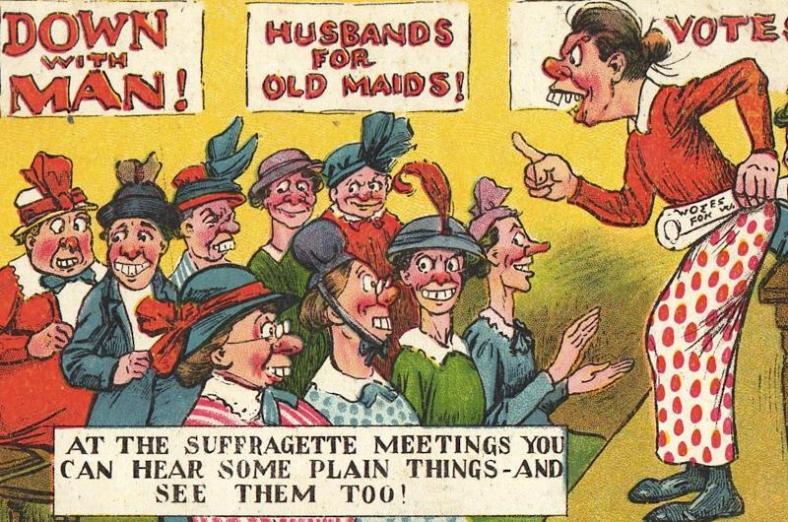
Consider that feminism originates with the 19th-century suffrage movement, that is, with some ragtag groups of women banding together to oppose second-class citizenship and demand the right to vote. Consider, too, that reactions to their early rallies to assert their rights presaged those of the MSNBC reporter who wrote about last month’s men’s conference.

His rhetorical strategies (which, like an apt pupil—or myrmidon—he lifts straight from the feminist playbook) were these:

  • Underrepresent the opposition. The MSNBC piece is surmounted by a photograph (snapped and cropped by the writer) showing a sparsely populated conference room. Some 16 people are visible if you count the odd pair of hands or feet poking into the frame. Though in a passing nod to journalistic accuracy the writer later reports attendees numbered “more than 100,” the first impression the reader is clearly meant to draw is “handful of nutters.”
  • Distort and caricature. Quotations featured in the piece were plainly culled for sensationalist impact. Commentary—for example on the phrase equity feminists, coined by a female feminist philosopher whose acumen is redoubtable—was confidently careless and pandering.
  • Distract. “The conference comes amid increased focus on women’s rights,” the writer observes saliently. Later he quotes a feminist post-grad as saying, “[D]ue to concerns for physical safety, we have decided the best way to oppose the conference that is now going on…is to keep our distance.” The source of fear was unspecified.
  • Ridicule. Pick a paragraph, any paragraph.

Attacks on the efforts of the early suffragists to have their grievances answered were…right, exactly the same.

Copyright © 2014 RestrainingOrderAbuse.com
Confusing Women’s Rights with Feminism: Some Observations on MSNBC’s Coverage of the First Annual International Conference on Men’s Issues

Apparently the first annual International Conference on Men’s Issues was held in Michigan recently. I read this fact on the MSNBC website in an article that disdained even to capitalize the title of the conference and which, for more reasons than just that one, reminded me of the days when I edited my high school paper.

My journalism adviser would’ve given the piece a C, among other reasons because it seems uncertain whether it wants to be a news story or an editorial—or an advertisement for its writer’s Twitter feed.

Its introduction, at least, was gripping to read: “At what was billed as the first annual international conference on men’s issues, feminists were ruining everything.” I was keen to hear about how the meeting was disrupted by a mob of angry women swinging truncheons.

I’ve come to expect disappointment, which expectation the reporter continued to cement over an ensuing two dozen paragraphs.

Not having attended the conference, I can’t say whether the reporter’s characterization of its presenters’ arguments as cranky is fair or not. Remarking that he failed to probe any of the topics he glosses in the article, however, does seem fair. A reporter’s job is to ask questions, not assemble a boa of plucked horsefeathers and hyperlinks.

I’m sympathetic to men’s plaints about legal mockeries that trash lives, including those of children, so I found the MSNBC coverage offensively yellow-tinged in more senses than one, but I’m not what feminists call an MRA or “men’s rights activist.” I don’t think men need any rights the Constitution doesn’t already promise them. What they need is for their government to recognize and honor those rights. The objection to feminism is that it has induced the state to act in wanton violation of citizens’ civil entitlements—not just men’s, but women’s, too.

On this subject, something useful the referenced MSNBC article does accomplish is reveal its writer’s unexamined presupposition that women’s rights and what feminists advocate for are the same thing. Probably many women are under the same illusion.

It’s understandable. Feminism still waves the same banner its pioneers sewed decades ago on which is blazoned that rainbow word EQUALITY. Today’s mainstream feminists, however, have redefined that word to mean “whatever’s best for us,” which doesn’t always mean what’s best for women.

To illustrate, take the 60-year-old woman who wrote last year to relate that she was expelled from the home she’d shared for 10 years with her invalid mother and terminally ill brother, whom she nursed, by her sister. The latter spitefully lied about her to the court—possibly because she was the executor of her mother’s will—and then destroyed her belongings, including her clothes and family memorabilia (photos, videos, etc.—a lifetime’s worth) when it was mandated that she vacate her residence. Her sister’s malicious testimony was rendered in a few minutes without the woman’s even being present. Though the fraudulent restraining order it succeeded in having issued was tossed on appeal, the woman’s record was sufficiently corrupted to cost her her job at a bank and the income and medical benefits it provided. When I last heard from her, she was living out of her car and trying to stay warm.

Or take the naïve girl who was lured away from her family, knocked up, and deserted by a twice-divorced pastor’s son. When the girl appealed to him to take an interest nine months later and moved to Virginia with her newborn on assurances from him that he’d found Jesus and wanted to do right by her, he and his family represented her as a hysteric to the court and, when last I got a status update, were in the process of seeking custody of her baby (cf. Charlotte Perkins Gilman’s “The Yellow Wallpaper”).

These aren’t merely people who “believe” they’ve been treated unfairly; these are women who’ve been used viciously and rolled into the gutter.

Women I’ve corresponded with in the three years I’ve maintained this blog have reported being stripped of their dignity and good repute, their livelihoods, their homes and possessions, and even their children according to prejudicial laws and court processes that are feminist handiworks. These laws and processes favor plaintiffs, who are typically women, so their prejudices are favored by feminists. Feminists decry inequality when it’s non-advantageous. They’re otherwise cool with it. What’s more, when victims of the cause’s interests are women, those victims are just as indifferently shrugged off—as “casualties of war,” perhaps.

I don’t know that feminists are “ruining everything,” but I do know that among the fruits of their industry has been ruining a lot of people’s lives.

Copyright © 2014 RestrainingOrderAbuse.com
Victims Are Important, but They’re Not More Important than Anyone Else: Amending Priorities and Reconceiving Restraining Order Policy According to the Principle of Equality

“While some municipal court judges acknowledge that the domestic violence law can create injustices—one calls it ‘probably the most abused piece of legislation that comes to my mind’—there are counterpoints. Melanie Griffin, executive director of the Commission to Study Sex Discrimination in the Statutes, a legislative commission that drafted much of the 1991 law, says that for every individual who files a false report, ‘there are 100 women who don’t come in at all and stay there and get beaten.’”

—“N.J. Judges Told to Ignore Rights in Abuse TROs

This quotation comes from a nearly 20-year-old journalistic exposé, yet you’ll find the same starkly meretricious apology for restraining order abuse routinely voiced today.

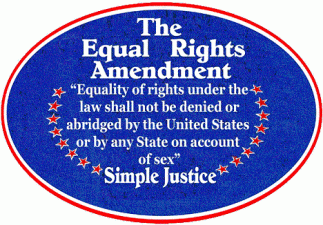
This quotation from the proposed Equal Rights Amendment (ERA) means that all people should be treated equally under the law, not that women should be privileged. Anyone who’s for women’s being afforded special treatment by the authorities and the courts, as proponents of the Violence Against Women Act (VAWA) are, opposes the ERA.

This quotation from the proposed Equal Rights Amendment (ERA) means that all people should be treated equally under the law, not that women should be privileged. Anyone who’s for women’s being afforded special treatment by the authorities and the courts opposes the message of the ERA, as do proponents of the Violence Against Women Act (VAWA).

The argument, basically, is that it doesn’t matter if restraining order defendants’ rights are ignored, and it doesn’t matter if defendants are falsely accused, because there are many more victims of abuse who suffer in silence than there are false accusers.

The argument equates apples with orangutans. Its reasoning is partisan and purely emotion-based—and betrays ignorance of the fact that women, too, are falsely accused of domestic violence. Its thesis is that since there may be multitudes of unacknowledged victims of domestic violence, the state’s creating victims by abetting false prosecutions is of no statistical significance.

While everyone should feel for women who are “beaten” at home, no one should be forced by the state to endure “sympathy pains.” The falsely accused man or woman whose life is upturned or undone by hyped allegations or gross lies credited by careless judges is absolutely blameless for the suffering of strangers.

Life, liberty, and the pursuit of happiness are inalienable rights guaranteed to all citizens under the Constitution, and equality and fair treatment under the law are among its mandates that brook no compromise. Denying the latter to anyone, ever—even if the motive is a sympathetic one—is categorically wrong.

The statement in the epigraph says: It’s okay if you, Mr. or Ms. Doe, are falsely accused and battered by the system, and it’s okay if it deprives you of your kids and home and livelihood and dignity and sanity, because some people you don’t know and never will know are reportedly “beaten” by some other people you don’t know and never will know.

It says there are women who suffer unjustly, so never mind if we make you suffer unjustly, too.

Copyright © 2014 RestrainingOrderAbuse.com

Restraining Orders and Feminist Self-Sabotage: On the Error of Preferring the Stick to the Carrot

Consider: At least a couple more restraining orders will have been issued in the time it takes you to read this post.

I pointed out recently that after 30 years and the issuance of millions or tens of millions of restraining orders, feminists and others continue to report that the incidence rate of domestic violence, which is the go-to rationale for restraining orders, is unchanged.

They report, in fact, that it’s “epidemic.”

Plainly restraining orders have put no dent in the problem. What’s more, it’s possible they’ve made it worse.
How this may be possible is simple. By authorizing gross and large-scale (epidemic) civil rights abuses for decades, the system has jaded the sentiment of a significant sector of the public. The punitive nature of both biased legal policies and the feminist rhetoric that has inspired them does nothing to change minds. It inspires resentment, outrage, and distrust, if not contempt.

Male victims of false restraining orders, in particular, who may well be a majority of recipients and number in the millions, can hardly be expected to sympathize with the feminist agenda. Worse yet, a goodly proportion of them may be far from sensitive to the interests of women generally, because feminism has associated itself with those interests inextricably.

Feminism doesn’t appeal to or cultivate sympathy; it largely strives to chastise and dominate, which can only foster misogyny.

Resentment toward feminist-influenced legal processes conduces to resentment toward feminists and consequently resentment toward women. Feminism works against its own mission statement and the interests of its nominated beneficiaries.

It’s certain that restraining orders have provided peace of mind to some petitioners. It’s certain, also, that they’ve compromised or devastated the lives of a significantly greater number of falsely accused defendants, who receive no compassion from feminist quarters.

On balance, the curative value of restraining orders is null if not negative. Per capita, that is, they do more harm than good. And the impact of each instance of abuse of power is chain-reactive, because every victim has relatives and friends who may be jarred by its reverberations.

Although it doesn’t occur to feminists, because they’re the darlings of the government and the media, their zeal to blame and punish is alienating instead of unifying.

The feminist m.o. is to win not win over…and nobody doesn’t hate a bully.

Thanks to kangaroo legal processes that are effectively products of feminist authorship, feminists’ potential supporters may number several fewer now than when you started reading this post.

Copyright © 2014 RestrainingOrderAbuse.com

False Restraining Orders That Allege Emotional Abuse ARE Emotional Abuse

A theme that emerges upon consideration of restraining order abuse is lack of empathy—from impulsive or false accusers and from those who abet them. Plaintiffs who act either spitefully or viciously seldom appreciate the ramifications of their actions. They may possess what we call a normal conscience but either don’t think or, in the heat of the moment, don’t care.

The horror is that this same indifference extends not only to authorities and officers of the court but to feminist advocates for restraining orders and the public at large, who are persuaded that the gravity of violence against women trivializes all other considerations. Their indifference may in fact be unconsciousness, but when people’s livelihoods and lives are at stake, unconsciousness is no more pardonable.

It’s ironic that the focus of those who should be most sensitized to injustice is so narrow. Ironic, moreover, is that “emotional abuse” is frequently a component of state definitions of domestic violence. The state recognizes the harm of emotional violence done in the home but conveniently regards the same conduct as harmless when it uses the state as its instrument.
From “Are You a Victim of Emotional Abuse?” by Cathy Meyer:

Emotional abuse is used to control, degrade, humiliate, and punish a spouse. While emotional abuse differs from physical abuse, the end result is the same….

Note the writer’s conclusion that emotional abuse is equivalent to violence in its effects.

Her orientation, of course, is toward victims of domestic violence, but her judgment is just as applicable to false allegations, whose intent is to “control, degrade, humiliate, and punish.”

Plainly the motive of most reasonable feminist arguments and appeals, at least as that motive is understood by those making them, is to induce empathic understanding. They want people to care.

Here’s yet another irony. Too often the perspectives of those who decry injustices are partisan. Feminists themselves are liable to see only one side.

“But my side’s more important” isn’t a rebuttal but a confirmation of chauvinism.

In the explication quoted above, the writer compares the conduct of emotional abusers to that of prison guards toward prisoners of war, who use psychological torment to achieve compliance from their wards. Consider that victims of false allegations may literally be imprisoned.

Consider further some of the tactics that Ms. Meyer identifies as emotionally abusive:

  • Isolating a spouse from friends and family.
  • Discourag[ing] any independent activities such as work; taking classes or activities with friends.
  • If the spouse does not give into the control, they are threatened, harassed, punished, and intimidated by the abuser.
  • Us[ing] the children to gain control by undermining the other parent’s authority or threatening to leave and take the children.
  • Control[ling] all the financial decisions, refus[ing] to listen to their partner’s opinion, withhold[ing] important financial information and mak[ing] their spouse live on limited resources.
  • Mak[ing] all major decisions such as where to live, how to furnish the home, and what type of automobile to drive.

Now consider the motives of false allegations and their certain and potential effects: isolation, termination of employment and impediment to or negation of employability, inaccessibility to children (who are used as leverage), and being forced to live on limited means (while possibly being required under threat of punishment to provide spousal and child support) and perhaps being left with no home to furnish or automobile to drive at all.
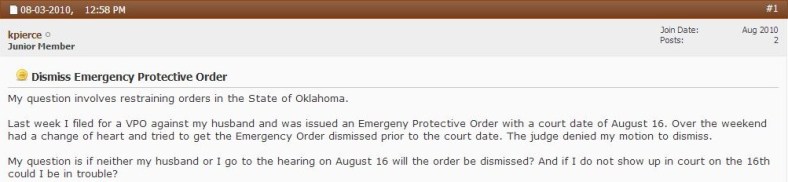
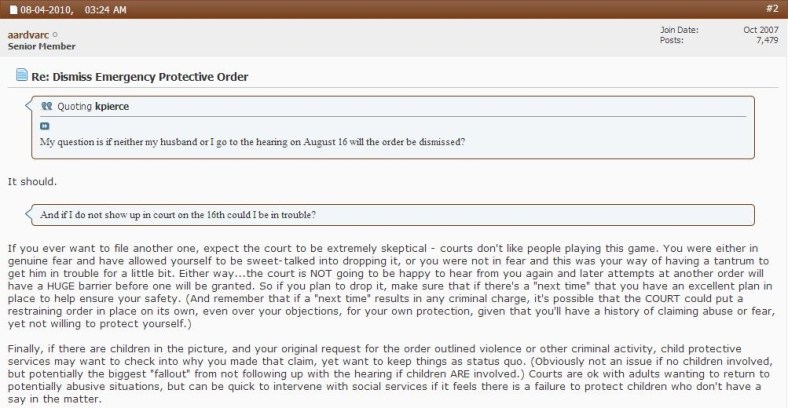
The correspondence is obvious…if you’re looking for it. Opponents of emotional abuse need to recognize it in all of its manifestations, because the expectation of empathy is only justified if it’s reciprocated.

Copyright © 2014 RestrainingOrderAbuse.com

Impulse: How Restraining Orders Encourage and Reward Tantrum Behavior and Why Feminist Advocates Should Be the First to Push for Their Reform

It’s often fairly remarked that feminists tend not to acknowledge restraining order abuse, let alone express resentment toward female offenders. There are exceptional instances, however, as you’ll see below.

It’s also remarked that rash or false allegations mock and discredit the suffering of genuine victims. The respondent in the forum exchange that follows, though she doesn’t say as much, clearly agrees.

Notable about the response, whose tone is reproving, is that its writer recognizes that restraining orders may be sought impulsively to gratify a “tantrum” and get their defendants “in trouble” (which recognition fittingly uses the language of the playground).

Notable, contrariwise, however, is that the respondent discourages the petitioner of the restraining order, who’s admitted to proceeding impulsively, from following through with her expressed intention to rectify an act that may have been motivated by spite. The respondent is the executive director of AARDVARC (An Abuse, Rape, and Domestic Violence Aid and Resource Collection), and behaviors like those the questioner owns up to undermine her endeavor’s credibility.

Notable, finally, is the respondent’s observation that once the state machine is roused, it can be tough to quiet again—like a swarm of killer bees.

The slack standards applied to the restraining order process cut both ways. Not only do they make it easy to lynch defendants undeservedly based on a few brief statements rendered in minutes; the drive-thru, come-one-come-all policy they authorize urges plaintiffs to proceed full-steam ahead without consideration of consequence to themselves and their families.

Plaintiffs shouldn’t be able to incriminate others impulsively, and those who are baited into doing so have as much reason to fault the state as they do to fault themselves.

Representatives of victims of domestic violence and rape, furthermore, are at least as keenly aware as anyone that people follow vicious impulses when there are no checks on their behavior. Logically, then, feminist proponents should be the first to perceive that if state processes have no reins, they’ll be abused. These activists should, accordingly, recognize restraining orders’ potential for abuse and be at the forefront of advocacy for more rigorous and responsible policy.

Copyright © 2014 RestrainingOrderAbuse.com

WomensLaw: A Domain Name That Says All You Need to Know about Where Restraining Order Reform Needs to Start

The biggest challenge to sensitizing people to abusive restraining order policies that are readily and pervasively exploited by malicious litigants can be summed up in a single word: sex.
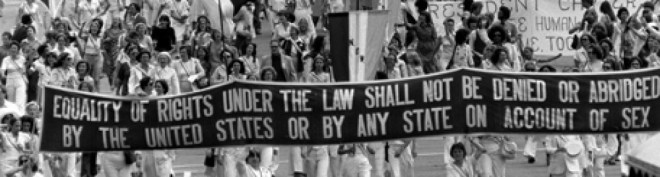
Women, who are often victims of abuse of court process, don’t want to implicate women in their injuries; they want to blame their false accusers, who are frequently men. Appreciate that this urge to blame men is the reason why restraining orders as processes of law exist in the first place.

Appreciate also that men aren’t the force behind the perpetuation of the status quo, and pointing fingers in their direction isn’t going to change that fact.

In the last month, I’ve sifted the Internet to discover what types of restraining order are available where and how to undo their misapplication. The most thorough source of information on restraining orders offered by the various states that I’ve found—and one I’ve repeatedly returned to—is WomensLaw.org.

It’ll tell you everything you ever wanted to know about restraining orders in your neck of the woods. Its domain name will also remind you why restraining orders exist and what they signify (there is no MensLaw.org).

After decades of rampant abuse’s being tolerated and with restraining orders’ having become a familiar institution, men have hopped onto the abuse industry bandwagon, and their malicious exploitation of restraining orders will probably continue to escalate with the passage of time.

The authorship of restraining orders, however, is by women, for women. Anyone with an interest in social justice or in reforming a handily abused process that fractures families and derails lives every day must acknowledge this fact and resist the reflex to divert blame from where it’s due.

The women who advocate for restraining orders don’t necessarily understand that they’re abused, why they’re abused, how they’re abused, or what the consequences of their abuse are. And they’re not going to take men’s word for it.

Copyright © 2014 RestrainingOrderAbuse.com

“Redeeming Feminism”: Making It about Equality and Not Victimhood

Since the publication of this post, the feminist blog it cites and criticizes has been made private.


When criticizing injustices wrought by prejudicial, feminist-motivated laws and court procedures like the restraining order process, restraint isn’t easy to pull off.

It’s nevertheless worthy of striving for, because the gender divide that fosters the perpetuation of these prejudicial laws and procedures needs to be bridged—for the sake not just of their male victims but of their female victims, too.

I came across a blog yesterday titled, Redeeming Feminism. It arrested my attention, because its banner reads, “Equality of rights under the law shall not be denied or abridged by the United States or by any state on account of sex.”

The dramatic irony is lost on the blog’s author, but this is, of course, the argument against feminism, whose “second wave” has done at least as much to promote and enforce sexual bigotry as it has to eliminate it. (First-wave feminists, who sought to dissolve gender discrimination instead of cement it, were those who pushed for the 1972 Equal Rights Amendment from which the quotation above derives.)

Some feminists categorically can’t be reasoned with. They’re the equivalents of high-conflict courtroom litigants who reason with their feelings. But I don’t get the impression that the author of this blog is one such, and I think there are many self-styled feminists like her out there. She seems very much in earnest and without spiteful motive. Her intentions are well-meaning.


To judge from the wattage of her smile in the photograph of her on her blog, however, she’s never been stalked by someone only to have that person publicly and persuasively accuse her of stalking, or had it falsely suggested to authorities and the courts, for example, that she’s violent or a danger to children.

To quote a falsely accused woman I’ve corresponded with for the past six months, a professional nurse and mother of three who’s been through years of hell, that sort of thing “changes a person on a cellular level.” Had the blog author been subjected to what my correspondent has been—or what most of the respondents to this blog and to other blogs and petitions it links to have been—her smile would be considerably more muted (which would be a shame, because it’s a good smile).

This is the shortcoming of most vigorous feminist advocacy out there: It tends to see only what it was looking for in the first place. Its argumentation is based in the abstract. I wouldn’t wish the real on anyone, but before taking up arms, advocates of one position or another have a moral obligation to look up, down, and sideways.

The post on the referenced blog that I read is called, “Anti-Feminist Memes pt.3: ‘Domestic abuse, Men are the real victims’.” It rebuts the rhetorical strategies of counter-feminist “memes” on the Internet.

This is a meme.

This type of meme is extremely popular. In looking for memes to write about for this blog project, this theme was one of the most prevalent. Memes like these send a lot of messages simultaneously. First, they suggest that feminism is rooted in hypocrisy. They want us to assume that feminists not only support negative gender restrictions on men, but that they also encourage policy that will oppress men. A lot of these memes have phrases in them like “according to feminists,” “feminists believe,” and “feminist logic.” It’s not enough for these memes to suggest that men are oppressed more than women claim to be, the meme must also suggest that feminism causes and supports violence against men, with the aim of total male oppression.

Her criticisms, though spirited, lack balance. The “memes” she refers to don’t actually “suggest feminism is rooted in hypocrisy” (though this is certainly true of today’s feminism) or posit that “men are oppressed more than women,” nor do they appear to want anyone to “assume” anything. What they do is point out and denounce a double standard, which is an endeavor every true feminist should commend. The author of the blog doesn’t address the double standard; she takes a defensive tack and asserts that women are victims of violence and that such “memes” insensitively ignore this urgent fact.

This line of (emotional) reasoning basically says never mind if there is a double standard, because women are victims. It’s a logical bait-and-switch—and one that betrays unawareness that women are also injured by the same double standard.

meme2

These, too, are memes.

Laws that have arisen and been fortified in the last three decades in response to demands for the curtailment of violence against women are applied unequally and unfairly (which is another way of saying they disregard the most basic tenets of our Constitution). The prevalence of violence in the world is completely beside the point. John Doe isn’t his brother’s keeper and can’t justly be held to account for the actions of others. The fact is whenever anyone makes a complaint of domestic violence today, whether a woman or a man, his or her allegation may be presumed valid, especially in civil court, and the reason why this is so owes to feminist lobbying, which has engendered prejudice against defendants (who, once upon a time, were only men). When allegations of abuse are exaggerated or false, the consequences are often the same as they would have been had the allegations been true. Innocent men and women are rubbed out every day by procedures that are virtually automated. They’re criminalized, exiled from their families, stripped of property and resource, and sometimes barred from employment and even left living out of their cars or homeless.

The blog writer, a young woman, is piqued by domestic violence, as should we all be. Matters peripheral to it, like legal inequities, are lost in the shadows cast by its specter—and shouldn’t be. Even the specter itself is seldom scrutinized.

It must be considered, for example, that the authority for the statistic “1 in 4 women will experience domestic violence in her lifetime” cited by this writer (and which is commonly cited) is a pamphlet: “Domestic Violence Facts.”
Consulting its footnotes, you’ll find that this stat is derived from something called the National Violence Against Women Survey. In other words, the figure’s based on what women report on questionnaires.

Last week, I was sitting outside of a Starbucks in a posh strip mall and observed a couple standing 20 feet distant from me in the company of two others. The woman repeatedly belted the man in the shoulder and chest with a closed fist, and then proceeded to pinch him a series of good ones. He laughed and cringed from the attack. “Did you fart?” she demanded. He giggled. She punched him a few more times—good, resonant thwacks like you’d hear if you slapped a ham. She was still punching and pinching him when I turned back to my laptop.

What someone like the author of the blog I’ve cited would never conceive is that had this man called the cops and alleged that his wife assaulted him, there’s a very excellent chance that horseplay like this could cost her everything she owns, including her identity. “Did she punch him?” an officer might ask of witnesses. “Well…yeah, but….” And that might be that (criminal restraining order to ensue). It happens. Sometimes even the reports of onlookers precipitate arrests.

What everyone must be brought to appreciate is that a great deal of what’s called “domestic violence” (and, for that matter, “stalking”) depends on subjective interpretation, that is, it’s all about how someone reports feeling (or what someone reports perceiving).

Important to recognize is that how someone reports feeling about being punched or pinched may depend a lot on how that person is feeling toward the puncher or pincher at the time (or at a later time). In other words, actions that are harmless can be represented however a person wants to represent them.

When the state gets involved in private, interpersonal matters, consequences can be severe. What the “memes” the referenced blog writer confronts are concerned with is public perception that translates into law. Fervent condemnations of domestic violence don’t simply inform general opinion; they inform legislation and the application of laws by police officers and judges.

Feminist predilections, both to blame men and to perceive “violence” everywhere, encourage and, consciously or not, endorse exaggerated, impulsive, and/or false allegations. Feminism’s basic message to women today is, “You’re a victim.”

Is there any person walking the face of the planet over the age of five who hasn’t been slapped, punched, kicked, spanked, pinched, poked, or threatened? That’s a rhetorical question. Everyone has been the “victim of violence” if not the “victim of domestic violence” sometime in his or her life. The difference is not everyone is going to characterize him- or herself as a “victim.”

When someone like the author of the blog I’ve referenced uses the phrase domestic violence, she means wanton physical abuse and household terrorism, which is what the phrase used to mean. That’s not, however, how domestic violence is any longer defined by the law. The same phrase may be applied to angry phone calls—even a single angry phone call (which may easily be misrepresented or not even real). This blogger’s outrage is sympathetic; she’s just unconscious—as most people are—that the messages she’s outraged by aren’t veiled arguments in defense of battery; they’re rejections of a feminist message that has jaundiced popular perceptions and corrupted our laws and how they’re applied.

The zealousness of the public and of the authorities and courts to acknowledge people, particularly women, who claim to be “victims” as victims has produced miscarriages of justice that are far more epidemic than domestic violence is commonly said to be. Discernment goes out the window, and lives are unraveled based on finger-pointing. Thanks to feminism’s greasing the gears and to judicial procedures that can be initiated or even completed in minutes, people in the throes of angry impulses can have those impulses gratified instantly. All parties involved—plaintiffs, police officers, and judges—are simply reacting, as they’ve been conditioned to.

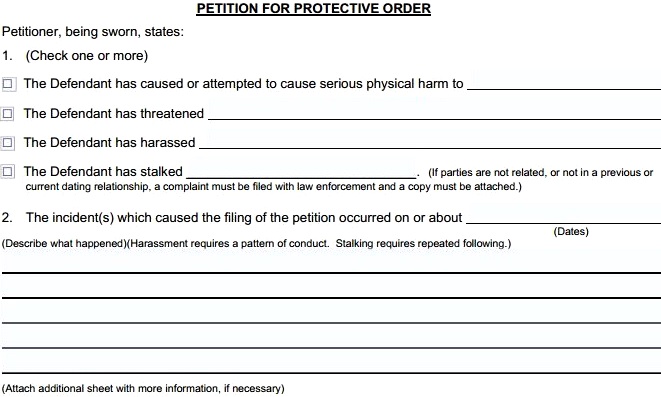
When everyone’s simply reacting, nobody’s actually thinking.

The road to feminism’s redemption will only be paved when feminists begin making observations like this.

Copyright © 2014 RestrainingOrderAbuse.com

How Men Lie on Restraining Orders: A Tutorial for Feminists

The topic of this discussion is vicious men—not real men but the kind who’d make false allegations against a woman and ruin her for self-gratification or -gain.

Below is an excerpt from a standard restraining order form. Apply your imagination and consider how a man might exploit the opportunity it affords to trash a woman’s life. I’ll guide you. See the tick boxes and blanks? What he’d do is flick the cap off his Bic and write lies in the spaces provided. It only takes a few minutes.

A false complainant might allege, for example, that his girlfriend stalked him, coerced him into having sex, threatened to kill him, beat his daughter or made her smoke crack, etc. His motive might be revenge, or his motive might be to deflect blame from himself for actually engaging in the same or worse activities. Restraining order petitioners may be the real offenders, and the courts graciously provide them with the chance to compound their victims’ torment and walk away scot free. The first one up the courthouse steps is the “good guy.”

Besides a pen and a few minutes to kill, the only requisite for upending a woman’s life this way is a malicious will. For men to apply for false restraining orders against women is usually free (that is, the cost is covered by the taxpayer), as the Violence Against Women Act (VAWA) mandates it be.

All there is to making allegations on restraining orders is tick boxes and blanks, and there are no bounds imposed upon what allegations can be made. A false applicant merely writes whatever he wants in the spaces provided—and he can use additional pages if he’s feeling inspired. The basis for a woman’s being alleged to be a domestic abuser or even “armed and dangerous” is the unsubstantiated say-so of the petitioner. Can the defendant be a vegetarian single mom or an arthritic, 80-year-old great-grandmother? Sure. The judge who rules on the application won’t have met her and may never even learn what she looks like. She’s just a name.

The worst that happens is a fraudulently accused woman appears for a hearing after a week or two of sleepless nights (possibly spent living out of her car) and manages to persuade a judge that she’s not a stalker, child-beater, or whatever. Although even this won’t ensure the judge finds in her favor and dismisses the order, let’s say the judge does dismiss the order.

The false accuser is subject to no sanctions from the court and is at no risk of prosecution from the state, and it isn’t guaranteed that the dismissed restraining order will be expunged from the woman’s public record, which may be the public record of a kindergarten teacher, a therapist, or a police officer (even dismissed orders are stigmatizing and cost people jobs).

The man’s just out a little time and may still have cause to smirk.
And, anyway, he can always file for another restraining order later on. There’s no statutory ceiling on how many times he’s authorized by the state to do this. The sky’s the limit. He could even reapply for multiple restraining orders from different jurisdictions to up the fun.

High-conflict litigants can consume years of their targets’ lives like this. Between rounds of false allegations, their targets may languish in a personal hell, unable to reconcile themselves to betrayals and lies, unable to work in chosen professions because unable to rinse those lies from their public faces, and never knowing what to expect next or when. Whatever familial and social infrastructures depend on them may obviously crumble, besides.

How men lie on restraining orders and make wrecks of women’s lives—and how easily—should be clearer now.

How women lie on restraining orders and make wrecks of men’s and other women’s lives is exactly the same way.

Copyright © 2014 RestrainingOrderAbuse.com

SPITE: Feminism and Restraining Order Rampancy

“I wasn’t thinking when I wrote my domestic abuse statement in Virginia against my boyfriend.”

“Can I get a permanent protection order against my spouse’s lover?”

“How [do you] bait someone into violating a restraining order?”

—A few recent search terms leading to this blog

I stumbled upon a video presentation the other day by a self-styled anti-feminist activist Karen Straughan, who’s blogged for a couple years under the moniker “girlwriteswhat.” I thought her talk, “Feminism: Socialism in Panties,” was evenhandedly confrontational, nervy, and smart.

Responses from feminist quarters that I hastily gleaned yesterday suggest that this activist’s denunciations have raised some hackles. I noted, though, that more than one woman respectfully remarked that she’s “articulate,” if “biased.” She’s in fact very articulate. And something I don’t think her female critics are able to appreciate is that her “bias” is a counter-bias and that she isn’t employing rhetorical strategies that are any more tendentious or inflammatory than those used by the people she draws a bead on.

For feminists to argue that turnabout is foul play is silly, and it’s interesting to observe that when dogma’s challenged using its own tactics, it pitches a fit.

The same impulsive emotional reasoning exemplified by this foot-stamping is what’s suggested by the search terms that introduce this post (to which I could have appended thousands more of a similar nature).

The large-scale injustices perpetrated by the restraining order process (on both men and women) are the product of impulsive emotional reasoning, as is the process itself. What may have started out as a sober guard dog 30 years ago has transformed into a manic dragon that arbitrarily spits fire when fingers are snapped, particularly nail-polished fingers. It doesn’t warn its targets to back down; it torches them.

There’s an ancient philosophic principle called the golden mean that advocates avoidance of extremes (“moderation in all things”). According to this principle, if something gets too far off-kilter in one direction, you have to counteract the imbalance by excessively striving in the contrary direction. If the above-referenced activist strikes some as overstating her case, they might consider that she’s endeavoring to knock things back toward equilibrium.

Reading through online comments about her, I was familiarized with the acronyms MRM and MRA, which apparently stand for “men’s rights movement” and “men’s rights activist,” respectfully. One thread about her I found was titled, “What do Feminists think about YouTube blogger ‘Girl Writes What,’ a Female MRA?”

You see from this question how far abroad feminism has strayed and why equity feminists are appalled by what they call the “feminist establishment” (a.k.a. “The Sorority”). The motive of the feminist movement that was underway when I was a kid was to dissolve distinctions and dichotomies between the sexes. Yet as conversational prompts like this one show, today’s so-called feminism promotes division: Us versus Them. Its compulsion is to split everyone into camps. The original idea was to have everybody recognized as the same, irrespective of whether they had an innie or an outie between their legs.

The thrust of today’s mainstream ideological feminism is to blame, subjugate, and punish, not unify. Feminism has betrayed itself.

It has also betrayed women. Something that’s long been a source of curiosity to me is that while the feminist establishment is often criticized as misandronist (man-hating), it’s rarely criticized as misogynist (woman-hating).

Yet inducing women to self-identify as victims can hardly be called “empowering.” If the source of power isn’t you, the power isn’t yours. What inducing women to self-identify as victims is, rather, is denigrating to feminine self-respect. The feminist establishment doesn’t encourage women to cultivate or rely on personal agency; it infantilizes them and urges them to apply for paternal protection (and the abuse and domestic dispute industries have been glad to profit by the ensuing strife).

Contemporary feminism has conditioned women to identify themselves respective to men, namely, as their victims. It’s thoroughly preoccupied with men—to the point of fixation. (The online conversational threads I’ve just looked at either concerned bitching about men or bitching about women who don’t bitch about men.)

The original feminist platform argued that women should identify themselves as independent people. Feminism, however, has become entirely male-centric. There is no feminist identification independent of men.

Prejudicial laws and court processes criticized in this blog and elsewhere are a societal response to women’s conceding that they lack personal agency. Consider that the reason why infants cry for help is because they’re incapable of meeting their own needs (incapable, literally, of standing on their own two feet). Women are much more capable than they’ve been led to believe.

Restraining orders are by and large sought impulsively—in the millions every year. Both motives and the engine that generates them are virtually automatic.

Interesting to me, finally, is that men have adapted to the new status quo (“If you can’t beat ‘em, join ‘em”). Most of the complainants of court abuses who’ve responded to this blog are women, some of whose lives have been shattered by lies and fraud. Men have hopped onto the abuse industry bandwagon, too, and the time may come that the equality that feminism is supposed to be advocating for is realized in the form of both sexes’ exploiting state protections to bash each other into a uniform goo.

Copyright © 2014 RestrainingOrderAbuse.com