What Massachusetts Law Firm Dane Shulman Associates Says about Restraining Order Abuse and Divorce

Below is Massachusetts law firm Dane Shulman Associates writing about the game of false accusation. Lawyers know this happens. They know it very well.

Various feminist advocates doggedly assert that restraining order abuse, particularly to gain leverage in family court, is insignificant—or worse, that claims of it are merely men’s rights propaganda—and such assertions are made even by professors of law. Practitioners of law (the lawyers in the trenches, not the ivory tower) report otherwise.

Restraining Order Abuse in Divorce Cases” (emphases added):

Unfortunately, some people are abusing Massachusetts’ restraining order laws and using them as a divorce tactic. An individual involved in divorce proceedings may file a temporary restraining order against [his or her] spouse, alleging abuse of him or [her] or of the couple’s children. This would prevent the alleged abuser from having contact with his or her children during the 10-day temporary order, and if the allegations stick, the restraining order would last up to a year after the accusations were made. Often, such allegations are false, and only a way to put a wrench in the divorce proceedings and for the accusing spouse to gain custody of the children involved.

To prevent the restraining order from being extended, it is imperative that the alleged abuser present evidence [in] the second hearing that the allegations made against him or her are false. This is the first and only time an alleged abuser can present his or her case. If he or she fails to appear, chances are that the restraining order will be extended, and the accusing spouse will gain custody of the children.

A restraining order can have disastrous effects on the alleged abuser. The order is put on his or her criminal record, and any violation of the order results in criminal charges. The alleged abuser is also listed in the statewide Domestic Violence Registry, a record that never goes away. All of these actions greatly impact an alleged abuser’s ability to secure new employment, especially jobs for the government or jobs that involve working with children.

Massachusetts’ courts issue restraining orders to protect victims, not so the orders can be used as frivolous tactics to gain the upper hand in a divorce or a child custody matter. Restraining orders have serious consequences for the alleged abuser, and also for the relationship between the alleged abuser and his or her children, since the order could put strain on the parent-child relationship. A restraining order is something no one should consider obtaining without a serious, truthful cause.

Copyright © 2018 RestrainingOrderAbuse.com

*One of the most outspoken critics of restraining orders, attorney Gregory Hession, also practices in Massachusetts.

Legal Abuse and “Learned Helplessness” (Including Commentary on the Mythical Value of “Taking the High Road”)

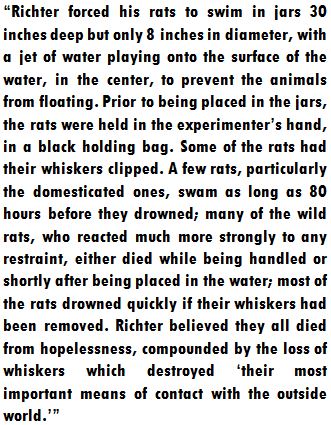
“Learned helplessness is behavior typical of an organism (human or animal) that has endured repeated painful or otherwise aversive stimuli which it was unable to escape or avoid. After such experience, the organism often fails to learn escape or avoidance in new situations where such behavior would be effective. In other words, the organism seems to have learned that it is helpless in aversive situations, that it has lost control, and so it gives up trying. Such an organism is said to have acquired learned helplessness. Learned helplessness theory is the view that clinical depression and related mental illnesses may result from such real or perceived absence of control over the outcome of a situation.”

Wikipedia

I introduced this psychological theory to a judge in 2010 when I filed a lawsuit against a woman who falsely accused me to the police and multiple courts in 2006. The accusations began in March, and before the close of July, she had defrauded at least four judges.

To be falsely accused is bewildering; it savages the mind. To then learn that efforts to expose the truth are met by judges not with keen interest and probing questions but variably with mute indifference, scornful derision, and offhand dismissal—that’s to have it firmly impressed upon you that resistance is futile. Worse, it’s to learn that resistance compounds the frustration and pain.

The system isn’t on your side, and bucking it for many is just an invitation to be scourged afresh.

After attempting some direct appeals to people who, I reasoned, might care more about the truth than the court did (2007), then writing about the business online (2008), then employing an attorney to mediate a resolution (2009), all of which efforts were met with stony silence, I filed a lawsuit (on my own).

That was in 2010. By then, unknown to me, the statutes of limitation on the civil torts I alleged—fraud, false light, defamation, and intentional infliction of emotional distress—had flown. My accuser’s attorney, with mock ingenuousness, wondered to the court why I hadn’t filed my suit in 2006, right after having had the court twice swat down my appeals.
learned_helplessnessI offered the explanation to the judge that people who go through this become conditioned to helplessness (or hopelessness), because process militates against the proposition that a claimant of abuse has engaged in deception. The righteous indignation and outrage of the wronged defendant gradually succumb to the inevitable conclusion that facts, truth, and reason are impotent against fraud and judicial bias. (The defendant lives besides under the constant menace of unwarranted arrest.)

I didn’t know I could prosecute a lawsuit on my own until a legal assistant told me so in 2009, which I also told the judge. I might have been motivated to find out sooner if I’d had the least faith that a judge would heed my testimony.

My accuser’s attorney disdained the explanation for my tardy filing as “self-diagnosis,” and the judge eagerly echoed his assessment and dismissed the case (the court’s interest is in economy, not truth or justice). What was another six months of my life? (Letters from a physician and a therapist, along with witness affidavits, including one from a former cop, made no difference.)

I wasn’t wrong, though. People who defy a rigged system—whether restraining order defendants, domestic violence defendants, or family court defendants—can be conditioned to helplessness, and many accordingly report experiencing posttraumatic stress (which fortifies their distrust and their aversion to further rude scrutiny and contemptuous treatment from the court).

A lesson to take from this is that the “high road” (i.e., trusting in facts, truth, and reason) is a detour to hell. If I had known in 2006 what I know today, I could have extricated myself from my accuser’s false accusations in five minutes by playing the game according to her rules, which were “whatever works.”

The studies from which the term “learned helplessness” emerged were studies of drowned rats and tortured dogs. Playing fair (or aspiring to saintliness by never uttering an ill word against your accuser) is noble, but nobly drowned is still drowned. If an accuser lies about you, denounce him or her as a liar. Similarly, if a process of law is bullshit, call it what it is.

Some respondents to this blog, even after they’ve been through the courthouse ringer, retain a beleaguered faith in ethics. They believe that if injustice is laid bare to a discerning audience by rhetorical appeals to reason and decency, this will spur change. “Our objective is to fix the problem, not the blame” was quoted in a recent comment.
The abstract and impersonal may be informative, but they don’t arouse curiosity, because they don’t inflame the passions; controversy does. Advocates of the “high road” eschew naming names, for example, because it’s aggressive. Avoidance of confrontation, however, accomplishes little and exemplifies “learned helplessness.” The “high road” is safe and tame, and it leads to a dead-end.

The reason restraining order abuse endures is that the abused are paralyzed by indecisiveness. They won’t knuckle down and demand that a flawed process be repealed.
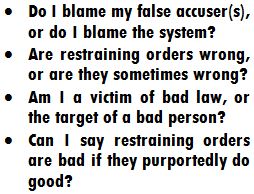
Among people who’ve been damaged by fraudulent abuse of restraining orders and related civil court procedures that are supposed to protect the defenseless, you’ve got, for instance, your liberals who’ll defend the process on principle, because they insist it must be preserved to protect the vulnerable, and they’ll fence-sit just to spite conservatives who flatly denounce the process as a governmental intrusion that undermines family.

Liberals and women who identify with legitimately victimized women feel obligated to “negotiate the gray space” and acknowledge the pros and cons of “women’s law.”

Then you have people (of whatever political allegiance or none) who believe that if you eliminated procedural inequities and ensured that defendants’ due process rights were observed, the system would work fine.

Maybe they believe a process that allows a person in Nevada to mosey into a courthouse, fill out some forms, and accuse a person in Wyoming of “stalking” or “domestic violence,” necessitating that the person in Wyoming hustle him- or herself to Nevada to present a defense within the week, can be made fair, and maybe they don’t know that the same Nevadan can prosecute the same claim over and over against the same Wyomingite (three times, six times, a dozen times, or more).

Maybe they believe that appeals to public conscience will urge the passage of laws that require free legal counsel be provided to defendants.

This would mean that if, say, a million restraining orders are petitioned a year, and legal representation for each defendant in each case could be capped at $2,000 (which might translate to a feeble defense, anyway), state governments would be required to shell out $2,000,000,000 to make everything “fair and square.” But that’s not all. If government gave free representation to “abusers,” advocates for “victims” would demand the same for them. So your $2,000,000,000 would become $4,000,000,000.

That’s per annum. (Also, the hypothetical Wyomingite would still need to travel to Nevada, and who’s paying for that?)

Others believe that if lying (perjury) were prosecuted, that would straighten things out. The costs to prosecute what may be hundreds of thousands of liars a year might be less than $4,000,000,000…or it might not be. Too, how do you prove someone is lying about an emotional state, like “fear”? How do you prove an alleged event didn’t happen?

You can’t, not conclusively, which is what a criminal prosecution requires.

More say appeal to your senator, to the president, to the press…nicely and cogently. They follow a utopian faith that basic decency will prevail if “the problem” is exposed.

As a rhetorical stance, the position has its merits. It suggests calmness and rationality, and calmness and rationality should recommend attention from others. “We’re calm and rational,” proponents of the position imply, “so when we say there’s a problem in need of fixing, it’s calmness and rationality speaking, not anger.”

The limitation is that no one who needs to be convinced has a motive to listen. No one can be made to care about abstractions like equity and due process when in the other ear they’re being cited statistics about epidemic violence.

Everything to do with the law is adversarial. If you seek to revise it without being personal or confrontational, the soonest you can expect a just reward is in the afterlife.
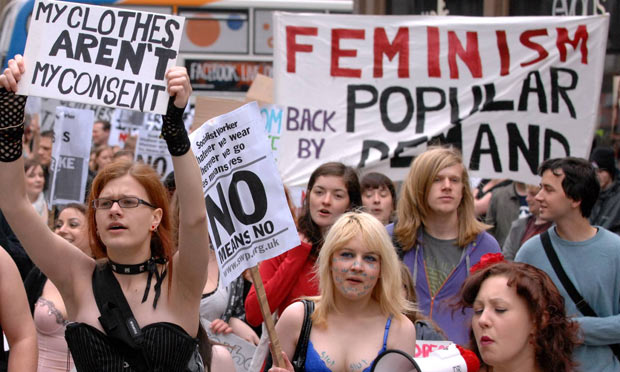
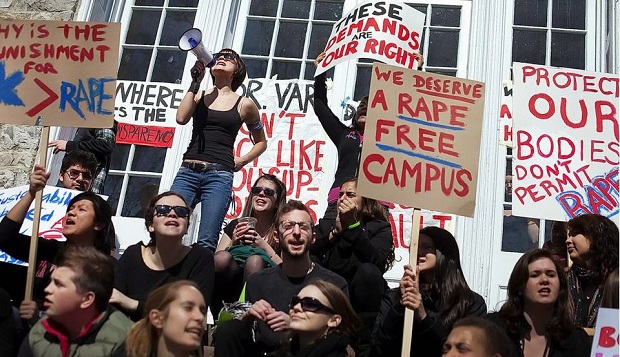
Protesters march on a SlutWalk in Newcastle

Copyright © 2015 RestrainingOrderAbuse.com

*Splendid writers, particularly Cathy Young, have responsibly and lucidly exposed “the problem” for 20 years in major news outlets. The system has responded with statutes that are broader, laxer, and more punishing.

Report Family Court Fraud to the Federal Trade Commission, Says FCLU

The Family Civil Liberties Union (FCLU) has taken a novel approach to attacking legal abuse and the ineptitude and corruption of the courts: reporting it as consumer fraud. The FCLU invites complainants of legal violations to join its campaign.

FCLU has opened a formal Federal Trade Commission (FTC) case for investigation into Family Court Fraud, Deception, and Racketeering. Send your complaints to crcmessages@ftc.gov or fax 202-326-2012.  Please reference Case Number 58748109 in the email subject line. State all judges, lawyers, “experts,” laws broken, duration, and cost of your case. Make sure you include your contact information, docket number, and jurisdictional information. Your document can be as little as one page or numerous pages. We need volumes of complaints to support our formal legal filings. FTC’s charter is “Protecting America’s Consumer,” and Family Court needs to be abolished or strongly regulated federally. Let’s make it do its job.

The FCLU has also reportedly developed a Judicial Investigative Program—whose felicitous acronym, JIP, sounds like gyp (as in ripoff)—and it urges participation in its Violations Research Program (VRP).

Registering complaint is vital, and here may be a way to do it constructively and “legitimately.” (Complainants who chose to email the FTC might, furthermore, choose to send copies of their emails to their local political representatives, along with a prompt that they take independent action.)

FYI.

Copyright © 2015 RestrainingOrderAbuse.com

*The preceding three posts have concerned Legal Abuse Syndrome, a term coined by marriage and family therapist Karin P. Huffer. Dr. Huffer numbers among the FCLU’s board of advisors (as does civil litigation attorney David Heleniak, an ardent proponent of reform).

Abandon All Hope Ye Who Enter Here: The Hell of Legal Abuse Syndrome

This is the third sequential post on this blog about Legal Abuse Syndrome (LAS), a condition proposed by marriage and family therapist Karin P. Huffer “that develops in individuals assaulted by ethical violations, legal abuses, betrayals, and fraud” and that’s exacerbated by “abuse of power and authority and a profound lack of accountability in our courts.” This post surveys accounts of affliction (and its sources) drawn from various websites.

abandon all hope
Editorial intrusions and commentary in this post have been kept to a minimum, but some grammatical polishing is acknowledged.

You May Be Suffering from Legal Abuse Syndrome if You Have Been a Victim of DCF”:

I have been doing some reading on LAS (Legal Abuse Syndrome) and PTSD since I have begun to fear my own shadow. I hate the doorbell to ring. I run to the window to try to see who it might be, and rarely answer. If someone knocks on the door with any force, I am paralyzed. I do not like to answer the phone and thank God for caller ID. When I go out of the house, heaven help me if I see a child who reminds me of what we have lost. I cannot tell you the number of times I have vomited in public toilets. A police car in the rearview mirror leads to deep breathing and panic attacks. The thought of walking into a courtroom is enough to reduce me to a shaking mess. Certain names…can cause me to feel a sense of violation like no other. Sleep rarely happens and is often interrupted by nightmares, or even worse, waking and screaming for my child. No one cares; all of those I thought would protect us have not only failed us but willingly allowed misconduct and lies. Those I held in high regard due to their positions of trust and power I have found to have let their power corrupt their values and morals. Do I think I am ill? Yes, I know I am. I have a good doctor who is trying to help, a church to support me, and my husband and children who have stood by me, but I also know I will never be the same person I was. I will never trust in the “system” and have been totally disillusioned by what I always thought were my constitutional rights as an American citizen not only being disregarded but willfully being trampled on by those sworn to protect them.

Sufferer Legal Abuse Syndrome” (MyPTSD.com):

I was just diagnosed with PTSD from a prolonged and nasty legal battle (10 years). It was my understanding that PTSD was only for vets coming back from war. I guess there are other ways to fight wars. Mine was in the courtroom trying to fight off the onslaught of unethical attorneys and judges. I believe I fought for a good cause, but it has taken its toll on me. My nerves are shot; I have anxiety from the minute I wake up until I go to bed. Thoughts of what they did and the power they had over me and my children are with me always. I want to have a life, but I still deal with the consequences every day. I feel guilty for feeling this way as there are so many other people who have been through much worse. I think the feeling of being powerless and abused by a system I had faith in has shaken my foundation. My feelings about people and the world have changed forever, and my trust level is very low. A psychologist involved in the battle betrayed me and my family with lies, along with two other professionals in this field, all my attorneys, and the judges. You might discount my viewpoint as overboard. It took a long time to see it myself, but my investigations proved correct.

Legal Abuse Syndrome” (Caught.net):

I became depressed, physically ill, and seriously suicidal after experiencing the insanity of litigation. I lost my home and was sent to the street with nothing but the clothes on my back. Literally everything I owned was gone for several years. I fought my fight to points of exhaustion where all I could do was stare into space. Friends had left; I was emotionally isolated, and normal living activities were no longer normal. Rage doesn’t come close to describing the feelings I lived with for years. Even this is not the full story of how bad it got.

Posttraumatic Stress Disorder Legal Abuse Syndrome”:

I was diagnosed about two years ago with LAS [Legal Abuse Syndrome]. Protracted litigation and corrupt court decisions not only exacerbated my fibromyalgia but caused me to begin a whole new set of debilitating symptoms which have rendered me unable to sleep properly, hold a job, succeed in relationships, enjoy life, maintain goals, dreams, and hope. I suffer from what I call “spinal cord attacks,” which feel like rushes of adrenaline or cortisol permeating my spine, making me feel paralyzed, causing severe pain, lasting for 30 seconds to two minutes, and resulting in complete exhaustion and distress.

My once beautiful life as a drama and music teacher, writer and producer of children’s musicals, and fledgling writer has all but vanished. I am so debilitated from extensive legal research, useless and destructive attorneys and judges, horrendous living conditions imposed upon me by corrupt judges who denied me due process, the loss of my beautiful family home to my ex (which I had been paying for but couldn’t qualify for), the purging of all my earthly belongings, a now transient lifestyle, and increasing medical problems like high blood pressure, anxiety attacks, and hopelessness.

Massachusetts Mother Calling for Family Court Justice in Domestic Abuse Cases”:

I have missed all of my three daughters’ birthdays, first days of school, first dances, holidays, vacations, and school volunteering since 2007. My youngest daughter, Kelly, is nine. That means I have already missed out on half her life. I am not a drug addict. I am not an alcoholic.  I was and still am an upstanding citizen in the community despite Attorney Arabasz and his clients’ attempts to cause deliberate and malicious harm to me. I do my best to volunteer in the community, including hospice and domestic abuse, and have won numerous awards for my volunteerism over the years, which tends to bring me a renewed sense of healing from my own traumas. My children and I cannot get back those formative years we have missed. They are gone forever, never to return.  I am speechless in my ability to describe the pain and anguish I feel over this injustice alone.

Over that time, as documented through the courts, I have endured numerous, repeated, serious abuses that I have come to the court pleading for help with to no avail.  I am a human being who can take being abused only for so long.  I have suffered serious, repeated, unrelenting, undue stresses, many of which are criminal in nature, that have caused health issues. When the trial arrived, I prayed and hoped for justice to finally prevail for the sake of my children.

I have been severed from my children’s lives with little to no contact since August 3, 2011, and even longer since September 2007. The verdict of August 2012 from the trial was devastating to me and I worried about the long-term negative impact it would have on my children….

As a result, I am currently being treated for ADHD, Legal Abuse Syndrome, and trauma-related stress, and my treatment since trial has increased. Symptoms of trauma-related stress include gastrointestinal issues; anxiety and fear, especially when exposed to situations reminding me of the many repeated traumatic events; trouble sleeping; trouble eating; low energy; memory problems, including difficulty remembering aspects of the trauma; a “scattered” feeling and inability to focus on work or daily activities;  emotional “numbness,” which causes me to feel withdrawn, disconnected, or different from others; and protectiveness of loved ones or fear for their safety.

I did not suffer any of these symptoms until after I married an abusive partner and endured years of abuse. I was a victim that the system failed to protect, and now I suffer greatly. I was a fantastic mother, and even the father never questioned my ability to care for or mother these children until he got what he wanted and stole financially through the divorce.  However, the system has stripped away all my ability to love, nurture, and parent my three daughters who need me greatly.

The foregoing first-person accounts are hardly comprehensive; they were culled because they’re evocative. Notably, they echo numerous comments submitted by visitors to this blog, who have reported everything from homelessness and hopelessness to living “like a hamster” to contemplating suicide. Many respondents to the e-petition “Stop False Allegations of Domestic Violence” have reported the same.

The third-person account below, though it leaves the victim’s torment to the reader’s imagination, is certainly no less sympathetic than those above. It speaks, particularly, to how blind or indifferent others may be to the effects of legal abuse.

How academia betrayed and continues to betray Aaron Swartz”:

As news spread last week that digital rights activist Aaron Swartz had killed himself ahead of a federal trial on charges that he illegally downloaded a large database of scholarly articles with the intent to freely disseminate its contents, thousands of academics began posting free copies of their work online, coalescing around the Twitter hashtag #pdftribute.

This was a touching tribute: a collective effort to complete the task Swartz had tried—and many people felt died trying—to accomplish himself. But it is a tragic irony that the only reason Swartz had to break the law to fulfill his quest to liberate human knowledge was that the same academic community that rose up to support his cause after he died had routinely betrayed it while he was alive.

This survey concludes with an impersonal commentary from a woman who’s still embroiled in legal strife and fears the consequences of speaking about it too candidly in a public medium. She has removed herself to another state to escape a malicious accuser’s clutches but remains in the crosshairs, despite having been deprived of everything she once took for granted—including her sense of self.

‘White Collar’ Domestic Violence Sanctioned by the State”:

The fraudulently obtained protective order is the new tool of abuse for abusers to obtain total power and control over their victims. The protective order is obtained using false allegations of domestic violence and abuse against the victim in an open court of law without due process or an evidentiary hearing. The protective order is then used as a state-sanctioned license to stalk, harass, intimidate, and continue to abuse the victim. The victim lives in constant fear that s/he will be arrested and incarcerated any time the abuser chooses to place him or her in jail. The accuser plays the victim of his or her own crime [cf. Dr. Tara Palmatier’s “Presto, Change-o, DARVO: Deny, Attack, and Reverse Victim and Offender”].

This is the new “white collar” form of domestic violence and abuse. It is a tactic used by both men and women to gain the upper hand in a divorce or custody battle, or to have a domestic partner simply removed from a lease and ejected from his or her own home. In the case of a victim’s terrible misfortune of coupling with a psychopath or sociopath suffering from a narcissistic or borderline personality disorder, the protective order is fraudulently obtained by means of false accusations of domestic abuse simply to gain total power and control over him or her while simultaneously inflicting emotional distress to hurt and humiliate him or her and publicly harm his or her reputation. This in and of itself allows the abuser to compromise the integrity of his or her victim with a permanent public record, thereby impugning the victim’s character. This not only serves to satisfy the malicious intent of the abuser; it also renders the victim helpless in any and all attempts to plead innocence and defend him- or herself to law enforcement and the courts.

Acts of malicious intent by way of falsifying police reports, manufacturing evidence, and committing perjury in a court of law—all crimes at a felony offense level—go criminally unprosecuted because restraining order courts are of a civil nature, held by low level officials with no due process. Any attempts by the victim to file complaints or police reports of his or her own are useless and futile attempts at self-protection, because probable cause cannot be proven; a victim simply cannot prove with tangible evidence the intent or motive of the abuser. All attempts by the victim to file complaints or police reports to protect him- or herself do is embolden and provoke the abuser to escalate the abusive behavior toward the victim to the point that the victim cannot attend school, go to work, or even leave his or her own home out of living in a constant state of fear that the abuser will have him or her arrested on a whim.

Without due process and without protection, the victim is ultimately under the total power and control of the abuser. Law enforcement and the legal system (the courts, the judges, the attorneys) are all simply pawns in the sociopath’s sick game of abuse of process. A carefully constructed web of lies is in itself so complex that the victim is powerless to prove s/he is the victim of abuse, not its perpetrator. Over time, after the victim is professionally and academically destroyed, publicly humiliated, and ultimately alienated and completely isolated from his or her community, from friends, and even from family, s/he begins to doubt him- or herself and eventually loses all sense of human identity. Many victims commit suicide as a result of the abuse.

Copyright © 2015 RestrainingOrderAbuse.com

*See also this post about the death of Christopher Mackney, which contains links to his suicide note: “First Amendment Rights from Beyond the Grave: Defense of a Suicide’s Publication of His Final Words by the Randazza Legal Group.” The circumstances that conduced to Mr. Mackney’s taking his life are chronicled in a forthcoming book by investigative journalist Michael Volpe, which is titled, Bullied to Death: The Chris Mackney Story.

Kangaroo Court: The Australian Government Acknowledges “Abuse of Process,” so Why Doesn’t Ours?

The previous post introduced Legal Abuse Syndrome (LAS), a condition posited by marriage and family therapist Karin P. Huffer and defined as a form of posttraumatic stress disorder (PTSD). “It is a personal injury that develops in individuals assaulted by ethical violations, legal abuses, betrayals, and fraud,” Dr. Huffer explains. “Abuse of power and authority and a profound lack of accountability in our courts have become rampant, compounding an already stressful experience.” This post catalogs types of legal abuse that exemplify the “ethical violations…betrayals, and fraud” to which Dr. Huffer refers.


Australians aren’t distinguished for their refinement. I like them, though.

Plenty have plainly spent too much time with the sheep—I think we have an Aussie to thank for the Creation Museum, which features dinosaurs cavorting in the Garden of Eden—but Australians tend to tell it straighter than Americans do; they’re frank.

Maybe it comes of living in an equatorial zone that forbids the Puritan dress code.

I learned last week that they have a “Law Reform Commission.” The Australian government, like governments everywhere else, may be slow to acknowledge abusive laws, but at least it acknowledges laws are abused.

In America, feminism (not the equity-for-all kind but the men-suck kind) holds sway. There’s no shortage of conscientious objectors who feel abuses of statutory processes that were conceived to curb violence against women are out of control, but their voices are effectively subdued. To express a quibble is to be immediately beset by frenzied piranha.

So I was pleasantly surprised to discover that the Australian Law Reform Commission openly acknowledges “false or misleading evidence about family violence” and “vexatious applications in protection order proceedings”—which it wouldn’t do if these violations weren’t a lot more common than Americans like to pretend they are.

(Vexatious, incidentally, means “intended to harass.” It’s a warm-and-fuzzy euphemism for intended to destroy.)

The commission predictably wimps out and concludes that “existing measures [in Australia] to sanction persons who give false evidence of family violence are sufficient,” but it does indicate that it finds “merit in allowing courts to order that a person who has brought several vexatious applications or cross applications for protection orders against the same person without reasonable grounds may not make further applications except with the leave of the court.”

This absurdly says that even if a person is repeatedly found to abuse process, the worst consequence s/he should face is having to ask special permission before doing it again. What makes the commission’s comments significant, however, is that they actually own that there are people who exploit court process to hurt others and that they may do it over and over.

In America, you’re not allowed to acknowledge this—or even to allege process is abused to any degree worthy of note. To criticize legal processes instituted to protect women means you think women are “disposable.” The indictment is a non sequitur, but it works. It shuts most politicians up. It shuts most professors and journalists up, too. Never mind that each of “several vexatious applications” for restraining orders or assertions of “false or misleading evidence about family violence” may (permanently) associate the accused with “stalking,” “violent threat,” “assault,” “child abuse,” “molestation,” or even “rape.” Remarkably, there are influential people who briskly opine in venerable media that being accused of these acts, including rape, is no big deal.

(What do you wanna bet it hasn’t happened to them?)

It’s a big enough deal that some people never recover, and some kill themselves (or others). Most survive and persist, but this isn’t the same thing as recovering; they may never be “whole” again. One false accusation that sticks can unravel a life…and the accusation doesn’t even have to stick.

Victims of legal abuse are said to be negligible by the political powers that be, however, because there are women who are battered or raped who never receive justice. Victims of legal abuse are called a “drop in the bucket” in contrast. This argument—ye olde non sequitur again—ignores (among a great many other considerations) that there are women who are battered and/or raped who are also then falsely accused by their batterers or rapists to compound the violation and conceal their crimes. In some cases, at least, feminists who deny legal abuse and its horrors abet batterers and rapists of women.

Completely lost on flatulent opinion-mongers, besides, is that falsely accusing someone of violence or one or more “violence-related” acts is an acutely personal attack that’s often committed by a trusted intimate or former intimate (a friend, for example, or a spouse, family member, or lover), and that judicial process is punishing even when no punishment is meted out. It’s dehumanizing. People’s dignity is violated, their credibility is compromised, their names are tarnished, and their trust is savaged. The scrutiny alone is traumatic—just the anticipation of it is. Regardless of the court’s judgment, an entire network of relationships may be trashed. Members become invested in one side or the other, and no one backs down. Even if the truth emerges and frauds are exposed, apologies and reconciliations may be rare and grudging.

It’s not called “adversarial process” for nothing.

Legal gamesmanship, what’s more, runs the gamut, and this, too, is significant among the Australian Law Reform Commission’s observations. It includes false or misleading accusations of violence, false petitions for state protection, false cross-petitions for protection, false claims made to have restraining orders changed or revoked, etc. (fraud here, fraud there, fraud everywhere). What no one in authority wants to concede is that if the laws make it easy and attractive to lie impulsively and hurtfully, people will lie impulsively and hurtfully.

One of my favorite phrases in the English language is shit for brains when it’s pronounced in an Australian accent. It never fails to make me smile.

What the Australian Law Reform Commission’s remarks make clear is that any shit for brains should recognize that a whole lot of fraud is committed in these volatile yet superficial court procedures that are often started and finished in minutes but whose consequences, irrespective of rulings, are nevertheless extensive, lasting, and crushing.

Copyright © 2015 RestrainingOrderAbuse.com

“Shame and Stigma” and the “Mean-Spirited Cultural Response” That Efforts to Cast Them Off Provoke: Procedural Abuse and Parental Alienation

“Parental alienation is the ‘programming’ of a child by one parent to denigrate the other (targeted) parent, in an effort to undermine and interfere with the child’s relationship with that parent, and most often occurs within the context of a child custody conflict. This includes the ‘legal abuse’ of parents who have been disenfranchised from their children’s lives subsequent to sole custody and primary residence judgments. Within an adversarial legal process, non-custodial parents are often subjected to shame and stigma, lack of access to their children, and devaluation of their role as parents. And those who speak about the pain and woundedness in their lives are subjected to a mean-spirited cultural response, where their talk of woundedness is mocked.”

Edward Kruk, Ph.D.

Here’s child and family social worker Edward Kruk corroborating that parents may be the targets of “legal abuse”; that they’re subjected to shame and stigma, and to alienation from their children; and that they’re ridiculed and regarded with contempt for complaining about it: “The Impact of Parental Alienation on Parents: Post-traumatic Stress in the Rupture of Parent-Child Relationships” (2013). There are mothers who endure this, make no mistake, but as Dr. Kruk observes, “Most alienated parents are non-custodial fathers.”

Members of both genders (parents and non-parents alike) have reported on this blog that they’ve experienced (or are in the throes of) PTSD consequent to abusive legal contests, and it’s not the intent of this post to discount the plaints of mothers who face this torment. It must be emphasized, however, that the “mean-spirited cultural response” Dr. Kruk notes is predominately, if not exclusively, directed at men, and it’s because fathers’/men’s plaints are so roundly and effectively denounced and dismissed that mothers’/women’s plaints also lack a sympathetic audience.

(Feminists would prefer that female victims of legal abuse quietly recede into obscurity and accept the role of martyr for “the cause.”)

The “mean-spirited cultural response” is broad but includes highly influential voices, including law professors and esteemed advocacy groups like the Southern Poverty Law Center, which has equated men’s and fathers’ rights representatives with hate groups, asserting that they’re on a par with the Ku Klux Klan.

No kidding.

To vehemently complain about being treated prejudicially by the courts and alienated from your kids is to be caricatured as a racist wearing a bedsheet and brandishing a torch. (Few in the mainstream press, moreover, scoff at this rhetoric.) For moms (and women in general) who’ve been victimized by legal abuse to be heeded, the demonization of men’s and fathers’ advocates as mere “misogynists” must first be controverted.

Last year, a post on this blog reported the award of a $500,000 grant to a female law professor to “debunk” the claim that court procedures are abused to alienate parents from their children, and it’s this sort of (government-funded) social science research that marginalizes voices like Dr. Kruk’s.

It provides fodder to bloggers and other commentators, and it’s used to “train” judges how to rule.

The selective orientation of feminist social science ignores competing (and compelling) findings like these Dr. Kruk cites:

Suicide rates are reported to be of epidemic proportions among parents, fathers in particular, who are struggling to maintain a parenting relationship with their children (Kposowa, 2000; Kposowa, 2003); and legal abuse has been noted as a key factor in these cases.

A recent post on this blog referenced the suicide of a father who’d undergone years of legal hell and couldn’t face any more. He bled out—emotionally, morally, and financially. Feminist advocates stress the consequences and “rampancy” of domestic violence—focusing narrowly on female victims—while denying that the effects of legal abuses are grave. They trivialize those effects and often deny legal abuses occur to any extent worthy of attention or redress.

The devaluation of family and the curtailment of lives aren’t trivial.

Copyright © 2015 RestrainingOrderAbuse.com

Invoking the Fifth Amendment Protection against Self-Incrimination in “Domestic Violence” Cases

In “How the Fifth Amendment Impacts Family Court in Domestic Violence Cases” (2013), family attorney Tracy Duell-Cazes offers the following counsel against self-incrimination (it’s directed to Californians but may be applicable generally):

To make this easier to read, I will use Respondent when referring to the person who is accused of committing a domestic violence offense and Petitioner for the person against whom the violence was alleged to have been committed.

The Respondent has the right not to make [self-]incriminating statements in any proceeding. This includes discovery, hearings, and any other place where statements may be made. The general rule is that the Respondent cannot be required to testify at the restraining order hearing. The Respondent does not have to produce any discovery regarding the domestic violence issue if the Respondent timely claims the privilege against self-incrimination in response to the discovery request.


Courts usually grant a continuance until the criminal action is concluded. The temporary restraining orders stay in effect. Once the criminal action is concluded, then the hearing in Family Court can go forward. Usually the criminal case is dispositive of whether or not permanent restraining orders in Family Court are issued. If there is a conviction, the permanent restraining orders will almost always be ordered.

The Respondent must make sure that s/he doesn’t say anything to anyone but his/her attorney. (It is usually a good idea in these kinds of cases to have an attorney who practices family law and knows something about criminal law.) If any discovery is sent to you to answer, you need to assert your privilege against self-incrimination in a timely fashion. If you do not, you will lose this right and be required to testify against yourself and be required to respond to the discovery request. This means that the court can compel you to answer the questions, or sanctions will be imposed. Sanctions can be anything from your paying money to the other side to the issue being decided with only the other person’s information.

In order for [the] Respondent to give up his/her right to remain silent, s/he must knowingly and intelligently waive that right. This means that s/he has to know the consequences if s/he talks about the facts and that s/he understands that whatever s/he says can (read will) be used against her/him in the criminal case. If you are ever unsure of whether or not you have a “right to remain silent,” you should immediately consult with an attorney. It is best to consult with an attorney who practices both family law and criminal law or who handles domestic violence cases.

Copyright © 2013, 2015 Tracy Duell-Cazes and RestrainingOrderAbuse.com

*The Fifth Amendment guarantees you don’t have to say anything against yourself. To enjoy this privilege, however, you have to say you don’t intend to say anything against yourself (e.g., “I decline to answer on the grounds that it may tend to incriminate me”). You can’t, in other words, be completely silent. (See Ms. Duell-Cazes’s next to last paragraph above.)

First Amendment Rights from Beyond the Grave: Defense of a Suicide’s Publication of His Final Words by the Randazza Legal Group

“I couldn’t flee and I could not fight. I was never going to be allowed to heal or recover. I wish I were better at articulating the psychological and emotional trauma I experienced. I could fill a book with all the lies and mysterious rulings of the Court. Never have I experienced this kind of pain. I asked for help, but good men did nothing and evil prevailed.”

—Chris Mackney (1968–2013)

An emailed riposte from Las Vegas attorney Marc Randazza was introduced to my attention this week. It was an answer to a move by the “estranged wife” of a man who committed suicide in 2013 to have the man’s suicide note removed from the blog A Voice for Men.

The genesis of this dispute appears to be that Mr. Christopher Hines Machnij a/k/a Christopher Hines Mackney and his estranged wife were in an acrimonious relationship. Due to the strains of that relationship, Mr. Mackney started a blog in order to express his thoughts about his treatment in the family law system. This culminated in a suicide note, which he published to his blog from Washington, D.C., on December 29, 2013, and then he committed suicide on December 29, 2013. His writing and his suicide note were admittedly unflattering to your client. Your client then petitioned a Virginia state court to grant her some ambiguous (and questionable) intellectual property rights to the blog’s contents, which she is using to attempt to purge Mr. Mackney’s expression from every corner possible. One of those corners is my client’s blog.

[…]

It is our position that A Voice for Men’s republication of the suicide note is not copyright infringement, pursuant to 17 U.S.C. § 107. Accordingly, even if Mr. Mackney were to rise from the dead and insist upon the depublication of the suicide note, it is my client’s position that it has a right to continue publication of the letter.

Perusal of Mr. Randazza’s email, which is masterfully composed, is recommended to anyone invested in the right to redress perceived injustices by the public exercise of his or her voice.

Christopher Mackney

I’ve read Mr. Mackney’s “suicide note,” which is neither a manifesto of hate nor a farewell-cruel-world. It’s a supremely calm and sincere apology that’s all the more haunting for its quiet lucidity and resignation.

What Mr. Mackney describes in his final statement (dated four days after Christmas) will be familiar to anyone who’s endured something similar: the isolation, alienation, and paralysis; the mute indifference from anyone who could have intervened; the loss of identity, emotional decay, and financial ruin; and the hopelessness that comes from repeated confirmations that resistance is futile.

The consequences of the court’s intrusion into family and interpersonal matters—and the imposition of its judgment—are seldom viewed with the gravity they deserve.

Much of the debate of issues orbital to the events that prompted Mr. Mackney’s suicide occurs in the abstract. Commentators’ opinions (and they are legion) can rarely be seen to acknowledge the real-life strains and torments that real, live accused people suffer.

What is animating fodder for conversation to some, however, leads others to kill themselves.

Copyright © 2015 RestrainingOrderAbuse.com

*Among Mr. Mackney’s final words are an adjuration to stand up and speak out in defense of the abused (his blog resided at GoodMenDidNothing.com).

How Dogma Is Preserved: A Feminist Law Professor Is Awarded a $500,000 Grant from Uncle Sam to Prove Claims of False Allegations in Family Court Are “Junk Science”

“Ten years ago, about one in 10 domestic violence arrests involved women as defendants. Now, it’s one in five in Michigan and Connecticut, one in four in Vermont and Colorado, and more than one in three in New Hampshire. Public officials are trying to figure out what’s going on. They are especially mystified because, according to [The New York Times], the trend ‘so diverges from the widely accepted estimate that 95 percent of batterers are men.’

“Interesting logic: first, a dogma contradicted by virtually all social science research [namely, 95% of batterers are men] becomes ‘widely accepted.’ Then, when it’s disproved by the facts, the response is to ask what’s wrong with the facts.”

—Cathy Young, “Female Aggression—Domestic Violence’s ‘Dirty Little Secret’” (1999)

What the quoted writer means is that when dogma becomes “widely accepted,” it stays “widely accepted.” Time has proven her right. Fifteen years later, that dogma—men are abusers; women are victims—still predominates.

It gets by with a little help from its friends.
Some months ago, a post on this blog responded to research conclusions published this year by Prof. Kelly Behre, director of the UC Davis Law School’s Family Protection and Legal Assistance Clinic.

Among those conclusions was that anecdotal reports of procedural abuses, false allegations, and judicial bias by what she calls FRGs (fathers’ rights groups) have no “legitimate” research studies to back them up and should therefore exert no influence on public policy. They should, according to the professor’s own research, be disregarded.

Last month, it was reported that a George Washington University law professor was awarded a $500,000 grant from the National Institute of Justice (i.e., taxpayers) to “conduct a study in which she hopes to show that family courts across the country have fallen into a pattern of awarding custody” of children to fathers who are “known abusers.”

The professor, Joan Meier, directs the university’s Domestic Violence Project. She’s also the “founder and legal director of the Domestic Violence Legal Empowerment and Appeals Project, a nonprofit that [helps] domestic violence survivors receive pro-bono [legal aid].” Her credentials, you’ll notice, are conspicuously similar to those of Prof. Behre, referenced above.

Consider why Prof. Meier was awarded the grant:

She said researchers can say anecdotally that courts have awarded custody to known abusers or fathers whose [partners or ex-partners] have warned could be abusive to children, but researchers and advocates’ sharing their experiences alone hasn’t yet led to change.

Now consider that fathers’ rights researchers and advocates’ sharing their experiences has also yet to lead to change, and appreciate that those researchers and advocates aren’t being cut half-million-dollar checks to compile research data. What they have to say doesn’t accord with the “widely accepted” dogma; it isn’t popular.

Because their anecdotal reports of false allegations, procedural abuses, and judicial bias don’t have any official research to validate them, they’re to be ignored.

Ignoring those reports, in fact, is essential for a hypothesis like Prof. Meier’s to be tenable. It depends on absolutely denying that those whom the professor calls “known abusers” could be men who’ve been falsely implicated.

Prof. Meier says she expects to use the $500,000 federal grant to conclusively expose gender bias in family court against women—and to do it using a study sample of “over 1,000 court cases from the past 15 years” (a study sample, in other words, of fewer than 2,000 cases).

For the professor’s hypothesis to be proven “true,” it just has to be shown that in a significant number of the “over 1,000 cases” reviewed, a father awarded custody of children had previously been accused of abuse.

The researchers hope to debunk “junk science” that mothers make false accusations of abuse to alienate fathers from their sons or daughters, a misconception that Meier said has put many children in danger.

Prof. Meier seems to fail to grasp that the complaint is that mothers successfully “make false accusations of abuse to alienate fathers from their sons and daughters.” Even if her study were to show that child custody is awarded to fathers who’ve been successfully accused of abuse, it wouldn’t necessarily prove that the complaint that false accusations are routine  is based on “junk science” (unless by that phrase she means science that hasn’t been government-funded and -audited).

Prof. Meier’s assertion that claims of false allegations are a “misconception,” what’s more, ignores that any number of attorneys who practice family law publicly corroborate that so-called misconception. Some indeed say false allegations to gain the advantage in custody battles are commonplace. These are the attorneys who actually practice in the trenches. Their reports, however, are once again only anecdotal.

Fathers and their advocates who claim false accusations are made don’t, of course, misconceive anything. They know what they know; they’ve lived it. The professor’s use of the word misconception is directed at the “people who count,” that is, the policy-makers. What she means is any credibility they might be disposed to show complainants of procedural abuse is based on a misconception. That misconception, apparently, is that men without law degrees could possibly be telling the truth.

The professor’s assertion that reports of false accusations are “junk science,” furthermore, would seem to advocate for good science, and there’s certainly nothing scientific about prejudicially dismissing those reports offhand. Studies like those proposed by Prof. Meier need to be counterbalanced by studies with opposing hypotheses—and they aren’t.

Meier and her team of legal and statistical experts will create a database of court opinions that she hopes will show a pattern that supports her hypothesis, and will then present it to activists, local courts, and organizations that train judges.

Preservation of dogma is a game of ring-around-a-rosy. Advocacy for what’s widely accepted to be true is lavishly funded, and the resultant “science” may then be used to “train” judges how to rule, further reinforcing the dogma.

(If the context of this policy were Russia instead of the United States, would training still be the word we used to mean influencing judges?)

This is how underhand gets the upper hand, and it’s remarkable how openly this kind of business is transacted. No one bats an eye, because it’s “official.”

Prof. Meier may have the best of intentions. The author of this post has never known anyone whom he would characterize as a domestic violence “survivor.” He has no doubt, however, that there are people who are daily subject to violent cruelty, and if he did know someone like that, he’d be grateful that there were people like Prof. Meier looking out for their interests.

Victims need advocates and defenders.

The reality is, though, that victims of domestic violence have quite an abundance of public and private sympathizers, while victims of abuse of civil and criminal processes legislated to protect battered women and children (including restraining orders) receive little public recognition at all. An agency that calls itself the “National Institute of Justice” shouldn’t play (or pay) favorites. Justice would, in fact, advocate that an equal payout be provided to researchers to study the frequency of fraudulent accusations, which can’t be determined from court rulings, because those rulings are influenced if not dictated by the prevailing dogma.

Hypotheses, it’s been amply observed, tend to incline researchers to find evidence of whatever it was they were looking for in the first place (this is called “confirmation bias” or “myside bias”).

Leora Rosen, a former senior social science analyst at the National Institute of Justice, said [Prof. Meier’s] study is unique because it is transparent about its lack of objectivity and looks at family court rather than criminal court cases. She has partnered with Meier for the study.

Copyright © 2014 RestrainingOrderAbuse.com

“Why Would Someone Get a False Restraining Order?”

This question pops up a lot.

Simply rephrasing it can dispel some of the wonderment: “What would someone have to gain by falsely accusing someone else of conduct society condemns?”

Satisfaction of a spiteful impulse might come to mind.

I remember looking at a book once by a guy named Hayduke. It was chock full of ingenious vengeance schemes—pretty much all of them criminal or bordering on it. Lying on a restraining order to sate a hurtful yen, while technically criminal, is never treated as such and may well succeed in criminalizing the target of that yen.

Common allegations on restraining orders are harassment, stalking, danger, and violence. Any of these—and especially the last—can doom a person’s employment or professional aspirations, tear relationships apart, and gnaw at and vex the innocently accused indefinitely (to his or her physical and psychological erosion). Allegations like this from a domestic partner can deprive the same victim of assets and access to loved ones. The use of fraudulent restraining orders to gain the upper hand in child custody battles is pretty much cliché.

And restraining orders don’t just vanish from public record when the expire. In some regions, there are even restraining order registries to make finding out who’s had a restraining order sworn out against him or her conveniently (and alluringly) accessible by the public. The political push is toward making such registries universal.

It’s possible that the question, “Why would someone get a false restraining order?” is prompted by a disbelief that a person could be so unethical. Such a disbelief betrays the questioner’s naivety.

People frame people for crimes or commit crimes to hurt others every day. Abusing restraining orders is just more fail-safe. Perjury (lying in court or on a sworn statement) is never prosecuted, and restraining orders are generally free for the asking. You get the state to exercise your malice for you, it costs you nothing, and everyone extends you their sympathies.

The worst that happens when someone lies to obtain a restraining order is that it’s overturned on appeal. And even if it’s quashed, the recipient of the fraudulent restraining order will have been put through hell (and possibly cost several thousands of dollars in attorney fees). In fact succeeding in having a restraining order vacated (canceled) doesn’t necessarily mean it disappears from public record. Even if a fraud loses, s/he wins.

Clearly then the answer to the question, “Why would someone get a false restraining order?” is “Why not?”

Copyright © 2013 RestrainingOrderAbuse.com