Let’s get something clear: protests against restraining orders aren’t about restraining orders.
Granted, it’s a violation against decency and all things American for the government to casually curtail citizens’ freedoms without even consulting them first. But, seriously, who cares if a judge says one adult can’t talk to some other adult?
Objections to restraining orders are never about not being allowed to talk to the plaintiffs who were treacherous enough seek them. I would imagine (and I don’t strictly have to imagine) that most restraining order defendants’ feelings toward the people they’re prohibited from talking to are considerably less than friendly, anyway.
Here’s what objections to restraining orders are about:
- On a modicum of evidence of “threat” or none at all, a spouse or boy- or girlfriend can be ejected from his or her home (even if s/he holds the deed) and forbidden access to his or her children, pets, money, and property on pain of police arrest.
- Allegations ranging from harassment to domestic violence can be permanently stamped on defendants’ (that is, recipients’) records, again based on a modicum of evidence (very possibly misrepresented) or none at all. An allegation amounting to nothing more than “I’m afraid” is sufficient to obtain an “order of protection,” the implications of which phrase alone signify stalking, violence, or violent intent.
- Restraining orders are public documents that may be accessible to anyone, including employers and would-be employers. Records of their issuance remain on public view even after their expiration and may be entered into public registries.
- The truth or falsity of allegations that may be as extreme as assault with a deadly weapon, child molestation, or rape is determined according to the same civil standard of evidence as contract and insurance disputes: “preponderance of the evidence.” Regardless of the extremity of allegations on restraining orders, neither a trial by jury nor “proof beyond a reasonable doubt” is ever required for their validation. If a judge feels there’s a better than 50/50 probability that allegations are true, “preponderance of the evidence” is satisfied.
- Allegations on restraining orders, which may be either criminal or criminal in nature and may besides be entirely false, indefinitely remain on defendants’ public records whether they’re found meritorious or not, that is, even baseless allegations that a judge ignores are never stricken from the record but remain on public view and may reasonably be interpreted as true or valid by anyone who consults those records.
- The restraining order process is conducted ex parte, which means orders are issued based on one party’s claims alone, and these may be both damning and egregiously false.
- Statutory penalties for lying to police officers and judges (false reporting and perjury) are never enforced, and allegations of lying are furthermore discounted by the courts.
 Federal grant monies (average grants being in the neighborhood of $500,000) are awarded to police districts and courts in return for their consenting to have their officers “educated” about how they should respond to allegations of fear and violence. Mandated responses include accepting allegations of violence by women at face value (that is, they’re not to be questioned). This mandated response roughly translates to allegations by anyone being recognized as legitimate.
- Irrespective of the nature of allegations entered against a defendant, which may be innocuous or false, that defendant is subjected to traumatizing menace, intimidation, and public disparagement by the state. S/he is treated generically like a fiend, the paradigmatic basis for which treatment is the domestic batterer whose conduct restraining orders were originally conceived to check, despite allegations of violence being rare today relative to the vast number of restraining orders issued (estimated at two to three million per annum).
- Restraining orders, which circumvent due process entirely and which originate in civil court and are therefore subject to no standard of proof, may implicate defendants as criminals and may have criminal consequences if “violated.” Alleged violations, also, may be subject to no standard of proof. In other words, a defendant can find him- or herself locked up, never having been granted his or her constitutional right to a trial and very possibly on maliciously false grounds (based on a decision formed by the court prior to even knowing what that defendant looked like).
- Opportunities to contest allegations on restraining orders, which defendants may literally have to ask for within a brief window of time, may be assigned no more than a few minutes, and defendants are never provided counsel. An innocent defendant forced to contest utterly malicious allegations may face the quandary of living with them permanently stamped on his or her public record or shelling out $2,500 to $5,000 for an attorney’s representation, which measure is no guarantee of vindication and which measure few can afford even if they’re conscious of the need (which few are).
- Restraining orders are usually free for the asking and may be petitioned serially or multiply by a single applicant, making them marvelous instruments of harassment and torment. There’s no statutory limit on the number of restraining orders a single applicant may apply for, no penalties for having false or groundless restraining orders dismissed, and of course no penalties for lying.
- Restraining orders impose no limitations on the actions of plaintiffs (that is, applicants), leaving them free to taunt or stalk defendants, or bait them into violating orders of the court.
- Courts pander to and reward even those guided by spite, jealousy, malice, and/or personality disorders or mental illness. The interchange between a judge and a plaintiff is no more than five or 10 minutes in duration and is more procedural and perfunctory than probative. A judge authorizes a restraining order, which may permanently alter many lives for the worse (including those of children), based on knowing nothing whatever about its defendant, who’s just a name on a form, and almost nothing about its petitioner, who may be disturbed or even insane.
- Upon plaintiffs’ successfully making false allegations stick once (or baiting defendants into violating false restraining orders), they now have a foundation upon which to make further falsehoods entirely plausible. Thus can innocent defendants’ lives be scarred or fractured irreparably by chronic abuse (a single potent lie, or a series of them, can be nursed for years). And these defendants may have been the actual victims in the first place.
Most people (including authorities and officers of the court) aren’t conscious that restraining orders are abused, let alone conscious of how they’re abused, why they’re abused, or how extremely they can be abused.
It’s hoped that this synopsis makes the means and motive for restraining order abuse clearer to those in the dark, at sea, or on the ropes. Whether you’re a legislator, a judge, a police officer, an attorney, a counselor, a feminist or feminist partisan, a victim of restraining order fraud, or just someone with reasonable expectations about how the justice system operates, whatever your perceptions were about restraining orders and their administration, those perceptions were probably either naïve or wrong.
The ease and convenience with which restraining orders may be obtained make their attractiveness as instruments of passive-aggressive castigation, spite, and vengeance irresistible.
You’ve seen that game carnival-goers are invited to take a crack at that gives them three tries to drop a seated person into a pool of water? Restraining orders are sort of the same thing, only the cost of a ticket is free, a player doesn’t need to be able to hit the broadside of a barn, and the water beneath the target is scalding.
Copyright © 2013 RestrainingOrderAbuse.com

 The 148 search engine terms that appear below—at least one to two dozen of which concern false allegations—are ones that brought readers to this blog between the hours of 12 a.m. and 7:21 p.m. yesterday (and don’t include an additional 49 “unknown search terms”).
 Since restraining orders are “civil” instruments, however, their issuance doesn’t require proof beyond a reasonable doubt of anything at all. Approval of restraining orders is based instead on a “preponderance of evidence.” Because restraining orders are issued ex parte, the only evidence the court vets is that provided by the applicant. This evidence may be scant or none, and the applicant may be a sociopath. The “vetting process” his or her evidence is subjected to by a judge, moreover, may very literally comprise all of five minutes.
 You know, a box like you’ll find on any number of bureaucratic forms. Only this box didn’t identify her as white or single or female; it identified her as a batterer. A judge—who’d never met her—reviewed this form and signed off on it (tac), and she was served with it by a constable (toe) and informed she’d be jailed if she so much as came within waving distance of the plaintiff or sent him an email. The resulting distress cost her and her daughter a season of their lives—and to gain relief from it, several thousands of dollars in legal fees.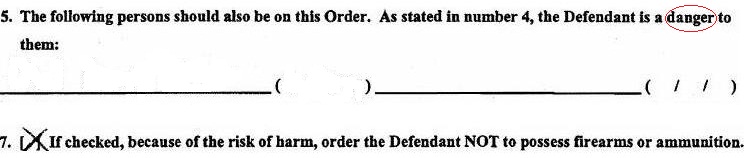
 The ethical, if facile, answer to his or her (most likely her) question is have the order vacated and apologize to the defendant and offer to make amends. The conundrum is that this would-be remedial conclusion may prompt the defendant to seek payback in the form of legal action against the plaintiff for unjust humiliation and suffering. (Plaintiffs with a conscience may even balk from recanting false testimony out of fear of repercussions from the court. They may not feel entitled to do the right thing, because the restraining order process, by its nature, makes communication illegal.)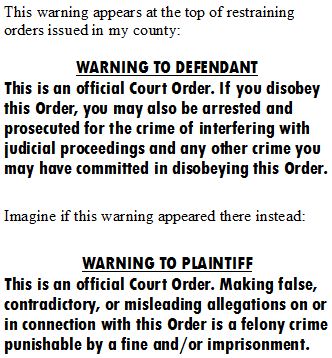
 If the courts really sought to discourage frauds and liars, the consequences of committing perjury (a felony crime whose statute threatens a punishment of two years in prison—in my state, anyhow) would be detailed in bold print at the top of page 1. What’s there instead? A warning to defendants that they’ll be subject to arrest if the terms of the injunction that’s been sprung on them are violated.
 TALKING BACK to restraining orders