“My 87-year-old father has been arrested and jailed three times by my mentally ill mother, who is using domestic violence laws to her advantage in a divorce. This is a man who served in the military for 20 years, the federal government for 25 years, and the Department of Social Services for five years before retiring. My dad has never even had so much as a speeding ticket in his entire life, but now, at the end of his life, he has been humiliated, placed on supervised probation, and will probably lose everything due to the abuse of domestic violence laws. Nobody in law enforcement will listen to what is really going on here. Even though I had prior knowledge that my dad was being set up, I have actually been told by the District Attorney…and I quote, ‘I have convicted your father of assault on a female, and I will convict him of everything else I can.’ The justice system has gone off the rails, and the truth means nothing. My father fought in World War II and in Korea to keep this country free, and this is how he is repaid.”
—E-petition respondent
How did you spend the yuletide? With friends and family, listening to Nat King Cole and Bing Crosby, mussing kids’ hair and congratulating them on their Christmas spoils?
Read the epigraph above, and you’ll have a pretty clear idea of what Todd L. of Wilmington, North Carolina had on his mind. Not much to raise a cup of cheer to, is it?

This distinguished service veteran’s age approximates that of the cited victim of false allegations.
Two hours after Todd shared his story on the e-petition “Stop False Allegations of Domestic Violence,” a fellow North Carolinian opined, “There should be a legal penalty for false accusations!”
Lawmakers have agreed, actually, and statutes making lying to the court a felony crime are universal. What this commenter should have said is that legal penalties for false accusations should be enforced.
Perjury is never prosecuted. District attorneys will tell you that if they did prosecute perjurers, there’d be no resources left for putting “dangerous people” behind bars.
Let’s parse that logic.
First, it actually recognizes that lying occurs a lot. If it only occurred now and then, prosecutions would be few and hardly a budgetary strain.
Second, recognizing that lying occurs a lot also recognizes that the so-called dangerous people the state prefers to prosecute may simply be victims of false allegations. Preferring to prosecute alleged domestic assailants, therefore—take, for example, the 87-year-old man cited in this post’s epigraph—may mean preferring to prosecute the falsely accused (the innocent) over the genuinely criminal (the false accusers).
Ask yourself which would look better on the books: “We’ve successfully prosecuted [x number of] wife-beaters” or “We’ve successfully prosecuted [x number of] perjurers”? Everyone knows what wife-beater means. How many people even know what a perjurer is?
 “If we did prosecute perjurers, there’d be no resources left for putting dangerous people behind bars…so we’ll prosecute the people perjurers falsely accuse of being dangerous”—as analysis of most of the arguments made in defense of domestic violence and restraining order policies reveals, the reasoning is circular and smells foul. It’s in fact unreasoned “reasoning” that’s really just something to say to distract attention from unflattering truths that don’t win elections, federal grants, popular esteem, or political favor. So entrenched are these policies and so megalithic (and lucrative) that rhetoric like this actually passes for satisfactory when it’s used by someone in a crisp suit with a crisper title.
Obviously it wouldn’t be necessary to prosecute all perjurers to arrest epidemic lying. Ensuring that false allegations were made less frequently would only entail putting a few frauds in cages for a year or two where they belong, making examples of them, and revising policy so that the consequences of lying were impressed upon other would-be frauds. As it is, policy (including menacing rhetoric on court documents like restraining orders) is to impress upon defendants how serious the consequences of being lied about are: “For being publicly lied about, you may be subject to arrest and incarceration for being publicly lied about some more.”
The absurdity is patent, as is the wanton cruelty. Applying the word justice to any aspect of this policy should itself be criminal.
The 87-year-old man referenced in the epigraph above may be at the end of his life, and it’s a reasonable surmise that whatever remaining time he could have hoped for will be shortened by the treatment he’s received from the country in whose service he’s dedicated over half of that life.
If a YouTube video were posted of state agents bludgeoning an 87-year-old veteran, it would shortly go viral, reporters would elbow their way onto the man’s front stoop, lawyers would scrap and scrabble to represent him, and cable commentators would decry the outrage of the abuse.
Heads would roll.
Since state agents have instead subjected this man to public denigration and dehumanizing psychic torments under the guise of propriety, the odds are strong that he’ll slip away erelong, invisibly, his final days having been poisoned by anguish, disgrace, and the unrelenting consciousness that 50 years of public service were callously invalidated: “I have convicted your father of assault on a female, and I will convict him of everything else I can.”
Copyright © 2013 RestrainingOrderAbuse.com
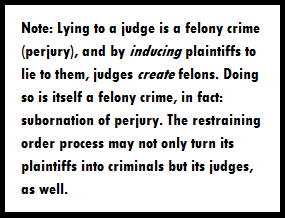 The restraining order process has become a perfunctory routine verging on a skit, a scripted pas de deux between a judge and a complainant. Exposure of the iniquity of this procedural farce hardly requires commentary.
 The answer to these questions is of course known to (besides men) any number of women who’ve been victimized by the restraining order process. They’re not politicians, though. Or members of the ivory-tower club that determines the course of what we call mainstream feminism. They’re just the people who actually know what they’re talking about, because they’ve been broken by the state like butterflies pinned to a board and slowly vivisected with a nickel by a sadistic child.
 In case you were wondering—and since you’re here, you probably were—there is no gaining relief from false allegations on a civil restraining order. Repetition for emphasis: There is no gaining relief from false allegations on a civil restraining order. Why? Because as far as the court’s concerned, there are no such things.
 Many of the respondents to this blog are the victims of collisions like this. Some anomalous moral zero latched onto them, duped them, exploited them, even assaulted them and then turned the table and misrepresented them to the police and the courts as a stalker, harasser, or brute to compound the injury. Maybe for kicks, maybe for “payback,” maybe to cover his or her tread marks, maybe to get fresh attention at his or her victim’s expense, or maybe for no motive a normal mind can hope to accurately interpret.
 The phrase restraining order fraud, too, needs to gain more popular currency, and I encourage anyone who’s been victimized by false allegations to employ it. Fraud in its most general sense is willful misrepresentation intended to mislead for the purpose of realizing some source of gratification. As fraud is generally understood in law, that gratification is monetary. It may, however, derive from any number of alternative sources, including attention and revenge, two common motives for restraining order abuse. The goal of fraud on the courts is success (toward gaining, for example, attention or revenge).
 I came upon a monograph recently that articulates various motives for the commission of fraud, including to bolster an offender’s ego or sense of personal agency, to dominate and/or humiliate his or her victim, to contain a threat to his or her continued goal attainment, or to otherwise exert control over a situation.
 Below is a list of cognitive distortions (categories of automatic thinking) drawn from
  The narcissist has a distorted sense of his or her own self-worth, distorts perceived slights or criticisms into monstrous proportions, and endeavors to distort others’ perceptions of those who dared to “criticize.”
 The outrage of
  Consider whether you don’t think this kind of scenario is more likely to exert a detrimental influence on a child’s development (and whether Jesus wouldn’t have thought so):
 Because restraining orders place no limitations on the actions of their plaintiffs (that is, their applicants), stalkers who successfully petition for restraining orders (which are easily had by fraud) may follow their targets around; call, text, or email them; or show up at their homes or places of work with no fear of rejection or repercussion. In fact, any acts to drive them off may be represented to authorities as violations of those stalkers’ restraining orders. It’s very conceivable that a stalker could even assault his or her victim with complete impunity, representing the act of violence as self-defense (and at least one such victim of assault has been brought to this blog).
 Consider: If someone falsely circulates that you’re a sexual harasser, stalker, and/or violent threat—possibly endangering your employment, to say nothing of savaging you psychologically—you can report that person to the police, seek a restraining order against that person for harassment, and/or sue that person for defamation and intentional infliction of emotional distress. If, however, that person first obtains a restraining order against you based on the same false allegations—which is simply a matter of filling out a form and lying to a judge for five or 10 minutes—s/he can then circulate those allegations, which have been officially recognized as legitimate on an order of the court, with impunity. Your credibility, both among colleagues, perhaps, as well as with authorities and the courts, is instantly shot. You may, besides, be subject to police interference based on further false allegations, or even jailed (arrest for violation of a restraining order doesn’t require that the arresting officer actually witness or have incontrovertible proof of anything). And if you are arrested, your credibility is so hopelessly compromised that a false accuser can successfully continue a campaign of harassment indefinitely. Not only that, s/he can expect to do so with the solicitous support and approval of all those who recognize him or her as a “victim” (which may be practically everyone).
 Restraining orders are unparalleled tools for discrediting, intimidating, and silencing those they’ve been petitioned against. It’s presumed that those people (their defendants) are menaces of one sort or another. Why else would they be accused?
 Memorable stories of restraining orders’ being used to conceal (or indulge) indiscretions or infidelities that have been shared with me since I began this blog over two years ago include a woman’s being accused of domestic violence by a former boyfriend she briefly renewed a (Platonic) friendship with who had a viciously jealous wife who put him up to it; a man’s being charged with domestic violence after catching his wife texting her lover and wrestling with her for possession of the phone for an hour (he was forced to abandon his house so his rival could move in); and a young , female attorney’s being seduced by an older, married colleague who never told her he was married and subsequently petitioned an emergency restraining order against her, both to shut her up and to minimize her opportunity to prepare a defense. I’ve even been apprised of people’s (women’s) having restraining orders petitioned against them by spouses (women) who resented being informed of their mates’ sleeping around.
 What this blog and
  That’s why I’m particularly impressed when I encounter writers whose literary protests are not only controlled but very lucid and balanced. One such writer maintains a blog titled
  Casual charlatanism, though, is hardly an accomplishment for people without consciences to answer to. And rubes and tools are ten cents a dozen.
 A principle of law that everyone ensnarled in any sort of legal shenanigan should be aware of is stare decisis. This Latin phrase means “to abide by, or adhere to, decided things” (Black’s Law Dictionary). Law proceeds and “evolves” in accordance with stare decisis.
 I had an exceptional encounter with an exceptional woman this week who was raped as a child (by a child) and later violently raped as a young adult, and whose assailants were never held accountable for their actions. It’s her firm conviction—and one supported by her own experiences and those of women she’s counseled—that allegations of rape and violence in criminal court can too easily be dismissed when, for example, a woman has voluntarily entered a man’s living quarters and an expectation of consent to intercourse has been aroused.
 Lapses by the courts have piqued the outrage of victims of both genders against the opposite gender, because most victims of rape are female, and most victims of false allegations are male.
 As many people who’ve responded to this blog have been, this woman was used and abused then publicly condemned and humiliated to compound the torment. She’s shelled out thousands in legal fees, lost a job, is in therapy to try to maintain her sanity, and is due back in court next week. And she has three kids who depend on her.
 The
The  Not many years ago, philosopher Harry Frankfurt published a treatise that I was amused to discover called
  The logical extension of there being no consequences for lying is there being no consequences for lying back. Bigger and better.
 The sad and disgusting fact is that success in the courts, particularly in the drive-thru arena of restraining order prosecution, is largely about impressions. Ask yourself who’s likelier to make the more impressive showing: the liar who’s free to let his or her imagination run wickedly rampant or the honest person who’s constrained by ethics to be faithful to the facts?
 A recent respondent to this blog detailed his restraining order ordeal at the hands of a woman who he persuasively alleges is a

 The 148 search engine terms that appear below—at least one to two dozen of which concern false allegations—are ones that brought readers to this blog between the hours of 12 a.m. and 7:21 p.m. yesterday (and don’t include an additional 49 “unknown search terms”).
 TALKING BACK to restraining orders