Claiming Fear and Harassment to Terrorize and Harass: How to Deal with Serial Restraining Order Abuse

“Can anything be done when someone constantly gets TROs [temporary restraining orders] falsely…?”

—Search term leading to this blog

This conduct is properly labeled harassment and stalking, and (absurdly) deterrence of this conduct is properly achieved by applying to the court for a restraining order.

The court may be resistant to acknowledging that this sort of thing happens, but it’s in fact a wonder that it doesn’t happen on a larger scale. Restraining orders are free and easily got by claims of apprehension or by outright and calculated fraud, including false allegations of dismaying specificity or even manufactured evidence. (You can’t make this stuff up: I remember reading several years ago of a false accuser’s situating a chainsaw in her driveway and then summoning police to photograph the tableau, which she represented as a “warning” from an ex—vivid, indeed.)

Victims of serial restraining order petitioners must be assertive and present their cases reasonably. Harassment is, by definition, behavior that’s intended to disturb, disrupt, and wear down, and that’s repeated over time. As easy as it is for a crank or a sociopath to continuously obtain restraining orders, it nevertheless represents a very deliberate and sustained course of action that’s furthermore clearly evident of fixation (i.e., stalking).

Provided that a separate case is opened by the victim who alleges chronic harassment by restraining orders, the fact that his or her abuser applied for restraining orders against him or her first isn’t an obstacle.

Essential is showing a pattern of deviant and repetitively malicious misconduct.

Short of applying for a restraining order to arrest this misconduct, the value of which is to discredit false allegations a malicious accuser may make in the future, a victim’s only “easy” remedy is to relocate beyond a false accuser’s reach. Restraining orders may still be issued but cannot be served.

(Yes, dealing with these obscenities forces people to completely uproot their lives.)

Filing a lawsuit is always an option, but it’s never one easily realized, and a successful prosecution is very demanding and stressful, and is only reliably accomplished with the aid of an attorney, making it very expensive besides.

I live in the formerly Wild West. One brush with a nut who exploits the system this way makes you yearn for the lawless days when you could call someone into the street and settle a dispute with an expeditious showdown…and then grab a slice of pie at the diner while the undertaker tidied up.

Copyright © 2014 RestrainingOrderAbuse.com

“Three Times She Said I Ran Her Over”: On the Nature of False Allegations and False Accusers

There was a story out of England last summer about a Zimbabwean refugee, a mom, who clashed with a neighbor over a parking place—a parking place—shortly after moving into her cul-de-sac. The dispute was brief but inspired the neighbor to begin accusing her of crimes. She called the police and claimed the Zimbabwean woman had “stabbed her with a screwdriver and a set of keys” and that she had “smashed into her car and used her keys to scratch her vehicle.” Then, after police determined the allegations were baseless and issued the woman a harassment notice, she began keeping her neighbor under video surveillance.

The neighbor’s account:

“It has been a very unhappy nightmare.

“I’ve had so many different people knock on my door questioning me—that is really scary, even if you know you’ve done nothing wrong.

“It’s really difficult to cope.

“I am a quiet person; I don’t like conflict. I don’t understand why she’s doing it.

“Three times she said I ran her over. It frightened me, because I’d look out the window and see police looking underneath my car, and your heart starts pounding.

“Once she phoned the police in front of me and said, ‘Help me, my neighbour’s stabbing me’ and they were out straight away.”

In this story, the fraud was hoist on her own petard and eventually issued a restraining order for her misconduct. The horror is that had this woman sought a restraining order instead and then made her false allegations, the neighbor’s torment could have been magnified manifold. This is particularly easy to accomplish in the United States.

All of her allegations—stabbing, vandalism, vehicular assault—would have remained on her target’s public record had these allegations been made on a restraining order. And the suspicion of the authorities and courts would have been reversed.

This blog was contacted over the summer by a solitary woman in her 60s, living alone, who similarly aroused the wrath of her neighbor, who proceeded to accuse her of threatening behavior, sought a restraining order against her, and eventually accused her of killing her horse. To avoid further false allegations, the formerly independent senior was forced to abandon her home and rely on the kindness of strangers for a roof and a warm bed.

It’s difficult enough impressing upon someone that restraining orders are issued casually through a process that entails no more than a few-minute theatrical audition. Impressing upon him or her that people willfully and persuasively lie without any motive but malice is next to impossible. “Why would people do that?” they ask, incredulous. One answer might be for attention or for kicks. The simple answer, though, is this: “Because they can.” It isn’t just the case that allegations to authorities and judges may be exaggerated or invested with a little hammed hysteria; they may be calculatedly, sadistically, and hugely false.

And when sadistic impulses aren’t discerned and shut down—and, when they’re ventilated on a restraining order, they often aren’t—they may be indulged by the system repeatedly, even over many years, and to the ruination of their victims.

False accusers are never prosecuted in civil cases, and if they’re sanctioned at all, it’s only in highly publicized cases.

The question people should ask is, “Why wouldn’t people lie?” And the answer should be, “Because they’d go to jail.”

Copyright © 2014 RestrainingOrderAbuse.com

Who or What Can’t Be Published on CafeMom?: On Ad Hominem Attacks, Feminist Hatemongering, and the Victimization of Moms by Both

I was concerned to see that someone was brought to this site recently by the search term “Tara Palmatier [X].” I’ve omitted the final word of the phrase not because it’s vulgar but because I don’t want an anomalous Google query to put an idea into the head of some crank with too much time on her hands.

Dr. Tara J. Palmatier is a psychotherapist whose writing I’ve come to admire and respect, and which I’ve consequently quoted many times. She has what distinguishes the brilliant from the intelligent: bold candor. I did a hasty Google search of my own to see what would have prompted someone to use the keywords cryptically quoted above and nothing correspondent appeared except a page that appeared to be a spoof.

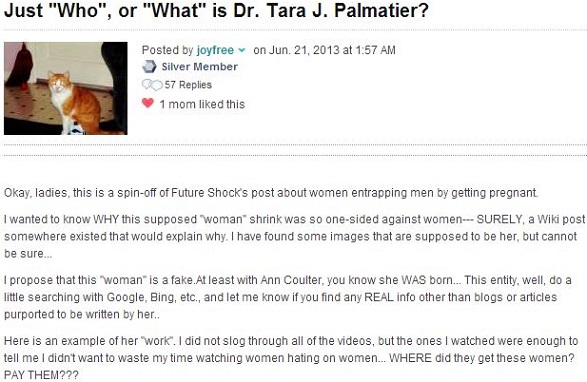
I did, however, notice this post, published eight months ago, on CafeMom: “Just ‘Who’ or ‘What’ is Dr. Tara J. Palmatier?” (which was deleted subsequent to the publication of this post).

In several pieces I’ve published over the last couple of months, I’ve given critical scrutiny to feminist rhetoric, because I believe the gross civil injustices this blog concerns owe their ontological debt and perpetuation to such rhetoric.

Consider the rhetorical strategies of this writer, who identifies herself with a picture of a kitty cat and the alias “joyfree” (prompting this writer to wonder whether she’d be less catty if she were more joy-ful).

Note first that the question that titles the post disdains to recognize Dr. Palmatier as human. Why? Apparently because she wrote about women’s entrapping men by getting pregnant. Assuming she did, how this observation could be “one-sided against women” is baffling, not for the least of reasons because it’s impossible for men to entrap women by getting pregnant. The actual source of the beef, of course, isn’t its writer’s perception of Dr. Palmatier as unfair; it’s kneejerk resentment of a woman’s criticizing women. That’s why instead of offering a reasoned critical response, the writer simply denounces a (“supposed”) woman with a doctorate in clinical psychology as a “fake.” (William Buckley called this “rebuttal by epithet.”)

There’s little point in my spending an hour parsing (and thereby dignifying) the facile hatemongering of an anonymous writer who probably invested half that time cobbling her post together. What I would bring to the attention of this blog’s audience (particularly its female readers) is that this vitriol was published on a site called CafeMom. This isn’t a forum of radical feminist academicians; these are your everyday householders. And the question I would hope scrutiny of public statements like this arouses is when did it become okay to attack someone’s sexuality and qualification as a human being, because she voiced an eminently informed, professional opinion that wasn’t favorable to female exaltation?

If Dr. Palmatier were black, would it still be okay to suggest she wasn’t human? Not so much, right? Observe, though, that this writer’s rhetorical strategies (like those of any number of like-minded writers) pretty much mirror those of racial bigots of centuries past.

And it slides under the radar.

What shouldn’t slide under the radar of this blog’s readers is that the acceptability of these kinds of views is an indicator of the breadth of feminist influence, and it’s this coercive influence by women that allows this to continue (quoted from the e-petition “Stop False Allegations of Domestic Violence”):

“My ex has used the law and the justice system, and destroyed my life and those of my minor children! He lied and said he had a witness to testify to his false accusations and bullied me into a deal with the devil eight months ago, and has filed five emergency ex parte motions to remove my kids…. He has put me in debt. I lost my job. I have no money, no friends. Therapists will not help my children as they are afraid he will ruin their lives, too…. Lawyers drop the case because of the constant verbal abuse he does to me and eventually to them, too. I have no friends left. Everyone has left me, and my family is far away, and their hands are tied. He has told teachers and principals and camp counselors these horrible accusations and caused me to have to move to a different town. My five-year-old told me his mind is telling him to die because his mommy is never happy. So what about the [woman] who [doesn’t] cry wolf and [leaves] an unhealthy marriage to save [her] kids and [has] a scorned, mentally ill, narcissistic ex-husband who is torturing every single day and using the law to harass [her]? He is a doctor and has deep pockets, and I am now in debt with no income. Had they been ethical the day of the hearing and admitted that they had no witness anymore, this would never have happened. So what about the tortured women?”

Over to you, CafeMom.

Copyright © 2014 RestrainingOrderAbuse.com

Why Women Are Abused by the Restraining Order Process So Easily

People—brothers, sisters, mothers, fathers, friends, lovers, spouses, exes, and strangers—abuse women with false restraining orders for the same reason rapists abuse women: because they can. And the reason why women are so easily abused by malicious prosecutors is that the restraining order process is the bowling alley of jurisprudence.

Set ‘em up, knock ‘em down.

Women are abused by restraining orders, because restraining order policy is lax and prejudiced in favor of applicants. Why? Because women are abused.

Sound circular? It is. The social push to address violations against women, agitated by galvanic denunciations of “rape culture” and domestic violence, has unwittingly contributed to violations against women.

Rape and domestic violence happen. There’s no question about it. There’s likewise no question that their effects may be damaging beyond either qualification or quantification.

The overwhelming majority of rapes represent sexual violence against women by men. Social perception to the contrary notwithstanding, however, victims of domestic violence may be of either gender, and the ratio is nearly 50-50.

Perception is the operative word here, and perception is the preeminent concern of this blog, because it’s what informs the bias for plaintiffs and against defendants (of both genders) that’s customary to the restraining order process.

The precedent for this bias reaches back three decades to the institution of the process as a deterrent to domestic violence against women, and the influence exerted by second-wave feminists since has only reinforced the bias to the extent that anyone who’s accused on a restraining order, male or female, is considered guilty, ipso facto.

To assert guilt, in a majority of cases, is to “prove” guilt.

Beyond satisfying social expectations, the court must satisfy its ethical obligation, so guilt is presumed not just of male defendants on restraining orders but of all defendants on restraining orders (to make the process “fair”).

A significant number, if not the majority, of respondents to this blog who report being the victims of false allegations on restraining orders—particularly the ones who detail their stories at length—are women. This doesn’t mean that women, who represent less than 20% of restraining order defendants, are more commonly the victims of false allegations. It’s indicative, rather, of women’s disposition to socially connect and express their pain, indignity, and outrage. (Women, furthermore, aren’t perceived as dangerous and deviant, so they feel less insecure about publicly declaiming their innocence; they have the greater expectation of being believed and receiving sympathy.)

The irony is that it’s this same disposition, the disposition to engage with others and ventilate suffering, that has given feminist propaganda such emotive force, force that has spawned the prejudices endemic to the restraining order process that have trashed these women’s lives.

The metaphor that inevitably presents itself to the writer who contemplates restraining order injustice is the knot, and I’ve used it more than once.

Abuse of restraining orders, which originate with gender loyalty, is sustained by gender loyalty. Who do women who’ve been abused by male restraining order plaintiffs resent? Men. Who do the feminist advocates for restraining orders resent? Men. Who makes it so easy for restraining order plaintiffs to total the lives of female victims of false allegations (including mothers and grandmothers), possibly leaving them destitute besides psychologically shattered? Women.

This is the vicious circle of misattributed blame that has preserved an unjust process from scrutiny and reform.

And this discussion circles back on itself by reintroducing perception as the ultimate culprit.

Victims of restraining order abuse only recognize the immediate causes of their torment: the scabby liars who falsely accused them and the cruel, careless, or clueless judges who validated their false accusers’ lies.

The invisible, germinal cause of that torment is the demonization of men as rapists and batterers. The restraining order process is both fueled and funded by this perception, and until this perception is more actively challenged by women, particularly by women who’ve been victimized by its effects on public policy, the self-perpetuating cycle of grief will grind on.

Copyright © 2014 RestrainingOrderAbuse.com

False Allegations of Rape: A Digression into Taboo Territory from Talking back to the Usual Sorts of False Allegations Made on Restraining Orders

=The prevalence of false allegations of rape is contested. What isn’t contested by anyone is that false allegations of rape are made, and what shouldn’t be contested by anyone is that false allegations of rape (and any number of other offenses) are heinous lies that may end life as they knew it for the falsely accused.

The specter invoked by “rape culture” is what informs public perceptions of allegations of fear and violence made on restraining orders, and has prompted the operant conditioning to which authorities and judges have been subjected for decades and which translates to an accused’s being presumed guilty on little or no more basis than that an accusation was made. So influential has rhetoric like this been that most or all allegations made on restraining orders are perceived as valid, urgent, and sinister, whether they’re made against men or women. Police officers and judges have been conditioned to react reflexively instead of critically in these cases, and they’ve been authorized, moreover, to view and treat the accused with contempt.

Acknowledging that false allegations are made doesn’t discount the reality and trauma of rape, nor does it excuse the act; it isn’t a concession to the “enemy.” Not acknowledging that false allegations are made, however, does make light of human torment and is inexcusable. Also, it’s false accusers, more than anyone, who discredit and mock the trauma of real victims; and for this reason, they should be the targets of feminist ire, instead of those who advocate for the victims of false accusers.

Statistics reported by Cathy Young, whose journalistic integrity is unimpeachable, conservatively put false allegations of rape at 9% (as computed by the FBI). It’s often posited that many more rapes occur than are reported, which is no doubt true. So the percentage of false allegations relative to the number of actual rapes may be less than 9%. This, though, is a misleading observation that mixes apples and oranges. Unreported rapes have nothing to do with the fact that a conservatively estimated 9% of alleged rapes are falsely alleged rapes.

A consideration that isn’t statistically irrelevant, furthermore, is that some false allegations of rape aren’t recognized as false.

To a feminist, even a 9% false-allegation rate is deemed negligible. Maybe it’s statistically negligible—and that’s a BIG maybe—but people aren’t statistics. That nine in a hundred represents nine people. In 1,000 cases, that’s 90 people. In 10,000 cases, that’s 900 people.

According to Wikipedia, “Nearly 90,000 people reported being raped in the United States in 2008.”

What’s evident in the slant of writing that discounts false allegations of rape is that the lives of the falsely accused are somehow less important than the lives of rape victims. Categorically, they are not, and concluding otherwise betrays what psychologists call “emotional reasoning.” The falsely accused have no relationship either to the victims or perpetrators of rape whatsoever.

Falsely accused = innocent.

What’s implicit in the slant of writing that discounts false allegations of rape is that the victims of those allegations are men, and men having it coming to them anyway.

This manner of thinking is wrong. Like a rape victim, someone falsely accused of rape (or anything else) is someone who is guiltless. Period. (S)he is not accountable, by any sane standard, for the actions of rapists (or other offenders). Period.

Thinking to the contrary has infected the perceptions of our administrators, legislators, judges, and police officers to the lasting detriment of every man who’s falsely accused of anything. And not just every man who’s falsely accused. The propagandist rhetoric generated by this thinking is lethal, and it has corrupted our system and our social conscience to their marrows.

Victims of false allegations are casualties—casualties—not trivia.

Copyright © 2014 RestrainingOrderAbuse.com

The Modern-Day Witch Trial: On Using a Restraining Order to Accuse a Mother of Rape

The last post addressed the case of a mom who’s been accused of serial rape by the father of one of her children.

Ignore whether it’s okay to allow a man’s record to be contaminated with an uncorroborated allegation of rape scrawled on a restraining order application—an allegation, incidentally, that will ruin his life (there’s not an employer on the face of the planet who’s going to respond to “She accused me of rape” with “Oh, fiddlesticks. When can you start?”).

Ignore that and consider what judge, in the “bad old days” before restraining orders existed, would have allowed a woman to be publicly labeled a rapist, merely by implication.

Now consider how far back in history we’d have to reach to find a time when such an unfounded allegation would previously have been taken seriously. I’m not a historian, but my guess would be during the period when we last had witch trials.

It was probably possible, say, as recently as the 1600s to have a woman tried as a succubus (a demon in female form who forcibly copulated with men while they slept) just based on “persuasive” testimony like “She consorts with the devil!”

Our modern-day witch trials, restraining order adjudications, which proceed from the same non-evidentiary basis, don’t threaten penalties like drowning or incineration. I wonder, though, whether their draconian punishments were the only aspects of the original witch trials that were unjust.

Copyright © 2014 RestrainingOrderAbuse.com

Restraining Orders Are Heroin: On Feminists, “Rape Culture,” and Affliction Addiction

“I have known my ex since 2007, and our relationship was never easy. I stood with him during the affairs, the lies, whatever…. We had a child in 2009, and then the violence started…. After the last failed mediation in Nov[ember] 2012, he again wanted to get back together, [and] I was hit with a new motion to change the parenting time for our child, and he stated that I was harming or endangering our child.

“In Jan[uary] 2013, he again wanted us to work [things] out, and I again agreed…. I began to assist with bills, his house, [and] accommodating his requests with our child. Fast forward to Oct[ober] 2013…after learning once again there were other women involved and accepting his apology at dinner one night, the next day I was served with a temp[orary] restraining order. It was filled with a whole lot of false allegations and a report that he filed with the police. The report with the police came back unfounded, and shortly after that report was put into evidence, he filed an addendum to his original…restraining order in Nov[ember] 2013, adding on 38 more individual allegations dating back to 2007 from when we first met.

“In mid-Nov[ember] 2013, he then filed an additional complaint against [me] through military channels…. He has also filled more in [on] our parenting-time case against me.

“He is now stating that since 2007, he feels I have been forcing him into sex, and he may now need to seek therapy after learning how often he has been raped.

“Since the restraining order has been in effect, my ex has contacted my family, has [had] his new [girlfriend] file complaints with me at my job, has filed additional allegations with my job, and is now saying I am an unfit parent.

“I just am unsure where to turn…or what to do. If this restraining order is found to go permanently against me, I have more to lose with my career and way of providing for my children, and though he is aware of this, he is also not backing down. And now with his new allegations in court about the forced sexual encounters for years, his feelings of being afraid, and his claim that he will need to seek therapy, I am not sure how all of this will play out against me.”

 Blog respondent

I recently acquainted myself with rape culture,” a term used ubiquitously in feminist screeds, and observed that there’s a contrary case to be made for its being applied to the defenders of court-mediated villainies that emotionally scourge innocents and cripple their lives.

The woman whose story serves as epigraph to this discussion is one such victim. Here’s a woman, a mother, moreover, who has endured beastly treatment with the patience of Job only to be labeled a rapist, terrorist, unfit mother, etc., etc. and who now faces the prospect of having her entire existence tweezed apart.

With regard to so-called rape culture, consider that this woman’s story shows that not only may false allegations of rape be readily put over on the courts through restraining order abuse; it isn’t just men who can be falsely accused.

Maybe feminist readers of this woman’s saga of pain would only conclude that it wasn’t impressed upon her early enough that women need men like fish need bicycles. Or maybe they’d conclude that it just goes to show how awful men can be, disregarding that the woman has also been persecuted by her ex’s new girlfriend.

In fact, what it and any number of others’ ordeals show is that when you offer people an easy means to excite drama and conflict, they’ll exploit it.

There’s a reason why opiates are carefully controlled substances that aren’t freely handed out to everyone who claims to need them for pain relief. If they were, a lot of people would welcome a cheap high.

Process abusers need to be recognized for what they are: substance abusers. Restraining orders, whose injustices persist because they’re vehemently championed by ideologues, are dispensed gratuitously and used gratuitously. For too many users, what’s more, they’re gateway drugs that whet an insatiable, predatory appetite.

Drama and attention junkies are no different from any other kind. Offer them a free narcotic, and they’ll take it and jones for more.

Defenders of restraining orders, who think of them as fixes, don’t realize how right they are.

Copyright © 2014 RestrainingOrderAbuse.com

DARVO and the Diva: A Hypothetical Case in Point of Restraining Order Abuse to Reverse the Roles of Victim and Offender

“False allegations and bogus calls to the police are an extremely sick form of abuse.”

Tara J. Palmatier, Psy.D.

I introduced a useful term in my previous post coined by psychologist Jennifer Freyd and adapted by psychologist Tara Palmatier to her own practice and professional writing: DARVO, an acronym of Deny, Attack, and Reverse Victim and Offender.

In sum, the abuser in a relationship denies a behavior s/he’s called on, attacks his or her confronter (the victim of the behavior), and by social manipulation (including false allegations, hysterical protestations, smear tactics, etc.) reverses roles with him or her: the batterer becomes the beaten, the stalker becomes the stalked, the sexual harasser becomes the sexually harassed, etc.

The restraining order process and DARVO are a jigsaw-puzzle fit, because the first party up the courthouse steps is recognized as the victim, that party’s representations are accepted as “the truth,” a restraining order is easily got with a little dramatic legerdemain, and procurement of a restraining order instantly qualifies its plaintiff as the victim and its defendant as the villain in the eyes of nearly everybody. In one fell swoop, the exploiter dodges accountability for his or her misconduct and punishes his or her victim for being intolerant of that misconduct.

To illustrate, a conjectural case in point:

Imagine that a solitary, bookish man, a starving but striving artist working on a project for children, haplessly attracts a group of overeducated and neglected women keen for recognition and attention. Their leader, a brassy, charismatic, married woman, works her wiles on the man to indulge an infatuation, contriving reasons to hang around his house up to and past midnight. He lives remotely, and the secluding darkness and intimacy are delicious and allow the woman to step out of the strictures of her daytime life as easily as she slips off her wedding ring and mutes her cellphone.

Her coterie of girlfriends is transposed straight from the halls of high school. They’re less physically favored than the leader of their pack and content to warm themselves in her aura. The adolescent intrigue injects some color into their treadmill lives, and they savor the vicarious thrill of the hunt. The man is a topic of their daily conversation. The women feel young again for a few months, like conspirators in an unconsummated teen crush.

Eventually, however, the creeping finger of consequence insinuates itself between the pages of the women’s Harlequin-novel holiday, and the game is a lark no more. Realizing the ruse can’t be maintained indefinitely, the married woman abruptly vanishes, and her cronies return where they came from like shadows retreating from the noonday sun.

What no one knows can’t hurt them.

The man, though, nevertheless learns of the deception and confronts the woman in a letter, asking her to meet with him so he can understand her motives and gain some closure. The woman denies understanding the source of his perplexity and represents him (to himself) as a stalker. She then proceeds to represent him as such to her peers at his former place of work and then to her husband, the police, and the court over a period of days and weeks. She publicly alleges the man sexually harassed her, is dangerous, and poses a threat to her and her spouse, and to her friends and family.

Her co-conspirators passively play along. It’s easy: out of sight, out of mind.

The life of the man who’d hospitably welcomed the strangers, shaking hands in good faith and doling out mugs of cheer, is trashed: multiple trips to the police precinct to answer false charges and appeals to the court that only invite censure and further abuse. His record, formerly that of an invisible man, becomes hopelessly corrupted. His artistic endeavor, a labor of love that he’d plied himself at for years and on which he’d banked his future joy and financial comfort, is predictably derailed.

The women blithely return to realizing their ambitions while the man’s life frays and tatters.

Sleepless years go by, the economy tanks, and the man flails to simply keep afloat. The paint flakes on his house and his hopes. His health deteriorates to the extent that he’s daily in physical pain. He finally employs an attorney to craft a letter, pointlessly, undertakes a lawsuit on his own, too late, and maunders on like this, alternately despairing and taking one stab or another at recovering his life and resuscitating his dreams.

The married woman monitors him meanwhile, continuing to represent him as a stalker, both strategically and randomly to titillate and arouse attention, while accruing evidence for a further prosecution, and bides her time until the statute of limitation for her frauds on the court lapses to ensure that she’s immune from the risk of punishment. A little over seven years to the day of her making her original allegations, she takes the man to court all over again, enlisting the ready cooperation of one of her former confederates, to nail the coffin shut.

This is DARVO at its most dedicated and devotional, and it’s pure deviltry and exemplifies the dire effects and havoc potentially wrought by a court process that’s easily and freely exploited and indifferently administered.

In her explication of DARVO, Dr. Palmatier introduces this quotation from attorney and mediator William (Bill) Eddy: “It’s only the Persuasive Blamers of Cluster B [see footnote] who keep high-conflict disputes going. They are persuasive, and to keep the focus off their own behavior (the major source of the problem), they get others to join in the blaming.”  As a scenario like the one I’ve posited above illustrates, persuasive blame-shifters may keep high-conflict clashes going for years, clashes that in their enlistment of others verge on lynch-mobbing that includes viral and virulent name-calling and public denigration.

Consider the origins of consequences that cripple lives and can potentially lead to physical violence, including suicide or even homicide, and then consider whether our courts should be the convenient tools of such ends. Absent our courts’ availability as media of malice, the appetite of the practitioner of DARVO would starvo.

Copyright © 2014 RestrainingOrderAbuse.com

Dr. Tara Palmatier: “Cluster B disorders include histrionic personality disorder, borderline personality disorder, narcissistic personality disorder, and antisocial personality disorder. At their core, I believe all Cluster B disorders stem from sociopathy (i.e., lack of empathy for others, refusal to hold themselves accountable for their behaviors, and exploitation of others). Bleiberg (2001) refers to these characterological disorders as ‘severe,’ because they chronically engage in extreme conflict [and] drama, and cause the most problems in society.”

Shifting Blame: DARVO, Personality Disorders, and Restraining Order Abuse

“DARVO refers to a reaction that perpetrators of wrongdoing…display in response to being held accountable for their behavior. The perpetrator or offender may Deny the behavior, Attack the individual doing the confronting, and Reverse the roles of Victim and Offender such that the perpetrator assumes the victim role and turns the true victim into an alleged offender. This occurs, for instance, when an actually guilty perpetrator assumes the role of ‘falsely accused’ and attacks the accuser’s credibility or even blames the accuser of being the perpetrator of a false accusation.”

—Jennifer J. Freyd, Ph.D.

I discovered this quotation and the acronym it unpacks in Dr. Tara Palmatier’s “Presto, Change-o, DARVO: Deny, Attack, and Reverse Victim and Offender,” one of the most validating explications of the motives of false accusers I’ve read. There’s nothing in it that I can’t identify with personally, and I’ve heard from many others who I know would respond similarly.

DARVO seems to be a combination of projection, denial, lying, blame-shifting, and gaslighting…. It also seems to be common behavior in most predators, bullies, high-conflict individuals, and/or abusive personality-disordered individuals.

Goaded by some instances of blame-shifting that screamed at me from the e-petition “Stop False Allegations of Domestic Violence,” I recently wrote about “Role Reversal: Using Restraining Orders to Conceal Misconduct and Displace Blame.” I even referred to Dr. Palmatier’s work in the post, not yet having come across the above-mentioned entry in her own blog, which incisively exposes the origins of false motives.

Dr. Palmatier is a psychologist who specializes in treating male victims of domestic violence and abuse, but the behaviors she elucidates aren’t gender-specific, and both male and female victims of blame-shifting will be edified by her revelations, among them “why many Narcissists, Borderlines, Histrionics, and Antisocials effectively employ smear-campaign and mobbing tactics when they target someone” (“By blaming others for everything that’s wrong in their lives, they keep the focus off the real problem: themselves”).

At least a few visitors are brought here daily by an evident interest in understanding the motives of personality-disordered individuals—usually their spouses, lovers, or exes—who’ve obtained restraining orders against them by fraud or otherwise abused them through the courts. If you’re such a reader, consider whether this sounds familiar:

The offender takes advantage of the confusion we have in our culture over the relationship between public provability and reality (and a legal system that has a certain history in this regard) in redefining reality. Future research may test the hypothesis that the offender may well come to believe in [his or her] innocence via this logic: if no one can be sure [s/he] is guilty then logically [s/he] is not guilty no matter what really occurred. The reality is thus defined by public proof, not by personal lived experience [quoting Dr. Freyd].

So thorough and laser-sighted is Dr. Palmatier’s topical treatment of “[a]busive, persuasive blamers [who] rely on the force of their emotions to sell their lies, half-truths, and distortions” that there’s little point in my repeatedly quoting it and adding my two cents, but I eagerly bring it to the attention of those who’ve been attacked through the courts by abusers who used them as scapegoats to mask their own misconduct.

Dr. Palmatier remarks, “This behavior is crazy-making if you are the target of it.” If you respond, Amen—and especially if you respond, F*ckin’ A!men—read this.

Copyright © 2014 RestrainingOrderAbuse.com

“Truth,” Ms. Magazine, and Restraining Order Allegations

In a recent post, I commented on a 2010 entry on the Ms. Magazine Blog whose writer evinced no awareness either of how false allegations work or how damaging they can be, and that advocated for laxer restraining order laws in Maryland. Even if this writer were capable of conceding that false allegations are made, it’s unlikely that she could intuit a subtlety like this: allegations don’t even have to be lies to be frauds. It’s for this reason, not least of all, that higher standards and expectations of verification, equity, and deliberation must be applied to the civil restraining order process.

Consider this scenario:

A man eyes a younger, attractive woman at work every day. She’s impressed by him, also, and reciprocates his interest. They have a brief sexual relationship that, unknown to her, is actually an extramarital affair, because the man is married. The younger woman, having naïvely trusted him, is crushed when the man abruptly drops her, possibly cruelly, and she then discovers he has a wife. Maybe she openly confronts him at work. Maybe she calls or texts him. Maybe repeatedly. The man, concerned to preserve appearances and his marriage, applies for a restraining order alleging the woman is harassing him, has become fixated on him, is unhinged. As evidence, he provides phone records, possibly dating from the beginning of the affair—or pre-dating it—besides intimate texts and emails. He may also provide tokens of affection she’d given him, like a birthday card the woman signed and other romantic trifles, and represent them as unwanted or even (implicitly) disturbing. “I’m a married man, Your Honor,” he testifies, admitting nothing, “and this woman’s conduct is threatening my marriage, besides my status at work.”

Question: Where’s the lie?

The woman, who had fallen for this man, may have been desperate for an explanation for his betrayal, reasonably expecting the man who had courted her with flowers and sweet nothings to reemerge. Maybe she becomes incensed by his disowning his deception, and angrily takes him to task. He may genuinely feel harassed and alarmed by her not simply going away after giving him what he wanted from the relationship, because his marriage and reputation are at stake. His evidence is real. He doesn’t explicitly use the word “stalker”; he just lets the facts speak for him. In a literal sense, he’s telling the truth.

Not so cut-and-dried, is it?

This scenario isn’t fantasy. It roughly corresponds to a story that was shared with me by a woman who had just begun a promising career in law and had bright and lofty ambitions she’d toiled many years to realize. The job she aspired to have is one from which she’s been permanently disqualified by the man’s having (very easily) obtained a restraining order against her to mask his own misconduct and punish her for not minding her place.

In 10 years, the woman, a 20-something attorney who had set her sights on working for the FBI, may instead be a recovering alcoholic working for Legal Aid. Her lover, by contrast, may have made partner at her former law firm. The seniors there may sometimes jokingly speculate, sipping from lowballs and puffing on stogies, about what became of “that crazy stalker who used to work here.”

If this is the justice Ms. Magazine advocates for, it needs a new name.

Copyright © 2014 RestrainingOrderAbuse.com

“Rape Culture” and Restraining Order Abuse

“During the early 1970s, feminists began to engage in consciousness-raising efforts to educate the public about the reality of rape. Until then, rape was rarely discussed or acknowledged: ‘Until the 1970s, most Americans assumed that rape, incest, and wife-beating rarely happened.’ The idea of rape culture was one result of these efforts.”

—Wikipedia, “Rape Culture

I think I’d heard the phrase rape culture before reading this Wikipedia entry, but I’d never really contemplated its offensiveness. According to this entry, “rape culture is a concept that links rape and sexual violence to the culture of a society…in which prevalent attitudes and practices normalize, excuse, tolerate, and even condone rape.” While I can accept that, prior to the 70s, people discounted the incidence rates of “rape, incest, and wife-beating,” I find the allegation that Americans as a social collective “excuse, tolerate, and even condone rape” or ever have to be facile and extremist.

I hear weekly if not daily from victims of second-wave feminist rhetoric and the influence it’s exercised over the past 30 years on social perceptions that translate to public policy. Today most Americans assume that the instrument born of 60s and 70s consciousness-raising efforts by equity feminists, the civil restraining order, is rarely abused. This falsehood is promulgated through the unconsciousness-raising efforts of radical feminist usurpers who’ve left proto-feminists like philosopher Christina Hoff Sommers asking, Who Stole Feminism?

Injustice, in the wake of the radical feminist movement, has merely performed an about-face.

Not un-ironically, more than one female respondent to this blog whose life has been trashed by false allegations legitimated through the medium of the restraining order has characterized her treatment by the state as “rape.”

Since it’s been projected that as many as 80% of the two to three million restraining orders issued each year by our courts, instruments that can completely dismantle their targets’ lives and are easily got by fraud, are based on frivolous or false allegations, users of the phrase rape culture—who have unquestionably contributed to the genesis of the “abuse industry”—should assess their own culpability in the manufacture of social injustice.

The Wikipedia entry I’ve cited explains rape culture includes behaviors like “victim-blaming” and “trivializing rape.” Considering that a significant proportion of restraining order abuses may be instances of victim-blaming, that is, of abusers’ (including violent abusers’) inducing the state to harass, humiliate, and drop the hammer on their victims; and considering that this abuse (characterized by some as “rape”) is arguably trivialized by its being categorically ignored or denied, a case arises for the reverse application of the phrase rape culture.

Acknowledging that restraining orders may be motivated by malice and do malice doesn’t somehow trivialize violence against women. I had occasion to talk with a victim of multiple rapes not long ago whose assailants were never held to account for their crimes. I certainly don’t discount either rape’s immediate trauma or the proximal trauma that results when its perpetrator gets off scot-free. Nor do I discount the claim by rape victims that perpetrators too often do walk even when victims are intrepid enough to report them, which may be only a small percentage of the time. Social justice, however, isn’t a zero-sum game played between men and women. Wrong is wrong, whoever its source or target. That’s what equity and equality denote. Since victims of restraining order abuse may be female, moreover, acknowledging the harms done by restraining orders does the opposite of trivializing violence against women. It’s denying that restraining orders are abused and abusive, rather, that trivializes violence against women.

It trivializes people and the value of their lives.

Copyright © 2014 RestrainingOrderAbuse.com

“Clear and Convincing” Evidence: Applying a Standard of Decency to Restraining Order Prosecutions

“This spring, the Maryland legislature killed a bill that would have brought Maryland’s restraining order policies into line with every other state in the union. Remarkably, in Maryland, a stalking victim seeking help is required to prove her case with ‘clear and convincing’ evidence, a higher standard than ‘preponderance of the evidence,’ which is the universal standard for civil dispute.

“There can be only one reason for this absurd requirement: that the Maryland legislators who voted for the bill…believe that women who testify that they’ve been abused are less credible than men who deny being abusers. That’s not a level playing field, and it’s an absolutely unacceptable attitude for a legislator to hold.”

Ms. Magazine Blog (May 19, 2010)

It really isn’t an unacceptable attitude.

“Credibility” is not the equivalent of fact. For that matter, requiring substantiation of allegations that can undo a person’s life is hardly unreasonable, let alone “absurd.” What’s absurd is that the author of this blog post assumes that sexism is “the only reason” legislators might find proof to be reasonable standard to apply to restraining order allegations.

Concluding that “‘clear and convincing’ evidence” is an unfair judicial demand betrays a misunderstanding of what fair means.

What the writer’s conclusions also betray are the suppositions that false allegations are never made, that allegations of stalking or domestic violence should be matters of indifference to defendants (no biggie), that restraining orders are only sought by women, and that women are never the victims of false allegations.

Wrong, on all counts.

The Ms. Magazine Blog post features a picture of a woman with bruises on her throat and is titled, “Abused Women in Maryland Aren’t Lying.” There’s little reason to doubt that many women who allege abuses in Maryland aren’t lying. Saying so and posting lurid graphics, however, doesn’t prove that all of them are telling the truth or that all who allege abuses in the future would be. Laws tend to stick around for a while.

Requiring clear and convincing evidence that public accusations are true isn’t absurd; it’s the hallmark of civilization.

The idea that even one perpetrator of violence should escape justice is horrible, but the idea that anyone who’s alleged to have committed a violent offense or act of deviancy should be assumed guilty is far worse.


I don’t fault the writer for her earnestness. I think, rather, that she overestimates what the phrase preponderance of the evidence may signify. Too often in civil prosecutions, this standard may equate to persuasiveness; and false accusers, who may be in the throes of bitter malice or may live for an audience, can be very persuasive…for all the wrong motives. Restraining orders are issued ex parte, which means that in the absence of a standard of proof, anything plaintiffs say during brief interviews with judges is taken at face value and immune from controverting evidence from defendants, who are only inked names on bureaucratic forms. Defendants are excluded from the application process entirely.

No one wants victims’ plaints to go disregarded, but there must be a failsafe in place to protect against false allegations and guarantee a measure of equity. An ex parte ruling is already a prejudicial one.

Expecting less than a standard of clear and convincing evidence is absurd.

Copyright © 2014 RestrainingOrderAbuse.com

“Fag,” “Stalker,” “Sicko,” “Brute,” “Creep”: On Labeling and the Psychic Effects of Public Revilement in and out of Court

One of my favorite puzzles when I was a boy directed the solver to figure out what was different between almost identical pictures. I think it appeared in Highlights for Children. I have a collection of Highlights someplace, because I meant to write for kids and used to study and practice children’s writing daily, but I haven’t looked at them in years.

I’m reminded of this, because, as you might have discerned, one among the epithets in this post’s title is distinct from the others: fag.

When I was growing up, I knew a very simple boy who was singled out at an early age—nine or thereabouts—and routinely ridiculed by the “cool” boys at school. Some girls occasionally joined in, too, albeit half-heartedly, to curry favor with boys they wanted to like them. “Fag!” or “Faggot!” was a favored insult among schoolboys. No other had anything close to its heft as a term of contempt to pierce a man-child to the bone.

The boy I’m recalling happened to be Polish, and Polack was a competing term of derision that might have conveniently been used to hurt him. It didn’t rouse nearly as much pack frenzy, though. His name started with F, besides, so its pairing with fag was poetic kismet. “Fag!” followed this boy from grade to grade like a toxic echo. It was how he was greeted, and he would sometimes mince, affect limp wrists, and swipe at the other boys, because it amused them and won him attention and the closest thing to membership he could hope for.

The boy wasn’t gay; he was just easy meat to sate the bloodlust of cruel kids.

The last time I saw him was when I was a young adult. He was panhandling outside of a drugstore for diaper money. He’d apparently gotten a girl pregnant right out of high school to prove his virility. The abuses to which he’d been relentlessly subjected determined the arc of his life.

I relate this story in the context of restraining order abuse to highlight the grave effects of public humiliation and revilement. Labeling of this sort isn’t just tormenting and alienating but destructive. It corrupts the mind, silently and sinuously. It confounds ambitions, erodes trust, and hobbles lives.

Victims of false allegations made on restraining orders may be labeled “stalker,” “batterer,” “sicko,” “sexual harasser,” “child-abuser,” “whore,” or even “rapist”—publicly and permanently—by accusers whose sole motive is to brutalize. And agents of these victims’ own government(s) arbitrarily authorize this bullying and may baselessly and basely participate in it, compounding the injury exponentially.


I’ve been contacted by people who’ve either been explicitly or implicitly branded with one or several of these labels. Falsely and maliciously. I’ve been branded with more than one myself, and these epithets have been repeatedly used with and among people I don’t even know. For many years. Even at one of my former places of work. And there’s f* all I can do about it, legally.

Labels like these, even when perceived as false by judges, aren’t scrupulously scrubbed away. Resisting them, furthermore, simply invites the application of more of the same. Judges’ turning a blind eye to them, what’s more than that, authorizes their continuously being used with impunity, as the boys in the story I shared used the word fag. Victims of false allegations report being in therapy, being on meds for psychological disturbances like depression and insomnia, leaving or losing jobs—sometimes serially—and entertaining homicidal thoughts and even acting on suicidal ones.

No standard of proof is applied to labels scribbled or check-marked on restraining orders, which to malicious accusers are the documentary equivalents of toilet stalls begging for graffiti.

That the courts may only enable bullying, taunting, and humiliation is no defense, nor is “policy.” Adding muscle to malice is hardly blameless. Anyone occupying a position of public trust who abets this kind of brutality, actively or passively, knowingly or carelessly, should be removed, whether a judge, a police officer, or other government official, agent, or employee.

This hateful misconduct is bad enough when it originates on the playground.

Copyright © 2014 RestrainingOrderAbuse.com

Diving into the Shallow End: What It Takes to Disprove and Recover Damages for a Restraining Order Based on Fraud

Many restraining order recipients are brought to this site wondering how to recover damages for false allegations and the torments and losses that result from them. Not only is perjury (lying to the court) never prosecuted; it’s never explicitly acknowledged. The question arises whether false accusers ever get their just deserts.

It turns out it does happen sometimes. Or has at least once. Kinda.

A news story I came across the other day exemplifies how extreme false allegations must be, how vigorously they must be confuted, and how prominently their victim must stand out from the crowd for a judge to sit up and take notice.

The story concerned a woman’s being ordered to pay her former boyfriend over $55,000 after she “falsely accused him of raping and brutalizing her…during a child-custody dispute.” She had applied for a permanent restraining order against him alleging that he “perpetrated a horrific physical attack.” Her specific allegations to the police and court were that he “knocked her unconscious,” “dragged her in the house,” “sexually assaulted her,” and “burned her with matches and committed other violence.”

The boyfriend was arrested and held without bail for three months before a judge dismissed the charges. To regain his liberty, the man had to hire (besides an attorney, of course) a private investigator, who turned up “10 witnesses who were ready to testify that they saw [him] in other locations at the time of the alleged attack.”

According to his lawyer, he would otherwise have “faced the possibility of five life sentences in prison as a result of [his girlfriend’s] criminal complaint.” The money he was awarded was for legal and travel expenses. Although the lawyer informed the district attorney’s office that she had evidence the girlfriend had committed perjury, the woman wasn’t prosecuted. She had accused her boyfriend of breaking her shoulder during his alleged assault, but, the lawyer said, “her medical records reveal that she broke her shoulder diving into the shallow end of a swimming pool.”

The news story goes on to report that the boyfriend was pursuing a malicious prosecution lawsuit against his accuser, with whom he shares a son, alleging false imprisonment, abuse of process, and infliction of emotional distress.

While the recognition this man received for his suffering may surprise readers who’ve also been victimized by false allegations only to be subjected to further ridicule and disparagement from the court for resisting a bum rap, the fact that this rare recipient of quasi-justice is the senior vice president of a bank won’t be surprising at all.

Copyright © 2014 RestrainingOrderAbuse.com

Reflections of a Half-Hearted Activist on the Tyranny of False Allegations

I’m 100 blog posts old…and feel it.

I determined 15 years ago that I wanted to write professionally, but this isn’t what I had in mind. Both the financial and spiritual rewards have fallen considerably short of expectations.

Plus, prose kind of bores me. (I know William Safire disdained beginning sentences with plus, because words and writing have been my studies since I was a teen, but I’m feeling contrarious. Plus, I’m tired.)

I couldn’t tell you how much text or how many hundreds of hours of time is represented by the contents of this blog. It’s a more than reasonable guess, though, that its substance equates to a fairly chunky book. If the tens of thousands of readers bewildered and/or victimized by the legal process this blog concerns—it draws 100 to 200 visitors a day—had purchased a bound volume I’d gladly authored instead of browsing the desolate musings printed here, I’d be sitting pretty.

This chasmic disparity exemplifies and highlights the toll exacted by procedural abuses and the state’s countenance of them. Victims may lose their livelihoods, their lives, and their way to what is fairly called a game. And the ripples of the horseplay that occasions thefts like this are broad and come to lap at and erode the fortunes of many peripheral to it.

C’est levy.

Copyright © 2014 RestrainingOrderAbuse.com

Turning the Tables: Avoiding Service of a Restraining Order and Applying for One Yourself

I’ve been asked a few times whether avoiding service of a restraining order was advisable, and I’ve recommended that defendants appeal rather than go off the grid. I’m not an attorney, and I don’t strictly know what consequences might befall a defendant who ducked the law and then got caught. To the best of my limited knowledge, s/he’d be subject to arrest. The story that follows, therefore, is posted strictly FYI, and is not intended nor should be construed as advice, legal or otherwise. Its facts, furthermore, may not apply universally, as laws that govern the administration of restraining orders differ from state to state.

I was contacted by a woman a few months ago who was issued a false restraining order sought by a vindictive and parasitic man who meant to use the system to hurt her. She happened to be out of town and timed her return to coincide with the order’s expiration for non-service. (Restraining orders must be served within a specified period, for example, 45 days. If this term elapses, the restraining order is voided, and its applicant must return to the courthouse and start the process over.) This cagey woman actually called the police, explained the situation, and inquired how long they had to serve her. She didn’t hide from them; she simply remained unavailable for that period. Upon her return, she applied for a restraining order against her false accuser…and got it.

While it’s the official position of this ever probative writer that she should be ashamed of herself, some reprobate scofflaws might chalk one up for poetic justice.

Copyright © 2014 RestrainingOrderAbuse.com

What’s Legal, What’s Iffy, and What’s Not: How to Talk about a “Restraining Ordeal” without Risking More of the Same Mistreatment

Technically, freedom of speech is your Constitutional right. Technically, you can say anything, and if it’s true (and not a state secret), it’s not actionable. “Not actionable” means you can’t be sued for saying it (or shot). Technically, you can even say blatantly defamatory things if you’re defaming someone back to protect your own interests.

That’s technically.

Practically, however, is a different story. In lawsuits alleging libel (written defamation), the law presumes that the plaintiff has been defamed. The burden falls on the defendant to prove that his or her “libelous” statements are true and thus privileged or protected speech.

Click here to learn “How a Blogger Can Get Legal Protection from Libel and Slander.”

Practically, also, if a defendant has been talking about a false restraining order that s/he was issued, the court may not even look at the defendant’s evidence but take it for granted that s/he’s just engaging in “further” harassment, which is certainly how the false accuser will represent his or her actions. That the defendant was in fact the victim of harassment and fraudulent allegations by the plaintiff won’t be perceived. This is particularly likely to be the case if the plaintiff is represented by an attorney, and the defendant isn’t.

What this means practically is that if you intend to talk about a restraining order you were falsely issued, you’ll want to do it with care.

I know of a woman who was very candid in a blog—even posting (she said) graphic genital photographs of her false accuser (sext messages, presumably)—and she successfully defended herself in court. Neither she nor her accuser was represented by an attorney. The judge ruled that the blog was her private space (the equivalent of an online diary). A different judge might have ruled otherwise, however, and the same judge might have ruled differently had an attorney argued for the plaintiff.

Since your name was dragged through the mud, and the stains are ones that can’t be washed off, both fairness and impulse will dictate that you not pull your punches (especially if you had everything you valued most stripped from you arbitrarily). To protect yourself from being subjected to another miscarriage of justice, though, it’s advisable that you refer to your false accuser in the third person (“he” or “she”) and identify him or her only generally. If you don’t out your accuser explicitly, the grounds for a libel suit are going to be pretty thin. It’s furthermore likely that a judge would actually review the substance of what you had to say rather than just ruling by reflex, and if your accuser demonstrably engaged in fraud, there’s a good probability s/he won’t want to invite further judicial attention to the matter.

Everything in law is a toss of the dice. If your accuser is batshit crazy, for example, there’s absolutely no reliably predicting what s/he may do. If that accuser is moreover well-heeled, s/he may be able to hire a team of heavy-hitting attorneys. And the fear inspired by uncertain consequences assuredly explains why so few complaints of restraining order abuse are publicized. The restraining order apparatus is finely tuned to intimidate its victims into silence, which is why it’s able to victimize citizens en masse and yet never excite mass protest.

The practical question becomes, if you don’t name your false accuser, what’s the point of telling your story? The question is a good one. Neutered of detail, it’s likely to accomplish little to assuage your sense of injustice or urge your false accuser to make amends. This is another reason why so little attention to restraining order injustices is successfully aroused.

An answer might be to tell your side or ventilate frustration. Catharsis, while hardly as valuable as justice, may restore to you a sense of equilibrium.

If this dubious prospect hardly seems worth the effort, there are other courses. Your story can be told (in synoptic form) on public petitions aimed at reforming the laws that enabled the abuses to which you were subjected. You could even tell your story on a petition of your own that you started, and you could do it anonymously if you wished.

Alternatively, particularly if the details of your ordeal were compelling, you could seek to tell your story in an online periodical, like the Huffington Post. Others have shared their courtroom sagas this way. Venue can give a story chops that in another medium might seem suspect (venue may also come with heavy-hitting attorneys of its own). Alternative to this alternative would be attracting the interest of a writer who works for such a venue. If your professional or collegiate credentials were such that they would elevate you from seeming like a crank and you had an interesting story, doing so might very well be in the realm of possibility.

If you choose to tell your story yourself, you should avoid ranting and name-calling, irrespective of the medium. Since you’ve already been labeled a crank by the system, anything you do that could cement that label probably will. I won’t tell you that I haven’t heard of someone being sued for criminal stalking based on such behavior, because I have. To be clear, though, this case involved the complainant’s naming his accuser in a wide variety of media and making an equally wide variety of allegations that were uncorroborated. I corresponded with this complainant’s accuser and was given the unmistakable impression that her allegations weren’t without merit and that her lawsuit was filed reluctantly. In other words, she was a good person. Unheard of in cases of actual restraining order abuse, this woman had tried to work things out privately with a man who was in the grip of alcoholism. Actual restraining order abusers have no such scruples and often have no scruples at all.

Since you’re reading this, chances are high that you are sane and sober, in spite of everything. And congratulations, because that may be saying a lot about your fortitude and resilience. Just take care in anything you say about your trials and tribulations not to sound otherwise.

Copyright © 2014 RestrainingOrderAbuse.com

*See also: “Talking Back to Restraining Orders Online: What the First Amendment Says Is Okay” (2015).

The Court Isn’t against You, It Just Doesn’t Understand You: On Why Restraining Order Defenses often Fail

Eight years ago, I was a curmudgeon working on a manuscript of humor for kids. I had appeared for jury duty before but was sent home, because the cases were dismissed or settled out of court. The only time I’d ever sat in on a trial—either out of curiosity or because a professor I had recommended I do it—the bailiff banished me, because I was wearing shorts. He invited me to return if I found some pants.

I couldn’t have told you anything about how the justice system works. I have, however, learned a good deal about it since. Mostly involuntarily.

A judge I appeared before last spring memorably remarked to me, “Pretend I don’t know anything.” I didn’t appreciate that he was in earnest. What I appreciate now is that everyone who appears before a judge should always assume the judge knows nothing.

I don’t mean this critically but practically. Judges may know a lot, but the way trials proceed is by each side’s informing the judge of what s/he should know. When lawyers cite legal cases, they’re not just reminding judges; they’re cluing them in to rulings they may well have no familiarity with whatever.

What this means is that it’s insufficient to tell the truth and expect a judge to perceive what action s/he should take. Judges are moved by argument, not facts alone. Put simply, judges should be told how they should rule, and this is what attorneys do. Attorneys don’t always do this because they believe they’re right or even because they anticipate the judge will agree with them. They hurl theories and arguments hoping one will hit home.

Law isn’t about what it should be about: right and wrong, truth and falsity. Law is about persuasion, even domination. I’ve been involved in two superior court actions now. Both times I was astonished by the dictatorial tone of the attorney I opposed. More astonishing to me was that the attorney was never rebuked for his demands but more often than not bowed to.

It’s unlikely that judges will be as obsequious toward non-attorneys, but the self-represented should nevertheless take care to spell out how they think the judge should act and not leave that to interpretation.

Litigants who aren’t attorneys must take care not to come on too strong, because judicial impulse may be to kneecap them for their impudence. It’s a difficult balancing act, but as anyone who’s been wronged by a miscarriage of justice will tell you, the reason his or her opponent “prevailed” had little or nothing to do with truth or reason.

What restraining order plaintiffs seek is understood going in. They don’t have to clarify their expectations. Defendants do: dismissal. And the grounds for dismissal must be argued, not simply articulated, especially if defendants are responding to false allegations, because judges won’t understand that the motives for a restraining order may be completely fraudulent or that the whole thing may be an elaborate and malicious hoax.

Self-represented litigants should be polite but direct and insistent. They shouldn’t, that is, be afraid of playing the legal game, which isn’t a duel of contrasting facts but a Sumo match that terminates with one side’s moving the judge to assume his or her perspective.

Copyright © 2014 RestrainingOrderAbuse.com

If You’re not Part of the Solution, You’re Part of the Problem: On Why Restraining Order Abuses Have Persisted for So Long and How to Do Something about It

“Men are bastards!”

“Women are cun[ning]!”

I could end this editorial here, and I would have summed up the problem, which originates with hearts but owes its infinitude to different organs entirely.

Predictably, since most restraining orders are sought against a member of the opposite sex, online forums about dirty divorces, domestic abuse, treacherous lovers, vengeful exes, predatory or parasitic whackjobs, etc. often boil down to cross-gender sniping and “team camaraderie.” Women just want to be pissed with men and bitch about them with other women, and men just want to be pissed with women and bitch about them with other men.

Both genders have limitless potential to suck; sex is beside the point.

Those who profit politically and monetarily by the misery inflicted through court processes that are easily abused by the “morally unencumbered” love all this conflict and misdirected rage, which only ensure that these corrupt processes continue to thrive.

They’ve already hummed along without a hitch for over 30 years. In fact, they’ve gained momentum, despite reasoned and articulately critical pans from distinguished members of the legal, journalistic, academic/philosophic, and public policy communities.

Not only does cross-gender bitching by victims of state abuses distract from the actual source of the problem, which is bad laws; it makes those victims sound like the cranks and nuts everyone else is glad to assume they are.

True, the person who betrayed you and lied about you should be subjected to medieval punishment. True, the judge you got may be worthy of the same for his or her cruelty or carelessness or cluelessness. But…the reason either was entitled to abuse and humiliate, rob and defame you was THE LAW.

Except for the statutes that authorized your injuries, those injuries wouldn’t have been possible.

Passive aggression isn’t going to accomplish anything. I can’t imagine venting even makes anyone feel better for very long.

Aggressive aggression holds a lot more promise. If you’ve been wronged, tell your story, and tell it in a way that will count. Sign a petition and add a comment about your own circumstances. You don’t even have to expose your name. Sign several and tweet them, too (a few are below). Start a petition of your own. Tweet that also and post it here. Start a Facebook page. Connect and consolidate forces.

STOP FALSE ALLEGATIONS OF DOMESTIC VIOLENCE

THE SUPREME COURT: FEATHER FOR THE FALSELY ACCUSED

RESTRAINING ORDER LAWS ARE DANGEROUS AND UNFAIR TO MEN

This may seem unthinkable to you, especially if your wounds are fresh, but appreciate that the impulse to conceal shame only potentiates that shame. If you’ve been wronged, the shame isn’t yours. Re-channel your emotions in constructive ways. You’re not alone.

No one wants to do this. No one should have to. I wanted to write humor for kids. Though not a big dream, it contented me, and I think I would have been successful at it by now and that other doors would have opened. I was dragged from my interior world and away from the life I might have enjoyed. Not only am I not a political person; I don’t even like board games.

I do, though, hate bullies, especially ones with gangs behind them.

Recognize that the ringleader of the gang that assaulted you isn’t that petty lowlife you mistakenly invested your trust in; he’s an invisible man who’s represented in posters wearing red, white, and blue, and his gang is everybody.

The only way you can beat him and attain some satisfaction is by taking away his gang and making it yours.

Copyright © 2014 RestrainingOrderAbuse.com

Lies AREN’T a Game Leg: On Recognizing That False Allegations Only HAVE to Be Tolerated, Because They’re Not Retracted

I have a crippled leg.

It’s hardly the impediment it would have been if a surgeon hadn’t reconstructed it, but there’s only so much I can expect from it, and barring some advances in orthopedic science and my winning the lottery, its limitations are ones I’ll have to live with.

A recent comment from a very generous woman moved to express sympathy for a fellow victim of false allegations brought something to my attention. She said she was trying to get past her pain.

I understand her very well, but at the risk of pointing out the obvious, she shouldn’t have to. False allegations aren’t a withered limb, a ruptured disc, or an autoimmune disease. These latter things are real and unavoidable. Lies aren’t real, and their pain is easily relieved. The lies just have to be rectified.

That lies were made to the court doesn’t somehow convert them to truths that necessarily must be lived with. Lies don’t become authenticated or authorized because they work. The court isn’t God, and its rulings aren’t ineluctable verities etched on stone tablets. The pains of false allegations are artificially induced and nothing the wrongly accused should have to bear.

I’ve known people who were participants in compound hoaxes on the court. They, too, convinced themselves that false allegations were something that the victims of those allegations had to live with. One of the people I’m thinking of is a parent. She’s probably commanded her children to apologize for lying more than once, because she recognizes it’s wrong and wants to impress that fact upon her kids.

Lies by adults only have to be borne, because those adults aren’t equal to the expectations placed on infants. This fact isn’t changed because the lies were made to judges (who may be unequal to those expectations themselves).

The civil in civil process (from the Latin for citizen) is you and I. “The court” is a concept that society (also you and I) made up and invested with meaning. It stands for a collection of procedures that are supposed to preserve brotherly (and sisterly) harmony. The common denominator here—and the only real part—is you and I. The court’s agents are merely more infinitely fallible you’s and I’s.

It’s certainly pragmatic to accept that liars who don’t have to recant their lies probably won’t. But lies are never irreversible impositions of divine will.

They’re just the acts of liars, and there’s nothing lowlier and less divine than them. The only ones who should have to live with lies are their perpetrators.

Copyright © 2014 RestrainingOrderAbuse.com

Role Reversal: Using Restraining Orders to Conceal Misconduct and Displace Blame

“My brother was [the] victim of [domestic violence], but he was the one [who] got arrested, because he didn’t report it, and she called the police saying that she was the victim.”

“I have been accused of domestic violence. When my wife was arrested for credit fraud, I told her I wanted a divorce. She said she wasn’t letting me go. So she called the police and said I hit her so I was arrested. I’m so confused.”

—E-petition respondents

I’ve been monitoring the online petition, “Stop False Allegations of Domestic Violence,” since I came across it almost three years ago. The comments above were topmost when I looked at it Sunday evening.

The motives of the frauds they describe are essentially the same: cover-up. Plaintiffs’ blaming their victims for their own misconduct is a common motive for frauds on the police and courts, which typically stem from or involve restraining order abuse.

Dr. Tara Palmatier, on her website Shrink4Men.com, has written extensively about domestic violence committed by women, as well as about female abusers’ filing false allegations against their victims to compound the injury and garner attention. It’s neither my intention nor my interest to alienate female victims of restraining order abuse or to discount the horrors of their own ordeals with this observation, but women like attention (and, sure, men are hardly indifferent to it). This observation isn’t made gratuitously, either. Attention-seeking is a basic motive for the fraudulent abuse of restraining orders, which may derail or destroy defendants’ lives and which may be awarded based on nothing more substantial that hysterical hot air.

Playing the victim is a very potent form of passive aggression when the audience includes authorities and judges. Validation from these audience members is particularly gratifying to the egos of frauds, and both the police and judges have been trained to respond gallantly to the appeals of “damsels in distress.”

Besides attracting attention, bad faith abuses of civil process gratify abusers’ will to dominate and own their victims. Here you see the correspondence between the two scenarios in the epigraph. Potential threats in both cases have been defanged and subjugated to the control of the false accusers.

With their false allegations now in place, any threat to them that their victims may have posed has effectively been neutralized. Should the victim in the former case report that his wife is in fact the batterer, his allegation will be profoundly controverted by her beating him to the punch. She’s killed his credibility. If the victim in the latter case seeks a divorce, what should have been a clean break will have been made very messy by the domestic violence charge.

The most unacknowledged horror of the restraining order process is its convenient use to victimize men and women a second time even as they’re reeling from grievous or humiliating betrayals committed by their false accusers.

The reason this horror is unacknowledged is that the courts are very good at covering up, too.

Copyright © 2014 RestrainingOrderAbuse.com

Middle Class to Pauper in a Day: On Restraining Order Fraud, Homelessness, and Suicide

This describes what happened and continues to happen to me because of my wife’s lying to the court authorities. I am desperately seeking someone to help me, because I lost everything: job, home, money, and reputation. I already tried once to take my life because of it. [Although I have never] been in trouble with the law in the past…she was able to have me arrested for [domestic violence] and stalking with no proof, facts, or witnesses. I did not do those things, and I have surveillance video to prove my innocence. She [has] stalked and continues to stalk, intimidate, harass, threaten, and humiliate me regularly. I’m homeless in [an area where I know] no one [and have no one] to turn to, no job, no money, [and] no adequate legal representation. My life as I knew it is over. Help me, please!!!”

E-petition respondent

He’s lying, right? Like the thousands of others who’ve responded to the same petition he has? Really ask yourself. It’s appalling to me that there are intelligent human beings in the world who find it an easy matter to dismiss pleas like this out of hand.

Does this person sound crazy? Does he sound dangerous? I also find it appalling how rarely obvious questions like these present themselves even to minds trained to think critically.

I’ll answer for you: No, he doesn’t sound crazy or dangerous. Next question (this is how critical thinking works): If he’s telling it true, how is something like this possible?

It’s possible for exactly the reason he names: substantiating claims of stalking and domestic violence made through the civil court requires no evidence (nor does substantiating any other allegations), and on their basis a defendant can be summarily stripped of everything. Any adult can walk into a courtroom off the street and make allegations like these against another adult and have a restraining order issued. This can even be true when the accuser has no domestic relationship with his or her “abuser” or has never even met that “abuser” before. Allegations like these can moreover be made by people who live in different states from the accused. The restraining order process, in other words, is a golden ticket to any liar or crank with an ax to grind or even to any psycho responding to the urges of the voices in his or her head. There’s no inspection or corroboration of credentials. (One recent respondent to this blog reports that his wife’s embittered ex-boyfriend was awarded one of her children upon his falsely swearing out a restraining order against her and claiming to be the boy’s father. The boy was removed from school and handed to him. Consider how you’d feel if one of your kids were placed in the custody of a stranger…who hated you. Just based on his say-so. If you tried to recover the child and return him or her to safety, incidentally, you’d be arrested by the state and charged at the very least with contempt of court for violating the restraining order.)

It’s imagined, I think, even by those who are capable of acknowledging the stink of injustice, that the fallout of false allegations is exaggerated. There is no exaggerating it. Whatever you think you own and whoever you think you are can be taken from you and reinterpreted in an instant. By public factotums who’ve never even clapped eyes on you, couldn’t care less, and wouldn’t scruple a bit about locking you in a cage.

The nifty part is that once a person like the man quoted in the epigraph is forcibly divested of all means to fight back, s/he can’t. And no journalist is going to touch a story like his. Allegations that may lead to someone’s being stripped of home, property, and dignity may be so impossible to discriminate from the truth that there’s no way to assuredly expose the injustice. There’s no proving an allegation of fear, for instance, to be false. For that matter, there’s no proving an allegation of threat or violence to be false.

There’s no proving them to be true, either (even welts and bruises can be self-inflicted). But that doesn’t matter. This glaring bias is the only ascertainable injustice.

Aside, that is, from the fact that the man whose story prompted this discussion is sleeping in a box and thinking about offing himself.

Copyright © 2014 RestrainingOrderAbuse.com

The Impact of Fraudulent Restraining Orders on Employment Prospects

“This law needs to change. NOW! A very good friend of mine had a false PFA filed against her by her sister, causing her to lose her career as a police officer. I have seen firsthand how this can ruin someone’s life! Please help bring the true victims in these circumstances some justice!”

E-petition respondent

One of the prevailing myths about civil restraining orders is that they’re harmless. In fact, they may exercise a graver effect on a defendant’s future prospects than a felony conviction might, because the immediate associations evoked by “restraining order” or “protection order” are those of stalking, threat, and violence. It’s presumed that a restraining order plaintiff would only petition a restraining order because s/he was afraid for his or her safety.

A restraining order defendant, including one who’s the victim of false allegations, may well be viewed with greater distaste, suspicion, and apprehension than someone with a criminal record (a burglar, for instance) whose crimes didn’t suggest s/he posed a danger to another person.

Those who’ve responded to this blog whose careers have been imperiled or derailed by false allegations made through the medium of a restraining order include an inventor and entrepreneur with a Ph.D. in science, a nurse, a lawyer, a therapist, a stock broker, a firefighter, teachers (one an aspirant composer and performer), university students, and several police officers. And any number of people who haven’t identified their professions have visited this site desperate to know if restraining orders are public records and can damage their careers.

They are and they can.

Job applications may explicitly ask whether applicants have “ever been the subject of a restraining order.” And not only has more than one visitor here reported that s/he’s lost multiple jobs because of a false restraining order; several have reported losing jobs because of a false restraining order that was dismissed. Even restraining orders recognized by the court as groundless are liabilities.

That’s how prejudicial these instruments are.

The general public has no idea how easily they’re obtained, let alone how easily they’re obtained by fraud—or that they’re obtained by fraud.

This is due as much to the system’s successfully shaming and intimidating its victims into silence as it is to propaganda that promotes restraining orders as instruments that can only do good. And that perception of restraining orders’ being harmless and of public benefit extends to government and other administrators, as well as to lawmakers. Judges and authorities may very well know that restraining orders are abused, as many lawyers certainly do, but are compelled to act otherwise.

I have a lifelong friend who works for a defense contractor and is subject to periodic background checks, as, for example, was the aforementioned stock broker. By the FBI. My friend doesn’t even have text messaging on his cell phone, because he has to be vigilant about paper trails. A restraining order would finish him: hasta la bye-bye. The aforementioned lawyer, a young woman fresh out of law school who was victimized by a false accuser, wanted to work for the FBI. Not gonna happen. And that may have been her dream since she was a little girl. She was falsely fingered as a crackpot by an older, male colleague (also an attorney) who seduced her while concealing from her that he was married. He wanted to shut her up and shut her down—and did.

It was easy.

One of the aforementioned teachers was on his way to Nashville to become a songwriter, that is, a creative artist. Any career in the public eye like this one is vulnerable to being compromised or trashed by a scandal that may be based on nothing but cunning lies or a disturbed person’s fantasies spewed impulsively in a window of five or 10 minutes. Besides the obvious impairment that something like this can exert on income prospects, its psychological effects alone can make performance of a job impossible. And nothing kills income prospects more surely than that.

Restraining orders are publicly recorded on courthouse websites, and in some regions restraining order recipients are entered in public registries, like sex offenders. Imagine being a schoolteacher and never knowing when one of your students is going to out that you were issued a restraining order that may have been filed by some short-term loser boy- or girlfriend and based on malicious lies. The juicy parts can be copied at the local courthouse for a couple of dollars (and scanned and electronically circulated on the Internet for nothing).

The abovementioned therapist has agonized over whether to publicly own what she’s been put through for fear than she’ll damage her professional standing or embarrass her children. She’s opted on the path that she’d probably counsel a patient to take: reject shame, own what’s happened to you, and defy lies sooner than let them unravel your sanity. That path is commendably courageous, but what the consequences of choosing it will be only time will tell.

Implications are what restraining orders are based on (no proof of anything is requisite), and those implications can be socially and psychologically crippling or fatal.

The prosperity of the independently wealthy—trust fund babies, for instance—doesn’t depend on public image. For these people, restraining orders likely aren’t big deals. Not coincidentally, of course, these are the folks who successfully escape from courtroom travails, anyway.

Bullshit talks, money walks.

Copyright © 2014 RestrainingOrderAbuse.com

An American Horror Story: The Institution of Restraining Orders

I’ve just been watching American Horror Story: Asylum. It’s a cable show about a throng of victims who are wrongly labeled deviants by the state and subjected to torturous abuse. Those in authority do what they want with impunity and relish. Threat looms from all sides, and betrayal is the only constant.

If you’ve been put through the restraining order wringer, this scenario will sound familiar.

The show is set in 1964, so we can pretend that we’re looking back at a distant, degenerate period in the past when heinous violations could occur right under everyone’s nose, and no one would lift a finger to intervene. The same political games masked as “conversion therapies” are indulged today, of course, only their abuses are subtler and directed at the psyche instead of being committed with canes, electrodes, tongs, and scalpels.

And those abuses are what this blog is about.

The protagonists on the show, which is set in a mental institution, are all punished brutally for being honest, and those in authority, who are supposed to uncover the truth and restore sanity, are concealing horrible lies of their own and cultivating madness to gratify personal agendas, which they justify to themselves as furthering the common good.

Maybe I’m a little mad myself, but these themes resonate with many that have preoccupied my life since I had my first brush with the “justice system” nearly eight years ago. I rarely watched TV before that. Print was my obsession—and I still nostalgically sniff it sometimes. I’m watching the show this post is about, in fact, on DVDs borrowed from the library. For several years, I didn’t go to the library, and I can’t remember when I last borrowed a novel that I actually finished.

Like the characters in American Horror Story: Asylum, many individuals who’ve visited this blog and I have told our tales repeatedly to figures in authority who’ve discounted or disregarded them, preferring instead to administer the mandated treatment.
A line in the show goes something like, “Go ahead and scream. No one will hear you.” It’s juicily sinister and rings true. Truer yet is that even if someone does hear you, s/he’ll make believe s/he didn’t.

Screaming, though, at least gives you something to do. As a number of those who’ve visited this blog have reported of their own ambitions, what I’d rather be doing has been rankly corrupted.

I haven’t watched the show’s last episodes yet. I’m waiting for the villains in charge to cannibalize one another or get plastered by the karma bus. It could happen. It’s fiction, after all.

Copyright © 2014 RestrainingOrderAbuse.com

Covens, Cabals, and Coercion: On Peer Pressure as a Motive for Restraining Order Abuse

Last month, I emphasized that the evils wrought by the restraining order process aren’t, strictly speaking, conspiratorial in origin. That’s basically true of the macrocosm. On the local level, though, they well may be.

It’s not uncommon for victims of restraining order abuse to report that their false accusers had confederates who spurred them on, lied for or sided with them, or put them up to making false allegations. Some report, alternatively, that they were coerced either by threat or urgent prompting by authorities. They were emotionally bullied into acting: Do it, Do it, Do it.

(Or: Do it or else. Women may be intimidated into seeking restraining orders against their husbands under threat from the state of eviction from government housing or having their children taken from them and fostered out.)

There’s something in us that thrills at seeing the ax fall on someone else’s neck. (If you haven’t read Shirley Jackson’s short story, “The Lottery,” do.) We get excited, like coyotes summoned to partake in the kill. We’re glad to be among the pack.

Although men regularly abuse the restraining order process, it’s more likely that tag-team offensives will be by women against men. Women may be goaded on by their parents or siblings, by authorities, by girlfriends, or by dogmatic women’s advocates. The expression of discontentment with a partner may be regarded as grounds enough for exploiting the system to gain a dominant position. These women may feel obligated to follow through to appease peer or social expectations. Or they may feel pumped up enough by peer or social support to follow through on a spiteful impulse. Girlfriends’ responding sympathetically, whether to claims of quarreling with a spouse or boy- or girlfriend or to claims that are clearly hysterical or even preposterous, is both a natural female inclination and one that may steel a false or frivolous complainant’s resolve.

And, sure, women will lie for women, too. This is something I’ve witnessed personally. Academic types, in particular—women who’ve been cultivated in the feminist hothouse—may well nurse a great deal of animosity toward men in general and be happy for any opportunity to indulge it (manipulating the court can make a Minnie Mouse feel like Arnold Schwarzenegger). A contrasting but also correspondent dynamic is mothers-in-law’s lying about their daughters-in-law (or their sons’ girlfriends). It’s not for nothing that we have a word like catty.

I’ve never heard of men urging other men to acquire restraining orders. When men are egged on, it’s reportedly by a woman who’s jealous of a rival and wants to see her suffer, but men are just as likely to exploit false allegations successfully put over on the courts to smear their victims. My impression is that this is less about attention-seeking than rubbing salt in the wound and fortifying the credibility of their frauds—though attention, particularly female, may be a welcome dividend.

An exceptional case is the person with an attention-seeking personality disorder, whose concoctions may be so extravagantly persuasive that s/he has everyone s/he knows siding with him or her. S/he creates his or her own sensation. Perfectly innocent and well-intentioned chumps may testify on such a person’s behalf firmly convinced that they’re acting nobly (which reinforces their own resolve to self-defensively stick to their stories, even if they’re later given cause to doubt them). Domineering personality types like pathological narcissists, who come in both genders and compulsively lie with sociopathic cold-bloodedness, may even coerce or seduce others into assuming their perspectives. They generate peer pressure and alliance. Narcissists are walking Jiffy Pops in search of a little heat to rub against.

Everything to do with restraining orders is about pressure. Possibly the same could be said about all court procedures involving conflict (real or hyped), but this is particularly true of the restraining order process. Those who game the system often do so to gain attention and approbation or to appease others’ expectations.

If invoking this state procedure failed or ceased to excite drama, its applicant pool would dry up faster than a Visine tear.

Copyright © 2014 RestrainingOrderAbuse.com