“Hacked”: A Word Used by False Accusers That’s Code for CRAZY

This post introduces the fauna and flora of false accusation: spiders and nuts. Spiders are subtle, and their webs are hard to see. Nuts…aren’t subtle at all.


Marty Grist, Martha Grist, Marty Tackitt Grist, Martha Tackitt Grist, Martina Walkingstick


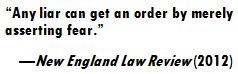
Restraining orders can be issued based on nothing but an inarticulate claim of “fear,” so willful deception of the authorities and courts is easily perpetrated by fraudulent petitioners’ use of vague claims like “he won’t stop calling me,” “her emails are disturbing and aggressive, “[s/he] threatened me, “I’m afraid”—that kind of thing. The more emotion-based lies are, the less they can be exposed. The worst accusers can be called is histrionic.

Good liars manipulate facts; they spin, like spiders. They’re plausible. They have social skills and endeavor to get their audiences to “relate” to them. They want approval, and getting it is part of the kick, as it is for any con artist.

Nuts, however, make up any lunacy they want, and they may not even know they’re making it up. The restraining order process is so deplorably automated that crazy works.

This is a code word for crazy that shouldn’t work: “hacked.”

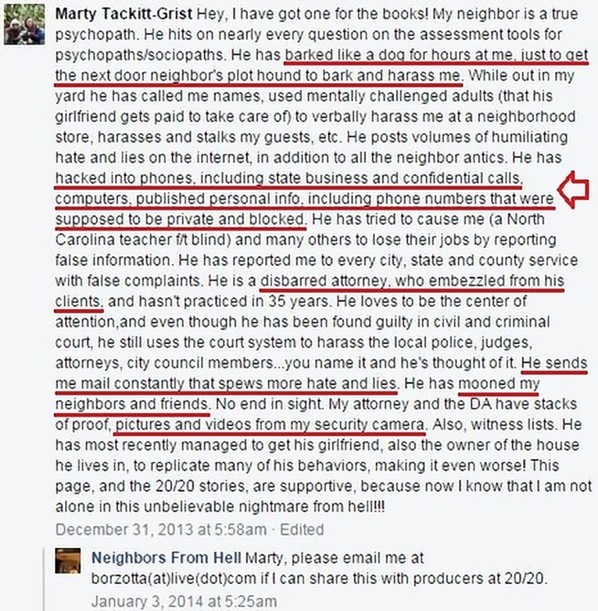
If someone claims her neighbor, for example, has remotely “hacked” her email account, “hacked into” her phone, or “hacked” her computer, she’s crazy.

I regularly talk to and correspond with a man who’s been accused of “hacking” in a court of law (and, no, he’s not a retired NSA agent). He was last summoned before a judge to respond to criminal allegations of “cyberstalking.” He’s in his 70s and has three toy poodles (which I’ve been scolded for suggesting is in any way unmanly). He says when his accuser trotted out her claims of “hacking,” the judge rolled his eyes.

That’s cute, but what the judge should have done was immediately dismiss the case and have the bailiff escort the prosecuting witness to the door—if not the loony bin. Then he should have turned the prosecuting attorneys over his knee.

Instead, the judge indulgently listened to the woman’s teary testimony about how her security had been breached and how she’d had to get a new computer because her old one had been infiltrated, etc.

The same woman, a school teacher, had previously reported to 20/20 that some confidential calls to important “state” agencies had been eavesdropped upon (this is also code for crazy) and made reference to her video surveillance camera (also code for crazy).

The judge eventually gave her a tongue-lashing and vacated her allegations…but they had just been the latest of dozens (over years), and her other actions (including a restraining order, which inaugurated and licensed her reign of terror) were not vacated retroactively.

If nuts are treated this tolerantly by the justice system, is it any wonder that frauds by spiders are so effective?

Copyright © 2016 RestrainingOrderAbuse.com

*The categories spiders and nuts aren’t hard-and-fast; eight-legged head cases aren’t unheard of among freaks of nature. I’ve known more than one. For some excellent fictional representations, see the novels of Gillian Flynn.

Why Women Who Are Falsely Implicated as Abusers Have No Defenders

Women who are ravaged by false allegations of domestic violence or “violence-related” offenses—whether in civil restraining order prosecutions, or in domestic violence or family court cases—are a minority among the targets of lies.

Hunt up comments by female victims on the e-petition “Stop False Allegations of Domestic Violence,” and there’s a good chance those comments will contain an emphatic line like “This happens to women, too.”

Men who’ve been falsely accused may be unaware that the community of the damned includes members of both sexes. The women who support those men—e.g., girlfriends, wives, sisters, or mothers—may also be unaware. Alternatively, their compassion may be numbed by the consciousness that restraining order, stalking, and domestic violence laws exist for women, or their compassion may be jaded by the conviction that when women are falsely accused of abuse, the implications aren’t as severe, which may be true.

This doesn’t mean, however, that the women who are falsely impugned feel any less anguished, betrayed, mortified, or indignant. Psychic pain is subjective, and the privations than ensue from false allegations of abuse—loss of access to children, property, home, employment, etc.—may be exactly the same, whether the accused is male or female.

What we call “society” doesn’t care to acknowledge that laws enacted to curb violence against women are ever abused to inflict harm (this “society” is really the people who mold public opinion, like government reps, journalists, and various talking heads on TV; society proper only knows what it’s told). Men who’ve complained of judicial crookedness and mistreatment for years or decades are still widely discounted, dismissed, or openly derogated in accordance with established dogma.

The phrase men’s rights continues to be framed with quotation marks (often contemptuously), and that includes in the mainstream press. Those who advocate for “men’s rights” may be called “rape deniers,” “anti-feminists,” or simply “misogynists.” Men’s rights activists have achieved some sympathetic traction, particularly recently, but popular admission that “women’s law” is easily and widely exploited by fraud is still a ways off.

Admitting, then, that women are destroyed by laws that are supposed to protect them is, for a host of reasons, taboo. Acknowledgment that the laws are doing the opposite of protecting women would mean their justification is false. It would besides implicate the system itself in the abuse of women, and be politically embarrassing and compromising,

If it were admitted, finally, that processes for women can be abused to falsely incriminate them, this question would inevitably follow: How much easier must it be for those processes to be abused to falsely incriminate men?

Feminists and feminist-oriented rights advocacy groups like the ACLU can’t afford to speak on behalf of female victims of procedural abuses, because that would be to call attention to the lax standards, inherent biases, and general corruptness of policies they’ve championed (and for which they congratulate themselves). It would be to discredit “all they’ve accomplished.” Criticizing victimized women would likewise be to their discredit. So they just avert their eyes.

Men who complain of procedural abuses are broadly lumped together and demonized as a group; women who complain of the same are exiled to their own private hells.

Copyright © 2014 RestrainingOrderAbuse.com

Restraining Orders and the First Amendment: A Female Blogger’s Successful Appeal of a Restraining Order That Labeled Her a “Cyber-Stalker”

“The First Amendment is FIRST for a reason.”

Larry Smith, former attorney and indomitable muckraker

A recent post on this blog revisited the case of Matthew Chan, author of ExtortionLetterInfo.com (ELI), whose appeal of a lifetime restraining order is presently under consideration by the Georgia Supreme Court. A verdict is anticipated within the coming month or months.

Criticisms are handily represented as acts of terrorism to the courts, whose officers have been conditioned to pander to accusers. Anyone is a potential target of facile accusations, which are made in mere moments. Retirees and vegetarian soccer moms, for whom the cost of attorney representation is often prohibitive, report being implicated as violent menaces and tyrants.

This post reports a successful appeal waged by North Carolinian Cindie Harman, who was issued a no-contact order for allegedly “cyber-stalking” a mother and her minor daughter by publicly criticizing them in a blog. Mrs. Harman named the adult plaintiff’s daughter a “bully” of other children and opined that her behavior was influenced by her mother’s conduct.

According to the Associated Press, the mother, who owns or owned an Asheville-area water services company, was “sentenced to nearly three years in prison for faking thousands of tests designed to ensure that drinking water is safe” in 2012 (and also faced “conspiracy charges”), had “plead guilty in 2010 to mail fraud,” and “paid a fine and did community service after pleading guilty to misconduct by a public official after she was charged with embezzling more than $10,000 from Marshal when she served as town clerk there.” Mrs. Harman’s accuser, whose husband is a former magistrate, controverts the popular notion that restraining order applicants are innocent lambs seeking protection from marauding predators.

Mrs. Harman prevailed in her restraining order appeal, but the vindication of her character and her judgment of her accuser’s character didn’t come without a steep price—and that’s excluding attorney fees.

According to the blogger quoted in the epigraph, Larry Smith, a friend of Mrs. Harman’s and fellow comrade-in-arms:

During the long time this case was pending, I had been talking to Cindie on the telephone, trying to reassure her that she would win her case in the NC Court of Appeals. She was very nervous, inconsolable, dyspeptic, upset about it.

Being accused of stalking, let alone being accused of stalking a child, isn’t funny. It’s the kind of thing that breaks a person.

To be charged with stalking in North Carolina signifies you’ve caused someone “to suffer substantial emotional distress by placing that person in fear of death, bodily injury, or continued harassment.” (Note that the latter element of the statutory definition of stalking, “continued harassment,” is glaringly incongruous to the elements that precede it. The contrast between fear of “death [or] bodily injury” and fear of “continued harassment” underscores the slapdash, catch-all nature of stalking and related statutes that makes them not only objectionable but outrageous, and urges their legislative revision or repeal.)

The trial court that heard the restraining order case against Mrs. Harman, and whose backroom judgment was overturned by the North Carolina Court of Appeals, had ruled, “Defendant [Harman] has harassed plaintiffs within the meaning of [N.C. Gen. Stat. §] 50C-1(6) and (7) by knowingly publishing electronic or computerized transmissions directed at plaintiffs that torments, terrorizes, or terrifies plaintiffs and serves no legitimate purpose” (italics added).

Observe that even the court’s grammar was bad. The ruling should have read “transmissions…that torment, terrorize, or terrify.” Gaffes like this are hardly surprising considering how hastily and carelessly restraining order judgments are formed.

Mrs. Harman was said to have tormented, terrorized, or terrified the child plaintiff by referring to her as a “bully” (a “reason kids hate to go to school”) and tormented, terrorized, or terrified her mother by calling her a “crow,” an “idiot,” and a “wack” on a blog.

Terrifying indeed.

At the beginning of this year, Law Professor Jonathan Turley eagerly reported that the U.S. Court of Appeals for the Ninth Circuit ruled “Bloggers Have Same First Amendment Rights As Journalists” (cf. Robinson Meyer’s “U.S. Court: Bloggers Are Journalists,” published in The Atlantic, and “Reporters’ Privilege,” prepared by the Electronic Frontier Foundation). Judges in North Carolina seem not to have heard the news.

The decision came in a defamation lawsuit where the panel ordered a new trial in the case of Crystal L. Cox, a blogger from Eureka, Montana. Cox was sued for defamation by attorney Kevin Padrick and his company, Obsidian Finance Group LLC, after she wrote about what she viewed as fraud, corruption, money-laundering and other illegal activities.

The details may sound familiar.

In legal commentary presented in Chan v. Ellis, the appeal mentioned in the introduction to this post, Law Profs. Eugene Volokh and Aaron Caplan asserted to the Georgia Supreme Court:

The First Amendment protects the right to speak about people, so long as the speech does not fall into an established First Amendment exception (such as those for defamation or for true threats). This includes the right to speak about private figures, especially when they do something that others see—rightly or wrongly—as unethical.

Restraining orders and criminal stalking law may properly restrict unwanted speech to a person. But they may not restrict unwanted speech about a person, again unless the speech falls within a First Amendment exception. The trial court’s order thus violates the First Amendment.

This may also sound familiar.

Cindie Harman ultimately won the case against her, a case that should never have been entertained by the court in the first place, but a victory that should have reassured her that freedom of speech in our country is a revered and inviolate privilege has had the opposite effect.

Reportedly consequent to receiving threats against her person and having several of her pets poisoned, Mrs. Harman has removed her blogs. Even her Twitter feed is now “protected” and no longer accessible to a general audience. Mrs. Harman lives in the sticks and says if she weren’t armed, she’d be afraid to be alone.

She has been terrorized into silence.

Copyright © 2014 RestrainingOrderAbuse.com

*The author of this blog, too, has had a lifetime injunction imposed upon him by the court for communication “about a person” (communication that alleged misconduct, including criminal, by a public official). His 2013 trial, which was conducted in the Superior Court of Arizona and in which he represented himself, concluded less than four months before the Ninth Circuit Court of Appeals’ ruling in Cox v. Obsidian Finance Group. He hasn’t subsequently received any threats but has been monitored. His accuser, a married woman he encountered standing outside of his house one day in 2005 (and many nights thereafter), is believed to be among the first to read anything posted here.

The Politics of Feminism and Women’s Law: A Response to Zerlina Maxwell’s Editorial “No Matter What Jackie Said, We Should Generally Believe Rape Claims”

Implicit in the headline of this op-ed is that even “wrongly accused” men are “perps.”

The only complimentary thing this writer can find to say about attorney Zerlina Maxwell’s December 6 column in The Washington Post is—yeah, scratch that; it has no redeeming qualities.

The editorial is not only intellectually callow but morally vacuous. Even its research and computations are careless.

Ms. Maxwell’s piece concerns a story published last month in Rolling Stone Magazine about a purported gang rape at the University of Virginia. The story was swiftly lofted upon a current of hot air then failed to maintain elevation because of a number of holes.

By Ms. Maxwell’s pained logic, the story’s having nosedived is all the more reason why allegations of rape should be accepted wholesale.

Many people (not least U-Va. administrators) will be tempted to see this as a reminder that officials, reporters and the general public should hear both sides of the story and collect all the evidence before coming to a conclusion in rape cases. This is what we mean in America when we say someone is “innocent until proven guilty.” After all, look what happened to the Duke lacrosse players.

In important ways, this is wrong. We should believe, as a matter of default, what an accuser says.

Default means negligence, which Ms. Maxwell equates with propriety. According to feminist algebra, negligence = propriety is a balanced equation.

Note that Ms. Maxwell isn’t actually making an argument for policy reform. We already do, by default, believe what an accuser says, hence outraged and anguished accounts like the ones you’ll find here: “Stop False Allegations of Domestic Violence.”

Ms. Maxwell fails to appreciate that our crediting what a rape accuser says “as a matter of default” means the slope is greased all the way to the bottom. Accepting allegations of rape on faith means accepting on faith all allegations that relate to or imply violence.

And the grease flows sideways, also, not just top-down.

According to the same policy, women  too, are victimized by false allegations, false allegations made in criminal, civil, and family court (as well as to government agencies like Child Protective Services)—and the standard applied in non-criminal procedures is already much reduced from “innocent until proven guilty.” Women unjustly lose their good names, their livelihoods, their children, and their homes (and that’s just the abbreviated list). These are among the consequences of equating allegations with facts “as a matter of default.”

false-rape-letterMs. Maxwell concludes: “Ultimately, the costs of wrongly disbelieving a survivor far outweigh the costs of calling someone a rapist.”

She asserts that rape leaves a “lasting psychological wound” but that the fallout from being falsely accused of rape is minor and ephemeral. “The accused would have a rough period,” she allows. “He might be suspended from his job; friends might defriend him on Facebook.”

Haunting is not only that people like Ms. Maxwell can appeal to pathos to make their case or that they can make such an appeal despite demonstrating no faculty for empathy; haunting is that their appeals nevertheless succeed.

Ms. Maxwell says the “cost of disbelieving women…signals that women don’t matter and that they are disposable.” No, it signals that no one is any more disposable than anyone else.

Copyright © 2014 RestrainingOrderAbuse.com

Why It’s Valuable to Report Your Story of Restraining Order Abuse or Other Procedural Abuse on an E-Petition or Similar Medium

Government statistics used to train police officers and judges are derived significantly from surveys, as discussed in the previous post.

These surveys are represented as “science” but are in fact simply acts of collecting responses, responses that may be completely anecdotal (that is, unverified and most likely unverifiable). Interviewers ask questions, and volunteers answer. Some studies according to which policy is determined (for example, on college campuses) may not even be conducted person-to-person; they may be electronic.

Policy that indelibly impacts lives on a grand scale may be based, yes, on glorified questionnaires.

“Science” that influences research trends and legislation, and that consequently conditions police and judicial impulses, is derived by “randomly” eliciting responses from a sample population—and not a particularly large one at that.

When you hear a controversial statistic, the kind that appears in international headlines and in feminist blogs from one end of the Internet to the other, like one in five college women has been a victim of sexual assault (a statistic drawn from a Web survey administered at two American universities), that figure was based on survey data.

What is a petition?

It’s a survey (of personal experience and public sentiment).

Copyright © 2014 RestrainingOrderAbuse.com

PERJURY: BS-ing the Court, the Frequency of False Allegations, and the Fraudulent Abuse of the Civil Restraining Order

In the last post, I discussed how lying is generally gotten away with beneath the radar. What people who’ve blessedly had no personal experience with fraudulent abuse of legal process fail to grasp is (1) there’s no incentive to expose untruths except (perhaps) when they’re used to frame people for crimes for which they stand to be convicted, (2) lies are much more commonly used to re-frame the truth into one favorable to the image or malicious intentions of fraudsters than they are to send people to prison, (3) lies don’t have to succeed in false criminal convictions to be damning or ruinous, and (4) lies may be of sorts that are impossible to discredit yet may permanently corrupt the public records and lives of the falsely accused.

Writers, for instance, who confront false allegations of domestic violence don’t actually invite their imaginations to conceive what such false allegations might be. Perhaps they vaguely suppose they’re of this nature: “He beats me with a belt buckle” or “She locks me in the pantry.” False allegations like these may certainly be made, but lies may be much more subtle or vaporous: “I live in a constant state of fear” or “She said she was going to kill me while I sleep.” Is the truth or falsity of these latter claims possible to ascertain? No. Police reports and restraining orders may be based on allegations like these, however, and anyone who imagines maliciously motivated people are incapable of making false statements to this effect have lived enviably sheltered lives.

False claims of stalking are as easily manufactured: “He creeps around my neighborhood late at night” or “She cut me off in traffic, almost running me off the road.” Allegations like these may not only be the substance of false police reports (which may—and do—gnaw at the sanity of their victims) but may be grounds for false restraining orders (which are far more nightmarish). In fact, the latter allegation was the basis of an emergency restraining order reported to this blog, which was petitioned against a college girl, in or just out of her teens, by her female counselor. The girl and her mom had a weekend to prepare her defense, and she wasn’t fully exonerated of her accuser’s litany of “terror-inspiring misconduct” (which included the girl’s greeting her accuser a few times in chance public encounters in a town of 2,000 residents and seeing her at church).

False allegations of sexual harassment? “He‘s repeatedly told me he wants me to [X] him” or “She keeps propositioning me”—try disproving allegations like these, which may be much more explicit and include claims of physical molestation. The consequences, if it’s necessary to enumerate them, could include termination of employment, marital dissolution, peer or social isolation, and the emotional and thus physical decay that accompany each or all. False claims like these, which take mere seconds to articulate, may never be recovered from.

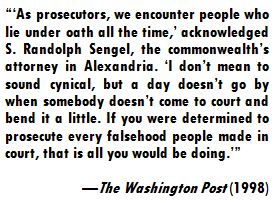
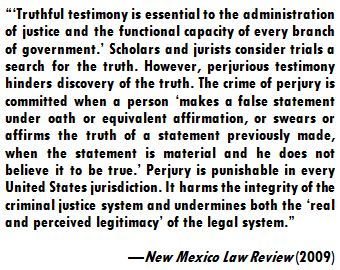
For making such false allegations to the authorities and courts, there are no consequences, except to their victims. There are statutory penalties on the books for making false claims (committing perjury), but they’re rarely if ever enforced and couldn’t be enforced consistently within governmental budgetary constraints, so commonplace is lying. Are such false claims going to end up in some statistical database? Of course not. Ask an honest district attorney, though, why lying isn’t prosecuted, and s/he’ll tell you it’s because lying is an everyday occurrence.

This is the invisible irony that escapes everyone who tackles consideration of rates of false allegations: the fact that lying isn’t prosecuted is the indicator of its rampancy (prosecution of frauds on the police and courts would overwhelm the system). And because lying isn’t prosecuted, it’s in the interest of maintaining the dignity of the legal system and the semblance of just and orderly process that judges not acknowledge even flagrant lies as such. To acknowledge them in all their plenitude, yet not punish them, would be to call into question the legitimacy of the system itself. Restraining order frauds, moreover, may be rewarded with favorable verdicts in spite of lies, making the concealment of those lies by judges that much more urgent.

Society has been conditioned, in the decades since the advent of the restraining order, to be hyper-vigilant and -reactive toward allegations of domestic violence, stalking, and sexual harassment—behaviors associated with male abuse of women, which the restraining order was conceived to curb, if not remedy. These offenses are ones to which the population has been vigorously, even coercively, sensitized. The justice system is consequently poised to descend upon those accused of such behaviors (including women), as is the public poised to believe allegations of such behaviors to be true, especially when validated by the courts.

False accusers are certainly aware of these prejudices and may easily exploit them—and should hardly be expected not to. Agents of the system may, in fact, goad them on, even while salting the wounds of those who report that they’re victims of false allegations by telling them they have no legal recourse (which, practically speaking, they don’t). Judges, furthermore, may scourge such victims in the courtroom based on allegations that their accusers leveled in one-sided, five- or 10-minute auditions.

To recap: Liars aren’t prosecuted, so lies aren’t acknowledged as lies, but the civil procedure that’s most eagerly and impulsively abused by liars, the restraining order process,  is supremely lax, instantly gratifying, and universally promoted. This procedure, what’s more, indelibly fouls a falsely accused defendant’s public record; may deny him or her entitlement to home, children, and property; and may cost him or her, besides, employment and employability in his or her chosen field of endeavor.

If this weren’t infernal enough, the outrage and misery expressed by victims who’ve found themselves in the eye of this perfect storm of unreason, some of whom are left impoverished of everything that gave their lives meaning, are credibly denounced or even mocked as crackpot.

Copyright © 2014 RestrainingOrderAbuse.com

Middle Class to Pauper in a Day: On Restraining Order Fraud, Homelessness, and Suicide

This describes what happened and continues to happen to me because of my wife’s lying to the court authorities. I am desperately seeking someone to help me, because I lost everything: job, home, money, and reputation. I already tried once to take my life because of it. [Although I have never] been in trouble with the law in the past…she was able to have me arrested for [domestic violence] and stalking with no proof, facts, or witnesses. I did not do those things, and I have surveillance video to prove my innocence. She [has] stalked and continues to stalk, intimidate, harass, threaten, and humiliate me regularly. I’m homeless in [an area where I know] no one [and have no one] to turn to, no job, no money, [and] no adequate legal representation. My life as I knew it is over. Help me, please!!!”

E-petition respondent

He’s lying, right? Like the thousands of others who’ve responded to the same petition he has? Really ask yourself. It’s appalling to me that there are intelligent human beings in the world who find it an easy matter to dismiss pleas like this out of hand.

Does this person sound crazy? Does he sound dangerous? I also find it appalling how rarely obvious questions like these present themselves even to minds trained to think critically.

I’ll answer for you: No, he doesn’t sound crazy or dangerous. Next question (this is how critical thinking works): If he’s telling it true, how is something like this possible?

It’s possible for exactly the reason he names: substantiating claims of stalking and domestic violence made through the civil court requires no evidence (nor does substantiating any other allegations), and on their basis a defendant can be summarily stripped of everything. Any adult can walk into a courtroom off the street and make allegations like these against another adult and have a restraining order issued. This can even be true when the accuser has no domestic relationship with his or her “abuser” or has never even met that “abuser” before. Allegations like these can moreover be made by people who live in different states from the accused. The restraining order process, in other words, is a golden ticket to any liar or crank with an ax to grind or even to any psycho responding to the urges of the voices in his or her head. There’s no inspection or corroboration of credentials. (One recent respondent to this blog reports that his wife’s embittered ex-boyfriend was awarded one of her children upon his falsely swearing out a restraining order against her and claiming to be the boy’s father. The boy was removed from school and handed to him. Consider how you’d feel if one of your kids were placed in the custody of a stranger…who hated you. Just based on his say-so. If you tried to recover the child and return him or her to safety, incidentally, you’d be arrested by the state and charged at the very least with contempt of court for violating the restraining order.)

It’s imagined, I think, even by those who are capable of acknowledging the stink of injustice, that the fallout of false allegations is exaggerated. There is no exaggerating it. Whatever you think you own and whoever you think you are can be taken from you and reinterpreted in an instant. By public factotums who’ve never even clapped eyes on you, couldn’t care less, and wouldn’t scruple a bit about locking you in a cage.

The nifty part is that once a person like the man quoted in the epigraph is forcibly divested of all means to fight back, s/he can’t. And no journalist is going to touch a story like his. Allegations that may lead to someone’s being stripped of home, property, and dignity may be so impossible to discriminate from the truth that there’s no way to assuredly expose the injustice. There’s no proving an allegation of fear, for instance, to be false. For that matter, there’s no proving an allegation of threat or violence to be false.

There’s no proving them to be true, either (even welts and bruises can be self-inflicted). But that doesn’t matter. This glaring bias is the only ascertainable injustice.

Aside, that is, from the fact that the man whose story prompted this discussion is sleeping in a box and thinking about offing himself.

Copyright © 2014 RestrainingOrderAbuse.com