A Circle of Moms Reports on False Allegations to CPS (and Says the Same Things That Father’s Groups Say about the Abuse of Restraining Orders and Domestic Violence Laws)

Here’s a group of women on a forum for mothers with school-aged kids responding to a conversational prompt that deserves the attention of those who believe false allegations made out of spite are rare and that the report of such allegations is overblown and only originates from father’s rights groups (or what one notable polemicist calls “FRGs”).

Has someone ever called CPS on you out of spite? Have you called on someone? Why?

Not surprising to this writer, a number of respondents commented in the affirmative. Also worthy of note in this context is that the site FightCPS.com is authored by a woman.

Here are a few of the topmost comments on the Circle of Moms thread:

Yes, twice I’ve had CPS called on me out of spite. Both times a social worker came to my house. I had nothing to hide, so I let them in and they both said, “I can’t tell you who called us, but I can tell you this is absolutely ludicrous for us to even come to your house, because we can’t find a single thing wrong. Sounds like a false allegation to me.” I was like, “I know, right. Thank you.” They couldn’t tell me who called, but I already knew who was behind it. The person who did it was just mad because I wouldn’t pay them money I didn’t even owe! This person was my babysitter, who is the most manipulative, money hungry witch. I just didn’t know it until now.

[M]y mom and sister have been calling and making false accusations about me ever since I told them they’re not my children’s mom—I am. They thought they were just going to tell me how to [rear my] kids, and I told them both, sorry about your luck, I’m their mom, and that’s final. I’ve never gotten a break from CPS since. Especially because my mom didn’t raise us—we did ourselves. And then she thought she was going to take mine and my husband’s first daughter and raise her as her [own] to try to fix mistakes that couldn’t be fixed. UH-UH, she wasn’t getting my daughter. Not till she called my sick, demented sister in to plot against me for 16 years and stole my life, my soul, my heart, my babies. Don’t trust no one.

The person [who] called them on me and my two children knew my mom was very sick and did not have much time to live. My mom died four days ago. Six days before she died, CPS came out. The person who called them on me wanted to add even more pain to my life—and fear. I went and picked up the report. It said [no] on every one of the allegations. I think CPS should let you know who called so you can file a lawsuit. I mean, if they do not do anything, then we should have a choice. We should have the right to know so we can stay away from those who called on us. It should be up to us to tell CPS to press charges or let us do it ourselves, and if we do not know who did call, then we have not got the right kind of privacy or peace throughout our lives.

According to a brochure published by the U.S. Department of Health and Human Services’ Children’s Bureau:

Approximately 29 States carry penalties in their civil child protection laws for any person who willfully or intentionally makes a report of child abuse or neglect that the reporter knows to be false. In New York, Ohio, Pennsylvania, and the Virgin Islands, making false reports of child maltreatment is made illegal in criminal sections of State code.

Nineteen states and the Virgin Islands classify false reporting as a misdemeanor or similar charge. In Florida, Illinois, Tennessee, and Texas, false reporting is a felony, while in Arkansas, Illinois, Indiana, Missouri, and Virginia, second or subsequent offenses are upgraded to felonies.

In Michigan, false reporting can be either a misdemeanor or a felony, depending on the seriousness of the alleged abuse in the report. No criminal penalties are imposed in California, Maine, Montana, Minnesota, and Nebraska; however, immunity from civil or criminal action that is provided to reporters of abuse or neglect is not extended to those who make a false report.

Eleven States and the Virgin Islands specify the penalties for making a false report. Upon conviction, the reporter can face jail terms ranging from 90 days to 5 years or fines ranging from $500 to $5,000. Florida imposes the most severe penalties: In addition to a court sentence of 5 years and $5,000, the Department of Children and Family Services may fine the reporter up to $10,000. In six States, the reporter may be civilly liable for any damages caused by the report.

Based on the anecdotal reports in the referenced Circle of Moms thread, consider how likely it is any of the reported mischief was ever prosecuted. This kind of sniping, which is impossible to fend off, exactly corresponds to that perpetrated by abusers of the restraining order process, which is also exempted from the exacting standards of police and judicial scrutiny that are supposed to be applied when allegations have criminal overtones or can lead to serious privations or criminal consequences.

The women responding in this forum aren’t “anti-feminists,” and they’re certainly not motivated to report malicious exploitation of state process because they’re “for” child abuse: They’re moms.

Yet despite that under the Violence Against Women Act (VAWA), billions of dollars have been invested over the past 20 years toward conditioning authorities and the courts to take allegations of violence and abuse on faith, when fathers allege identical exploitation of restraining orders and domestic violence laws according to the spiteful motives alleged by the mothers cited in this post, they’re dismissed as cranks by feminists and their partisans.

Disinterested parties and feminist sympathizers are urged to recognize that if mothers and fathers are saying the same things, then the claim that allegations of procedural abuses are nothing more than the baseless rants of angry men is flatly wrong.

Copyright © 2014 RestrainingOrderAbuse.com

Battering Women to Protect Battered Women: Using Massachusetts’s Policies to Examine Restraining Order Publicity and Its Damages

“In the event a Restraining Order is issued for any period of time (initial 10 days or subsequent extension/dismissal), you will be listed in the statewide Domestic Violence Registry system. This could impact your ability to obtain or maintain employment in government, law enforcement, certain medical fields, or social services, or to work with/coach children. Impoundment of the restraining order does not expunge your listing on the statewide domestic violence registry, as certain government agencies and private companies with significant government contracts still have access to the registry system.”

—“Massachusetts Restraining Orders Procedure and Ramifications

I’ve just been corresponding with a Florida woman named Ally who had a domestic violence (209A) protection order petitioned against her in Massachusetts alleging she was a danger to a former boyfriend (these kinds of instruments can be obtained by plaintiffs who don’t even live in the same state or country as their defendants).

Ally contends the allegations against her are false and has been living in hell for over a year.

She’s surviving day to day and can’t afford to procure the services of an attorney. Ally’s trying to defend herself and clear her name with no money and from another time zone. She’s preparing a motion on her own (very possibly ill-fated) to request that the order against her be expunged, because it has ruined her employability.

Note: As the epigraph explains, even were Ally to succeed in having the order simply dismissed (which is itself unlikely), she would still remain registered as a domestic abuser.

From a draft of Ally’s “Motion to Expunge”:

Defendant was refused jobs, [is] not allowed to attend [or] volunteer [at] her daughter’s school events, [and has had] numerous other rights taken away due to Plaintiff’s Abuse of Process and Fraudulent Allegations and written Affidavit to the Court. This continues today.

Note: To successfully combat prosecutions like this requires money…which prosecutions like this prevent their defendants from earning.

A recent post on this blog observed the court’s schizophrenic regard toward restraining orders. On the one hand, they’re viewed by judges as urgent, potentially life-or-death matters; on the other hand, they’re viewed as inconsequential as long as defendants mind their prohibitions for the prescribed period of time.

Ignored is that adjudications both initiated and finalized in minutes yield rulings that are entered into state and national law enforcement databases indefinitely. Orders become “inactive” once they expire, but they don’t disappear. A woman like Ally remains for the rest of her life marked as a perpetrator of domestic violence.

In contrast—and the contrast is a telling one—consider this excerpt from a “Memoradum” issued by the Massachusetts Supreme Court last year on “Internet Dissemination of Personal Protection Order Information.”

As transparency and improved access remain court goals, it is important that we not unknowingly or unintentionally release victims’ personally identifiable information through the Internet, recognizing that this information is easily accessed and that access to such information could be dangerous to victims. Additionally, it has been brought to our attention that current federal law prohibits providing information over the Internet about personal protection orders (PPOs) that would be likely to reveal the identity or location of the petitioner (“PPO Information”).

18 USC 2265(d)(3) states:

A State, Indian tribe, or territory shall not make available publicly on the Internet any information regarding the registration, filing of a petition for, or issuance of a protection order, restraining order, or injunction in either the issuing or enforcing State, tribal or territorial jurisdiction, if such publication would be likely to publicly reveal the identity or location of the party protected under such order. A State, Indian tribe, or territory may share court-generated and law enforcement-generated information contained in secure, governmental registries for protection order enforcement purposes.

The privacy of restraining order plaintiffs (who are nominated “victims”) is to be tightly guarded.

Note: Based on “determinations” formed in minutes and possibly based on nothing more substantial than accusation, a plaintiff is deemed a “victim” whose identity and privacy must be protected, and the defendant is deemed a “violent threat” whose privacy is accordingly due no consideration. After the term of the restraining order has flown, the “danger” to the accuser is assumed to have been resolved, but the accuser continues to enjoy anonymity while the accused must go on bearing the implications of the restraining order for the rest of his or her life, exactly as if those implications were a criminal sentence.

Only in the recent past, in fact, did it even become possible to remove a Massachusetts restraining order defendant’s name from the domestic violence registry if it were found that allegations against him or her were substantially or totally false. (Remember that such allegations are made ex parte in the time it takes to place an order at McDonald’s.)

Until recently, it was almost impossible to expunge a person’s record with the domestic violence registry once the initial entry was made. In the 2006 case of Commissioner of Probation v. Adams, it was recognized that a judge has the inherent authority to expunge a record of an abuse [from the] violence registry system in the rare and limited circumstance that the judge finds the order was obtained through fraud on the court.

Note: The phrase rare…circumstance (of fraud) is emphasized in the original document quoted above (“Massachusetts Restraining Orders Procedure and Ramifications”), which was authored by an all-female law firm (Mavrides Law of Boston). Allegations of rampant restraining order misuse in Massachusetts have actually been the subject of press coverage and at least one law review monograph, and one of the most outspoken critics of restraining orders, attorney Gregory Hession, practices in Massachusetts and has for many years reported that restraining orders are “out of control.”

The previous two posts on this blog were responses to allegations that those who criticize restraining orders and domestic violence laws are “opposed to the battered women’s movement.” Defenders of these laws are urged to ask themselves how Ally’s wanting to be able to provide for her daughter and one day attend her daughter’s graduation has anything to do with battered women at all.

They’re also urged to ask themselves how denying Ally these opportunities isn’t itself an act of brutality.

Copyright © 2014 RestrainingOrderAbuse.com

Big Money v. No Money: VAWA and the Men’s Rights Movement

The previous post was a response to research conclusions published this year by Dr. Kelly Behre, director of the UC Davis Law School’s Family Protection and Legal Assistance Clinic.

In a paper titled, “Digging beneath the Equality Language: The Influence of the Fathers’ Rights Movement on Intimate Partner Violence Public Policy Debates and Family Law Reform,” Dr. Behre asserts there’s an absence of empirical evidence to support various arguments and statistical estimates published by men’s rights advocates respecting false restraining orders, false allegations of domestic violence, and judicial bias against men in family courts.

Ironic is that Dr. Behre’s denial of men’s groups’ position that men aren’t treated fairly is itself unfair.
When Dr. Behre says there’s no “empirical support” for estimates like 60 to 80% of restraining orders are unnecessary or based on falsehood, she means there are no formal audits of the process to back them up. She further examines studies that have been pointed to and finds those studies “problematic.”

Dr. Behre may well be right that empirical support for the claims of men’s groups is scant, shaky, or at best anecdotal. It’s disturbing, though, that Dr. Behre doesn’t find the dearth of studies that could be cited as empirical support a source of concern.

Clearly she has interests in both justice and human welfare.

A truism in law is that those with no money have no voice. Men’s rights groups are not lavishly funded teams of crack Ph.D.’s (they may in fact represent ragtag groups of man-on-the-street volunteers), and many if not most of those represented by such groups are themselves on the outside of the system looking in.

In contrast, consider these facts from the chart “Comparison of VAWA 1994, VAWA 2000, and VAWA 2005 Reauthorization Bill” compiled by the National Coalition Against Domestic Violence (NCADV) eight years ago.

  • Grand total of [federal] money allocated [under the Violence Against Women Act] from 1994 to 2011: $9.43 billion, including:
  • STOP (Services and Training for Officers and Prosecutors) Grants: $2.85 billion
  • Grants to Encourage Arrest Policies: $886 million
  • Rural Domestic Violence and Child Abuse Enforcement Grants: $555 million
  • Civil Legal Assistance for Victims of Violence: $588 million
  • Sexual Assault Services: $250 million
  • Education and Training for Judges and Court Personnel: $35 million

If battered women’s advocates like Dr. Behre find little empirical support for the plaints of men’s groups, they might at least find ample motive in these figures for systemic prejudice against men—and by extension all defendants who find themselves the targets of allegations of abuse (male and female).

While it’s noteworthy that comparatively little federal money has been approved for allocation to research studies, the magnitude of investment toward countering domestic violence is a clear pronouncement of priority, and this investment alone should suggest to a mind as trained and astute as Dr. Behre’s that allegations like “family courts discriminate against men and…mothers frequently and successfully make false allegations against men to obtain custody of children” entirely plausible.

Dr. Behre would call this observation a “commonsense argument” (“implying that the truth…is intuitively evident”).

Fair enough.

Copyright © 2014 RestrainingOrderAbuse.com

Responding to a Feminist Professor Kelly Behre’s Perspectives on Men’s Rights Activism

Since the publication of this post, the “research paper” it responds to has been removed from the Internet.


“I had a false allegation of domestic violence ordered against me on June 19, 2006. It was based on lies, but the local sheriff’s office and state attorney’s office didn’t care that he was a covert, lying narcissist. I doubt they ever heard of the term, in fact. I made the mistake of moving back in with him in September 2008.

“Last year, on July 23, 2013, he, with the help of his conniving sister, literally abandoned me. Left me without transportation and tried to have the electricity cut off. However, the electric company told him it was unlawful to do so. I am disabled, because of him, and have been fighting to get my life, reputation, and sanity restored. It has been over a year, and while life goes on for him, I am still struggling from deep scars of betrayal, lies, and his continued smear campaign against me.

“I thank you for the opportunity to speak out and stand with other true victims of abuse. You see, it isn’t just women who abuse the system, but men, as well.”

—Female e-petition respondent (August 30, 2014)

Contrast this woman’s story with this excerpt from a UC Davis Law Prof. Kelly Behre’s 2014 research paper:

At first glance, the modern fathers’ rights movement and law reform efforts appear progressive, as do the names and rhetoric of the “father’s rights” and “children’s rights” groups advocating for the reforms. They appear a long way removed from the activists who climbed on bridges dressed in superhero costumes or the member martyred by the movement after setting himself on fire on courthouse steps. Their use of civil rights language and appeal to formal gender equality is compelling. But a closer look reveals a social movement increasingly identifying itself as the opposition to the battered women’s movement and intimate partner violence advocates. Beneath a veneer of gender equality language and increased political savviness remains misogynistic undertones and a call to reinforce patriarchy.

The professor’s perceptions aren’t wrong. Her perspective, however, is limited, because stories like the one in the epigraph fall outside of the boundaries of her focus and awareness (and her interest and allegiance, besides).

What isn’t appreciated by critics of various men’s rights advocacy groups is that these groups’ own criticisms are provoked by legal inequities that are inspired and reinforced by feminist groups and their socially networked loyalists. These feminist groups arrogate to themselves the championship of female causes, among them that of battered women. Feminists are the movers behind the “battered women’s movement.”
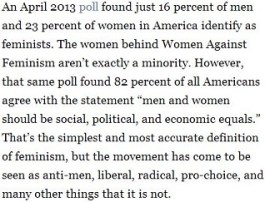
Those who criticize unfair laws and policies that purport to protect battered women are not “pro-domestic violence”; they’re anti-injustice, which may well mean they’re anti-feminist, and this can be construed as “opposition to the battered women’s movement.” The opposition, however, is to what the feminist movement has wrought. No one is “for” the battery of women or “against” the protection of battered women.

To put this across in a way a feminist can appreciate, to believe women should have the right to abort a fetus is not the same thing as being “pro-abortion.” No one is “for” abortion, and no one is “for” domestic violence. (“Yay, abortion” is never a sign you’ll see brandished by a picketer at a pro-choice demonstration.)

The Daily Beast op-ed this excerpt is drawn from criticizes a group called “Women Against Feminism” and asserts that feminism is defined by the conviction that “men and women should be social, political, and economic equals.” If this were strictly true, then inequities in judicial process that favor female complainants would be a target of feminism’s censure instead of its vigorous support.

The “clash” the professor constructs in her paper is not, strictly speaking, adversarial, and thinking of it this way is the source of the systemic injustices complained of by the groups she targets. Portraying it as a gender conflict is also archly self-serving, because it represents men’s rights groups as “the enemy.” Drawing an Us vs. Them dichotomy (standard practice in the law) promotes a far more visceral opposition to the plaints of men’s groups than the professor’s 64-page evidentiary survey could ever hope to (“Oh, they’re against us, are they?”).

The basic, rational argument against laws intended to curb violence against women is that they privilege women’s interests and deem women more (credit)worthy than men, which has translated to plaintiffs’ being regarded as more “honest” than defendants, and this accounts for female defendants’ also being victimized by false allegations.

(Women, too, are the victims of false restraining orders and fraudulent accusations of domestic abuse. Consequently, women also lose their jobs, their children, their good names, their health, their social credibility, etc.)

The thesis of the professor’s densely annotated paper (“Digging beneath the Equality Language: The Influence of the Father’s Rights Movement on Intimate Partner Violence Public Policy Debates and Family Law Reform”) is that allegations of legal inequities by men’s groups shouldn’t be preferred to facts, and that only facts should exercise influence on decision-making. This assertion is controverted by the professor’s defense of judicial decisions that may be based on no ascertainable facts whatever—and need not be according to the law. The professor on the one hand denounces finger-pointing from men’s groups and on the other hand defends finger-pointing by complainants of abuse, who are predominately women.

In the arena of law this post concerns, the courts typically follow the dictum that the person pointing the finger is right (and this person is usually female). In other words, the courts judge allegations to be facts. In many instances, what’s more, state law authorizes this formulation. It grants judges the authority “at their discretion” to rule according to accusations and nothing more. Hearsay is fine (and, for example, in California where the professor teaches, the law explicitly says hearsay is fine). The expression of a feeling of danger (genuinely felt or not) suffices as evidence of danger.

The professor’s defense of judicial decision-making based on finger-pointing rather undercuts the credibility of her 64-page polemic against decision-making based on finger-pointing by men’s groups that allege judicial inequities. The professor’s arguments, then, reduce to this position: women’s entitlement to be heeded is greater than men’s.

The problem with critiques of male opposition to domestic violence and restraining order statutes is that those critiques stem from the false presuppositions that (1) the statutes are fair and constitutionally conscientious (they’re not), (2) adjudications based on those statutes are even-handed and just (they’re not), and (3) no one ever exploits those statutes for malicious or otherwise self-serving ends by lying (they do—because they can, for the reasons enumerated above).

Attorneys acknowledge procedural abuses are common.

Many critiques of men’s, father’s, and children’s rights groups fail to even recognize that motives for lying exist. What presupposition underlies this? That everyone’s an angel? If everyone were an angel, we wouldn’t need laws at all. Or is the presupposition that women are angels? A woman should know better.

A casual Google query will turn up any number of licensed, practicing attorneys all over the country who acknowledge restraining orders and domestic violence laws are abused and offer their services to the falsely accused. Surely the professor wouldn’t allege that these attorneys are fishing for clients who don’t exist—and pretending there’s a problem that doesn’t exist—because they, too, are part of the “anti-battered-women conspiracy.”

The professor’s evidentiary pastiche is at points compelling—it’s only natural that a lot of rage will have been ventilated by people who’ve had their lives torn apart—but her paper’s arguments are finally, exactly like those they criticize, tendentious.

It’s obvious what the professor’s “side” is.

(She accordingly identifies her opposition indiscriminately. For example, the blog you’re right now reading was labeled the product of a father’s rights group or “FRG” in the footnotes of the professor’s paper. This blog is authored by one person only, and he’s not a father. Wronged dads have this writer’s sympathies, but this blog has no affiliation with any groups.)

The professor carefully prefaces her points with phrases like “Researchers have noted,” which gives them the veneer of plausibility but ignores this obvious question: where do the loyalties of those “researchers” lie? The professor cites, for example, the Southern Poverty Law Center’s equation of SAVE Services with a hate group. An attentive survey of SAVE’s reportage, however, would suggest little correspondence. The professor doesn’t quote any of SAVE’s reports; she simply quotes an opposing group’s denunciation of them as being on a par with white supremacist propaganda.

(What the professor does quote are some statistics generated by SAVE that she contends are dubious, like estimates of the number and costs of false and frivolous prosecutions. Such estimates must necessarily be speculative, because there are no means of conclusively determining the degree or extent of false allegations. Lies are seldom if ever acknowledged by the courts even if they’re detected. This fact, again, is one that’s corroborated by any number of attorneys who practice in the trenches. Perjury is rarely recognized or punished, so there are no ironclad statistics on its prevalence for advocacy groups to adduce.)

Besides plainly lacking neutrality, insofar as no comparative critical analysis of feminist rhetoric is performed, the professor’s logocentric orientation wants compassion. How much of what she perceives (or at least represents) as bigoted or even crazy would seem all too human if she were to ask herself, for instance, how would I feel if my children were ripped from me by the state in response to lies from someone I trusted, and I were falsely labeled a monster and kicked shoeless to the curb? Were she to ask herself this question and answer it honestly, most of the outraged and inflammatory language she finds offensively “vitriolic” and incendiary would quite suddenly seem understandable, if not sympathetic.

The professor’s approach is instead coolly legalistic, which is exactly the approach that has spawned the heated actions and language she finds objectionable.

Copyright © 2014 RestrainingOrderAbuse.com

Connecticut Lawmakers Conclude Getting a Restraining Order Isn’t Easy Enough Already

Those victimized by liars who abuse restraining order and domestic violence laws often blame their judges. It’s natural. They’re the ones who deprive the wrongly accused of dignity, liberty, property, and family—and theirs are the words that echo in the memory and grate on the nerves during the empty hours.

Lawmakers it must be remembered, though, are the enablers.

Judges may be careless. They may even be cruel. But legislators are clueless.

To give an example, consider this story reported today in Hartford, Connecticut’s The Courant (August 25, 2014):

Domestic violence victims need to have a simpler process of applying for restraining orders and better communication with the agencies that handle them, a legislative subcommittee said Monday.

To that end, the subcommittee of the task force on restraining orders agreed to recommend a streamlined version of restraining order applications and an accompanying checklist to pave the way for better communication among victims, marshals and courts.

The Connecticut legislature purposes to make simpler yet a process that’s already so “streamlined” that accusers don’t have to prove anything.

CONN. GEN. STAT. ANN. § 46b-15(b): “The court, in its discretion, may make such orders as it deems appropriate for the protection of the applicant and such dependent children or other persons as the court sees fit.… If an applicant alleges an immediate and present physical danger to the applicant, the court may issue an ex parte order granting such relief as it deems appropriate.”

This literally means that if a domestic partner merely alleges s/he feels in danger, which only takes a few seconds to do, the court is authorized to order the accused to be forcibly ejected from his or her home by armed agents of the state—even if the accused owns that home and has lived in it all of his or her life. In other words (again, for example), it’s entirely possibly for someone who has no home to move in with someone else, falsely accuse him or her of abuse, and for all intents and purposes seize possession of his or her home. Other obvious motives for lying are malice or gaining custody of kids.

No evidence of anything is required by the law, which is a blank check that authorizes accusers to say whatever they feel like and judges to do whatever they feel like.

Members of the legislative subcommittee referenced in The Courant article reportedly expect to improve their understanding of the flaws inherent in the restraining order process by taking a field trip. They plan “a ‘ride along’ with the representative of the state marshals on the panel…to learn more about how restraining orders are served.”

The urgent problem with restraining orders as they see it is ensuring that more of them are successfully delivered.

The article cites concerns expressed by the executive director of the Connecticut Coalition Against Domestic Violence “about the complicated process domestic violence victims face when they apply for restraining orders.”

The “complicated process” to have someone evicted shoeless from his or her home in the Connecticut winter and prohibited access to his or kids based on an allegation is filling out a form.

The Connecticut legislators “decided to remove the instructions in small print at the top of the form, which start with the outdated suggestion that the applicant ‘use a typewriter.’ Applicants will have access to a separate sheet of paper that has step-by-step instructions.”

Authorizing the court “in its discretion” to fill out orders “as it deems appropriate” would seem more expeditious and economical to this writer.

Copyright © 2014 RestrainingOrderAbuse.com

Reporting Restraining Order Abuse to Elected Officials

“I am suffering from the effects of a fraudulent protection order in Colorado, which was filed by my female roommate and had me and my young daughter kicked out of our home.

“There appears to be no recourse for me, but I did contact 10 state representatives and senators, and I heard back from three of them. If more people report this abuse to their elected officials, maybe something will actually be done about this awful system.”

—Respondent to this blog

Writing to district and state representatives can be a lot like trying to communicate with judges. Expecting a human response isn’t unreasonable, but it’s often disappointed.

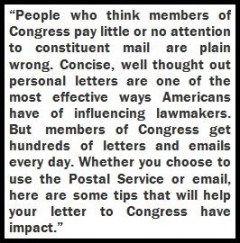
There’s nevertheless value in bringing systemic injustices to the attention of legislators (senators and congressmen and -women), because (1) they make, reform, and repeal laws, and (2) if they hear the same complaints over and over—and especially if they know other people of influence are hearing the same complaints and looking to them for action—there’s a chance some of them might step up.

The voices of women who’ve been abused by court process, particularly, need to be heard, because the procedures that are most often and easily abused are ones it’s presumed are protecting them.

Consult this site for the names and addresses/websites of elected officials with whom to register a complaint (state legislators should be first in order of importance):

Find Your Representatives

See also these tutorials:

Writing to Your Legislator

“How to Write a Letter to Your United States Senator

How to Write Letters to Congress

A petition that automatically forwards stories of abuses of domestic violence laws and restraining orders to legislators/administrators is here.

Copyright © 2014 RestrainingOrderAbuse.com

*See also: What to Do if You’ve Been Abused by a Judge

Restraining Orders Based on Fraud Falsely Imprison Defendants Whether They’re Incarcerated or Not

“Forensic psychiatrists and other mental health professionals must remember that although allegations are often genuine, there is an almost equal number of cases…in which they are not. Complete and objective assessment is always required, and especially so when accusations emerge in contexts such as the following:

  • Certain kinds of mental illness and character traits (particularly in allegations against clinicians). One should note poor doctor-patient relationships, whether real or perceived, patients with psychotic or delusional symptoms, certain hysterical and factitious disorders, some fragmenting or dissociative disorders, and those with substantial borderline, inadequate, and/or passive personality traits
  • Divorce proceedings
  • Child custody proceedings
  • Situations with the potential for substantial financial reward
  • Situations in which the accuser has an emotional or characterological reason to avoid discovery, prosecution, or confrontation with legal (or parental) authority (e.g., those with antisocial personality traits, some substance abusers)
  • A history of repeated past allegations, particularly if they have not been fully investigated
  • Unusual timing of the accusation or alleged event (e.g., alleged ‘date rape’ within an otherwise close and stable relationship, or accusations made only when some sort of secondary purpose or reward is evident).”

—“False Allegations: The Role of the Forensic Psychiatrist

The previous post called attention to an excerpt from a story featured in The Times of Malta this month that concluded that incidences of false allegations weren’t “one-offs,” meaning they’re not singular occurrences but more common than the public imagines.

The lawyers quoted by reporter, what’s more, refer to criminal cases in which sexual abuse is alleged and, consequently, in which the accused are afforded attorney representation.
By contrast, civil restraining order hearings are mere minutes long, defendants aren’t afforded counsel, and fraud is typically ignored by the court even if it’s perceived. There is, therefore, no accurately determining the pervasiveness or degree of lying in such adjudications.

Many authoritative sources conclude it’s rampant, and anecdotal reports concur.

The application process for restraining orders is typically free, it’s concluded in an afternoon if not within minutes, and there are no consequences for lying. Why, then, shouldn’t the process be broadly and routinely abused?

To believe that such a process wouldn’t be abused would depend on an unshakably naïve conviction in the inherent goodness of people, and such a belief would determine the process unnecessary. Anyone who believes people are capable of beastly behavior and that restraining orders are necessary—take, for example, feminists—must believe people are capable of lying hurtfully to get them.

Exposing the flaws in the belief that anyone who points a finger must necessarily be telling the truth doesn’t take a professor of philosophy.

Consider, then, that allegations made in civil court may be identical to those introduced against defendants in criminal court—and can include rape, child molestation, or even murder. The only difference between civil and criminal rulings is legal consequence.

This is the source of the cognitive disconnect exemplified by judges and, largely, everyone else. Because civil restraining orders only threaten incarceration rather than mandate it, they’re considered “no biggie.”

The conceit is that though falsely accused restraining order defendants may be denied access to their homes, money, property, and children—besides facing other privations—they aren’t denied their freedom; it’s only curtailed somewhat (“Here are your shoes—you’re free to leave”).

Faith in the conceit that restraining orders are minor impingements on defendants’ lives depends on accepting that being falsely, publically, and permanently labeled a stalker or batterer, for example, shouldn’t interfere with a person’s comfort, equanimity, or ability to realize his or her dreams. Such faith is founded, in other words, on the fantastical belief that wrongful vilification won’t exercise a detrimental influence on a person’s mental state, won’t affect his or her familial and social relationships, won’t negatively impact his or her employment and employability, etc.

Clearly such faith is beyond unreasonable; it’s inane. Being forced to live with false allegations can be crippling—for painfully obvious reasons. Whether a person is forced to agonize in a cell or is permitted to agonize in his or her place of choice is of scant significance to the psycho-emotional well-being of the sufferer. Prison isn’t just an environment, and arresting someone doesn’t require handcuffs.

Copyright © 2014 RestrainingOrderAbuse.com

Eight Years of Hell: On the Toll of False Allegations of Abuse

“Bitter separation battles and unrequited love are among the reasons why people falsely accuse others of sexual abuse, according to legal professionals.

“Lawyers contacted by The Sunday Times of Malta came across several examples of cases when people, often women, made false claims that they or their children had been abused.

“Lawyer Roberto Montalto gave the example of one situation where a woman claimed her children were abused by her husband’s colleague.

“The case dragged on for eight years and the man was acquitted after the court found that the woman lied….”

—“False Abuse Accusations Not One-Offs, Say Lawyers

To read the rest of this story, published just a couple of weeks ago, you have to subscribe to The Times of Malta. I can guess the remainder’s content, as I know many men and women who’ve visited this site can.

This excerpt is highlighted, because even today most people are under the impression that instances of false allegations’ being made repeatedly in protracted legal assaults are rare and isolated occurrences.

As attorneys and others attest, they’re not. Only hearing about them is.

Among the reasons why restraining orders are criticized on this site and elsewhere is that they’re superlative and intoxicating gateway fixes for spiteful accusers bent on gratifying malicious impulses. They can be obtained in a few hours—even a few minutes—based on allegations that require no substantiation and that are subjected to a minimum of scrutiny, if any at all.

They’re easily exploited to establish claims that can then be parlayed into interminable attacks.

False criminal allegations suggestive of sexual or violent deviancy—e.g., stalking, sexual harassment or molestation, and domestic abuse—can be just as effective and for the same reasons. The hysteria promoted by the abuse industry and the political influence it has bent to its “cause” have conditioned police, municipal prosecutors, and judges to credit allegations of abuse automatically (especially ones from women).

Eight years—that’s the term in hell the man in the epigraph had to endure before it was apparently demonstrated that the whole ordeal was based on lies: eight years lost for nothing. Nothing. More horrible yet is that the only thing that makes this story exceptional is that the fraudulent accuser was eventually exposed and acknowledged as such.

Eight years is a Ph.D. Eight years is a career. Eight years is a son or daughter’s childhood.

Copyright © 2014 RestrainingOrderAbuse.com

Impulse: How Restraining Orders Encourage and Reward Tantrum Behavior and Why Feminist Advocates Should Be the First to Push for Their Reform

It’s often fairly remarked that feminists tend not to acknowledge restraining order abuse, let alone express resentment toward female offenders. There are exceptional instances, however, as you’ll see below.

It’s also remarked that rash or false allegations mock and discredit the suffering of genuine victims. The respondent in the forum exchange that follows, though she doesn’t say as much, clearly agrees.

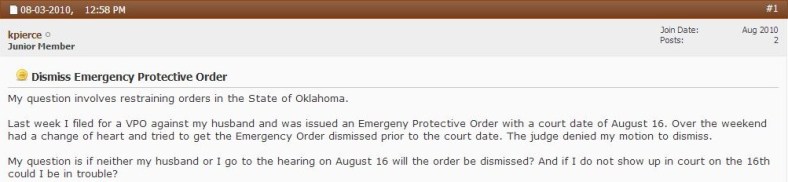
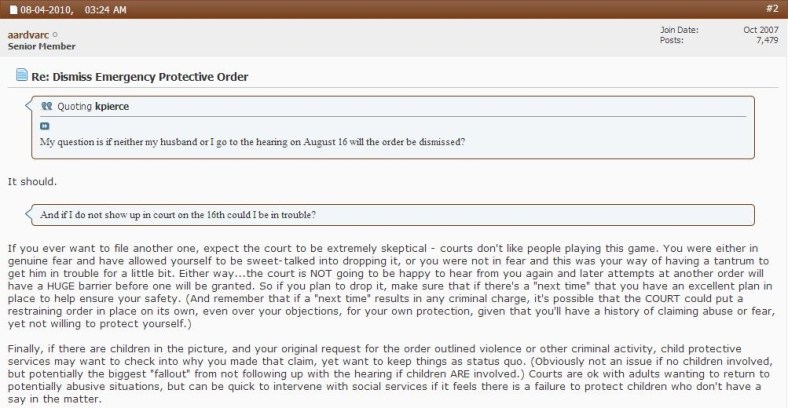
Notable about the response, whose tone is reproving, is that its writer recognizes that restraining orders may be sought impulsively to gratify a “tantrum” and get their defendants “in trouble” (which recognition fittingly uses the language of the playground).

Notable, contrariwise, however, is that the respondent discourages the petitioner of the restraining order, who’s admitted to proceeding impulsively, from following through with her expressed intention to rectify an act that may have been motivated by spite. The respondent is the executive director of AARDVARC (An Abuse, Rape, and Domestic Violence Aid and Resource Collection), and behaviors like those the questioner owns up to undermine her endeavor’s credibility.

Notable, finally, is the respondent’s observation that once the state machine is roused, it can be tough to quiet again—like a swarm of killer bees.

The slack standards applied to the restraining order process cut both ways. Not only do they make it easy to lynch defendants undeservedly based on a few brief statements rendered in minutes; the drive-thru, come-one-come-all policy they authorize urges plaintiffs to proceed full-steam ahead without consideration of consequence to themselves and their families.

Plaintiffs shouldn’t be able to incriminate others impulsively, and those who are baited into doing so have as much reason to fault the state as they do to fault themselves.

Representatives of victims of domestic violence and rape, furthermore, are at least as keenly aware as anyone that people follow vicious impulses when there are no checks on their behavior. Logically, then, feminist proponents should be the first to perceive that if state processes have no reins, they’ll be abused. These activists should, accordingly, recognize restraining orders’ potential for abuse and be at the forefront of advocacy for more rigorous and responsible policy.

Copyright © 2014 RestrainingOrderAbuse.com

A Scratch, a Push, a Pinch: “Domestic Violence,” False Allegations, and Restraining Order Abuse

The subject of this excursion is “domestic violence,” which phrase is placed in quotation marks because it’s a suspect term that’s become so broadly inclusive as to mean virtually anything a user wants it to.

This is how domestic violence is defined by the American Psychiatric Association—and by many states’ statutes, as well:

Domestic violence is control by one partner over another in a dating, marital, or live-in relationship. The means of control include physical, sexual, emotional, and economic abuse, threats, and isolation.

Emphatically noteworthy at the outset of this discussion is that false allegations of domestic violence have the same motive identified by the APA that domestic violence has: “control”; have the same consequences: “psychological and economic entrapment [and] physical isolation”; use the same methods to abuse: “fear of social judgment, threats, and intimidation”; have the same mental health effects on victims: “depression, anxiety, panic attacks, substance abuse, and post-traumatic stress disorder”; and can also “trigger suicide attempts [and] homelessness.”

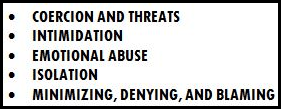
A domestic violence factsheet published by the National Coalition Against Domestic Violence features a “Power and Control” pie chart. These segments of it are ALSO among the motives and effects of false allegations.

Accordingly, then, making false allegations of domestic violence is domestic violence.

When I was a kid, domestic violence meant something very distinct. It meant serial violence, specifically the habitual bullying or wanton battery by a man of his wife. The phrase represented a chronic behavior, one that gave rise to terms like battered-wife syndrome and to domestic violence and restraining order statutes.

These days, however, domestic violence, which is the predominant grounds for the issuance of civil protection orders, can be a single act, an act whose qualification as “violence” may be highly dubious, and an act not only of a man but of a woman (that can be alleged on a restraining order application merely by ticking a box).

As journalist Cathy Young observed more than 15 years ago, the War on Domestic Violence, which was “[b]orn partly in response to an earlier tendency to treat wife-beating as nothing more than a marital sport,” has caused the suspension of rational standards of discernment and introduced martial law into our courtrooms. “[T]his campaign treats all relationship conflict as a crime. The zero-tolerance mentality of current domestic violence policy means that no offense is too trivial, not only for arrest but for prosecution.” Reduced standards of judicial discrimination inspired by this absolutist mentality further mean that even falsely alleged minor offenses are both credited and treated as urgent and damnable.

Consider this recent account posted to the e-petition Stop False Allegations of Domestic Violence:

My boyfriend accused me of DV after an argument about separating and my 18-month-old…. The officer arrested me in front of my daughter, and when I asked why, he said he had a scratch on his arm.

A scratch.

The woman goes on to report that she spent two days in jail, had to post a $5,000 bond to get out, and that she was subsequently “displaced” from her former life.

Here’s another:

My ex-husband told the police that I pushed him, even though a witness had called the police on him for pushing me. He was completely drunk…but I got arrested instead. Right in front of my stunned family.

And another:

I was accused of domestic violence because I pinched my ex-husband when he pinned me and my son between two trucks. He ruined my life.

A scratch, a push, a pinch—which may not even have been real but whose allegation had real enough consequences.

I’ve also heard from and written about a man who caught his wife texting her lover and tried to take her phone. The two rowed for an hour, wrestling for it. The upshot was that the man was arrested and tried for domestic violence and ended up having to forfeit the home they shared to his wife, into which she had already moved her boyfriend.

(This week, I was contacted by a man trying to vacate an old restraining order whose story is identical: “[T]he only incident was in 2008 when I caught her cheating and tried to grab her phone.”)

False allegations to shift blame for misconduct are common, as are stories like these—stories of lives turned upside down by acts of “violence” that are daily tolerated by little kids—and they’re the motive of my politically incorrect two cents.

I read a feminist bulletin about domestic violence not long ago that featured for its graphic a woman who had very conspicuously been punched in the eye. Her injury was certainly more serious than a scratch or a pinch, but it, too, may have represented a single occurrence and was an injury that would heal within a month or two at the outside.

The gravity with which a single act of assault like this is regarded by the justice system can’t be overstated. The perpetrator is liable to have the book thrown at him.

By contrast, false allegations of domestic violence—or any number of other disreputable offenses—aren’t regarded by the courts or the public with any gravity at all, and their injuries don’t go away.

I work outside with my hands most days—which I wouldn’t be doing if I hadn’t had my own aspirations curtailed by the courts years ago (not based on allegations of domestic violence but on ones sufficiently crippling). I bang, stab, and gash myself routinely. From stress, besides, I’m prone to the occasional ruptured capillary in one of my eyes. I wouldn’t tolerate someone’s hurting a woman—or anyone else—in my presence, but at the same time, if I were offered the chance to recover my name, my peace of mind, and the years I’ve lost by taking a punch in the eye, I’d take the punch. In fact, I’d take many more than one.

I think other targets of false allegations who’ve had their lives wrung dry by them would say the same.

In my 20s, I was run down in the road when I left my vehicle to go to the help of a maimed animal. A 35-year-old guy, driving on a lit street under a full moon, smashed into me hard enough to lift me out of my shoes. The consequences of my injuries are ones I still live with, but a few surgeries and a year later, I was walking without a noticeable limp. I haven’t given the driver another thought since and couldn’t tell you his last name today. I think it started with an M.

Not only do I dispute the idea that physical injuries are worse than injuries done by fraudulent abuse of legal process; I don’t believe most physical injuries even compare.

And I think victims of domestic terrorism, whose torments are ridiculed by false accusers, would acknowledge that the lasting damage of that terrorism is psychic, which further corroborates my point.

Such violation promotes insecurity, distrust, and a state of constant anxiety—exactly as false allegations to authorities and the courts do, which may besides strip from a victim everything s/he has, everything s/he is, and possibly everything that s/he hoped to have and be.

There are no support groups for victims like this—nor shelters, nor relief, nor sympathy. Victims of lies aren’t even recognized as victims.

I’ve written recently about the abuse of restraining orders by fraudulent litigants to punish. What needs observation is that the laws themselves, that is, restraining order and domestic violence statutes, are corrupted by the same motive: to punish. Their motive is not simply to protect (a fact that’s borne out by the prosecution of alleged pinchers).
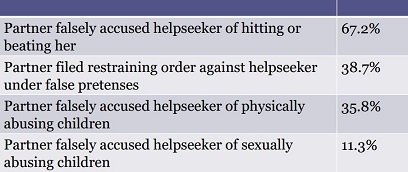

Reforms meant to apply perspective to these statutes and reduce miscarriages of justice from their exploitation have been proposed; they’ve just been vehemently resisted by the feminist establishment.

Laws that were conceived decades ago to redress a serious societal problem have not only been let out at the seams but are easily contorted into tools of domestic violence. This hasn’t been accomplished by fraudulent manipulators of legal process, who merely take advantage of a readily available weapon; it’s rather the product of a dogmatic will to punish exerted by advocates who wouldn’t concede that even real scratches, pushes, or pinches are hardly just grounds for having people forcibly detained, tried, and exiled.

Copyright © 2014 RestrainingOrderAbuse.com

Victim-Blaming: The “Patriarchal Paradigm,” Discrimination against Male Victims of Domestic Violence, the Frequency of False Allegations, and Abuses of Men and Women by Restraining Order Fraud

“Accounting for the discrepancy between the empirical data and current public policy has been the gender paradigm (Dutton and Nicholls 2005), also known as the patriarchal paradigm (Hamel 2007b), a set of assumptions and beliefs about domestic violence that has shaped domestic violence policy on arrest, treatment, and victim services at all levels for the past several decades. A product of feminist sociopolitical theory, the paradigm posits that the causes of domestic violence can be found in patriarchy and male dominance…. Despite data that are inconsistent with the feminist perspective…it remains a dominant influence….”

Journal of Family Violence (2009)

In a recent post, I wrote about false allegations of domestic violence and quoted a male victim who was arrested when he reported to police that he was being assaulted. The ensuing ordeal cost him his “career, [his] name, and three years of income” before the police department copped to wrongdoing and settled with him out of court.

DV1Deplorably, this is what comes of asking for help from a system that’s been conditioned to perceive men as stalkers, batterers, and rapists (despite the fact that best population-based studies reveal as many as half of victims of partner violence are men).

According to findings by Dr. Denise Hines, more than a quarter of male victims of domestic violence who call the police are themselves arrested as a result (26%). Half of the time, responding police officers do nothing, and in less than one in five cases (17%) is a reported female abuser arrested.

Imagine the outrage of the National Organization of Women if half the women who reported being battered were blown off by authorities, or if one in every four women who reported being battered was herself arrested and prosecuted for assault.

This isn’t to say, of course, that the “patriarchal paradigm” promoted by feminist advocates and the Violence against Women Act (VAWA) doesn’t also brutally injure women.

Alternative to filing criminal complaints is the filing of civil protection orders—and this knife cuts both ways. Diminished standards of verification applied to allegations made in connection with restraining orders ensure that women, too, are abused by the state according to false allegations leveled against them by conniving men. The frequency of female victimization by men is lesser; the damages of that victimization are not.

Returning to the journal article quoted in the epigraph (Muller, Desmarais, and Hamel), consider:

Every state in the United States now authorizes its courts to issue civil orders of protection against domestic violence. Typically, a temporary domestic violence restraining order (TRO) is issued ex parte at the request of any plaintiff who expresses an “objectively reasonable subjective fear of being injured” (Miller 2005, p. 74), without the respondent (i.e., the alleged perpetrator) having to be present in court. TROs are granted for two- to four-week periods, at which point a hearing is held to determine if a permanent order is warranted, valid in most states for a period of one to four years. In California, as of June 6, 2003, there were 227,941 active restraining orders (including temporary and permanent) issued against adults, almost all of them for domestic violence. Of the domestic violence orders, approximately 72% restrained a man from a protected woman, 19% restrained a same-sex partner, and 9% restrained a woman from a protected man (Sorenson and Shen 2005). Of particular significance to family court cases, the protected parent almost automatically obtains custody of the children, without a custody hearing or a custody decision being made (Kanuha and Ross 2004; Sorenson and Shen 2005).

Various motives for lying to the court are both obvious and confirmed.

“Many TROs and POs [protection orders],” concludes a Hawaiian task force on restraining orders, “are obtained by one party to a dispute to try to gain advantage over another party in future or ongoing divorce proceedings or a custody dispute” (Murdoch 2005, p. 17). In California, the Family Law section of the state bar expressed concern that domestic violence restraining orders “are increasingly being used in family law cases to help one side jockey for an advantage in child custody and/or property litigation and in cases involving the right to receive spousal support” (Robe and Ross 2005, p. 26). A retired Massachusetts judge revealed to the press that, in his experience, one-third of restraining orders are strategic ploys used for leverage in divorce cases (“Retiring Judge” 2001). Attorneys Sheara Friend and Dorothy Wright, the latter also a former board member of a battered women’s shelter, estimate that 40 to 50% of restraining orders are used to manipulate the system (Young 1999). In some cases, mothers secure custody despite a history of abuse against the father or the children (Cook 1997; Pearson 1997).

As I prefaced these quotations by remarking, they shouldn’t be interpreted to mean that men don’t also lie to inculpate women (who may be the actual victims of domestic violence), because they do, as the study these quotations are drawn from suggests. The rate of false allegations between the sexes may in fact be equivalent (and as high as 50%).

The difference is that women far more often make allegations (and thus false allegations) against men than vice-versa.

Absent from all analytic studies and contemplations is the toll of false allegations and victim-blaming on those devastated by them, which can’t be quantified.

Copyright © 2014 RestrainingOrderAbuse.com

Face Mask or Baseball Bat?: Abuse of Domestic Violence Laws and Restraining Orders

“As a male victim of domestic violence, my voice was never heard by any responding police officer. In fact, when they arrived my batterer made false allegations against me [that] led to my arrest. Three years later, the Eloy Police Department settled out of court, admitting wrongdoing. Still, I lost my career, my name, and three years of income because of the sexist actions taken by Arizona law enforcement.”

—E-petition respondent

“As strange as it sounds, the very laws designed to help victims sometimes hurt them. After I spent over a year as a lead attorney in a specialized felony domestic violence court, I realized the potential for abuse of the domestic violence system. Often, perpetrators of domestic violence would twist the system by accusing their victims of domestic violence. On the theory that ‘the best defense is a good offense,’ batterers accused the victims to neutralize any claims they feared their victims would make against them. In addition, I have seen parties to family law cases make allegations of domestic violence to try to gain an advantage in a divorce proceeding as relates to custody or property settlements.”

—Family attorney Samantha D. Malloy

Everything that’s wrong with restraining orders becomes emphatically pronounced when you observe that a process originally conceived to provide relief to victims of domestic violence may easily be abused to magnify and compound their torments.

That abusers should eagerly embrace the opportunity to heap further pain on their victims (while simultaneously exculpating themselves) should hardly be shocking to anyone. What’s shocking is how readily this opportunity for offenders to reverse roles with their victims presents itself (which role-reversal, readers will note, the quoted attorney remarks occurs “often” not rarely, as is commonly posited by those hostile to exposure of the rampancy of false allegations and abuses of restraining orders).

To get a protective order, one must only complete and sign a petition “under oath” or “penalty of perjury.” The petition is given “ex parte” (in the absence of the accused and without their notice) to a judge, who will enter the order if certain necessary allegations are made. There is no trial or requirement of further evidence before the initial order is entered.

The subsequent hearing of testimony and evidence, typically prejudiced by the preconception that the accused is guilty, is furthermore answerable to no strict standard of proof (hence Ms. Malloy’s advertisement of her services). It’s too often the case that procurement of an “initial order” represents a fait accompli, because calculated histrionics, finger-pointing, and concocted allegations from a persuasive plaintiff (particularly a female plaintiff) are all but certain to clinch a favorable judgment.

Noteworthy finally is Ms. Malloy’s acknowledgment that false allegations of violence, which are devastating in the emotional oppression, humiliation, and social and professional havoc they wreak on the falsely accused, are used strategically to gain leverage in divorce proceedings.
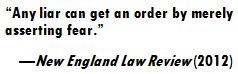
None of this information is new. Its potency, however, is defused by feminist dogmatists and their sympathizers—who refuse to concede that false allegations are commonplace—with the claim that men’s rights or fathers’ rights groups sensationalize the frequency of false allegations or purvey false information about their frequency. If feminist hardliners were sincerely invested in social justice, they would ask practitioners in the field of law, particularly family law, what their impressions and perceptions are (based on real-life experience).

Ms. Malloy, who may well be an exceptional attorney but isn’t exceptional among attorneys in her acknowledgment that restraining orders are abused, advertises her services both to victims of domestic violence and victims of false allegations of domestic violence. If the dogmatists were right about false allegations’ being rare, or if the restraining order process were anything approaching fair and just, she wouldn’t have to switch-hit, would she?

Copyright © 2014 RestrainingOrderAbuse.com

PERJURY: BS-ing the Court, the Frequency of False Allegations, and the Fraudulent Abuse of the Civil Restraining Order

In the last post, I discussed how lying is generally gotten away with beneath the radar. What people who’ve blessedly had no personal experience with fraudulent abuse of legal process fail to grasp is (1) there’s no incentive to expose untruths except (perhaps) when they’re used to frame people for crimes for which they stand to be convicted, (2) lies are much more commonly used to re-frame the truth into one favorable to the image or malicious intentions of fraudsters than they are to send people to prison, (3) lies don’t have to succeed in false criminal convictions to be damning or ruinous, and (4) lies may be of sorts that are impossible to discredit yet may permanently corrupt the public records and lives of the falsely accused.

Writers, for instance, who confront false allegations of domestic violence don’t actually invite their imaginations to conceive what such false allegations might be. Perhaps they vaguely suppose they’re of this nature: “He beats me with a belt buckle” or “She locks me in the pantry.” False allegations like these may certainly be made, but lies may be much more subtle or vaporous: “I live in a constant state of fear” or “She said she was going to kill me while I sleep.” Is the truth or falsity of these latter claims possible to ascertain? No. Police reports and restraining orders may be based on allegations like these, however, and anyone who imagines maliciously motivated people are incapable of making false statements to this effect have lived enviably sheltered lives.

False claims of stalking are as easily manufactured: “He creeps around my neighborhood late at night” or “She cut me off in traffic, almost running me off the road.” Allegations like these may not only be the substance of false police reports (which may—and do—gnaw at the sanity of their victims) but may be grounds for false restraining orders (which are far more nightmarish). In fact, the latter allegation was the basis of an emergency restraining order reported to this blog, which was petitioned against a college girl, in or just out of her teens, by her female counselor. The girl and her mom had a weekend to prepare her defense, and she wasn’t fully exonerated of her accuser’s litany of “terror-inspiring misconduct” (which included the girl’s greeting her accuser a few times in chance public encounters in a town of 2,000 residents and seeing her at church).

False allegations of sexual harassment? “He‘s repeatedly told me he wants me to [X] him” or “She keeps propositioning me”—try disproving allegations like these, which may be much more explicit and include claims of physical molestation. The consequences, if it’s necessary to enumerate them, could include termination of employment, marital dissolution, peer or social isolation, and the emotional and thus physical decay that accompany each or all. False claims like these, which take mere seconds to articulate, may never be recovered from.

For making such false allegations to the authorities and courts, there are no consequences, except to their victims. There are statutory penalties on the books for making false claims (committing perjury), but they’re rarely if ever enforced and couldn’t be enforced consistently within governmental budgetary constraints, so commonplace is lying. Are such false claims going to end up in some statistical database? Of course not. Ask an honest district attorney, though, why lying isn’t prosecuted, and s/he’ll tell you it’s because lying is an everyday occurrence.

This is the invisible irony that escapes everyone who tackles consideration of rates of false allegations: the fact that lying isn’t prosecuted is the indicator of its rampancy (prosecution of frauds on the police and courts would overwhelm the system). And because lying isn’t prosecuted, it’s in the interest of maintaining the dignity of the legal system and the semblance of just and orderly process that judges not acknowledge even flagrant lies as such. To acknowledge them in all their plenitude, yet not punish them, would be to call into question the legitimacy of the system itself. Restraining order frauds, moreover, may be rewarded with favorable verdicts in spite of lies, making the concealment of those lies by judges that much more urgent.

Society has been conditioned, in the decades since the advent of the restraining order, to be hyper-vigilant and -reactive toward allegations of domestic violence, stalking, and sexual harassment—behaviors associated with male abuse of women, which the restraining order was conceived to curb, if not remedy. These offenses are ones to which the population has been vigorously, even coercively, sensitized. The justice system is consequently poised to descend upon those accused of such behaviors (including women), as is the public poised to believe allegations of such behaviors to be true, especially when validated by the courts.

False accusers are certainly aware of these prejudices and may easily exploit them—and should hardly be expected not to. Agents of the system may, in fact, goad them on, even while salting the wounds of those who report that they’re victims of false allegations by telling them they have no legal recourse (which, practically speaking, they don’t). Judges, furthermore, may scourge such victims in the courtroom based on allegations that their accusers leveled in one-sided, five- or 10-minute auditions.

To recap: Liars aren’t prosecuted, so lies aren’t acknowledged as lies, but the civil procedure that’s most eagerly and impulsively abused by liars, the restraining order process,  is supremely lax, instantly gratifying, and universally promoted. This procedure, what’s more, indelibly fouls a falsely accused defendant’s public record; may deny him or her entitlement to home, children, and property; and may cost him or her, besides, employment and employability in his or her chosen field of endeavor.

If this weren’t infernal enough, the outrage and misery expressed by victims who’ve found themselves in the eye of this perfect storm of unreason, some of whom are left impoverished of everything that gave their lives meaning, are credibly denounced or even mocked as crackpot.

Copyright © 2014 RestrainingOrderAbuse.com

Role Reversal: Using Restraining Orders to Conceal Misconduct and Displace Blame

“My brother was [the] victim of [domestic violence], but he was the one [who] got arrested, because he didn’t report it, and she called the police saying that she was the victim.”

“I have been accused of domestic violence. When my wife was arrested for credit fraud, I told her I wanted a divorce. She said she wasn’t letting me go. So she called the police and said I hit her so I was arrested. I’m so confused.”

—E-petition respondents

I’ve been monitoring the online petition, “Stop False Allegations of Domestic Violence,” since I came across it almost three years ago. The comments above were topmost when I looked at it Sunday evening.

The motives of the frauds they describe are essentially the same: cover-up. Plaintiffs’ blaming their victims for their own misconduct is a common motive for frauds on the police and courts, which typically stem from or involve restraining order abuse.

Dr. Tara Palmatier, on her website Shrink4Men.com, has written extensively about domestic violence committed by women, as well as about female abusers’ filing false allegations against their victims to compound the injury and garner attention. It’s neither my intention nor my interest to alienate female victims of restraining order abuse or to discount the horrors of their own ordeals with this observation, but women like attention (and, sure, men are hardly indifferent to it). This observation isn’t made gratuitously, either. Attention-seeking is a basic motive for the fraudulent abuse of restraining orders, which may derail or destroy defendants’ lives and which may be awarded based on nothing more substantial that hysterical hot air.

Playing the victim is a very potent form of passive aggression when the audience includes authorities and judges. Validation from these audience members is particularly gratifying to the egos of frauds, and both the police and judges have been trained to respond gallantly to the appeals of “damsels in distress.”

Besides attracting attention, bad faith abuses of civil process gratify abusers’ will to dominate and own their victims. Here you see the correspondence between the two scenarios in the epigraph. Potential threats in both cases have been defanged and subjugated to the control of the false accusers.

With their false allegations now in place, any threat to them that their victims may have posed has effectively been neutralized. Should the victim in the former case report that his wife is in fact the batterer, his allegation will be profoundly controverted by her beating him to the punch. She’s killed his credibility. If the victim in the latter case seeks a divorce, what should have been a clean break will have been made very messy by the domestic violence charge.

The most unacknowledged horror of the restraining order process is its convenient use to victimize men and women a second time even as they’re reeling from grievous or humiliating betrayals committed by their false accusers.

The reason this horror is unacknowledged is that the courts are very good at covering up, too.

Copyright © 2014 RestrainingOrderAbuse.com

Middle Class to Pauper in a Day: On Restraining Order Fraud, Homelessness, and Suicide

This describes what happened and continues to happen to me because of my wife’s lying to the court authorities. I am desperately seeking someone to help me, because I lost everything: job, home, money, and reputation. I already tried once to take my life because of it. [Although I have never] been in trouble with the law in the past…she was able to have me arrested for [domestic violence] and stalking with no proof, facts, or witnesses. I did not do those things, and I have surveillance video to prove my innocence. She [has] stalked and continues to stalk, intimidate, harass, threaten, and humiliate me regularly. I’m homeless in [an area where I know] no one [and have no one] to turn to, no job, no money, [and] no adequate legal representation. My life as I knew it is over. Help me, please!!!”

E-petition respondent

He’s lying, right? Like the thousands of others who’ve responded to the same petition he has? Really ask yourself. It’s appalling to me that there are intelligent human beings in the world who find it an easy matter to dismiss pleas like this out of hand.

Does this person sound crazy? Does he sound dangerous? I also find it appalling how rarely obvious questions like these present themselves even to minds trained to think critically.

I’ll answer for you: No, he doesn’t sound crazy or dangerous. Next question (this is how critical thinking works): If he’s telling it true, how is something like this possible?


It’s possible for exactly the reason he names: substantiating claims of stalking and domestic violence made through the civil court requires no evidence (nor does substantiating any other allegations), and on their basis a defendant can be summarily stripped of everything. Any adult can walk into a courtroom off the street and make allegations like these against another adult and have a restraining order issued. This can even be true when the accuser has no domestic relationship with his or her “abuser” or has never even met that “abuser” before. Allegations like these can moreover be made by people who live in different states from the accused. The restraining order process, in other words, is a golden ticket to any liar or crank with an ax to grind or even to any psycho responding to the urges of the voices in his or her head. There’s no inspection or corroboration of credentials. (One recent respondent to this blog reports that his wife’s embittered ex-boyfriend was awarded one of her children upon his falsely swearing out a restraining order against her and claiming to be the boy’s father. The boy was removed from school and handed to him. Consider how you’d feel if one of your kids were placed in the custody of a stranger…who hated you. Just based on his say-so. If you tried to recover the child and return him or her to safety, incidentally, you’d be arrested by the state and charged at the very least with contempt of court for violating the restraining order.)

It’s imagined, I think, even by those who are capable of acknowledging the stink of injustice, that the fallout of false allegations is exaggerated. There is no exaggerating it. Whatever you think you own and whoever you think you are can be taken from you and reinterpreted in an instant. By public factotums who’ve never even clapped eyes on you, couldn’t care less, and wouldn’t scruple a bit about locking you in a cage.

The nifty part is that once a person like the man quoted in the epigraph is forcibly divested of all means to fight back, s/he can’t. And no journalist is going to touch a story like his. Allegations that may lead to someone’s being stripped of home, property, and dignity may be so impossible to discriminate from the truth that there’s no way to assuredly expose the injustice. There’s no proving an allegation of fear, for instance, to be false. For that matter, there’s no proving an allegation of threat or violence to be false.

There’s no proving them to be true, either (even welts and bruises can be self-inflicted). But that doesn’t matter. This glaring bias is the only ascertainable injustice.

Aside, that is, from the fact that the man whose story prompted this discussion is sleeping in a box and thinking about offing himself.

Copyright © 2014 RestrainingOrderAbuse.com

Because Perjury Occurs a Lot, It’s Ignored: On the Absurdity and Toll of Domestic Violence and Restraining Order Policies’ Disregarding False Allegations

“My 87-year-old father has been arrested and jailed three times by my mentally ill mother, who is using domestic violence laws to her advantage in a divorce. This is a man who served in the military for 20 years, the federal government for 25 years, and the Department of Social Services for five years before retiring. My dad has never even had so much as a speeding ticket in his entire life, but now, at the end of his life, he has been humiliated, placed on supervised probation, and will probably lose everything due to the abuse of domestic violence laws. Nobody in law enforcement will listen to what is really going on here. Even though I had prior knowledge that my dad was being set up, I have actually been told by the District Attorney…and I quote, ‘I have convicted your father of assault on a female, and I will convict him of everything else I can.’ The justice system has gone off the rails, and the truth means nothing. My father fought in World War II and in Korea to keep this country free, and this is how he is repaid.”

—E-petition respondent

How did you spend the yuletide? With friends and family, listening to Nat King Cole and Bing Crosby, mussing kids’ hair and congratulating them on their Christmas spoils?

Read the epigraph above, and you’ll have a pretty clear idea of what Todd L. of Wilmington, North Carolina had on his mind. Not much to raise a cup of cheer to, is it?

This distinguished service veteran’s age approximates that of the cited victim of false allegations.

Two hours after Todd shared his story on the e-petition “Stop False Allegations of Domestic Violence,” a fellow North Carolinian opined, “There should be a legal penalty for false accusations!”

Lawmakers have agreed, actually, and statutes making lying to the court a felony crime are universal. What this commenter should have said is that legal penalties for false accusations should be enforced.

Perjury is never prosecuted. District attorneys will tell you that if they did prosecute perjurers, there’d be no resources left for putting “dangerous people” behind bars.

Let’s parse that logic.

First, it actually recognizes that lying occurs a lot. If it only occurred now and then, prosecutions would be few and hardly a budgetary strain.

Second, recognizing that lying occurs a lot also recognizes that the so-called dangerous people the state prefers to prosecute may simply be victims of false allegations. Preferring to prosecute alleged domestic assailants, therefore—take, for example, the 87-year-old man cited in this post’s epigraph—may mean preferring to prosecute the falsely accused (the innocent) over the genuinely criminal (the false accusers).

Ask yourself which would look better on the books: “We’ve successfully prosecuted [x number of] wife-beaters” or “We’ve successfully prosecuted [x number of] perjurers”? Everyone knows what wife-beater means. How many people even know what a perjurer is?

“If we did prosecute perjurers, there’d be no resources left for putting dangerous people behind bars…so we’ll prosecute the people perjurers falsely accuse of being dangerous”—as analysis of most of the arguments made in defense of domestic violence and restraining order policies reveals, the reasoning is circular and smells foul. It’s in fact unreasoned “reasoning” that’s really just something to say to distract attention from unflattering truths that don’t win elections, federal grants, popular esteem, or political favor. So entrenched are these policies and so megalithic (and lucrative) that rhetoric like this actually passes for satisfactory when it’s used by someone in a crisp suit with a crisper title.

Obviously it wouldn’t be necessary to prosecute all perjurers to arrest epidemic lying. Ensuring that false allegations were made less frequently would only entail putting a few frauds in cages for a year or two where they belong, making examples of them, and revising policy so that the consequences of lying were impressed upon other would-be frauds. As it is, policy (including menacing rhetoric on court documents like restraining orders) is to impress upon defendants how serious the consequences of being lied about are: “For being publicly lied about, you may be subject to arrest and incarceration for being publicly lied about some more.”

The absurdity is patent, as is the wanton cruelty. Applying the word justice to any aspect of this policy should itself be criminal.

The 87-year-old man referenced in the epigraph above may be at the end of his life, and it’s a reasonable surmise that whatever remaining time he could have hoped for will be shortened by the treatment he’s received from the country in whose service he’s dedicated over half of that life.

If a YouTube video were posted of state agents bludgeoning an 87-year-old veteran, it would shortly go viral, reporters would elbow their way onto the man’s front stoop, lawyers would scrap and scrabble to represent him, and cable commentators would decry the outrage of the abuse.

Heads would roll.

Since state agents have instead subjected this man to public denigration and dehumanizing psychic torments under the guise of propriety, the odds are strong that he’ll slip away erelong, invisibly, his final days having been poisoned by anguish, disgrace, and the unrelenting consciousness that 50 years of public service were callously invalidated: “I have convicted your father of assault on a female, and I will convict him of everything else I can.”

Copyright © 2013 RestrainingOrderAbuse.com

The New Domestic Violence: Restraining Order Abuse

Daughter: “He hits me, Ma.”

Mother: “Well…I can’t say I’m surprised. What’d ya do?”

Daughter: “Whaddya mean, what’d I do?”

Mother: “What’d ya do to make him angry? He didn’t just hit ya outta the blue.”

Daughter: “I guess I didn’t do what he wanted me to.”

This exchange is extracted from a recent Hollywood movie set in the 1970s immediately preceding the advent of the restraining order and illustrates the social mindset that ’70s-era feminists sought to counteract, namely, one that tolerated spousal abuse and placed the blame for it on its victims.

Living in an environment of insecurity and intimidation is a daily torment no one should have to bear, and no one can deny that the motives that led to restraining order legislation’s being drafted were very sympathetic ones.

What this blog and others like it seek to bring to light is that restraining orders have become the arbitrarily brutal hand that they were originally conceived to check—and they’ve put brass knuckles on it.

Restraining orders’ abuses arise from the same impulse: anger, jealousy, or control, for instance; but they’re much worse in many ways than slaps and threats, because their consequences are more exacting, enduring, and inescapable.

As in the exchange above, the answer to why someone had a restraining order petitioned against him or her is too often: “I guess I didn’t do what [s/he] wanted me to.”  The motive for the abuser’s action may be identical. Only the means of abuse are different.

Because those means may, and often do, include lying and lying publicly and savagely, abuses accomplished with restraining orders don’t fade like bruises do. A man falsely accused of domestic violence, for example, is publicly recognized as a batterer for the rest of his life, and that label may follow him from job to job or relationship to relationship. Years of his life may pass in agony before his ordeal in the courts has even concluded. A lie impulsively told to a judge in a few minutes may be something its victim has to continue to counteract forever, and though counseling may help him reconcile himself to the lie and its injuries, no amount of it will ever erase that lie, because it’s branded on his public face.

And while women alleged to be batterers may not be perceived as harshly as men accused of domestic violence, women, too, may be abused by restraining orders in exactly the same way, making a process that was designed to protect women a convenient means of brutalizing them that has the sanction of both the government and the feminist establishment.

Fraudulent allegations, furthermore, don’t need to be of domestic violence to lay victims low. Falsely characterizing them as stalkers or sources of sexual harassment or threat may be just as damning and damaging, both socially and psychologically. The implications of the phrase “protection order” or “restraining order” are alone sufficient enough, because their resonance never diminishes. It and its ramifications persist indefinitely.

The horror of the woman in the domestic situation suggested in the scene recited above was that she was stuck in an untenable situation, a situation she was powerless to correct or extricate herself from. Thirty years ago, a woman might have had nowhere to turn. Even mom and dad might turn her away and remind her that she swore a vow of fidelity she was obligated to honor (which is what the mother in this scene does).

Today, a (female) victim of spousal abuse has options. Public and familial reactions to her plaints are liable to be very different. She can move out and divorce without any stigma affixing itself to her, and if she lacks the wherewithal, there are shelters that may take her in until she’s able to provide for herself.

For the victim of restraining order abuse, there are no escapes. The stigma, which may be debilitating, is permanent and may be accompanied besides by his or her being denied access to home, kids, pets, property, and money. In other words, s/he may find him- or herself robbed by the state of all resources and values on top of having to bear a psychic wound there’s no staunching.

Restraining order frauds go over easily, because three decades later authorities and the courts are still responding to what they imagine are scenarios like the one sketched in the scene above. Irrespective of the actual circumstances, it’s what sparks and fuels the indignation that meets many defendants on the faces and in the conduct of judges they’re brought before, conduct that verges on retributive vigilantism.

It’s time to dust off the misperceptions and the process itself. Restraining order laws, which originated in the 1970s, have “evolved” retrospectively, seemingly aiming to amend injustices that occurred before many or most recipients of restraining orders today even drew breath.

The sins of our fathers and forefathers, however villainous (and they assuredly were), aren’t anyone’s but theirs.

Copyright © 2013 RestrainingOrderAbuse.com