Talking Back to Restraining Orders Online: What the First Amendment Says Is Okay

“If someone puts a restraining order on you, can you write about it online?”

—Google query that brought a visitor here recently

Here are some other search terms that led people to this site last week: “lying to obtain a restraining order,” “false cps reports perjury,” “fake rape restraining order,” “restraining order lie,” “falsely accused of molestation […],” “ex lied on order of protection,” “what happens when a bogus pfa is filed on a police officer[?],” “protection order fraud,” “old restraining order keeping me from coaching,” “ex-girlfriend lied about domestic violence and i lost my career.”
You see why people might be inspired to talk back.

I was introduced last year to how the constitutionally guaranteed right to free speech is qualified. In Chan v. Ellis, an appeal before the Georgia Supreme Court that was brought to my attention, First Amendment privileges are spelled out by two prominent authorities who offered opinions on the case, Profs. Eugene Volokh and Aaron Caplan (the latter a former staff attorney for the American Civil Liberties Union). Their amicus brief opposed the trial court’s issuance of a permanent protection order against Matthew Chan (the appellant) on the grounds that the order exerted an unconstitutional “prior restraint” on Mr. Chan’s lawfully writing about his accuser, Linda Ellis, a self-styled motivational speaker/writer whom Mr. Chan had criticized as a “copyright troll” (someone who threatens to sue people for unsanctioned use of his or her original material).

The First Amendment protects the right to speak about people, so long as the speech does not fall into an established First Amendment exception (such as those for defamation or for true threats). This includes the right to speak about private figures, especially when they do something that others see—rightly or wrongly—as unethical.

Succinctly, the First Amendment licenses a person to write about another, including critically, but not necessarily to write to him or her. In other words, you can say things about a person that s/he doesn’t necessarily want to hear; if you say those things to the person, you could be lawfully restrained by the court from continuing.
About a person is okay; to a person may not be.

Qualifiers are that what you say about someone publicly must be true (you can’t lie about someone, i.e., defame him or her), you must not infringe upon his or her privacy (e.g., by revealing his or her medical history), and you must not threaten him or her (i.e., don’t say, “I’m coming to kill you”).

Otherwise, the Constitution says you’re good.

Can a trial court judge, though, blow off the Constitution and come down on you for criticizing someone who obtained a restraining order against you (even by fraud)? Yes, s/he can. Rightly or wrongly, it happens, and lawful has nothing to do with it. Restraining order rulings and those peripheral to them are largely about spin.

(What do I mean by spin? Literally, words—actually expressed or merely alleged—can be represented to and by the court as “harassment,” which may satisfy a state’s statutory definition of “stalking,” which definition may imply sexual molestation. Alleged statements, then, may effectively implicate someone as a sex offender on public record. I wish I were kidding, but I emphatically am not. In a case I recently reviewed, the defendant was said to have committed harassment by “facial gestures.” This exemplifies spin.)

This writer’s thoughts are these:

  1. If you’re presently under a restraining order, exercise informed caution, because anything you say publicly that can be construed as “harassing” may well be interpreted that way by a lower tier judge (these guys are answerable to no one; they do what they want). These posts are about people who were issued restraining orders or show cause orders simply because they wrote about someone: “Restraining Orders and the First Amendment: A Female Blogger’s Successful Appeal of a Restraining Order That Labeled Her a ‘Cyber-Stalker’” and “The Use of Restraining Orders to Bully Women: Jenny’s Story.” Is a judge likely to throw you in jail for merely speaking about someone? No, but there’s no surefire guarantee. What’s strictly lawful and what’s possible are two different things.
  2. There are constitutional grounds to appeal a judgment against you for simply writing about someone. The questions to ask yourself are: How committed are you? Are you up for more court drama? The Constitution is on your side, but reversing a bad judgment requires appealing it to a higher court.
  3. If a restraining order against you has expired, and what you write isn’t false, invasive, or threatening, then you have a strong basis for opposing any further legal action taken against you so long as what you write is about your former accuser and not to him or her (or anyone associated with him or her).

I was sued for writing about someone, and I wasn’t trying to “tell my side”; I wanted to terminate a nasty hoax that had already consumed years of my life. I speculated about my accuser’s motives, and I used a lot of names. I also reported what I knew to be misconduct and applied to a distant family member of my accuser’s (a pastor) to help me effect a resolution. Had I only written in a blog and had I confined what I wrote to facts that couldn’t be represented as invasive or libelous, the court may not have found for my accuser, particularly if I’d had a lawyer to speak for me.

The point of this post is to inform you of your legal rights, and to assert that purveyors of the truth should never have to hide or censor themselves. This is the United States of America, not North Korea. It is not the point of this post, however, to downplay the eagerness of the American court system to deny citizens their rights. If judges weren’t ready and willing to violate citizens’ constitutional entitlements, this blog wouldn’t exist in the first place.

Copyright © 2015 RestrainingOrderAbuse.com

When Girls’ Being Girls Isn’t Cute: False Allegations of Violence and Rape

I was just contemplating what I’ve come to think of as “estrogen rage”—a peculiarly feminine mode of violence that orbits around false allegations to authority figures. Furious men do violence, which is why domestic violence and restraining order laws exist. Furious women delegate violence (by lying), which is why the abuse of domestic violence and restraining order laws is rampant.

I was distracted from this rumination by two accounts that emerged in the press recently of women accusing men of rape to conceal affairs:

Ex-Counselor Gets up to 18 Months in Prison for False Reports of Abduction, Assault” (Bellefonte, Pennsylvania)

Sheriff: Woman Files False Rape Report to Cover up Affair” (Athens, Alabama)

Their motive wasn’t rage; it was selfishness. That same theme is present, however: using others (cops and judges) as tools of violence.

When stories like this are bruited, it’s always to show that, hey, women lie about rape: See! That’s not what people should find disturbing about these stories, though.

whateverWhat people should find disturbing about these stories is how feminine false accusers think about lying, including lying about physical and sexual violence (or their threat). They think it’s no big deal—or they don’t think about it at all.

If false accusers regard lying about rape as no biggie, then what does that say not only about how they regard other types of false allegations but about how they regard rape itself? Right, they regard rape as no biggie.

This is what no one ever confronts head-on.

Even feminists who regard false allegations of physical and sexual violence as insignificant must regard acts of physical and sexual violence as insignificant. You can’t say the acts are ghastly and in the same breath say being falsely accused of them isn’t.

Either both are consequential, or neither is.

Feminists are more prone to denounce even the falsely accused (that is, to blame the victims) than they are to denounce false accusers (their “sisters”). Feminists’ denunciations, then, aren’t ultimately of (sexual) violence; their denunciations are of men. Here we come back to the topic of estrogen.

Feminine and feminist psychology are due more scrutiny than they receive. I can’t count the number of times I’ve read even sympathetic reporters of false allegations say they recognize that the more urgent problem is (sexual) violence against women—a sentiment that, intentionally or not, motivates false allegations. False accusers aren’t just aided and abetted by this pronouncement of priority; they’re encouraged by it.

Trivializing false allegations can hardly be said to deter women from making them. The message it conveys, rather, is that false accusers can and should expect sympathy and attention (because all women who make allegations can and should expect sympathy and attention).

The idea that men do evil in response to their hormonal urges is broadly promulgated, and the influence of that idea is to be seen plainly in our laws and in how our courts administer those laws.

Women have hormonal urges, too, and they’re not just toward maternity.

Consider that the women in the stories highlighted in this post falsely accused men of rape whom they’d just been rolling beneath the sheets with…and put a name to that act.

Both women’s lies, incidentally, were undone by text messages they’d exchanged with their lovers that showed the sex was consensual.

Girls will be girls.

Copyright © 2014 RestrainingOrderAbuse.com

A Legislated License to Lie: Nothing CAN’T Be Falsely Alleged on a Restraining Order

OK

Battery, rape, child molestation—any heinous allegation imaginable can be made in a petition for a restraining order, and it can be made falsely without consequence to the accuser.

Victims of false allegations often ask incredulously, “Can somebody say that?”

There’s nothing that can’t be alleged to the courts (or, for that matter, to the police). There’s no such thing as “can’t allege.” A judge might view allegations of genocide or conspiracy with aliens to achieve global domination as suspect—or s/he might not. Certainly there’s nothing to stop a restraining order applicant from making these allegations, and there’s nothing to stop a judge from crediting them. Neither accusers nor judges are answerable to a literal burden of proof.

As the infamous David Letterman case shows, even the most outlandish allegations easily duck judicial radar. For anyone unfamiliar with the case, here’s Massachusetts attorney Gregory Hession’s synopsis and commentary (quoted from “Restraining Orders Out of Control”):

One day in December of 2005, Colleen Nestler came to Santa Fe County District Court in New Mexico with a bizarre seven-page typed statement and requested a domestic-abuse restraining order against late-night TV host David Letterman.

She stated, under oath, that Letterman seriously abused her by causing her bankruptcy, mental cruelty, and sleep deprivation since 1994. Nestler also alleged that he sent her secret signals “in code words” through his television program for many years and that he “responded to my thoughts of love” by expressing that he wanted to marry her.

Judge Daniel Sanchez issued a restraining order against Letterman based on those allegations. By doing so, it put Letterman on a national list of domestic abusers, gave him a criminal record, took away several of his constitutionally protected rights, and subjected him to criminal prosecution if he contacted Nestler directly or indirectly, or possessed a firearm.

Letterman had never met Colleen Nestler, and this all happened without his knowledge. Nonetheless, she requested that the order include an injunction requiring him not to “think of me, and release me from his mental harassment and hammering.” Asked to explain why he had issued a restraining order on the basis of such an unusual complaint, Judge Sanchez answered that Nestler had filled out the restraining-order request form correctly. After much national ridicule, the judge finally dismissed the order against Letterman. Those who don’t have a TV program and deep pockets are rarely so fortunate.

If allegations like these don’t trip any alarms, consider how much easier putting across plausible allegations is, plausible allegations that may be egregiously false and may include battery, rape, child molestation, or the commission of any other felony crimes.

What recent posts to this blog have endeavored to expose is that false allegations on restraining orders are very effective, because the “standard of evidence” applied to restraining order allegations both tolerates and rewards lying. The only thing that keeps false allegations reasonably in check is the fear that malicious litigants may have of their lies’ being detected. Normal people at least understand that lying is “bad” and that you don’t want to get caught doing it.

To some degree at least, this understanding restricts all but the mentally ill, who may be delusional, and high-conflict litigants, who may have personality disorders and have no conscience, or whose thinking, like that of personality-disordered people’s, is overruled by intense emotions, self-identification as victims, and an urgent will to blame. Normal people may lie cunningly or viciously; high-conflict people may lie cunningly, viciously, compulsively, outrageously, and constantly.
The fear of getting caught in a lie is in fact baseless, because perjury (lying to the court) is prosecuted so rarely as to qualify as never. Most false litigants, however, don’t know that, so their lies are seldom as extravagant as they could be.

Often, though, their lies are extravagant enough to unhinge or trash the lives of those they’ve accused.

Appreciate that false allegations on restraining orders of battery, rape, child molestation, or their like don’t have to be proved. Restraining orders aren’t criminal prosecutions. Allegations just have to persuade a judge that the defendant is a sick puppy who should be kenneled. An allegation of battery, rape, or child molestation is just a contributing influence—except to the people who have to bear its stigma.

More typical than utterly heinous lies are devious misrepresentations. Accusations of stalking and untoward contact or conduct, which may simply be implied, are a common variety. The alleged use merely of cruel language may be very effective by itself. Consider how prejudicial a female plaintiff’s accusing someone (male or female) of forever calling her a “worthless bitch” could be. Substantiation isn’t necessary. Restraining order judges are already vigilantly poised to whiff danger and foul misconduct everywhere. In processes that are concluded in minutes, false or malicious accusers just have to toss judges a few red herrings.

Irrespective of the severity of allegations, the consequences to the fraudulently accused are the same: impediment to or loss of employment and employability, humiliation, distrust, gnawing outrage, depression, and despondency, along with possibly being menacingly barred access to home, children, property, and financial resource. This is all besides being forced to live under the ever-looming threat of further state interference, including arrest and incarceration, should additional false allegations be brought forth.

Even if no further allegations are made, restraining orders, which are public records accessible by anyone, are recorded in the databases of state and federal police…indefinitely.

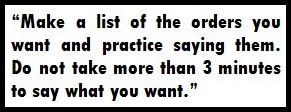
This “advice,” which urges restraining order applicants to rehearse, comes from the California court system and is offered on a page titled, “Ask for a Restraining Order.” The page’s title is not only invitational but can be read as an order itself: Do it. Note, also, that finalization of a restraining order may be based on less than “3 minutes” of testimony and that the court prefers it to be.

Recourses available to the falsely accused are few, and even lawsuits that allege abuse of process may face hurdles like claim preclusion (res judicata), which prohibits previously adjudicated facts from being reexamined. Never mind that the prior rulings may have been formulated in mere minutes based on fantasy and/or cooked allegations. Victims of defamation, fraud on the police and courts, and intentional infliction of emotional distress may moreover face stony indifference from judges, even if their lives have been entirely dismantled. And it should be stressed that attempting to rectify and purge their records of fraudulent allegations, which are established in minutes, can consume years of falsely accused defendants’ lives.

Recognizing that there are no bounds placed upon what false accusers may claim and that there are no consequences to false accusers for lying, the wonder is that more victims of lies aren’t alleged to be “batterers,” “rapists,” and “child molesters.”

Copyright © 2014 RestrainingOrderAbuse.com

“American Law is Irresponsible”: The American Civil Standard of Evidence and Abuse of Restraining Orders

“On the European continent, for the court to hold against the defendant, the judge must be convinced that the facts brought forward by the plaintiff in support of the claim are indeed true. In principle, continental law does not make a difference between civil law and criminal law […]. By contrast, U.S. law has three different standards of proof […]. In criminal law, the charge must be established ‘beyond a reasonable doubt.’ In civil law, normally the plaintiff wins if only ‘the preponderance of the evidence’ is in [his or] her favour. Only in a limited number of civil law matters, of particular gravity for the defendant, the intermediate standard of ‘clear and convincing evidence’ must be met.”

—Dr. Cristoph Engel

The monograph from which this quotation is excerpted, which is by a professor of experimental law and economics, begins by candidly remarking that “American law is irresponsible.”

No argument here.

At the root of restraining order injustice is the lax evidentiary standard applied to plaintiffs’ allegations. Not only may allegations on restraining orders be false; a judge doesn’t have to be convinced that they’re not false to find in favor of their plaintiff.

Excepting in Maryland, which adjudicates the merits of civil restraining order allegations based on the intermediate standard of “clear and convincing evidence,” the standard applied to restraining orders is “preponderance of the evidence.”

If claims seem more likely true than false, “preponderance of the evidence” is satisfied.

In other words, the law is contented if a single judge (not a jury of independent thinkers) reckons the allegations against a defendant are “probably true” (or “maybe true” or “true enough”). To be effective, all allegations have to be is compelling.

Making allegations compelling isn’t a tall task for people in the throes of bitter animosity, as restraining order plaintiffs typically are, and it’s a cakewalk for unscrupulous liars, who are hardly rare among restraining order plaintiffs.

Officers of our courts have furthermore had it impressed upon them that they shouldn’t question allegations made pursuant to the procurement of restraining orders, which are presumed to be sought by those in need of protection.

The legal standard familiar from TV and the movies, “proof beyond a reasonable doubt,” is reserved for criminal prosecutions. For a judge to find in favor of a civil restraining order plaintiff, no proof of his or her allegations is necessary.

Why this is a big deal is that being publically accused is agonizing. Cops and constables serve restraining orders on people at their homes, and just the documents themselves terrorize and shame (as they’re meant to). Allegations on restraining orders, what’s more, are never harmless. Even alleged minor offenses like harassment are inevitably tinged with overtones of danger and/or sexual deviancy. Plaintiffs are inclined to make their allegations as sensational as possible to justify their applications to the courts, and the courts are inclined to find threat or perversion even where none may exist to justify their intrusions into defendants’ lives.

Defendants are met with damning fingers from all directions—and enduringly, because restraining orders (and the allegations on them) are public records, accessible by anyone, that never disappear.

What makes this an even bigger deal, especially when evidence is fraudulently represented or allegations are false, is that restraining order defendants further face loss of employment and employability, as well as loss of access to kids, home, and property in a majority of cases.

Revisiting a phrase used by the author of the epigraph, such losses easily qualify as “particularly grave” and should therefore require the application of a more conclusive standard of evidence by our courts than “close enough.”

Exacerbating the injustice of this tenuous standard is that restraining orders are issued based solely on the word of their plaintiffs (ex parte). Decisions that may result in the losses enumerated above proceed from testimony given in interviews rarely lasting longer than 10 minutes.

Such hearings are far more perfunctory than probative. Basically a judge is just looking for a few cue words to run with and may literally be satisfied by a plaintiff’s saying, “I’m afraid.” (Talk show host David Letterman was notoriously issued a restraining order based on the petition of a woman who accused him of mentally oppressing her through her TV.)

What you have, then, on top of the presupposition of guilt, is a wishy-washy protocol yoked to a wishy-washy evidentiary standard.

It’s true that defendants are afforded the opportunity to challenge allegations leveled against them and actually address the court, but these follow-up hearings, also mere minutes long, are necessarily biased by the court’s prior findings.

The issuance of a restraining order (based on a few-minute chitchat) already represents a ruling, and the court’s disposition isn’t to contradict itself. This bias, authorized by a low evidentiary bar, too often translates to follow-up hearings’ being little more than theater—and an opportunity to subject defendants to additional humiliation and scorn.

Judges coyly criticize their partiality as “paternal.” Considering, however, the steep toll that that partiality may exact from innocent defendants, this self-excuse is nothing shy of obscene (and underscores the cognitive disconnect to which judges are prone between their performances in the courtroom and the effects of those performances on people’s lives).

Clearly the motive for applying a diminished standard of evidence to any courtroom procedure is not to decrease the likelihood of error. The lower the standard of evidence is, that much greater is the probability that miscarriages of justice will occur. When such miscarriages equate to innocent defendants’ being subjected to public humiliation and defamation, loss of employment, and effacement from their former lives, besides their having to tolerate the ever-looming possibility of incarceration following further false allegations’ being made against them, nothing less than the highest standard of evidence is conscionable.

The criticism of the writer of this post’s epigraph that “American law is irresponsible” doesn’t even begin to say it.

Copyright © 2014 RestrainingOrderAbuse.com

Bullying: A Proposition for Psychological Study Inspired by Accounts of Restraining Order Abuse and Fraud

I’ve just corresponded with another victim of tag-teaming involving false allegations made to authorities and the court that were augmented and exacerbated by false rumors and group threats made on Facebook, hyped protestations of fear and danger circulated among friends and family, etc.

This moved me to investigate whether there’s a label for this kind of misconduct and if group-bullying is a recognized social phenomenon.

What I discovered was that group-bullying certainly is a recognized social phenomenon among kids, and it’s one that’s given rise to the coinage cyberbullying and been credited with inspiring teen suicide. The clinical term for this conduct is relational aggression, and one of the forms it takes is defamation by spreading rumors and gossiping about its victim, or publicly humiliating him or her. We’re talking about the vulgar mischief most of us thought we’d escaped when we graduated from high school.

The restraining order process is paternal and infantilizing, and its use mirrors children’s running to adults to adjudicate a perceived or claimed injustice (which is among the reasons why such processes are objected to and derogated as demeaning to women by equity feminists like Camille Paglia). Among the consequences of the availability of restraining orders is the promotion of developmental reversion, a regression into adolescent or even pre-adolescent modes of behavior.

Explications of group-bullying don’t identify one gender or the other as the likelier abuser, though relational aggression is said (by Wikipedia) to have been primarily observed and studied among girls.

Bullies, despite being quite morally competent, tend to engage in morally wrong behaviors because of several reasons, including a lack of moral compassion. In general, bullies seem to engage in a kind of cold cognition and have a good theory of mind. They also have an average to good social intelligence. These skills seem to be especially important in order to use relational aggression in an instrumental manner—for achieving specific social goals. As mentioned previously, male and female bullies usually score differently on sociometric measures. Male bullies often fall in the socially rejected category while female bullies tend to fall in the controversial category. They can be popular yet not liked.

According to the group-bullying paradigm, you have the bully, or ringleader, and a number of orbital “bully-reinforcers and assistants,” besides peripheral outsiders who are less committal but may nevertheless participate.

Bully-reinforcers and assistants do not normally initiate aggressive actions themselves, but they support, reinforce, and/or assist the bully. They often have rather large friendship networks when compared to outsiders, victims, and their defenders. These individuals are similar to bullies in regards of their personal characteristics. Female bully-reinforcers and assistants usually score low on social acceptance and high on rejection by their peers while male bully assistants have average scores on both, and bully-reinforcers are often quite popular among their peers. The characteristic that is common among all these individuals across both genders is low level of empathy.

(I’ve been subject to this misconduct, including by two women who claim their own brothers were victims of false allegations by other women. Interestingly, this didn’t deter these “bully-reinforcers” from participating in the identical misconduct. I’m curious now to learn whether it’s the case that morally diminished or vacuous people tend to gravitate toward one another.)

It’s noteworthy, of course, that upon consideration of the personality-disordered, sociopaths, and bullies (in this context vis-à-vis restraining order abuse), the underlying character qualification that’s repeatedly echoed is “low level of empathy” (and clearly there may be overlap between these types, that is, an offender may be all three in one—in fact, I just learned a single person can have multiple personality disorders). It’s disturbingly noteworthy, what’s more, that though the quoted typologies in this discussion are meant to apply to children, adults will have no difficulty in recognizing other “adults” to whom they’re equally applicable. Deplorably, the “social goals” that motivate bullying by adults may be little different from those that inspire teens: revenge, self-exaltation or -advancement by alienation of another, dominance, attention-seeking, and/or sport.

The restraining order merits special inquiry by psychological researchers, because it (1) allows a bully or false accuser to make allegations outside of normal channels to judges who are, effectively, parental strangers (nullifying any potential for in-group contradiction or negative social fallout, including in work settings); (2) authorizes the bully or false accuser (and his or her minions) to then spread false rumors within normal channels that have received external and official validation; and (3) enables the bully or false accuser to many times more effectively arouse attention and third-party (outsider) participation, because his or her allegations have been officially (parentally) legitimated.

Because of its innate procedural prejudices and low evidentiary threshold (in cases, zero), the restraining order as a medium of lying is uniquely disinhibiting even while promising exorbitant rewards to a bully or false accuser. Incidence rates of false allegations derived from other contexts are therefore wrongfully expected to cross-apply to this medium and are extravagantly low by contrast.

That the recognized by-products of adolescent bullying, furthermore, including depression, difficulties in academic performance, and undermined feelings of competence may likewise manifest in adult victims of bullying but with the additional consequences of loss of employment or employability and familial disruption or dissolution makes the need for critical scrutiny of adult bullying facilitated and authorized by restraining order abuse that much more urgent.

Copyright © 2014 RestrainingOrderAbuse.com

Claiming Fear and Harassment to Terrorize and Harass: How to Deal with Serial Restraining Order Abuse

“Can anything be done when someone constantly gets TROs [temporary restraining orders] falsely…?”

—Search term leading to this blog

This conduct is properly labeled harassment and stalking, and (absurdly) deterrence of this conduct is properly achieved by applying to the court for a restraining order.

The court may be resistant to acknowledging that this sort of thing happens, but it’s in fact a wonder that it doesn’t happen on a larger scale. Restraining orders are free and easily got by claims of apprehension or by outright and calculated fraud, including false allegations of dismaying specificity or even manufactured evidence. (You can’t make this stuff up: I remember reading several years ago of a false accuser’s situating a chainsaw in her driveway and then summoning police to photograph the tableau, which she represented as a “warning” from an ex—vivid, indeed.)

Victims of serial restraining order petitioners must be assertive and present their cases reasonably. Harassment is, by definition, behavior that’s intended to disturb, disrupt, and wear down, and that’s repeated over time. As easy as it is for a crank or a sociopath to continuously obtain restraining orders, it nevertheless represents a very deliberate and sustained course of action that’s furthermore clearly evident of fixation (i.e., stalking).

Provided that a separate case is opened by the victim who alleges chronic harassment by restraining orders, the fact that his or her abuser applied for restraining orders against him or her first isn’t an obstacle.

Essential is showing a pattern of deviant and repetitively malicious misconduct.

Short of applying for a restraining order to arrest this misconduct, the value of which is to discredit false allegations a malicious accuser may make in the future, a victim’s only “easy” remedy is to relocate beyond a false accuser’s reach. Restraining orders may still be issued but cannot be served.

(Yes, dealing with these obscenities forces people to completely uproot their lives.)

Filing a lawsuit is always an option, but it’s never one easily realized, and a successful prosecution is very demanding and stressful, and is only reliably accomplished with the aid of an attorney, making it very expensive besides.

I live in the formerly Wild West. One brush with a nut who exploits the system this way makes you yearn for the lawless days when you could call someone into the street and settle a dispute with an expeditious showdown…and then grab a slice of pie at the diner while the undertaker tidied up.

Copyright © 2014 RestrainingOrderAbuse.com

“Three Times She Said I Ran Her Over”: On the Nature of False Allegations and False Accusers

There was a story out of England last summer about a Zimbabwean refugee, a mom, who clashed with a neighbor over a parking place—a parking place—shortly after moving into her cul-de-sac. The dispute was brief but inspired the neighbor to begin accusing her of crimes. She called the police and claimed the Zimbabwean woman had “stabbed her with a screwdriver and a set of keys” and that she had “smashed into her car and used her keys to scratch her vehicle.” Then, after police determined the allegations were baseless and issued the woman a harassment notice, she began keeping her neighbor under video surveillance.

The neighbor’s account:

“It has been a very unhappy nightmare.

“I’ve had so many different people knock on my door questioning me—that is really scary, even if you know you’ve done nothing wrong.

“It’s really difficult to cope.

“I am a quiet person; I don’t like conflict. I don’t understand why she’s doing it.

“Three times she said I ran her over. It frightened me, because I’d look out the window and see police looking underneath my car, and your heart starts pounding.

“Once she phoned the police in front of me and said, ‘Help me, my neighbour’s stabbing me’ and they were out straight away.”

In this story, the fraud was hoist on her own petard and eventually issued a restraining order for her misconduct. The horror is that had this woman sought a restraining order instead and then made her false allegations, the neighbor’s torment could have been magnified manifold. This is particularly easy to accomplish in the United States.

All of her allegations—stabbing, vandalism, vehicular assault—would have remained on her target’s public record had these allegations been made on a restraining order. And the suspicion of the authorities and courts would have been reversed.

This blog was contacted over the summer by a solitary woman in her 60s, living alone, who similarly aroused the wrath of her neighbor, who proceeded to accuse her of threatening behavior, sought a restraining order against her, and eventually accused her of killing her horse. To avoid further false allegations, the formerly independent senior was forced to abandon her home and rely on the kindness of strangers for a roof and a warm bed.

It’s difficult enough impressing upon someone that restraining orders are issued casually through a process that entails no more than a few-minute theatrical audition. Impressing upon him or her that people willfully and persuasively lie without any motive but malice is next to impossible. “Why would people do that?” they ask, incredulous. One answer might be for attention or for kicks. The simple answer, though, is this: “Because they can.” It isn’t just the case that allegations to authorities and judges may be exaggerated or invested with a little hammed hysteria; they may be calculatedly, sadistically, and hugely false.

And when sadistic impulses aren’t discerned and shut down—and, when they’re ventilated on a restraining order, they often aren’t—they may be indulged by the system repeatedly, even over many years, and to the ruination of their victims.

False accusers are never prosecuted in civil cases, and if they’re sanctioned at all, it’s only in highly publicized cases.

The question people should ask is, “Why wouldn’t people lie?” And the answer should be, “Because they’d go to jail.”

Copyright © 2014 RestrainingOrderAbuse.com