A Brief Introduction to Feminist Rape Culture

“For those who don’t know, rape culture is an environment in which rape is highly prevalent, normalized and excused by the society’s media, popular culture, and political figures.”

—Ashley Jordan, The Humanist


Copyright © 2018 RestrainingOrderAbuse.com

*Omitted from this collage, its author realizes belatedly, is the acronym VAWA, which stands for a vector of evil. A chronicle of what this collage summarizes is here.

How Blindness to the Consequences of False Accusation Is Perpetuated

The last post highlighted the murder of a woman’s cherished dog by police officers responding to a false report.

First thing, then, let’s acknowledge that false accusation can do more than “inconvenience” the accused: It can kill.

Why then isn’t it roundly criticized? Why aren’t multitudes clamoring for accountability? Answer: politics.

Few who are sympathetic to the effects of false accusation are induced to crusade against it, journalists who appreciate the consequences of lying tend to believe that nothing short of being false accused of rape is even worthy of complaining about in the first place, and vociferous critics of complaints of false accusation deny it’s ever a big deal (if they even allow it occurs).

The latter position, particularly, assumes that the falsity of false allegations is always detected before any real harm can be done (always wrong), and that the falsely accused therefore are only ever “hassled” and will recover after a shower and a Xanax.

The result of this wanton idiocy is that citizens (traditionally men) who’ve been falsely accused of “lesser” violations of catastrophic significance to them (like “domestic violence” or “stalking”) find reasons to question the validity of rape claims (and there certainly are some legitimate ones), because only false rape claims pique press attention (and maybe they think that exposing false rape claims will make people scratch their chins and say, “Hey, if people lie about rape, what don’t they lie about?”). They’re also provoked to hit back against a virulently sexist advocacy base where they know it will sting most.

This, in turn, confirms to the false-allegations-are-no-big-deal crowd (which is a powerful and noisy contingent) that complainants of false accusation are simply misogynistic cranks (“See?”) who should not only be discounted but denounced.

This finally translates to the inane formula: Critics of false accusation and its consequences are rape deniers.

Accordingly, for example, innocent citizens must continue to have to watch impotently as their dogs are gunned down by the police at their own homes. (The cops are criticized; the false accusers escape notice.)

Copyright © 2016 RestrainingOrderAbuse.com

*However objectionable mainstream feminists may find the phrase false accusation culture, there’s no denying that a culture that tolerates false accusation is a culture that fosters it. (Exasperatingly, deniers of false accusation culture point out that rarely is anyone prosecuted for lying and assert that fact to be “proof” that lying rarely occurs…even as they bombard government with objections to prosecuting anyone for lying.)

Laying the Blame for Epidemic Bullying where It Belongs: At the Feet of Feminist Liberalism

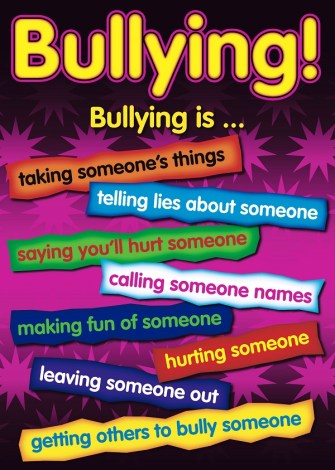
The phrases in this poster that define bullying (for little kids) also precisely identify the motives and consequences of false accusation and malicious prosecution (by grownup little kids): material privation (i.e., loss of home and property), mischaracterization, threat (by the state), name-calling, public belittlement and humiliation, infliction of pain, social isolation/marginalization, and mobbing.

I mentioned in the last post that a teenage girl I know, an AP student, told me she was called a “whore” through a website called Snapchat. She also told me classmates of hers—girl classmates—had accused her of prostituting herself for money to buy cocaine…which is pretty specific.

It’s true the social media that the Internet Age has spawned make bullying a lot easier than it was when I was a kid (and you had to face your victim), and I’m sure the Liberal Establishment blames it for a wealth of abuses. (I think a valid observation would be that social media make female passive-aggression a lot easier to exercise…just like restraining orders do: You don’t have to look the target of your malice in the eye.)

What, though, has made calling a high school junior a “cocaine whore” okay?

Zero accountability—that’s one thing. Kids know adults can’t do anything but civilly ask that they “behave more considerately.” Anything sterner would be “child abuse,” and kids know they can sink any adult shoulder-deep in it if they finger him or her (especially him) as an abuser. Easy-peasy. (If I were a school administrator in charge of reprimanding kids, I’d never close my office door.)

It’s not just the kids, though, is it?

Feminist liberalism, in the name of “progressive reform,” has encouraged accusation and demanded knee-jerk responsiveness to it from the system for a long time. It was horrible when abused women faced social stigma for complaining of mistreatment in their homes, no question, but that was 40 years ago.

Today, someone has to ask what we lost when we abandoned shame and made accusation not merely acceptable and sympathetic but virtuous and rewarding. Accusation garners attention, and it’s potent. People in power rush to our defense at the drop of a name (cf. McCarthyism). And if we fudge the facts a little, there’s no risk anyone in power is going to back-peddle and turn the glare of blame our way. It’s not an exaggeration to say accusation has become a sport, and it’s certainly no exaggeration to say it has become a weapon, as well as a way to whitewash your own misconduct and make bank.

Kids don’t just “get this stuff off the Internet,” and they’re not just inherently cruel. Kids absorb from their social environment like the sponges they are, and today’s social environment says finger-pointing is cool.

Kids know what they can get away with, and they know there are no reprisals. Adults sling dirt with impunity, so why shouldn’t they?

Accusation and bullying are flipsides of the same coin. The feminist liberal who says it’s okay to accuse your husband (father, teacher, etc.) if you feel like it is the same person who made it okay to call a 16-year-old girl a “cocaine whore.”

Copyright © 2016 RestrainingOrderAbuse.com

Borderline Personality Disorder, Procedural Abuse, and Feminism: A Victim’s Reckoning of Their Tolls

YY_mural

“I hate this world and almost everybody in it. People use each other. I find most of you disgusting. My brothers are disgusting. The people I used to work with are disgusting. You’re shallow, you’re two-faced and hypocritical, you’re judgmental, you cause me more pain than you could ever possibly know. You don’t want me around? Guess what? I don’t want to be around you ugly motherf[—]ers, either. You cause all of your own problems, heap them onto other people, and then blame those people for your problems. You bitch about the amount of pain you’re in, then tell other people to get over their pain.

“I am done with all of you. I am done with your lies and your shitty society, and most of all, I am done kissing your ass.”

—Mrs. Nathan Larson (May 9, 2014)

Virginian Nathan Larson has had a tumultuous year.

He married a woman he met online (April 23, 2014); then she moved out (June 21, 2014) and accused him, among other things, of rape (August 2014 through January 2015); then they divorced; then he learned he was a father when the news reached him that his ex-wife had committed suicide.

The quotation above is from an online post of his former wife’s published between their marriage and their separation. Below is an excerpt from a digital diary entry of hers written when she was a teen (which included a “hit list”):

I hate the students at […]. They are arrogant and foolish. My one dream, my passion is to achieve a machine gun or something and shoot every f[—]er in the school. I want to pump them full of metal, their blood splattered on the tiles. I want to make a massacre that becomes the worst in American history. There are only a few people who I would spare. Everyone else…I would love to see them writhing on the ground in pain, blood oozing out of a million holes in their body.

Nathan’s wife, who was an arguably troubled woman, abruptly terminated their relationship of “75 days total” and then informed him she had miscarried their child. In August 2014, she accused him of rape to the police, but he declined to talk with them and was never charged. In November 2014, she began to accuse him to the courts.

This wasn’t a trial run, either. The accusations brought against Nathan by his wife mirrored charges she had made against a previous partner, also to damning effect.

She petitioned three ex parte (temporary) restraining orders before successfully obtaining a permanent order against Nathan in January of this year (by default). Its alleged bases were “domestic abuse, stalking, sexual assault, and physical assault.” The order was petitioned in Colorado, and Nathan would have had to travel a significant distance to be heard in his defense. “Not wanting to invest money and emotional energy in fighting it, and knowing it would be hard for me to successfully contest it, I didn’t show up to the hearing,” he says. He elected to “move on.”

The two were divorced in April 2015, and that seemed to be an end on it.

Two months later, Nathan was told his (then) wife had given birth to a child in February, presumably the one she had told him she had miscarried. This information reached him along with the news that his former wife had killed herself following her commitment for “suicidal depression” and allegedly hearing voices compelling her “to hurt or kill the Child.”

Nathan must now contest a “dependency and neglect petition” in Colorado asserting he’s an unfit parent.

What follows are his reflections on his marriage to a woman who he alleges had untreated borderline personality disorder, on feminism, and on “abuse culture” and its damages.
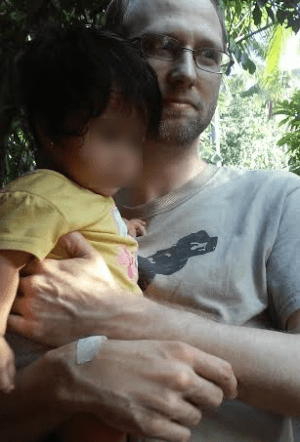
Nathan Larson (with his new fiancée’s infant cousin)

Having the benefit of distance from the situation and more calmness about it (especially now that she’s dead), I would say that we both made a lot of mistakes during and after the relationship. There are some people who say that it’s a mistake to enter into a relationship with someone with untreated borderline personality, because it simply won’t work, no matter what you do. Unfortunately, once you get into a relationship like that, your sense of reality can get distorted because you’re so in love, and they’re so convincing, and they get so many other people to agree with them, that you too start to believe it if you don’t have enough of an understanding of BPD to realize what’s happening and why.

For example, suppose you used to argue with your BPD partner, and occasionally lost your temper and had to apologize for saying something unkind. Because they’re so sensitive to minor betrayals, they might claim that you horribly emotionally abused and bullied them to get your way, and then tried to be sweet to them and make up, just like in the classic model we’ve been taught of the cycle of abuse. If you’re still thinking this person is the most wonderful person in the world, then logically you might think that you really did emotionally abuse them, because why would such a wonderful person say it if it weren’t true? Plus, they are clearly very upset over how you treated them, and they broke up the relationship over it, and now they’ve told everyone in your circle of friends and family about it, and many of them are telling you they agree that the breakup was your fault because of your emotional abuse.

These are people you respect and trust, and therefore this could not possibly be happening unless you really were abusive!

You start to blame yourself and even tell people, “She left me because I was emotionally abusive” (which of course attracts more criticism, because who would admit that if it weren’t true?). Eventually, you run into someone who hears your account of what was actually said and done, and challenges your interpretation, saying you’re being too hard on yourself, and that this chick is not as great as you seem to think she is. (To which, of course, you may think, “He just doesn’t know and understand her and our deep and beautiful relationship! We were soulmates! What are the chances I will ever find another woman like that? I searched my whole life, and she was the only one like that I’ve ever met who loved and appreciated me so much.”)

If you have good friends, they’ll awaken you to the fact that someone who truly loved you that much would be willing to forgive and come back to you, or at least treat you decently, rather than holding a grudge and trying to make you suffer.

Also, there’s the fact to consider that people with borderline personality disorder idealize and devalue, and they view people as either completely good or completely bad. This means that once they’re faced with the inescapable reality that you’re not perfect, they have to view you as completely evil. They also have to deny any blame at all for the end of the relationship, lest they have to conclude that they too are flawed, which would cause them to view themselves as completely evil. They can’t handle any feelings of guilt; they have to deflect all blame, including the blame for their own emotionality.

Feminists, of course, are not thinking about all this psychology going on behind the scenes.

They’re busy calculating whether being skeptical of the claims of someone like that will make the public more likely to be skeptical of the claims of someone with legitimate, serious complaints, and make those victims more reluctant to come forward. So the innocent who was accused gets sacrificed for the greater good.

Some women with borderline personality disorder are attracted to the feminist movement and voraciously read all of their materials about abuse, patriarchy, rape culture, etc. because it helps them view themselves as a helpless victim of powerful sociopaths, and thus deflect blame.

They can find a community of people who will give them the benefit of the doubt by believing their stories, and confirm their interpretation of what happened. Borderlines also sometimes struggle to find a sense of identity, and the feminist movement can provide that as well. Their victimhood actually makes them useful to someone, since it’s a story they can tell and retell to those who need to be persuaded that political change is necessary to stop these abuses. (Feminists, like advocates for most other political movements, would bristle at any suggestion that their ideology attracts mentally ill people, since that would tend to discredit them.)

Yet what the feminist movement can never satisfactorily explain to them is why, despite all this training in recognizing red flags of abusers, and despite all the tools the system has provided for punishing abusers (e.g., restraining orders, prison sentences, etc.), they keep getting “abused” by partner after partner, while many other women seem to have successful, happy relationships.

The only possible answer is that it’s a combination of sociopaths’ finding them particularly attractive for some reason (maybe they sense they’ve been abused and think it’ll be easy to re-victimize them) combined with the fact that the patriarchy is still strong, abused women are still not being believed, and therefore we need to punish abusers more harshly and give the accusers even more benefit of the doubt.

Then, finally, when we have a world where all you need to do to get a man locked away for life is cry rape without any supporting evidence, rational men will finally stop raping. Except, even if such a system were put in place, these insecure women would still feel victimized by their partners, and they would attribute the “abuse” to these guys’ acting impulsively without regard to the certain punishment.

Copyright © 2015 RestrainingOrderAbuse.com

*An excellent explication of procedural abuse by “high-conflict” people (who are associated with personality disorders like BPD) and why court procedure is attractive to them is here.

More on False Accusation Culture: A Memoir That Exemplifies how False Accusations Are Motivated by “Mass Panic”

Meredith Maran, in writing about falsely accusing her father of molesting her, has been lauded for her bravery, compassion, and honesty by no lesser literary lights than Anne Lamott, Elizabeth Loftus, and Michael Chabon. One must wonder, however, whether a memoir by her father about the torment of being falsely accused and alienated from his grandchildren, particularly if Ms. Maran had maintained her story of abuse, would have received the same sympathetic interest, never mind the same critical acclaim.

Thanks to how Google News is prioritizing its returns for the search term “false accusations,” I came across a Salon.com interview the other day (published in 2010) that speaks significantly to how false claims of abuse, even “false memories” of abuse, can be socially coerced. What it relates exemplifies why how we talk about violence is a very big deal.

More than 20 years ago, Meredith Maran falsely accused her father of molestation. That she came to believe such a thing was possible reveals what can happen when personal turmoil meets a powerful social movement. In her book My Lie: A True Story of False Memory (the introduction of which is excerpted on Salon), Maran recounts the 1980s feminist-inspired campaign to expose molestation, which hit feverish levels in 1988 with the book The Courage to Heal. As an early reporter on the story, Maran observed family therapy sessions, interviewed molesters, and steeped herself in cases where abuse clearly took place. Meanwhile, she divorced her husband and fell in love with a woman who was also an incest survivor. Maran began having nightmares about her own molestation and soon what had been a contentious relationship with her father turned into accusations of unspeakable crimes. Eventually, she came to realize the truth. She was the person who had done wrong.

Toward the end of her memoir, her father asks her, “What I really want to know is how the hell you could have thought that of me.”

Ms. Maran tells Salon reporter Michael Humphrey that she was a thrall of “mass hysteria” (of “mind control” or “brainwashing”).

I was working as a feminist journalist, writing exposés of child sexual abuse, trying to convince the world that incest was more than a one-in-a-million occurrence. In the process, I convinced myself that my father had molested me. After five years of incest nightmares and incest workshops and incest therapy, I accused my father, estranging myself and my sons from him for the next eight years.

In the early 1990s the culture flipped, and so did I. Across the country, falsely accused fathers were suing their daughters’ incest therapists. Falsely accused molesters were being freed from jail—and I realized that my accusation was false. I was one of the lucky ones. My father was still alive, and he forgave me.

The early ’90s, coincidentally, was when restraining orders entered full swing, and the Violence Against Women Act emerged—and allegations of “epidemic violence,” largely from feminist quarters, have never broken stride since.

Ms. Maran’s memoir presents a case study in the coercive effects of rhetoric, especially when it’s backed by widely embraced “social science.”

In 2007, I was out for a walk with someone I wasn’t even that close to. She asked me if I’d ever done anything I was ashamed of and had never forgiven myself for. And without hesitation I said, yeah, when I was in my 30s I accused my father of molesting me, and then I realized it wasn’t true. She stopped walking and stood still, just staring at me and she said, “The same exact thing happened to me.” When I came home from that hike I started calling people I had known back then and speaking to some of the therapists I had seen during that period. With the exception of my ex-lover, every other person I talked to who had accused her father in the ’80s and early ’90s now believed she had been wrong.

[…]

It really shocked me, I must say, to see how much influence the external had on the internal. That the most intimate emotions and relationships can be so affected by the dominant paradigm.

Today’s “dominant paradigm” (a.k.a. dogma) is that accusers who allege abuse are telling it straight, especially if the accusers are female and they’re alleging violence. Conscientious voices continue to meet with vehement hostility, even for making the mild (and very reasonable) suggestion that allegations shouldn’t be treated as facts.

[T]he statement of accusation is all it takes to put the wheels in motion. Either legally or in your family. One thing I’ve learned is the relevance of the phrase “the perfect storm.” Not only for me, but for a lot of women I know who made these false accusations, it was very much a social phenomenon. Metaphorically, everything we were saying was true. But there was a confusion between a metaphor and a fact. And it was a highly relevant difference.

Put plainly, the difference Ms. Maran remarks is between real and fictional—a “highly relevant difference” indeed. So much of the rhetoric that continues to exert a governing influence on social perspectives mirrors what we “want to think” or what we’ve been motivated or conditioned to think (what it’s “right” or politically correct to think). There’s a broad and vocal contingent of “true believers” who are deeply invested in the notion that “violence is epidemic” and that “victim’s” needs should preempt all other concerns, including justice and the false implication of the innocent.

Mr. Humphrey’s interview with Ms. Maran ends on a chilling statement that’s worthy of reflection, coming as it does from a woman who’s written a book acknowledging that people may be led to falsely accuse and that she herself was “brainwashed” into doing so.

In the middle of the book, while you are still deeply in the mind-set of being molested, there’s a notion you agree with that if one innocent man goes to prison, but it stops a hundred molesters, it’s worth it. Do you still agree with that notion?

I’m fairly close to a man still in prison, and really believe he is innocent. I know how he’s suffered. I know he’s 80 years old and in ill health. He’s spent 20 years in prison, for no reason. If every elementary school child is now taught how to protect themselves from sexual abuse—and even more to the point, some father or preschool teacher who feels the urge to molest a child will be inhibited from doing so because they think there are guys still in jail for doing that—but innocent people are in prison, do I have to make that choice? It is a Sophie’s choice kind of thing. Would I allow an innocent man to sit in prison if it meant keeping children safe?

So would you make that choice?

I think so.

In closing, appreciate these facts: (1) A false accuser isn’t pilloried but praised for “bravely” admitting the truth years later, years during which someone else—may we also say “bravely”?—lived with the isolating stigma of her accusations; and (2) the same false accuser who “saw the light” nevertheless opines that other people’s lives are arbitrarily expendable for a virtuous cause.

If these compound horrors weren’t bad enough, the view the memoirist expresses is generally shared and, for all intents and purposes, held by our own “justice system” (consequently).

The question the interviewer poses isn’t a “Sophie’s choice.” The character in William Styron’s novel is forced by a Nazi soldier to choose which of her children should be allowed to live. The choice wasn’t a moral one. Opting to punish people for crimes they haven’t committed to make “object lessons” of them against their will decidedly is.

Whether it’s “worth it” to expediently destroy some other person’s life for the betterment of society isn’t a decision anyone gets to make but the owner of that life—and how dare anyone presume otherwise.

Copyright © 2015 RestrainingOrderAbuse.com

*The definition of expedient in my dictionary (World Book) includes this model sentence: “No honest judge would make a decision that was expedient rather than fair and just.”

Feminism and False Accusation Culture

“The idea that—as pandering anti-feminist goon Christina Hoff Sommers asserted over the weekend—university campuses have a ‘false accusation culture’ is as ludicrous as the idea that Sommers herself is a feminist. Not only do we not have a ‘false accusation culture’ anywhere on earth, we don’t have an accusation culture at all. Most victims never say a word. The price is too high. And, if their joy at the outing, harassment and supposed ‘discrediting’ of Jackie is any indication, Sommers and her cohort would like to keep it that way.”

Lindy West, The Guardian (Dec. 9, 2014)

Alongside the headline of Lindy West’s op-ed, “Rolling Stone threw a rape victim to the misogynist horde,” is a tag that reads, “Comment is free.” It’s a fitting commentary on Ms. West’s commentary, which is cheaper than just cheap.

Not only is false accusation culture real; it extends beyond the quad.

Ms. West’s piece centers on the “Jackie story,” a Rolling Stone “exposé” that ran a couple of months ago about a purported gang rape at the University of Virginia whose details have since proved unreliable.

According to Ms. West, “The result was swift, frightening and predictable [italics added]. Jackie became an anti-feminist rallying point—incontrovertible ‘proof’ that women maliciously (or recreationally, even) lie about rape to ruin men’s lives, and that ‘rape culture’ is nothing but hysterical feminist propaganda.”

Ms. West’s diagnosis is itself hysterical feminist propaganda that’s swift and predictable…and shopworn. Writers like her incite rhetorical food fights. They tweak and pique, and this excites a flood of comments, some of them earnest, some of them dismissive or disgusted, and all of them leading to nothing.

This is a constructive formula: thesis + antithesis = synthesis. There is no synthesis, though. Provocateurs like Ms. West never relent and are only egged on by criticism, even if it’s coolly reasoned. They’re looking for conflict, not a conversation. Their arguments are purposefully outrageous to ignite attention, a motive that not coincidentally underlies many false accusations, especially ones made by women.

The quotation from Ms. West at the top of this post is stressed because it exemplifies the flatfooted feminist m.o.: nonsensical but snarky.

Ignoring the slight to Dr. Sommers, whose discernment Windy Lindy’s doesn’t hold a candle to, here’s a quickie analysis of Ms. West’s assertion that there’s no “‘false accusation culture’ anywhere on earth” (an assertion that only merits a quickie analysis):

  1. Ms. West says there’s no “false accusation culture.”
  2. The proof, she says, is there’s no “accusation culture.”
  3. The evidence of this is that “most victims never say a word” (i.e., most victims never make accusations).

The only victims of a false accusation culture are the falsely accused; false accusers aren’t victims. A false accusation culture doesn’t require that actual victims of abuse ever report anything. Therefore whether actual victims “never say a word” is completely irrelevant to the existence of a false accusation culture. Feminists are encouraged to read this paragraph again and to look up words they may misunderstand, such as false.

There is a false accusation culture, and feminists like Ms. West are the reason why. They’ve made it attractive and rewarding (even ennobling) for people to style themselves “victims.” They’re also, consequently, the authors of what they label “rape denial.”

The culture of false accusation they’ve inspired is why there are so-called rape deniers. Sure, there may actually be people who deny “rape!” is ever rape, but it’s a fair deduction that most resistance to feminist social indictment that’s called “rape denial” is really a manifestation of resentment toward what feminist rhetoric has wrought. Men who’ve wrongly been treated like brutes and sex offenders over the decades since the enactment of the Violence Against Women Act (VAWA), which ensures all men are regarded by the system prejudicially, are pained animals. (Appreciate that while prosecuting rape may be rare and difficult in criminal court, implicating someone as a violent offender in civil court, including falsely, is cake.) What do pained animals do? They snarl and claw at what hurt them (and whatever they associate with it).

Feminists provoke animosity—which rightly or wrongly may be directed toward all women—and then they denounce that animosity as misogyny…which provokes more animosity…which is denounced as misogyny (and on and on). “Rape deniers” may simply be people who’ve been conditioned to distrust accusations of violence from women and to hate feminists.

Unconscious of this, along comes someone like Megan Carpentier, who writes in the same commentary section of The Guardian as Ms. West, “I’m a victim of sexual assault and the law failed. How many of us must speak out for you to believe?” She describes a harrowing experience, to which response is mostly sympathetic, and responses that are guarded don’t challenge the accuracy of her account; they reasonably point out that “these constant calls for automatic belief of accusers signal a desire to move away from the presumption of innocence.” This challenge is what’s commonly represented as “rape denial,” and it’s the challenge of minds jaded by a culture that tolerates and rewards—and thus encourages—false accusations.

Ms. Carpentier says that “of every 100 sexual assaults in the United States, only 40 are reported to the police, only 10 result in arrests, only eight get prosecuted and only four result in a felony conviction,” not appreciating that this can only touch as it should the person (particularly the man) who has never been falsely implicated or known someone who was. Snipes like this one, besides, don’t win over any fence-sitters: “Too many women who are sexually assaulted are not considered sexual assault victims in the eyes of the law—and in the words of more than a few bloviating bystanders.”

The irony of her statement is that feminists are the original “bloviating bystanders,” and it’s their call for selective accountability instead of universal accountability that has aroused skepticism toward allegations of violence against women, including sexual violence.

Feminists blame reactions they themselves have provoked by fostering a climate of false accusation.

Copyright © 2015 RestrainingOrderAbuse.com